SEMINAR/REMOTE SENSING
UTM COORDINATE SYSTEM
PREPARED BY JACOBS LIONEL

E-MAIL:jacobslionel025@gmail.com
Definition of UTM grid:
The Universal Transverse Mercator (UTM) conformal
projection uses a 2-dimensional Cartesian coordinate
system to give locations on the surface of the Earth. Like
the traditional method of latitude and longitude, it is
a horizontal position representation, i.e. it is used to
identify locations on the Earth independently of vertical
position. However, it differs from that method in several
respects.
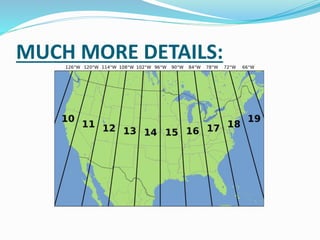
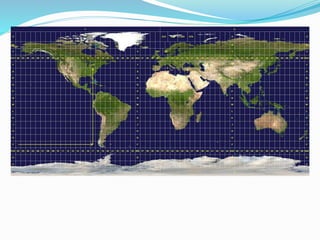
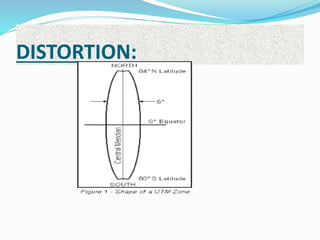
The UTM system is not a single map projection. The
system instead divides the Earth into sixty zones, each
being a six-degree band of longitude, and uses
a secant transverse Mercator projection in each zone.
MUCH MORE DETAILS:
HOW TO CALCULATE TIME BETWEEN
MERIDIANS:
 The earth has 360 imaginary lines called longitudes or
meridians running vertically between the poles. Each
of these longitudes is called a degree. The 0 degree
longitude passing through Greenwich, near London,
is considered as standard and the time of all other time
zones are calculated accordingly. The time difference
between each longitude (each degree) is 4 minutes. So
if it is 12 noon at Greenwich (0 degree), it would be
12:04 pm at 1 degree meridian and so on. In India, the
standard meridian is 82-and-half degree. So the time
difference between Greenwich and India is 82.5 x 4,
which is 330 minutes (5 hours 30 minutes).
Important terms to understand:
Longitude
Latitude
Distortion
Map
Northing
Easting
Coordinate system
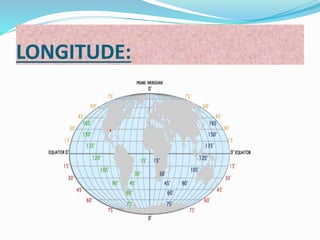
LONGITUDE:
DEFINITION
 Longitude (shown as a vertical line) is the angular
distance, in degrees, minutes, and seconds, of a point
east or west of the Prime (Greenwich) Meridian. Lines
of longitude are often referred to as meridians.
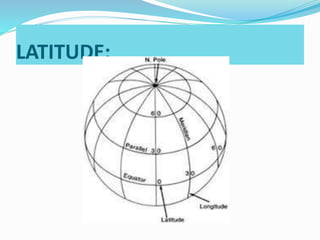
LATITUDE:
DEFINITION:
 the angular distance of a place north or south of the
earth's equator, or of the equator of a celestial object,
usually expressed in degrees and minutes.
DISTORTION:
Definition:
 Each of the different types of projections have
strenghts and weaknesses. Knowledge of these
different advantages and disadvantages for a particular
map projection will often help in which map to choose
for a particular project. The basic problem inherent in
any type of map projection is that it will result in some
distortion of the ‘ground truth’ of the area being
mapped.
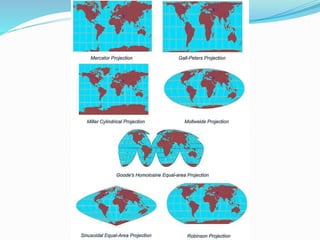
Why every world map you're looking
at is WRONG: Africa, China and India
 The distortion is the result of the Mercator map which was
created in 1596 to help sailors navigate the world.It gives the
right shapes of countries but at the cost of distorting sizes in
favour of the wealthy lands to the north.For instance, north
America looks larger, or at least as big, as Africa, and
Greenland also looks of comparable size.In reality, you can fit
north America into Africa and still have space for India,
Argentina, Tunisia and some left over.Map suggests
Scandinavian countries are larger than India, whereas in
reality India is three times the size.
The biggest challenge for cartographers is that it is impossible
to portray reality of spherical world on a flat map
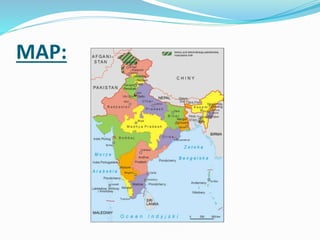
MAP:
Definition: A map is a symbolic depiction highlighting
relationships between elements of some space,
such as objects, regions, and themes.
Northing and Easting:
 The terms easting and northing are geographic
Cartesian coordinates for a point. Easting refers to the
eastward-measured distance (or the x-coordinate),
while northing refers to the northward-measured
distance (or the y-coordinate). UTM-zones.
Coordinate systems:
 In geometry, a coordinate system is a system which
uses one or more numbers, or coordinates, to
uniquely determine the position of a point or other
geometric element on a manifold such as Euclidean
space.
Briefly about the topic:
They are 60 zones numbered from 1-60.
Each zone is 6 degrees of longitude wide and 8
degree latitude except last quadrant of each zone
which counts 12 degrees.
Each one zone is subdivided into quadrants
accordingly.
Northings and eastings are used to locate a place
and represented by latitude and longitude as
explained earlier.
End
Thank you‘
Motto:

Seminar

  • 1.
    SEMINAR/REMOTE SENSING UTM COORDINATESYSTEM PREPARED BY JACOBS LIONEL  E-MAIL:jacobslionel025@gmail.com
  • 2.
    Definition of UTMgrid: The Universal Transverse Mercator (UTM) conformal projection uses a 2-dimensional Cartesian coordinate system to give locations on the surface of the Earth. Like the traditional method of latitude and longitude, it is a horizontal position representation, i.e. it is used to identify locations on the Earth independently of vertical position. However, it differs from that method in several respects. The UTM system is not a single map projection. The system instead divides the Earth into sixty zones, each being a six-degree band of longitude, and uses a secant transverse Mercator projection in each zone.
  • 3.
  • 5.
    HOW TO CALCULATETIME BETWEEN MERIDIANS:  The earth has 360 imaginary lines called longitudes or meridians running vertically between the poles. Each of these longitudes is called a degree. The 0 degree longitude passing through Greenwich, near London, is considered as standard and the time of all other time zones are calculated accordingly. The time difference between each longitude (each degree) is 4 minutes. So if it is 12 noon at Greenwich (0 degree), it would be 12:04 pm at 1 degree meridian and so on. In India, the standard meridian is 82-and-half degree. So the time difference between Greenwich and India is 82.5 x 4, which is 330 minutes (5 hours 30 minutes).
  • 6.
    Important terms tounderstand: Longitude Latitude Distortion Map Northing Easting Coordinate system
  • 7.
  • 8.
    DEFINITION  Longitude (shownas a vertical line) is the angular distance, in degrees, minutes, and seconds, of a point east or west of the Prime (Greenwich) Meridian. Lines of longitude are often referred to as meridians.
  • 9.
  • 10.
    DEFINITION:  the angulardistance of a place north or south of the earth's equator, or of the equator of a celestial object, usually expressed in degrees and minutes.
  • 11.
  • 13.
    Definition:  Each ofthe different types of projections have strenghts and weaknesses. Knowledge of these different advantages and disadvantages for a particular map projection will often help in which map to choose for a particular project. The basic problem inherent in any type of map projection is that it will result in some distortion of the ‘ground truth’ of the area being mapped.
  • 14.
    Why every worldmap you're looking at is WRONG: Africa, China and India  The distortion is the result of the Mercator map which was created in 1596 to help sailors navigate the world.It gives the right shapes of countries but at the cost of distorting sizes in favour of the wealthy lands to the north.For instance, north America looks larger, or at least as big, as Africa, and Greenland also looks of comparable size.In reality, you can fit north America into Africa and still have space for India, Argentina, Tunisia and some left over.Map suggests Scandinavian countries are larger than India, whereas in reality India is three times the size. The biggest challenge for cartographers is that it is impossible to portray reality of spherical world on a flat map
  • 15.
  • 16.
    Definition: A mapis a symbolic depiction highlighting relationships between elements of some space, such as objects, regions, and themes.
  • 17.
    Northing and Easting: The terms easting and northing are geographic Cartesian coordinates for a point. Easting refers to the eastward-measured distance (or the x-coordinate), while northing refers to the northward-measured distance (or the y-coordinate). UTM-zones.
  • 18.
    Coordinate systems:  Ingeometry, a coordinate system is a system which uses one or more numbers, or coordinates, to uniquely determine the position of a point or other geometric element on a manifold such as Euclidean space.
  • 19.
    Briefly about thetopic: They are 60 zones numbered from 1-60. Each zone is 6 degrees of longitude wide and 8 degree latitude except last quadrant of each zone which counts 12 degrees. Each one zone is subdivided into quadrants accordingly. Northings and eastings are used to locate a place and represented by latitude and longitude as explained earlier.
  • 20.