Spatial Coordinate System
Models of Earth
 When specifying location we need to use a model to
describe the shape of the Earth.
 At small scales, the Earth may be assumed to be round
(i.e. a sphere).
 At larger scales, we need to model the Earth as an
ellipsoid (an oblate spheroid).
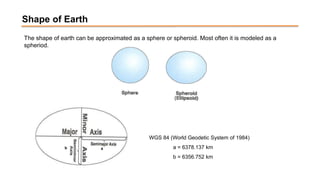
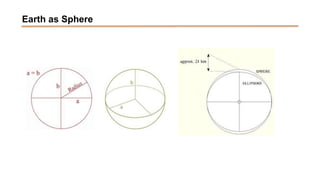
The shape of earth can be approximated as a sphere or spheroid. Most often it is modeled as a
spheriod.
a
b
WGS 84 (World Geodetic System of 1984)
a = 6378.137 km
b = 6356.752 km
Shape of Earth
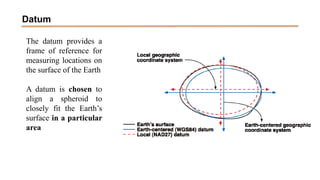
The datum provides a
frame of reference for
measuring locations on
the surface of the Earth
A datum is chosen to
align a spheroid to
closely fit the Earth’s
surface in a particular
area
Datum
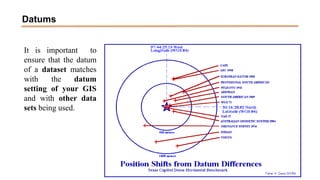
It is important to
ensure that the datum
of a dataset matches
with the datum
setting of your GIS
and with other data
sets being used.
Datums
Spatial Scale
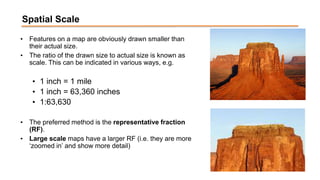
• Features on a map are obviously drawn smaller than
their actual size.
• The ratio of the drawn size to actual size is known as
scale. This can be indicated in various ways, e.g.
• 1 inch = 1 mile
• 1 inch = 63,360 inches
• 1:63,630
• The preferred method is the representative fraction
(RF).
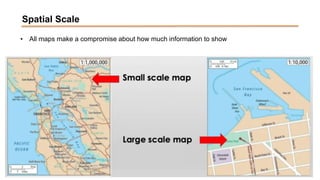
• Large scale maps have a larger RF (i.e. they are more
‘zoomed in’ and show more detail)
Spatial Scale
• All maps make a compromise about how much information to show
Earth as Sphere
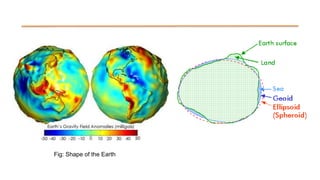
Fig: Shape of the Earth
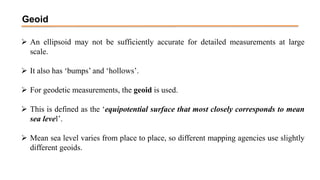
Geoid
 An ellipsoid may not be sufficiently accurate for detailed measurements at large
scale.
 It also has ‘bumps’ and ‘hollows’.
 For geodetic measurements, the geoid is used.
 This is defined as the ‘equipotential surface that most closely corresponds to mean
sea level’.
 Mean sea level varies from place to place, so different mapping agencies use slightly
different geoids.
Coordinate System
Usually there are two types of coordinate system
• Geographic coordinate system
• Projected coordinate system
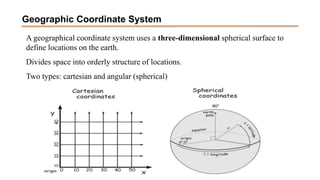
A geographical coordinate system uses a three-dimensional spherical surface to
define locations on the earth.
Divides space into orderly structure of locations.
Two types: cartesian and angular (spherical)
Geographic Coordinate System
Spherical Coordinate
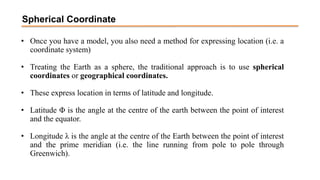
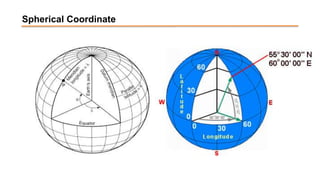
• Once you have a model, you also need a method for expressing location (i.e. a
coordinate system)
• Treating the Earth as a sphere, the traditional approach is to use spherical
coordinates or geographical coordinates.
• These express location in terms of latitude and longitude.
• Latitude Φ is the angle at the centre of the earth between the point of interest
and the equator.
• Longitude λ is the angle at the centre of the Earth between the point of interest
and the prime meridian (i.e. the line running from pole to pole through
Greenwich).
Spherical Coordinate
+ =
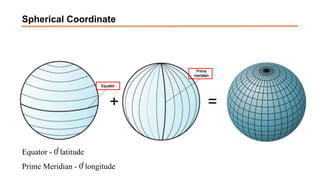
Equator - 0̊̊ latitude
Prime Meridian - 0̊̊ longitude
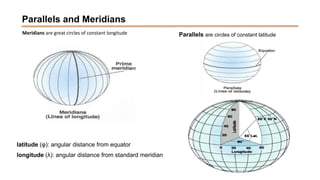
Meridians are great circles of constant longitude
latitude (φ): angular distance from equator
longitude (λ): angular distance from standard meridian
Parallels are circles of constant latitude
Parallels and Meridians
Spherical Coordinate
• By convention the latitude of a place in the northern hemisphere is
positive, and in the southern hemisphere it is negative.
• Places east of Greenwich have a positive longitude, places west
have a negative longitude.
• Degrees were traditionally divided into 60 minutes, and each
minute into 60 seconds.
• For computing purposes, decimal degrees are more normally used.
Cartesian Coordinate
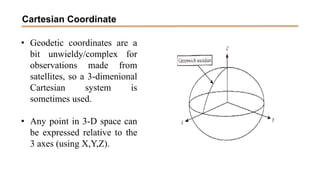
• Geodetic coordinates are a
bit unwieldy/complex for
observations made from
satellites, so a 3-dimenional
Cartesian system is
sometimes used.
• Any point in 3-D space can
be expressed relative to the
3 axes (using X,Y,Z).
Projected Coordinate System
• Two dimensional Cartesian coordinates are normally used for projected
maps.
• The X coordinate measures distance in an east-west direction, and the Y
coordinate measures it in a north-south direction.
• The true origin is at the centre of the map, but because negative values
are unwieldy, a false origin is usually defined to produce positive
values.
• The location of the false origin (i.e. offset) and type of projection
should be specified in the datum.
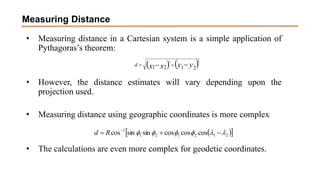
Measuring Distance
• Measuring distance in a Cartesian system is a simple application of
Pythagoras’s theorem:
• However, the distance estimates will vary depending upon the
projection used.
• Measuring distance using geographic coordinates is more complex
• The calculations are even more complex for geodetic coordinates.
   
y
y
x
x
d
2
1
2
1
2
2

 

 
 
2
1
2
1
2
1
1
cos
cos
cos
sin
sin
cos 




 

 
R
d
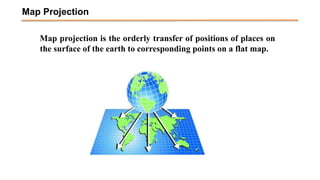
Map projection is the orderly transfer of positions of places on
the surface of the earth to corresponding points on a flat map.
Map Projection
Map Projection
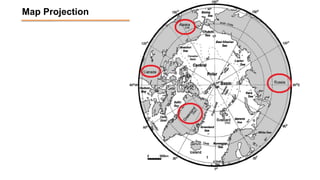
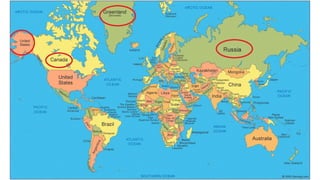
• A map projection is a systematic transformation of the latitudes and
longitudes of locations on the surface of a sphere or an ellipsoid into locations
on a plane.
• Map projections are necessary for creating maps. All map projections distort
the surface in some fashion.
• Depending on the purpose of the map, some distortions are acceptable and
others are not; therefore, different map projections exist in order to preserve
some properties of the sphere-like body at the expense of other properties.
• There is no limit to the number of possible map projections.
Map Projection
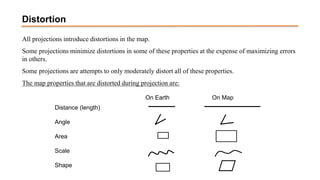
All projections introduce distortions in the map.
Some projections minimize distortions in some of these properties at the expense of maximizing errors
in others.
Some projections are attempts to only moderately distort all of these properties.
The map properties that are distorted during projection are:
On Earth On Map
Distance (length)
Angle
Area
Scale
Shape
Distortion
Map Projection
Map Projection
Types of Map Projection
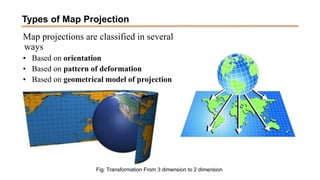
Map projections are classified in several
ways
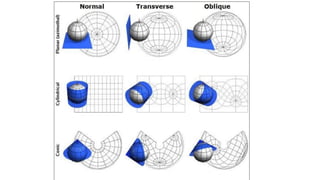
• Based on orientation
• Based on pattern of deformation
• Based on geometrical model of projection
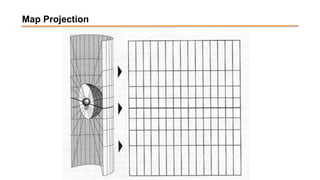
Fig: Transformation From 3 dimension to 2 dimension
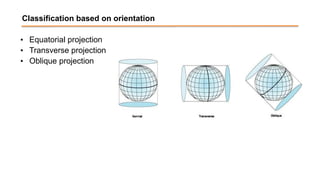
Classification based on orientation
• Equatorial projection
• Transverse projection
• Oblique projection
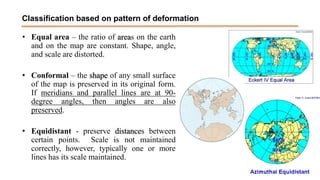
• Equal area – the ratio of areas on the earth
and on the map are constant. Shape, angle,
and scale are distorted.
• Conformal – the shape of any small surface
of the map is preserved in its original form.
If meridians and parallel lines are at 90-
degree angles, then angles are also
preserved.
• Equidistant - preserve distances between
certain points. Scale is not maintained
correctly, however, typically one or more
lines has its scale maintained.
Classification based on pattern of deformation
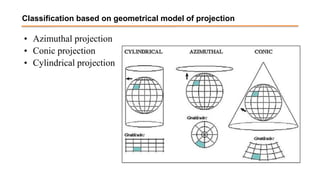
Classification based on geometrical model of projection
• Azimuthal projection
• Conic projection
• Cylindrical projection
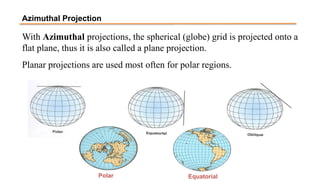
With Azimuthal projections, the spherical (globe) grid is projected onto a
flat plane, thus it is also called a plane projection.
Planar projections are used most often for polar regions.
Polar Equatorial
Azimuthal Projection
Classification of Azimuthal projection
1. Gnomonic projection
2. General Perspective projection
3. Orthographic projection
4. Azimuthal conformal projection
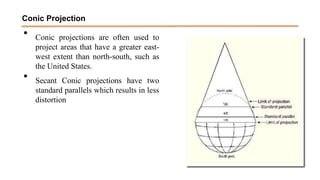
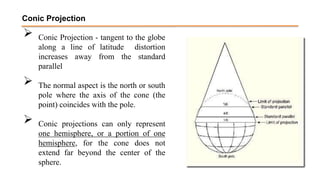
 Conic Projection - tangent to the globe
along a line of latitude distortion
increases away from the standard
parallel
 The normal aspect is the north or south
pole where the axis of the cone (the
point) coincides with the pole.
 Conic projections can only represent
one hemisphere, or a portion of one
hemisphere, for the cone does not
extend far beyond the center of the
sphere.
Conic Projection
• Conic projections are often used to
project areas that have a greater east-
west extent than north-south, such as
the United States.
• Secant Conic projections have two
standard parallels which results in less
distortion
Conic Projection
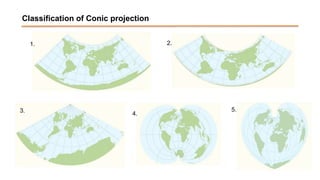
Classification of Conic Projection
Classification of Conic projection
1. Equidistance Conic
2. Albers Equal Area Projection
3. Lambert Conformal Conic Projection
4. Polyconic Projection
5. Pseudo-Conical Projection
Classification of Conic projection
1. 2.
3.
4.
5.
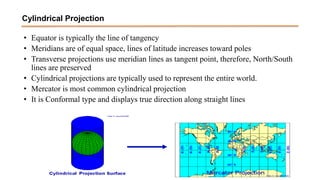
• Equator is typically the line of tangency
• Meridians are of equal space, lines of latitude increases toward poles
• Transverse projections use meridian lines as tangent point, therefore, North/South
lines are preserved
• Cylindrical projections are typically used to represent the entire world.
• Mercator is most common cylindrical projection
• It is Conformal type and displays true direction along straight lines
Cylindrical Projection
Types of Cylindrical projection
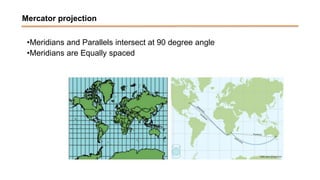
Mercator projection
•Meridians and Parallels intersect at 90 degree angle
•Meridians are Equally spaced
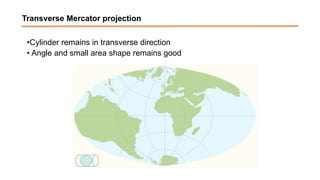
Transverse Mercator projection
•Cylinder remains in transverse direction
• Angle and small area shape remains good
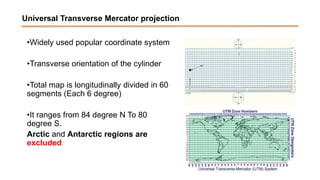
Universal Transverse Mercator projection
•Widely used popular coordinate system
•Transverse orientation of the cylinder
•Total map is longitudinally divided in 60
segments (Each 6 degree)
•It ranges from 84 degree N To 80
degree S.
Arctic and Antarctic regions are
excluded
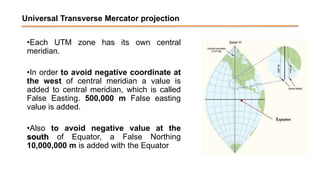
Universal Transverse Mercator projection
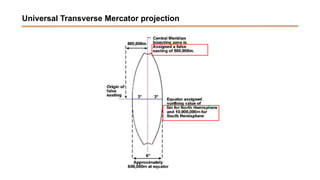
•Each UTM zone has its own central
meridian.
•In order to avoid negative coordinate at
the west of central meridian a value is
added to central meridian, which is called
False Easting. 500,000 m False easting
value is added.
•Also to avoid negative value at the
south of Equator, a False Northing
10,000,000 m is added with the Equator
Universal Transverse Mercator projection
• Easting and northing are geographic Cartesian coordinates for a
point.
• Easting is the eastward-measured distance (or the x-coordinate)
and northing is the northward-measured distance (or the y-
coordinate)
• Easting and northing coordinates are commonly measured in metres
from the axes of some horizontal datum
Universal Transverse Mercator projection
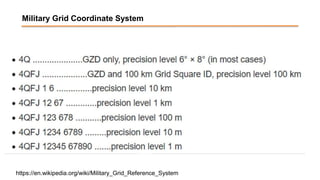
Military Grid Coordinate System
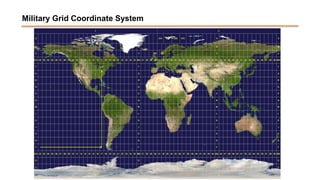
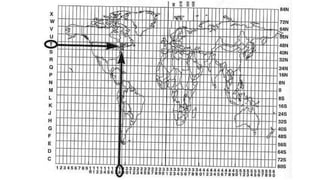
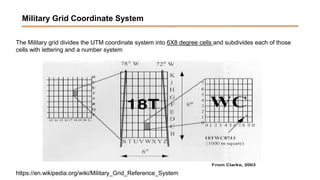
The Military grid divides the UTM coordinate system into 6X8 degree cells and subdivides each of those
cells with lettering and a number system
Military Grid Coordinate System
https://en.wikipedia.org/wiki/Military_Grid_Reference_System
Military Grid Coordinate System
https://en.wikipedia.org/wiki/Military_Grid_Reference_System
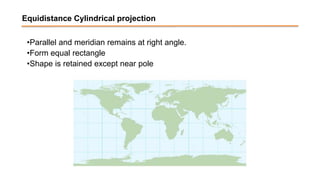
Equidistance Cylindrical projection
•Parallel and meridian remains at right angle.
•Form equal rectangle
•Shape is retained except near pole
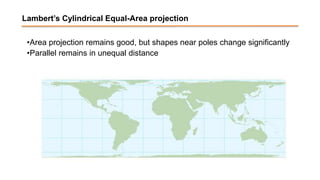
Lambert’s Cylindrical Equal-Area projection
•Area projection remains good, but shapes near poles change significantly
•Parallel remains in unequal distance
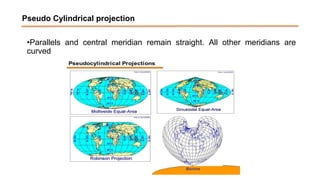
Pseudo Cylindrical projection
•Parallels and central meridian remain straight. All other meridians are
curved
Time Zones
Greenwich
Mean Time
(GMT)
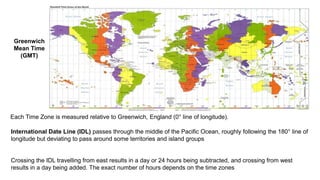
Each Time Zone is measured relative to Greenwich, England (0° line of longitude).
International Date Line (IDL) passes through the middle of the Pacific Ocean, roughly following the 180° line of
longitude but deviating to pass around some territories and island groups
Crossing the IDL travelling from east results in a day or 24 hours being subtracted, and crossing from west
results in a day being added. The exact number of hours depends on the time zones
BTM (Bangladesh Transverse Mercator) Coordinate System
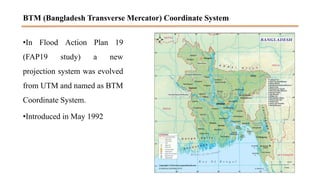
•In Flood Action Plan 19
(FAP19 study) a new
projection system was evolved
from UTM and named as BTM
Coordinate System.
•Introduced in May 1992
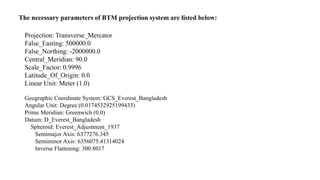
The necessary parameters of BTM projection system are listed below:
Projection: Transverse_Mercator
False_Easting: 500000.0
False_Northing: -2000000.0
Central_Meridian: 90.0
Scale_Factor: 0.9996
Latitude_Of_Origin: 0.0
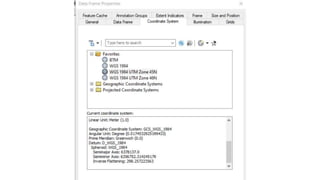
Linear Unit: Meter (1.0)
Geographic Coordinate System: GCS_Everest_Bangladesh
Angular Unit: Degree (0.0174532925199433)
Prime Meridian: Greenwich (0.0)
Datum: D_Everest_Bangladesh
Spheroid: Everest_Adjustment_1937
Semimajor Axis: 6377276.345
Semiminor Axis: 6356075.41314024
Inverse Flattening: 300.8017
GIS_lec 2_Different_Spatial coordinate system.ppt

GIS_lec 2_Different_Spatial coordinate system.ppt

  • 1.
  • 2.
    Models of Earth When specifying location we need to use a model to describe the shape of the Earth.  At small scales, the Earth may be assumed to be round (i.e. a sphere).  At larger scales, we need to model the Earth as an ellipsoid (an oblate spheroid).
  • 3.
    The shape ofearth can be approximated as a sphere or spheroid. Most often it is modeled as a spheriod. a b WGS 84 (World Geodetic System of 1984) a = 6378.137 km b = 6356.752 km Shape of Earth
  • 5.
    The datum providesa frame of reference for measuring locations on the surface of the Earth A datum is chosen to align a spheroid to closely fit the Earth’s surface in a particular area Datum
  • 6.
    It is importantto ensure that the datum of a dataset matches with the datum setting of your GIS and with other data sets being used. Datums
  • 8.
    Spatial Scale • Featureson a map are obviously drawn smaller than their actual size. • The ratio of the drawn size to actual size is known as scale. This can be indicated in various ways, e.g. • 1 inch = 1 mile • 1 inch = 63,360 inches • 1:63,630 • The preferred method is the representative fraction (RF). • Large scale maps have a larger RF (i.e. they are more ‘zoomed in’ and show more detail)
  • 9.
    Spatial Scale • Allmaps make a compromise about how much information to show
  • 12.
  • 13.
    Fig: Shape ofthe Earth
  • 14.
    Geoid  An ellipsoidmay not be sufficiently accurate for detailed measurements at large scale.  It also has ‘bumps’ and ‘hollows’.  For geodetic measurements, the geoid is used.  This is defined as the ‘equipotential surface that most closely corresponds to mean sea level’.  Mean sea level varies from place to place, so different mapping agencies use slightly different geoids.
  • 15.
    Coordinate System Usually thereare two types of coordinate system • Geographic coordinate system • Projected coordinate system
  • 16.
    A geographical coordinatesystem uses a three-dimensional spherical surface to define locations on the earth. Divides space into orderly structure of locations. Two types: cartesian and angular (spherical) Geographic Coordinate System
  • 17.
    Spherical Coordinate • Onceyou have a model, you also need a method for expressing location (i.e. a coordinate system) • Treating the Earth as a sphere, the traditional approach is to use spherical coordinates or geographical coordinates. • These express location in terms of latitude and longitude. • Latitude Φ is the angle at the centre of the earth between the point of interest and the equator. • Longitude λ is the angle at the centre of the Earth between the point of interest and the prime meridian (i.e. the line running from pole to pole through Greenwich).
  • 18.
    Spherical Coordinate + = Equator- 0̊̊ latitude Prime Meridian - 0̊̊ longitude
  • 19.
    Meridians are greatcircles of constant longitude latitude (φ): angular distance from equator longitude (λ): angular distance from standard meridian Parallels are circles of constant latitude Parallels and Meridians
  • 20.
  • 21.
    Spherical Coordinate • Byconvention the latitude of a place in the northern hemisphere is positive, and in the southern hemisphere it is negative. • Places east of Greenwich have a positive longitude, places west have a negative longitude. • Degrees were traditionally divided into 60 minutes, and each minute into 60 seconds. • For computing purposes, decimal degrees are more normally used.
  • 22.
    Cartesian Coordinate • Geodeticcoordinates are a bit unwieldy/complex for observations made from satellites, so a 3-dimenional Cartesian system is sometimes used. • Any point in 3-D space can be expressed relative to the 3 axes (using X,Y,Z).
  • 23.
    Projected Coordinate System •Two dimensional Cartesian coordinates are normally used for projected maps. • The X coordinate measures distance in an east-west direction, and the Y coordinate measures it in a north-south direction. • The true origin is at the centre of the map, but because negative values are unwieldy, a false origin is usually defined to produce positive values. • The location of the false origin (i.e. offset) and type of projection should be specified in the datum.
  • 24.
    Measuring Distance • Measuringdistance in a Cartesian system is a simple application of Pythagoras’s theorem: • However, the distance estimates will vary depending upon the projection used. • Measuring distance using geographic coordinates is more complex • The calculations are even more complex for geodetic coordinates.     y y x x d 2 1 2 1 2 2         2 1 2 1 2 1 1 cos cos cos sin sin cos           R d
  • 25.
    Map projection isthe orderly transfer of positions of places on the surface of the earth to corresponding points on a flat map. Map Projection
  • 26.
    Map Projection • Amap projection is a systematic transformation of the latitudes and longitudes of locations on the surface of a sphere or an ellipsoid into locations on a plane. • Map projections are necessary for creating maps. All map projections distort the surface in some fashion. • Depending on the purpose of the map, some distortions are acceptable and others are not; therefore, different map projections exist in order to preserve some properties of the sphere-like body at the expense of other properties. • There is no limit to the number of possible map projections.
  • 27.
  • 28.
    All projections introducedistortions in the map. Some projections minimize distortions in some of these properties at the expense of maximizing errors in others. Some projections are attempts to only moderately distort all of these properties. The map properties that are distorted during projection are: On Earth On Map Distance (length) Angle Area Scale Shape Distortion
  • 29.
  • 30.
  • 31.
    Types of MapProjection Map projections are classified in several ways • Based on orientation • Based on pattern of deformation • Based on geometrical model of projection Fig: Transformation From 3 dimension to 2 dimension
  • 32.
    Classification based onorientation • Equatorial projection • Transverse projection • Oblique projection
  • 33.
    • Equal area– the ratio of areas on the earth and on the map are constant. Shape, angle, and scale are distorted. • Conformal – the shape of any small surface of the map is preserved in its original form. If meridians and parallel lines are at 90- degree angles, then angles are also preserved. • Equidistant - preserve distances between certain points. Scale is not maintained correctly, however, typically one or more lines has its scale maintained. Classification based on pattern of deformation
  • 34.
    Classification based ongeometrical model of projection • Azimuthal projection • Conic projection • Cylindrical projection
  • 35.
    With Azimuthal projections,the spherical (globe) grid is projected onto a flat plane, thus it is also called a plane projection. Planar projections are used most often for polar regions. Polar Equatorial Azimuthal Projection
  • 36.
  • 37.
    Classification of Azimuthalprojection 1. Gnomonic projection 2. General Perspective projection 3. Orthographic projection 4. Azimuthal conformal projection
  • 38.
     Conic Projection- tangent to the globe along a line of latitude distortion increases away from the standard parallel  The normal aspect is the north or south pole where the axis of the cone (the point) coincides with the pole.  Conic projections can only represent one hemisphere, or a portion of one hemisphere, for the cone does not extend far beyond the center of the sphere. Conic Projection
  • 39.
    • Conic projectionsare often used to project areas that have a greater east- west extent than north-south, such as the United States. • Secant Conic projections have two standard parallels which results in less distortion Conic Projection
  • 40.
  • 41.
    Classification of Conicprojection 1. Equidistance Conic 2. Albers Equal Area Projection 3. Lambert Conformal Conic Projection 4. Polyconic Projection 5. Pseudo-Conical Projection
  • 42.
    Classification of Conicprojection 1. 2. 3. 4. 5.
  • 43.
    • Equator istypically the line of tangency • Meridians are of equal space, lines of latitude increases toward poles • Transverse projections use meridian lines as tangent point, therefore, North/South lines are preserved • Cylindrical projections are typically used to represent the entire world. • Mercator is most common cylindrical projection • It is Conformal type and displays true direction along straight lines Cylindrical Projection
  • 44.
  • 45.
    Mercator projection •Meridians andParallels intersect at 90 degree angle •Meridians are Equally spaced
  • 46.
    Transverse Mercator projection •Cylinderremains in transverse direction • Angle and small area shape remains good
  • 47.
    Universal Transverse Mercatorprojection •Widely used popular coordinate system •Transverse orientation of the cylinder •Total map is longitudinally divided in 60 segments (Each 6 degree) •It ranges from 84 degree N To 80 degree S. Arctic and Antarctic regions are excluded
  • 48.
    Universal Transverse Mercatorprojection •Each UTM zone has its own central meridian. •In order to avoid negative coordinate at the west of central meridian a value is added to central meridian, which is called False Easting. 500,000 m False easting value is added. •Also to avoid negative value at the south of Equator, a False Northing 10,000,000 m is added with the Equator
  • 49.
    Universal Transverse Mercatorprojection • Easting and northing are geographic Cartesian coordinates for a point. • Easting is the eastward-measured distance (or the x-coordinate) and northing is the northward-measured distance (or the y- coordinate) • Easting and northing coordinates are commonly measured in metres from the axes of some horizontal datum
  • 50.
  • 51.
  • 53.
    The Military griddivides the UTM coordinate system into 6X8 degree cells and subdivides each of those cells with lettering and a number system Military Grid Coordinate System https://en.wikipedia.org/wiki/Military_Grid_Reference_System
  • 54.
    Military Grid CoordinateSystem https://en.wikipedia.org/wiki/Military_Grid_Reference_System
  • 55.
    Equidistance Cylindrical projection •Paralleland meridian remains at right angle. •Form equal rectangle •Shape is retained except near pole
  • 56.
    Lambert’s Cylindrical Equal-Areaprojection •Area projection remains good, but shapes near poles change significantly •Parallel remains in unequal distance
  • 57.
    Pseudo Cylindrical projection •Parallelsand central meridian remain straight. All other meridians are curved
  • 58.
    Time Zones Greenwich Mean Time (GMT) EachTime Zone is measured relative to Greenwich, England (0° line of longitude). International Date Line (IDL) passes through the middle of the Pacific Ocean, roughly following the 180° line of longitude but deviating to pass around some territories and island groups Crossing the IDL travelling from east results in a day or 24 hours being subtracted, and crossing from west results in a day being added. The exact number of hours depends on the time zones
  • 59.
    BTM (Bangladesh TransverseMercator) Coordinate System •In Flood Action Plan 19 (FAP19 study) a new projection system was evolved from UTM and named as BTM Coordinate System. •Introduced in May 1992
  • 60.
    The necessary parametersof BTM projection system are listed below: Projection: Transverse_Mercator False_Easting: 500000.0 False_Northing: -2000000.0 Central_Meridian: 90.0 Scale_Factor: 0.9996 Latitude_Of_Origin: 0.0 Linear Unit: Meter (1.0) Geographic Coordinate System: GCS_Everest_Bangladesh Angular Unit: Degree (0.0174532925199433) Prime Meridian: Greenwich (0.0) Datum: D_Everest_Bangladesh Spheroid: Everest_Adjustment_1937 Semimajor Axis: 6377276.345 Semiminor Axis: 6356075.41314024 Inverse Flattening: 300.8017

Editor's Notes

  • #3 oblate - flattened at the poles. Spheroid - A spheroid, also known as an ellipsoid of revolution or rotational ellipsoid, is a quadric surface obtained by rotating an ellipse about one of its principal axes; Large scale maps show a smaller amount of area with a greater amount of detail. – ZOOMED IN.. could have a RF scale of 1 : 1,000 Small scale maps show a larger geographic area with few details on them.  RF could be 1 : 1,000,000
  • #6 Chosen Not something fixed for all places
  • #14 Before determining coordinates – one has to fix what shape or model of earth is being considered
  • #15 Sea level varies from place to place. This is because of differences in geography, gravity, temperature, ocean currents and tides. For instance, the absolute water level height is higher along the West Coast of the United States than the East Coast. “global sea level,” which refers to the average height of all of the Earth's ocean basin
  • #23 Unwieldy – (of a system) too large or disorganized to function efficiently Geodesy - the branch of mathematics dealing with the shape and area of the earth or large portions of it
  • #28 Transfering points on globe to a plane surface
  • #30 actual distance is distorted in 2D projections
  • #33 Relation between Axis of earth and axis of cylinder
  • #34 conformal – latitude and longitude lines curved to get actual angles
  • #40 Scale factor is 1 at standard parallel – no distortion
  • #51 1 degree = 111 km, 1 minute = 1.86 km, 1 second = 30 m
  • #52 NATO militaries
  • #54 A single rectangle, 6 by 8 degrees, generally falls within about a 1000 km square Each grid cell is then further subdivided into squares 100,000 meter on a side. Each cell is assigned two additional letter identifies The 100,000 meter square can be further subdivided into 10,000 meter squares, then 1000 meter squares and 100 meter squares
  • #55 A single rectangle, 6 by 8 degrees, generally falls within about a 1000 km square Each grid cell is then further subdivided into squares 100,000 meter on a side. Each cell is assigned two additional letter identifies The 100,000 meter square can be further subdivided into 10,000 meter squares, then 1000 meter squares and 100 meter squares
  • #59 Like travelling even further east from Japan to USA crossing the IDL –subtract a day Like travelling even further west from USA to Japan crossing the IDL – add a day