Lecture 3.
Coordinate systems
COORDINATE SYSTEM AS A PART OF REFERENCE SYSTEM
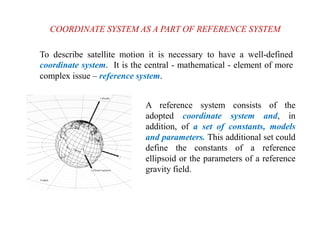
To describe satellite motion it is necessary to have a well-defined
coordinate system. It is the central - mathematical - element of more
complex issue – reference system.
A reference system consists of the
adopted coordinate system and, in
addition, of a set of constants, models
and parameters. This additional set could
define the constants of a reference
ellipsoid or the parameters of a reference
gravity field.
GENERAL DEFINITION
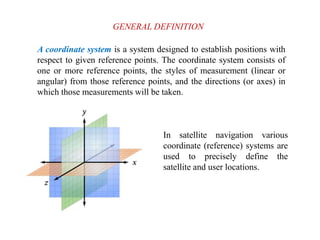
A coordinate system is a system designed to establish positions with
respect to given reference points. The coordinate system consists of
one or more reference points, the styles of measurement (linear or
angular) from those reference points, and the directions (or axes) in
which those measurements will be taken.
In satellite navigation various
coordinate (reference) systems are
used to precisely define the
satellite and user locations.
CLASSIFICATION
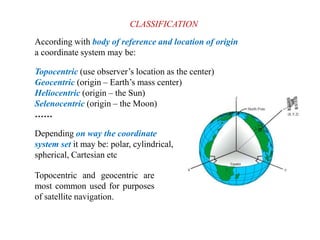
According with body of reference and location of origin
a coordinate system may be:
Topocentric (use observer’s location as the center)
Geocentric (origin – Earth’s mass center)
Heliocentric (origin – the Sun)
Selenocentric (origin – the Moon)
……
Depending on way the coordinate
system set it may be: polar, cylindrical,
spherical, Cartesian etc
Topocentric and geocentric are
most common used for purposes
of satellite navigation.
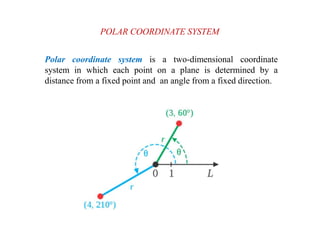
POLAR COORDINATE SYSTEM
Polar coordinate system is a two-dimensional coordinate
system in which each point on a plane is determined by a
distance from a fixed point and an angle from a fixed direction.
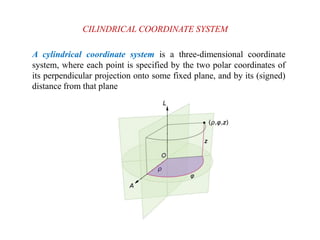
CILINDRICAL COORDINATE SYSTEM
A cylindrical coordinate system is a three-dimensional coordinate
system, where each point is specified by the two polar coordinates of
its perpendicular projection onto some fixed plane, and by its (signed)
distance from that plane
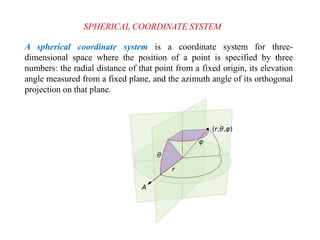
SPHERICAL COORDINATE SYSTEM
A spherical coordinate system is a coordinate system for three-
dimensional space where the position of a point is specified by three
numbers: the radial distance of that point from a fixed origin, its elevation
angle measured from a fixed plane, and the azimuth angle of its orthogonal
projection on that plane.
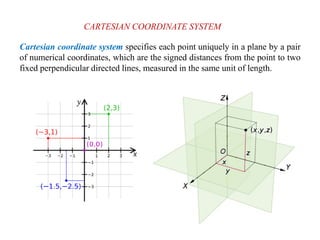
CARTESIAN COORDINATE SYSTEM
Cartesian coordinate system specifies each point uniquely in a plane by a pair
of numerical coordinates, which are the signed distances from the point to two
fixed perpendicular directed lines, measured in the same unit of length.
GEOGRAPHIC COORDINATE SYSTEM
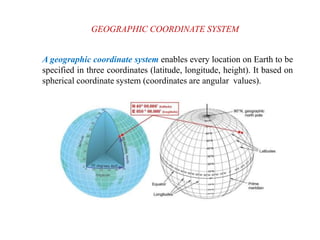
A geographic coordinate system enables every location on Earth to be
specified in three coordinates (latitude, longitude, height). It based on
spherical coordinate system (coordinates are angular values).
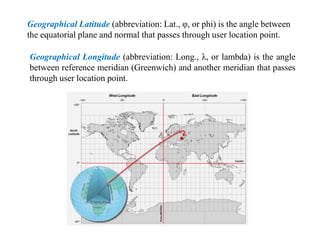
Geographical Latitude (abbreviation: Lat., φ, or phi) is the angle between
the equatorial plane and normal that passes through user location point.
Geographical Longitude (abbreviation: Long., λ, or lambda) is the angle
between reference meridian (Greenwich) and another meridian that passes
through user location point.
EARTH-CENTERED EARTH-FIXED (ECEF)
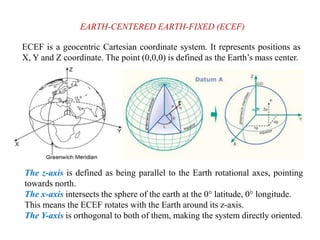
ECEF is a geocentric Cartesian coordinate system. It represents positions as
X, Y and Z coordinate. The point (0,0,0) is defined as the Earth’s mass center.
The z-axis is defined as being parallel to the Earth rotational axes, pointing
towards north.
The x-axis intersects the sphere of the earth at the 0° latitude, 0° longitude.
This means the ECEF rotates with the Earth around its z-axis.
The Y-axis is orthogonal to both of them, making the system directly oriented.
INERTIAL AND NON-INERTIAL REFERENCE SYSTEMS
An inertial reference system is a coordinate system in which Newton’s
laws of motion are valid. Inertial reference frames are neither rotating
nor accelerating.
A non-inertial reference system is a system that is undergoing acceleration
with respect to an inertial system.
EARTH-CENTERED INERTIAL (ECI)
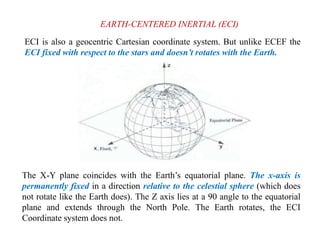
ECI is also a geocentric Cartesian coordinate system. But unlike ECEF the
ECI fixed with respect to the stars and doesn’t rotates with the Earth.
The X-Y plane coincides with the Earth’s equatorial plane. The x-axis is
permanently fixed in a direction relative to the celestial sphere (which does
not rotate like the Earth does). The Z axis lies at a 90 angle to the equatorial
plane and extends through the North Pole. The Earth rotates, the ECI
Coordinate system does not.
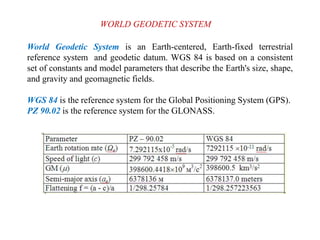
World Geodetic System is an Earth-centered, Earth-fixed terrestrial
reference system and geodetic datum. WGS 84 is based on a consistent
set of constants and model parameters that describe the Earth's size, shape,
and gravity and geomagnetic fields.
WGS 84 is the reference system for the Global Positioning System (GPS).
PZ 90.02 is the reference system for the GLONASS.
WORLD GEODETIC SYSTEM
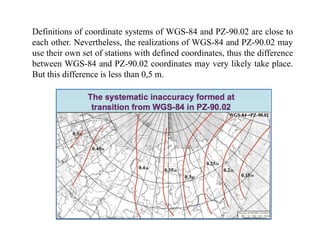
Definitions of coordinate systems of WGS-84 and PZ-90.02 are close to
each other. Nevertheless, the realizations of WGS-84 and PZ-90.02 may
use their own set of stations with defined coordinates, thus the difference
between WGS-84 and PZ-90.02 coordinates may very likely take place.
But this difference is less than 0,5 m.

Coordinate systems (Lecture 3)

  • 1.
  • 2.
    COORDINATE SYSTEM ASA PART OF REFERENCE SYSTEM To describe satellite motion it is necessary to have a well-defined coordinate system. It is the central - mathematical - element of more complex issue – reference system. A reference system consists of the adopted coordinate system and, in addition, of a set of constants, models and parameters. This additional set could define the constants of a reference ellipsoid or the parameters of a reference gravity field.
  • 3.
    GENERAL DEFINITION A coordinatesystem is a system designed to establish positions with respect to given reference points. The coordinate system consists of one or more reference points, the styles of measurement (linear or angular) from those reference points, and the directions (or axes) in which those measurements will be taken. In satellite navigation various coordinate (reference) systems are used to precisely define the satellite and user locations.
  • 4.
    CLASSIFICATION According with bodyof reference and location of origin a coordinate system may be: Topocentric (use observer’s location as the center) Geocentric (origin – Earth’s mass center) Heliocentric (origin – the Sun) Selenocentric (origin – the Moon) …… Depending on way the coordinate system set it may be: polar, cylindrical, spherical, Cartesian etc Topocentric and geocentric are most common used for purposes of satellite navigation.
  • 5.
    POLAR COORDINATE SYSTEM Polarcoordinate system is a two-dimensional coordinate system in which each point on a plane is determined by a distance from a fixed point and an angle from a fixed direction.
  • 6.
    CILINDRICAL COORDINATE SYSTEM Acylindrical coordinate system is a three-dimensional coordinate system, where each point is specified by the two polar coordinates of its perpendicular projection onto some fixed plane, and by its (signed) distance from that plane
  • 7.
    SPHERICAL COORDINATE SYSTEM Aspherical coordinate system is a coordinate system for three- dimensional space where the position of a point is specified by three numbers: the radial distance of that point from a fixed origin, its elevation angle measured from a fixed plane, and the azimuth angle of its orthogonal projection on that plane.
  • 8.
    CARTESIAN COORDINATE SYSTEM Cartesiancoordinate system specifies each point uniquely in a plane by a pair of numerical coordinates, which are the signed distances from the point to two fixed perpendicular directed lines, measured in the same unit of length.
  • 9.
    GEOGRAPHIC COORDINATE SYSTEM Ageographic coordinate system enables every location on Earth to be specified in three coordinates (latitude, longitude, height). It based on spherical coordinate system (coordinates are angular values).
  • 10.
    Geographical Latitude (abbreviation:Lat., φ, or phi) is the angle between the equatorial plane and normal that passes through user location point. Geographical Longitude (abbreviation: Long., λ, or lambda) is the angle between reference meridian (Greenwich) and another meridian that passes through user location point.
  • 11.
    EARTH-CENTERED EARTH-FIXED (ECEF) ECEFis a geocentric Cartesian coordinate system. It represents positions as X, Y and Z coordinate. The point (0,0,0) is defined as the Earth’s mass center. The z-axis is defined as being parallel to the Earth rotational axes, pointing towards north. The x-axis intersects the sphere of the earth at the 0° latitude, 0° longitude. This means the ECEF rotates with the Earth around its z-axis. The Y-axis is orthogonal to both of them, making the system directly oriented.
  • 12.
    INERTIAL AND NON-INERTIALREFERENCE SYSTEMS An inertial reference system is a coordinate system in which Newton’s laws of motion are valid. Inertial reference frames are neither rotating nor accelerating. A non-inertial reference system is a system that is undergoing acceleration with respect to an inertial system.
  • 13.
    EARTH-CENTERED INERTIAL (ECI) ECIis also a geocentric Cartesian coordinate system. But unlike ECEF the ECI fixed with respect to the stars and doesn’t rotates with the Earth. The X-Y plane coincides with the Earth’s equatorial plane. The x-axis is permanently fixed in a direction relative to the celestial sphere (which does not rotate like the Earth does). The Z axis lies at a 90 angle to the equatorial plane and extends through the North Pole. The Earth rotates, the ECI Coordinate system does not.
  • 14.
    World Geodetic Systemis an Earth-centered, Earth-fixed terrestrial reference system and geodetic datum. WGS 84 is based on a consistent set of constants and model parameters that describe the Earth's size, shape, and gravity and geomagnetic fields. WGS 84 is the reference system for the Global Positioning System (GPS). PZ 90.02 is the reference system for the GLONASS. WORLD GEODETIC SYSTEM
  • 15.
    Definitions of coordinatesystems of WGS-84 and PZ-90.02 are close to each other. Nevertheless, the realizations of WGS-84 and PZ-90.02 may use their own set of stations with defined coordinates, thus the difference between WGS-84 and PZ-90.02 coordinates may very likely take place. But this difference is less than 0,5 m.