NETWORK ANALYSIS
Swapnil R. Rajput
Roll No:19 , M.tech 1st year
WHAT IS NETWORK ?
 Network is a set of connected lines
 Network can represent rivers , roads, waterlines ,
telecommunication lines etc.
 Networks can be Directed and Undirected / planer and
non-planner.
 In GIS Networks are widely used for two kinds of
modeling.
Transportation network
Utility network
TRANSPORTATION NETWORK:
 Undirected networks.
 edge on a network may have a direction assigned to it,
the person or resource being transported is free to
decide the direction, speed, and destination of
traversal. example-person in a car travelling on street.
UTILITY NETWORK:
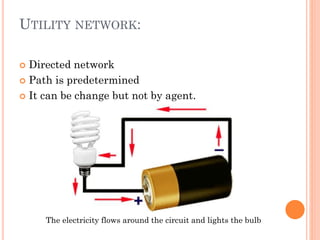
 Directed network
 Path is predetermined
 It can be change but not by agent.
The electricity flows around the circuit and lights the bulb
 In ArcGIS ,Transportation network modeled
using network dataset.
 For Utility Dataset in ArcGIS modeled using
geometric dataset.
NETWORK ANALYSIS:
 Network analysis analyze the way ‘goods’ can be
transported along these lines (telecommunication lines ,
road etc)
Example: undirected roads.
 Network analysis can be done in raster or in vector.
TYPES OF OPERATION:
 Shortest path analysis
 Best Route
 Closest facility
 Allocation
 location-Allocation
 OD-cost matrix
 Network-partitioning
SHORTEST PATH ANALYSIS:
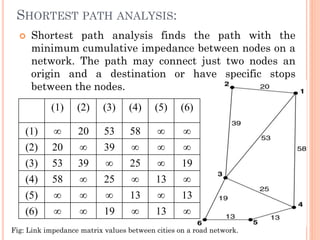
 Shortest path analysis finds the path with the
minimum cumulative impedance between nodes on a
network. The path may connect just two nodes an
origin and a destination or have specific stops
between the nodes.
(1) (2) (3) (4) (5) (6)
(1) ∞ 20 53 58 ∞ ∞
(2) 20 ∞ 39 ∞ ∞ ∞
(3) 53 39 ∞ 25 ∞ 19
(4) 58 ∞ 25 ∞ 13 ∞
(5) ∞ ∞ ∞ 13 ∞ 13
(6) ∞ ∞ 19 ∞ 13 ∞
Fig: Link impedance matrix values between cities on a road network.
BEST ROUTE:
 Whether finding a simple route between two locations
or one that visits several locations, people usually try
to take the best route. But "best route" can mean
different things in different situations.
 Best route can be the quickest, shortest, or most
scenic route, depending on the impedance chosen.
 Impedance  time, distance.
We uses time as an impedance. The quickest path is shown in blue
and has a total length of 4.5 miles, which takes 8 minutes to
traverse.
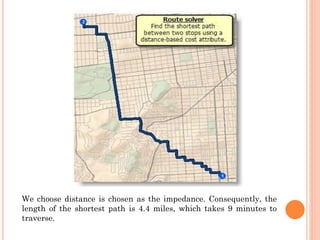
We choose distance is chosen as the impedance. Consequently, the
length of the shortest path is 4.4 miles, which takes 9 minutes to
traverse.
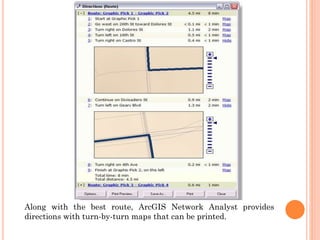
Along with the best route, ArcGIS Network Analyst provides
directions with turn-by-turn maps that can be printed.
CLOSEST FACILITY:
Closest facility finds the closest facility, such as a hospital,
fire station, or ATM, to any location on a network.
ALLOCATION:
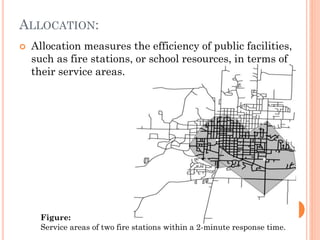
 Allocation measures the efficiency of public facilities,
such as fire stations, or school resources, in terms of
their service areas.
Figure:
Service areas of two fire stations within a 2-minute response time.
LOCATION-ALLOCATION:
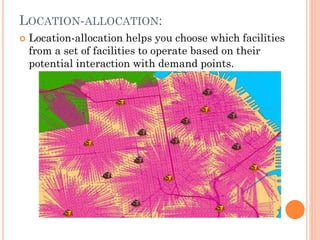
 Location-allocation helps you choose which facilities
from a set of facilities to operate based on their
potential interaction with demand points.
OD-COST MATRIX:
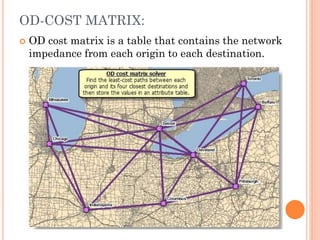
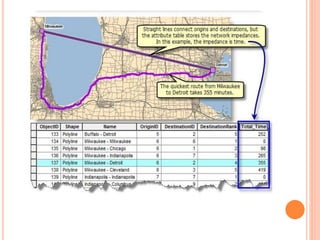
 OD cost matrix is a table that contains the network
impedance from each origin to each destination.
NETWORK PARTITIONING-TRACE
 Trace analysis is performed when we want to
understand which part of network is ‘conditionally
connected’ to a chosen node on the network ,known as
trace origin.
REFERENCES:
 http://webhelp.esri.com
 Geographic Information System, Kang-tsung
Chang, fourth edition Tata McGraw-Hill.
 Spatial data analysis by Ms. Vandita Srivastava
IIRS Dehradun,India
 ArcGIS 10 help
THANK YOU 4 YOUR ATTENTION !

Network analysis in gis

  • 1.
    NETWORK ANALYSIS Swapnil R.Rajput Roll No:19 , M.tech 1st year
  • 2.
    WHAT IS NETWORK?  Network is a set of connected lines  Network can represent rivers , roads, waterlines , telecommunication lines etc.  Networks can be Directed and Undirected / planer and non-planner.  In GIS Networks are widely used for two kinds of modeling. Transportation network Utility network
  • 3.
    TRANSPORTATION NETWORK:  Undirectednetworks.  edge on a network may have a direction assigned to it, the person or resource being transported is free to decide the direction, speed, and destination of traversal. example-person in a car travelling on street.
  • 4.
    UTILITY NETWORK:  Directednetwork  Path is predetermined  It can be change but not by agent. The electricity flows around the circuit and lights the bulb
  • 5.
     In ArcGIS,Transportation network modeled using network dataset.  For Utility Dataset in ArcGIS modeled using geometric dataset.
  • 6.
    NETWORK ANALYSIS:  Networkanalysis analyze the way ‘goods’ can be transported along these lines (telecommunication lines , road etc) Example: undirected roads.  Network analysis can be done in raster or in vector.
  • 7.
    TYPES OF OPERATION: Shortest path analysis  Best Route  Closest facility  Allocation  location-Allocation  OD-cost matrix  Network-partitioning
  • 8.
    SHORTEST PATH ANALYSIS: Shortest path analysis finds the path with the minimum cumulative impedance between nodes on a network. The path may connect just two nodes an origin and a destination or have specific stops between the nodes. (1) (2) (3) (4) (5) (6) (1) ∞ 20 53 58 ∞ ∞ (2) 20 ∞ 39 ∞ ∞ ∞ (3) 53 39 ∞ 25 ∞ 19 (4) 58 ∞ 25 ∞ 13 ∞ (5) ∞ ∞ ∞ 13 ∞ 13 (6) ∞ ∞ 19 ∞ 13 ∞ Fig: Link impedance matrix values between cities on a road network.
  • 9.
    BEST ROUTE:  Whetherfinding a simple route between two locations or one that visits several locations, people usually try to take the best route. But "best route" can mean different things in different situations.  Best route can be the quickest, shortest, or most scenic route, depending on the impedance chosen.  Impedance  time, distance.
  • 10.
    We uses timeas an impedance. The quickest path is shown in blue and has a total length of 4.5 miles, which takes 8 minutes to traverse.
  • 11.
    We choose distanceis chosen as the impedance. Consequently, the length of the shortest path is 4.4 miles, which takes 9 minutes to traverse.
  • 12.
    Along with thebest route, ArcGIS Network Analyst provides directions with turn-by-turn maps that can be printed.
  • 13.
    CLOSEST FACILITY: Closest facilityfinds the closest facility, such as a hospital, fire station, or ATM, to any location on a network.
  • 14.
    ALLOCATION:  Allocation measuresthe efficiency of public facilities, such as fire stations, or school resources, in terms of their service areas. Figure: Service areas of two fire stations within a 2-minute response time.
  • 15.
    LOCATION-ALLOCATION:  Location-allocation helpsyou choose which facilities from a set of facilities to operate based on their potential interaction with demand points.
  • 16.
    OD-COST MATRIX:  ODcost matrix is a table that contains the network impedance from each origin to each destination.
  • 18.
    NETWORK PARTITIONING-TRACE  Traceanalysis is performed when we want to understand which part of network is ‘conditionally connected’ to a chosen node on the network ,known as trace origin.
  • 19.
    REFERENCES:  http://webhelp.esri.com  GeographicInformation System, Kang-tsung Chang, fourth edition Tata McGraw-Hill.  Spatial data analysis by Ms. Vandita Srivastava IIRS Dehradun,India  ArcGIS 10 help
  • 20.
    THANK YOU 4YOUR ATTENTION !