Type of projection
Cylindrical
In standard presentation, these map regularly-spaced meridians to equally
spaced vertical lines, and parallelsto horizontallines.
Pseudocylindrical
In standard presentation, these map the central meridian and parallels as
straight lines. Other meridians are curves (or possibly straight from poleto
equator), regularly spaced along parallels.
Conic
In standard presentation, conic (or conical)projections map meridians as
straight lines, and parallelsas arcs of circles.
Pseudoconical
In standard presentation, pseudoconicalprojectionsrepresent the central
meridian as a straight line, othermeridians as complex curves, and parallels
as circular arcs.
Azimuthal
In standard presentation, azimuthal projectionsmap meridians as straight
lines and parallelsas complete, concentriccircles. They are radially
symmetrical. In any presentation (or aspect), they preserve directionsfrom
the center point. This means great circles through the central point are
represented by straight lines on the map.
Pseudoazimuthal
In standard presentation, pseudoazimuthalprojectionsmap the equatorand
central meridian to perpendicular,intersecting straight lines. They map
parallelsto complex curves bowing away from the equator,and meridians
to complex curves bowing in toward the central meridian. Listed here after
pseudocylindrical as generally similar to them in shape and purpose.
Other
Typically calculatedfrom formula, and not based on a particularprojection
Polyhedral maps
Polyhedral maps can be folded up into a polyhedral approximation to the
sphere, using particularprojection to map each face with low distortion.
Properties
Conformal
Preserves angles locally, implying that local shapes are not distorted and
that local scale is constant in all directions from any chosen point.
Equal-area
Area measure is conserved everywhere.
Compromise
Neither conformal nor equal-area, but a balanceintended to reduceoverall
distortion.
Equidistant
All distances from one (or two) points are correct. Other equidistant
propertiesare mentioned in the notes.
Gnomonic
All great circles are straight lines.
Retroazimuthal
Direction to a fixed location B (by the shortest route)correspondsto the
direction on the map from A to B.
The UTM systemdividesthe Earthinto60 zones,each6° of longitude inwidth. Zone 1coverslongitude 180° to 174° W; zone numbering
increaseseastwardto zone 60, whichcoverslongitude174°E to 180°. The polarregionssouthof 80°S and northof 84°N are excluded
UTM zone
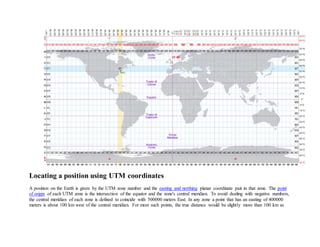
The UTM system divides the Earth into 60 zones, each 6° of longitude in width. Zone 1 covers longitude 180° to 174° W; zone
numbering increases eastward to zone 60, which covers longitude 174°E to 180°. The polar regions south of 80°S and north of 84°N
are excluded.
Each of the 60 zones uses a transverse Mercator projection that can map a region of large north-south extent with low distortion. By
using narrow zones of 6° of longitude (up to 668 km) in width, and reducing the scale factor along the central meridian to 0.9996 (a
reduction of 1:2500), the amount of distortion is held below 1 part in 1,000 inside each zone. Distortion of scale increases to 1.0010 at
the zone boundaries along the equator.
In each zone the scale factor of the central meridian reduces the diameter of the transverse cylinder to produce a secant projection with
two standard lines, or lines of true scale, about 180 km on each side of, and about parallel to, the central meridian (Arc cos 0.9996 =
1.62° at the Equator). The scale is less than 1 inside the standard lines and greater than 1 outside them, but the overall distortion is
minimized.
Overlapping grids
Distortionof scale increasesineachUTM zone as the boundariesbetweenthe UTMzonesare approached.However,itisoften
convenientornecessarytomeasure aseriesof locationsonasingle gridwhensome are locatedintwoadjacentzones.Aroundthe
boundariesof large scale maps(1:100,000 or larger) coordinatesforbothadjoiningUTMzonesare usuallyprintedwithinaminimum
distance of 40 km oneitherside of a zone boundary.Ideally,the coordinatesof eachpositionshouldbe measuredon the gridforthe
zone inwhichtheyare located,butbecause the scale factorisstill relativelysmallnearzone boundaries,itispossibletooverlap
measurementsintoanadjoiningzone forsome distance whennecessary.
Locating a position using UTM coordinates
A position on the Earth is given by the UTM zone number and the easting and northing planar coordinate pair in that zone. The point
of origin of each UTM zone is the intersection of the equator and the zone's central meridian. To avoid dealing with negative numbers,
the central meridian of each zone is defined to coincide with 500000 meters East. In any zone a point that has an easting of 400000
meters is about 100 km west of the central meridian. For most such points, the true distance would be slightly more than 100 km as
measured on the surface of the Earth because of the distortion of the projection. UTM eastings range from about 167000 meters to
833000 meters at the equator.
In the northern hemisphere positions are measured northward from zero at the equator. The maximum "northing" value is about
9300000 meters at latitude 84 degrees North, the north end of the UTM zones. In the southern hemisphere northings decrease
southward from the equator, set at 10000000 meters, to about 1100000 meters at 80 degrees South, the south end of the UTM zones.
For the southern hemisphere, its northing at the equator is set at 10000000 meters so no point has a negative northing value.
The CN Tower is at 43°38′33.24″N 79°23′13.7″W, which is in UTM zone 17, and the grid position is 630084 m east, 4833438 m
north. Two points in Zone 17 have these coordinates, one in the northern hemisphere and one in the south; one of two conventions is
used to say which:
1. Append a hemisphere designator to the zone number, "N" or "S", thus "17N 630084 4833438". This supplies the minimum
information to define the position uniquely.
2. Supply the grid zone, i.e., the latitude band designator appended to the zone number, thus "17T 630084 4833438". The
provision of the latitude band along with northing supplies redundant information (which may, as a consequence, be
contradictory if misused).
Because latitude band "S" is in the northern hemisphere, a designation such as "38S" is unclear. The "S" might refer to the latitude
band (32°N–40°N) or it might mean "South". It is therefore important to specify which convention is being used, e.g., by spelling out
the hemisphere, "North" or "South", or using different symbols, such as − for south and + for north.
Table of projections
Projection Image Type Properties Creator Year Notes
Equirectangular
= equidistant
cylindrical
= rectangular
Cylindrical Equidistant Marinus of Tyre c. 120
Simplest geometry;
distances along meridians
are conserved.
Projection Image Type Properties Creator Year Notes
= la carte
parallélogrammatique Plate carrée: special case
having the equator as the
standard parallel.
Cassini
= Cassini–Soldner
Cylindrical Equidistant
César-François
Cassini de
Thury
1745
Transverse of equidistant
projection; distances along
central meridian are
conserved.
Distances perpendicular to
central meridian are
preserved.
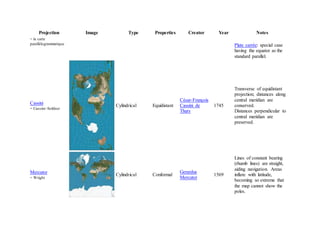
Mercator
= Wright
Cylindrical Conformal
Gerardus
Mercator
1569
Lines of constant bearing
(rhumb lines) are straight,
aiding navigation. Areas
inflate with latitude,
becoming so extreme that
the map cannot show the
poles.
Projection Image Type Properties Creator Year Notes
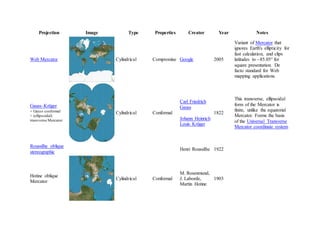
Web Mercator Cylindrical Compromise Google 2005
Variant of Mercator that
ignores Earth's ellipticity for
fast calculation, and clips
latitudes to ~85.05° for
square presentation. De
facto standard for Web
mapping applications.
Gauss–Krüger
= Gauss conformal
= (ellipsoidal)
transverse Mercator
Cylindrical Conformal
Carl Friedrich
Gauss
Johann Heinrich
Louis Krüger
1822
This transverse, ellipsoidal
form of the Mercator is
finite, unlike the equatorial
Mercator. Forms the basis
of the Universal Transverse
Mercator coordinate system.
Roussilhe oblique
stereographic
Henri Roussilhe 1922
Hotine oblique
Mercator
Cylindrical Conformal
M. Rosenmund,
J. Laborde,
Martin Hotine
1903
Projection Image Type Properties Creator Year Notes
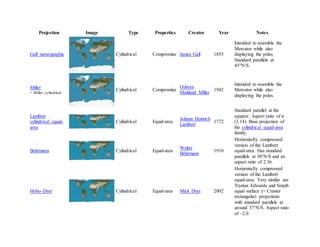
Gall stereographic Cylindrical Compromise James Gall 1855
Intended to resemble the
Mercator while also
displaying the poles.
Standard parallels at
45°N/S.
Miller
= Miller cylindrical
Cylindrical Compromise
Osborn
Maitland Miller
1942
Intended to resemble the
Mercator while also
displaying the poles.
Lambert
cylindrical equal-
area
Cylindrical Equal-area
Johann Heinrich
Lambert
1772
Standard parallel at the
equator. Aspect ratio of π
(3.14). Base projection of
the cylindrical equal-area
family.
Behrmann Cylindrical Equal-area
Walter
Behrmann
1910
Horizontally compressed
version of the Lambert
equal-area. Has standard
parallels at 30°N/S and an
aspect ratio of 2.36.
Hobo–Dyer Cylindrical Equal-area Mick Dyer 2002
Horizontally compressed
version of the Lambert
equal-area. Very similar are
Trystan Edwards and Smyth
equal surface (= Craster
rectangular) projections
with standard parallels at
around 37°N/S. Aspect ratio
of ~2.0.
Projection Image Type Properties Creator Year Notes
Gall–Peters
= Gall orthographic
= Peters
Cylindrical Equal-area
James Gall
(Arno Peters)
1855
Horizontally compressed
version of the Lambert
equal-area. Standard
parallels at 45°N/S. Aspect
ratio of ~1.6. Similar is
Balthasart projection with
standard parallels at 50°N/S.
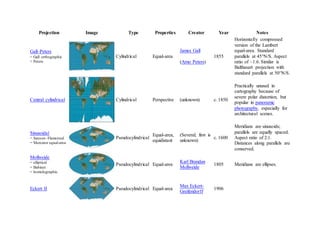
Central cylindrical Cylindrical Perspective (unknown) c. 1850
Practically unused in
cartography because of
severe polar distortion, but
popular in panoramic
photography, especially for
architectural scenes.
Sinusoidal
= Sanson–Flamsteed
= Mercator equal-area
Pseudocylindrical
Equal-area,
equidistant
(Several; first is
unknown)
c. 1600
Meridians are sinusoids;
parallels are equally spaced.
Aspect ratio of 2:1.
Distances along parallels are
conserved.
Mollweide
= elliptical
= Babinet
= homolographic
Pseudocylindrical Equal-area
Karl Brandan
Mollweide
1805 Meridians are ellipses.
Eckert II Pseudocylindrical Equal-area
Max Eckert-
Greifendorff
1906
Projection Image Type Properties Creator Year Notes
Eckert IV Pseudocylindrical Equal-area
Max Eckert-
Greifendorff
1906
Parallels are unequal in
spacing and scale; outer
meridians are semicircles;
other meridians are
semiellipses.
Eckert VI Pseudocylindrical Equal-area
Max Eckert-
Greifendorff
1906
Parallels are unequal in
spacing and scale; meridians
are half-period sinusoids.
Ortelius oval Pseudocylindrical Compromise Battista Agnese 1540 Meridians are circular.[2]
Goode homolosine Pseudocylindrical Equal-area
John Paul
Goode
1923
Hybrid of Sinusoidal and
Mollweide projections.
Usually used in interrupted
form.
Kavrayskiy VII Pseudocylindrical Compromise
Vladimir V.
Kavrayskiy
1939
Evenly spaced parallels.
Equivalent to Wagner VI
horizontally compressed by
a factor of .
Robinson Pseudocylindrical Compromise
Arthur H.
Robinson
1963
Computed by interpolation
of tabulated values. Used by
Rand McNally since
inception and used by NGS
in 1988–1998.
Projection Image Type Properties Creator Year Notes
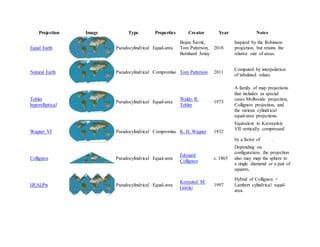
Equal Earth Pseudocylindrical Equal-area
Bojan Šavrič,
Tom Patterson,
Bernhard Jenny
2018
Inspired by the Robinson
projection, but retains the
relative size of areas.
Natural Earth Pseudocylindrical Compromise Tom Patterson 2011
Computed by interpolation
of tabulated values.
Tobler
hyperelliptical
Pseudocylindrical Equal-area
Waldo R.
Tobler
1973
A family of map projections
that includes as special
cases Mollweide projection,
Collignon projection, and
the various cylindrical
equal-area projections.
Wagner VI Pseudocylindrical Compromise K. H. Wagner 1932
Equivalent to Kavrayskiy
VII vertically compressed
by a factor of .
Collignon Pseudocylindrical Equal-area
Édouard
Collignon
c. 1865
Depending on
configuration, the projection
also may map the sphere to
a single diamond or a pair of
squares.
HEALPix Pseudocylindrical Equal-area
Krzysztof M.
Górski
1997
Hybrid of Collignon +
Lambert cylindrical equal-
area.
Projection Image Type Properties Creator Year Notes
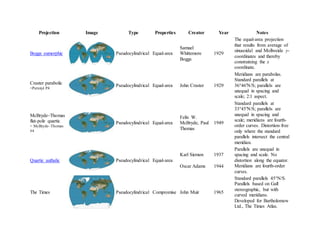
Boggs eumorphic Pseudocylindrical Equal-area
Samuel
Whittemore
Boggs
1929
The equal-area projection
that results from average of
sinusoidal and Mollweide y-
coordinates and thereby
constraining the x
coordinate.
Craster parabolic
=Putniņš P4
Pseudocylindrical Equal-area John Craster 1929
Meridians are parabolas.
Standard parallels at
36°46′N/S; parallels are
unequal in spacing and
scale; 2:1 aspect.
McBryde–Thomas
flat-pole quartic
= McBryde–Thomas
#4
Pseudocylindrical Equal-area
Felix W.
McBryde, Paul
Thomas
1949
Standard parallels at
33°45′N/S; parallels are
unequal in spacing and
scale; meridians are fourth-
order curves. Distortion-free
only where the standard
parallels intersect the central
meridian.
Quartic authalic Pseudocylindrical Equal-area
Karl Siemon
Oscar Adams
1937
1944
Parallels are unequal in
spacing and scale. No
distortion along the equator.
Meridians are fourth-order
curves.
The Times Pseudocylindrical Compromise John Muir 1965
Standard parallels 45°N/S.
Parallels based on Gall
stereographic, but with
curved meridians.
Developed for Bartholomew
Ltd., The Times Atlas.
Projection Image Type Properties Creator Year Notes
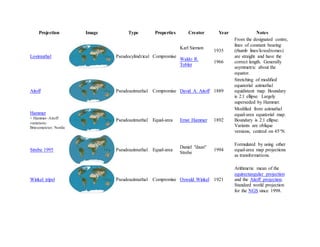
Loximuthal Pseudocylindrical Compromise
Karl Siemon
Waldo R.
Tobler
1935
1966
From the designated centre,
lines of constant bearing
(rhumb lines/loxodromes)
are straight and have the
correct length. Generally
asymmetric about the
equator.
Aitoff Pseudoazimuthal Compromise David A. Aitoff 1889
Stretching of modified
equatorial azimuthal
equidistant map. Boundary
is 2:1 ellipse. Largely
superseded by Hammer.
Hammer
= Hammer–Aitoff
variations:
Briesemeister; Nordic
Pseudoazimuthal Equal-area Ernst Hammer 1892
Modified from azimuthal
equal-area equatorial map.
Boundary is 2:1 ellipse.
Variants are oblique
versions, centred on 45°N.
Strebe 1995 Pseudoazimuthal Equal-area
Daniel "daan"
Strebe
1994
Formulated by using other
equal-area map projections
as transformations.
Winkel tripel Pseudoazimuthal Compromise Oswald Winkel 1921
Arithmetic mean of the
equirectangular projection
and the Aitoff projection.
Standard world projection
for the NGS since 1998.
Projection Image Type Properties Creator Year Notes
Van der Grinten Other Compromise
Alphons J. van
der Grinten
1904
Boundary is a circle. All
parallels and meridians are
circular arcs. Usually
clipped near 80°N/S.
Standard world projection
of the NGS in 1922–1988.
Equidistant conic
= simple conic
Conic Equidistant
Based on
Ptolemy's 1st
Projection
c. 100
Distances along meridians
are conserved, as is distance
along one or two standard
parallels.[3]
Lambert conformal
conic
Conic Conformal
Johann Heinrich
Lambert
1772 Used in aviation charts.
Albers conic Conic Equal-area
Heinrich C.
Albers
1805
Two standard parallels with
low distortion between
them.
Projection Image Type Properties Creator Year Notes
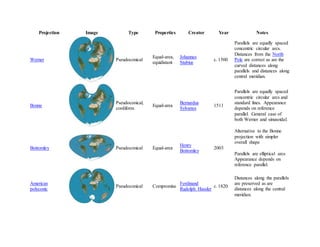
Werner Pseudoconical
Equal-area,
equidistant
Johannes
Stabius
c. 1500
Parallels are equally spaced
concentric circular arcs.
Distances from the North
Pole are correct as are the
curved distances along
parallels and distances along
central meridian.
Bonne
Pseudoconical,
cordiform
Equal-area
Bernardus
Sylvanus
1511
Parallels are equally spaced
concentric circular arcs and
standard lines. Appearance
depends on reference
parallel. General case of
both Werner and sinusoidal.
Bottomley Pseudoconical Equal-area
Henry
Bottomley
2003
Alternative to the Bonne
projection with simpler
overall shape
Parallels are elliptical arcs
Appearance depends on
reference parallel.
American
polyconic
Pseudoconical Compromise
Ferdinand
Rudolph Hassler
c. 1820
Distances along the parallels
are preserved as are
distances along the central
meridian.
Projection Image Type Properties Creator Year Notes
Rectangular
polyconic
Pseudoconical Compromise
U.S. Coast
Survey
c. 1853
Latitude along which scale
is correct can be chosen.
Parallels meet meridians at
right angles.
Latitudinally
equal-differential
polyconic
Pseudoconical Compromise
China State
Bureau of
Surveying and
Mapping
1963
Polyconic: parallels are non-
concentric arcs of circles.
Nicolosi globular Pseudoconical[4] Compromise
Abū Rayḥān al-
Bīrūnī;
reinvented by
Giovanni
Battista
Nicolosi,
1660.[1]:14
c. 1000
Azimuthal
equidistant
=Postel
=zenithal equidistant
Azimuthal Equidistant
Abū Rayḥān al-
Bīrūnī
c. 1000
Distances from center are
conserved.
Used as the emblem of the
United Nations, extending
to 60° S.
Projection Image Type Properties Creator Year Notes
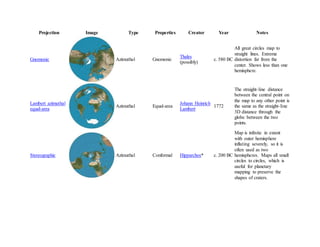
Gnomonic Azimuthal Gnomonic
Thales
(possibly)
c. 580 BC
All great circles map to
straight lines. Extreme
distortion far from the
center. Shows less than one
hemisphere.
Lambert azimuthal
equal-area
Azimuthal Equal-area
Johann Heinrich
Lambert
1772
The straight-line distance
between the central point on
the map to any other point is
the same as the straight-line
3D distance through the
globe between the two
points.
Stereographic Azimuthal Conformal Hipparchos* c. 200 BC
Map is infinite in extent
with outer hemisphere
inflating severely, so it is
often used as two
hemispheres. Maps all small
circles to circles, which is
useful for planetary
mapping to preserve the
shapes of craters.
Projection Image Type Properties Creator Year Notes
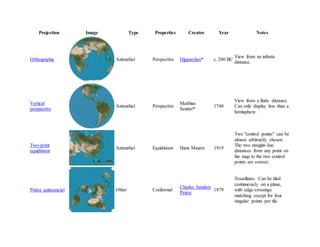
Orthographic Azimuthal Perspective Hipparchos* c. 200 BC
View from an infinite
distance.
Vertical
perspective
Azimuthal Perspective
Matthias
Seutter*
1740
View from a finite distance.
Can only display less than a
hemisphere.
Two-point
equidistant
Azimuthal Equidistant Hans Maurer 1919
Two "control points" can be
almost arbitrarily chosen.
The two straight-line
distances from any point on
the map to the two control
points are correct.
Peirce quincuncial Other Conformal
Charles Sanders
Peirce
1879
Tessellates. Can be tiled
continuously on a plane,
with edge-crossings
matching except for four
singular points per tile.
Projection Image Type Properties Creator Year Notes
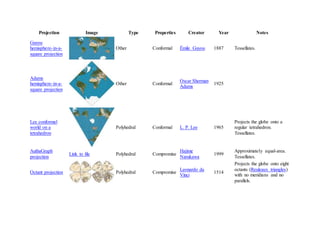
Guyou
hemisphere-in-a-
square projection
Other Conformal Émile Guyou 1887 Tessellates.
Adams
hemisphere-in-a-
square projection
Other Conformal
Oscar Sherman
Adams
1925
Lee conformal
world on a
tetrahedron
Polyhedral Conformal L. P. Lee 1965
Projects the globe onto a
regular tetrahedron.
Tessellates.
AuthaGraph
projection
Link to file Polyhedral Compromise
Hajime
Narukawa
1999
Approximately equal-area.
Tessellates.
Octant projection Polyhedral Compromise
Leonardo da
Vinci
1514
Projects the globe onto eight
octants (Reuleaux triangles)
with no meridians and no
parallels.
Projection Image Type Properties Creator Year Notes
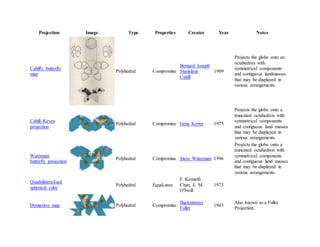
Cahill's butterfly
map
Polyhedral Compromise
Bernard Joseph
Stanislaus
Cahill
1909
Projects the globe onto an
octahedron with
symmetrical components
and contiguous landmasses
that may be displayed in
various arrangements.
Cahill–Keyes
projection
Polyhedral Compromise Gene Keyes 1975
Projects the globe onto a
truncated octahedron with
symmetrical components
and contiguous land masses
that may be displayed in
various arrangements.
Waterman
butterfly projection
Polyhedral Compromise Steve Waterman 1996
Projects the globe onto a
truncated octahedron with
symmetrical components
and contiguous land masses
that may be displayed in
various arrangements.
Quadrilateralized
spherical cube
Polyhedral Equal-area
F. Kenneth
Chan, E. M.
O'Neill
1973
Dymaxion map Polyhedral Compromise
Buckminster
Fuller
1943
Also known as a Fuller
Projection.
Projection Image Type Properties Creator Year Notes
Myriahedral
projections
Polyhedral Equal-area
Jarke J. van
Wijk
2008
Projects the globe onto a
myriahedron: a polyhedron
with a very large number of
faces.[5][6]
Craig
retroazimuthal
= Mecca
Retroazimuthal Compromise
James Ireland
Craig
1909
Hammer
retroazimuthal,
front hemisphere
Retroazimuthal Ernst Hammer 1910
Hammer
retroazimuthal,
back hemisphere
Retroazimuthal Ernst Hammer 1910
Projection Image Type Properties Creator Year Notes
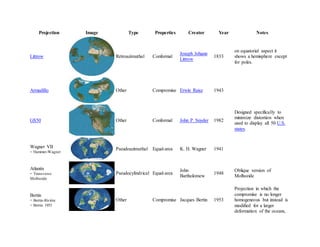
Littrow Retroazimuthal Conformal
Joseph Johann
Littrow
1833
on equatorial aspect it
shows a hemisphere except
for poles.
Armadillo Other Compromise Erwin Raisz 1943
GS50 Other Conformal John P. Snyder 1982
Designed specifically to
minimize distortion when
used to display all 50 U.S.
states.
Wagner VII
= Hammer-Wagner
Pseudoazimuthal Equal-area K. H. Wagner 1941
Atlantis
= Transverse
Mollweide
Pseudocylindrical Equal-area
John
Bartholomew
1948
Oblique version of
Mollweide
Bertin
= Bertin-Rivière
= Bertin 1953
Other Compromise Jacques Bertin 1953
Projection in which the
compromise is no longer
homogeneous but instead is
modified for a larger
deformation of the oceans,
Projection Image Type Properties Creator Year Notes
to achieve lesser
deformation of the
continents. Commonly used
for French geopolitical
maps.[7]
*The first known popularizer/user and not necessarily the creator.

projections.docx

  • 1.
    Type of projection Cylindrical Instandard presentation, these map regularly-spaced meridians to equally spaced vertical lines, and parallelsto horizontallines. Pseudocylindrical In standard presentation, these map the central meridian and parallels as straight lines. Other meridians are curves (or possibly straight from poleto equator), regularly spaced along parallels. Conic In standard presentation, conic (or conical)projections map meridians as straight lines, and parallelsas arcs of circles. Pseudoconical In standard presentation, pseudoconicalprojectionsrepresent the central meridian as a straight line, othermeridians as complex curves, and parallels as circular arcs.
  • 2.
    Azimuthal In standard presentation,azimuthal projectionsmap meridians as straight lines and parallelsas complete, concentriccircles. They are radially symmetrical. In any presentation (or aspect), they preserve directionsfrom the center point. This means great circles through the central point are represented by straight lines on the map. Pseudoazimuthal In standard presentation, pseudoazimuthalprojectionsmap the equatorand central meridian to perpendicular,intersecting straight lines. They map parallelsto complex curves bowing away from the equator,and meridians to complex curves bowing in toward the central meridian. Listed here after pseudocylindrical as generally similar to them in shape and purpose. Other Typically calculatedfrom formula, and not based on a particularprojection Polyhedral maps
  • 3.
    Polyhedral maps canbe folded up into a polyhedral approximation to the sphere, using particularprojection to map each face with low distortion. Properties Conformal Preserves angles locally, implying that local shapes are not distorted and that local scale is constant in all directions from any chosen point. Equal-area Area measure is conserved everywhere. Compromise
  • 4.
    Neither conformal norequal-area, but a balanceintended to reduceoverall distortion. Equidistant All distances from one (or two) points are correct. Other equidistant propertiesare mentioned in the notes. Gnomonic All great circles are straight lines. Retroazimuthal Direction to a fixed location B (by the shortest route)correspondsto the direction on the map from A to B. The UTM systemdividesthe Earthinto60 zones,each6° of longitude inwidth. Zone 1coverslongitude 180° to 174° W; zone numbering increaseseastwardto zone 60, whichcoverslongitude174°E to 180°. The polarregionssouthof 80°S and northof 84°N are excluded
  • 5.
    UTM zone The UTMsystem divides the Earth into 60 zones, each 6° of longitude in width. Zone 1 covers longitude 180° to 174° W; zone numbering increases eastward to zone 60, which covers longitude 174°E to 180°. The polar regions south of 80°S and north of 84°N are excluded. Each of the 60 zones uses a transverse Mercator projection that can map a region of large north-south extent with low distortion. By using narrow zones of 6° of longitude (up to 668 km) in width, and reducing the scale factor along the central meridian to 0.9996 (a reduction of 1:2500), the amount of distortion is held below 1 part in 1,000 inside each zone. Distortion of scale increases to 1.0010 at the zone boundaries along the equator. In each zone the scale factor of the central meridian reduces the diameter of the transverse cylinder to produce a secant projection with two standard lines, or lines of true scale, about 180 km on each side of, and about parallel to, the central meridian (Arc cos 0.9996 = 1.62° at the Equator). The scale is less than 1 inside the standard lines and greater than 1 outside them, but the overall distortion is minimized. Overlapping grids Distortionof scale increasesineachUTM zone as the boundariesbetweenthe UTMzonesare approached.However,itisoften convenientornecessarytomeasure aseriesof locationsonasingle gridwhensome are locatedintwoadjacentzones.Aroundthe boundariesof large scale maps(1:100,000 or larger) coordinatesforbothadjoiningUTMzonesare usuallyprintedwithinaminimum distance of 40 km oneitherside of a zone boundary.Ideally,the coordinatesof eachpositionshouldbe measuredon the gridforthe zone inwhichtheyare located,butbecause the scale factorisstill relativelysmallnearzone boundaries,itispossibletooverlap measurementsintoanadjoiningzone forsome distance whennecessary.
  • 6.
    Locating a positionusing UTM coordinates A position on the Earth is given by the UTM zone number and the easting and northing planar coordinate pair in that zone. The point of origin of each UTM zone is the intersection of the equator and the zone's central meridian. To avoid dealing with negative numbers, the central meridian of each zone is defined to coincide with 500000 meters East. In any zone a point that has an easting of 400000 meters is about 100 km west of the central meridian. For most such points, the true distance would be slightly more than 100 km as
  • 7.
    measured on thesurface of the Earth because of the distortion of the projection. UTM eastings range from about 167000 meters to 833000 meters at the equator. In the northern hemisphere positions are measured northward from zero at the equator. The maximum "northing" value is about 9300000 meters at latitude 84 degrees North, the north end of the UTM zones. In the southern hemisphere northings decrease southward from the equator, set at 10000000 meters, to about 1100000 meters at 80 degrees South, the south end of the UTM zones. For the southern hemisphere, its northing at the equator is set at 10000000 meters so no point has a negative northing value. The CN Tower is at 43°38′33.24″N 79°23′13.7″W, which is in UTM zone 17, and the grid position is 630084 m east, 4833438 m north. Two points in Zone 17 have these coordinates, one in the northern hemisphere and one in the south; one of two conventions is used to say which: 1. Append a hemisphere designator to the zone number, "N" or "S", thus "17N 630084 4833438". This supplies the minimum information to define the position uniquely. 2. Supply the grid zone, i.e., the latitude band designator appended to the zone number, thus "17T 630084 4833438". The provision of the latitude band along with northing supplies redundant information (which may, as a consequence, be contradictory if misused). Because latitude band "S" is in the northern hemisphere, a designation such as "38S" is unclear. The "S" might refer to the latitude band (32°N–40°N) or it might mean "South". It is therefore important to specify which convention is being used, e.g., by spelling out the hemisphere, "North" or "South", or using different symbols, such as − for south and + for north. Table of projections Projection Image Type Properties Creator Year Notes Equirectangular = equidistant cylindrical = rectangular Cylindrical Equidistant Marinus of Tyre c. 120 Simplest geometry; distances along meridians are conserved.
  • 8.
    Projection Image TypeProperties Creator Year Notes = la carte parallélogrammatique Plate carrée: special case having the equator as the standard parallel. Cassini = Cassini–Soldner Cylindrical Equidistant César-François Cassini de Thury 1745 Transverse of equidistant projection; distances along central meridian are conserved. Distances perpendicular to central meridian are preserved. Mercator = Wright Cylindrical Conformal Gerardus Mercator 1569 Lines of constant bearing (rhumb lines) are straight, aiding navigation. Areas inflate with latitude, becoming so extreme that the map cannot show the poles.
  • 9.
    Projection Image TypeProperties Creator Year Notes Web Mercator Cylindrical Compromise Google 2005 Variant of Mercator that ignores Earth's ellipticity for fast calculation, and clips latitudes to ~85.05° for square presentation. De facto standard for Web mapping applications. Gauss–Krüger = Gauss conformal = (ellipsoidal) transverse Mercator Cylindrical Conformal Carl Friedrich Gauss Johann Heinrich Louis Krüger 1822 This transverse, ellipsoidal form of the Mercator is finite, unlike the equatorial Mercator. Forms the basis of the Universal Transverse Mercator coordinate system. Roussilhe oblique stereographic Henri Roussilhe 1922 Hotine oblique Mercator Cylindrical Conformal M. Rosenmund, J. Laborde, Martin Hotine 1903
  • 10.
    Projection Image TypeProperties Creator Year Notes Gall stereographic Cylindrical Compromise James Gall 1855 Intended to resemble the Mercator while also displaying the poles. Standard parallels at 45°N/S. Miller = Miller cylindrical Cylindrical Compromise Osborn Maitland Miller 1942 Intended to resemble the Mercator while also displaying the poles. Lambert cylindrical equal- area Cylindrical Equal-area Johann Heinrich Lambert 1772 Standard parallel at the equator. Aspect ratio of π (3.14). Base projection of the cylindrical equal-area family. Behrmann Cylindrical Equal-area Walter Behrmann 1910 Horizontally compressed version of the Lambert equal-area. Has standard parallels at 30°N/S and an aspect ratio of 2.36. Hobo–Dyer Cylindrical Equal-area Mick Dyer 2002 Horizontally compressed version of the Lambert equal-area. Very similar are Trystan Edwards and Smyth equal surface (= Craster rectangular) projections with standard parallels at around 37°N/S. Aspect ratio of ~2.0.
  • 11.
    Projection Image TypeProperties Creator Year Notes Gall–Peters = Gall orthographic = Peters Cylindrical Equal-area James Gall (Arno Peters) 1855 Horizontally compressed version of the Lambert equal-area. Standard parallels at 45°N/S. Aspect ratio of ~1.6. Similar is Balthasart projection with standard parallels at 50°N/S. Central cylindrical Cylindrical Perspective (unknown) c. 1850 Practically unused in cartography because of severe polar distortion, but popular in panoramic photography, especially for architectural scenes. Sinusoidal = Sanson–Flamsteed = Mercator equal-area Pseudocylindrical Equal-area, equidistant (Several; first is unknown) c. 1600 Meridians are sinusoids; parallels are equally spaced. Aspect ratio of 2:1. Distances along parallels are conserved. Mollweide = elliptical = Babinet = homolographic Pseudocylindrical Equal-area Karl Brandan Mollweide 1805 Meridians are ellipses. Eckert II Pseudocylindrical Equal-area Max Eckert- Greifendorff 1906
  • 12.
    Projection Image TypeProperties Creator Year Notes Eckert IV Pseudocylindrical Equal-area Max Eckert- Greifendorff 1906 Parallels are unequal in spacing and scale; outer meridians are semicircles; other meridians are semiellipses. Eckert VI Pseudocylindrical Equal-area Max Eckert- Greifendorff 1906 Parallels are unequal in spacing and scale; meridians are half-period sinusoids. Ortelius oval Pseudocylindrical Compromise Battista Agnese 1540 Meridians are circular.[2] Goode homolosine Pseudocylindrical Equal-area John Paul Goode 1923 Hybrid of Sinusoidal and Mollweide projections. Usually used in interrupted form. Kavrayskiy VII Pseudocylindrical Compromise Vladimir V. Kavrayskiy 1939 Evenly spaced parallels. Equivalent to Wagner VI horizontally compressed by a factor of . Robinson Pseudocylindrical Compromise Arthur H. Robinson 1963 Computed by interpolation of tabulated values. Used by Rand McNally since inception and used by NGS in 1988–1998.
  • 13.
    Projection Image TypeProperties Creator Year Notes Equal Earth Pseudocylindrical Equal-area Bojan Šavrič, Tom Patterson, Bernhard Jenny 2018 Inspired by the Robinson projection, but retains the relative size of areas. Natural Earth Pseudocylindrical Compromise Tom Patterson 2011 Computed by interpolation of tabulated values. Tobler hyperelliptical Pseudocylindrical Equal-area Waldo R. Tobler 1973 A family of map projections that includes as special cases Mollweide projection, Collignon projection, and the various cylindrical equal-area projections. Wagner VI Pseudocylindrical Compromise K. H. Wagner 1932 Equivalent to Kavrayskiy VII vertically compressed by a factor of . Collignon Pseudocylindrical Equal-area Édouard Collignon c. 1865 Depending on configuration, the projection also may map the sphere to a single diamond or a pair of squares. HEALPix Pseudocylindrical Equal-area Krzysztof M. Górski 1997 Hybrid of Collignon + Lambert cylindrical equal- area.
  • 14.
    Projection Image TypeProperties Creator Year Notes Boggs eumorphic Pseudocylindrical Equal-area Samuel Whittemore Boggs 1929 The equal-area projection that results from average of sinusoidal and Mollweide y- coordinates and thereby constraining the x coordinate. Craster parabolic =Putniņš P4 Pseudocylindrical Equal-area John Craster 1929 Meridians are parabolas. Standard parallels at 36°46′N/S; parallels are unequal in spacing and scale; 2:1 aspect. McBryde–Thomas flat-pole quartic = McBryde–Thomas #4 Pseudocylindrical Equal-area Felix W. McBryde, Paul Thomas 1949 Standard parallels at 33°45′N/S; parallels are unequal in spacing and scale; meridians are fourth- order curves. Distortion-free only where the standard parallels intersect the central meridian. Quartic authalic Pseudocylindrical Equal-area Karl Siemon Oscar Adams 1937 1944 Parallels are unequal in spacing and scale. No distortion along the equator. Meridians are fourth-order curves. The Times Pseudocylindrical Compromise John Muir 1965 Standard parallels 45°N/S. Parallels based on Gall stereographic, but with curved meridians. Developed for Bartholomew Ltd., The Times Atlas.
  • 15.
    Projection Image TypeProperties Creator Year Notes Loximuthal Pseudocylindrical Compromise Karl Siemon Waldo R. Tobler 1935 1966 From the designated centre, lines of constant bearing (rhumb lines/loxodromes) are straight and have the correct length. Generally asymmetric about the equator. Aitoff Pseudoazimuthal Compromise David A. Aitoff 1889 Stretching of modified equatorial azimuthal equidistant map. Boundary is 2:1 ellipse. Largely superseded by Hammer. Hammer = Hammer–Aitoff variations: Briesemeister; Nordic Pseudoazimuthal Equal-area Ernst Hammer 1892 Modified from azimuthal equal-area equatorial map. Boundary is 2:1 ellipse. Variants are oblique versions, centred on 45°N. Strebe 1995 Pseudoazimuthal Equal-area Daniel "daan" Strebe 1994 Formulated by using other equal-area map projections as transformations. Winkel tripel Pseudoazimuthal Compromise Oswald Winkel 1921 Arithmetic mean of the equirectangular projection and the Aitoff projection. Standard world projection for the NGS since 1998.
  • 16.
    Projection Image TypeProperties Creator Year Notes Van der Grinten Other Compromise Alphons J. van der Grinten 1904 Boundary is a circle. All parallels and meridians are circular arcs. Usually clipped near 80°N/S. Standard world projection of the NGS in 1922–1988. Equidistant conic = simple conic Conic Equidistant Based on Ptolemy's 1st Projection c. 100 Distances along meridians are conserved, as is distance along one or two standard parallels.[3] Lambert conformal conic Conic Conformal Johann Heinrich Lambert 1772 Used in aviation charts. Albers conic Conic Equal-area Heinrich C. Albers 1805 Two standard parallels with low distortion between them.
  • 17.
    Projection Image TypeProperties Creator Year Notes Werner Pseudoconical Equal-area, equidistant Johannes Stabius c. 1500 Parallels are equally spaced concentric circular arcs. Distances from the North Pole are correct as are the curved distances along parallels and distances along central meridian. Bonne Pseudoconical, cordiform Equal-area Bernardus Sylvanus 1511 Parallels are equally spaced concentric circular arcs and standard lines. Appearance depends on reference parallel. General case of both Werner and sinusoidal. Bottomley Pseudoconical Equal-area Henry Bottomley 2003 Alternative to the Bonne projection with simpler overall shape Parallels are elliptical arcs Appearance depends on reference parallel. American polyconic Pseudoconical Compromise Ferdinand Rudolph Hassler c. 1820 Distances along the parallels are preserved as are distances along the central meridian.
  • 18.
    Projection Image TypeProperties Creator Year Notes Rectangular polyconic Pseudoconical Compromise U.S. Coast Survey c. 1853 Latitude along which scale is correct can be chosen. Parallels meet meridians at right angles. Latitudinally equal-differential polyconic Pseudoconical Compromise China State Bureau of Surveying and Mapping 1963 Polyconic: parallels are non- concentric arcs of circles. Nicolosi globular Pseudoconical[4] Compromise Abū Rayḥān al- Bīrūnī; reinvented by Giovanni Battista Nicolosi, 1660.[1]:14 c. 1000 Azimuthal equidistant =Postel =zenithal equidistant Azimuthal Equidistant Abū Rayḥān al- Bīrūnī c. 1000 Distances from center are conserved. Used as the emblem of the United Nations, extending to 60° S.
  • 19.
    Projection Image TypeProperties Creator Year Notes Gnomonic Azimuthal Gnomonic Thales (possibly) c. 580 BC All great circles map to straight lines. Extreme distortion far from the center. Shows less than one hemisphere. Lambert azimuthal equal-area Azimuthal Equal-area Johann Heinrich Lambert 1772 The straight-line distance between the central point on the map to any other point is the same as the straight-line 3D distance through the globe between the two points. Stereographic Azimuthal Conformal Hipparchos* c. 200 BC Map is infinite in extent with outer hemisphere inflating severely, so it is often used as two hemispheres. Maps all small circles to circles, which is useful for planetary mapping to preserve the shapes of craters.
  • 20.
    Projection Image TypeProperties Creator Year Notes Orthographic Azimuthal Perspective Hipparchos* c. 200 BC View from an infinite distance. Vertical perspective Azimuthal Perspective Matthias Seutter* 1740 View from a finite distance. Can only display less than a hemisphere. Two-point equidistant Azimuthal Equidistant Hans Maurer 1919 Two "control points" can be almost arbitrarily chosen. The two straight-line distances from any point on the map to the two control points are correct. Peirce quincuncial Other Conformal Charles Sanders Peirce 1879 Tessellates. Can be tiled continuously on a plane, with edge-crossings matching except for four singular points per tile.
  • 21.
    Projection Image TypeProperties Creator Year Notes Guyou hemisphere-in-a- square projection Other Conformal Émile Guyou 1887 Tessellates. Adams hemisphere-in-a- square projection Other Conformal Oscar Sherman Adams 1925 Lee conformal world on a tetrahedron Polyhedral Conformal L. P. Lee 1965 Projects the globe onto a regular tetrahedron. Tessellates. AuthaGraph projection Link to file Polyhedral Compromise Hajime Narukawa 1999 Approximately equal-area. Tessellates. Octant projection Polyhedral Compromise Leonardo da Vinci 1514 Projects the globe onto eight octants (Reuleaux triangles) with no meridians and no parallels.
  • 22.
    Projection Image TypeProperties Creator Year Notes Cahill's butterfly map Polyhedral Compromise Bernard Joseph Stanislaus Cahill 1909 Projects the globe onto an octahedron with symmetrical components and contiguous landmasses that may be displayed in various arrangements. Cahill–Keyes projection Polyhedral Compromise Gene Keyes 1975 Projects the globe onto a truncated octahedron with symmetrical components and contiguous land masses that may be displayed in various arrangements. Waterman butterfly projection Polyhedral Compromise Steve Waterman 1996 Projects the globe onto a truncated octahedron with symmetrical components and contiguous land masses that may be displayed in various arrangements. Quadrilateralized spherical cube Polyhedral Equal-area F. Kenneth Chan, E. M. O'Neill 1973 Dymaxion map Polyhedral Compromise Buckminster Fuller 1943 Also known as a Fuller Projection.
  • 23.
    Projection Image TypeProperties Creator Year Notes Myriahedral projections Polyhedral Equal-area Jarke J. van Wijk 2008 Projects the globe onto a myriahedron: a polyhedron with a very large number of faces.[5][6] Craig retroazimuthal = Mecca Retroazimuthal Compromise James Ireland Craig 1909 Hammer retroazimuthal, front hemisphere Retroazimuthal Ernst Hammer 1910 Hammer retroazimuthal, back hemisphere Retroazimuthal Ernst Hammer 1910
  • 24.
    Projection Image TypeProperties Creator Year Notes Littrow Retroazimuthal Conformal Joseph Johann Littrow 1833 on equatorial aspect it shows a hemisphere except for poles. Armadillo Other Compromise Erwin Raisz 1943 GS50 Other Conformal John P. Snyder 1982 Designed specifically to minimize distortion when used to display all 50 U.S. states. Wagner VII = Hammer-Wagner Pseudoazimuthal Equal-area K. H. Wagner 1941 Atlantis = Transverse Mollweide Pseudocylindrical Equal-area John Bartholomew 1948 Oblique version of Mollweide Bertin = Bertin-Rivière = Bertin 1953 Other Compromise Jacques Bertin 1953 Projection in which the compromise is no longer homogeneous but instead is modified for a larger deformation of the oceans,
  • 25.
    Projection Image TypeProperties Creator Year Notes to achieve lesser deformation of the continents. Commonly used for French geopolitical maps.[7] *The first known popularizer/user and not necessarily the creator.