Coordinate system and map
projection
prepared by Samuel Zewdu
Presentation out line
Projection
Coordinate system
Geographic coordinate system
Projection coordinate system
UTM and UTM Zones
Easting & Northing
What is a Datum?
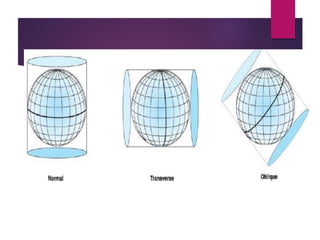
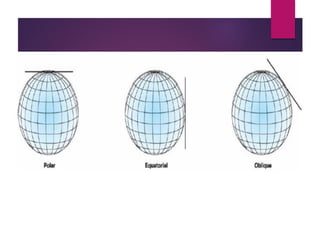
 Projection: the method by which the curved 3-D
surface of the earth is represented by X,Y
coordinates on a 2-D flat map/screen. Distortion is
inevitable
 Coordinate system
 A coordinate system is a method of defining how a
file’s point locations display on a map. Different
types of coordinate systems exist that control how
the coordinates are shown on the map. The two
main are:
 Geographic Coordinate System
 use of Geographic latitude and longitude
system, usually in Degree, Minutes and
Seconds (DMS)
 Use spherical coordinates to specify locations
on the surface of the earth
 When vertical locations (Elevation) are not
concerned, Latitude/longitude pair are used
 Geographic coordinate systems are commonly
called un projected lat/long
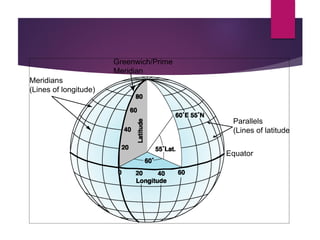
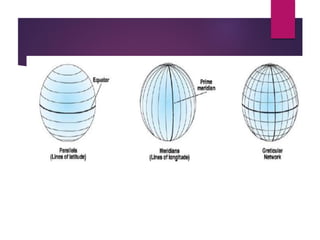
Equator
Greenwich/Prime
Meridian
Parallels
(Lines of latitude)
Meridians
(Lines of longitude)
Projection: the method by which the
curved 3-D surface of the earth is
represented by X,Y coordinates on a 2-D
flat map/screen.
use of a known projection and datum.
Linear cords (metres) are required in
many occasions
Distortions are inevitable with
projection
 Projections Preserve Some
 Earth Properties
 ►Area - correct earth surface area (Albers
 Equal Area) important for mass balances
 ►Shape - local angles are shown correctly
 (Lambert Conformal Conic)
 ►Direction - all directions are shown
 correctly relative to the center (Lambert
 Azimuthal Equal Area)
 ►Distance - preserved along particular lines
 ►Some projections preserve two properties
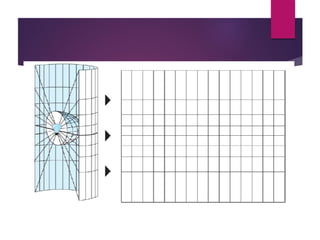
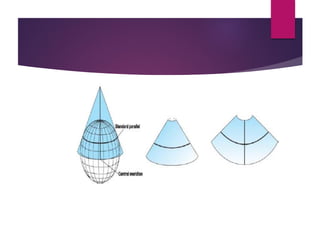
General rules for selecting a
projection
 Tropical Country—cylindrical
projection
Temperate Country—conical
projection
Polar Regions—Azimuthal
projection
 UTM and UTM Zones
Universal Transverse Mercator
(UTM) System
Developed in the late 1940s by the US
Army
the projection is the ‘Gauss-Kruger’
version of the Transverse Mercator-
equidistant cylindrical projection
 Intended for mapping areas : 840N – 800S
 Unit of measure is meter
 The world is divided into 60 zones of 60
of longitude in width (Fig. 2-4)
 Zone 1 starts at 1800 W and Each zone has
its own coordinate system
 Universal Transverse Mercator (UTM)
system is a specialized application of the
Transverse Mercator projection.
 It is not a single map projection. The globe
is divided into 60 longitudinal zones (1-60),
each spanning 6° of longitude or 6 degrees
(800km) wide. Each zone has its own
central meridian. Zones 1N and 1S start at
180° W
 The limits of each zone are 84° N and 80°
S, with the division between north and south
zones occurring at the equator.
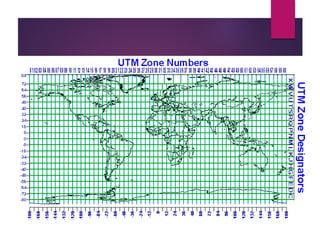
 There are also 20 longitudinal zones (8 degrees wide
except zone X, 12o wide) denoted by letters C to X
(Omitting letters I & O).
 The Polar Regions use the Universal Polar
Stereographic coordinate system.
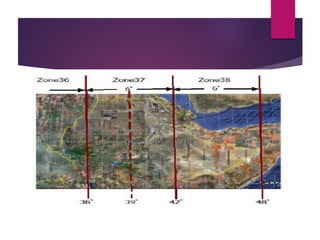
 Areas are referenced by quoting the longitudinal zone
number followed by the latitudinal zone letter or the
hemisphere e.g. points in Ethiopia, 37P, 37 N, 36P, 36N,
etc (37N, 36N using hemispheres
 What is a Datum?
 Every map projection and coordinate
system begins with a precisely surveyed
starting point
 The starting point and the network of
points that extends from it is called the
datum. e.g. for Adindan the starting
point is in Sudan referenced to Clarke
1880 ellipsoid/spheroid
 Using wrong datum can create an
error of up to 200 or 300m on your
map!
 Each datum has a name and often a
date associated with it. e.g. Adindan,
WGS 1984, etc
 Each datum has a name and often a date
associated with it. e.g. Adindan, WGS
1984, etc
 There are vertical and horizontal datum
usually available on maps. e.g.
Horizontal Datum: Adindan/ WGS 84
Vertical Datum: Mean Sea Level
 Projection: UTM

 Spatial Reference: Ethiopia
 1. DATUM = Adindan Ethiopia
 2. PROJECTION = TM Clark 1880
 3. COORDINATE SYSTEM = UTM
 4. MAP UNITS = meter
 a. False easting = 500, 000 m
 b. Central Meridian = 39o East
 c. Scale factor = 0.9996
 Easting & Northing
 Easting:
 UTM grid coordinates are always written or conveyed
with the easting data string appearing first, before the
northing data string
 By common convention, easting coordinates output
from GPs units are typically followed by the letter "E"
 Vertical lines are measured from a separate point for
each zone, namely, an imaginary line lying 500,000
meters west of the zone's central meridian

Cordinate system and map projection.pdf

  • 1.
    Coordinate system andmap projection prepared by Samuel Zewdu
  • 2.
    Presentation out line Projection Coordinatesystem Geographic coordinate system Projection coordinate system UTM and UTM Zones Easting & Northing What is a Datum?
  • 3.
     Projection: themethod by which the curved 3-D surface of the earth is represented by X,Y coordinates on a 2-D flat map/screen. Distortion is inevitable  Coordinate system  A coordinate system is a method of defining how a file’s point locations display on a map. Different types of coordinate systems exist that control how the coordinates are shown on the map. The two main are:
  • 4.
     Geographic CoordinateSystem  use of Geographic latitude and longitude system, usually in Degree, Minutes and Seconds (DMS)  Use spherical coordinates to specify locations on the surface of the earth  When vertical locations (Elevation) are not concerned, Latitude/longitude pair are used  Geographic coordinate systems are commonly called un projected lat/long
  • 5.
  • 7.
    Projection: the methodby which the curved 3-D surface of the earth is represented by X,Y coordinates on a 2-D flat map/screen. use of a known projection and datum. Linear cords (metres) are required in many occasions Distortions are inevitable with projection
  • 8.
     Projections PreserveSome  Earth Properties  ►Area - correct earth surface area (Albers  Equal Area) important for mass balances  ►Shape - local angles are shown correctly  (Lambert Conformal Conic)  ►Direction - all directions are shown  correctly relative to the center (Lambert  Azimuthal Equal Area)  ►Distance - preserved along particular lines  ►Some projections preserve two properties
  • 9.
    General rules forselecting a projection  Tropical Country—cylindrical projection Temperate Country—conical projection Polar Regions—Azimuthal projection
  • 14.
     UTM andUTM Zones Universal Transverse Mercator (UTM) System Developed in the late 1940s by the US Army the projection is the ‘Gauss-Kruger’ version of the Transverse Mercator- equidistant cylindrical projection
  • 15.
     Intended formapping areas : 840N – 800S  Unit of measure is meter  The world is divided into 60 zones of 60 of longitude in width (Fig. 2-4)  Zone 1 starts at 1800 W and Each zone has its own coordinate system  Universal Transverse Mercator (UTM) system is a specialized application of the Transverse Mercator projection.
  • 16.
     It isnot a single map projection. The globe is divided into 60 longitudinal zones (1-60), each spanning 6° of longitude or 6 degrees (800km) wide. Each zone has its own central meridian. Zones 1N and 1S start at 180° W  The limits of each zone are 84° N and 80° S, with the division between north and south zones occurring at the equator.
  • 17.
     There arealso 20 longitudinal zones (8 degrees wide except zone X, 12o wide) denoted by letters C to X (Omitting letters I & O).  The Polar Regions use the Universal Polar Stereographic coordinate system.  Areas are referenced by quoting the longitudinal zone number followed by the latitudinal zone letter or the hemisphere e.g. points in Ethiopia, 37P, 37 N, 36P, 36N, etc (37N, 36N using hemispheres
  • 20.
     What isa Datum?  Every map projection and coordinate system begins with a precisely surveyed starting point  The starting point and the network of points that extends from it is called the datum. e.g. for Adindan the starting point is in Sudan referenced to Clarke 1880 ellipsoid/spheroid
  • 21.
     Using wrongdatum can create an error of up to 200 or 300m on your map!  Each datum has a name and often a date associated with it. e.g. Adindan, WGS 1984, etc
  • 22.
     Each datumhas a name and often a date associated with it. e.g. Adindan, WGS 1984, etc  There are vertical and horizontal datum usually available on maps. e.g. Horizontal Datum: Adindan/ WGS 84 Vertical Datum: Mean Sea Level
  • 23.
     Projection: UTM  Spatial Reference: Ethiopia  1. DATUM = Adindan Ethiopia  2. PROJECTION = TM Clark 1880  3. COORDINATE SYSTEM = UTM  4. MAP UNITS = meter  a. False easting = 500, 000 m  b. Central Meridian = 39o East  c. Scale factor = 0.9996
  • 24.
     Easting &Northing  Easting:  UTM grid coordinates are always written or conveyed with the easting data string appearing first, before the northing data string  By common convention, easting coordinates output from GPs units are typically followed by the letter "E"  Vertical lines are measured from a separate point for each zone, namely, an imaginary line lying 500,000 meters west of the zone's central meridian