Device Isolation Techniques
Sudhanshu Janwadkar
TA, ECED, SVNIT
Objectives
• To understand what is device isolation
• To appreciate the need for device isolation in
micro-fabrication
• To study the various device isolation
techniques, and
• To identify merits and demerits of each
Device Isolation Techniques
• VLSI consists of several active and passive
components interconnected within a monolithic
block of semiconductor material. Each
component must be electrically isolated from
each other to allow design flexibility.
• In MOS, source-drain regions of adjacent MOS
transistors together with interconnection metal
lines may constitute parasitic MOS transistors
unless they are isolated from each other.
What is the need for Device Isolation?
4
Device Isolation is also necessary:
• To prevent undesired conducting paths;
• To avoid creation of inversion layers outside the
channels;
• To reduce leakage currents.
Device Isolation Techniques
What is the need for Device Isolation?
Device Isolation Techniques
• Junction Isolation Technique
• Dielectric Isolation Technique –
• Etched Field oxide Isolation
• LOCOS
• Trench Isolation Technique –
• STI
Junction Isolation Technique
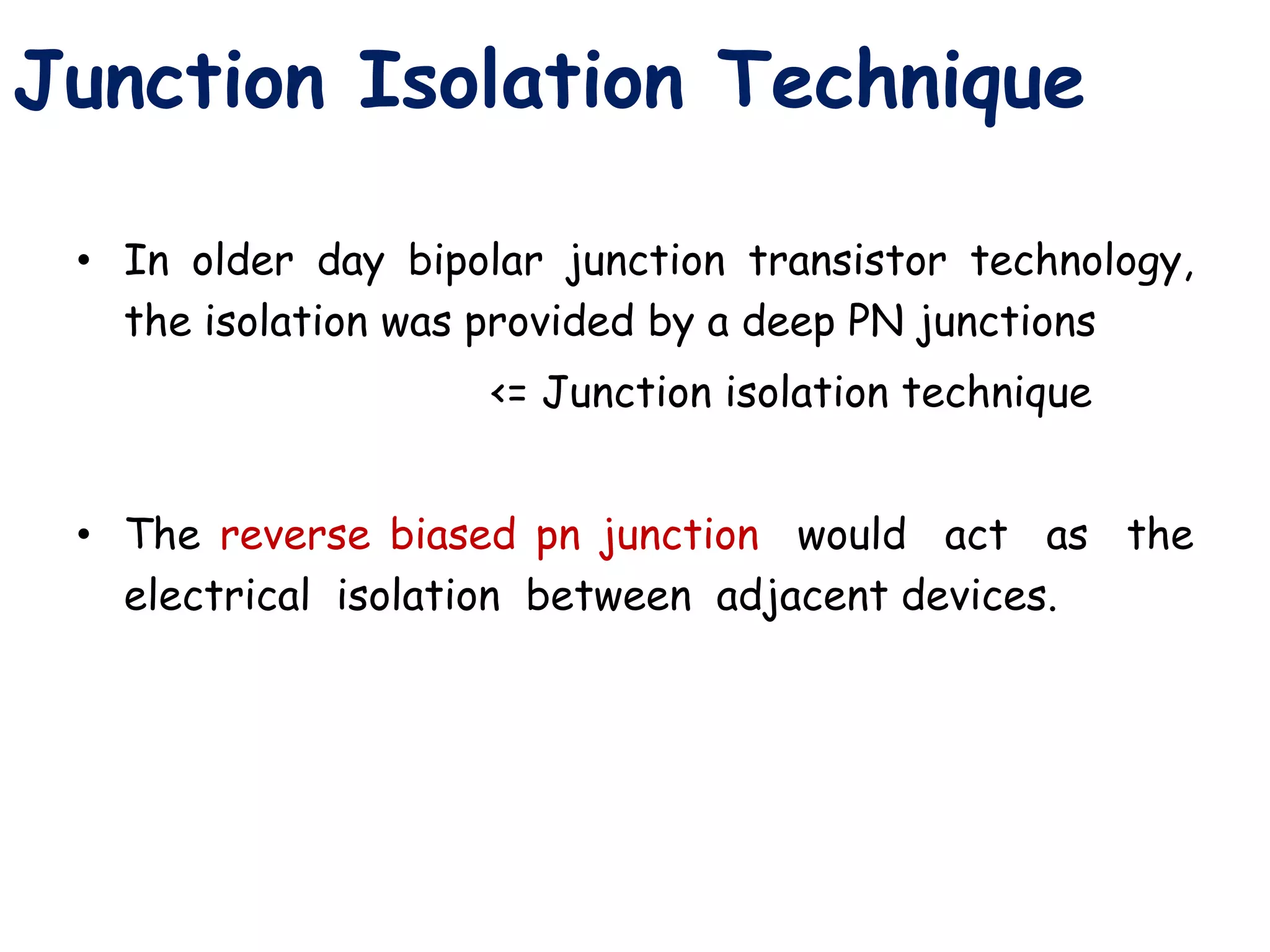
• In older day bipolar junction transistor technology,
the isolation was provided by a deep PN junctions
<= Junction isolation technique
• The reverse biased pn junction would act as the
electrical isolation between adjacent devices.
Junction Isolation Technique
Demerits:
• As the device dimensions were reduced and as we
wanted faster and faster devices, junction isolation
became non-viable technology, because :
• the diffusion will always have some lateral
spread; therefore, as the device dimensions
become smaller, it becomes more difficult to
control the isolation tub width and
• the capacitance associated with these
junctions, hinders the speed of the transistors
Dielectric Isolation Technique
• The most common dielectric, silicon dioxide is
used for isolation.
• Etched Field oxide Isolation
• LOCOS
Etched Field oxide Isolation
• Devices are created in dedicated regions
called active areas.
• Each active area is surrounded by thick oxide
barrier called field oxide.
• Thick oxide is grown on complete surface of
the chip and then selectively etched to define
active areas.
• Thickness of oxide leads to large oxide steps
at the boundaries of active areas and
isolation region.
LOCOS Technique
• LOCOS = local oxidation of Silicon
• Local oxidation that is oxidation is carried out
at some regions of the semiconductor; the
other regions are prevented from getting
oxidized by using a silicon nitride mask.
• Silicon nitride has an interesting behavior that it
does not allow oxidation to proceed
underneath. This has been used in LOCOS.
• The active region is protected by a depositing a layer
of silicon nitride -> Acts as oxide barrier
• Underneath, there is a layer of thin oxide called pad
oxide.
• Pad oxide is needed because otherwise silicon nitride
will not adhere very well to the silicon. There will be lot
of stress induced. By depositing the silicon nitride on
top of the pad oxide, the stress will be reduced.
LOCOS Technique
1
• The pattern transfer is performed by
photolithography. After lithography the
pattern is etched into the nitride.
• The active areas for the oxidation process
are thus defined
LOCOS Technique
2
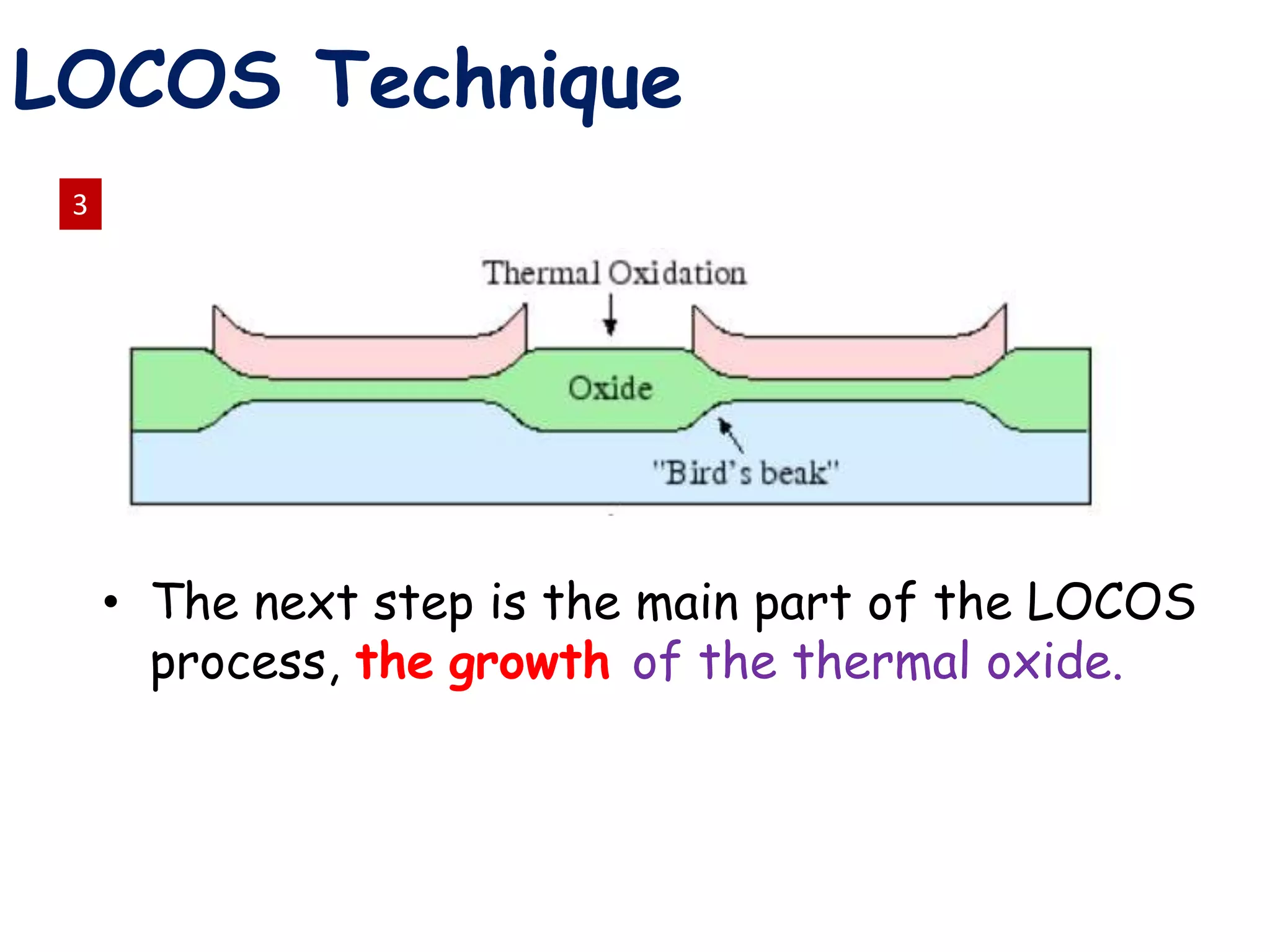
• The next step is the main part of the LOCOS
process, the growth of the thermal oxide.
3
LOCOS Technique
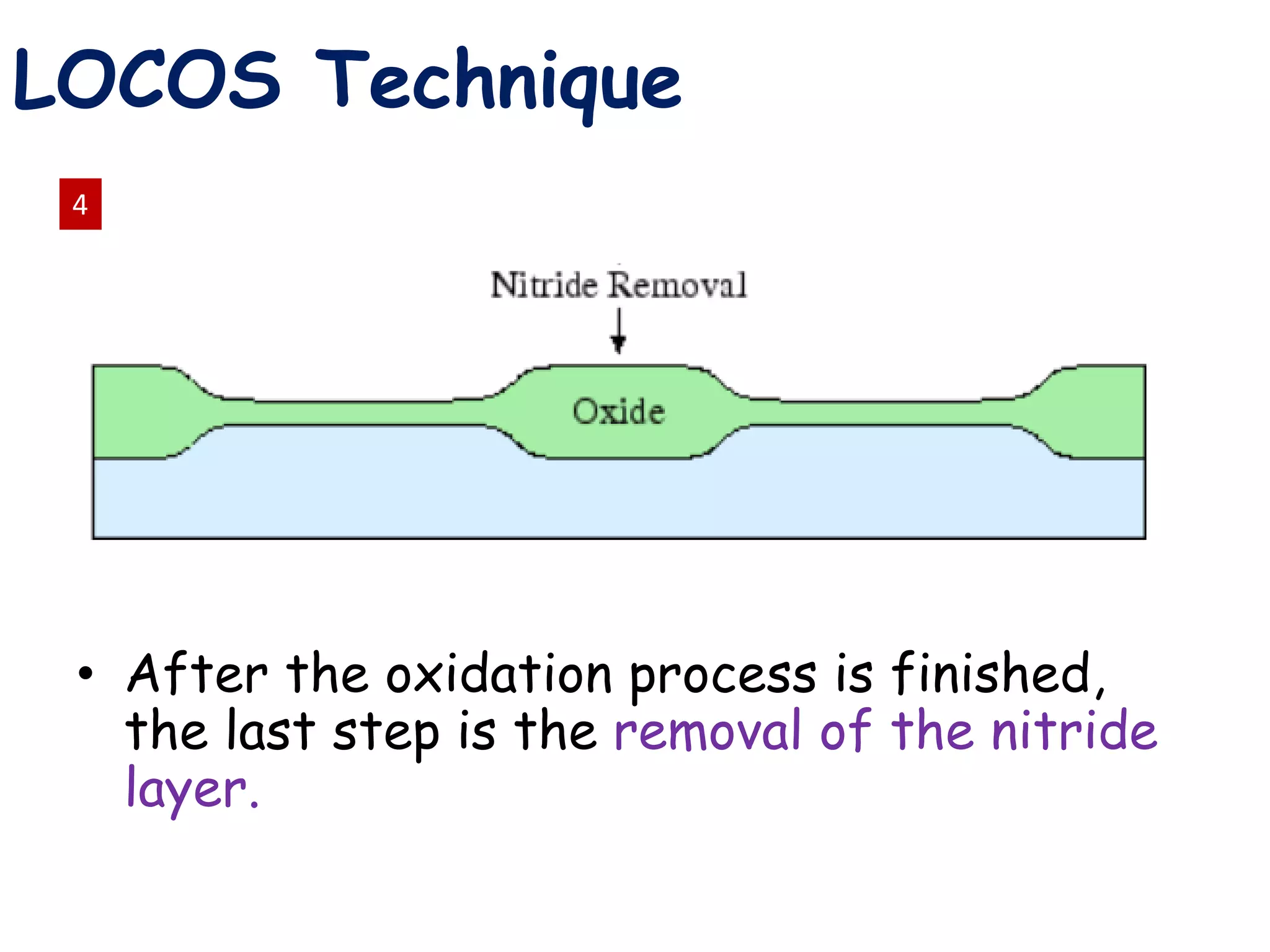
• After the oxidation process is finished,
the last step is the removal of the nitride
layer.
4
LOCOS Technique
The advantages of LOCOS fabrication are:
• the simple process flow and
• the high oxide quality, because the whole
LOCOS structure is thermally grown.
LOCOS Technique - Merits
• But, as the device dimensions went on becoming
smaller, the LOCOS technique also started to show
its limitation and what are these limitations?
• Bird’s Beak Problem
LOCOS Technique - Demerits
• There will be a little bit of encroachment of oxide
underneath silicon nitride.
• This is because oxidation is proceeding not merely in
the, on the horizontal surface, but also at the
vertical side walls.
• The slight encroachment under the silicon nitride is
shaped like a bird’s beak., hence this is called
bird's beak problem.
• As we reduce the device dimensions i.e If this
entire active transistor area itself is very small,
then even a small encroachment will be a considerable
percentage of the total active area.
LOCOS Technique - Demerits
Trench Isolation Technique
• In a trench isolation, A trench is cut in
the semiconductor and then the trench
is filled with non-conducting material.
• In shallow trench isolation, instead of
thermally growing oxide layer, the
silicon dioxide layer is deposited by
CVD.
Shallow Trench Isolation Technique
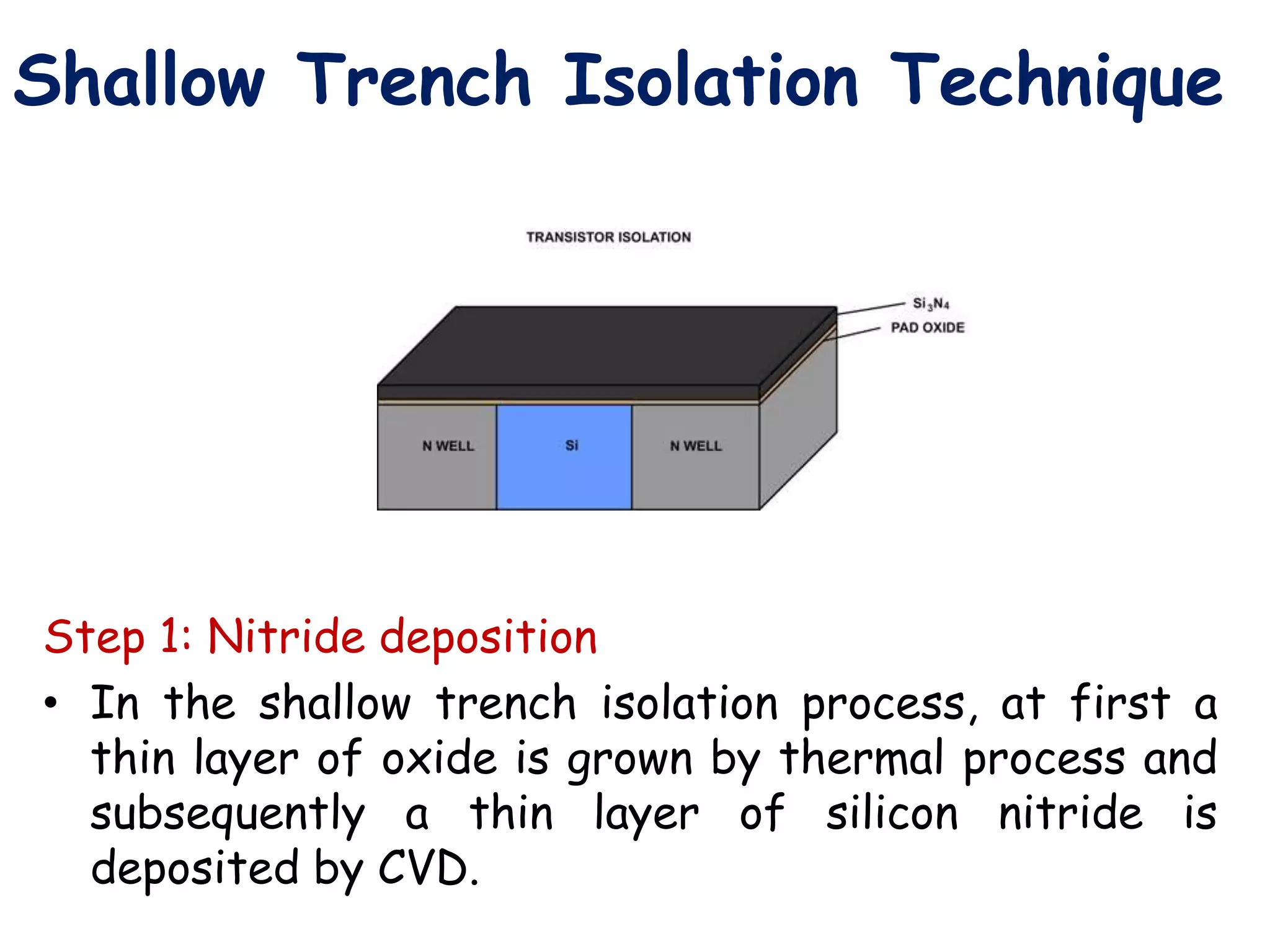
Step 1: Nitride deposition
• In the shallow trench isolation process, at first a
thin layer of oxide is grown by thermal process and
subsequently a thin layer of silicon nitride is
deposited by CVD.
Step 2. Create a Trench
• Using photo lithography and etching, wherever
electrical isolation is needed, a trench is made in
silicon (i.e. the silicon nitride, silicon dioxide and
then Si are removed by dry etching in those
areas).
Shallow Trench Isolation Technique
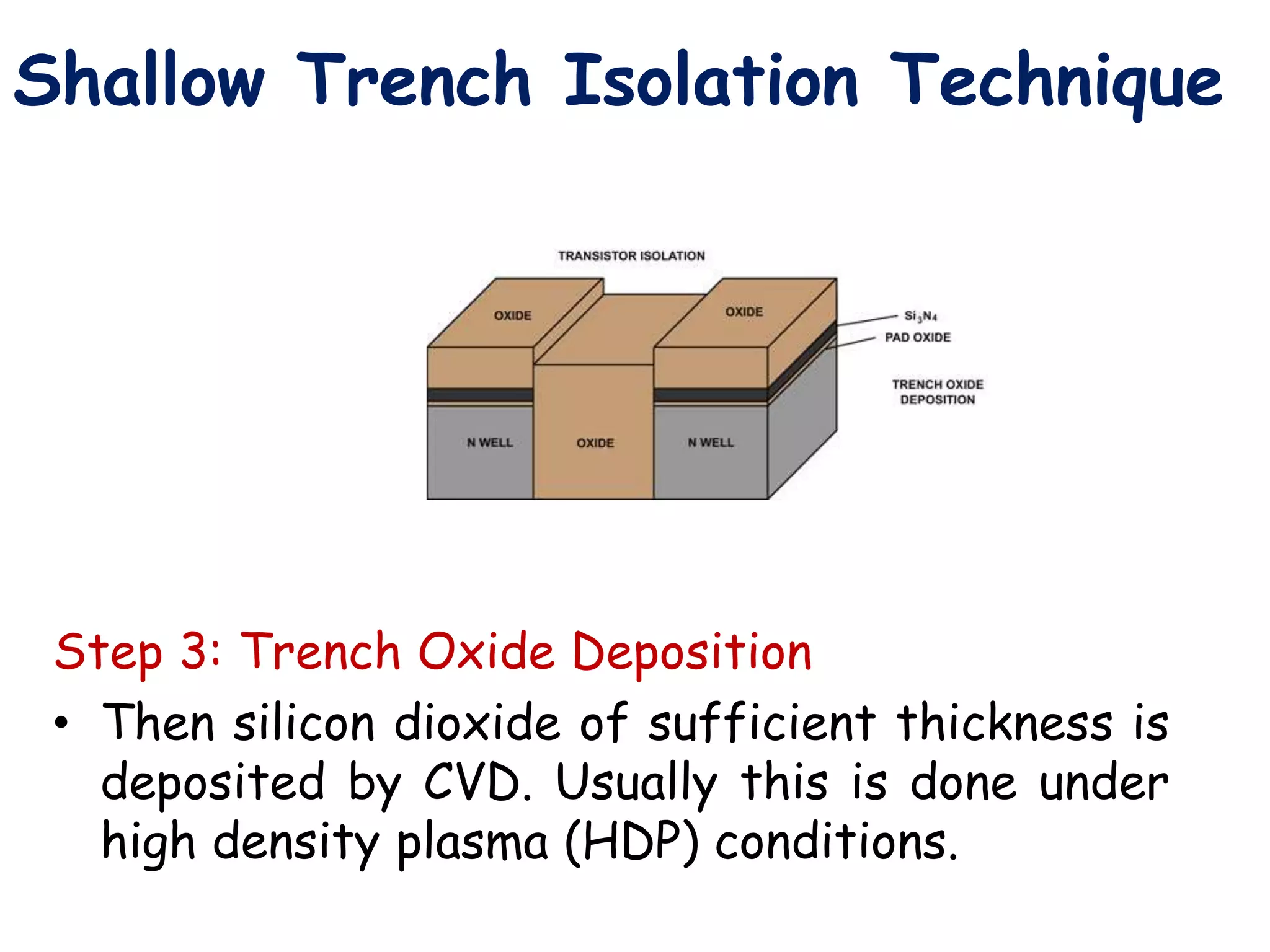
Step 3: Trench Oxide Deposition
• Then silicon dioxide of sufficient thickness is
deposited by CVD. Usually this is done under
high density plasma (HDP) conditions.
Shallow Trench Isolation Technique
Step 4: Chemical Mechanical Planarisation
• In the next step, the excess oxide is removed
by chemical mechanical planarization. Here,
care must be taken to ensure that only the
oxide is removed and the nitride is not
removed.
Shallow Trench Isolation Technique
Step 5:Nitride removal
• Then the nitride is removed by wet etching
using phosphoric acid.
Shallow Trench Isolation Technique

Device isolation Techniques

  • 1.
    Device Isolation Techniques SudhanshuJanwadkar TA, ECED, SVNIT
  • 2.
    Objectives • To understandwhat is device isolation • To appreciate the need for device isolation in micro-fabrication • To study the various device isolation techniques, and • To identify merits and demerits of each
  • 3.
    Device Isolation Techniques •VLSI consists of several active and passive components interconnected within a monolithic block of semiconductor material. Each component must be electrically isolated from each other to allow design flexibility. • In MOS, source-drain regions of adjacent MOS transistors together with interconnection metal lines may constitute parasitic MOS transistors unless they are isolated from each other. What is the need for Device Isolation?
  • 4.
    4 Device Isolation isalso necessary: • To prevent undesired conducting paths; • To avoid creation of inversion layers outside the channels; • To reduce leakage currents. Device Isolation Techniques What is the need for Device Isolation?
  • 5.
    Device Isolation Techniques •Junction Isolation Technique • Dielectric Isolation Technique – • Etched Field oxide Isolation • LOCOS • Trench Isolation Technique – • STI
  • 6.
    Junction Isolation Technique •In older day bipolar junction transistor technology, the isolation was provided by a deep PN junctions <= Junction isolation technique • The reverse biased pn junction would act as the electrical isolation between adjacent devices.
  • 7.
    Junction Isolation Technique Demerits: •As the device dimensions were reduced and as we wanted faster and faster devices, junction isolation became non-viable technology, because : • the diffusion will always have some lateral spread; therefore, as the device dimensions become smaller, it becomes more difficult to control the isolation tub width and • the capacitance associated with these junctions, hinders the speed of the transistors
  • 8.
    Dielectric Isolation Technique •The most common dielectric, silicon dioxide is used for isolation. • Etched Field oxide Isolation • LOCOS
  • 9.
    Etched Field oxideIsolation • Devices are created in dedicated regions called active areas. • Each active area is surrounded by thick oxide barrier called field oxide. • Thick oxide is grown on complete surface of the chip and then selectively etched to define active areas. • Thickness of oxide leads to large oxide steps at the boundaries of active areas and isolation region.
  • 10.
    LOCOS Technique • LOCOS= local oxidation of Silicon • Local oxidation that is oxidation is carried out at some regions of the semiconductor; the other regions are prevented from getting oxidized by using a silicon nitride mask. • Silicon nitride has an interesting behavior that it does not allow oxidation to proceed underneath. This has been used in LOCOS.
  • 11.
    • The activeregion is protected by a depositing a layer of silicon nitride -> Acts as oxide barrier • Underneath, there is a layer of thin oxide called pad oxide. • Pad oxide is needed because otherwise silicon nitride will not adhere very well to the silicon. There will be lot of stress induced. By depositing the silicon nitride on top of the pad oxide, the stress will be reduced. LOCOS Technique 1
  • 12.
    • The patterntransfer is performed by photolithography. After lithography the pattern is etched into the nitride. • The active areas for the oxidation process are thus defined LOCOS Technique 2
  • 13.
    • The nextstep is the main part of the LOCOS process, the growth of the thermal oxide. 3 LOCOS Technique
  • 14.
    • After theoxidation process is finished, the last step is the removal of the nitride layer. 4 LOCOS Technique
  • 15.
    The advantages ofLOCOS fabrication are: • the simple process flow and • the high oxide quality, because the whole LOCOS structure is thermally grown. LOCOS Technique - Merits
  • 16.
    • But, asthe device dimensions went on becoming smaller, the LOCOS technique also started to show its limitation and what are these limitations? • Bird’s Beak Problem LOCOS Technique - Demerits
  • 17.
    • There willbe a little bit of encroachment of oxide underneath silicon nitride. • This is because oxidation is proceeding not merely in the, on the horizontal surface, but also at the vertical side walls. • The slight encroachment under the silicon nitride is shaped like a bird’s beak., hence this is called bird's beak problem. • As we reduce the device dimensions i.e If this entire active transistor area itself is very small, then even a small encroachment will be a considerable percentage of the total active area. LOCOS Technique - Demerits
  • 18.
    Trench Isolation Technique •In a trench isolation, A trench is cut in the semiconductor and then the trench is filled with non-conducting material. • In shallow trench isolation, instead of thermally growing oxide layer, the silicon dioxide layer is deposited by CVD.
  • 19.
    Shallow Trench IsolationTechnique Step 1: Nitride deposition • In the shallow trench isolation process, at first a thin layer of oxide is grown by thermal process and subsequently a thin layer of silicon nitride is deposited by CVD.
  • 20.
    Step 2. Createa Trench • Using photo lithography and etching, wherever electrical isolation is needed, a trench is made in silicon (i.e. the silicon nitride, silicon dioxide and then Si are removed by dry etching in those areas). Shallow Trench Isolation Technique
  • 21.
    Step 3: TrenchOxide Deposition • Then silicon dioxide of sufficient thickness is deposited by CVD. Usually this is done under high density plasma (HDP) conditions. Shallow Trench Isolation Technique
  • 22.
    Step 4: ChemicalMechanical Planarisation • In the next step, the excess oxide is removed by chemical mechanical planarization. Here, care must be taken to ensure that only the oxide is removed and the nitride is not removed. Shallow Trench Isolation Technique
  • 23.
    Step 5:Nitride removal •Then the nitride is removed by wet etching using phosphoric acid. Shallow Trench Isolation Technique
  • 24.