TOPIC: SCORING RUBRICS AND RATING SCALES
PRESENTER: PARKASH MAL
ROLL NO: 2K16/BEDEL/39
DEPARTMENT: B.ED ELEMENTARY (HONS)
SUBJECT: CLASS LROOM ASSESSMENT
SUBMITTED TO: DR. AMJAD ALI ARAIN
UNIVERSITY OF SINDH
FACULTY OF EDUCATION
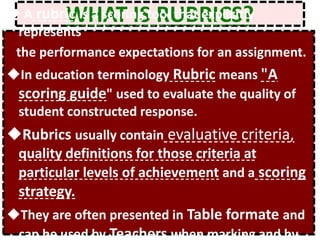
WHAT IS RUBRICS? A rubric is a scoring tool that explicitly
represents
the performance expectations for an assignment.
In education terminology Rubric means "A
scoring guide" used to evaluate the quality of
student constructed response.
Rubrics usually contain evaluative criteria,
quality definitions for those criteria at
particular levels of achievement and a scoring
strategy.
They are often presented in Table formate and
can be used by Teachers when marking and by
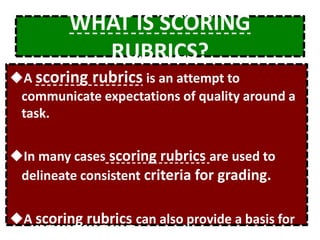
WHAT IS SCORING
RUBRICS?
A scoring rubrics is an attempt to
communicate expectations of quality around a
task.
In many cases scoring rubrics are used to
delineate consistent criteria for grading.
A scoring rubrics can also provide a basis for
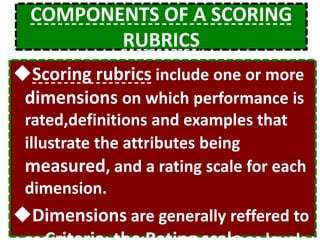
COMPONENTS OF A SCORING
RUBRICS
Scoring rubrics include one or more
dimensions on which performance is
rated,definitions and examples that
illustrate the attributes being
measured, and a rating scale for each
dimension.
Dimensions are generally reffered to
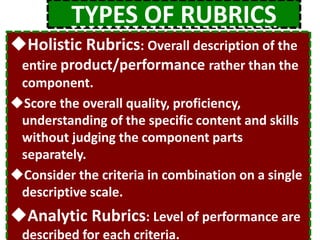
TYPES OF RUBRICS
Holistic Rubrics: Overall description of the
entire product/performance rather than the
component.
Score the overall quality, proficiency,
understanding of the specific content and skills
without judging the component parts
separately.
Consider the criteria in combination on a single
descriptive scale.
Analytic Rubrics: Level of performance are
described for each criteria.
Give feedback to students regarding
how to improve their performance.
Provide description at each level of
performance regarding: what is
expected for each criteria.
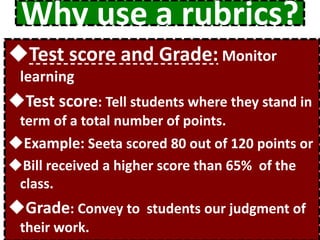
Why use a rubrics?
Test score and Grade: Monitor
learning
Test score: Tell students where they stand in
term of a total number of points.
Example: Seeta scored 80 out of 120 points or
Bill received a higher score than 65% of the
class.
Grade: Convey to students our judgment of
their work.
RUBRICS: Promote Learning
Rubrics reveal how students' work
compares to a standard
Provide students a clear
understanding of expectation
Communicate specific and
immediate feedback
Help students to become self-
reliant,self-directed,and self-assessing
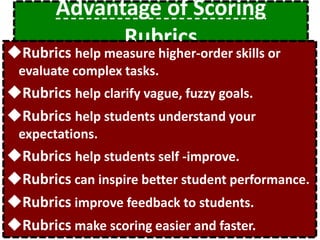
Advantage of Scoring
Rubrics
Rubrics help measure higher-order skills or
evaluate complex tasks.
Rubrics help clarify vague, fuzzy goals.
Rubrics help students understand your
expectations.
Rubrics help students self -improve.
Rubrics can inspire better student performance.
Rubrics improve feedback to students.
Rubrics make scoring easier and faster.
Rubrics can be used to
assess:
essays/papers
Projects
Lab work
Presentations
Exam questions
Exhibits
Performances
Portfolios of student work
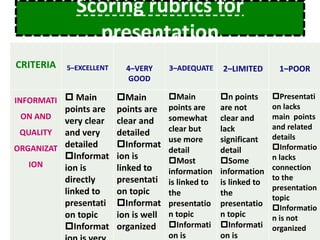
CRITERIA 5–EXCELLENT 4–VERY
GOOD
3–ADEQUATE 2–LIMITED 1–POOR
INFORMATI
ON AND
QUALITY
ORGANIZAT
ION
 Main
points are
very clear
and very
detailed
Informat
ion is
directly
linked to
presentati
on topic
Informat
Main
points are
clear and
detailed
Informat
ion is
linked to
presentati
on topic
Informat
ion is well
organized
Main
points are
somewhat
clear but
use more
detail
Most
information
is linked to
the
presentatio
n topic
Informati
on is
n points
are not
clear and
lack
significant
detail
Some
information
is linked to
the
presentatio
n topic
Informati
on is
Presentati
on lacks
main points
and related
details
Informatio
n lacks
connection
to the
presentation
topic
Informatio
n is not
organized
Scoring rubrics for
presentation
NONVERBA
LCOMMUN
ICATION
 speaker
spears very
comfortable
and
confident
Speaker
consistently
faces the
audience
and and
maintenance
good eye
contact
Speaker
consistently
appears to
enjudgien
with the
audience
Speaker
uses body
motions and
gestures
Speaker
appears
fairly
comfortable
and
confident
Speaker
generally
faces the
audience
and
maintenance
good eye
contact
Speaker
generally
appears to
be engaging
with the
audience
Speaker
uses body
motions and
Speaker
appears
generally at
ease and
confident
Speaker
sometimes
faces the
audience and
maintains eye
contact
Speaker
sometimes
appears to be
engaging with
the audience
Speaker's
body motions
and gestures
neither
support nor
detract from
presentation
Speaker
appears
uneasy and
somewhat
insecure
Speaker
rarely faces
the audience
are makes
eye contact
Speaker
rarely
appears to be
engaging with
the audience
Speaker
uses few
body motions
or gestures or
has gestures
or
movements
that distract
the audience
Speaker
appears very
uneasy and
insecure
Speaker
faces away
from the
audience or
makes no eye
contact
Speaker
appears
disengaging
from the
audience
Speaker
lacks any
body motions
or gestures or
demonstrates
( consistently
distraction
body motions
or gesture
QUALITY
VERBAL
COMMUNI
CATION
Speakers
voice is very
confident
steady
strong and
clear
Speakers
talking pace
is
consistently
appropriate
Speakers
voice is
steady
strong and
clear
Speakers
talking pace
is mostly
appreciate
Speakers
voice is
generally
steady
strong and
clear
Speakers
talking pace
is appreciate
Speakers
voice is
frequently
too weak or
too strong
Speakers
talking pace
is often too
slow or too
fast
Speakers
voice is
consistently
too weak or
too strong
Speakers
talking pace
is
consistently
to slow or
too fast
VISUAL
TOOLS
Visual
aids are
very
creative,
clear and
easy to read
Presentati
on is
consistently
enhanced
by the
visual
aids are
usually
creative
,clear and
easy to
read
Presentat
ion is often
enhanced
Visual aids
are
reasonably
creative, clear
and easy to
read
Presentatio
n is
sometimes
enhanced by
the visual
tools
Visual aids
have limited
creativity or
clarity or are
sometimes
difficult to
read
Presentatio
n is not
enhanced by
the visual
tools
Visual aids
demodemons
trate no
creativity or
clarity and or
often difficult
to read
Presentatio
n is
weakened by
the visual
tools
APPROPRIA
TE USE OF
VOCABULA
RY
All
terms are
include in
the
presentati
on
Used in
unique
and
creative
ways
Used in
context
All
terms are
include in
the
presentati
on
Used
effectively
Used in
context
Most
terms are
included in
the
presentatio
n
Generally
used
appropriate
ly
Generally
used in
appropriate
context
Several
terms are
included in
the
presentatio
n
May or
may not be
used
appropriate
ly
May lack
context
Few or
no terms
are
included
in the
presentati
on
May or
may not
be used
appropriat
ely
Lacks
context
OVERALL
PRESENTATI
ON
EFFECTIVEN
This was
an
exceptional
presentatio
n and
extremely
This was
a very good
presentatio
n and very
effective
I'd give
This
presentati
on was
good and
effective
I'd give
This
presentatio
n was
average and
somewhat
effective
This
presentatio
n was weak
and not
effective
I'd give
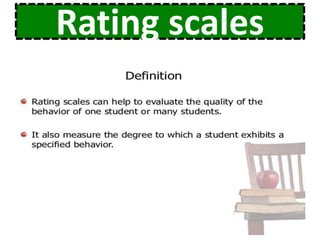
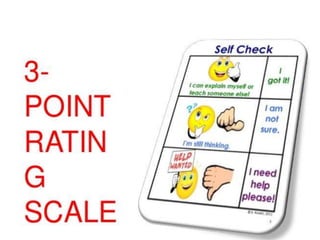
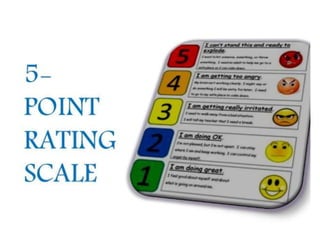
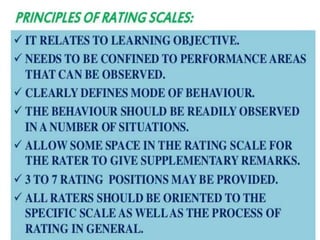
Rating scales
Scoring Rubrics and Rating Scale

Scoring Rubrics and Rating Scale

  • 2.
    TOPIC: SCORING RUBRICSAND RATING SCALES PRESENTER: PARKASH MAL ROLL NO: 2K16/BEDEL/39 DEPARTMENT: B.ED ELEMENTARY (HONS) SUBJECT: CLASS LROOM ASSESSMENT SUBMITTED TO: DR. AMJAD ALI ARAIN UNIVERSITY OF SINDH FACULTY OF EDUCATION
  • 3.
    WHAT IS RUBRICS?A rubric is a scoring tool that explicitly represents the performance expectations for an assignment. In education terminology Rubric means "A scoring guide" used to evaluate the quality of student constructed response. Rubrics usually contain evaluative criteria, quality definitions for those criteria at particular levels of achievement and a scoring strategy. They are often presented in Table formate and can be used by Teachers when marking and by
  • 4.
    WHAT IS SCORING RUBRICS? Ascoring rubrics is an attempt to communicate expectations of quality around a task. In many cases scoring rubrics are used to delineate consistent criteria for grading. A scoring rubrics can also provide a basis for
  • 5.
    COMPONENTS OF ASCORING RUBRICS Scoring rubrics include one or more dimensions on which performance is rated,definitions and examples that illustrate the attributes being measured, and a rating scale for each dimension. Dimensions are generally reffered to
  • 6.
    TYPES OF RUBRICS HolisticRubrics: Overall description of the entire product/performance rather than the component. Score the overall quality, proficiency, understanding of the specific content and skills without judging the component parts separately. Consider the criteria in combination on a single descriptive scale. Analytic Rubrics: Level of performance are described for each criteria.
  • 7.
    Give feedback tostudents regarding how to improve their performance. Provide description at each level of performance regarding: what is expected for each criteria.
  • 8.
    Why use arubrics? Test score and Grade: Monitor learning Test score: Tell students where they stand in term of a total number of points. Example: Seeta scored 80 out of 120 points or Bill received a higher score than 65% of the class. Grade: Convey to students our judgment of their work.
  • 9.
    RUBRICS: Promote Learning Rubricsreveal how students' work compares to a standard Provide students a clear understanding of expectation Communicate specific and immediate feedback Help students to become self- reliant,self-directed,and self-assessing
  • 10.
    Advantage of Scoring Rubrics Rubricshelp measure higher-order skills or evaluate complex tasks. Rubrics help clarify vague, fuzzy goals. Rubrics help students understand your expectations. Rubrics help students self -improve. Rubrics can inspire better student performance. Rubrics improve feedback to students. Rubrics make scoring easier and faster.
  • 11.
    Rubrics can beused to assess: essays/papers Projects Lab work Presentations Exam questions Exhibits Performances Portfolios of student work
  • 12.
    CRITERIA 5–EXCELLENT 4–VERY GOOD 3–ADEQUATE2–LIMITED 1–POOR INFORMATI ON AND QUALITY ORGANIZAT ION  Main points are very clear and very detailed Informat ion is directly linked to presentati on topic Informat Main points are clear and detailed Informat ion is linked to presentati on topic Informat ion is well organized Main points are somewhat clear but use more detail Most information is linked to the presentatio n topic Informati on is n points are not clear and lack significant detail Some information is linked to the presentatio n topic Informati on is Presentati on lacks main points and related details Informatio n lacks connection to the presentation topic Informatio n is not organized Scoring rubrics for presentation
  • 13.
    NONVERBA LCOMMUN ICATION  speaker spears very comfortable and confident Speaker consistently facesthe audience and and maintenance good eye contact Speaker consistently appears to enjudgien with the audience Speaker uses body motions and gestures Speaker appears fairly comfortable and confident Speaker generally faces the audience and maintenance good eye contact Speaker generally appears to be engaging with the audience Speaker uses body motions and Speaker appears generally at ease and confident Speaker sometimes faces the audience and maintains eye contact Speaker sometimes appears to be engaging with the audience Speaker's body motions and gestures neither support nor detract from presentation Speaker appears uneasy and somewhat insecure Speaker rarely faces the audience are makes eye contact Speaker rarely appears to be engaging with the audience Speaker uses few body motions or gestures or has gestures or movements that distract the audience Speaker appears very uneasy and insecure Speaker faces away from the audience or makes no eye contact Speaker appears disengaging from the audience Speaker lacks any body motions or gestures or demonstrates ( consistently distraction body motions or gesture
  • 14.
    QUALITY VERBAL COMMUNI CATION Speakers voice is very confident steady strongand clear Speakers talking pace is consistently appropriate Speakers voice is steady strong and clear Speakers talking pace is mostly appreciate Speakers voice is generally steady strong and clear Speakers talking pace is appreciate Speakers voice is frequently too weak or too strong Speakers talking pace is often too slow or too fast Speakers voice is consistently too weak or too strong Speakers talking pace is consistently to slow or too fast VISUAL TOOLS Visual aids are very creative, clear and easy to read Presentati on is consistently enhanced by the visual aids are usually creative ,clear and easy to read Presentat ion is often enhanced Visual aids are reasonably creative, clear and easy to read Presentatio n is sometimes enhanced by the visual tools Visual aids have limited creativity or clarity or are sometimes difficult to read Presentatio n is not enhanced by the visual tools Visual aids demodemons trate no creativity or clarity and or often difficult to read Presentatio n is weakened by the visual tools
  • 15.
    APPROPRIA TE USE OF VOCABULA RY All termsare include in the presentati on Used in unique and creative ways Used in context All terms are include in the presentati on Used effectively Used in context Most terms are included in the presentatio n Generally used appropriate ly Generally used in appropriate context Several terms are included in the presentatio n May or may not be used appropriate ly May lack context Few or no terms are included in the presentati on May or may not be used appropriat ely Lacks context OVERALL PRESENTATI ON EFFECTIVEN This was an exceptional presentatio n and extremely This was a very good presentatio n and very effective I'd give This presentati on was good and effective I'd give This presentatio n was average and somewhat effective This presentatio n was weak and not effective I'd give
  • 16.