Assessment in Learning 2:
Authentic Assessment
Learning Outcomes:
At the end of the Chapter, the student
should be able to:
 Explain what the scoring rubric is;
 Cite the parts of a scoring rubric;
 Distinguish between holistic and analytic
rubrics and between general and task-
specific rubric; and
 Cite the importance of the scoring rubric;
MEANING OF SCORING RUBRIC
A scoring rubric is “a coherent set of criteria for
students’ work that includes descriptions of levels of
performance quality on the criteria.” (Brookhart,
2013).
Mc Millan (2007) defines scoring rubric as a “scoring
guide that uses criteria to differentiate between levels
of student proficiency.”
Popham (2011) describes scoring rubrics as the
“scoring procedures for judging students’ responses to
performance tests.”
MEANING OF SCORING RUBRIC
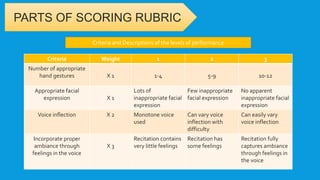
PARTS OF SCORING RUBRIC
Criteria Weight 1 2 3
Number of appropriate
hand gestures X 1 1-4 5-9 10-12
Appropriate facial
expression X 1
Lots of
inappropriate facial
expression
Few inappropriate
facial expression
No apparent
inappropriate facial
expression
Voice inflection X 2 Monotone voice
used
Can vary voice
inflection with
difficulty
Can easily vary
voice inflection
Incorporate proper
ambiance through
feelings in the voice
X 3
Recitation contains
very little feelings
Recitation has
some feelings
Recitation fully
captures ambiance
through feelings in
the voice
Criteria and Descriptions of the levels of performance
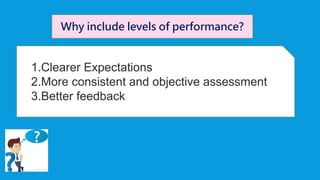
Why include levels of performance?
1.Clearer Expectations
2.More consistent and objective assessment
3.Better feedback
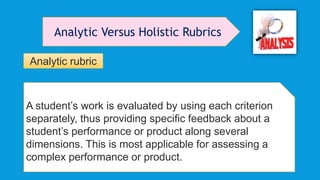
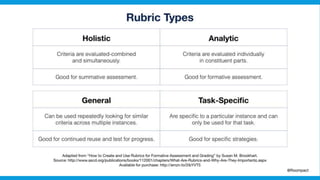
Analytic Versus Holistic Rubrics
Analytic rubric
A student’s work is evaluated by using each criterion
separately, thus providing specific feedback about a
student’s performance or product along several
dimensions. This is most applicable for assessing a
complex performance or product.
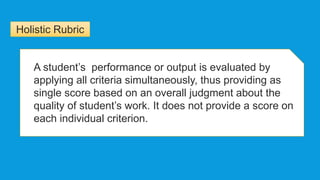
Holistic Rubric
A student’s performance or output is evaluated by
applying all criteria simultaneously, thus providing as
single score based on an overall judgment about the
quality of student’s work. It does not provide a score on
each individual criterion.
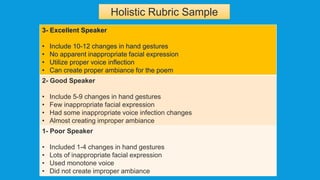
3- Excellent Speaker
• Include 10-12 changes in hand gestures
• No apparent inappropriate facial expression
• Utilize proper voice inflection
• Can create proper ambiance for the poem
2- Good Speaker
• Include 5-9 changes in hand gestures
• Few inappropriate facial expression
• Had some inappropriate voice infection changes
• Almost creating improper ambiance
1- Poor Speaker
• Included 1-4 changes in hand gestures
• Lots of inappropriate facial expression
• Used monotone voice
• Did not create improper ambiance
Holistic Rubric Sample
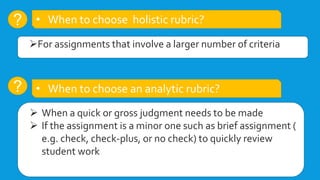
?
For assignments that involve a larger number of criteria
• When to choose holistic rubric?
• When to choose an analytic rubric?
?
 When a quick or gross judgment needs to be made
 If the assignment is a minor one such as brief assignment (
e.g. check, check-plus, or no check) to quickly review
student work
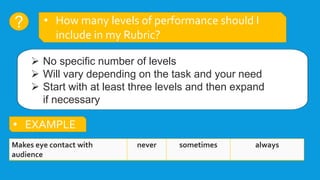
• How many levels of performance should I
include in my Rubric?
?
 No specific number of levels
 Will vary depending on the task and your need
 Start with at least three levels and then expand
if necessary
• EXAMPLE
Makes eye contact with
audience
never sometimes always
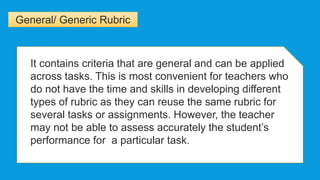
General/ Generic Rubric
It contains criteria that are general and can be applied
across tasks. This is most convenient for teachers who
do not have the time and skills in developing different
types of rubric as they can reuse the same rubric for
several tasks or assignments. However, the teacher
may not be able to assess accurately the student’s
performance for a particular task.
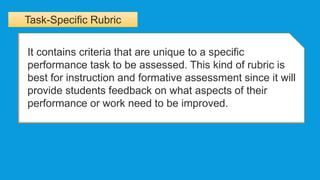
Task-Specific Rubric
It contains criteria that are unique to a specific
performance task to be assessed. This kind of rubric is
best for instruction and formative assessment since it will
provide students feedback on what aspects of their
performance or work need to be improved.
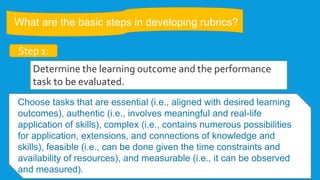
What are the basic steps in developing rubrics?
Step 1:
Determine the learning outcome and the performance
task to be evaluated.
Choose tasks that are essential (i.e., aligned with desired learning
outcomes), authentic (i.e., involves meaningful and real-life
application of skills), complex (i.e., contains numerous possibilities
for application, extensions, and connections of knowledge and
skills), feasible (i.e., can be done given the time constraints and
availability of resources), and measurable (i.e., it can be observed
and measured).
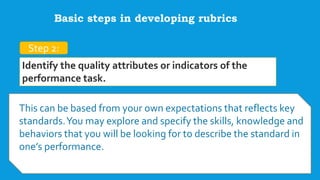
Step 2:
Identify the quality attributes or indicators of the
performance task.
This can be based from your own expectations that reflects key
standards.You may explore and specify the skills, knowledge and
behaviors that you will be looking for to describe the standard in
one’s performance.
Basic steps in developing rubrics
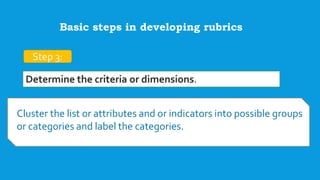
Step 3:
Determine the criteria or dimensions.
Cluster the list or attributes and or indicators into possible groups
or categories and label the categories.
Basic steps in developing rubrics
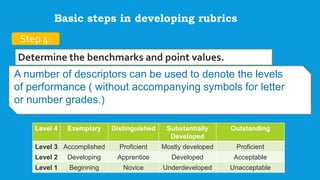
Step 4:
Determine the benchmarks and point values.
A number of descriptors can be used to denote the levels
of performance ( without accompanying symbols for letter
or number grades.)
Level 4 Exemplary Distinguished Substantially
Developed
Outstanding
Level 3 Accomplished Proficient Mostly developed Proficient
Level 2 Developing Apprentice Developed Acceptable
Level 1 Beginning Novice Underdeveloped Unacceptable
Basic steps in developing rubrics
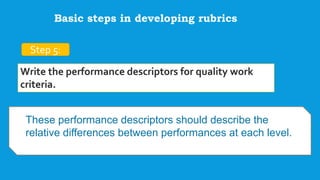
Step 5:
Write the performance descriptors for quality work
criteria.
These performance descriptors should describe the
relative differences between performances at each level.
Basic steps in developing rubrics
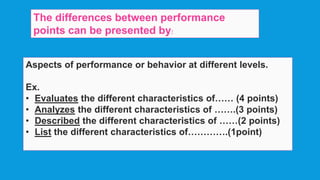
The differences between performance
points can be presented by:
Aspects of performance or behavior at different levels.
Ex.
• Evaluates the different characteristics of…… (4 points)
• Analyzes the different characteristics of …….(3 points)
• Described the different characteristics of ……(2 points)
• List the different characteristics of………….(1point)
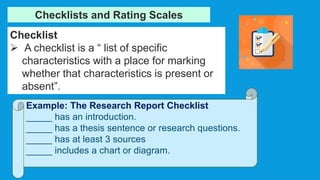
Checklists and Rating Scales
Checklist
 A checklist is a “ list of specific
characteristics with a place for marking
whether that characteristics is present or
absent”.
Example: The Research Report Checklist
_____ has an introduction.
_____ has a thesis sentence or research questions.
_____ has at least 3 sources
_____ includes a chart or diagram.
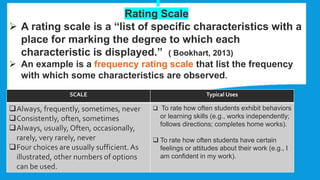
Rating Scale
 A rating scale is a “list of specific characteristics with a
place for marking the degree to which each
characteristic is displayed.” ( Bookhart, 2013)
 An example is a frequency rating scale that list the frequency
with which some characteristics are observed.
SCALE Typical Uses
Always, frequently, sometimes, never
Consistently, often, sometimes
Always, usually, Often, occasionally,
rarely, very rarely, never
Four choices are usually sufficient. As
illustrated, other numbers of options
can be used.
 To rate how often students exhibit behaviors
or learning skills (e.g., works independently;
follows directions; completes home works).
 To rate how often students have certain
feelings or attitudes about their work (e.g., I
am confident in my work).
GROUP 5 REPORTERS:
Arenga, Ronald
Araquil, Dennisse Nicole
Araquil, Princess Joy

Assessment-in-Learning.pptx.............

  • 1.
    Assessment in Learning2: Authentic Assessment
  • 2.
    Learning Outcomes: At theend of the Chapter, the student should be able to:  Explain what the scoring rubric is;  Cite the parts of a scoring rubric;  Distinguish between holistic and analytic rubrics and between general and task- specific rubric; and  Cite the importance of the scoring rubric;
  • 3.
    MEANING OF SCORINGRUBRIC A scoring rubric is “a coherent set of criteria for students’ work that includes descriptions of levels of performance quality on the criteria.” (Brookhart, 2013). Mc Millan (2007) defines scoring rubric as a “scoring guide that uses criteria to differentiate between levels of student proficiency.”
  • 4.
    Popham (2011) describesscoring rubrics as the “scoring procedures for judging students’ responses to performance tests.” MEANING OF SCORING RUBRIC
  • 5.
    PARTS OF SCORINGRUBRIC Criteria Weight 1 2 3 Number of appropriate hand gestures X 1 1-4 5-9 10-12 Appropriate facial expression X 1 Lots of inappropriate facial expression Few inappropriate facial expression No apparent inappropriate facial expression Voice inflection X 2 Monotone voice used Can vary voice inflection with difficulty Can easily vary voice inflection Incorporate proper ambiance through feelings in the voice X 3 Recitation contains very little feelings Recitation has some feelings Recitation fully captures ambiance through feelings in the voice Criteria and Descriptions of the levels of performance
  • 6.
    Why include levelsof performance? 1.Clearer Expectations 2.More consistent and objective assessment 3.Better feedback
  • 7.
    Analytic Versus HolisticRubrics Analytic rubric A student’s work is evaluated by using each criterion separately, thus providing specific feedback about a student’s performance or product along several dimensions. This is most applicable for assessing a complex performance or product.
  • 8.
    Holistic Rubric A student’sperformance or output is evaluated by applying all criteria simultaneously, thus providing as single score based on an overall judgment about the quality of student’s work. It does not provide a score on each individual criterion.
  • 9.
    3- Excellent Speaker •Include 10-12 changes in hand gestures • No apparent inappropriate facial expression • Utilize proper voice inflection • Can create proper ambiance for the poem 2- Good Speaker • Include 5-9 changes in hand gestures • Few inappropriate facial expression • Had some inappropriate voice infection changes • Almost creating improper ambiance 1- Poor Speaker • Included 1-4 changes in hand gestures • Lots of inappropriate facial expression • Used monotone voice • Did not create improper ambiance Holistic Rubric Sample
  • 10.
    ? For assignments thatinvolve a larger number of criteria • When to choose holistic rubric? • When to choose an analytic rubric? ?  When a quick or gross judgment needs to be made  If the assignment is a minor one such as brief assignment ( e.g. check, check-plus, or no check) to quickly review student work
  • 11.
    • How manylevels of performance should I include in my Rubric? ?  No specific number of levels  Will vary depending on the task and your need  Start with at least three levels and then expand if necessary • EXAMPLE Makes eye contact with audience never sometimes always
  • 12.
    General/ Generic Rubric Itcontains criteria that are general and can be applied across tasks. This is most convenient for teachers who do not have the time and skills in developing different types of rubric as they can reuse the same rubric for several tasks or assignments. However, the teacher may not be able to assess accurately the student’s performance for a particular task.
  • 13.
    Task-Specific Rubric It containscriteria that are unique to a specific performance task to be assessed. This kind of rubric is best for instruction and formative assessment since it will provide students feedback on what aspects of their performance or work need to be improved.
  • 15.
    What are thebasic steps in developing rubrics? Step 1: Determine the learning outcome and the performance task to be evaluated. Choose tasks that are essential (i.e., aligned with desired learning outcomes), authentic (i.e., involves meaningful and real-life application of skills), complex (i.e., contains numerous possibilities for application, extensions, and connections of knowledge and skills), feasible (i.e., can be done given the time constraints and availability of resources), and measurable (i.e., it can be observed and measured).
  • 16.
    Step 2: Identify thequality attributes or indicators of the performance task. This can be based from your own expectations that reflects key standards.You may explore and specify the skills, knowledge and behaviors that you will be looking for to describe the standard in one’s performance. Basic steps in developing rubrics
  • 17.
    Step 3: Determine thecriteria or dimensions. Cluster the list or attributes and or indicators into possible groups or categories and label the categories. Basic steps in developing rubrics
  • 18.
    Step 4: Determine thebenchmarks and point values. A number of descriptors can be used to denote the levels of performance ( without accompanying symbols for letter or number grades.) Level 4 Exemplary Distinguished Substantially Developed Outstanding Level 3 Accomplished Proficient Mostly developed Proficient Level 2 Developing Apprentice Developed Acceptable Level 1 Beginning Novice Underdeveloped Unacceptable Basic steps in developing rubrics
  • 19.
    Step 5: Write theperformance descriptors for quality work criteria. These performance descriptors should describe the relative differences between performances at each level. Basic steps in developing rubrics
  • 20.
    The differences betweenperformance points can be presented by: Aspects of performance or behavior at different levels. Ex. • Evaluates the different characteristics of…… (4 points) • Analyzes the different characteristics of …….(3 points) • Described the different characteristics of ……(2 points) • List the different characteristics of………….(1point)
  • 22.
    Checklists and RatingScales Checklist  A checklist is a “ list of specific characteristics with a place for marking whether that characteristics is present or absent”. Example: The Research Report Checklist _____ has an introduction. _____ has a thesis sentence or research questions. _____ has at least 3 sources _____ includes a chart or diagram.
  • 23.
    Rating Scale  Arating scale is a “list of specific characteristics with a place for marking the degree to which each characteristic is displayed.” ( Bookhart, 2013)  An example is a frequency rating scale that list the frequency with which some characteristics are observed. SCALE Typical Uses Always, frequently, sometimes, never Consistently, often, sometimes Always, usually, Often, occasionally, rarely, very rarely, never Four choices are usually sufficient. As illustrated, other numbers of options can be used.  To rate how often students exhibit behaviors or learning skills (e.g., works independently; follows directions; completes home works).  To rate how often students have certain feelings or attitudes about their work (e.g., I am confident in my work).
  • 24.
    GROUP 5 REPORTERS: Arenga,Ronald Araquil, Dennisse Nicole Araquil, Princess Joy