Grading
and
Reporting
Prepared by:
Mary Jane T. Hugo
BSE III- Gen. Science
3.3. Development of a GradingDevelopment of a Grading
and Reporting Systemand Reporting System
 Grading and reporting systems are guided
by the functions to be served by such in
the educative process.
 The system will most probably be a
compromise because of the hosts of
factors to be considered in the preparation
of such.
 we should always keep achievement
reports separate from effort expended.
Ideally, grading and reporting system,
should be developed cooperatively
(parents, students, school personnel)
They should thus be:
a. Based on clear statementa. Based on clear statement
of learning objectives.of learning objectives.
The grading and reporting
system needs to be based on
the same set of learning
objectives that the parents,
teachers and students agreed at
the beginning.
b.Consistent with school standards.b.Consistent with school standards.
The system must support the
school standards rather than
oppose the school standards
already set.
c.Based on adequate
assessment.
The grading and reporting
system should be easily
verifiable through adequate
system of testing, measurement
and assessment methods.
d.Based on the right level of
detail.
The system must be detailed
enough to be diagnostic but
compact enough to be practical:
not too time consuming to
prepare and use,
understandable to users and
easily summarized for school
record purposes.
e.Provide for parent-teachere.Provide for parent-teacher
conferences as needed.conferences as needed.
4. Assigning
Letter Grades
and Co
Computing
Grades
 Grades assigned to students must
include only achievement. It is very
important to avoid the temptation to
include effort for less able students
because it is difficult to distinguish
ability from achievement and effort
are combined in some way, grades
would mean different things for
different individuals.
 Grades reflected on report cards are
numbers or numerical quantities
arrived at after several data on
students’ performance are
combined. The following guidelines
may be considered in combining
such data:
Properly weight each componentProperly weight each component
to create a composite.to create a composite.
 The weights used are normally
agreed upon by the school officials.
e.g. how many percent goes for
quizzes, unit tests, periodic tests etc.
The more scientific approach is to
use a principal components analysis
which is hardly practiced in schools
because of the difficulty involved.
Put components on same
scale to weight properly:
a. equate ranges of scores
b. or, convert all to T- score or
other standard scores
4. Norm or
Criterion-
Referenced
Grading
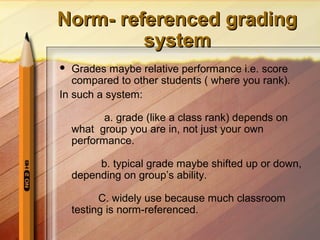
Norm- referenced gradingNorm- referenced grading
systemsystem
 Grades maybe relative performance i.e. score
compared to other students ( where you rank).
In such a system:
a. grade (like a class rank) depends on
what group you are in, not just your own
performance.
b. typical grade maybe shifted up or down,
depending on group’s ability.
C. widely use because much classroom
testing is norm-referenced.
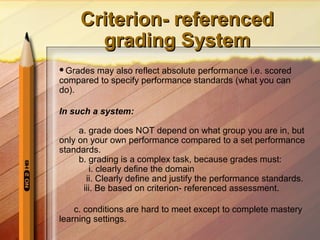
Criterion- referencedCriterion- referenced
grading Systemgrading System
Grades may also reflect absolute performance i.e. scored
compared to specify performance standards (what you can
do).
In such a system:
a. grade does NOT depend on what group you are in, but
only on your own performance compared to a set performance
standards.
b. grading is a complex task, because grades must:
i. clearly define the domain
ii. Clearly define and justify the performance standards.
iii. Be based on criterion- referenced assessment.
c. conditions are hard to meet except to complete mastery
learning settings.
          

Grading and Reporting

  • 1.
    Grading and Reporting Prepared by: Mary JaneT. Hugo BSE III- Gen. Science
  • 2.
    3.3. Development ofa GradingDevelopment of a Grading and Reporting Systemand Reporting System  Grading and reporting systems are guided by the functions to be served by such in the educative process.  The system will most probably be a compromise because of the hosts of factors to be considered in the preparation of such.  we should always keep achievement reports separate from effort expended.
  • 3.
    Ideally, grading andreporting system, should be developed cooperatively (parents, students, school personnel) They should thus be:
  • 4.
    a. Based onclear statementa. Based on clear statement of learning objectives.of learning objectives. The grading and reporting system needs to be based on the same set of learning objectives that the parents, teachers and students agreed at the beginning.
  • 5.
    b.Consistent with schoolstandards.b.Consistent with school standards. The system must support the school standards rather than oppose the school standards already set.
  • 6.
    c.Based on adequate assessment. Thegrading and reporting system should be easily verifiable through adequate system of testing, measurement and assessment methods.
  • 7.
    d.Based on theright level of detail. The system must be detailed enough to be diagnostic but compact enough to be practical: not too time consuming to prepare and use, understandable to users and easily summarized for school record purposes.
  • 8.
    e.Provide for parent-teachere.Providefor parent-teacher conferences as needed.conferences as needed.
  • 9.
    4. Assigning Letter Grades andCo Computing Grades
  • 10.
     Grades assignedto students must include only achievement. It is very important to avoid the temptation to include effort for less able students because it is difficult to distinguish ability from achievement and effort are combined in some way, grades would mean different things for different individuals.
  • 11.
     Grades reflectedon report cards are numbers or numerical quantities arrived at after several data on students’ performance are combined. The following guidelines may be considered in combining such data:
  • 12.
    Properly weight eachcomponentProperly weight each component to create a composite.to create a composite.  The weights used are normally agreed upon by the school officials. e.g. how many percent goes for quizzes, unit tests, periodic tests etc. The more scientific approach is to use a principal components analysis which is hardly practiced in schools because of the difficulty involved.
  • 13.
    Put components onsame scale to weight properly: a. equate ranges of scores b. or, convert all to T- score or other standard scores
  • 14.
  • 15.
    Norm- referenced gradingNorm-referenced grading systemsystem  Grades maybe relative performance i.e. score compared to other students ( where you rank). In such a system: a. grade (like a class rank) depends on what group you are in, not just your own performance. b. typical grade maybe shifted up or down, depending on group’s ability. C. widely use because much classroom testing is norm-referenced.
  • 16.
    Criterion- referencedCriterion- referenced gradingSystemgrading System Grades may also reflect absolute performance i.e. scored compared to specify performance standards (what you can do). In such a system: a. grade does NOT depend on what group you are in, but only on your own performance compared to a set performance standards. b. grading is a complex task, because grades must: i. clearly define the domain ii. Clearly define and justify the performance standards. iii. Be based on criterion- referenced assessment. c. conditions are hard to meet except to complete mastery learning settings.           

Editor's Notes

  • #8 One Kent student: “I can’t give my ESOL students anything but Ds and Fs because they can’t demonstrate mastery of standards as well as the other students.”
  • #10 Preface: This presentation does not provide answers. It asks questions and suggests possible solutions. The area of grading – for all students – is murky and there is by no means consensus in various issues. Kent County, MD – 84 ESOL (PK-12), less than 4% of total population (2,200). Kent is MD’s smallest county, with 1 hs, 1 ms, and 5 es. Four full-time ESOL teachers cover all students and buildings. Two daily ESOL classes, but mostly pull-out and push-in. 30 min. 3x/wk to 90 min daily.
  • #15 Preface: This presentation does not provide answers. It asks questions and suggests possible solutions. The area of grading – for all students – is murky and there is by no means consensus in various issues. Kent County, MD – 84 ESOL (PK-12), less than 4% of total population (2,200). Kent is MD’s smallest county, with 1 hs, 1 ms, and 5 es. Four full-time ESOL teachers cover all students and buildings. Two daily ESOL classes, but mostly pull-out and push-in. 30 min. 3x/wk to 90 min daily.