With respect to Parameters of
Comparison
NORM-REFERENCED &
CRITERION-REFERENCED
ASSESSMENT
HADEEQA WALEED
EDUCATIONIST
• NORM-REFERENCED ASSESSMENT
• Compares student’s performance against others
students
• ▪ Measure global language abilities.
CRITERION-REFERENCED ASSESSMENT
Measures A Student’s Performance Against A Goal, Specific
Objective, Or Standard.
• ▪ Measure Specific Instructional Objectives.
• ▪ Compares Students’ Performance To A Specific Criterion
Norm-referenced Assessment
• Compares a student’s performance against other students (a national
group or other “norm”).
• Student performance is assessed relative to the other students.
• ▪ Describes student’s performance or progress in relation to others of
the same peer group, age Or ability.
• ▪ Assessment to determine how a person performed in comparison
with that of a group.
• ▪ It is used to describe students performance according to relative
position in some known Group.
• ▪ Standardized test that compares and ranks test takers from low to
high achievers
• May involve ranking or scaling a pupil to help with streaming classes
• ▪ May look at cross-school achievements to compare achievement in
particular
• groups, subjects and years wit local and national levels of attainment
• ▪ Compare an individual's performance to the performance of other
people/Group.
• (Accomplished statistically by “norming” the test with large numbers
of people.)
• ▪ Require varying item difficulties.
• ▪ Assume not everybody is going to “GET IT”, Discriminate those
who “GOT IT” from those who didn’t.
• Used for ...
• ▪College placement
• ▪Competition comparisons
• ▪Comparing apples & oranges (countries, states, school districts)
• Examples: Usually multiple choice
• ❑ Khalid’s score in the periodical exams is below the mean
• ❑ Sameer ranked 5th in the unit test in Physics
• ❑ Ahmad’s percentile rank in the Math achievement test is 88.
NORM-REFERENCED ASSESSMENT
Advantages
• Compares students' performances against similar groups across the nation
• ▪ Proven track record of reliability and dependable rank order from highest to
lowest
• ▪ Broad coverage of academic standards
• ▪ Easy to administer
• ▪ Shows student performance relative to group.
• ▪ Ensures a “spread” between top and bottom of the class for clear
• grade setting
• Top and bottom performances can sometimes be very close.
• Dispenses with absolute criteria for performance.
• Results are limited e to a classroom teacher
• Opportunity to learn may not exist
• Expensive and time consuming
• Scoring could be flawed
NORM REFERENCED ASSESSMENT
Disadvantages
Criterion-Referenced ASSESSMENT
• Measures A Student’s Performance Against A Goal, Specific Objective, Or Standard.
• ▪ Student Performance Is Assessed Against A Set Of Predetermined Standards.
• ▪ Compares An Individual's Performance To The Acceptable Standard Of Performance
• For Those Tasks.
• ▪ Designed To Measure Student Performance Against A Fix Set Of Predetermined Criteria
• For A Specific Grade Level.
• ▪ Helps The Teacher That The Student Has Learned Specific Information
• ▪ Used To Confirm Full Understanding.
• ▪ Is Used When The Teacher Wants To Determine How Well The Students Have Learned
• Specific Knowledge Or Skills In A Certain Course Or Subject Matter.
• Used In The Assessment Of Vocational And Academic Qualifications
• ▪ Results Are Given On A PASS/FAIL, COMPETENT/NOT Basis.
• ▪ Results In Yes-no Decisions About Competence.
• ▪ Results Are Conclusive And Usually Open To Review
• ▪ Concerned With National Examination And Other Assessment Bodies
• ▪ Requires Completely Specified Objectives.
• Asks: Can This Person Do That Which Has Been Specified In The
Objectives?
• ▪ Reported As A Grade Or Percentage
• ▪ Based On A Predetermined Set Of Criteria. For Instance:
• 90% And Up=a; 80% To 89.99%=B; 70% To 79.99%=C; 60% To 69.99%=D;
Below 60% = F
• ▪Examples: (End of unit test; Quizzes;
vocabulary test; summer reading test; home
work)
• ▪Aziz can construct a pie graph with 75%
accuracy
• ▪Fareed scored 7 out of 10 in the spelling test
• ▪Usman can encode an article with no more
than 5 errors in spelling
Criterion-Referenced ASSESSMENT
Applications/Used for .........
• ▪ Measuring Performance & Assigning Grades(certification Of
Skills)
• Diagnostic Purposes: Individual Skill Deficiencies
• Motivation
• Influencing Study Habits
• Improving Classroom Effectiveness (Evaluation And Revision
Of Instruction)
Criterion-referenced ASSESSMENT
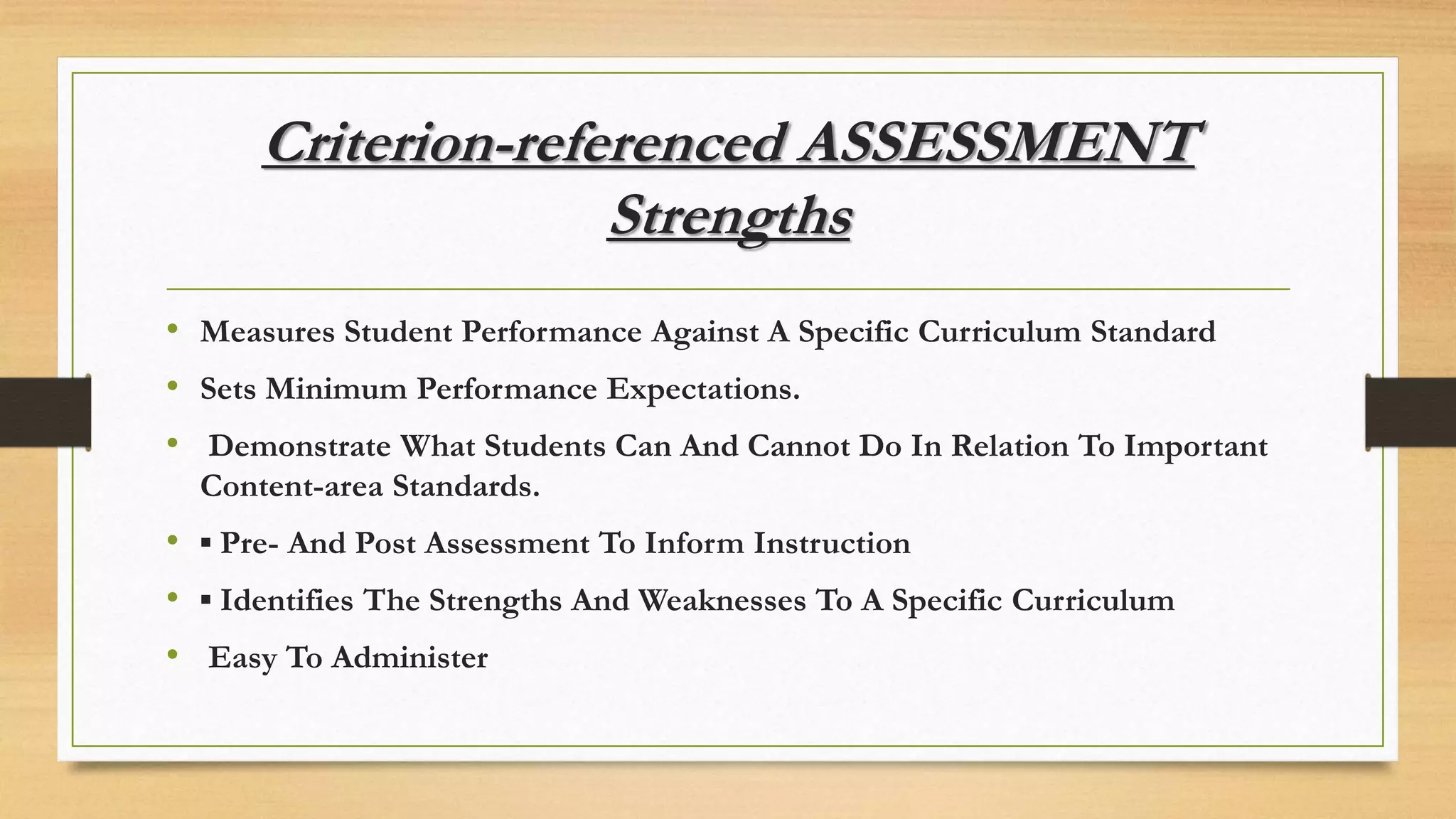
Strengths
• Measures Student Performance Against A Specific Curriculum Standard
• Sets Minimum Performance Expectations.
• Demonstrate What Students Can And Cannot Do In Relation To Important
Content-area Standards.
• ▪ Pre- And Post Assessment To Inform Instruction
• ▪ Identifies The Strengths And Weaknesses To A Specific Curriculum
• Easy To Administer
Criterion-referenced ASSESSMENT
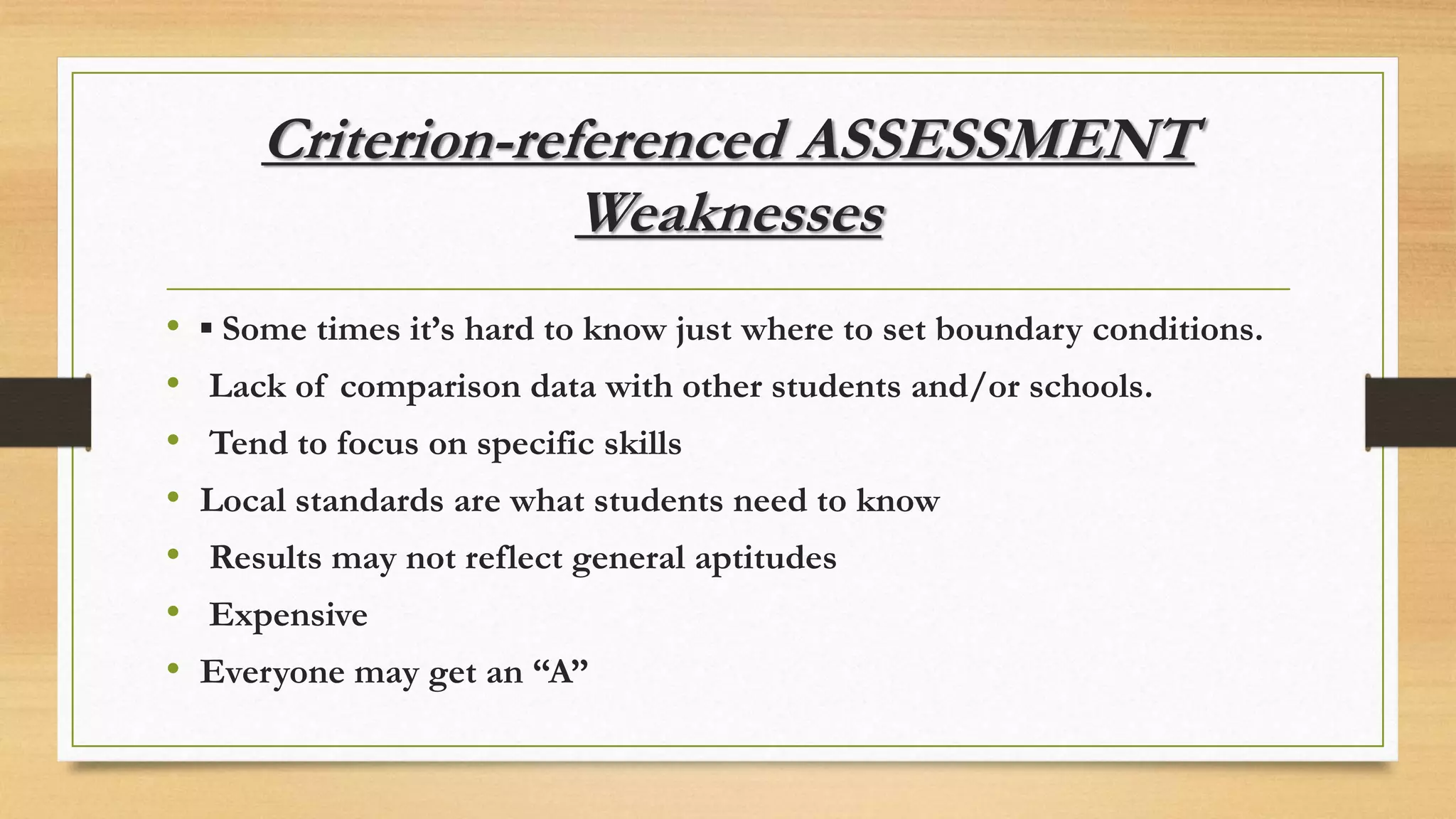
Weaknesses
• ▪ Some times it’s hard to know just where to set boundary conditions.
• Lack of comparison data with other students and/or schools.
• Tend to focus on specific skills
• Local standards are what students need to know
• Results may not reflect general aptitudes
• Expensive
• Everyone may get an “A”

Norm Referenced and Criterion Referenced

  • 1.
    With respect toParameters of Comparison NORM-REFERENCED & CRITERION-REFERENCED ASSESSMENT HADEEQA WALEED EDUCATIONIST
  • 2.
    • NORM-REFERENCED ASSESSMENT •Compares student’s performance against others students • ▪ Measure global language abilities. CRITERION-REFERENCED ASSESSMENT Measures A Student’s Performance Against A Goal, Specific Objective, Or Standard. • ▪ Measure Specific Instructional Objectives. • ▪ Compares Students’ Performance To A Specific Criterion
  • 3.
    Norm-referenced Assessment • Comparesa student’s performance against other students (a national group or other “norm”). • Student performance is assessed relative to the other students. • ▪ Describes student’s performance or progress in relation to others of the same peer group, age Or ability. • ▪ Assessment to determine how a person performed in comparison with that of a group. • ▪ It is used to describe students performance according to relative position in some known Group. • ▪ Standardized test that compares and ranks test takers from low to high achievers
  • 4.
    • May involveranking or scaling a pupil to help with streaming classes • ▪ May look at cross-school achievements to compare achievement in particular • groups, subjects and years wit local and national levels of attainment • ▪ Compare an individual's performance to the performance of other people/Group. • (Accomplished statistically by “norming” the test with large numbers of people.) • ▪ Require varying item difficulties. • ▪ Assume not everybody is going to “GET IT”, Discriminate those who “GOT IT” from those who didn’t.
  • 5.
    • Used for... • ▪College placement • ▪Competition comparisons • ▪Comparing apples & oranges (countries, states, school districts) • Examples: Usually multiple choice • ❑ Khalid’s score in the periodical exams is below the mean • ❑ Sameer ranked 5th in the unit test in Physics • ❑ Ahmad’s percentile rank in the Math achievement test is 88.
  • 6.
    NORM-REFERENCED ASSESSMENT Advantages • Comparesstudents' performances against similar groups across the nation • ▪ Proven track record of reliability and dependable rank order from highest to lowest • ▪ Broad coverage of academic standards • ▪ Easy to administer • ▪ Shows student performance relative to group. • ▪ Ensures a “spread” between top and bottom of the class for clear • grade setting
  • 7.
    • Top andbottom performances can sometimes be very close. • Dispenses with absolute criteria for performance. • Results are limited e to a classroom teacher • Opportunity to learn may not exist • Expensive and time consuming • Scoring could be flawed NORM REFERENCED ASSESSMENT Disadvantages
  • 8.
    Criterion-Referenced ASSESSMENT • MeasuresA Student’s Performance Against A Goal, Specific Objective, Or Standard. • ▪ Student Performance Is Assessed Against A Set Of Predetermined Standards. • ▪ Compares An Individual's Performance To The Acceptable Standard Of Performance • For Those Tasks. • ▪ Designed To Measure Student Performance Against A Fix Set Of Predetermined Criteria • For A Specific Grade Level. • ▪ Helps The Teacher That The Student Has Learned Specific Information • ▪ Used To Confirm Full Understanding. • ▪ Is Used When The Teacher Wants To Determine How Well The Students Have Learned • Specific Knowledge Or Skills In A Certain Course Or Subject Matter.
  • 9.
    • Used InThe Assessment Of Vocational And Academic Qualifications • ▪ Results Are Given On A PASS/FAIL, COMPETENT/NOT Basis. • ▪ Results In Yes-no Decisions About Competence. • ▪ Results Are Conclusive And Usually Open To Review • ▪ Concerned With National Examination And Other Assessment Bodies • ▪ Requires Completely Specified Objectives. • Asks: Can This Person Do That Which Has Been Specified In The Objectives? • ▪ Reported As A Grade Or Percentage • ▪ Based On A Predetermined Set Of Criteria. For Instance: • 90% And Up=a; 80% To 89.99%=B; 70% To 79.99%=C; 60% To 69.99%=D; Below 60% = F
  • 10.
    • ▪Examples: (Endof unit test; Quizzes; vocabulary test; summer reading test; home work) • ▪Aziz can construct a pie graph with 75% accuracy • ▪Fareed scored 7 out of 10 in the spelling test • ▪Usman can encode an article with no more than 5 errors in spelling
  • 11.
    Criterion-Referenced ASSESSMENT Applications/Used for......... • ▪ Measuring Performance & Assigning Grades(certification Of Skills) • Diagnostic Purposes: Individual Skill Deficiencies • Motivation • Influencing Study Habits • Improving Classroom Effectiveness (Evaluation And Revision Of Instruction)
  • 12.
    Criterion-referenced ASSESSMENT Strengths • MeasuresStudent Performance Against A Specific Curriculum Standard • Sets Minimum Performance Expectations. • Demonstrate What Students Can And Cannot Do In Relation To Important Content-area Standards. • ▪ Pre- And Post Assessment To Inform Instruction • ▪ Identifies The Strengths And Weaknesses To A Specific Curriculum • Easy To Administer
  • 13.
    Criterion-referenced ASSESSMENT Weaknesses • ▪Some times it’s hard to know just where to set boundary conditions. • Lack of comparison data with other students and/or schools. • Tend to focus on specific skills • Local standards are what students need to know • Results may not reflect general aptitudes • Expensive • Everyone may get an “A”