SUBMITTED TO: ASSOCIATE PROFESSOR DR SHAFAT ALI
SUBMITTED BY : AMNA TARIQ MPHIL EDUCATION MSF1700145
Rubrics
Rubrics
The word rubric came from Latin word for red .In education terminology rubrics mean a guide
listing specific criteria for grading or scoring academic papers, projects, or tests.
Definition
• A scoring tool that lays out the specific expectations for an assessment task
(Stevens & Levi, 2005)
• A set of clear explanations or criteria used to help teachers and students focus
on what is valued in a subject, topic, or activity (Russell, & Airasian, 2012).
What is Rubrics?
 A standardized scoring guide
 Identifies important criteria and levels of success for each criterion
 A table that identifies and describes various levels of student performance for each of a set of criteria
 A method of rating student work in a more objective manner.
 A kind of scorecard that breaks down a written or demonstrated assignment into manageable, observable
pieces.
Good for measuring higher-order skills or
evaluating complex tasks.
Summaries of results can reveal patterns
of student strengths and areas of concern.
Can generate great discussions of
student learning among faculty, especially
regarding expectations.
Grading is more objective, unbiased, and
consistent
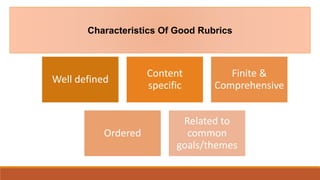
Characteristics Of Good Rubrics
Well defined
Content
specific
Finite &
Comprehensive
Ordered
Related to
common
goals/themes
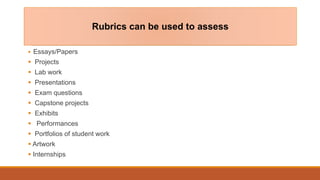
 Essays/Papers
 Projects
 Lab work
 Presentations
 Exam questions
 Capstone projects
 Exhibits
 Performances
 Portfolios of student work
 Artwork
 Internships
Rubrics can be used to assess
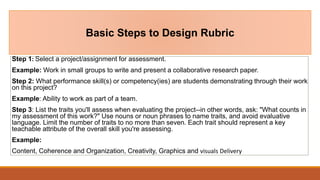
Basic Steps to Design Rubric
Step 1: Select a project/assignment for assessment.
Example: Work in small groups to write and present a collaborative research paper.
Step 2: What performance skill(s) or competency(ies) are students demonstrating through their work
on this project?
Example: Ability to work as part of a team.
Step 3: List the traits you'll assess when evaluating the project--in other words, ask: "What counts in
my assessment of this work?" Use nouns or noun phrases to name traits, and avoid evaluative
language. Limit the number of traits to no more than seven. Each trait should represent a key
teachable attribute of the overall skill you're assessing.
Example:
Content, Coherence and Organization, Creativity, Graphics and visuals Delivery
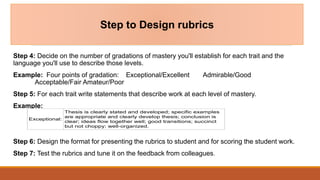
Step 4: Decide on the number of gradations of mastery you'll establish for each trait and the
language you'll use to describe those levels.
Example: Four points of gradation: Exceptional/Excellent Admirable/Good
Acceptable/Fair Amateur/Poor
Step 5: For each trait write statements that describe work at each level of mastery.
Example:
Step 6: Design the format for presenting the rubrics to student and for scoring the student work.
Step 7: Test the rubrics and tune it on the feedback from colleagues.
Step to Design rubrics
Exceptional:
Thesis is clearly stated and developed; specific examples
are appropriate and clearly develop thesis; conclusion is
clear; ideas flow together well; good transitions; succinct
but not choppy; well-organized.
Types Of Rubrics
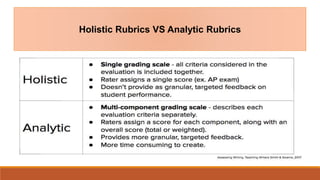
Holistic Rubrics:
• Single criteria rubrics (one-dimensional) used to
assess participants' overall achievement on an
activity or item based on predefined achievement
levels;
• performance descriptions are written in
paragraphs and usually in full sentences.
Sample for Holistic Rubrics
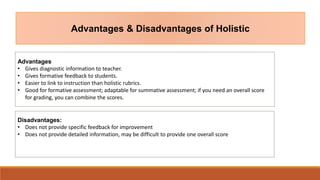
Advantages & Disadvantages of Holistic
Advantages
• Gives diagnostic information to teacher.
• Gives formative feedback to students.
• Easier to link to instruction than holistic rubrics.
• Good for formative assessment; adaptable for summative assessment; if you need an overall score
for grading, you can combine the scores.
Disadvantages:
• Does not provide specific feedback for improvement
• Does not provide detailed information, may be difficult to provide one overall score
Analytic Rubrics
Analytic rubrics
two-dimensional rubrics with levels of
achievement as columns and assessment criteria
as rows. Allows you to assess participants'
achievements based on multiple criteria using a
single rubric. You can assign different weights
(value) to different criteria and include an overall
achievement by totaling the criteria;
written in a table form.
Sample for Analytic Rubrics
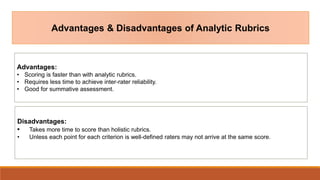
Advantages & Disadvantages of Analytic Rubrics
Advantages:
• Scoring is faster than with analytic rubrics.
• Requires less time to achieve inter-rater reliability.
• Good for summative assessment.
Disadvantages:
• Takes more time to score than holistic rubrics.
• Unless each point for each criterion is well-defined raters may not arrive at the same score.
Holistic Rubrics VS Analytic Rubrics
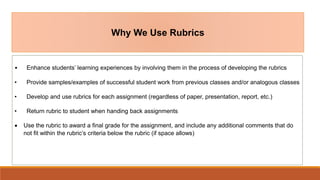
Why We Use Rubrics
• Enhance students’ learning experiences by involving them in the process of developing the rubrics
• Provide samples/examples of successful student work from previous classes and/or analogous classes
• Develop and use rubrics for each assignment (regardless of paper, presentation, report, etc.)
• Return rubric to student when handing back assignments
 Use the rubric to award a final grade for the assignment, and include any additional comments that do
not fit within the rubric’s criteria below the rubric (if space allows)
References
http://www.queensu.ca/teachingandlearning/modules/assessments/35_s4_05_types_of_rubrics.htm
l
https://ii.library.jhu.edu/tag/holistic-rubric/
http://www.ascd.org/publications/books/112001/chapters/What-Are-Rubrics-and-Why-Are-They-
Important%C2%A2.aspx
https://www.slideshare.net/rowenativoli/rubric-26693523
https://www.slideshare.net/joemdiazdelacruz/rubrics-analytic-and-holistic
https://uwaterloo.ca/centre-for-teaching-excellence/teaching-resources/teaching-tips/assessing-
student-work/grading-and-feedback/rubrics-useful-assessment-tools
Rubrics

Rubrics

  • 1.
    SUBMITTED TO: ASSOCIATEPROFESSOR DR SHAFAT ALI SUBMITTED BY : AMNA TARIQ MPHIL EDUCATION MSF1700145 Rubrics
  • 2.
    Rubrics The word rubriccame from Latin word for red .In education terminology rubrics mean a guide listing specific criteria for grading or scoring academic papers, projects, or tests. Definition • A scoring tool that lays out the specific expectations for an assessment task (Stevens & Levi, 2005) • A set of clear explanations or criteria used to help teachers and students focus on what is valued in a subject, topic, or activity (Russell, & Airasian, 2012).
  • 3.
    What is Rubrics? A standardized scoring guide  Identifies important criteria and levels of success for each criterion  A table that identifies and describes various levels of student performance for each of a set of criteria  A method of rating student work in a more objective manner.  A kind of scorecard that breaks down a written or demonstrated assignment into manageable, observable pieces.
  • 4.
    Good for measuringhigher-order skills or evaluating complex tasks. Summaries of results can reveal patterns of student strengths and areas of concern. Can generate great discussions of student learning among faculty, especially regarding expectations. Grading is more objective, unbiased, and consistent
  • 5.
    Characteristics Of GoodRubrics Well defined Content specific Finite & Comprehensive Ordered Related to common goals/themes
  • 6.
     Essays/Papers  Projects Lab work  Presentations  Exam questions  Capstone projects  Exhibits  Performances  Portfolios of student work  Artwork  Internships Rubrics can be used to assess
  • 7.
    Basic Steps toDesign Rubric Step 1: Select a project/assignment for assessment. Example: Work in small groups to write and present a collaborative research paper. Step 2: What performance skill(s) or competency(ies) are students demonstrating through their work on this project? Example: Ability to work as part of a team. Step 3: List the traits you'll assess when evaluating the project--in other words, ask: "What counts in my assessment of this work?" Use nouns or noun phrases to name traits, and avoid evaluative language. Limit the number of traits to no more than seven. Each trait should represent a key teachable attribute of the overall skill you're assessing. Example: Content, Coherence and Organization, Creativity, Graphics and visuals Delivery
  • 8.
    Step 4: Decideon the number of gradations of mastery you'll establish for each trait and the language you'll use to describe those levels. Example: Four points of gradation: Exceptional/Excellent Admirable/Good Acceptable/Fair Amateur/Poor Step 5: For each trait write statements that describe work at each level of mastery. Example: Step 6: Design the format for presenting the rubrics to student and for scoring the student work. Step 7: Test the rubrics and tune it on the feedback from colleagues. Step to Design rubrics Exceptional: Thesis is clearly stated and developed; specific examples are appropriate and clearly develop thesis; conclusion is clear; ideas flow together well; good transitions; succinct but not choppy; well-organized.
  • 9.
    Types Of Rubrics HolisticRubrics: • Single criteria rubrics (one-dimensional) used to assess participants' overall achievement on an activity or item based on predefined achievement levels; • performance descriptions are written in paragraphs and usually in full sentences. Sample for Holistic Rubrics
  • 10.
    Advantages & Disadvantagesof Holistic Advantages • Gives diagnostic information to teacher. • Gives formative feedback to students. • Easier to link to instruction than holistic rubrics. • Good for formative assessment; adaptable for summative assessment; if you need an overall score for grading, you can combine the scores. Disadvantages: • Does not provide specific feedback for improvement • Does not provide detailed information, may be difficult to provide one overall score
  • 11.
    Analytic Rubrics Analytic rubrics two-dimensionalrubrics with levels of achievement as columns and assessment criteria as rows. Allows you to assess participants' achievements based on multiple criteria using a single rubric. You can assign different weights (value) to different criteria and include an overall achievement by totaling the criteria; written in a table form. Sample for Analytic Rubrics
  • 12.
    Advantages & Disadvantagesof Analytic Rubrics Advantages: • Scoring is faster than with analytic rubrics. • Requires less time to achieve inter-rater reliability. • Good for summative assessment. Disadvantages: • Takes more time to score than holistic rubrics. • Unless each point for each criterion is well-defined raters may not arrive at the same score.
  • 13.
    Holistic Rubrics VSAnalytic Rubrics
  • 14.
    Why We UseRubrics • Enhance students’ learning experiences by involving them in the process of developing the rubrics • Provide samples/examples of successful student work from previous classes and/or analogous classes • Develop and use rubrics for each assignment (regardless of paper, presentation, report, etc.) • Return rubric to student when handing back assignments  Use the rubric to award a final grade for the assignment, and include any additional comments that do not fit within the rubric’s criteria below the rubric (if space allows)
  • 16.