



ASSESSMENT INSTRUMENTS
FOR THE XXI CENTURY
LEARNER
Montse Irun
mirun@xtec.cat
THREE IN A ROW
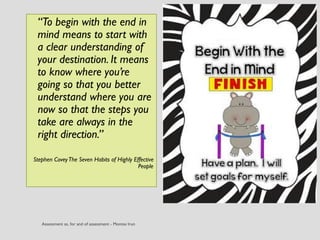
“To begin with the end in
mind means to start with
a clear understanding of
your destination. It means
to know where you’re
going so that you better
understand where you are
now so that the steps you
take are always in the
right direction.”
Stephen CoveyThe Seven Habits of Highly Effective
People
TEAM WORK
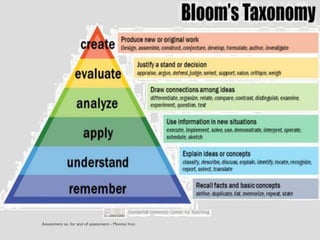
Classify the assessment
instruments according to
their cognitive complexity
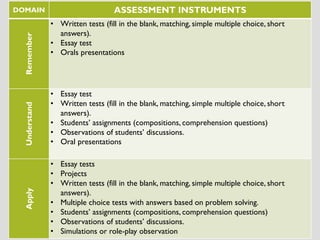
DOMAIN ASSESSMENT INSTRUMENTS
Remember
• Written tests (fill in the blank, matching, simple multiple choice, short
answers).
• Essay test
• Orals presentations
Understand
• Essay test
• Written tests (fill in the blank, matching, simple multiple choice, short
answers).
• Students’ assignments (compositions, comprehension questions)
• Observations of students’ discussions.
• Oral presentations
Apply
• Essay tests
• Projects
• Written tests (fill in the blank, matching, simple multiple choice, short
answers).
• Multiple choice tests with answers based on problem solving.
• Students’ assignments (compositions, comprehension questions)
• Observations of students’ discussions.
• Simulations or role-play observation
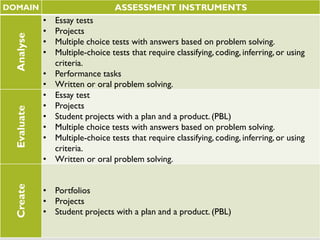
DOMAIN ASSESSMENT INSTRUMENTS
Analyse • Essay tests
• Projects
• Multiple choice tests with answers based on problem solving.
• Multiple-choice tests that require classifying, coding, inferring, or using
criteria.
• Performance tasks
• Written or oral problem solving.
Evaluate
• Essay test
• Projects
• Student projects with a plan and a product. (PBL)
• Multiple choice tests with answers based on problem solving.
• Multiple-choice tests that require classifying, coding, inferring, or using
criteria.
• Written or oral problem solving.
Create
• Portfolios
• Projects
• Student projects with a plan and a product. (PBL)
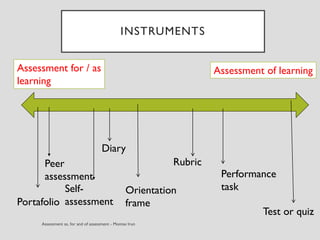
INSTRUMENTS
Assessment for / as
learning
Assessment of learning
Test or quiz
Rubric
Orientation
frame
Diary
Portafolio
Performance
taskSelf-
assessment
Peer
assessment
WHAT CAN BE ASSESSED SO
THAT STUDENTS LEARN?
• If the objectives are identified so they know what
they have to learn
• If they know how to anticipate and plan actions that they
have to carry out to succeed in a task.
• If assessment criteria are identified and, therefore,
students can decide if the task is carried out
effectively.
WHAT CAN BE ASSESSED SO
THAT STUDENTS LEARN?
• If the objectives are identified so they know what
they have to learn
• If they know how to anticipate and plan actions that they
have to carry out to succeed in a task.
• If assessment criteria are identified and, therefore,
students can decide if the task is carried out
effectively.
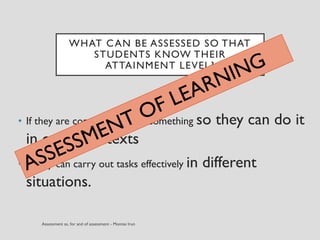
WHAT CAN BE ASSESSED SO THAT
STUDENTS KNOW THEIR
ATTAINMENT LEVEL?
• If they are competent to do something so they can do it
in other contexts
• If they can carry out tasks effectively in different
situations.
WHAT CAN BE ASSESSED SO THAT
STUDENTS KNOW THEIR
ATTAINMENT LEVEL?
• If they are competent to do something so they can do it
in other contexts
• If they can carry out tasks effectively in different
situations.
TEAM WORK
Classify the assessment
instruments according
to their function (for/
as / of learning) and
according to the
information they
provide.
SELF AND PEER ASSESSMENT
Assessment for learning
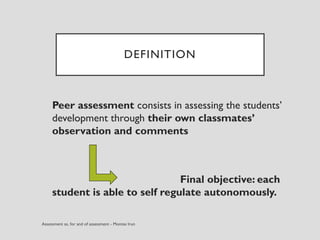
DEFINITION
Peer assessment consists in assessing the students’
development through their own classmates’
observation and comments
Final objective: each
student is able to self regulate autonomously.
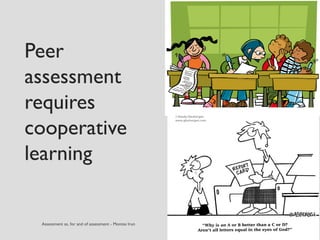
Peer
assessment
requires
cooperative
learning
PEER ASSESSMENT GRIDS
ORIENTATION FRAMEWORK
Assessment for learning
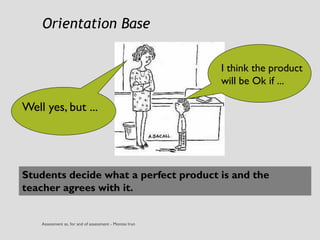
Students decide what a perfect product is and the
teacher agrees with it.
Orientation Base
I think the product
will be Ok if ...
Well yes, but ...
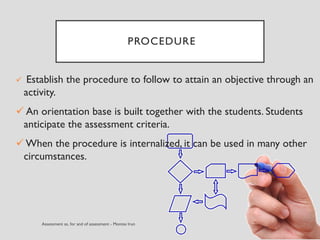
PROCEDURE
✓ Establish the procedure to follow to attain an objective through an
activity.
✓ An orientation base is built together with the students. Students
anticipate the assessment criteria.
✓When the procedure is internalized, it can be used in many other
circumstances.
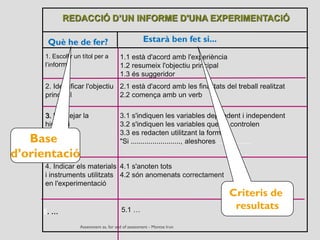
REDACCIÓ D’UN INFORME D'UNA EXPERIMENTACiÓ
Què he de fer? Estarà ben fet si...
1. Escollir un títol per a
l’informe
1.1 està d'acord amb l'experiència
1.2 resumeix l'objectiu principal
1.3 és suggeridor
2. Identificar l'objectiu
principal
2.1 està d'acord amb les finalitats del treball realitzat
2.2 comença amb un verb
3. Plantejar la
hipòtesi
3.1 s'indiquen les variables dependent i independent
3.2 s'indiquen les variables que es controlen
3.3 es redacten utilitzant la forma:
"Si ........................., aleshores .................
4. Indicar els materials
i instruments utilitzats
en l'experimentació
4.1 s'anoten tots
4.2 són anomenats correctament
5. … 5.1 …
Base
d’orientació
Criteris de
resultats
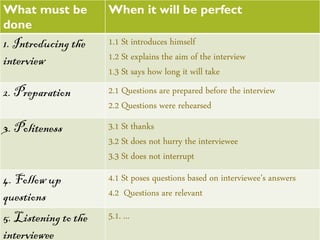
What must be
done
When it will be perfect
1. Introducing the
interview
1.1 St introduces himself
1.2 St explains the aim of the interview
1.3 St says how long it will take
2. Preparation 2.1 Questions are prepared before the interview
2.2 Questions were rehearsed
3. Politeness 3.1 St thanks
3.2 St does not hurry the interviewee
3.3 St does not interrupt
4. Follow up
questions
4.1 St poses questions based on interviewee’s answers
4.2 Questions are relevant
5. Listening to the
interviewee
5.1. ...
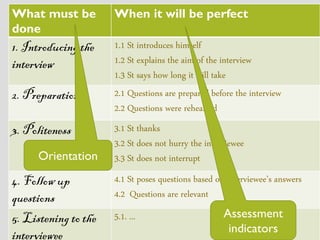
What must be
done
When it will be perfect
1. Introducing the
interview
1.1 St introduces himself
1.2 St explains the aim of the interview
1.3 St says how long it will take
2. Preparation 2.1 Questions are prepared before the interview
2.2 Questions were rehearsed
3. Politeness 3.1 St thanks
3.2 St does not hurry the interviewee
3.3 St does not interrupt
4. Follow up
questions
4.1 St poses questions based on interviewee’s answers
4.2 Questions are relevant
5. Listening to the
interviewee
5.1. ...
Orientation
Assessment
indicators
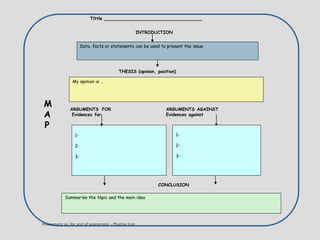
Data, facts or statements can be used to present the issue
My opinion is …
1-
2-
3-
1-
2-
3-
Summarise the tòpic and the main idea
Títtle ___________________________________
INTRODUCTION
THESIS (opinion, position)
ARGUMENTS FOR ARGUMENTS AGAINST
Evidences for Evidences against
CONCLUSION
M
A
P
CLASS DIARIES
Assessment for learning
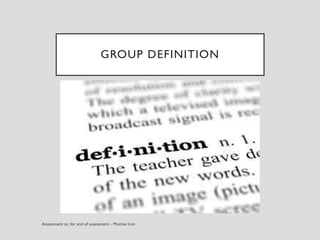
GROUP DEFINITION
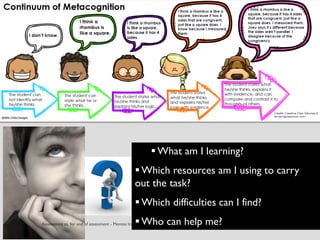
▪ What am I learning?
▪ Which resources am I using to carry
out the task?
▪ Which difficulties can I find?
▪ Who can help me?
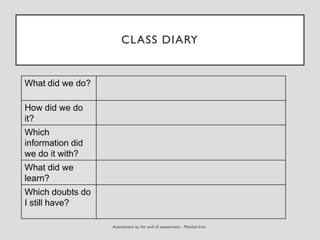
CLASS DIARY
What did we do?
How did we do
it?
Which
information did
we do it with?
What did we
learn?
Which doubts do
I still have?
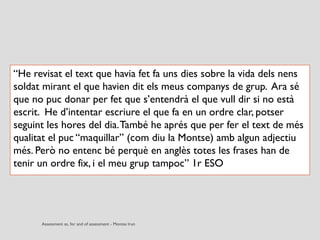
“He revisat el text que havia fet fa uns dies sobre la vida dels nens
soldat mirant el que havien dit els meus companys de grup. Ara sé
que no puc donar per fet que s’entendrà el que vull dir si no està
escrit. He d’intentar escriure el que fa en un ordre clar, potser
seguint les hores del dia.També he aprés que per fer el text de més
qualitat el puc “maquillar” (com diu la Montse) amb algun adjectiu
més. Però no entenc bé perquè en anglès totes les frases han de
tenir un ordre fix, i el meu grup tampoc” 1r ESO
ALSO ONLINE
Q SORT
Assessment for learning
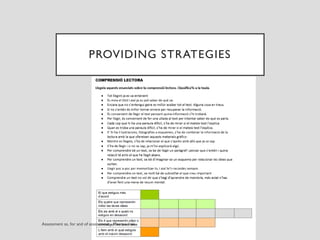
PROVIDING STRATEGIES
PORTFOLIO
Assessment for learning
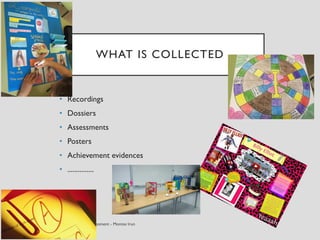
WHAT IS COLLECTED
• Recordings
• Dossiers
• Assessments
• Posters
• Achievement evidences
• ...............
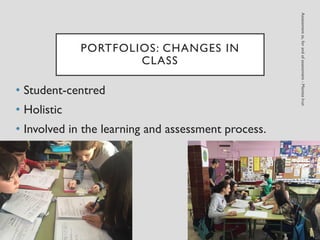
PORTFOLIOS: CHANGES IN
CLASS
• Student-centred
• Holistic
• Involved in the learning and assessment process.
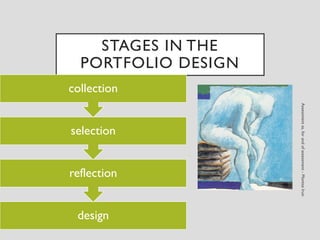
STAGES IN THE
PORTFOLIO DESIGN
design
reflection
selection
collection
Collection:
looking for
evidencies
ADVANTAGES OF SHOWING
LEARNING
• Conscious learning process
• Class thinking culture
• Learning about themselves
• Conscious of what and how they
learn
Selection:
Why?
• Selection criteria depend on evaluation criteria:
• Number of evidences
• Types
• Reflection
• Factors that intervene in the selection:
• Achievement Motivation
• Positive and negative emotions
• Frustrations: fears, insecurity
Reflection
FRAMEWORK TO SELECT
What? Reflection
on the present
situation
Why? Construction
personal theory
So what now?
Set aims for
improvements
DESIGN
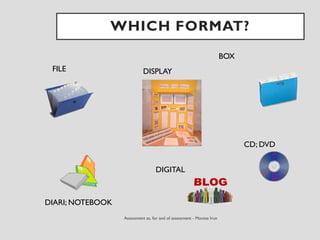
WHICH FORMAT?
FILE DISPLAY
BOX
DIARI; NOTEBOOK
CD; DVD
DIGITAL
I CAN ADD SOMETHING IN MY PORTFOLIO IF …
• I worked hard to do it.
• I enjoyed working with others (family, friends) when I
did it.
• I don’t have anything else like it in my portfolio.
• It’s a better version of an earlier work sample.
• My teacher suggested it.
• I think it’s very interesting.
• It shows I use my English outside the classroom.
• It shows my English is getting better.
• I like it a lot.
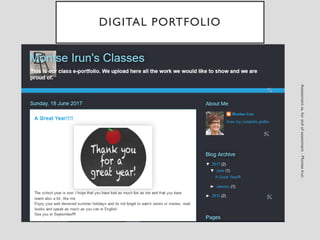
DIGITAL PORTFOLIO
RUBRICS
Assessment of / for learning
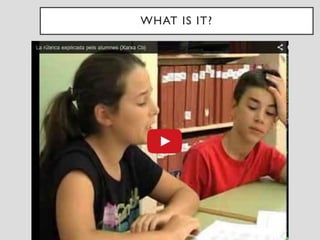
WHAT IS IT?
• Teachers:
• To share, within the school, what to teach and the
criteria to assess each competence.
• To check the students’ development along time.
• Students
• To understand where the assessment results come
from.
• To identify what is missing so that they can carry out
a task more effectively and be aware of their
progress.
WHAT IS THE USE OF RUBRICS?
• Students are not assessed, but how tasks
are carried out.
• Teachers and students (and families) can
see if a certain task is carried out in a more
effective way.
• Rubrics make teachers anticipate which
tasks students need to be competent at.
• Rubrics promote assessing tasks from their
complexity and not from partial aspects.
WHICH CHANGES IN ASSESSMENT DO
RUBRICS REPRESENT?
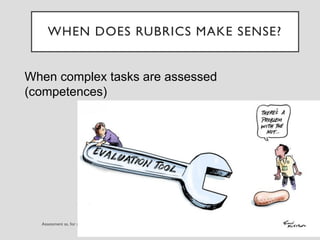
When complex tasks are assessed
(competences)
WHEN DOES RUBRICS MAKE SENSE?
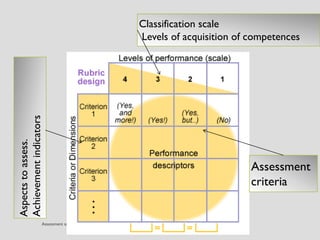
Aspectstoassess.
Achievementindicators
Classification scale
Levels of acquisition of competences
Assessment
criteria
PROCEDURE
• Revise topic or content thoroughly.
• Establish the objective to assess.
• Describe the assessment criteria
• Assign a number according to the level of attainment.
• Design a quality scale and stablish the level students can attain.
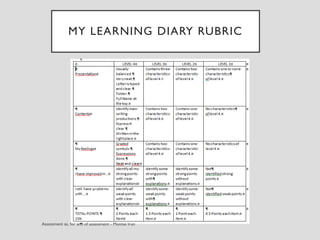
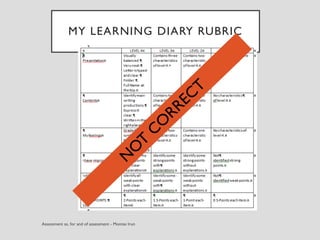
MY LEARNING DIARY RUBRIC
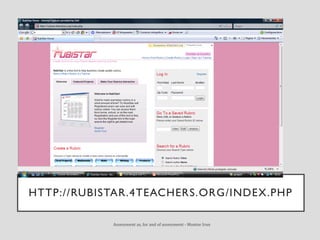
HTTP://RUBISTAR.4TEACHERS.ORG/INDEX.PHP
OTHER FORMATS
Assessment of learning
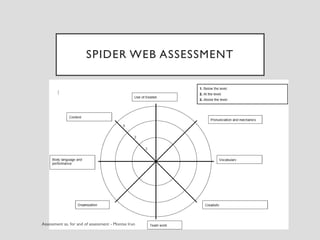
SPIDER WEB ASSESSMENT
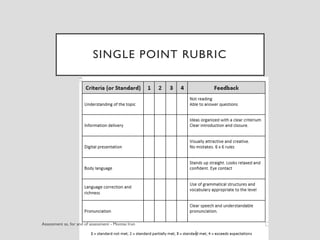
SINGLE POINT RUBRIC
EXAMS, QUIZZES AND TESTS
Assessment of learning
EXAMS
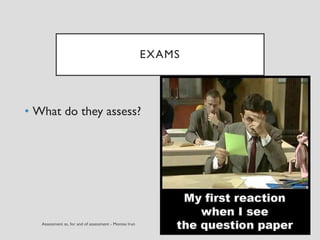
• What do they assess?
DOES THE FINAL EXAM HAVE SENSE?
• Useful to check what has been learnt
• Allows to check what needs to be learnt
BUT ONLY IF
• students may be successful
• exams are coherent with teaching
Assessment instruments of and for learning

Assessment instruments of and for learning

  • 1.
    ASSESSMENT INSTRUMENTS FOR THEXXI CENTURY LEARNER Montse Irun mirun@xtec.cat
  • 2.
  • 3.
    “To begin withthe end in mind means to start with a clear understanding of your destination. It means to know where you’re going so that you better understand where you are now so that the steps you take are always in the right direction.” Stephen CoveyThe Seven Habits of Highly Effective People
  • 6.
    TEAM WORK Classify theassessment instruments according to their cognitive complexity
  • 7.
    DOMAIN ASSESSMENT INSTRUMENTS Remember •Written tests (fill in the blank, matching, simple multiple choice, short answers). • Essay test • Orals presentations Understand • Essay test • Written tests (fill in the blank, matching, simple multiple choice, short answers). • Students’ assignments (compositions, comprehension questions) • Observations of students’ discussions. • Oral presentations Apply • Essay tests • Projects • Written tests (fill in the blank, matching, simple multiple choice, short answers). • Multiple choice tests with answers based on problem solving. • Students’ assignments (compositions, comprehension questions) • Observations of students’ discussions. • Simulations or role-play observation
  • 8.
    DOMAIN ASSESSMENT INSTRUMENTS Analyse• Essay tests • Projects • Multiple choice tests with answers based on problem solving. • Multiple-choice tests that require classifying, coding, inferring, or using criteria. • Performance tasks • Written or oral problem solving. Evaluate • Essay test • Projects • Student projects with a plan and a product. (PBL) • Multiple choice tests with answers based on problem solving. • Multiple-choice tests that require classifying, coding, inferring, or using criteria. • Written or oral problem solving. Create • Portfolios • Projects • Student projects with a plan and a product. (PBL)
  • 9.
    INSTRUMENTS Assessment for /as learning Assessment of learning Test or quiz Rubric Orientation frame Diary Portafolio Performance taskSelf- assessment Peer assessment
  • 10.
    WHAT CAN BEASSESSED SO THAT STUDENTS LEARN? • If the objectives are identified so they know what they have to learn • If they know how to anticipate and plan actions that they have to carry out to succeed in a task. • If assessment criteria are identified and, therefore, students can decide if the task is carried out effectively.
  • 11.
    WHAT CAN BEASSESSED SO THAT STUDENTS LEARN? • If the objectives are identified so they know what they have to learn • If they know how to anticipate and plan actions that they have to carry out to succeed in a task. • If assessment criteria are identified and, therefore, students can decide if the task is carried out effectively.
  • 12.
    WHAT CAN BEASSESSED SO THAT STUDENTS KNOW THEIR ATTAINMENT LEVEL? • If they are competent to do something so they can do it in other contexts • If they can carry out tasks effectively in different situations.
  • 13.
    WHAT CAN BEASSESSED SO THAT STUDENTS KNOW THEIR ATTAINMENT LEVEL? • If they are competent to do something so they can do it in other contexts • If they can carry out tasks effectively in different situations.
  • 14.
    TEAM WORK Classify theassessment instruments according to their function (for/ as / of learning) and according to the information they provide.
  • 15.
    SELF AND PEERASSESSMENT Assessment for learning
  • 17.
    DEFINITION Peer assessment consistsin assessing the students’ development through their own classmates’ observation and comments Final objective: each student is able to self regulate autonomously.
  • 18.
  • 19.
  • 21.
  • 23.
    Students decide whata perfect product is and the teacher agrees with it. Orientation Base I think the product will be Ok if ... Well yes, but ...
  • 24.
    PROCEDURE ✓ Establish theprocedure to follow to attain an objective through an activity. ✓ An orientation base is built together with the students. Students anticipate the assessment criteria. ✓When the procedure is internalized, it can be used in many other circumstances.
  • 25.
    REDACCIÓ D’UN INFORMED'UNA EXPERIMENTACiÓ Què he de fer? Estarà ben fet si... 1. Escollir un títol per a l’informe 1.1 està d'acord amb l'experiència 1.2 resumeix l'objectiu principal 1.3 és suggeridor 2. Identificar l'objectiu principal 2.1 està d'acord amb les finalitats del treball realitzat 2.2 comença amb un verb 3. Plantejar la hipòtesi 3.1 s'indiquen les variables dependent i independent 3.2 s'indiquen les variables que es controlen 3.3 es redacten utilitzant la forma: "Si ........................., aleshores ................. 4. Indicar els materials i instruments utilitzats en l'experimentació 4.1 s'anoten tots 4.2 són anomenats correctament 5. … 5.1 … Base d’orientació Criteris de resultats
  • 26.
    What must be done Whenit will be perfect 1. Introducing the interview 1.1 St introduces himself 1.2 St explains the aim of the interview 1.3 St says how long it will take 2. Preparation 2.1 Questions are prepared before the interview 2.2 Questions were rehearsed 3. Politeness 3.1 St thanks 3.2 St does not hurry the interviewee 3.3 St does not interrupt 4. Follow up questions 4.1 St poses questions based on interviewee’s answers 4.2 Questions are relevant 5. Listening to the interviewee 5.1. ...
  • 27.
    What must be done Whenit will be perfect 1. Introducing the interview 1.1 St introduces himself 1.2 St explains the aim of the interview 1.3 St says how long it will take 2. Preparation 2.1 Questions are prepared before the interview 2.2 Questions were rehearsed 3. Politeness 3.1 St thanks 3.2 St does not hurry the interviewee 3.3 St does not interrupt 4. Follow up questions 4.1 St poses questions based on interviewee’s answers 4.2 Questions are relevant 5. Listening to the interviewee 5.1. ... Orientation Assessment indicators
  • 28.
    Data, facts orstatements can be used to present the issue My opinion is … 1- 2- 3- 1- 2- 3- Summarise the tòpic and the main idea Títtle ___________________________________ INTRODUCTION THESIS (opinion, position) ARGUMENTS FOR ARGUMENTS AGAINST Evidences for Evidences against CONCLUSION M A P
  • 29.
  • 30.
  • 31.
    ▪ What amI learning? ▪ Which resources am I using to carry out the task? ▪ Which difficulties can I find? ▪ Who can help me?
  • 32.
    CLASS DIARY What didwe do? How did we do it? Which information did we do it with? What did we learn? Which doubts do I still have?
  • 33.
    “He revisat eltext que havia fet fa uns dies sobre la vida dels nens soldat mirant el que havien dit els meus companys de grup. Ara sé que no puc donar per fet que s’entendrà el que vull dir si no està escrit. He d’intentar escriure el que fa en un ordre clar, potser seguint les hores del dia.També he aprés que per fer el text de més qualitat el puc “maquillar” (com diu la Montse) amb algun adjectiu més. Però no entenc bé perquè en anglès totes les frases han de tenir un ordre fix, i el meu grup tampoc” 1r ESO
  • 34.
  • 35.
  • 36.
  • 37.
  • 38.
    WHAT IS COLLECTED •Recordings • Dossiers • Assessments • Posters • Achievement evidences • ...............
  • 39.
    PORTFOLIOS: CHANGES IN CLASS •Student-centred • Holistic • Involved in the learning and assessment process.
  • 40.
    STAGES IN THE PORTFOLIODESIGN design reflection selection collection
  • 41.
  • 42.
    ADVANTAGES OF SHOWING LEARNING •Conscious learning process • Class thinking culture • Learning about themselves • Conscious of what and how they learn
  • 43.
  • 44.
    • Selection criteriadepend on evaluation criteria: • Number of evidences • Types • Reflection • Factors that intervene in the selection: • Achievement Motivation • Positive and negative emotions • Frustrations: fears, insecurity
  • 45.
  • 46.
    FRAMEWORK TO SELECT What?Reflection on the present situation Why? Construction personal theory So what now? Set aims for improvements
  • 47.
  • 48.
    WHICH FORMAT? FILE DISPLAY BOX DIARI;NOTEBOOK CD; DVD DIGITAL
  • 49.
    I CAN ADDSOMETHING IN MY PORTFOLIO IF … • I worked hard to do it. • I enjoyed working with others (family, friends) when I did it. • I don’t have anything else like it in my portfolio. • It’s a better version of an earlier work sample. • My teacher suggested it. • I think it’s very interesting. • It shows I use my English outside the classroom. • It shows my English is getting better. • I like it a lot.
  • 50.
  • 51.
  • 52.
  • 53.
    • Teachers: • Toshare, within the school, what to teach and the criteria to assess each competence. • To check the students’ development along time. • Students • To understand where the assessment results come from. • To identify what is missing so that they can carry out a task more effectively and be aware of their progress. WHAT IS THE USE OF RUBRICS?
  • 54.
    • Students arenot assessed, but how tasks are carried out. • Teachers and students (and families) can see if a certain task is carried out in a more effective way. • Rubrics make teachers anticipate which tasks students need to be competent at. • Rubrics promote assessing tasks from their complexity and not from partial aspects. WHICH CHANGES IN ASSESSMENT DO RUBRICS REPRESENT?
  • 55.
    When complex tasksare assessed (competences) WHEN DOES RUBRICS MAKE SENSE?
  • 56.
    Aspectstoassess. Achievementindicators Classification scale Levels ofacquisition of competences Assessment criteria
  • 57.
    PROCEDURE • Revise topicor content thoroughly. • Establish the objective to assess. • Describe the assessment criteria • Assign a number according to the level of attainment. • Design a quality scale and stablish the level students can attain.
  • 58.
  • 59.
  • 60.
  • 61.
  • 62.
  • 63.
  • 64.
    EXAMS, QUIZZES ANDTESTS Assessment of learning
  • 65.
    EXAMS • What dothey assess?
  • 67.
    DOES THE FINALEXAM HAVE SENSE? • Useful to check what has been learnt • Allows to check what needs to be learnt BUT ONLY IF • students may be successful • exams are coherent with teaching