RUBRICS AS AN
ASSESSMENT TOOL
PREPARED
BY
VINYA.P
• Assessment..................................
• is the gathering
information from a variety of
sources that accurately reflect how
well a student
• is achieving curricular expectations
in scholastic and co-scholastic
aspects.
• A rubric is a scoring tool that teachers use to assess
student learning after a lesson, using a set of criteria
and standard.
• Rubric is a document that articulates the expectations
for an assignment by listing the criteria and describing
level of quality from excellent to poor.
• A rubric is a consistent set of criteria for student’s work
that includes description level of performance level on
the criteria.
DEFINITIONS:
IMPORTANCE OF RUBRICS
1)1.It helps teachers to teach.
2.It help coordinate instruction and
assessment.
3.It help student to learn.
TYPES OF RUBRICS
1) ANALYTIC RUBRIC
2) HOLISTIC RUBRIC
ANALYTIC RUBRIC
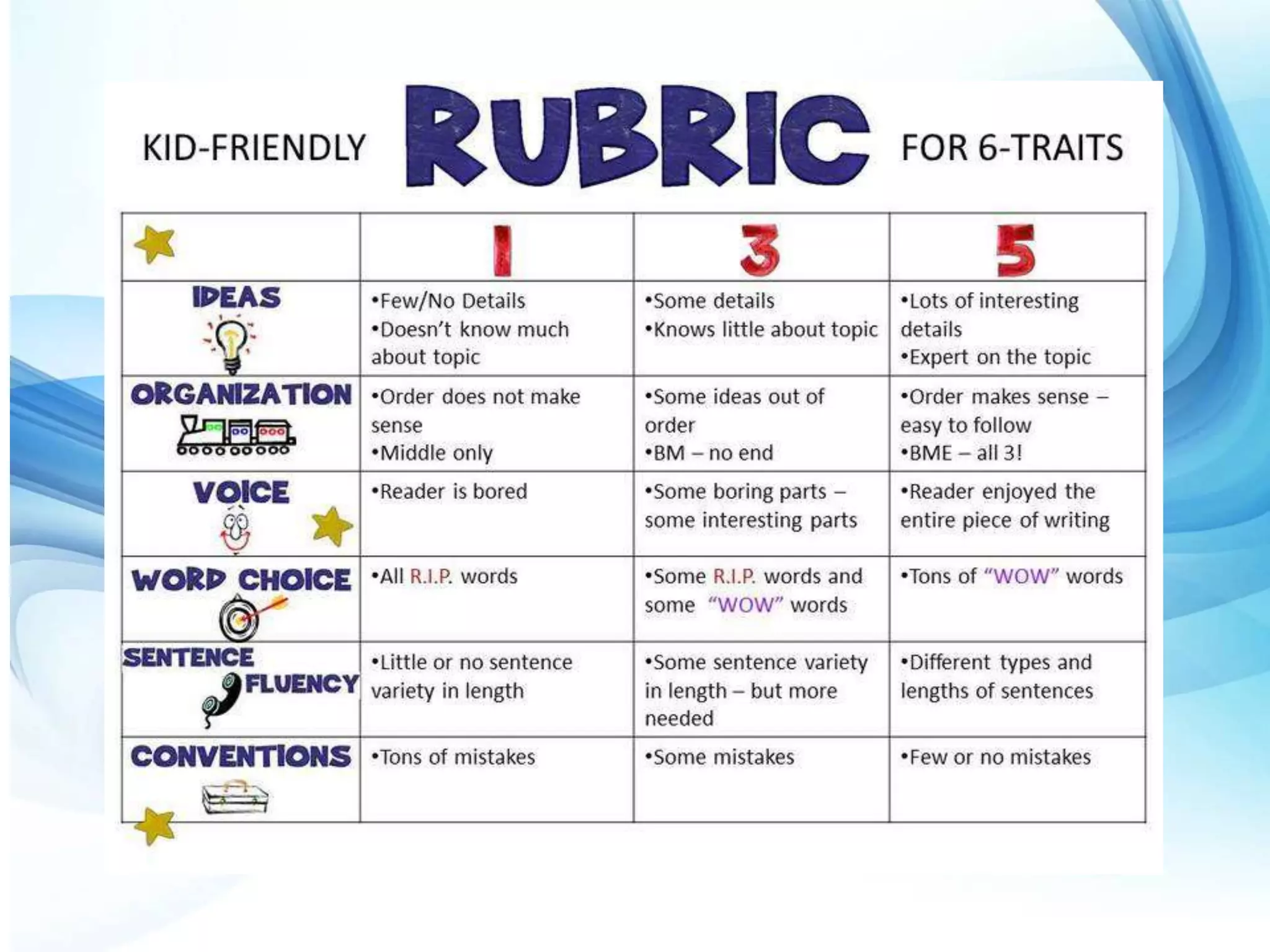
ANALYTIC RUBRIC EXAMPLE
• They provide useful feedback to learners on areas of
strength and weakness.
• Criterion can be weighted to reflect the relative
importance of each dimension.
Advantages of analytic rubrics:
Disadvantages of analytic rubrics:
• Takes more time to create and use .
• Unless each points for each criteria is well
defined raters may not arrive at the same
score.
HOLISTIC RUBRIC
Advantages of holistic rubrics:
• Emphasis on what learner is able to demonstrate,
rather than what she/he can not do.
• Same time by the number of decisions raters make.
• Can be applied consistently by trained raters
increasing reliability.
Disadvantages of holistic rubrics:
• Do not provide specific feed back for
improvement.
• Criteria can not be weighted.
• Because they lack specific details, they are not
useful for formative assessment.
Rubrics

Rubrics

  • 2.
    RUBRICS AS AN ASSESSMENTTOOL PREPARED BY VINYA.P
  • 3.
    • Assessment.................................. • isthe gathering information from a variety of sources that accurately reflect how well a student • is achieving curricular expectations in scholastic and co-scholastic aspects.
  • 5.
    • A rubricis a scoring tool that teachers use to assess student learning after a lesson, using a set of criteria and standard. • Rubric is a document that articulates the expectations for an assignment by listing the criteria and describing level of quality from excellent to poor. • A rubric is a consistent set of criteria for student’s work that includes description level of performance level on the criteria. DEFINITIONS:
  • 6.
    IMPORTANCE OF RUBRICS 1)1.Ithelps teachers to teach. 2.It help coordinate instruction and assessment. 3.It help student to learn.
  • 7.
    TYPES OF RUBRICS 1)ANALYTIC RUBRIC 2) HOLISTIC RUBRIC
  • 8.
  • 9.
  • 11.
    • They provideuseful feedback to learners on areas of strength and weakness. • Criterion can be weighted to reflect the relative importance of each dimension. Advantages of analytic rubrics: Disadvantages of analytic rubrics: • Takes more time to create and use . • Unless each points for each criteria is well defined raters may not arrive at the same score.
  • 12.
  • 14.
    Advantages of holisticrubrics: • Emphasis on what learner is able to demonstrate, rather than what she/he can not do. • Same time by the number of decisions raters make. • Can be applied consistently by trained raters increasing reliability. Disadvantages of holistic rubrics: • Do not provide specific feed back for improvement. • Criteria can not be weighted. • Because they lack specific details, they are not useful for formative assessment.

Editor's Notes