Definition
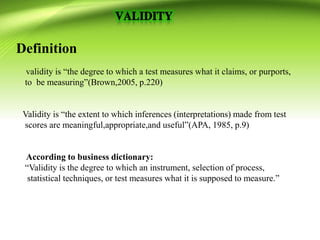
validity is “the degree to which a test measures what it claims, or purports,
to be measuring”(Brown,2005, p.220)
Validity is “the extent to which inferences (interpretations) made from test
scores are meaningful,appropriate,and useful”(APA, 1985, p.9)
According to business dictionary:
“Validity is the degree to which an instrument, selection of process,
statistical techniques, or test measures what it is supposed to measure.”
Validity is concerned with the question:
“how much of an individual’s test performance is due to the language
abilities we want to measure?”
More simply, it is how one knows that a math test measures students’
math ability, not their reading ability.
When a test is constructed so that its content measures what the whole
test claims to measure, the test is said to have content validity.
So it is concerned with the relevance of the contents of the items
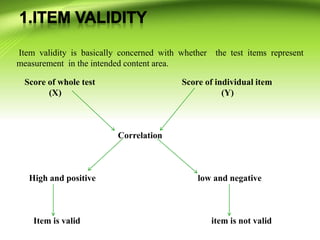
Item validity is basically concerned with whether the test items represent
measurement in the intended content area.
Score of whole test Score of individual item
(X) (Y)
Correlation
High and positive low and negative
Item is valid item is not valid
It is concerned with the extent to which the test samples the total content area.
E.g.- A test designed to measure knowledge of psychology might have good
item validity because all the items indeed deal with good psychology facts but
might have poor sampling validity, that is, all its item may deals only with
abnormal psychology. But when test cover all the branches of psychology then
it has good sampling validity also
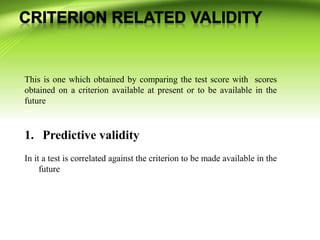
This is one which obtained by comparing the test score with scores
obtained on a criterion available at present or to be available in the
future
1. Predictive validity
In it a test is correlated against the criterion to be made available in the
future
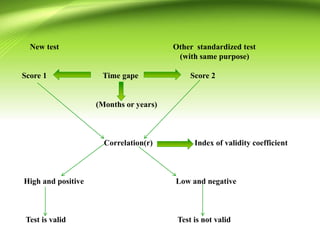
New test Other standardized test
(with same purpose)
Score 1 Time gape Score 2
(Months or years)
Correlation(r) Index of validity coefficient
High and positive Low and negative
Test is valid Test is not valid
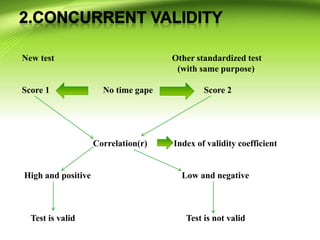
New test Other standardized test
(with same purpose)
Score 1 No time gape Score 2
Correlation(r) Index of validity coefficient
High and positive Low and negative
Test is valid Test is not valid
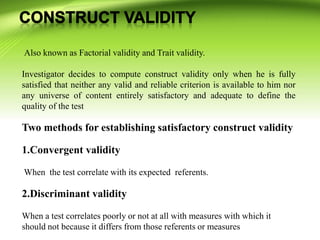
Also known as Factorial validity and Trait validity.
Investigator decides to compute construct validity only when he is fully
satisfied that neither any valid and reliable criterion is available to him nor
any universe of content entirely satisfactory and adequate to define the
quality of the test
Two methods for establishing satisfactory construct validity
1.Convergent validity
When the test correlate with its expected referents.
2.Discriminant validity
When a test correlates poorly or not at all with measures with which it
should not because it differs from those referents or measures
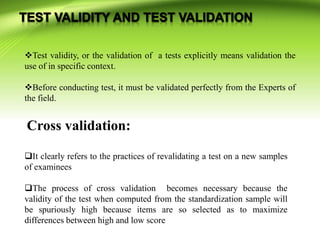
Test validity, or the validation of a tests explicitly means validation the
use of in specific context.
Before conducting test, it must be validated perfectly from the Experts of
the field.
Cross validation:
It clearly refers to the practices of revalidating a test on a new samples
of examinees
The process of cross validation becomes necessary because the
validity of the test when computed from the standardization sample will
be spuriously high because items are so selected as to maximize
differences between high and low score
Tests are designed to Measure;
Skills
Abilities
Traits
The process of using a test score as a sample of behavior in order to draw
conclusions about a larger domain of behaviors is characteristics of most
educational and psychological test
There are some extremely important points to remember
about the way that psychologists evaluate the validity of a
measurement method.
1. First, this process requires empirical evidence. A measurement method
cannot be declared valid or invalid before it has ever been used and the
resulting scores have been thoroughly analyzed.
2. Second, it is an ongoing process. The conclusion that a measurement
method is valid generally depends on the results of many studies done
over a period of years.
3. Third, validity is not an all-or-none property of a measurement method.
It is possible for a measurement method to judged "somewhat valid" or
for one measure to be considered "more valid" than another.
Validity

Validity

  • 3.
    Definition validity is “thedegree to which a test measures what it claims, or purports, to be measuring”(Brown,2005, p.220) Validity is “the extent to which inferences (interpretations) made from test scores are meaningful,appropriate,and useful”(APA, 1985, p.9) According to business dictionary: “Validity is the degree to which an instrument, selection of process, statistical techniques, or test measures what it is supposed to measure.”
  • 4.
    Validity is concernedwith the question: “how much of an individual’s test performance is due to the language abilities we want to measure?” More simply, it is how one knows that a math test measures students’ math ability, not their reading ability.
  • 6.
    When a testis constructed so that its content measures what the whole test claims to measure, the test is said to have content validity. So it is concerned with the relevance of the contents of the items
  • 7.
    Item validity isbasically concerned with whether the test items represent measurement in the intended content area. Score of whole test Score of individual item (X) (Y) Correlation High and positive low and negative Item is valid item is not valid
  • 8.
    It is concernedwith the extent to which the test samples the total content area. E.g.- A test designed to measure knowledge of psychology might have good item validity because all the items indeed deal with good psychology facts but might have poor sampling validity, that is, all its item may deals only with abnormal psychology. But when test cover all the branches of psychology then it has good sampling validity also
  • 9.
    This is onewhich obtained by comparing the test score with scores obtained on a criterion available at present or to be available in the future 1. Predictive validity In it a test is correlated against the criterion to be made available in the future
  • 10.
    New test Otherstandardized test (with same purpose) Score 1 Time gape Score 2 (Months or years) Correlation(r) Index of validity coefficient High and positive Low and negative Test is valid Test is not valid
  • 11.
    New test Otherstandardized test (with same purpose) Score 1 No time gape Score 2 Correlation(r) Index of validity coefficient High and positive Low and negative Test is valid Test is not valid
  • 12.
    Also known asFactorial validity and Trait validity. Investigator decides to compute construct validity only when he is fully satisfied that neither any valid and reliable criterion is available to him nor any universe of content entirely satisfactory and adequate to define the quality of the test Two methods for establishing satisfactory construct validity 1.Convergent validity When the test correlate with its expected referents. 2.Discriminant validity When a test correlates poorly or not at all with measures with which it should not because it differs from those referents or measures
  • 13.
    Test validity, orthe validation of a tests explicitly means validation the use of in specific context. Before conducting test, it must be validated perfectly from the Experts of the field. Cross validation: It clearly refers to the practices of revalidating a test on a new samples of examinees The process of cross validation becomes necessary because the validity of the test when computed from the standardization sample will be spuriously high because items are so selected as to maximize differences between high and low score
  • 14.
    Tests are designedto Measure; Skills Abilities Traits The process of using a test score as a sample of behavior in order to draw conclusions about a larger domain of behaviors is characteristics of most educational and psychological test
  • 15.
    There are someextremely important points to remember about the way that psychologists evaluate the validity of a measurement method. 1. First, this process requires empirical evidence. A measurement method cannot be declared valid or invalid before it has ever been used and the resulting scores have been thoroughly analyzed. 2. Second, it is an ongoing process. The conclusion that a measurement method is valid generally depends on the results of many studies done over a period of years. 3. Third, validity is not an all-or-none property of a measurement method. It is possible for a measurement method to judged "somewhat valid" or for one measure to be considered "more valid" than another.