This document discusses different grading systems used in education including absolute grading, relative grading, and common letter grade scales. Absolute grading involves assigning percentages based on how well a student's answers meet the requirements of a model answer. Relative grading compares students' performance to others taking the same test. Common letter grade scales range from A+ to F, with grade point values also defined. The document also defines terms related to grading like semester, semester grade point average, cumulative grade point average, credit points, and transcripts.
ABSOLUTE GRADING :
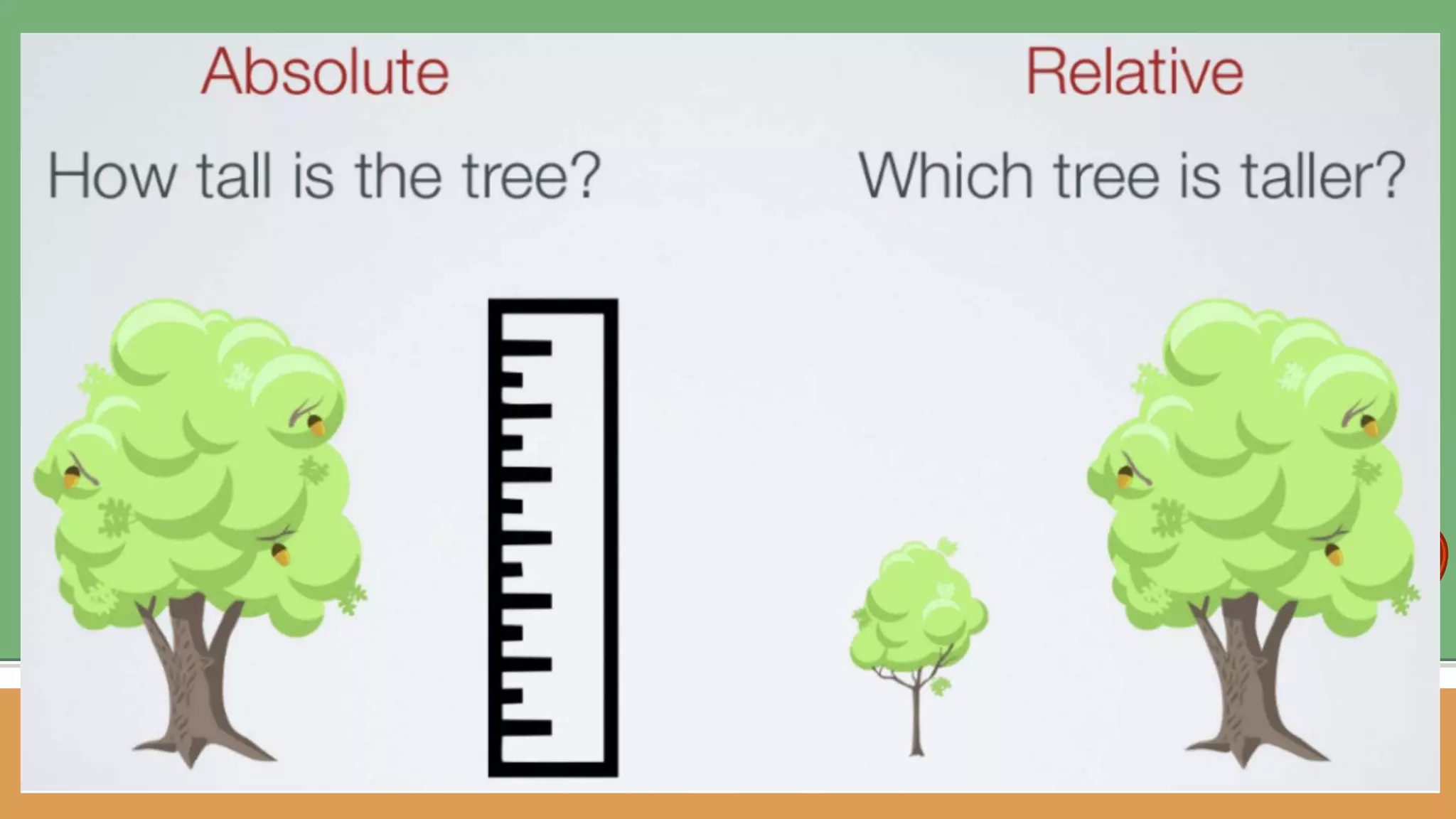
Thisis the system of assigning
grades by which the student
get the marks for the answers,
depending on how well he has
met the requirements of the
model answer and is
expressed as percentage.
6.
• When usingabsolute
grading it is useful to use
the analytic method of
marking.
• A marking key is
prepared in advance and
marks are allotted to the
specific point of content
in the model answer.
• This is a more reliable
method.
ABSOLUTE GRADING:
7.
This type ofgrading tells
the student how his
answers rated in relation to
other students doing the
same test, by indicating
whether or not he is
average, above average or
below average..
RELATIVE GRADING
8.
Relative grading,uses a literal
scale A, B, C and E With a
relative grading it is better to
use the global method of
marking.
The global method of marking
also requires a model answer,
but serves only a standard of
comparison.
The grades used are scales
and points are given as per
scale
CONT……
9.
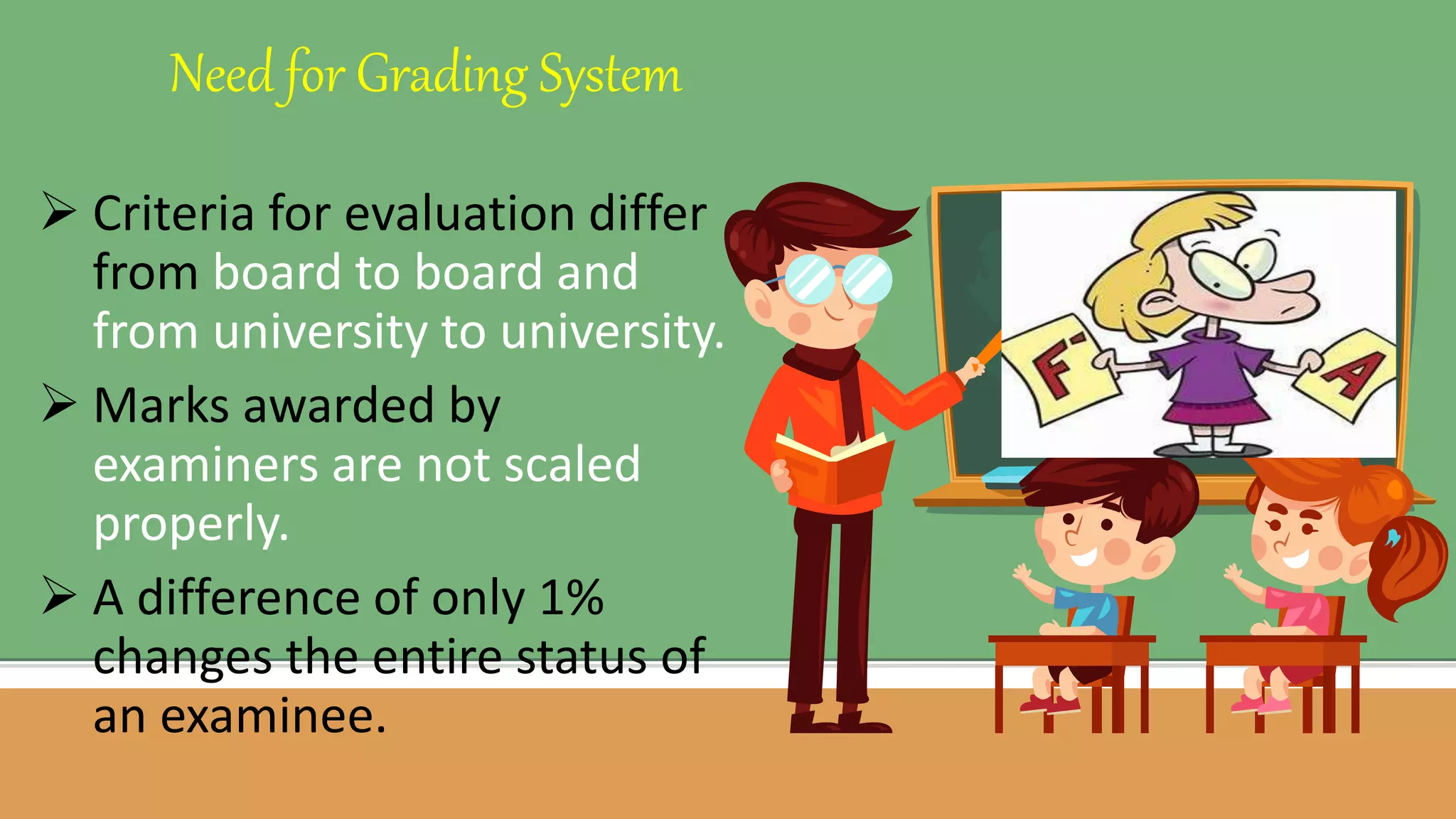
Criteria forevaluation differ
from board to board and
from university to university.
Marks awarded by
examiners are not scaled
properly.
A difference of only 1%
changes the entire status of
an examinee.
Need for Grading System
10.
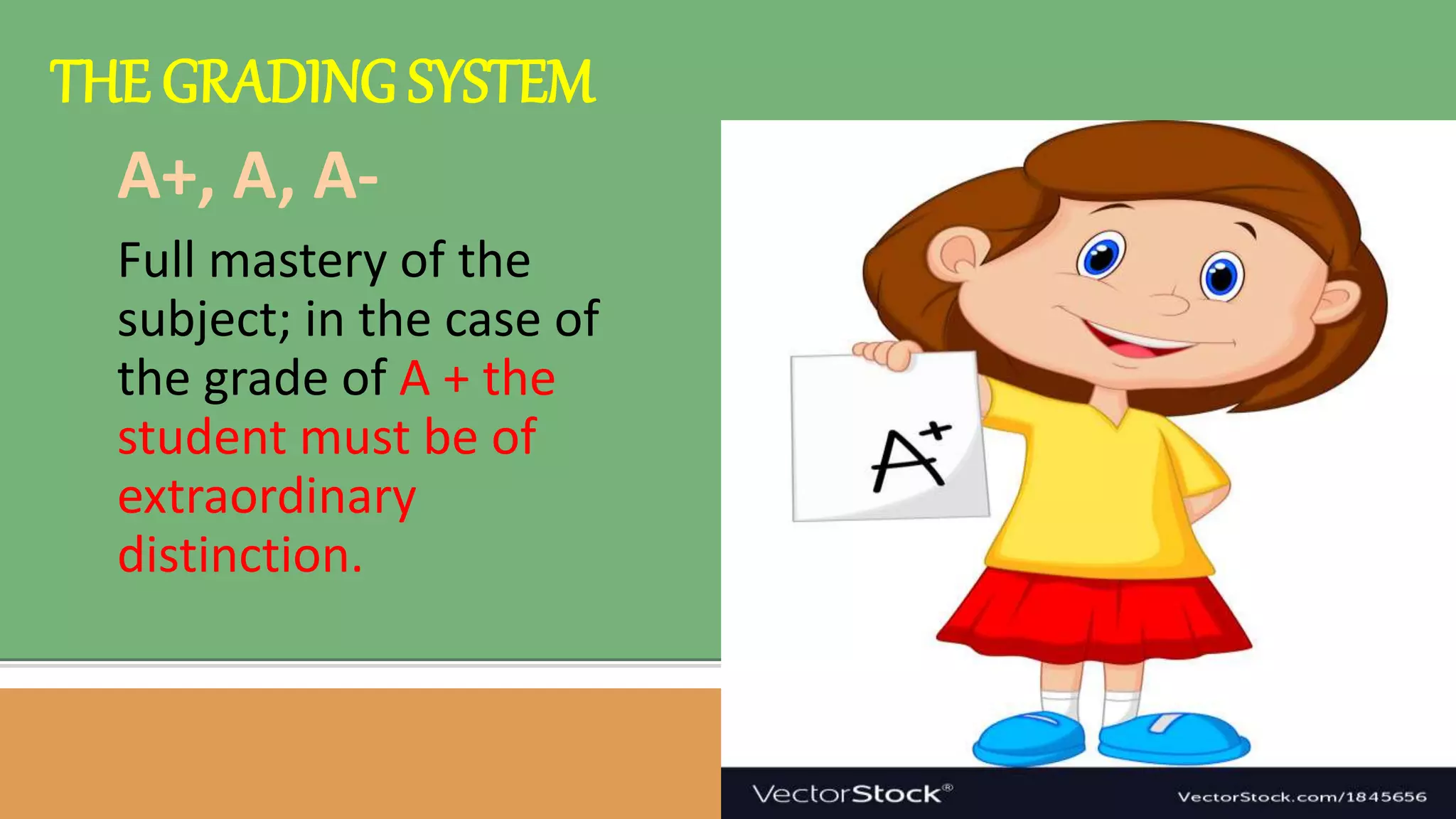
A+, A, A-
Fullmastery of the
subject; in the case of
the grade of A + the
student must be of
extraordinary
distinction.
THE GRADING SYSTEM
11.
• Good comprehensionof
the course material;
• A good command of the
skills needed to work with
the course material; and
• The student's full
engagement with the
course requirements and
activities.
B+, B, B-
12.
Adequate and satisfactory
comprehensionof the course
material;
The skills needed to work with the
course material;
The student has met the basic
requirements for completing
assigned work and participating in
class activities.
C+, C, C-
13.
Unsatisfactory, but some
minimalcommand of the
course materials;
some minimal participation
in class activities that is
worthy of course credit
toward the degree.
D+,D,D-
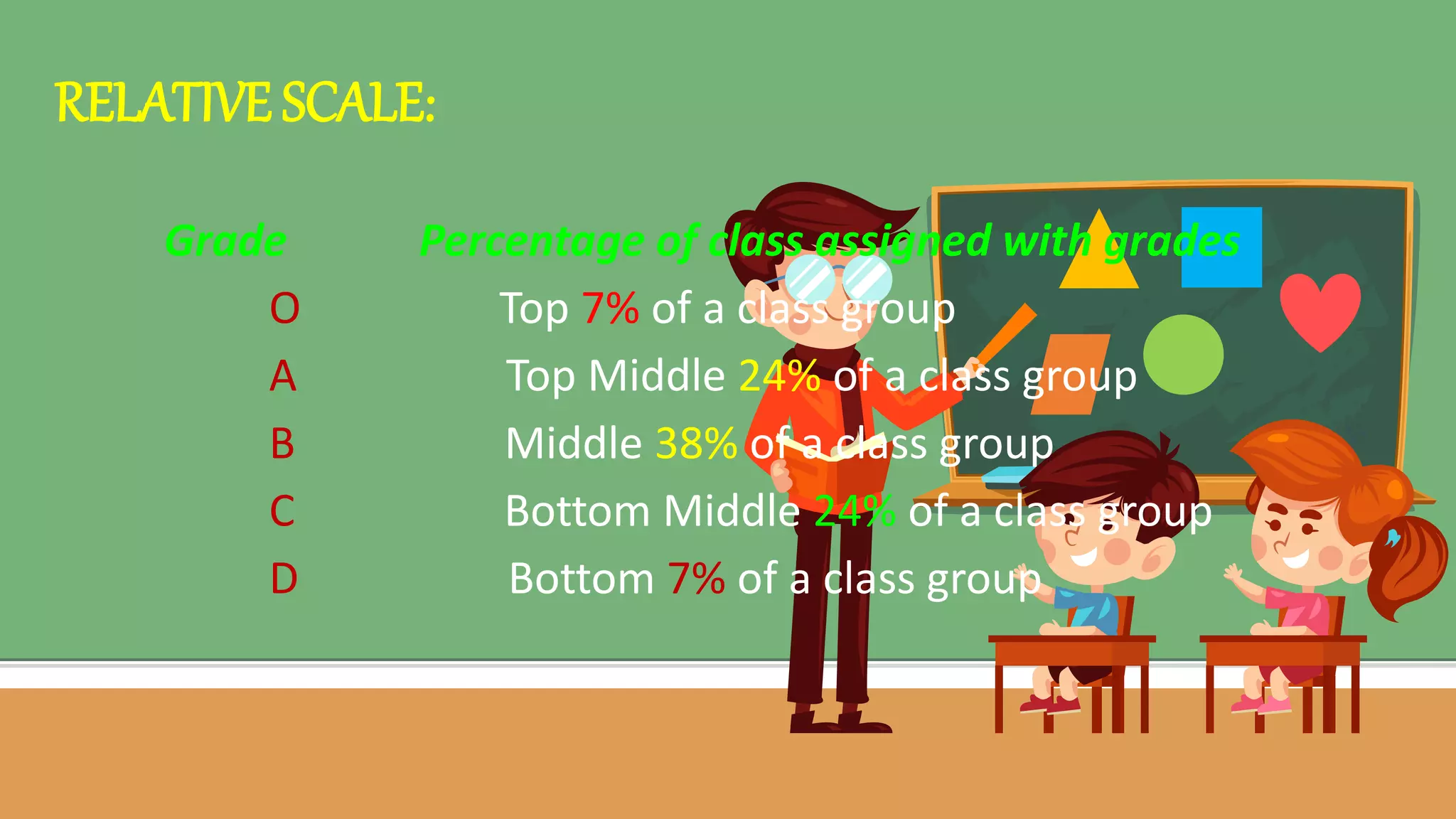
Grade Percentage ofclass assigned with grades
O Top 7% of a class group
A Top Middle 24% of a class group
B Middle 38% of a class group
C Bottom Middle 24% of a class group
D Bottom 7% of a class group
RELATIVE SCALE:
16.
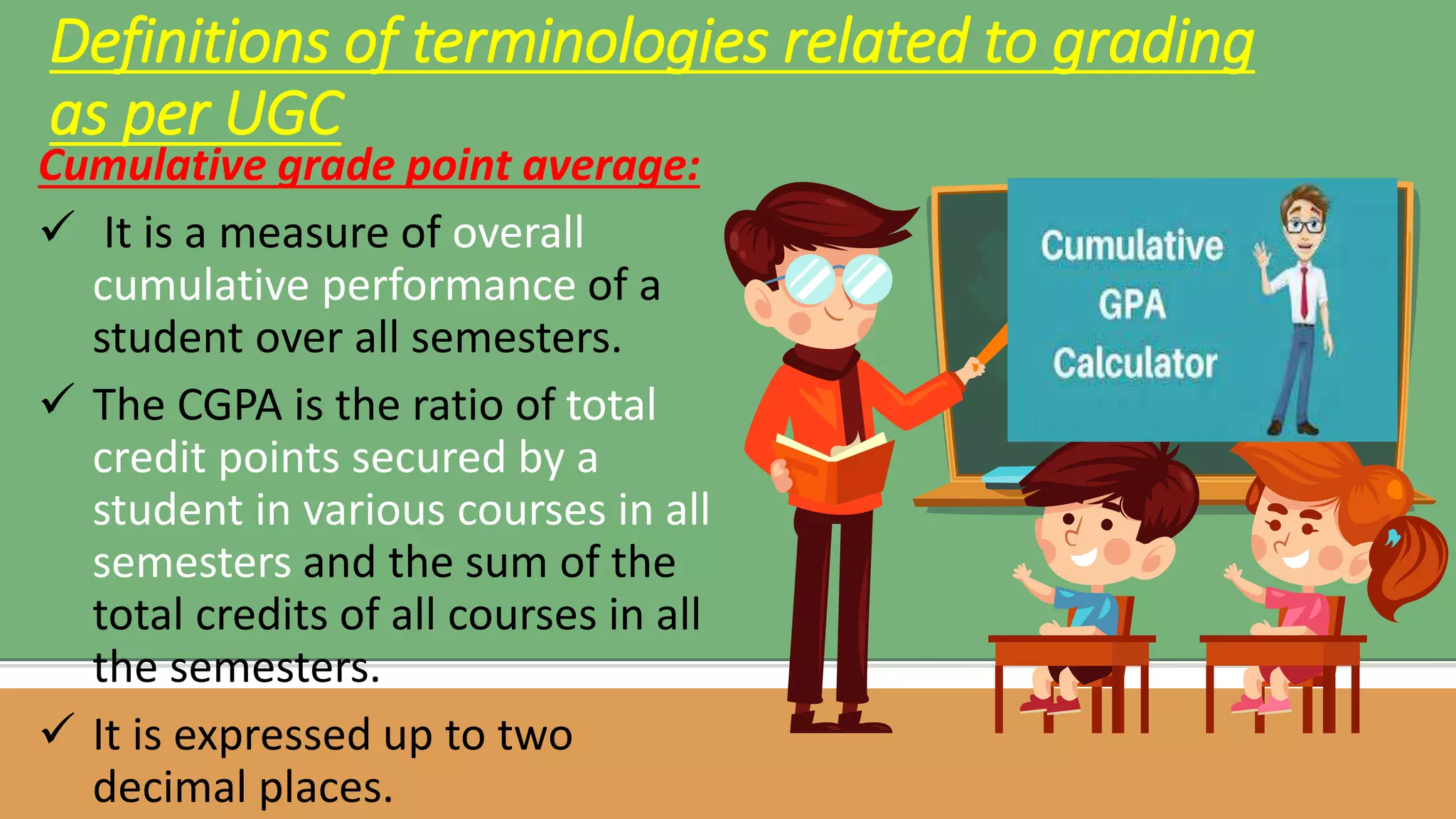
Cumulative grade pointaverage:
It is a measure of overall
cumulative performance of a
student over all semesters.
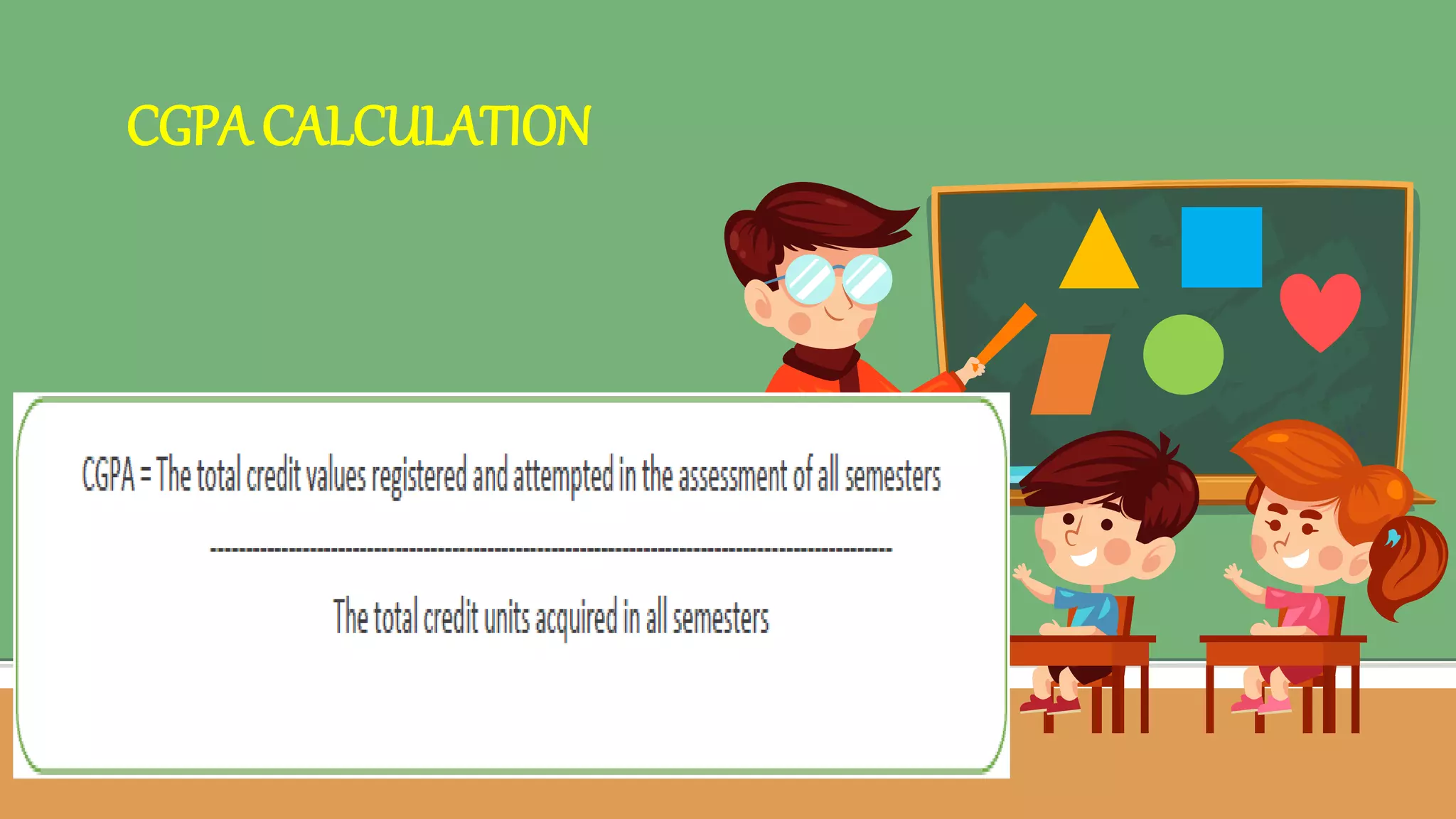
The CGPA is the ratio of total
credit points secured by a
student in various courses in all
semesters and the sum of the
total credits of all courses in all
the semesters.
It is expressed up to two
decimal places.
Definitions of terminologies related to grading
as per UGC
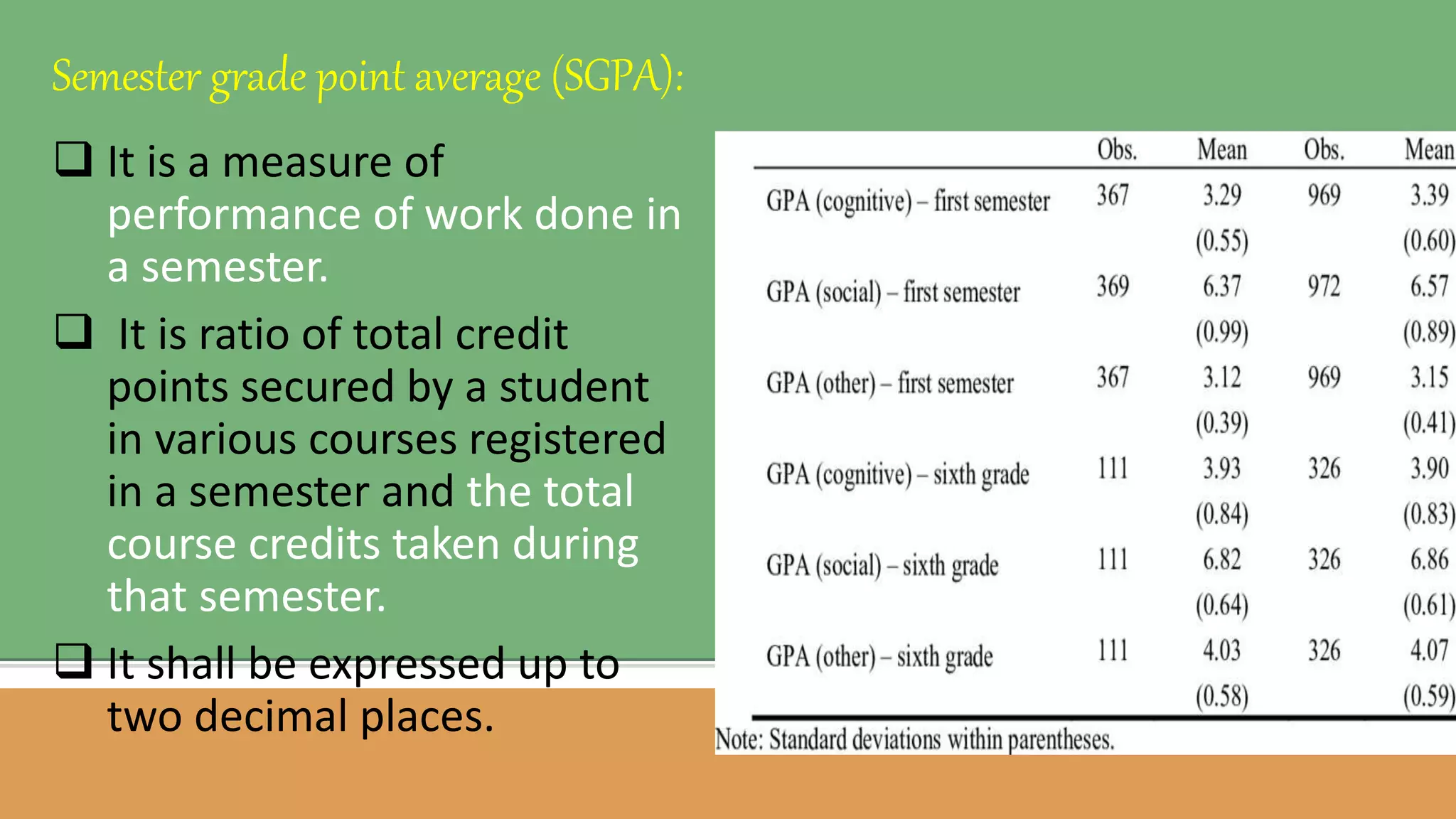
It isa measure of
performance of work done in
a semester.
It is ratio of total credit
points secured by a student
in various courses registered
in a semester and the total
course credits taken during
that semester.
It shall be expressed up to
two decimal places.
Semester grade point average (SGPA):
22.
Each semesterwill consist of 15-
18 weeks of academic work
equivalent to 90 actual teaching
days.
The odd semester may be
scheduled from July to
December and even semester
from January to June.
Semester:
23.
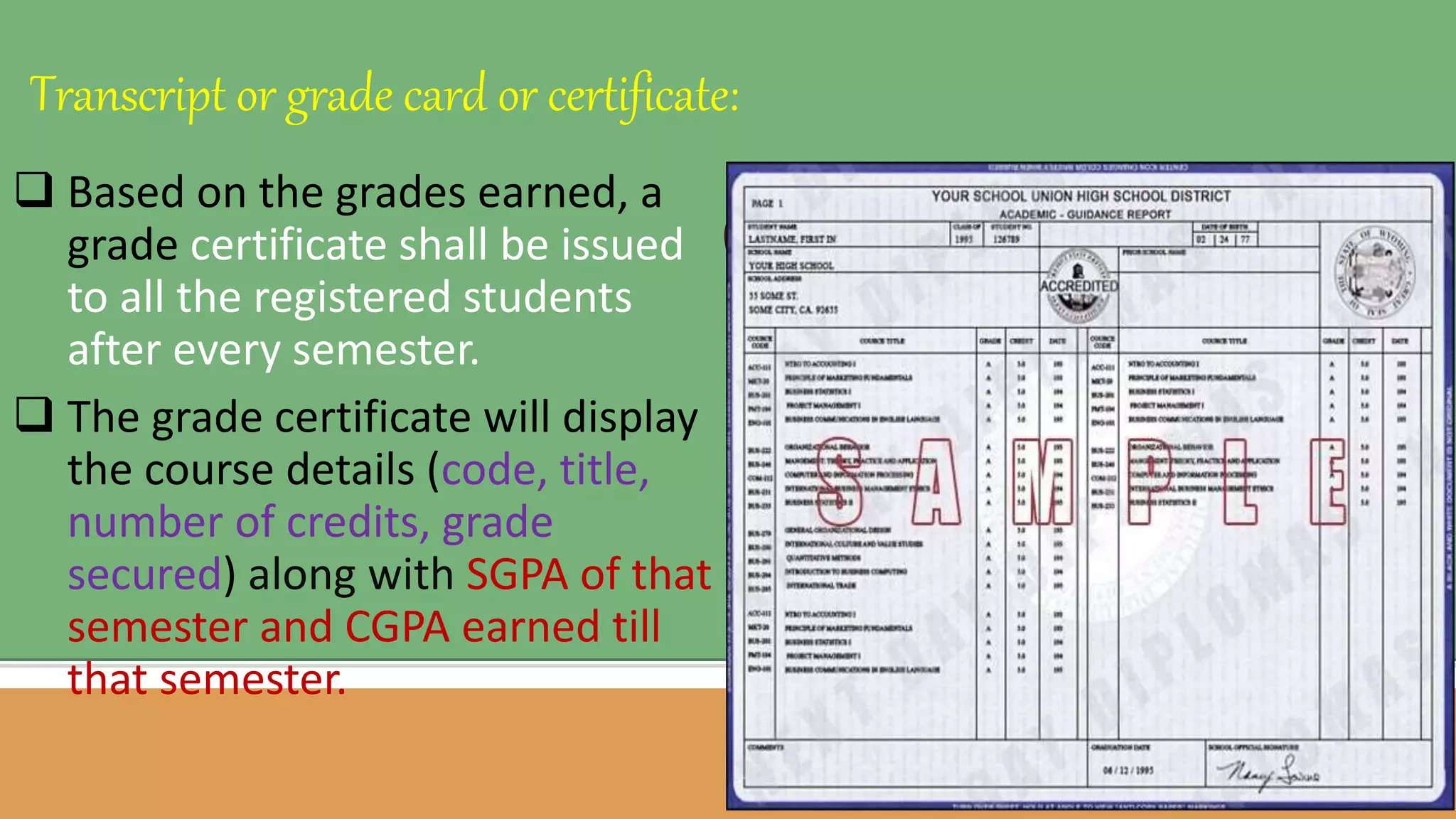
Based onthe grades earned, a
grade certificate shall be issued
to all the registered students
after every semester.
The grade certificate will display
the course details (code, title,
number of credits, grade
secured) along with SGPA of that
semester and CGPA earned till
that semester.
Transcript or grade card or certificate:










![Presentation ms english linguistics [autosaved]](https://cdn.slidesharecdn.com/ss_thumbnails/presentationmsenglishlinguisticsautosaved-201223023512-thumbnail.jpg?width=640&height=640&fit=bounds)


![Acute_respiratory_failure[1] [Autosaved].pptx](https://cdn.slidesharecdn.com/ss_thumbnails/acuterespiratoryfailure1autosaved-240613055024-837043a9-thumbnail.jpg?width=640&height=640&fit=bounds)


