
REPUBLIC OF THE PHILIPPINES
UNIVERSITY OF RIZAL SYSTEM
PROVINCE OF RIZAL
GRADUATE SCHOOL
PILILLA CAMPUS
The purpose of this presentation is to provide
an overview of “rubric” in language testing and
assessment and to highlight the parts of a rubric
through various dimensions.
It sets forth objectives; types of the rubric use.
It will create awareness of the effective use of
rubrics in reflecting robustness of this critical
assessment process.
 The word “rubric” comes from the Latin
word for “red.” It was once used to signify
the highlights of a legal decision as well as
the directions for conducting religious
services, found in the margins of liturgical
books—both written in red.
In a broad sense, rubric refers to a term which has
existed in English for more than 600 years and
during that time, mostly it has meant a set of
“printed rules or instructions” (Encarta
Encyclopedia, 2004).
However, in educational sense, it refers to different
categories such as criteria foe assessment,
evaluation of learning, gradients of learning of a set
of instructions etc. (Brown, 2012).
A good activity never guarantees the accurate
determination of a student’s competency at a
given task.
At this point, rubrics stand for this main
requirement. Since it specifies the skill being
examined and what constitutes various levels of
performance success.
 In order to construct a good rubric focus
on what to measure exactly, how to measure
performance and decision on what a passing
level of performance competency is” plays
the key role.
Rubric: A scoring guide used to judge
students’ work
Skill-Focused Rubrics: Scoring guides for
judging students’ mastery of the skill being
assessed
Student Behavior: A student’s performance
intended to demonstrate what the student
has learned
Student Product: Something material a
student creates to demonstrate the
student’s learning
 Task-Specific Rubrics: Scoring guides
suitable for judging responses to only a
particular task
 Hypergeneral Rubrics: Excessively inexact,
often vague, scoring guides
 Analytic Scoring: When a rubric’s
evaluative criteria are applied separately in
judging students’ work
 Holistic Scoring: When a rubric’s
evaluative criteria contribute to a single,
overall judgment of quality
Application Strategy: Use of a rubric’s
evaluative criteria holistically (all together)
or analytically (one-by-one)
 Evaluative Criteria: Factors considered
when using a rubric to judge a student’s
response
Constructed-Response Items: Test items
requiring students to generate their
answers
Selected-Response Items: Test items
requiring students to choose from two or
more options
 Cognitive Skill: A specific intellectual
competency that individuals can apply in
appropriate situations
 Knowledge: Memorized information, for
example, recollectable facts, dates,
principles, and terminology
 Performance Test: An assessment task
typically requiring students to create a
somewhat elaborately constructed response
 Quality Distinctions: Descriptions of
different qualitative levels for each of a
rubric’s evaluation criteria
REMEMBER:
 Rubrics can be used to evaluate the
of any student-generated product or any
student-generated behavior.
Student Product:
Something material a student creates to
demonstrate the student’s learning.
Student Behavior:
A student’s performance intended to
demonstrate what the student has learned.
 For instance, when a student in a woodworking
class creates a pair of mahogany bookends (a
product), the quality of those bookends can be
appraised more accurately when the instructor
relies on a rubric to make a systematic judgment
rather than trying to judge the bookends using a
more haphazard approach.
Similarly, when teachers in a speech class must
evaluate their students’ “demonstration speeches” (a
behavior), those teachers will do a more defensible
evaluative job when they employ rubrics.
Thus, whether it is the evaluation of students’ products
or behaviors, teachers who rely on rubrics almost
always do a better evaluative job than teachers who
don’t.
One useful way of thinking about the applicability of
rubrics to the evaluation of students’ work is to
distinguish between test items that call for students to
select their responses versus test items that call for
students to construct their responses.
 These two types of items are referred to, not
surprisingly, as selected-response items and
constructed-response items.
The most common varieties of selected-response items
are the sorts of multiple-choice and true-false items
that teachers have been using in their tests.
 The most common kinds of constructed-response
items, are short-answer and essay items.
When Plato asked Aristotle to “Define life, orally, in 100
words or less,” that test item also fell into the
constructed-response category.
Selected-Response Items:
- test items requiring students to choose
from two or more options
Constructed-Response Items:
- test items requiring students to generate
their answers
Even though based on the general
guidelines a general rubric design may
be organized and be used multiple
times. Here is the process in detail:
1. Defining the Behavior to Be Assessed
 Expected student outcomes, what they should
accomplish at the end of each unit and end of
each term should be clarified. For this, some
questions should be asked:
• What concept, skill or knowledge am I trying to
assess?
• What should my students know?
• At what level should my students be performing?
• What type of knowledge is being assessed:
reasoning, memory or process.)
2. Choosing the Activity
 After the determination of the purpose of the
assessment, you should decide an activity and
consider issues regarding time constraints,
resources, and how much data is required.
3. Defining the Criteria
 Third step after the decision of activity and tasks
to be used, definition of which elements of the
project/task will be used to find the success of the
students’ performance.
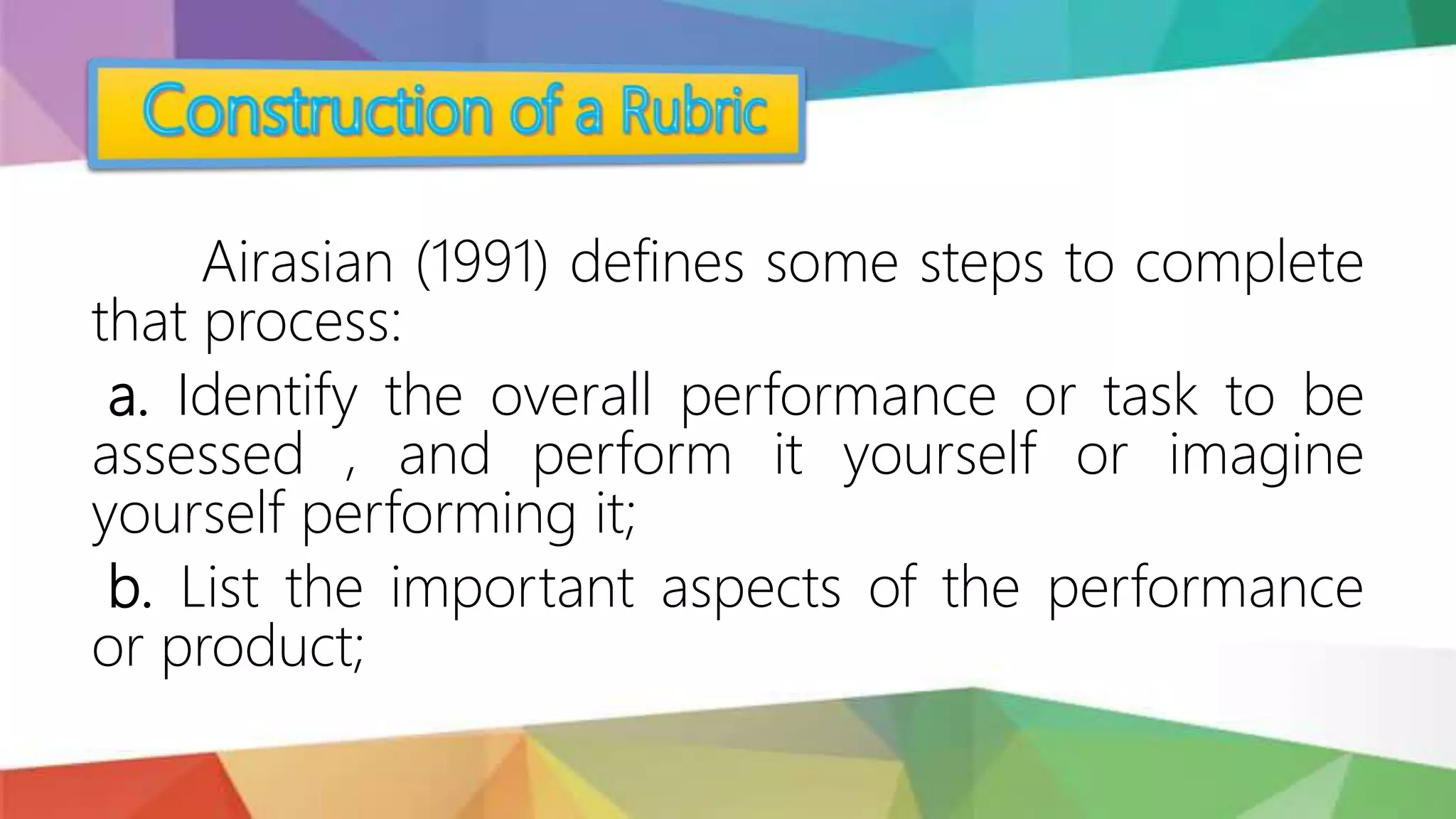
Airasian (1991) defines some steps to complete
that process:
a. Identify the overall performance or task to be
assessed , and perform it yourself or imagine
yourself performing it;
b. List the important aspects of the performance
or product;
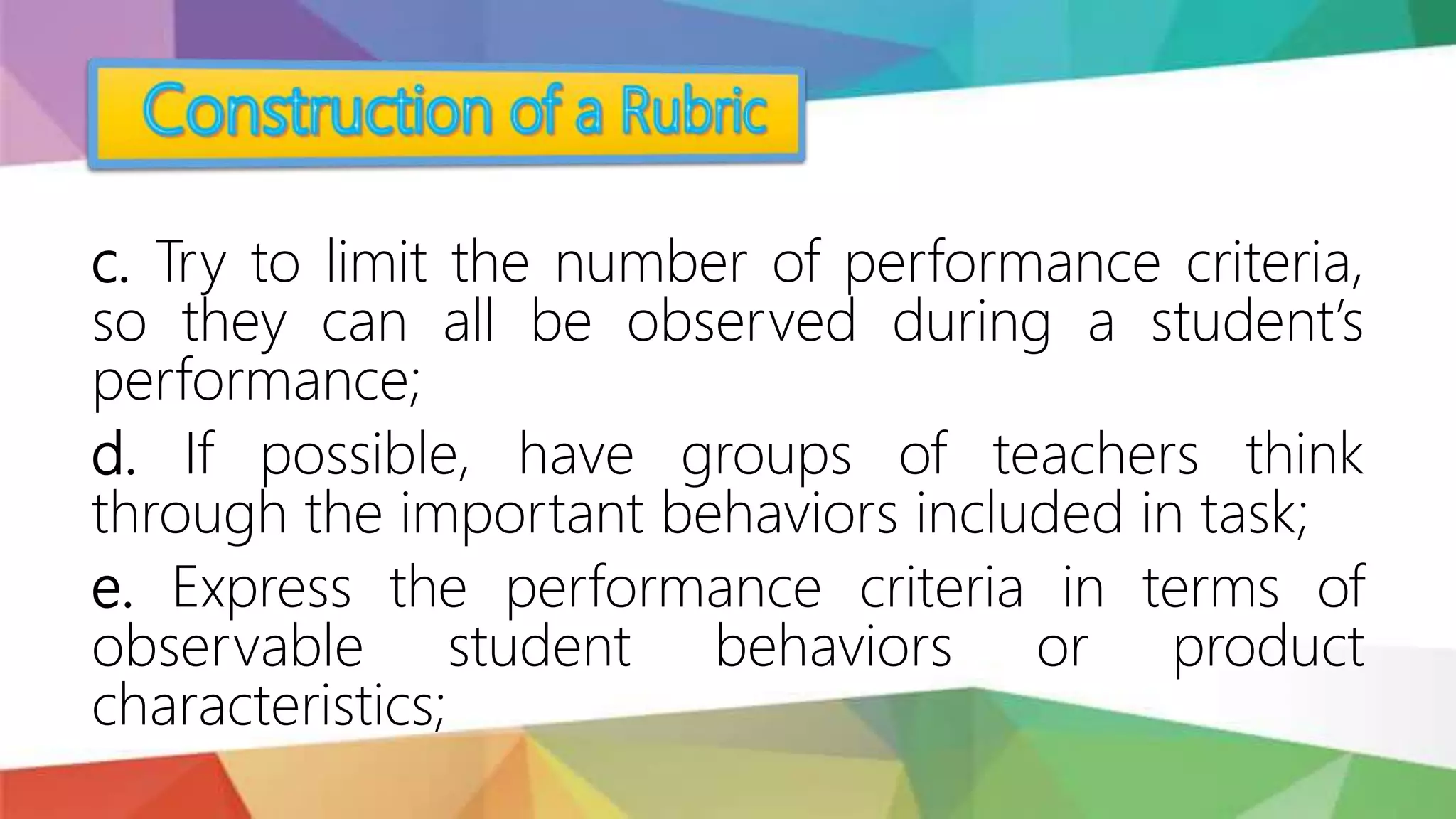
c. Try to limit the number of performance criteria,
so they can all be observed during a student’s
performance;
d. If possible, have groups of teachers think
through the important behaviors included in task;
e. Express the performance criteria in terms of
observable student behaviors or product
characteristics;
f. Don’t use ambiguous words that cloud the
meaning of the performance criteria;
g. Arrange the performance criteria in the order in
which they are likely to be observed.
In this part, it is aimed to provide an
understanding “a rubric in language teaching”. It
consists typically two sections:
a. Scores along with one axis of the grid and
language behavior descriptors inside the grid for
what each score means in terms of language
performance.
b. Language categories along one axis and scores along
the other axis and language behavior descriptors inside
the grid for what each score within each category means
in terms of language performance (Brown, 2012)
 However, there are different categorization to refer to
parts of a typical rubric. According to a Stevens and Levi,
it should have four parts (2005)
b. Language categories along one axis and scores along
the other axis and language behavior descriptors inside
the grid for what each score within each category means
in terms of language performance (Brown, 2012)
 However, there are different categorization to refer to
parts of a typical rubric. According to a Stevens and Levi,
it should have four parts (2005)
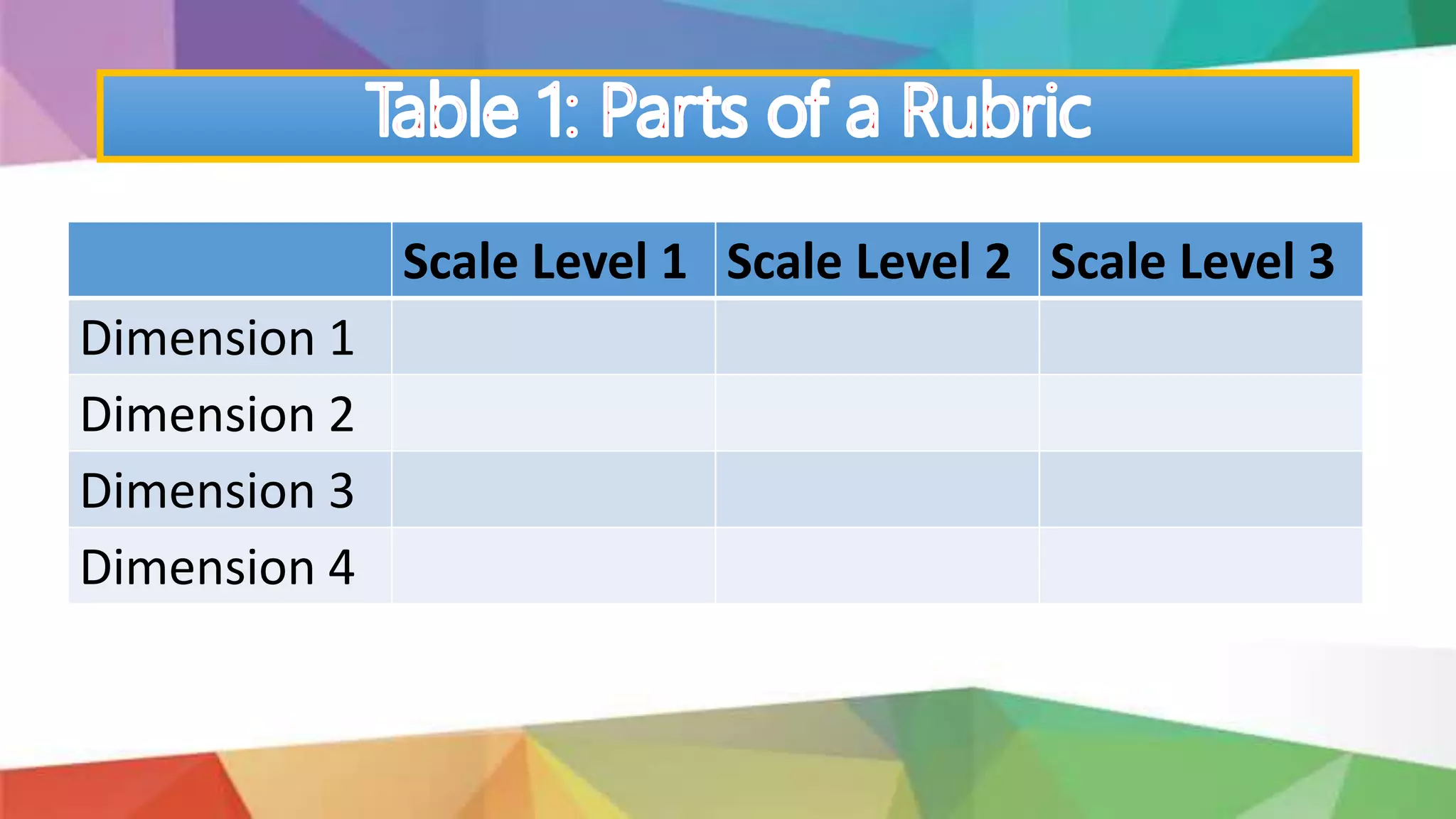
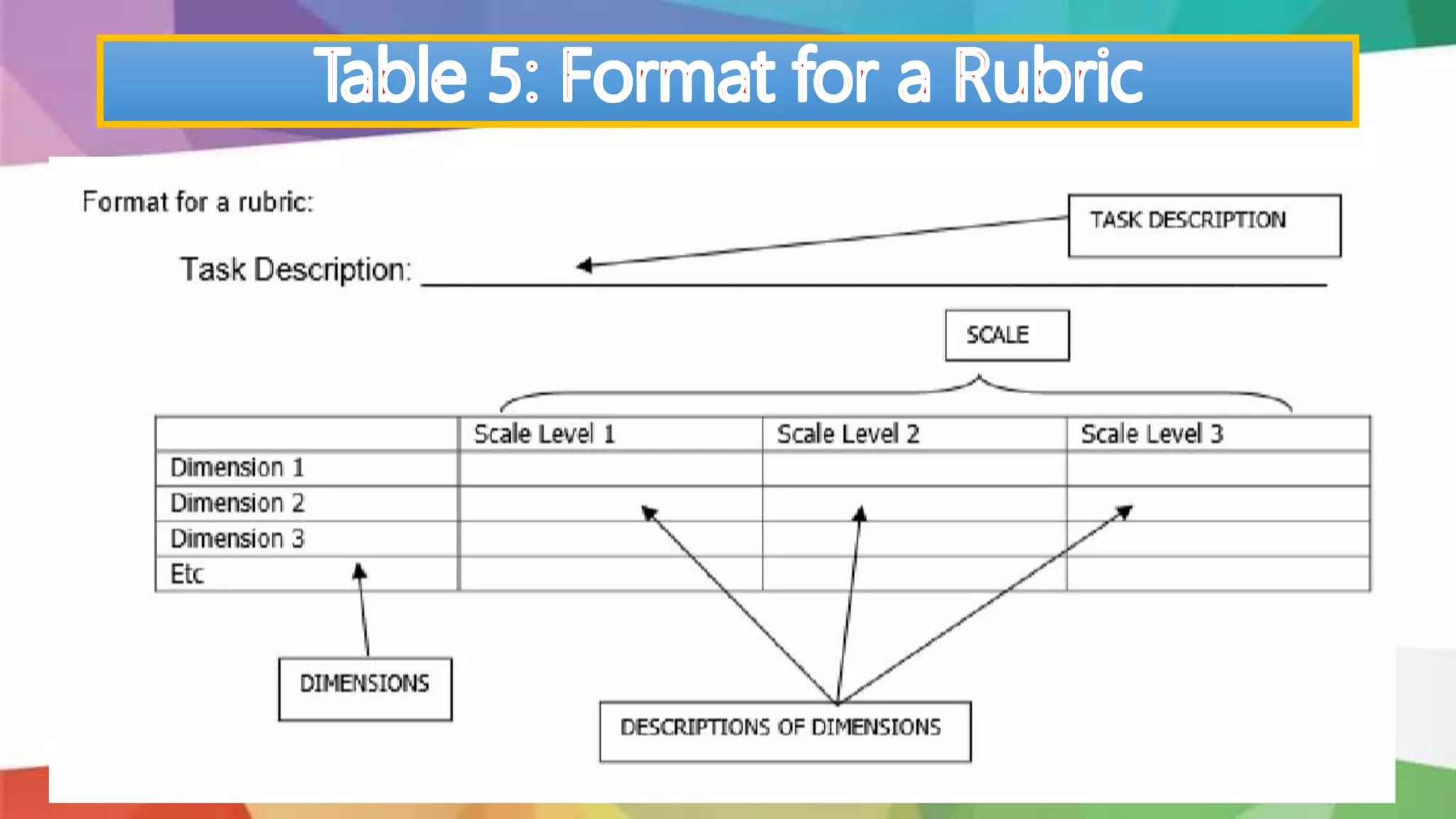
Scale Level 1 Scale Level 2 Scale Level 3
Dimension 1
Dimension 2
Dimension 3
Dimension 4
1. Task description: It is framed always by the instructor
and includes a “performance” of some types by the
student. That task can be a specific assignment, a paper, a
presentation, a poster etc. and it applies to overall
behavior of the student such as participation, behavioral
expectations in the classroom. Task descriptions are
mostly cut and pasted from the syllabus and placed at the
top of the grading rubric.
2. Scale:
• This part gives the description of how well or poor given
task is performed and indicates the rubric`s evaluative
goal.
• Terms applied to describe the level of performance
should be tactful but clear,
For example:
“Mastery, partial mastery, progressing and emerging”.
 These words provide a positive, active, verb description of
the next expectations from the student and mitigate the
potential shock of low marks in the lowest levels of scale.
• “Sophisticated, competent, partly competent, not yet competent
(NFS Synthesis Engineering Education Coalition, 1977);
• Accomplished, average, developing, beginning (College of
Education, 1997);
• Distinguished, proficient, intermediate, novice (Gotcher, 1997);
• Advanced, intermediate high, intermediate, novice (American
Council of Teachers of Foreign Languages, 1986, 278).
Some commonly used labels are:
3. Dimensions:
• This part lays out the components of the task.
• It also clarifies how the students` task can be broken
down into components in terms of importance:
content of the assignment, which aspect of the
assignment?
• Dimensions should represent the types of the
skill to be achieved by the students in a scholarly work
such as technique, citation, example analysis, use of
language appropriate to the occasion.
Task: Each student will make a 5-minute presentation on
the changes in one community over the past 30 years.
student may focus the presentation in any way he or she
wishes, but there needs to be a thesis of some sort, not
a chronological exposition. The presentation should
include appropriate photographs, maps, graphs, and
visual aids for the audience.
Example:
Excellent Competent Need Work
Knowledge/understanding 20%
Thinking/inquiry 30%
Communication 20%
Use of visual aids 20%
Presentation skills 10%
4. Descriptions of dimensions:
• Descriptions of dimensions help show where the student failed
the desired level of proficiency or highest expectation of the
task to be reached.
• If the dimension includes just one description, it is called
guide rubrics”. They allow greater flexibility and more
personalization while expanding the time needed.
• Mostly, three dimension descriptions are preferred. The more
descriptions, the harder it becomes to grade. If a dimension
exceeds 5 descriptions, the ability to grade becomes more
difficult.
Task: Each student will make a 5-minute presentation on
the changes in one community over the past 30 years.
student may focus the presentation in any way he or she
wishes, but there needs to be a thesis of some sort, not
a chronological exposition. The presentation should
include appropriate photographs, maps, graphs, and
visual aids for the audience.
Example: (Same task)
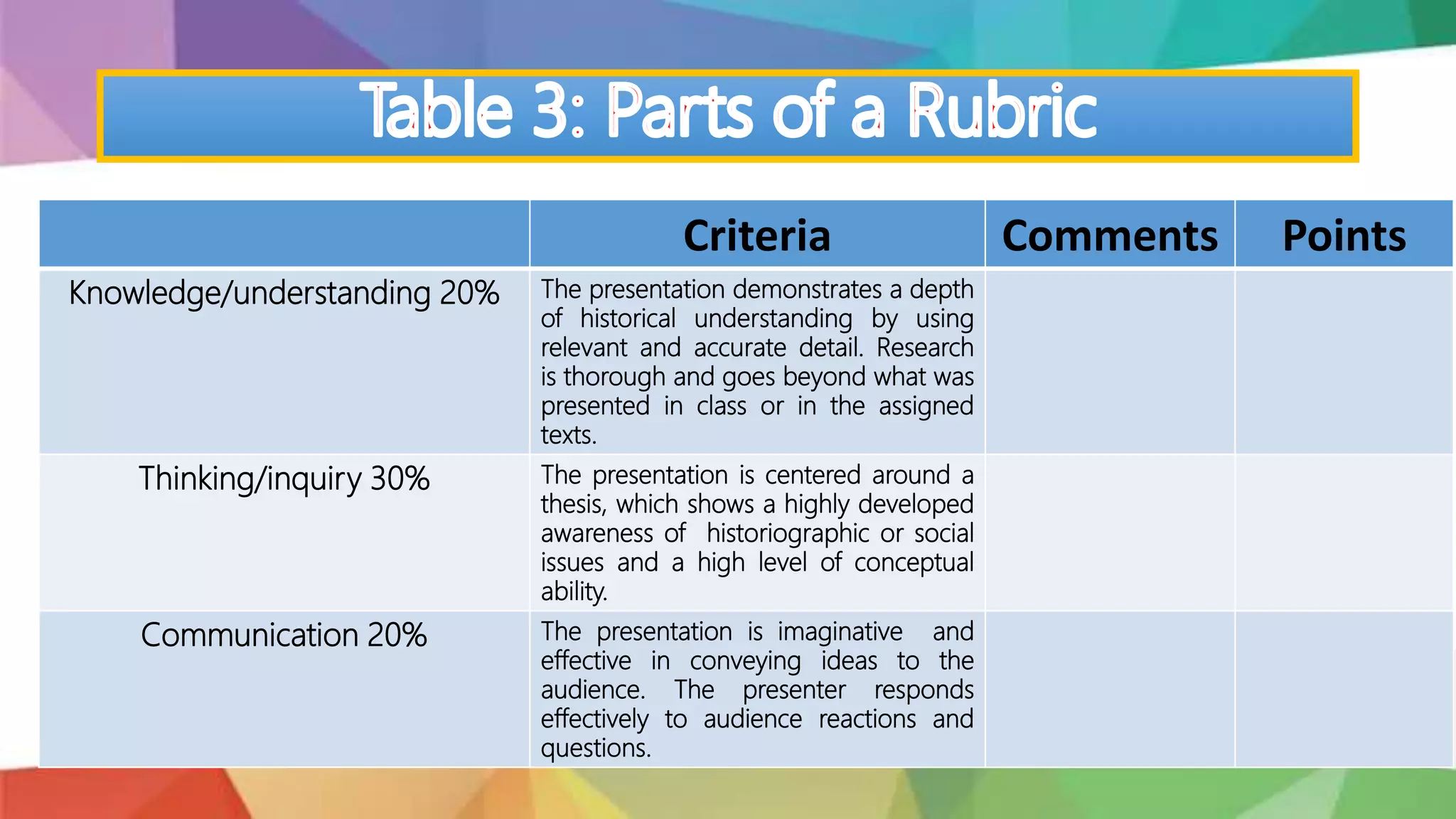
Criteria Comments Points
Knowledge/understanding 20% The presentation demonstrates a depth
of historical understanding by using
relevant and accurate detail. Research
is thorough and goes beyond what was
presented in class or in the assigned
texts.
Thinking/inquiry 30% The presentation is centered around a
thesis, which shows a highly developed
awareness of historiographic or social
issues and a high level of conceptual
ability.
Communication 20% The presentation is imaginative and
effective in conveying ideas to the
audience. The presenter responds
effectively to audience reactions and
questions.
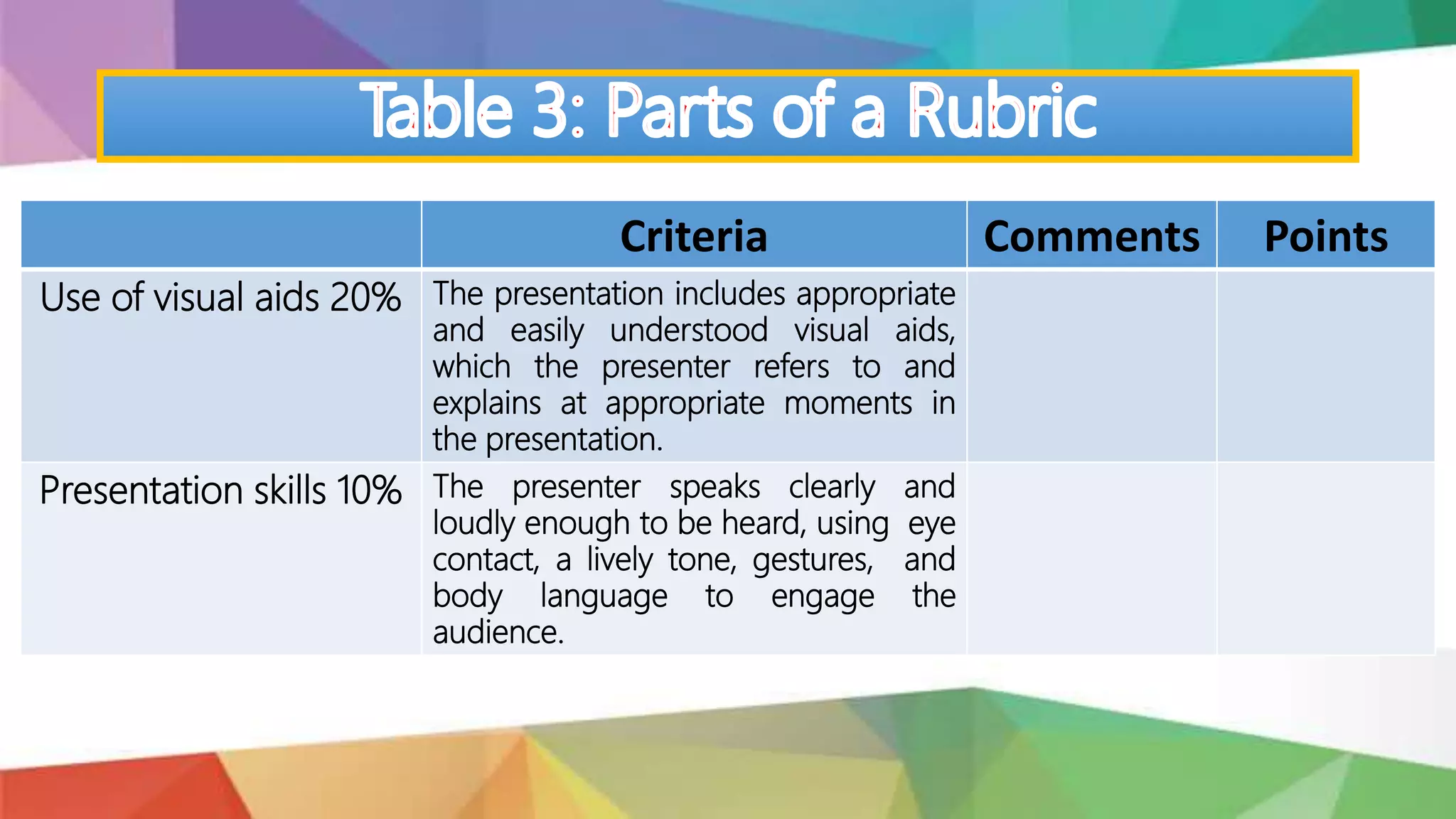
Criteria Comments Points
Use of visual aids 20% The presentation includes appropriate
and easily understood visual aids,
which the presenter refers to and
explains at appropriate moments in
the presentation.
Presentation skills 10% The presenter speaks clearly and
loudly enough to be heard, using eye
contact, a lively tone, gestures, and
body language to engage the
audience.
Task: Each student will make a 5-minute presentation on
the changes in one community over the past 30 years.
student may focus the presentation in any way he or she
wishes, but there needs to be a thesis of some sort, not
a chronological exposition. The presentation should
include appropriate photographs, maps, graphs, and
visual aids for the audience.
Three-level Rubric Sample: (same task)
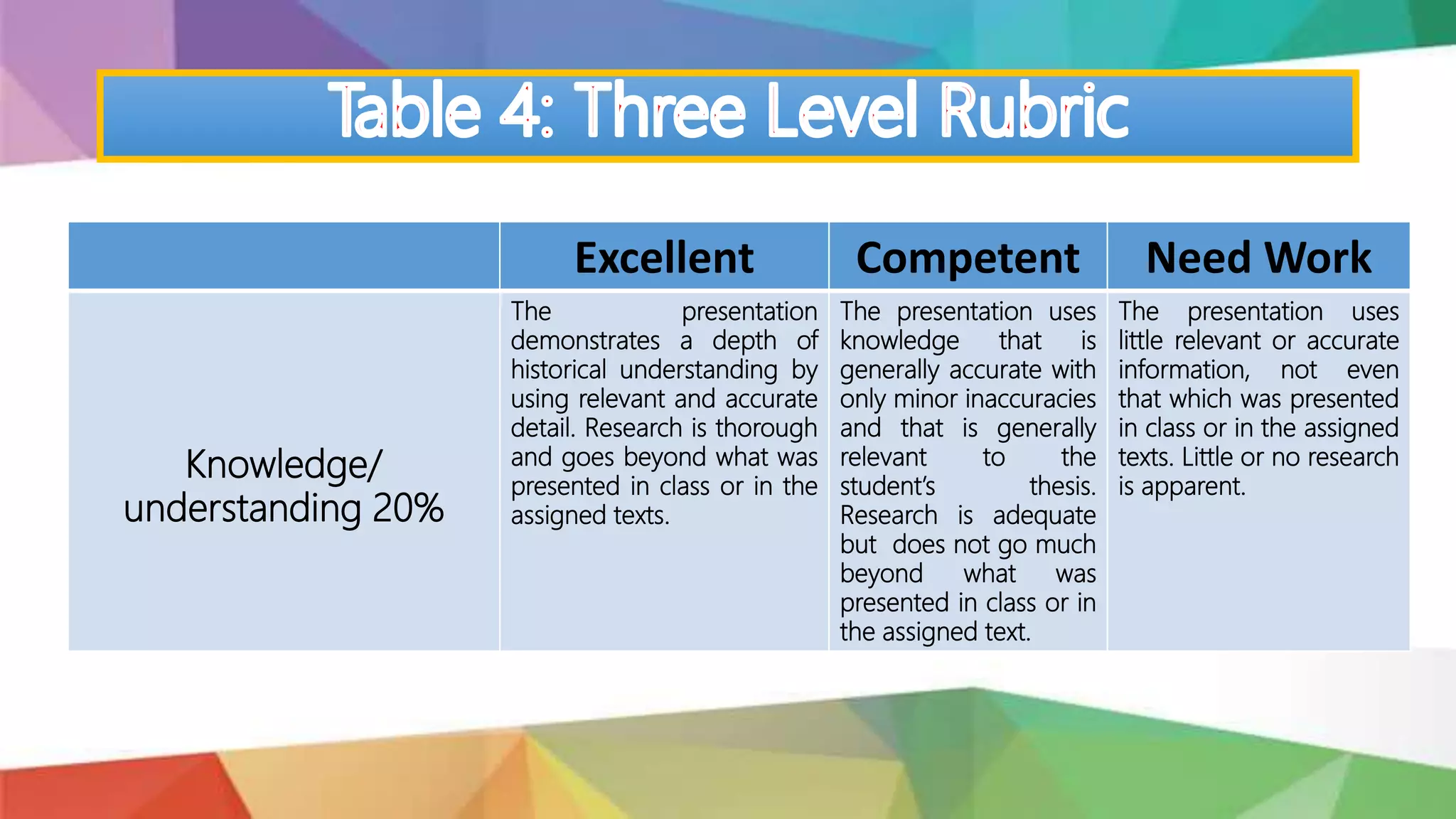
Excellent Competent Need Work
Knowledge/
understanding 20%
The presentation
demonstrates a depth of
historical understanding by
using relevant and accurate
detail. Research is thorough
and goes beyond what was
presented in class or in the
assigned texts.
The presentation uses
knowledge that is
generally accurate with
only minor inaccuracies
and that is generally
relevant to the
student’s thesis.
Research is adequate
but does not go much
beyond what was
presented in class or in
the assigned text.
The presentation uses
little relevant or accurate
information, not even
that which was presented
in class or in the assigned
texts. Little or no research
is apparent.
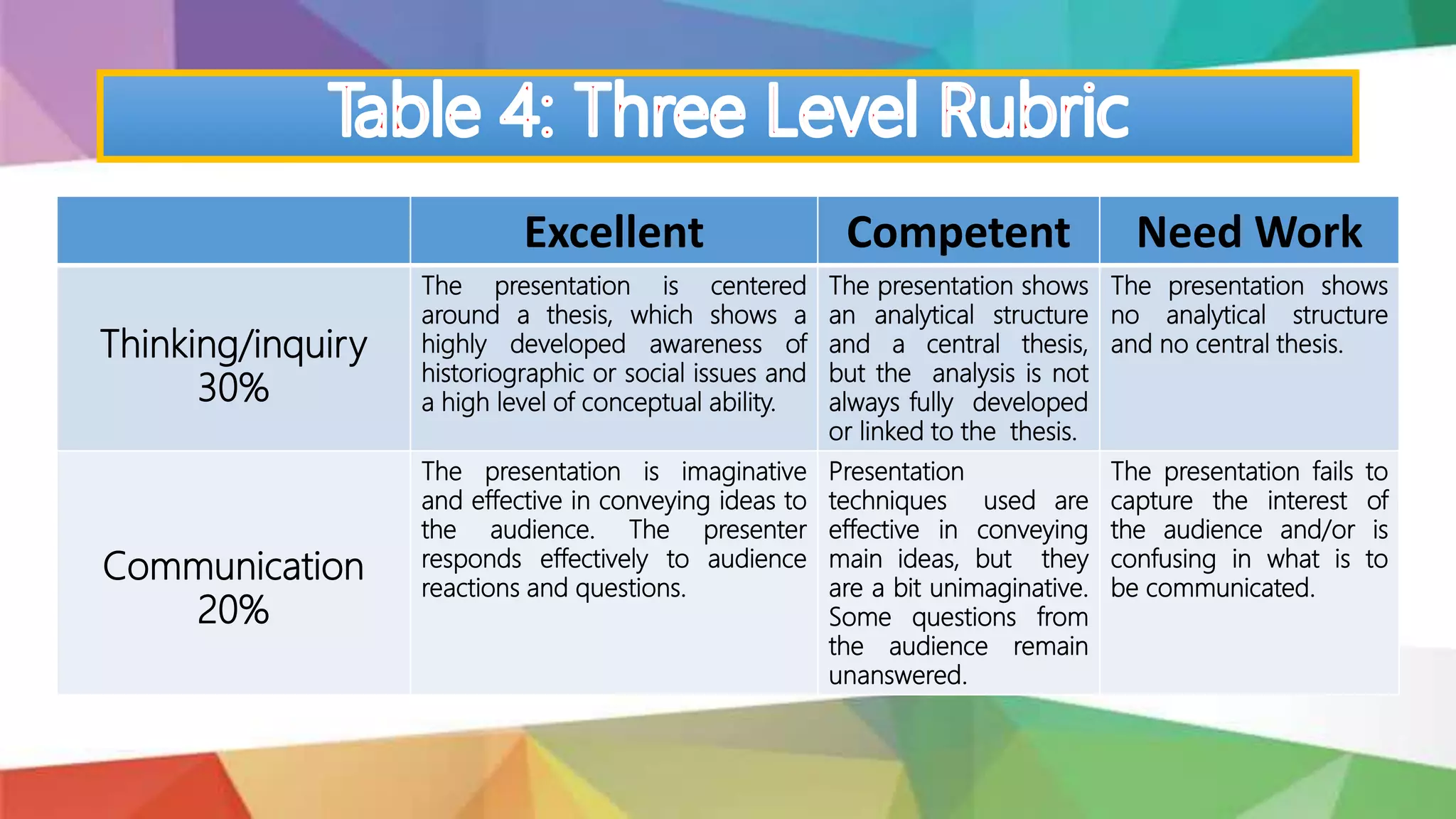
Excellent Competent Need Work
Thinking/inquiry
30%
The presentation is centered
around a thesis, which shows a
highly developed awareness of
historiographic or social issues and
a high level of conceptual ability.
The presentation shows
an analytical structure
and a central thesis,
but the analysis is not
always fully developed
or linked to the thesis.
The presentation shows
no analytical structure
and no central thesis.
Communication
20%
The presentation is imaginative
and effective in conveying ideas to
the audience. The presenter
responds effectively to audience
reactions and questions.
Presentation
techniques used are
effective in conveying
main ideas, but they
are a bit unimaginative.
Some questions from
the audience remain
unanswered.
The presentation fails to
capture the interest of
the audience and/or is
confusing in what is to
be communicated.
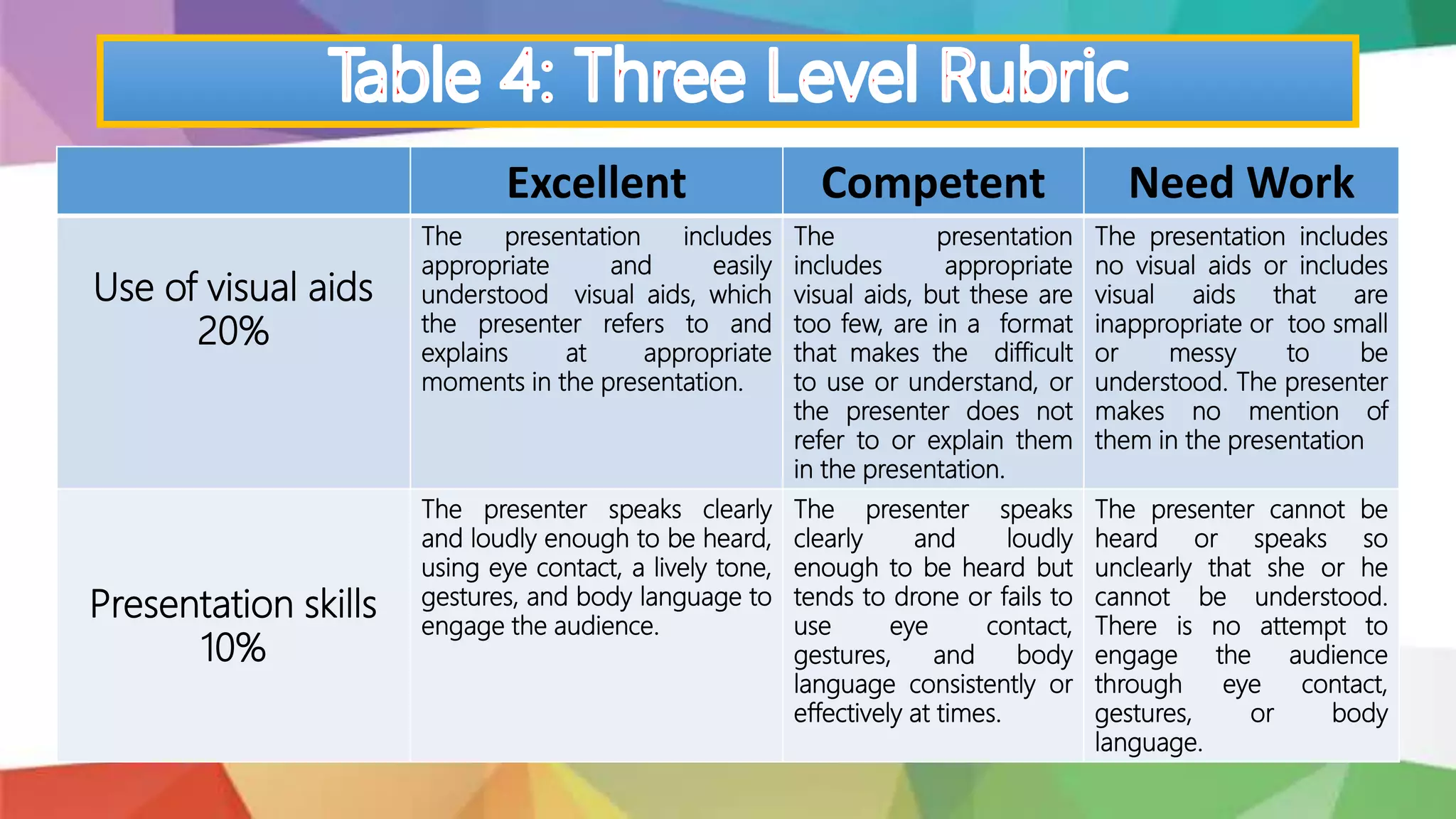
Excellent Competent Need Work
Use of visual aids
20%
The presentation includes
appropriate and easily
understood visual aids, which
the presenter refers to and
explains at appropriate
moments in the presentation.
The presentation
includes appropriate
visual aids, but these are
too few, are in a format
that makes the difficult
to use or understand, or
the presenter does not
refer to or explain them
in the presentation.
The presentation includes
no visual aids or includes
visual aids that are
inappropriate or too small
or messy to be
understood. The presenter
makes no mention of
them in the presentation
Presentation skills
10%
The presenter speaks clearly
and loudly enough to be heard,
using eye contact, a lively tone,
gestures, and body language to
engage the audience.
The presenter speaks
clearly and loudly
enough to be heard but
tends to drone or fails to
use eye contact,
gestures, and body
language consistently or
effectively at times.
The presenter cannot be
heard or speaks so
unclearly that she or he
cannot be understood.
There is no attempt to
engage the audience
through eye contact,
gestures, or body
language.
 CARLA (Center for Advanced Research on Language
Acquisition) compiled different sets of functions for the use
of rubrics (2013).
According to CARLA, rubrics help us to set anchor points
along a quality continuum, therefore, instructors can set
reasonable and appropriate expectations for learners and
judge consistently how well they are met or not.
 CARLA (Center for Advanced Research on Language
Acquisition) compiled different sets of functions for the
use of rubrics (2013).
According to CARLA, rubrics help us to set anchor
points along a quality continuum, therefore, instructors
can set reasonable and appropriate expectations for
learners and judge consistently how well they are met or
not.
1. Well-designed rubrics play a significant role to increase
an assessment construct and content validity by aligning
evaluation criteria to standards, curriculum, instruction
and assessment tasks.
2. By setting criteria to rate, well-designed rubrics can
increase the reliability of that assessment, thus, it applies
consistency and objectivity.
3. Bias can be reduced by evaluating student’s work with
established criteria that help instructors clarify goals and
improve their teaching by identifying the most salient
criteria for the evaluation of performance and by writing
the descriptions of excellent performance.
4. They help learners set goals and take the responsibility
of their own learning, since it provides an understanding
of optimal performance.
5. Learners can develop their ability to judge quality in
their own work and others` work through self and peer
assessment rubrics.
6. Rubrics answer the question "Why did I/my child get a
B on this project?"
7. Rubrics help learners get specific feedback about their
strong and weak areas and about how to develop their
performance.
8. They play role in the assessment of learners` effort and
performance on their own and make adjustments before
the submission of the assignments for grading.
9. Rubrics allow the learners, teachers, parent to monitor
the progress over a certain time period of instruction.
10. Time spent evaluating performance and providing
feedback can be reduced.
11. They help learners autonomy for their own learning
and assessment if they participate in rubric design, thus,
they become self-directed learners.
12. Subjectivity in grading can be moved away by
including students to assess work based on consistent,
agreed upon and objective criteria.
 There are two dominant types of rubrics: holistic
and analytic rubrics.
 However, primary trait and multiple trait rubrics
are also commonly used.
 In comparison with each other, it is hard to tell
which types or type is better to use since it
depends on the task, key criteria to be fulfilled by
the learners.
 Before giving the decision which one to use in class, it
is important to decide the key criteria.
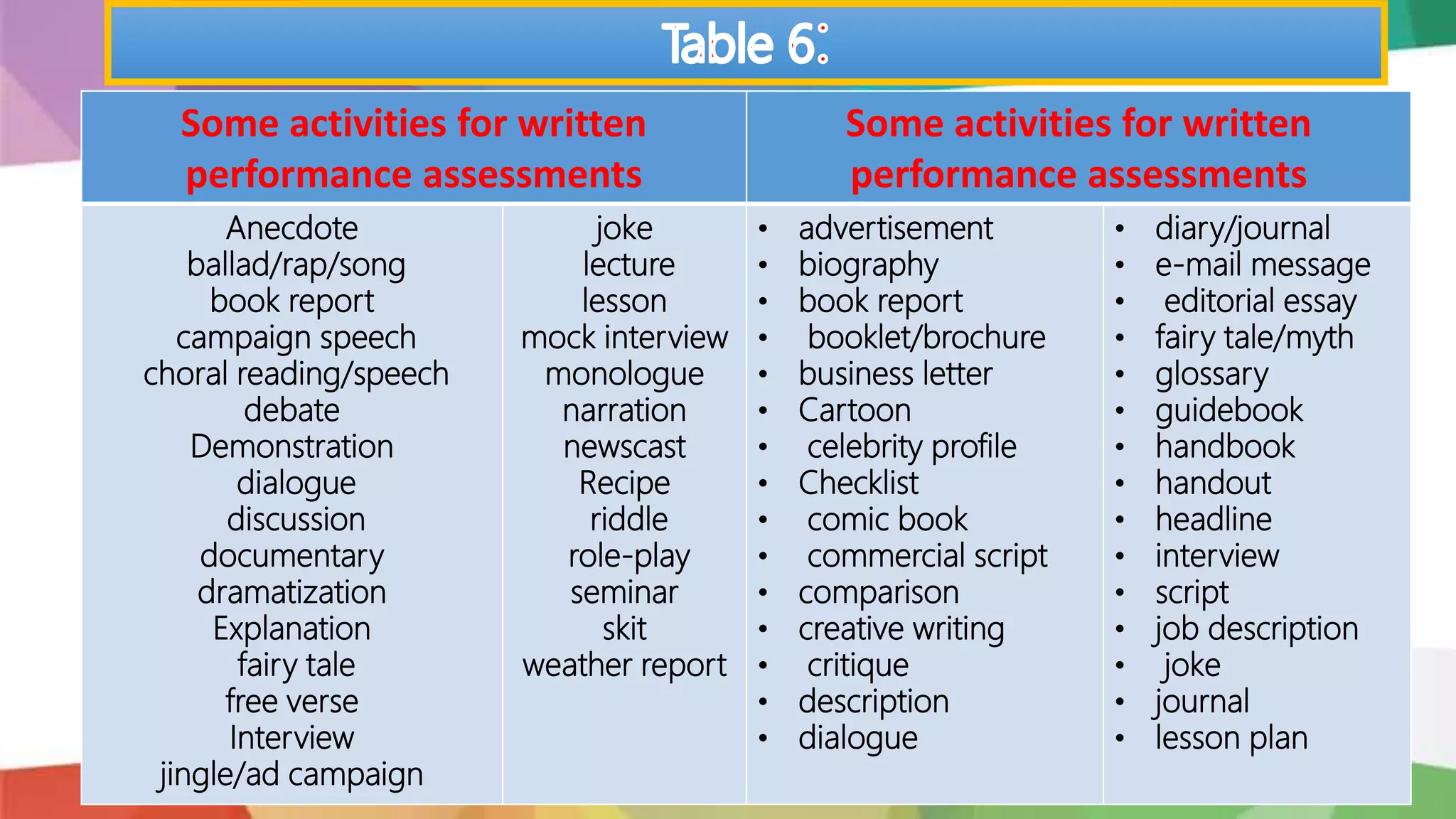
Blaz (2001) compile in her study most common tasks
used in assessments.
Her study is based on performance tasks: written and
oral tasks.
Some activities for written
performance assessments
Some activities for written
performance assessments
Anecdote
ballad/rap/song
book report
campaign speech
choral reading/speech
debate
Demonstration
dialogue
discussion
documentary
dramatization
Explanation
fairy tale
free verse
Interview
jingle/ad campaign
joke
lecture
lesson
mock interview
monologue
narration
newscast
Recipe
riddle
role-play
seminar
skit
weather report
• advertisement
• biography
• book report
• booklet/brochure
• business letter
• Cartoon
• celebrity profile
• Checklist
• comic book
• commercial script
• comparison
• creative writing
• critique
• description
• dialogue
• diary/journal
• e-mail message
• editorial essay
• fairy tale/myth
• glossary
• guidebook
• handbook
• handout
• headline
• interview
• script
• job description
• joke
• journal
• lesson plan
 Holistic rubrics contain different levels
of performance that describes the
quality, quantity, quantity/quality of a
task.
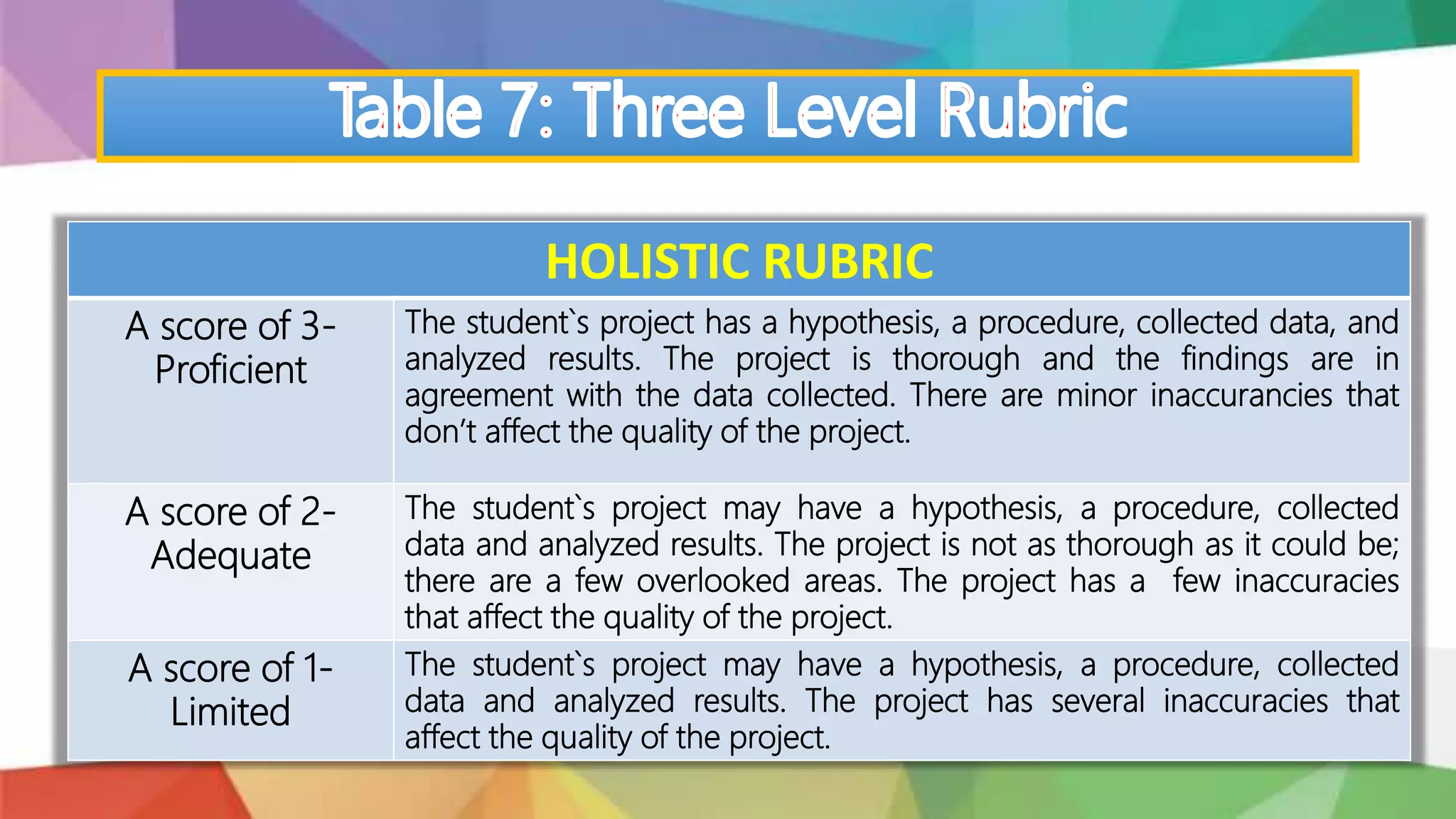
HOLISTIC RUBRIC
A score of 3-
Proficient
The student`s project has a hypothesis, a procedure, collected data, and
analyzed results. The project is thorough and the findings are in
agreement with the data collected. There are minor inaccurancies that
don’t affect the quality of the project.
A score of 2-
Adequate
The student`s project may have a hypothesis, a procedure, collected
data and analyzed results. The project is not as thorough as it could be;
there are a few overlooked areas. The project has a few inaccuracies
that affect the quality of the project.
A score of 1-
Limited
The student`s project may have a hypothesis, a procedure, collected
data and analyzed results. The project has several inaccuracies that
affect the quality of the project.
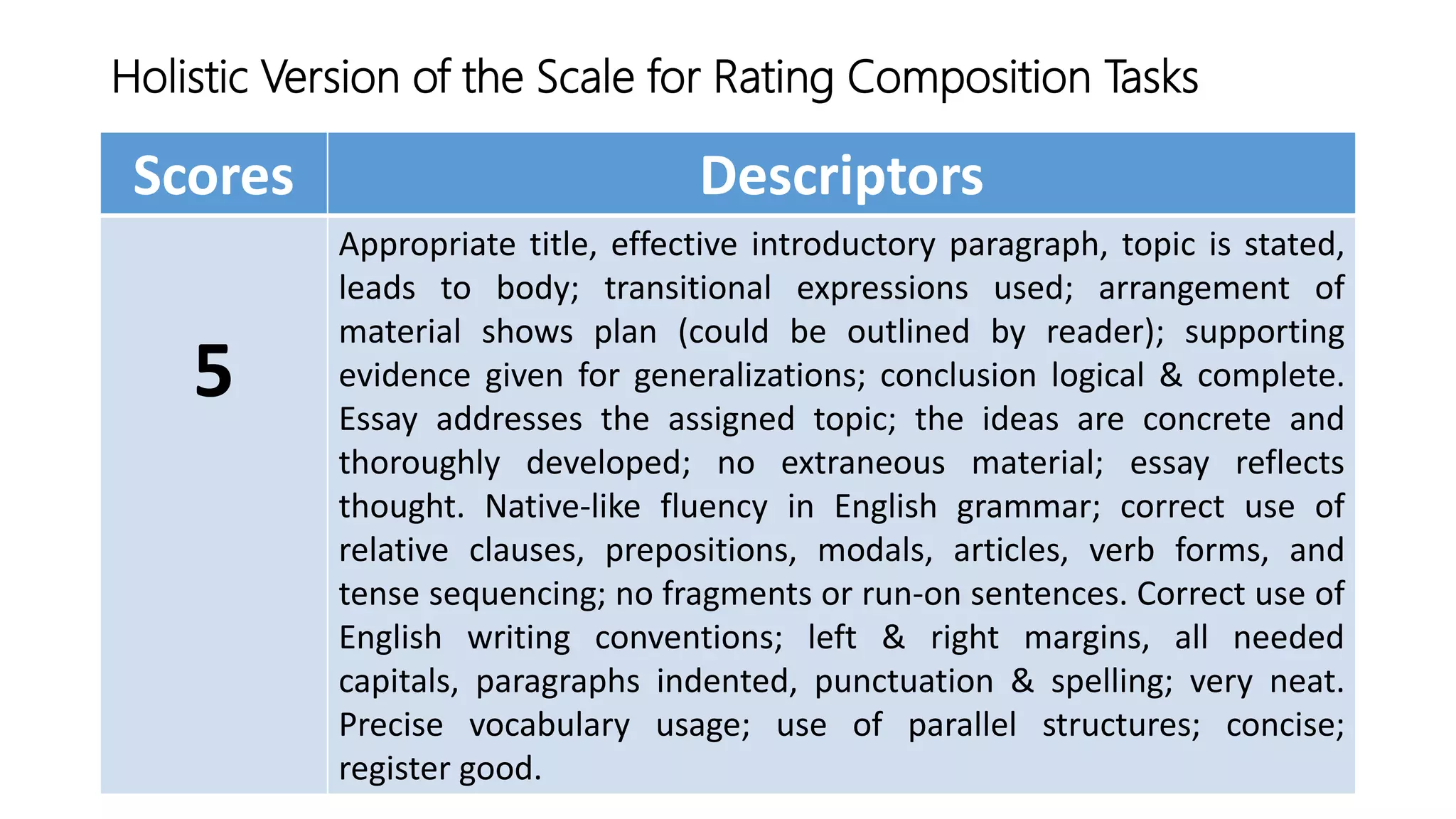
Holistic Version of the Scale for Rating Composition Tasks
Scores Descriptors
5
Appropriate title, effective introductory paragraph, topic is stated,
leads to body; transitional expressions used; arrangement of
material shows plan (could be outlined by reader); supporting
evidence given for generalizations; conclusion logical & complete.
Essay addresses the assigned topic; the ideas are concrete and
thoroughly developed; no extraneous material; essay reflects
thought. Native-like fluency in English grammar; correct use of
relative clauses, prepositions, modals, articles, verb forms, and
tense sequencing; no fragments or run-on sentences. Correct use of
English writing conventions; left & right margins, all needed
capitals, paragraphs indented, punctuation & spelling; very neat.
Precise vocabulary usage; use of parallel structures; concise;
register good.
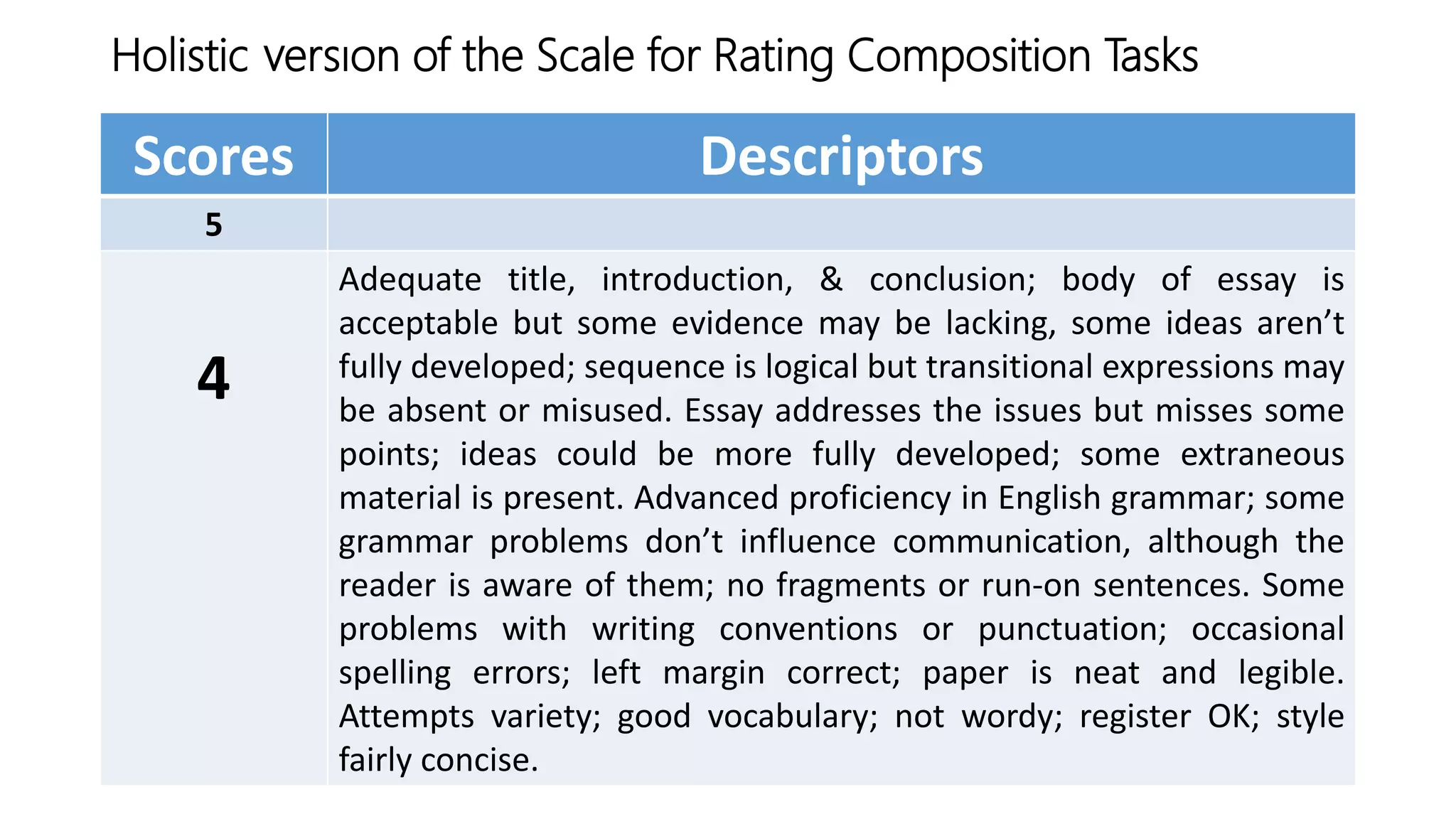
Holistic Version of the Scale for Rating Composition Tasks
Scores Descriptors
5
4
Adequate title, introduction, & conclusion; body of essay is
acceptable but some evidence may be lacking, some ideas aren’t
fully developed; sequence is logical but transitional expressions may
be absent or misused. Essay addresses the issues but misses some
points; ideas could be more fully developed; some extraneous
material is present. Advanced proficiency in English grammar; some
grammar problems don’t influence communication, although the
reader is aware of them; no fragments or run-on sentences. Some
problems with writing conventions or punctuation; occasional
spelling errors; left margin correct; paper is neat and legible.
Attempts variety; good vocabulary; not wordy; register OK; style
fairly concise.
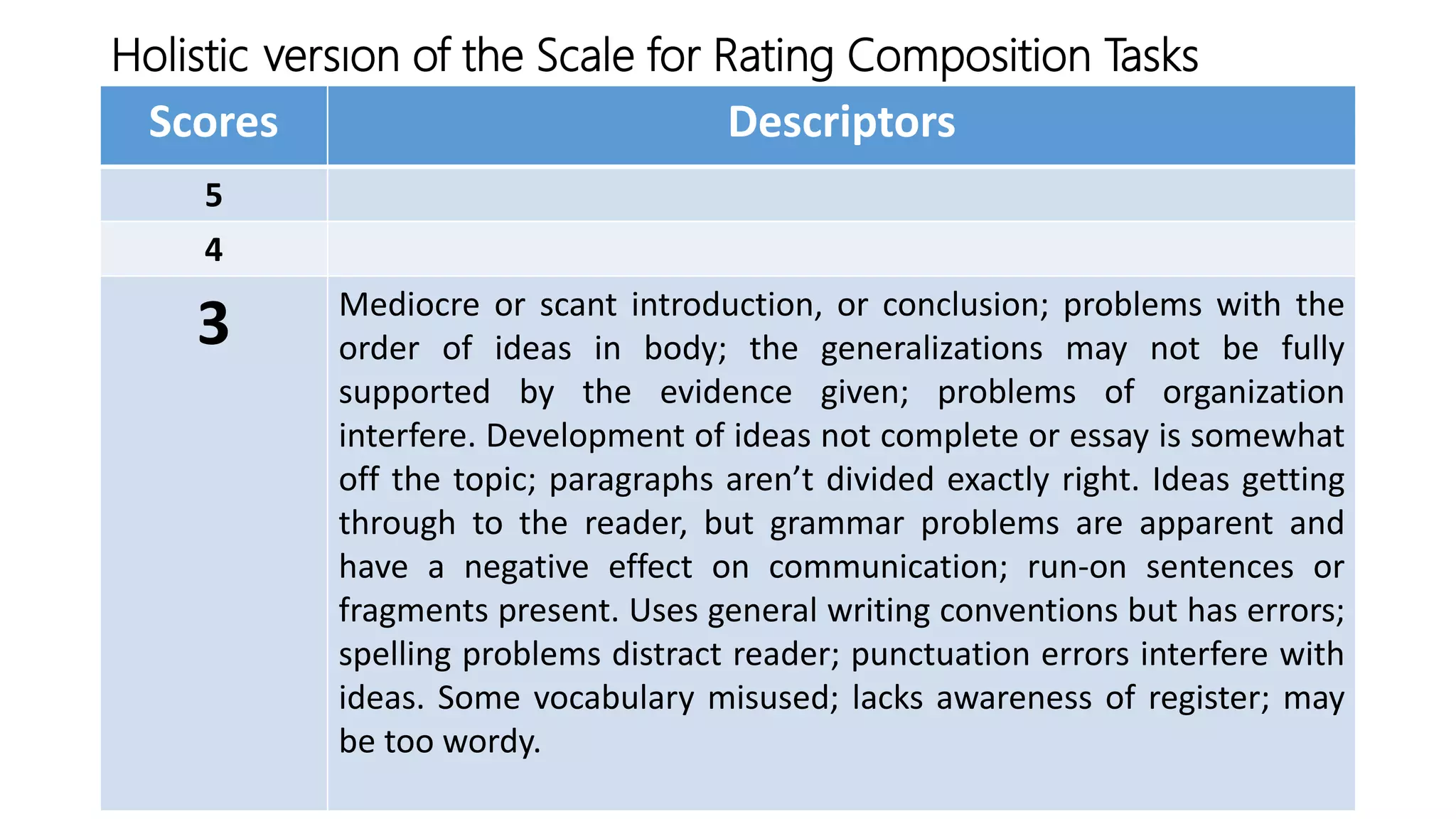
Holistic Version of the Scale for Rating Composition Tasks
Scores Descriptors
5
4
3 Mediocre or scant introduction, or conclusion; problems with the
order of ideas in body; the generalizations may not be fully
supported by the evidence given; problems of organization
interfere. Development of ideas not complete or essay is somewhat
off the topic; paragraphs aren’t divided exactly right. Ideas getting
through to the reader, but grammar problems are apparent and
have a negative effect on communication; run-on sentences or
fragments present. Uses general writing conventions but has errors;
spelling problems distract reader; punctuation errors interfere with
ideas. Some vocabulary misused; lacks awareness of register; may
be too wordy.
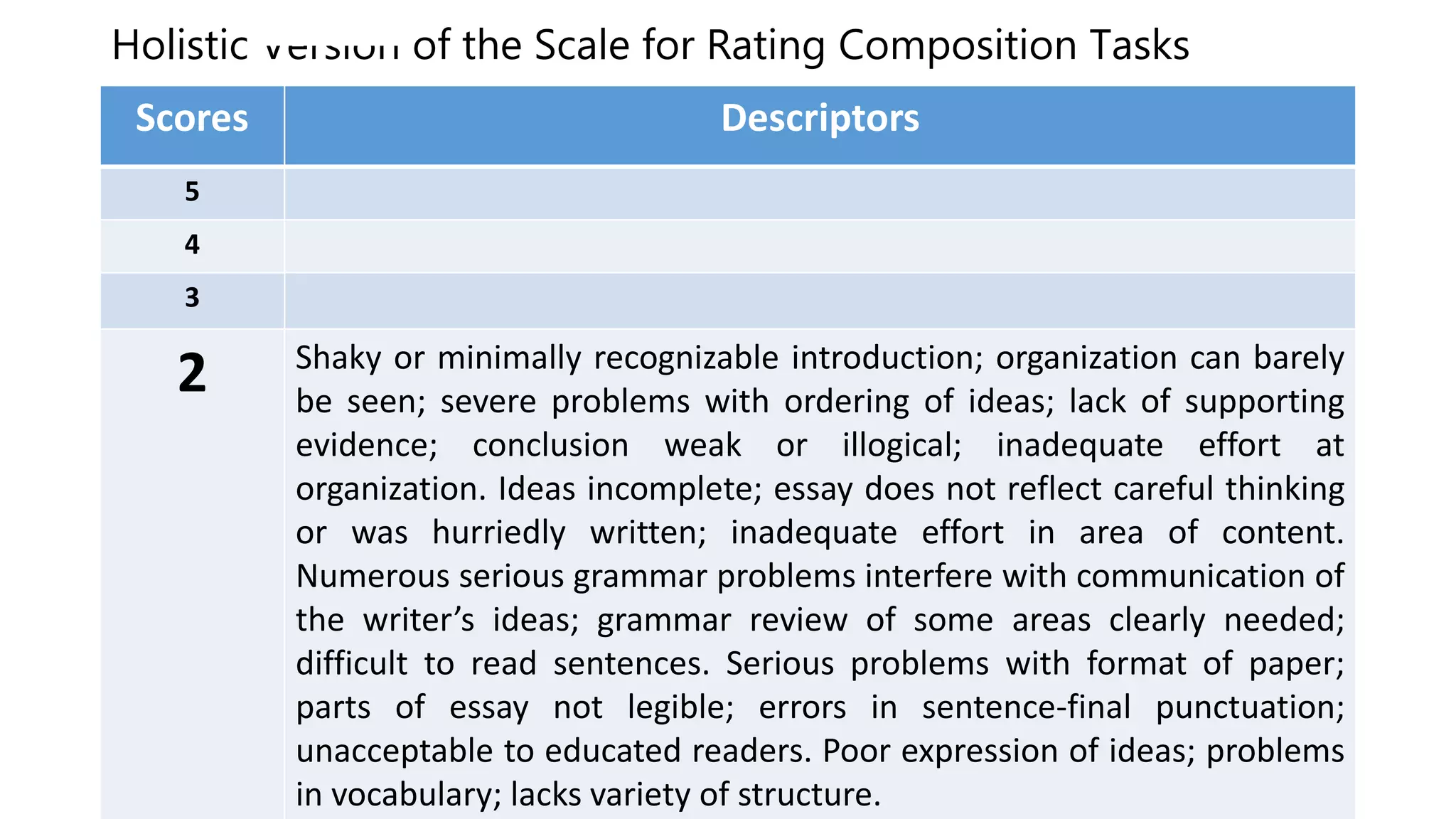
Holistic Version of the Scale for Rating Composition Tasks
Scores Descriptors
5
4
3
2 Shaky or minimally recognizable introduction; organization can barely
be seen; severe problems with ordering of ideas; lack of supporting
evidence; conclusion weak or illogical; inadequate effort at
organization. Ideas incomplete; essay does not reflect careful thinking
or was hurriedly written; inadequate effort in area of content.
Numerous serious grammar problems interfere with communication of
the writer’s ideas; grammar review of some areas clearly needed;
difficult to read sentences. Serious problems with format of paper;
parts of essay not legible; errors in sentence-final punctuation;
unacceptable to educated readers. Poor expression of ideas; problems
in vocabulary; lacks variety of structure.
Holistic Version of the Scale for Rating Composition Tasks
Scores Descriptors
5
4
3
2
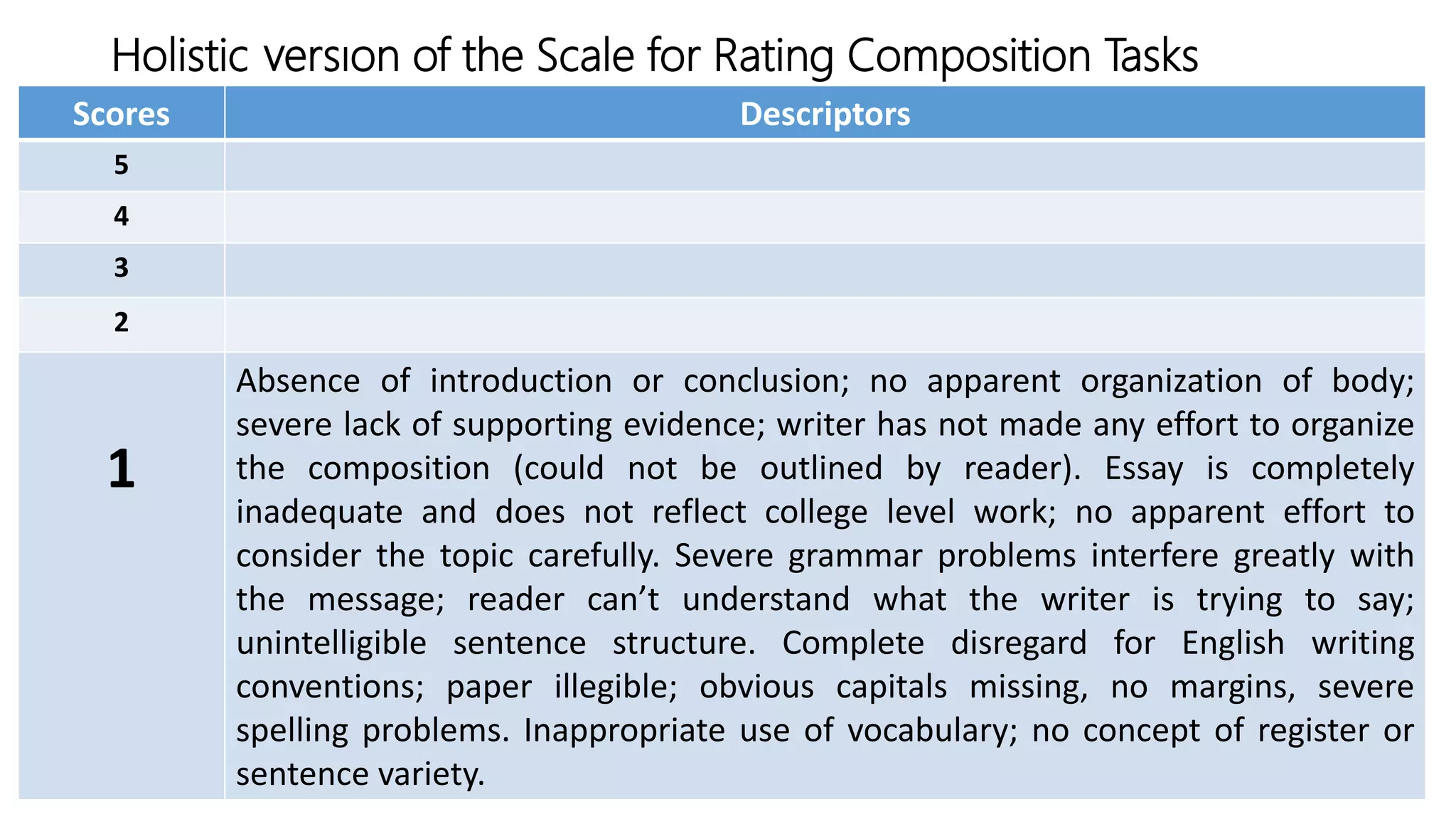
1
Absence of introduction or conclusion; no apparent organization of body;
severe lack of supporting evidence; writer has not made any effort to organize
the composition (could not be outlined by reader). Essay is completely
inadequate and does not reflect college level work; no apparent effort to
consider the topic carefully. Severe grammar problems interfere greatly with
the message; reader can’t understand what the writer is trying to say;
unintelligible sentence structure. Complete disregard for English writing
conventions; paper illegible; obvious capitals missing, no margins, severe
spelling problems. Inappropriate use of vocabulary; no concept of register or
sentence variety.
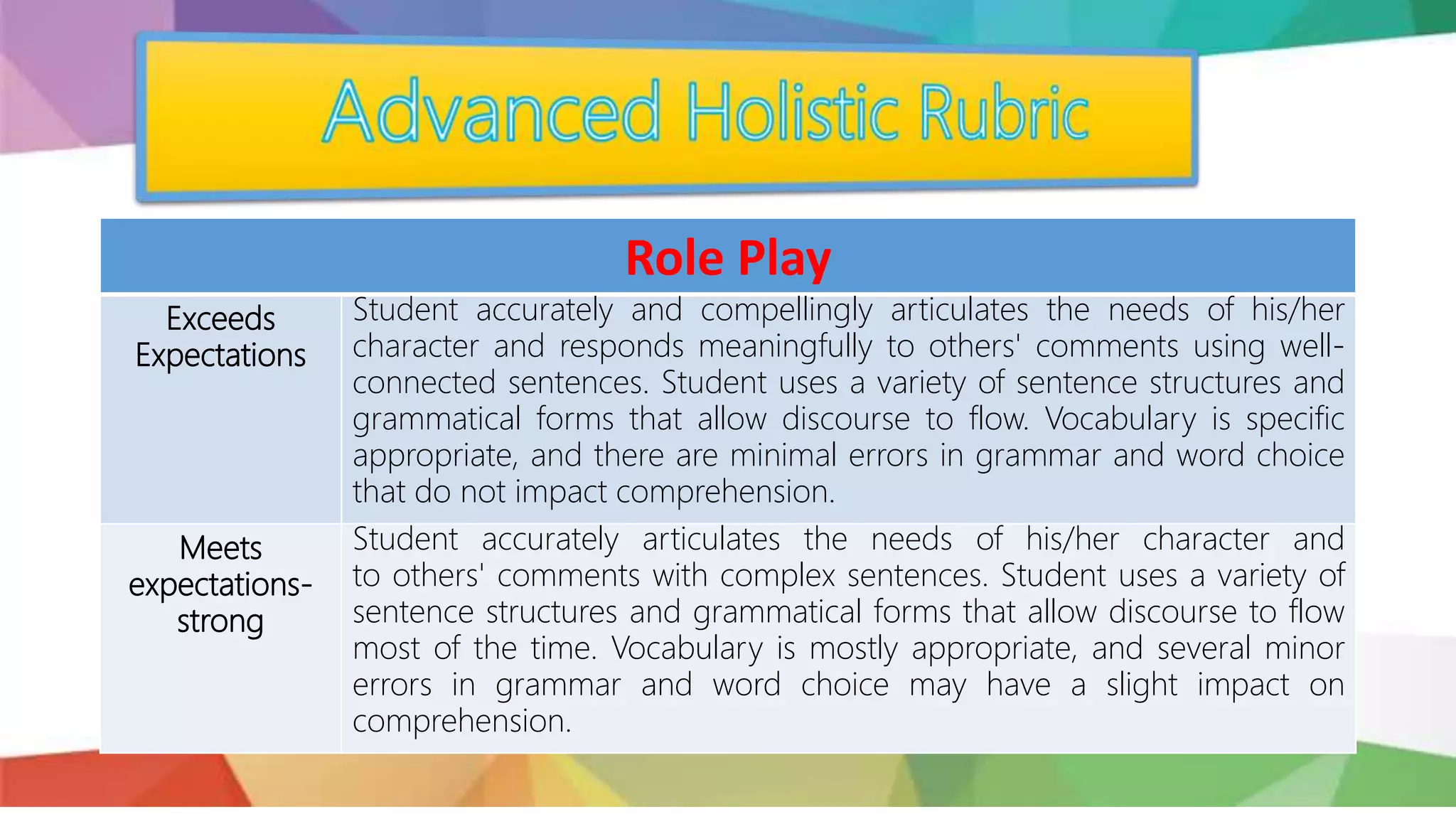
Role Play
Exceeds
Expectations
Student accurately and compellingly articulates the needs of his/her
character and responds meaningfully to others' comments using well-
connected sentences. Student uses a variety of sentence structures and
grammatical forms that allow discourse to flow. Vocabulary is specific
appropriate, and there are minimal errors in grammar and word choice
that do not impact comprehension.
Meets
expectations-
strong
Student accurately articulates the needs of his/her character and
to others' comments with complex sentences. Student uses a variety of
sentence structures and grammatical forms that allow discourse to flow
most of the time. Vocabulary is mostly appropriate, and several minor
errors in grammar and word choice may have a slight impact on
comprehension.
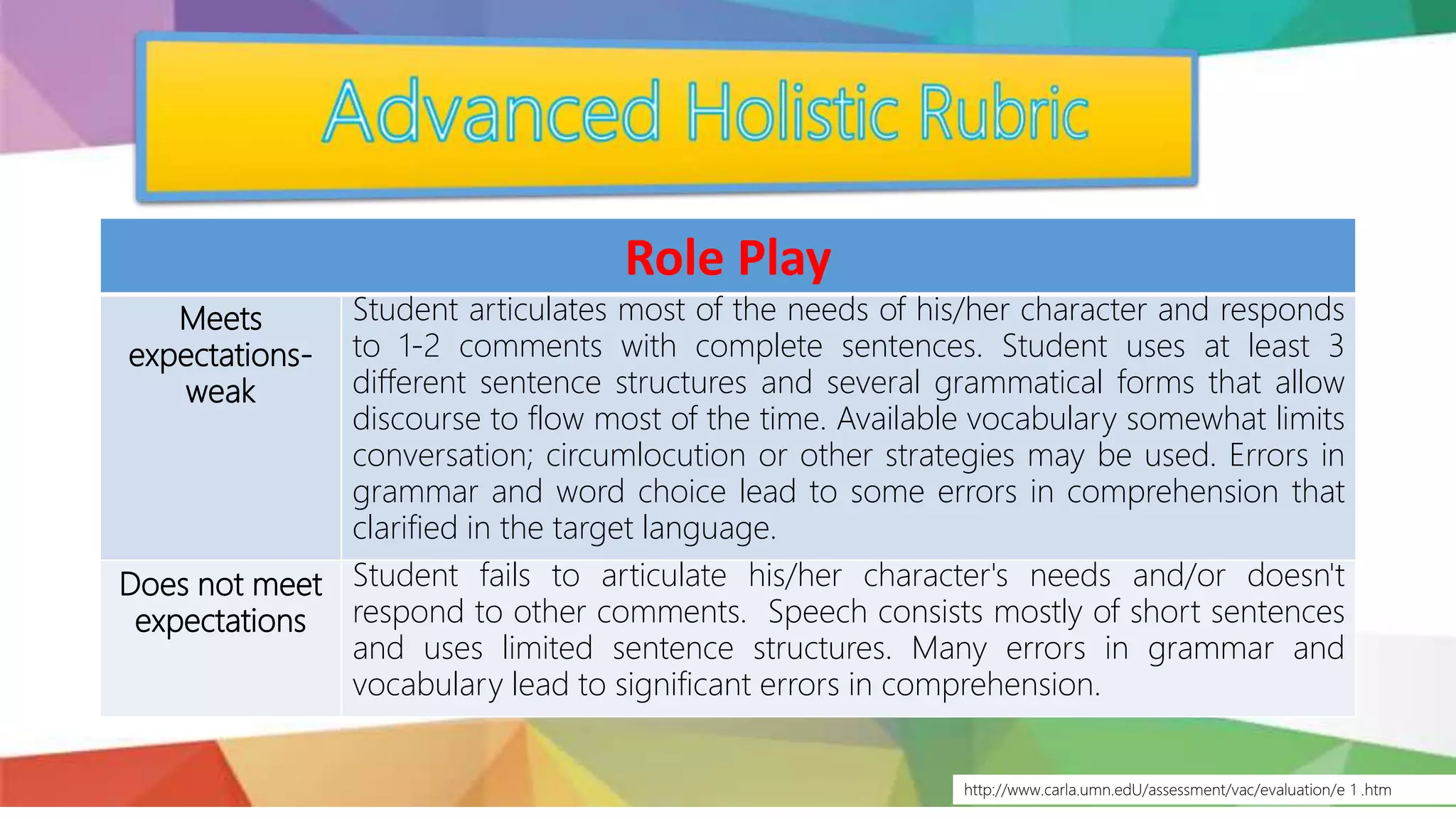
Role Play
Meets
expectations-
weak
Student articulates most of the needs of his/her character and responds
to 1-2 comments with complete sentences. Student uses at least 3
different sentence structures and several grammatical forms that allow
discourse to flow most of the time. Available vocabulary somewhat limits
conversation; circumlocution or other strategies may be used. Errors in
grammar and word choice lead to some errors in comprehension that
clarified in the target language.
Does not meet
expectations
Student fails to articulate his/her character's needs and/or doesn't
respond to other comments. Speech consists mostly of short sentences
and uses limited sentence structures. Many errors in grammar and
vocabulary lead to significant errors in comprehension.
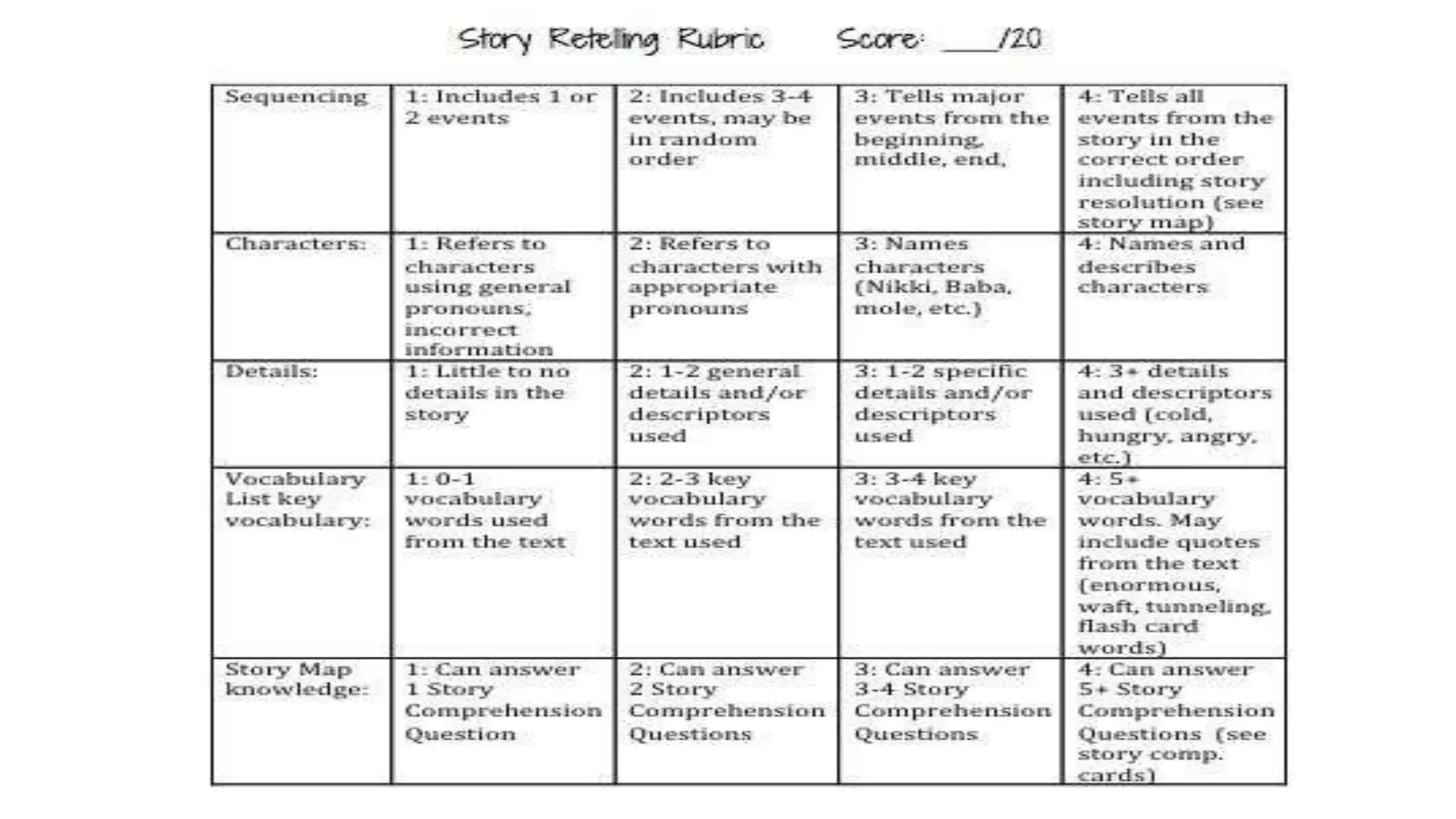
http://www.carla.umn.edU/assessment/vac/evaluation/e 1 .htm
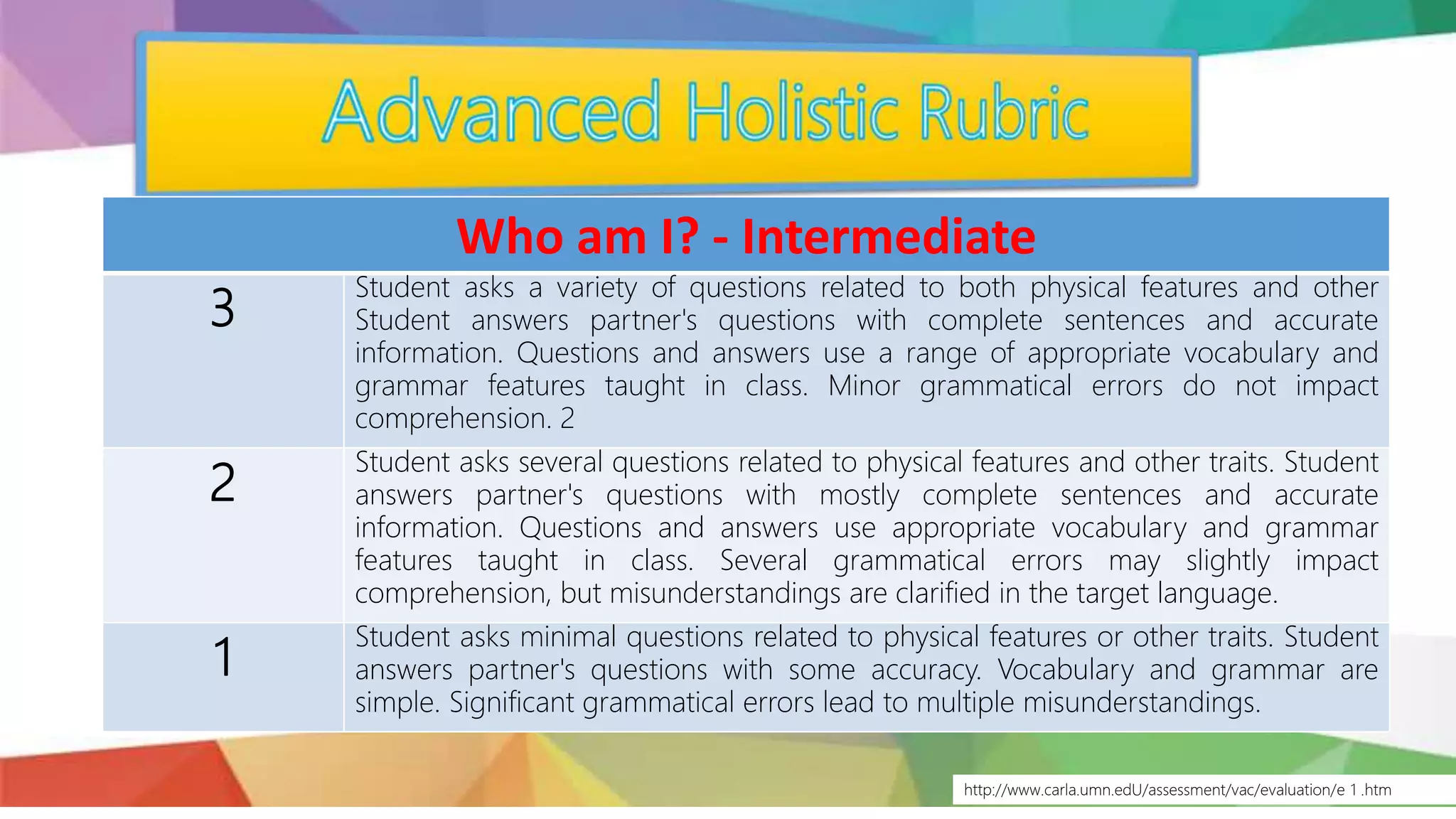
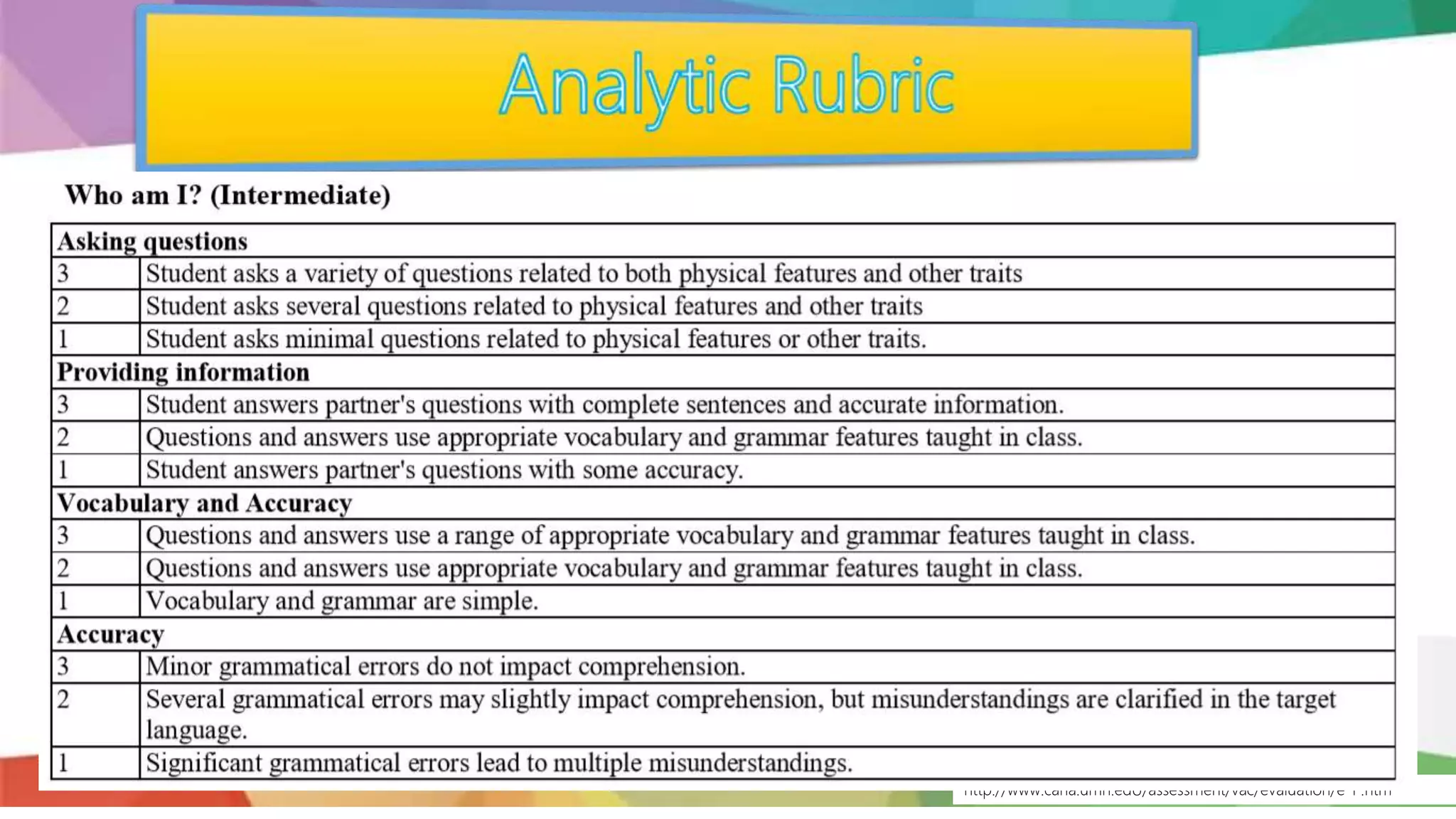
Who am I? - Intermediate
3
Student asks a variety of questions related to both physical features and other
Student answers partner's questions with complete sentences and accurate
information. Questions and answers use a range of appropriate vocabulary and
grammar features taught in class. Minor grammatical errors do not impact
comprehension. 2
2
Student asks several questions related to physical features and other traits. Student
answers partner's questions with mostly complete sentences and accurate
information. Questions and answers use appropriate vocabulary and grammar
features taught in class. Several grammatical errors may slightly impact
comprehension, but misunderstandings are clarified in the target language.
1
Student asks minimal questions related to physical features or other traits. Student
answers partner's questions with some accuracy. Vocabulary and grammar are
simple. Significant grammatical errors lead to multiple misunderstandings.
http://www.carla.umn.edU/assessment/vac/evaluation/e 1 .htm
 In that type of evaluation, raters judge by forming an overall
impression of learners` performance and matching it to best
fitting column on the scale.
 Each scale describes performance according to several criteria
such as range of vocabulary, grammatical accuracy, fluency etc.
Mostly, 4 or 5 performance levels are available in holistic rubrics.
Generally, teachers find it efficient and easy to use for classroom
assessments.
Advantages
 They are often written generically and can be used with many
tasks.
 They emphasize what learners can do, rather than what they
cannot do.
They save time by minimizing the number of decisions raters
must make.
 Trained raters tend to apply them consistently, resulting in more
reliable measurement.
They are usually less detailed than analytic rubrics and may be
more easily understood by younger learners.
Disadvantages
 They do not provide specific feedback to test takers about the
strengths and weaknesses of their performance.
 Performances may meet criteria in two or more categories,
making it difficult to select the one best description. (If this
occurs frequently, the rubric may be poorly written.)
 Criteria cannot be differentially weighted.
(Teddick, 2002; TeacherVision.com, 2000-2002)
According to Taggart, analytic scales are the types which tend to
focus on broad dimensions of writing or speaking performance.
These dimensions may be similar with those found in a holistic
scale, but they are presented in separate categories and rated
individually.
 Points may be assigned for performance on each of the
dimensions and a total score calculated.
In general sense, analytic rubrics are associated with large-scale
assessment of general dimensions of language performance.
However, analytic rubrics certainly can be created or adapted for
use in classroom settings and with particular tasks (1998).
In practice, the names "analytic rubric" and "multiple trait rubric"
may be used interchangeably.
Advantages
According to Moskal, analytic rubrics have those advantages;
 They provide useful feedback to learners on areas of strength
and weakness.
Their dimensions can be weighted to reflect relative importance.
 They can show learners that they have made progress over
time in some or all dimensions when the same rubric categories
are used repeatedly (2000).
Disadvantages
 According to Teddick, For different aspects of students` writing or speaking
performance, separate scores are considered more artificial, since learner
can`t get a good assessment of the whole of performance (2002).
 They take more time to create and use.
 It is hard to reach inter and intra reliability on all the dimensions in
comparison to a single scored holistic rubric.
 Raters tend to evaluate grammar related categories more strictly than
other categories. In other words, they overemphasize the role of accuracy.
(McNamara, T. (1996)
http://www.carla.umn.edU/assessment/vac/evaluation/e 1 .htm
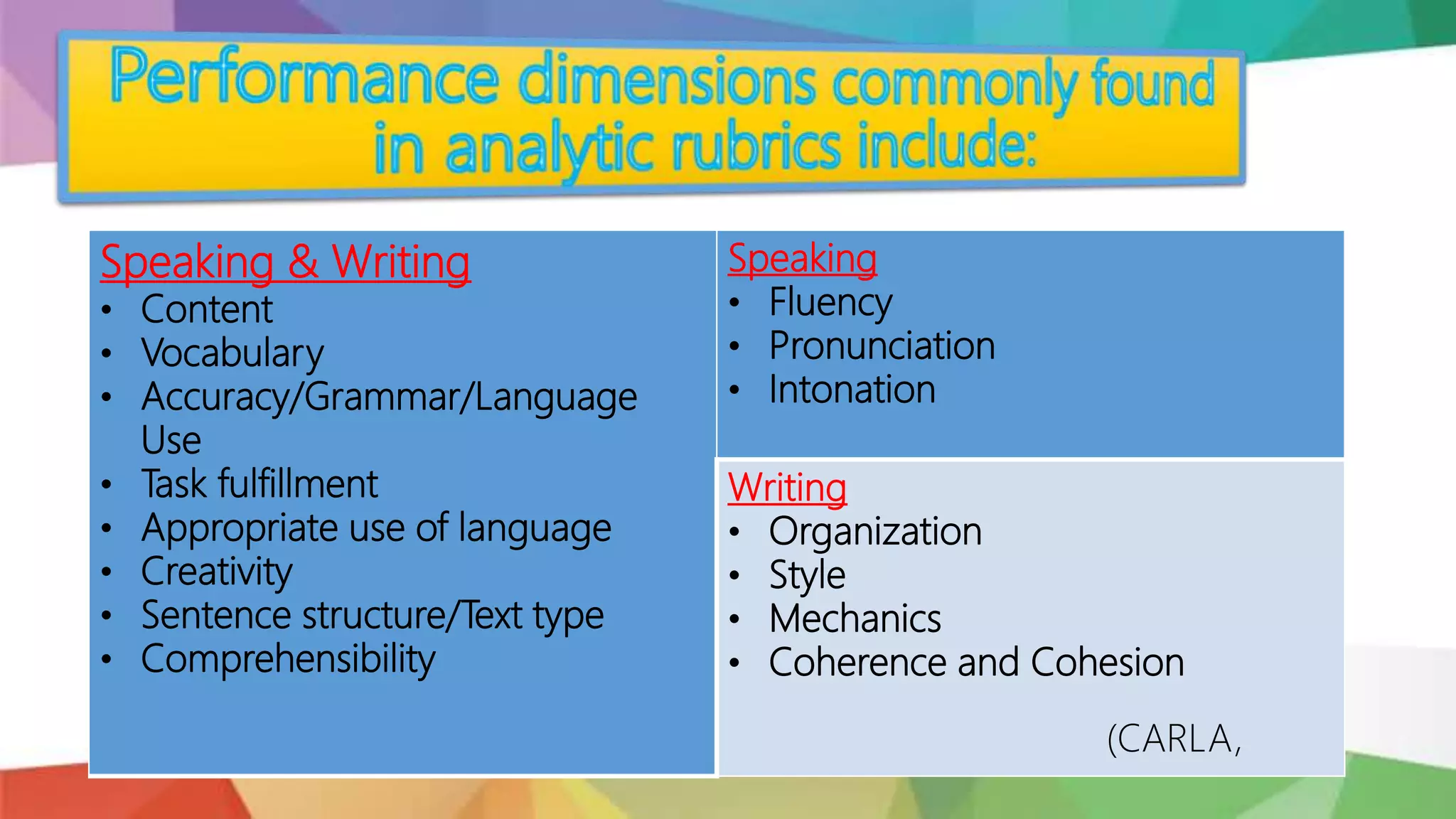
Speaking & Writing
• Content
• Vocabulary
• Accuracy/Grammar/Language
Use
• Task fulfillment
• Appropriate use of language
• Creativity
• Sentence structure/Text type
• Comprehensibility
Speaking
• Fluency
• Pronunciation
• Intonation
Writing
• Organization
• Style
• Mechanics
• Coherence and Cohesion
(CARLA,
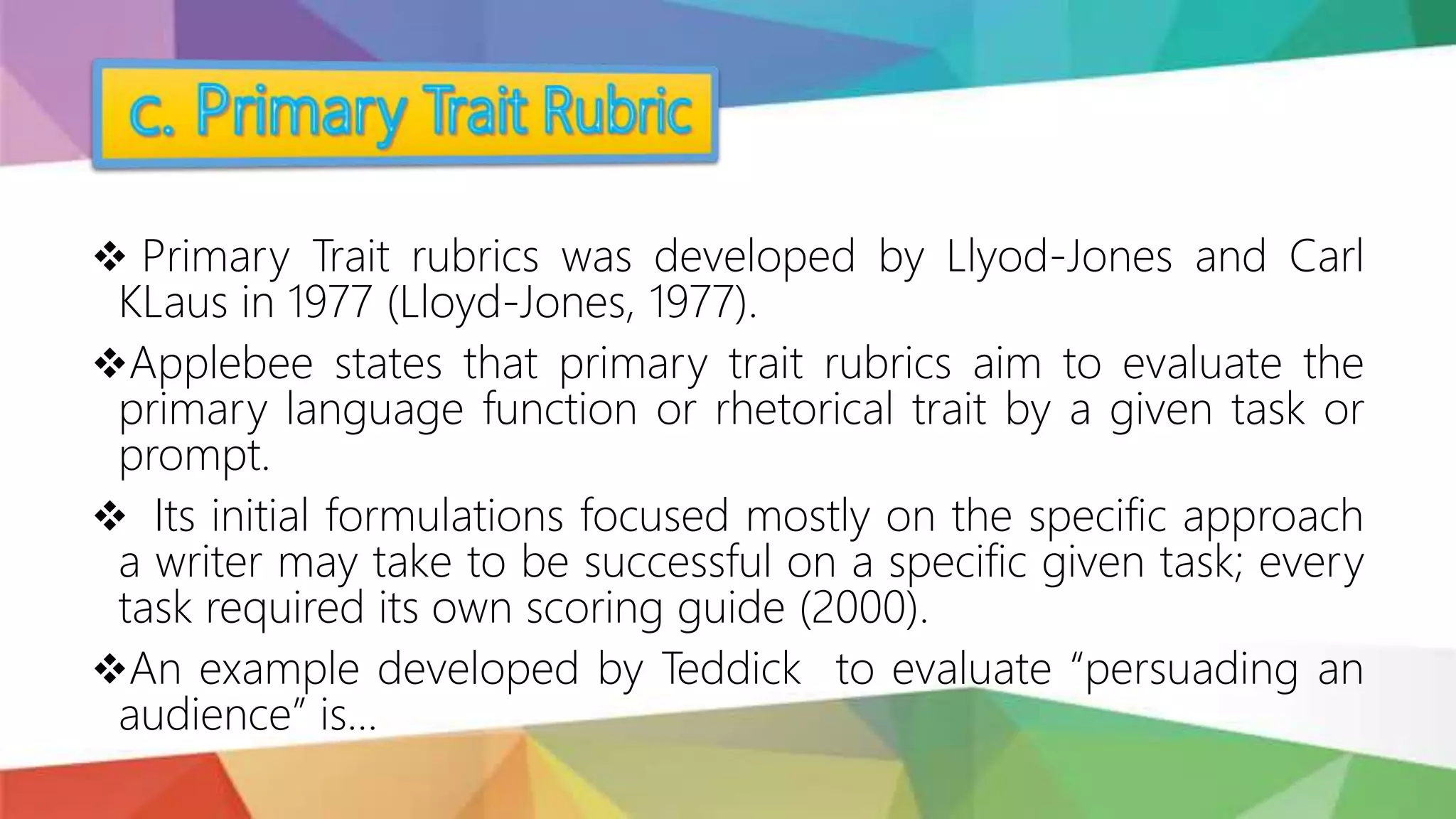
 Primary Trait rubrics was developed by Llyod-Jones and Carl
KLaus in 1977 (Lloyd-Jones, 1977).
Applebee states that primary trait rubrics aim to evaluate the
primary language function or rhetorical trait by a given task or
prompt.
 Its initial formulations focused mostly on the specific approach
a writer may take to be successful on a specific given task; every
task required its own scoring guide (2000).
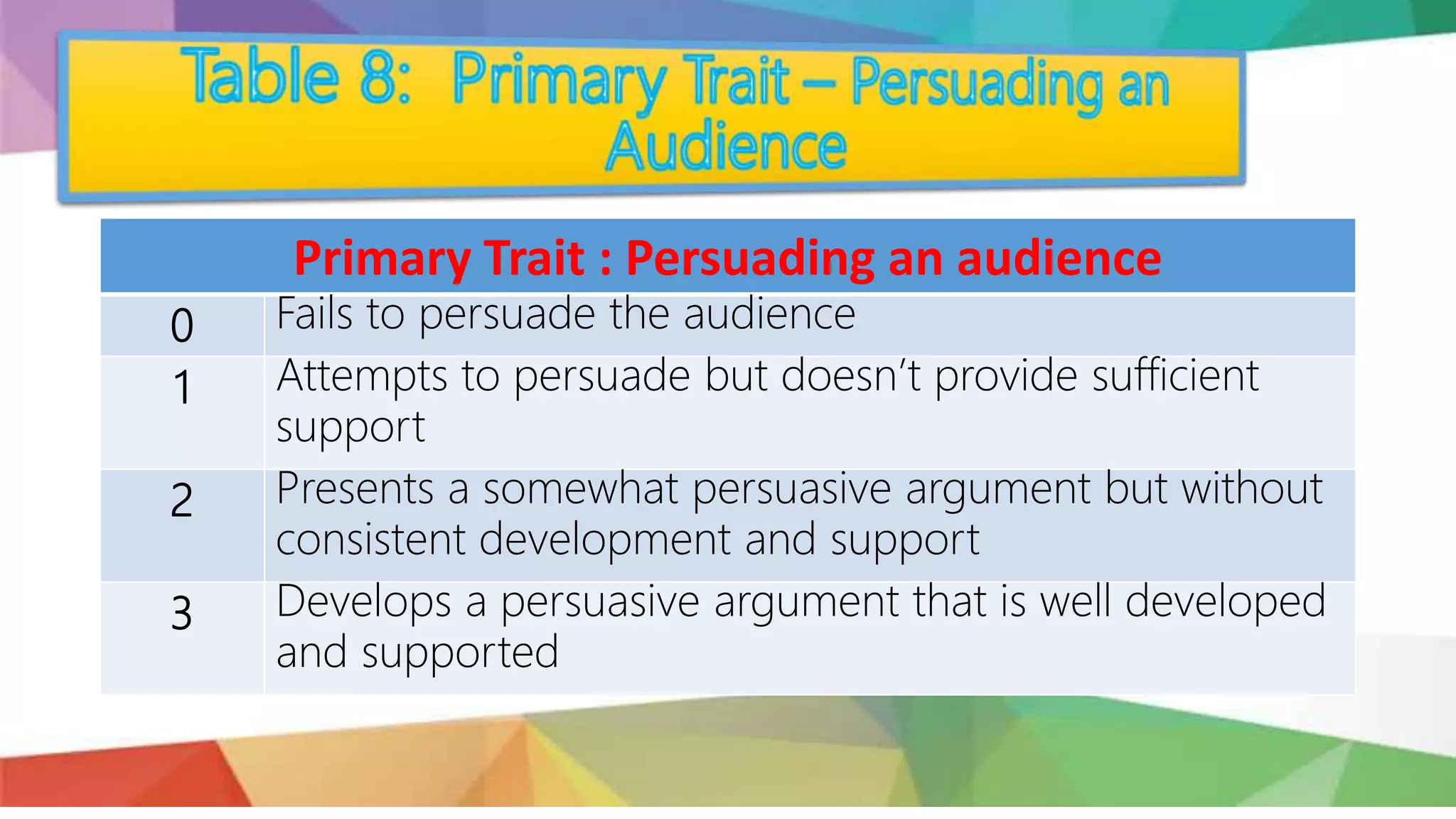
An example developed by Teddick to evaluate “persuading an
audience” is…
Primary Trait : Persuading an audience
0 Fails to persuade the audience
1 Attempts to persuade but doesn’t provide sufficient
support
2 Presents a somewhat persuasive argument but without
consistent development and support
3 Develops a persuasive argument that is well developed
and supported
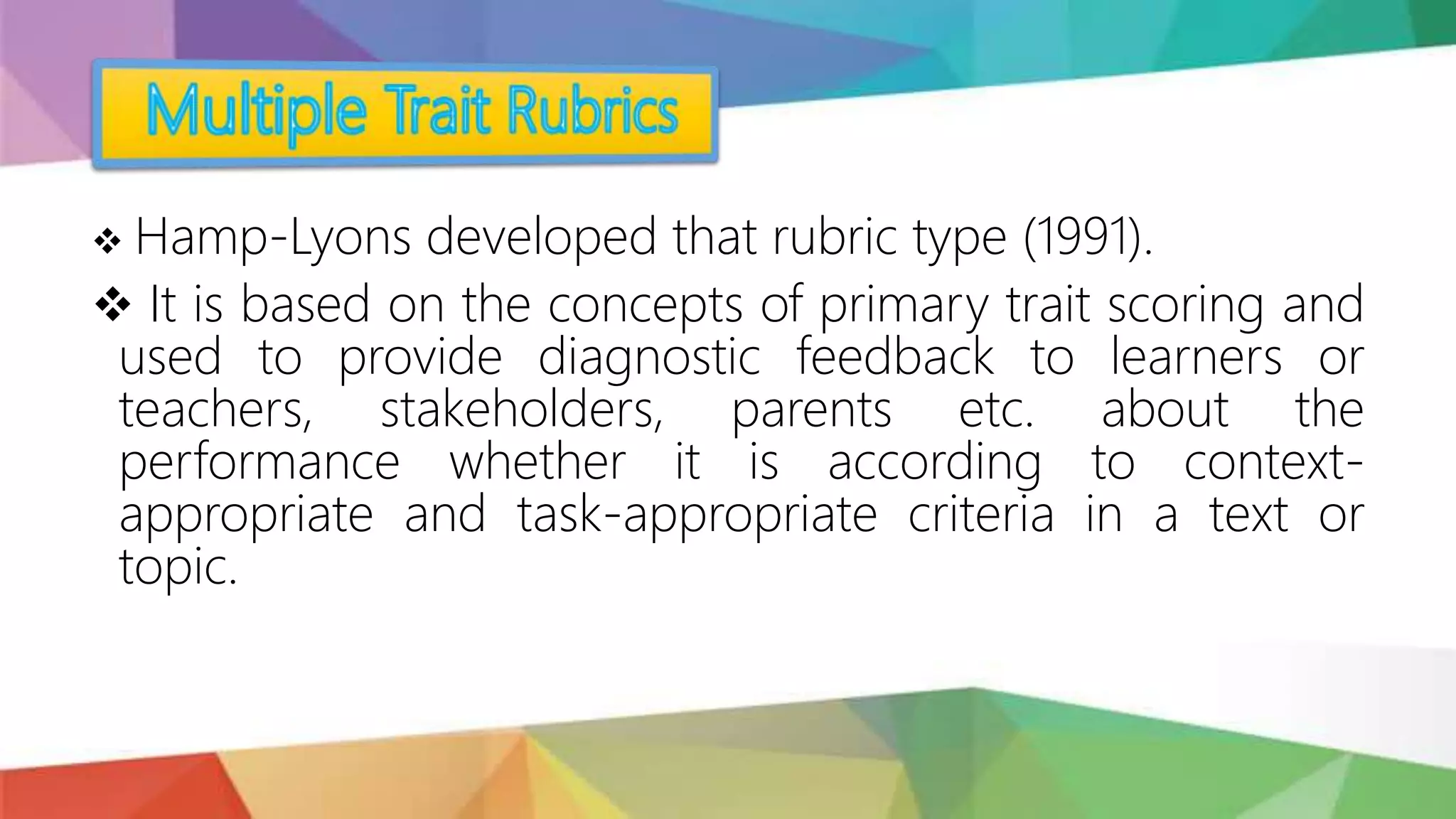
 Hamp-Lyons developed that rubric type (1991).
 It is based on the concepts of primary trait scoring and
used to provide diagnostic feedback to learners or
teachers, stakeholders, parents etc. about the
performance whether it is according to context-
appropriate and task-appropriate criteria in a text or
topic.
Multiple trait rubrics are similar to analytic rubrics
because of its several categories and in practice, there
are terms used interchangeably.
However, difference between two types is that analytic
rubrics evaluate more traditional and generic dimensions
of language production, while multiple trait rubrics focus
on specific features of performance required to fulfill the
given task or tasks.
Advantages
• The rubrics are aligned with the task and curriculum.
• Aligned and well-written primary and multiple trait rubrics can
ensure construct and content validity of criterion-referenced
assessments.
• Feedback is focused on one or more dimensions that are
important in the current learning context.
• With a multiple trait rubric, learners receive information about
their strengths and weaknesses.
Advantages
• Primary and multiple trait rubrics are generally written in
language that students understand.
• Teachers are able to rate performances quickly.
(International Journal of Language and Linguistics
Vol. 2, No. 2; June 2015)
• Many rubrics of this type have been developed by teachers who
are willing to share them online, at conferences, and in materials
available for purchase.
Disadvantages
 Information provided by primary trait rubrics is limited
and may not easily translate into grades.
 Task-specific rubrics cannot be applied to other tasks
without adaptation of at least one or more dimensions.
(CARLA, 2012)
http://www.carla.umn.edU/assessment/vac/evaluation/e 1 .htm
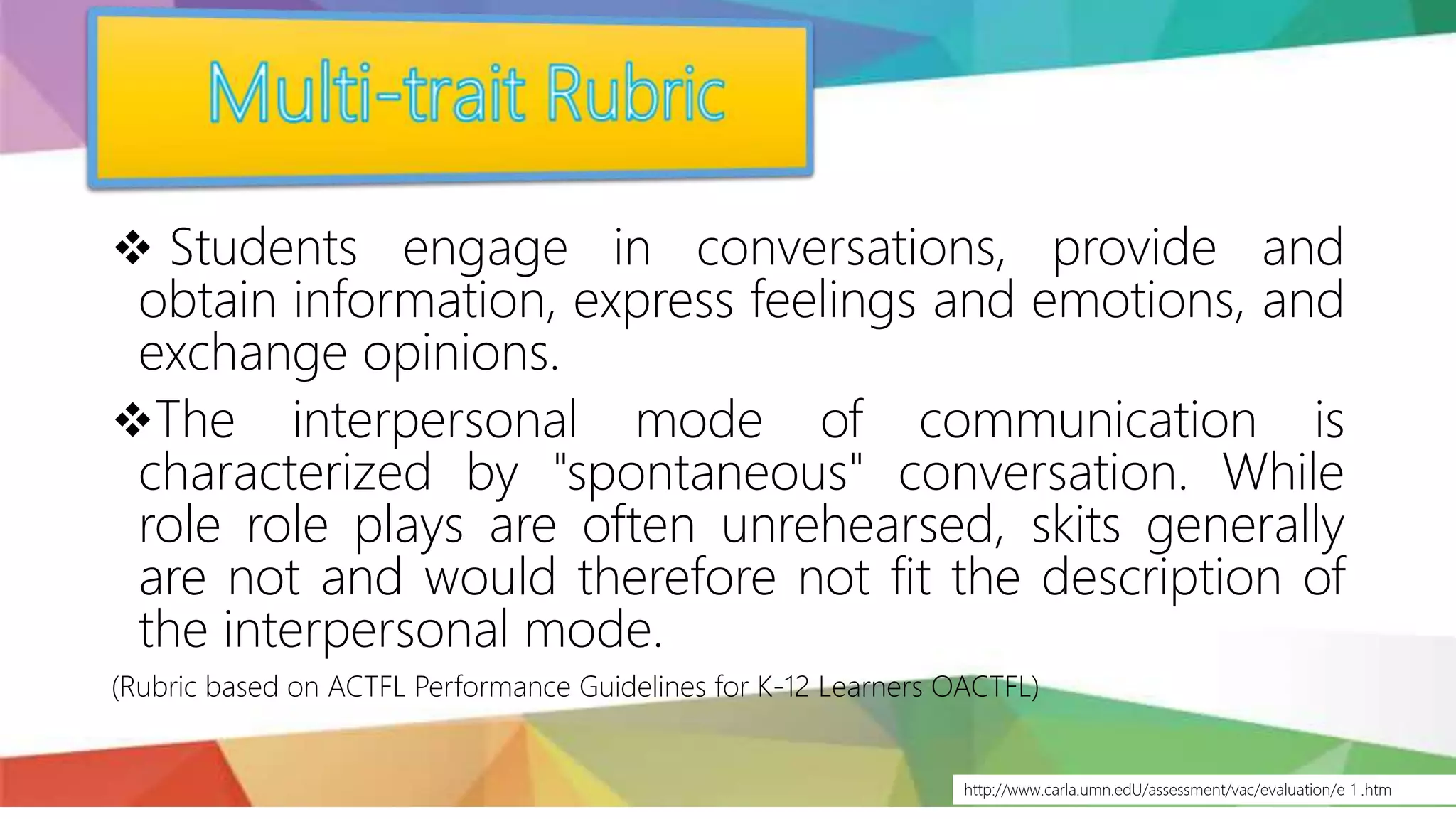
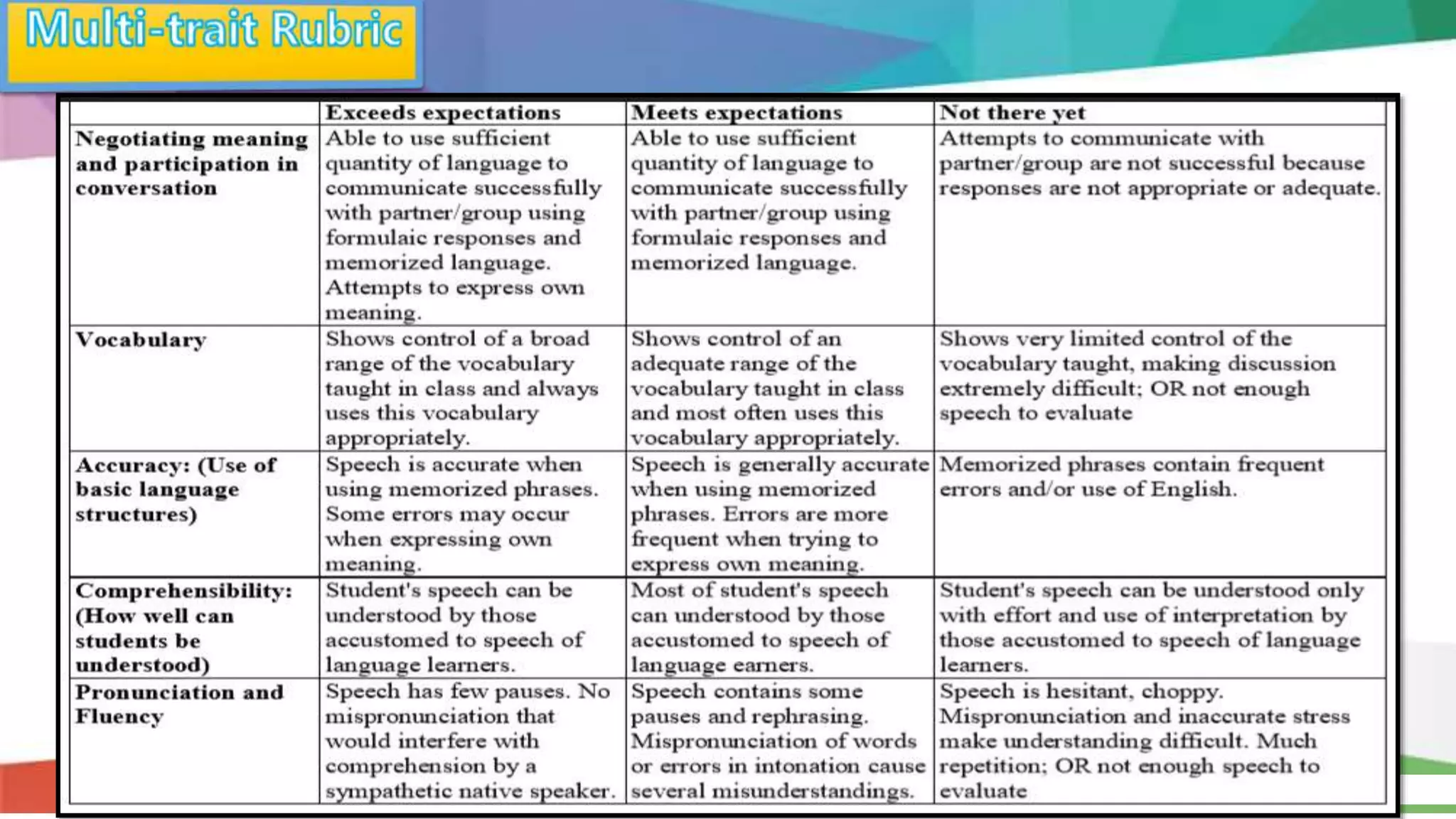
 Students engage in conversations, provide and
obtain information, express feelings and emotions, and
exchange opinions.
The interpersonal mode of communication is
characterized by "spontaneous" conversation. While
role role plays are often unrehearsed, skits generally
are not and would therefore not fit the description of
the interpersonal mode.
(Rubric based on ACTFL Performance Guidelines for K-12 Learners OACTFL)
http://www.carla.umn.edU/assessment/vac/evaluation/e 1 .htm
It is very significant to know the procedure of
assessment and use of efficient tools to do it. Rubrics
play a key role in evaluation of proficiency of
students especially by providing validity and
reliability. Getting right feedback, learners feel more
comfortable for the next step to be taken to improve;
Therefore, assessors` role is not just giving
feedback, but encouraging for further development
by indicating the learners` weakness without
discouraging in any way.
• M. Uğur Türkyılmaz, International Journal of Language and
Linguistics “Key of Language Assessment: Rubrics and Rubric
Design” Vol. 2, No. 2; June 2015
• http://ijllnet.com/journals/Vol_2_No_2_June_2015/12.pdf
• http://www.carla.umn.edU/assessment/vac/evaluation/e1 .htm
• https://www.brighthubeducation.com/esl-teaching-tips/102838-
english-language-learning-assessment-tools/
It is very significant to know the procedure of
assessment and use of efficient tools to do it. Rubrics
play a key role in evaluation of proficiency of
students especially by providing validity and
reliability. Getting right feedback, learners feel more
comfortable for the next step to be taken to improve;
Therefore, assessors` role is not just giving
feedback, but encouraging for further development
by indicating the learners` weakness without
discouraging in any way.
Thank you so
much for
listening! 

Specific Assessment Tools in Language (RUBRICS)

  • 1.
    REPUBLIC OF THEPHILIPPINES UNIVERSITY OF RIZAL SYSTEM PROVINCE OF RIZAL GRADUATE SCHOOL PILILLA CAMPUS
  • 2.
    The purpose ofthis presentation is to provide an overview of “rubric” in language testing and assessment and to highlight the parts of a rubric through various dimensions. It sets forth objectives; types of the rubric use. It will create awareness of the effective use of rubrics in reflecting robustness of this critical assessment process.
  • 3.
     The word“rubric” comes from the Latin word for “red.” It was once used to signify the highlights of a legal decision as well as the directions for conducting religious services, found in the margins of liturgical books—both written in red.
  • 4.
    In a broadsense, rubric refers to a term which has existed in English for more than 600 years and during that time, mostly it has meant a set of “printed rules or instructions” (Encarta Encyclopedia, 2004). However, in educational sense, it refers to different categories such as criteria foe assessment, evaluation of learning, gradients of learning of a set of instructions etc. (Brown, 2012).
  • 5.
    A good activitynever guarantees the accurate determination of a student’s competency at a given task. At this point, rubrics stand for this main requirement. Since it specifies the skill being examined and what constitutes various levels of performance success.
  • 6.
     In orderto construct a good rubric focus on what to measure exactly, how to measure performance and decision on what a passing level of performance competency is” plays the key role.
  • 7.
    Rubric: A scoringguide used to judge students’ work Skill-Focused Rubrics: Scoring guides for judging students’ mastery of the skill being assessed
  • 8.
    Student Behavior: Astudent’s performance intended to demonstrate what the student has learned Student Product: Something material a student creates to demonstrate the student’s learning
  • 9.
     Task-Specific Rubrics:Scoring guides suitable for judging responses to only a particular task  Hypergeneral Rubrics: Excessively inexact, often vague, scoring guides
  • 10.
     Analytic Scoring:When a rubric’s evaluative criteria are applied separately in judging students’ work  Holistic Scoring: When a rubric’s evaluative criteria contribute to a single, overall judgment of quality
  • 11.
    Application Strategy: Useof a rubric’s evaluative criteria holistically (all together) or analytically (one-by-one)  Evaluative Criteria: Factors considered when using a rubric to judge a student’s response
  • 12.
    Constructed-Response Items: Testitems requiring students to generate their answers Selected-Response Items: Test items requiring students to choose from two or more options
  • 13.
     Cognitive Skill:A specific intellectual competency that individuals can apply in appropriate situations  Knowledge: Memorized information, for example, recollectable facts, dates, principles, and terminology
  • 14.
     Performance Test:An assessment task typically requiring students to create a somewhat elaborately constructed response  Quality Distinctions: Descriptions of different qualitative levels for each of a rubric’s evaluation criteria
  • 15.
    REMEMBER:  Rubrics canbe used to evaluate the of any student-generated product or any student-generated behavior.
  • 16.
    Student Product: Something materiala student creates to demonstrate the student’s learning. Student Behavior: A student’s performance intended to demonstrate what the student has learned.
  • 17.
     For instance,when a student in a woodworking class creates a pair of mahogany bookends (a product), the quality of those bookends can be appraised more accurately when the instructor relies on a rubric to make a systematic judgment rather than trying to judge the bookends using a more haphazard approach.
  • 18.
    Similarly, when teachersin a speech class must evaluate their students’ “demonstration speeches” (a behavior), those teachers will do a more defensible evaluative job when they employ rubrics. Thus, whether it is the evaluation of students’ products or behaviors, teachers who rely on rubrics almost always do a better evaluative job than teachers who don’t.
  • 19.
    One useful wayof thinking about the applicability of rubrics to the evaluation of students’ work is to distinguish between test items that call for students to select their responses versus test items that call for students to construct their responses.  These two types of items are referred to, not surprisingly, as selected-response items and constructed-response items.
  • 20.
    The most commonvarieties of selected-response items are the sorts of multiple-choice and true-false items that teachers have been using in their tests.  The most common kinds of constructed-response items, are short-answer and essay items. When Plato asked Aristotle to “Define life, orally, in 100 words or less,” that test item also fell into the constructed-response category.
  • 21.
    Selected-Response Items: - testitems requiring students to choose from two or more options Constructed-Response Items: - test items requiring students to generate their answers
  • 22.
    Even though basedon the general guidelines a general rubric design may be organized and be used multiple times. Here is the process in detail:
  • 23.
    1. Defining theBehavior to Be Assessed  Expected student outcomes, what they should accomplish at the end of each unit and end of each term should be clarified. For this, some questions should be asked:
  • 24.
    • What concept,skill or knowledge am I trying to assess? • What should my students know? • At what level should my students be performing? • What type of knowledge is being assessed: reasoning, memory or process.)
  • 25.
    2. Choosing theActivity  After the determination of the purpose of the assessment, you should decide an activity and consider issues regarding time constraints, resources, and how much data is required.
  • 26.
    3. Defining theCriteria  Third step after the decision of activity and tasks to be used, definition of which elements of the project/task will be used to find the success of the students’ performance.
  • 27.
    Airasian (1991) definessome steps to complete that process: a. Identify the overall performance or task to be assessed , and perform it yourself or imagine yourself performing it; b. List the important aspects of the performance or product;
  • 28.
    c. Try tolimit the number of performance criteria, so they can all be observed during a student’s performance; d. If possible, have groups of teachers think through the important behaviors included in task; e. Express the performance criteria in terms of observable student behaviors or product characteristics;
  • 29.
    f. Don’t useambiguous words that cloud the meaning of the performance criteria; g. Arrange the performance criteria in the order in which they are likely to be observed.
  • 30.
    In this part,it is aimed to provide an understanding “a rubric in language teaching”. It consists typically two sections: a. Scores along with one axis of the grid and language behavior descriptors inside the grid for what each score means in terms of language performance.
  • 31.
    b. Language categoriesalong one axis and scores along the other axis and language behavior descriptors inside the grid for what each score within each category means in terms of language performance (Brown, 2012)  However, there are different categorization to refer to parts of a typical rubric. According to a Stevens and Levi, it should have four parts (2005)
  • 32.
    b. Language categoriesalong one axis and scores along the other axis and language behavior descriptors inside the grid for what each score within each category means in terms of language performance (Brown, 2012)  However, there are different categorization to refer to parts of a typical rubric. According to a Stevens and Levi, it should have four parts (2005)
  • 33.
    Scale Level 1Scale Level 2 Scale Level 3 Dimension 1 Dimension 2 Dimension 3 Dimension 4
  • 34.
    1. Task description:It is framed always by the instructor and includes a “performance” of some types by the student. That task can be a specific assignment, a paper, a presentation, a poster etc. and it applies to overall behavior of the student such as participation, behavioral expectations in the classroom. Task descriptions are mostly cut and pasted from the syllabus and placed at the top of the grading rubric.
  • 35.
    2. Scale: • Thispart gives the description of how well or poor given task is performed and indicates the rubric`s evaluative goal. • Terms applied to describe the level of performance should be tactful but clear, For example: “Mastery, partial mastery, progressing and emerging”.
  • 36.
    “Mastery, partial mastery,progressing and emerging”.  These words provide a positive, active, verb description of the next expectations from the student and mitigate the potential shock of low marks in the lowest levels of scale.
  • 37.
    • “Sophisticated, competent,partly competent, not yet competent (NFS Synthesis Engineering Education Coalition, 1977); • Accomplished, average, developing, beginning (College of Education, 1997); • Distinguished, proficient, intermediate, novice (Gotcher, 1997); • Advanced, intermediate high, intermediate, novice (American Council of Teachers of Foreign Languages, 1986, 278). Some commonly used labels are:
  • 38.
    3. Dimensions: • Thispart lays out the components of the task. • It also clarifies how the students` task can be broken down into components in terms of importance: content of the assignment, which aspect of the assignment? • Dimensions should represent the types of the skill to be achieved by the students in a scholarly work such as technique, citation, example analysis, use of language appropriate to the occasion.
  • 39.
    Task: Each studentwill make a 5-minute presentation on the changes in one community over the past 30 years. student may focus the presentation in any way he or she wishes, but there needs to be a thesis of some sort, not a chronological exposition. The presentation should include appropriate photographs, maps, graphs, and visual aids for the audience. Example:
  • 40.
    Excellent Competent NeedWork Knowledge/understanding 20% Thinking/inquiry 30% Communication 20% Use of visual aids 20% Presentation skills 10%
  • 41.
    4. Descriptions ofdimensions: • Descriptions of dimensions help show where the student failed the desired level of proficiency or highest expectation of the task to be reached. • If the dimension includes just one description, it is called guide rubrics”. They allow greater flexibility and more personalization while expanding the time needed. • Mostly, three dimension descriptions are preferred. The more descriptions, the harder it becomes to grade. If a dimension exceeds 5 descriptions, the ability to grade becomes more difficult.
  • 42.
    Task: Each studentwill make a 5-minute presentation on the changes in one community over the past 30 years. student may focus the presentation in any way he or she wishes, but there needs to be a thesis of some sort, not a chronological exposition. The presentation should include appropriate photographs, maps, graphs, and visual aids for the audience. Example: (Same task)
  • 43.
    Criteria Comments Points Knowledge/understanding20% The presentation demonstrates a depth of historical understanding by using relevant and accurate detail. Research is thorough and goes beyond what was presented in class or in the assigned texts. Thinking/inquiry 30% The presentation is centered around a thesis, which shows a highly developed awareness of historiographic or social issues and a high level of conceptual ability. Communication 20% The presentation is imaginative and effective in conveying ideas to the audience. The presenter responds effectively to audience reactions and questions.
  • 44.
    Criteria Comments Points Useof visual aids 20% The presentation includes appropriate and easily understood visual aids, which the presenter refers to and explains at appropriate moments in the presentation. Presentation skills 10% The presenter speaks clearly and loudly enough to be heard, using eye contact, a lively tone, gestures, and body language to engage the audience.
  • 45.
    Task: Each studentwill make a 5-minute presentation on the changes in one community over the past 30 years. student may focus the presentation in any way he or she wishes, but there needs to be a thesis of some sort, not a chronological exposition. The presentation should include appropriate photographs, maps, graphs, and visual aids for the audience. Three-level Rubric Sample: (same task)
  • 46.
    Excellent Competent NeedWork Knowledge/ understanding 20% The presentation demonstrates a depth of historical understanding by using relevant and accurate detail. Research is thorough and goes beyond what was presented in class or in the assigned texts. The presentation uses knowledge that is generally accurate with only minor inaccuracies and that is generally relevant to the student’s thesis. Research is adequate but does not go much beyond what was presented in class or in the assigned text. The presentation uses little relevant or accurate information, not even that which was presented in class or in the assigned texts. Little or no research is apparent.
  • 47.
    Excellent Competent NeedWork Thinking/inquiry 30% The presentation is centered around a thesis, which shows a highly developed awareness of historiographic or social issues and a high level of conceptual ability. The presentation shows an analytical structure and a central thesis, but the analysis is not always fully developed or linked to the thesis. The presentation shows no analytical structure and no central thesis. Communication 20% The presentation is imaginative and effective in conveying ideas to the audience. The presenter responds effectively to audience reactions and questions. Presentation techniques used are effective in conveying main ideas, but they are a bit unimaginative. Some questions from the audience remain unanswered. The presentation fails to capture the interest of the audience and/or is confusing in what is to be communicated.
  • 48.
    Excellent Competent NeedWork Use of visual aids 20% The presentation includes appropriate and easily understood visual aids, which the presenter refers to and explains at appropriate moments in the presentation. The presentation includes appropriate visual aids, but these are too few, are in a format that makes the difficult to use or understand, or the presenter does not refer to or explain them in the presentation. The presentation includes no visual aids or includes visual aids that are inappropriate or too small or messy to be understood. The presenter makes no mention of them in the presentation Presentation skills 10% The presenter speaks clearly and loudly enough to be heard, using eye contact, a lively tone, gestures, and body language to engage the audience. The presenter speaks clearly and loudly enough to be heard but tends to drone or fails to use eye contact, gestures, and body language consistently or effectively at times. The presenter cannot be heard or speaks so unclearly that she or he cannot be understood. There is no attempt to engage the audience through eye contact, gestures, or body language.
  • 50.
     CARLA (Centerfor Advanced Research on Language Acquisition) compiled different sets of functions for the use of rubrics (2013). According to CARLA, rubrics help us to set anchor points along a quality continuum, therefore, instructors can set reasonable and appropriate expectations for learners and judge consistently how well they are met or not.
  • 51.
     CARLA (Centerfor Advanced Research on Language Acquisition) compiled different sets of functions for the use of rubrics (2013). According to CARLA, rubrics help us to set anchor points along a quality continuum, therefore, instructors can set reasonable and appropriate expectations for learners and judge consistently how well they are met or not.
  • 52.
    1. Well-designed rubricsplay a significant role to increase an assessment construct and content validity by aligning evaluation criteria to standards, curriculum, instruction and assessment tasks. 2. By setting criteria to rate, well-designed rubrics can increase the reliability of that assessment, thus, it applies consistency and objectivity.
  • 53.
    3. Bias canbe reduced by evaluating student’s work with established criteria that help instructors clarify goals and improve their teaching by identifying the most salient criteria for the evaluation of performance and by writing the descriptions of excellent performance. 4. They help learners set goals and take the responsibility of their own learning, since it provides an understanding of optimal performance.
  • 54.
    5. Learners candevelop their ability to judge quality in their own work and others` work through self and peer assessment rubrics. 6. Rubrics answer the question "Why did I/my child get a B on this project?" 7. Rubrics help learners get specific feedback about their strong and weak areas and about how to develop their performance.
  • 55.
    8. They playrole in the assessment of learners` effort and performance on their own and make adjustments before the submission of the assignments for grading. 9. Rubrics allow the learners, teachers, parent to monitor the progress over a certain time period of instruction. 10. Time spent evaluating performance and providing feedback can be reduced.
  • 56.
    11. They helplearners autonomy for their own learning and assessment if they participate in rubric design, thus, they become self-directed learners. 12. Subjectivity in grading can be moved away by including students to assess work based on consistent, agreed upon and objective criteria.
  • 57.
     There aretwo dominant types of rubrics: holistic and analytic rubrics.  However, primary trait and multiple trait rubrics are also commonly used.  In comparison with each other, it is hard to tell which types or type is better to use since it depends on the task, key criteria to be fulfilled by the learners.
  • 58.
     Before givingthe decision which one to use in class, it is important to decide the key criteria. Blaz (2001) compile in her study most common tasks used in assessments. Her study is based on performance tasks: written and oral tasks.
  • 59.
    Some activities forwritten performance assessments Some activities for written performance assessments Anecdote ballad/rap/song book report campaign speech choral reading/speech debate Demonstration dialogue discussion documentary dramatization Explanation fairy tale free verse Interview jingle/ad campaign joke lecture lesson mock interview monologue narration newscast Recipe riddle role-play seminar skit weather report • advertisement • biography • book report • booklet/brochure • business letter • Cartoon • celebrity profile • Checklist • comic book • commercial script • comparison • creative writing • critique • description • dialogue • diary/journal • e-mail message • editorial essay • fairy tale/myth • glossary • guidebook • handbook • handout • headline • interview • script • job description • joke • journal • lesson plan
  • 60.
     Holistic rubricscontain different levels of performance that describes the quality, quantity, quantity/quality of a task.
  • 61.
    HOLISTIC RUBRIC A scoreof 3- Proficient The student`s project has a hypothesis, a procedure, collected data, and analyzed results. The project is thorough and the findings are in agreement with the data collected. There are minor inaccurancies that don’t affect the quality of the project. A score of 2- Adequate The student`s project may have a hypothesis, a procedure, collected data and analyzed results. The project is not as thorough as it could be; there are a few overlooked areas. The project has a few inaccuracies that affect the quality of the project. A score of 1- Limited The student`s project may have a hypothesis, a procedure, collected data and analyzed results. The project has several inaccuracies that affect the quality of the project.
  • 62.
    Holistic Version ofthe Scale for Rating Composition Tasks Scores Descriptors 5 Appropriate title, effective introductory paragraph, topic is stated, leads to body; transitional expressions used; arrangement of material shows plan (could be outlined by reader); supporting evidence given for generalizations; conclusion logical & complete. Essay addresses the assigned topic; the ideas are concrete and thoroughly developed; no extraneous material; essay reflects thought. Native-like fluency in English grammar; correct use of relative clauses, prepositions, modals, articles, verb forms, and tense sequencing; no fragments or run-on sentences. Correct use of English writing conventions; left & right margins, all needed capitals, paragraphs indented, punctuation & spelling; very neat. Precise vocabulary usage; use of parallel structures; concise; register good.
  • 63.
    Holistic Version ofthe Scale for Rating Composition Tasks Scores Descriptors 5 4 Adequate title, introduction, & conclusion; body of essay is acceptable but some evidence may be lacking, some ideas aren’t fully developed; sequence is logical but transitional expressions may be absent or misused. Essay addresses the issues but misses some points; ideas could be more fully developed; some extraneous material is present. Advanced proficiency in English grammar; some grammar problems don’t influence communication, although the reader is aware of them; no fragments or run-on sentences. Some problems with writing conventions or punctuation; occasional spelling errors; left margin correct; paper is neat and legible. Attempts variety; good vocabulary; not wordy; register OK; style fairly concise.
  • 64.
    Holistic Version ofthe Scale for Rating Composition Tasks Scores Descriptors 5 4 3 Mediocre or scant introduction, or conclusion; problems with the order of ideas in body; the generalizations may not be fully supported by the evidence given; problems of organization interfere. Development of ideas not complete or essay is somewhat off the topic; paragraphs aren’t divided exactly right. Ideas getting through to the reader, but grammar problems are apparent and have a negative effect on communication; run-on sentences or fragments present. Uses general writing conventions but has errors; spelling problems distract reader; punctuation errors interfere with ideas. Some vocabulary misused; lacks awareness of register; may be too wordy.
  • 65.
    Holistic Version ofthe Scale for Rating Composition Tasks Scores Descriptors 5 4 3 2 Shaky or minimally recognizable introduction; organization can barely be seen; severe problems with ordering of ideas; lack of supporting evidence; conclusion weak or illogical; inadequate effort at organization. Ideas incomplete; essay does not reflect careful thinking or was hurriedly written; inadequate effort in area of content. Numerous serious grammar problems interfere with communication of the writer’s ideas; grammar review of some areas clearly needed; difficult to read sentences. Serious problems with format of paper; parts of essay not legible; errors in sentence-final punctuation; unacceptable to educated readers. Poor expression of ideas; problems in vocabulary; lacks variety of structure.
  • 66.
    Holistic Version ofthe Scale for Rating Composition Tasks Scores Descriptors 5 4 3 2 1 Absence of introduction or conclusion; no apparent organization of body; severe lack of supporting evidence; writer has not made any effort to organize the composition (could not be outlined by reader). Essay is completely inadequate and does not reflect college level work; no apparent effort to consider the topic carefully. Severe grammar problems interfere greatly with the message; reader can’t understand what the writer is trying to say; unintelligible sentence structure. Complete disregard for English writing conventions; paper illegible; obvious capitals missing, no margins, severe spelling problems. Inappropriate use of vocabulary; no concept of register or sentence variety.
  • 67.
    Role Play Exceeds Expectations Student accuratelyand compellingly articulates the needs of his/her character and responds meaningfully to others' comments using well- connected sentences. Student uses a variety of sentence structures and grammatical forms that allow discourse to flow. Vocabulary is specific appropriate, and there are minimal errors in grammar and word choice that do not impact comprehension. Meets expectations- strong Student accurately articulates the needs of his/her character and to others' comments with complex sentences. Student uses a variety of sentence structures and grammatical forms that allow discourse to flow most of the time. Vocabulary is mostly appropriate, and several minor errors in grammar and word choice may have a slight impact on comprehension.
  • 68.
    Role Play Meets expectations- weak Student articulatesmost of the needs of his/her character and responds to 1-2 comments with complete sentences. Student uses at least 3 different sentence structures and several grammatical forms that allow discourse to flow most of the time. Available vocabulary somewhat limits conversation; circumlocution or other strategies may be used. Errors in grammar and word choice lead to some errors in comprehension that clarified in the target language. Does not meet expectations Student fails to articulate his/her character's needs and/or doesn't respond to other comments. Speech consists mostly of short sentences and uses limited sentence structures. Many errors in grammar and vocabulary lead to significant errors in comprehension. http://www.carla.umn.edU/assessment/vac/evaluation/e 1 .htm
  • 69.
    Who am I?- Intermediate 3 Student asks a variety of questions related to both physical features and other Student answers partner's questions with complete sentences and accurate information. Questions and answers use a range of appropriate vocabulary and grammar features taught in class. Minor grammatical errors do not impact comprehension. 2 2 Student asks several questions related to physical features and other traits. Student answers partner's questions with mostly complete sentences and accurate information. Questions and answers use appropriate vocabulary and grammar features taught in class. Several grammatical errors may slightly impact comprehension, but misunderstandings are clarified in the target language. 1 Student asks minimal questions related to physical features or other traits. Student answers partner's questions with some accuracy. Vocabulary and grammar are simple. Significant grammatical errors lead to multiple misunderstandings. http://www.carla.umn.edU/assessment/vac/evaluation/e 1 .htm
  • 70.
     In thattype of evaluation, raters judge by forming an overall impression of learners` performance and matching it to best fitting column on the scale.  Each scale describes performance according to several criteria such as range of vocabulary, grammatical accuracy, fluency etc. Mostly, 4 or 5 performance levels are available in holistic rubrics. Generally, teachers find it efficient and easy to use for classroom assessments.
  • 71.
    Advantages  They areoften written generically and can be used with many tasks.  They emphasize what learners can do, rather than what they cannot do. They save time by minimizing the number of decisions raters must make.  Trained raters tend to apply them consistently, resulting in more reliable measurement. They are usually less detailed than analytic rubrics and may be more easily understood by younger learners.
  • 72.
    Disadvantages  They donot provide specific feedback to test takers about the strengths and weaknesses of their performance.  Performances may meet criteria in two or more categories, making it difficult to select the one best description. (If this occurs frequently, the rubric may be poorly written.)  Criteria cannot be differentially weighted. (Teddick, 2002; TeacherVision.com, 2000-2002)
  • 73.
    According to Taggart,analytic scales are the types which tend to focus on broad dimensions of writing or speaking performance. These dimensions may be similar with those found in a holistic scale, but they are presented in separate categories and rated individually.  Points may be assigned for performance on each of the dimensions and a total score calculated.
  • 74.
    In general sense,analytic rubrics are associated with large-scale assessment of general dimensions of language performance. However, analytic rubrics certainly can be created or adapted for use in classroom settings and with particular tasks (1998). In practice, the names "analytic rubric" and "multiple trait rubric" may be used interchangeably.
  • 75.
    Advantages According to Moskal,analytic rubrics have those advantages;  They provide useful feedback to learners on areas of strength and weakness. Their dimensions can be weighted to reflect relative importance.  They can show learners that they have made progress over time in some or all dimensions when the same rubric categories are used repeatedly (2000).
  • 76.
    Disadvantages  According toTeddick, For different aspects of students` writing or speaking performance, separate scores are considered more artificial, since learner can`t get a good assessment of the whole of performance (2002).  They take more time to create and use.  It is hard to reach inter and intra reliability on all the dimensions in comparison to a single scored holistic rubric.  Raters tend to evaluate grammar related categories more strictly than other categories. In other words, they overemphasize the role of accuracy. (McNamara, T. (1996)
  • 77.
  • 78.
    Speaking & Writing •Content • Vocabulary • Accuracy/Grammar/Language Use • Task fulfillment • Appropriate use of language • Creativity • Sentence structure/Text type • Comprehensibility Speaking • Fluency • Pronunciation • Intonation Writing • Organization • Style • Mechanics • Coherence and Cohesion (CARLA,
  • 79.
     Primary Traitrubrics was developed by Llyod-Jones and Carl KLaus in 1977 (Lloyd-Jones, 1977). Applebee states that primary trait rubrics aim to evaluate the primary language function or rhetorical trait by a given task or prompt.  Its initial formulations focused mostly on the specific approach a writer may take to be successful on a specific given task; every task required its own scoring guide (2000). An example developed by Teddick to evaluate “persuading an audience” is…
  • 80.
    Primary Trait :Persuading an audience 0 Fails to persuade the audience 1 Attempts to persuade but doesn’t provide sufficient support 2 Presents a somewhat persuasive argument but without consistent development and support 3 Develops a persuasive argument that is well developed and supported
  • 81.
     Hamp-Lyons developedthat rubric type (1991).  It is based on the concepts of primary trait scoring and used to provide diagnostic feedback to learners or teachers, stakeholders, parents etc. about the performance whether it is according to context- appropriate and task-appropriate criteria in a text or topic.
  • 82.
    Multiple trait rubricsare similar to analytic rubrics because of its several categories and in practice, there are terms used interchangeably. However, difference between two types is that analytic rubrics evaluate more traditional and generic dimensions of language production, while multiple trait rubrics focus on specific features of performance required to fulfill the given task or tasks.
  • 83.
    Advantages • The rubricsare aligned with the task and curriculum. • Aligned and well-written primary and multiple trait rubrics can ensure construct and content validity of criterion-referenced assessments. • Feedback is focused on one or more dimensions that are important in the current learning context. • With a multiple trait rubric, learners receive information about their strengths and weaknesses.
  • 84.
    Advantages • Primary andmultiple trait rubrics are generally written in language that students understand. • Teachers are able to rate performances quickly. (International Journal of Language and Linguistics Vol. 2, No. 2; June 2015) • Many rubrics of this type have been developed by teachers who are willing to share them online, at conferences, and in materials available for purchase.
  • 85.
    Disadvantages  Information providedby primary trait rubrics is limited and may not easily translate into grades.  Task-specific rubrics cannot be applied to other tasks without adaptation of at least one or more dimensions. (CARLA, 2012)
  • 86.
    http://www.carla.umn.edU/assessment/vac/evaluation/e 1 .htm Students engage in conversations, provide and obtain information, express feelings and emotions, and exchange opinions. The interpersonal mode of communication is characterized by "spontaneous" conversation. While role role plays are often unrehearsed, skits generally are not and would therefore not fit the description of the interpersonal mode. (Rubric based on ACTFL Performance Guidelines for K-12 Learners OACTFL)
  • 87.
  • 88.
  • 104.
    It is verysignificant to know the procedure of assessment and use of efficient tools to do it. Rubrics play a key role in evaluation of proficiency of students especially by providing validity and reliability. Getting right feedback, learners feel more comfortable for the next step to be taken to improve; Therefore, assessors` role is not just giving feedback, but encouraging for further development by indicating the learners` weakness without discouraging in any way.
  • 105.
    • M. UğurTürkyılmaz, International Journal of Language and Linguistics “Key of Language Assessment: Rubrics and Rubric Design” Vol. 2, No. 2; June 2015 • http://ijllnet.com/journals/Vol_2_No_2_June_2015/12.pdf • http://www.carla.umn.edU/assessment/vac/evaluation/e1 .htm • https://www.brighthubeducation.com/esl-teaching-tips/102838- english-language-learning-assessment-tools/
  • 106.
    It is verysignificant to know the procedure of assessment and use of efficient tools to do it. Rubrics play a key role in evaluation of proficiency of students especially by providing validity and reliability. Getting right feedback, learners feel more comfortable for the next step to be taken to improve; Therefore, assessors` role is not just giving feedback, but encouraging for further development by indicating the learners` weakness without discouraging in any way.
  • 107.
    Thank you so muchfor listening! 