EDUCATIONAL EVALUATION
Dr. Thanuja karimbana
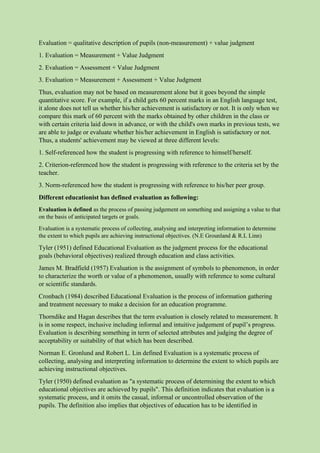
Educational evaluation is a broader concept as compared to Measurement and
Assessment. Evaluation may be considered as an umbrella term which includes measurement
and assessment.
Figure showing the relationship between Measurement, Assessment and Evaluation
In our day to day activities, we come across many situations where we want to make some
judgements based on certain objectives or criterion is usually termed as evaluation. It
includes either quantitative variable or qualitative variable or both quantitative and qualitative
variables description and interpretation of results or value judgements. For example, while
preparing a food, the cook continuously evaluating its taste, aroma, consistency etc. and
adding ingredients to get the final product according to her objective or predefined criteria.
The cook finally evaluates the quality and quantity of the food and make some judgements
based on the final product based on the intended outcome. Consider another example, after
conducting an achievement test in Mathematics, Riaan got 100/100 and Milan got 50/100. It
just indicates ‘how much’ Riaan and Milan has successfully answered. It does not include
any qualitative description i.e. ‘how good’ they are in Mathematics. On the basis of their
performance in Mathematics, teacher concludes that Riaan is doing well in Mathematics than
Milan and Milan need more feedback and correctives to achieve the target set by the teacher.
Here based on the quantity and criteria that is achievement test, teacher compares the
performance of the students and made some judgements regarding their performance. This
process is called evaluation. Evaluation on the other hand includes both quantitative
description (measurement) and qualitative description (Non measurement) along with value
judgements. In other words, evaluation includes testing and measurement and also qualitative
description of the pupil behaviour. It also includes value judgment regarding the worth or
desirability of the behaviour measured or assessed. Therefore, Gronlund (1981) has indicated
this relationship in the following equation:
Evaluation = quantitative description of pupils (measurement) + value judgment
EVALUATION
ASSESSMENT
MEASUREMENT
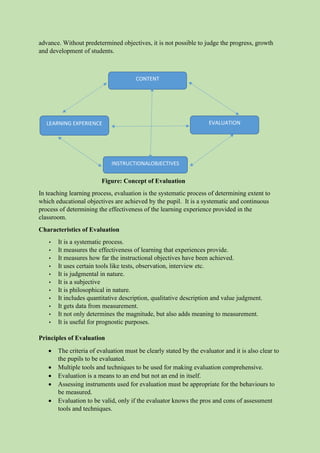
Evaluation = qualitative description of pupils (non-measurement) + value judgment
1. Evaluation = Measurement + Value Judgment
2. Evaluation = Assessment + Value Judgment
3. Evaluation = Measurement + Assessment + Value Judgment
Thus, evaluation may not be based on measurement alone but it goes beyond the simple
quantitative score. For example, if a child gets 60 percent marks in an English language test,
it alone does not tell us whether his/her achievement is satisfactory or not. It is only when we
compare this mark of 60 percent with the marks obtained by other children in the class or
with certain criteria laid down in advance, or with the child's own marks in previous tests, we
are able to judge or evaluate whether his/her achievement in English is satisfactory or not.
Thus, a students' achievement may be viewed at three different levels:
1. Self-referenced how the student is progressing with reference to himself/herself.
2. Criterion-referenced how the student is progressing with reference to the criteria set by the
teacher.
3. Norm-referenced how the student is progressing with reference to his/her peer group.
Different educationist has defined evaluation as following:
Evaluation is defined as the process of passing judgement on something and assigning a value to that
on the basis of anticipated targets or goals.
Evaluation is a systematic process of collecting, analysing and interpreting information to determine
the extent to which pupils are achieving instructional objectives. (N.E Grounland & R.L Linn)
Tyler (1951) defined Educational Evaluation as the judgment process for the educational
goals (behavioral objectives) realized through education and class activities.
James M. Bradfield (1957) Evaluation is the assignment of symbols to phenomenon, in order
to characterize the worth or value of a phenomenon, usually with reference to some cultural
or scientific standards.
Cronbach (1984) described Educational Evaluation is the process of information gathering
and treatment necessary to make a decision for an education programme.
Thorndike and Hagan describes that the term evaluation is closely related to measurement. It
is in some respect, inclusive including informal and intuitive judgement of pupil’s progress.
Evaluation is describing something in term of selected attributes and judging the degree of
acceptability or suitability of that which has been described.
Norman E. Gronlund and Robert L. Lin defined Evaluation is a systematic process of
collecting, analysing and interpreting information to determine the extent to which pupils are
achieving instructional objectives.
Tyler (1950) defined evaluation as "a systematic process of determining the extent to which
educational objectives are achieved by pupils". This definition indicates that evaluation is a
systematic process, and it omits the casual, informal or uncontrolled observation of the
pupils. The definition also implies that objectives of education has to be identified in
advance. Without predetermined objectives, it is not possible to judge the progress, growth
and development of students.
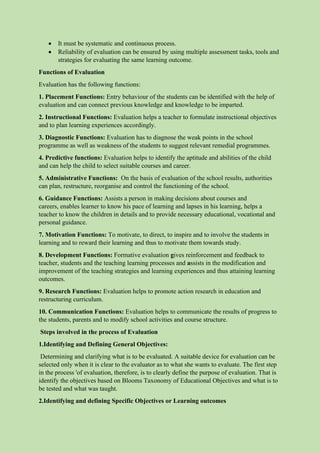
Figure: Concept of Evaluation
In teaching learning process, evaluation is the systematic process of determining extent to
which educational objectives are achieved by the pupil. It is a systematic and continuous
process of determining the effectiveness of the learning experience provided in the
classroom.
Characteristics of Evaluation
• It is a systematic process.
• It measures the effectiveness of learning that experiences provide.
• It measures how far the instructional objectives have been achieved.
• It uses certain tools like tests, observation, interview etc.
• It is judgmental in nature.
• It is a subjective
• It is philosophical in nature.
• It includes quantitative description, qualitative description and value judgment.
• It gets data from measurement.
• It not only determines the magnitude, but also adds meaning to measurement.
• It is useful for prognostic purposes.
Principles of Evaluation
• The criteria of evaluation must be clearly stated by the evaluator and it is also clear to
the pupils to be evaluated.
• Multiple tools and techniques to be used for making evaluation comprehensive.
• Evaluation is a means to an end but not an end in itself.
• Assessing instruments used for evaluation must be appropriate for the behaviours to
be measured.
• Evaluation to be valid, only if the evaluator knows the pros and cons of assessment
tools and techniques.
CONTENT
INSTRUCTIONALOBJECTIVES
OO
LEARNING EXPERIENCE EVALUATION
• It must be systematic and continuous process.
• Reliability of evaluation can be ensured by using multiple assessment tasks, tools and
strategies for evaluating the same learning outcome.
Functions of Evaluation
Evaluation has the following functions:
1. Placement Functions: Entry behaviour of the students can be identified with the help of
evaluation and can connect previous knowledge and knowledge to be imparted.
2. Instructional Functions: Evaluation helps a teacher to formulate instructional objectives
and to plan learning experiences accordingly.
3. Diagnostic Functions: Evaluation has to diagnose the weak points in the school
programme as well as weakness of the students to suggest relevant remedial programmes.
4. Predictive functions: Evaluation helps to identify the aptitude and abilities of the child
and can help the child to select suitable courses and career.
5. Administrative Functions: On the basis of evaluation of the school results, authorities
can plan, restructure, reorganise and control the functioning of the school.
6. Guidance Functions: Assists a person in making decisions about courses and
careers, enables learner to know his pace of learning and lapses in his learning, helps a
teacher to know the children in details and to provide necessary educational, vocational and
personal guidance.
7. Motivation Functions: To motivate, to direct, to inspire and to involve the students in
learning and to reward their learning and thus to motivate them towards study.
8. Development Functions: Formative evaluation gives reinforcement and feedback to
teacher, students and the teaching learning processes and assists in the modification and
improvement of the teaching strategies and learning experiences and thus attaining learning
outcomes.
9. Research Functions: Evaluation helps to promote action research in education and
restructuring curriculum.
10. Communication Functions: Evaluation helps to communicate the results of progress to
the students, parents and to modify school activities and course structure.
Steps involved in the process of Evaluation
1.Identifying and Defining General Objectives:
Determining and clarifying what is to be evaluated. A suitable device for evaluation can be
selected only when it is clear to the evaluator as to what she wants to evaluate. The first step
in the process 'of evaluation, therefore, is to clearly define the purpose of evaluation. That is
identify the objectives based on Blooms Taxonomy of Educational Objectives and what is to
be tested and what was taught.
2.Identifying and defining Specific Objectives or Learning outcomes
Every topic or unit must have specific objectives which would provide direction to teaching
learning process. They will also be useful in planning and organising appropriate learning
activities and in planning and organising appraisal procedures too. Specific objectives
determine two things;
1) the various types of learning situations to be provided by the class teacher to the learners.
2) the method to be employed to evaluate both the objectives and the learning experience
3.Selecting teaching points
The third step in the process of evaluation is to select teaching points through which the
objectives can be realised. This includes two elements - framing the content that is
curriculum, syllabus and courses content analysis. The first element is decided by the
philosophers and educationist and the second by the teachers. The teacher has to analyse the
subject matter into teaching points.
4. Planning suitable learning activities
In the fourth step, the teacher will have to plan the learning activities to be provided to the
pupils and, at the same time, bear two things in mind—the objectives as well as teaching
points. The process then becomes three dimensional, the three co-ordinates being objectives,
teaching points and learning activities. Hear the teacher will have to plan the learning
activities for the pupil so that the objectives may be substantially, if not completely are
obtained. The teacher may employee a variety of methods and techniques of teaching
learning to realise the specification.
5.Selecting evaluation tasks, tool or techniques in terms of the purposes to be served
There are a number of evaluation tasks, tools and techniques are available. Out of them select
most appropriate ones which best serve the purpose of evaluation. For example, if the
instructional objective to be evaluated is the pupils' ability to organize ideas and facts into
paragraphs then the written technique of test is the best choice. But if the listening of some
passage with proper understanding of the content is to be tested, oral testing technique may
be used.
6.Combining a variety of evaluation techniques for comprehensive evaluation
A variety of evaluation techniques are needed to evaluate pupils on all the aspects of
achievement, attitude and skills in a comprehensive manner. Since there are a variety of
instructional objectives and content areas and different domains of behaviour on which the
pupil’s performance is to be evaluated, use of only one technique is not sufficient to evaluate
the pupil achievement effectively. Therefore, to make evaluation comprehensive, different
types of evaluation procedures should be adopted depending on their suitability for testing the
various objectives. Moreover, use of a variety of techniques provides an evaluator more
evidence of different aspects of pupil achievement on different objectives and it helps
him/her in making evaluation of the pupil achievement more consistent, because more the
evidence better the evaluation.
7. Knowing the strengths and limitations of various evaluation techniques to be able to
use a particular evaluation device meaningfully and effectively.
The evaluator should be aware of the limitations as well the strengths of that device for
example, she should know that scores on an essay type question are liable to subjectivity or in
objective type questions there is always a possibility of guessing. S/he should be aware that
various evaluation procedures can provide only approximate results even after taking all the
precautions. Once the evaluator knows the limitations of the tools, she can minimize their
weaknesses by constructing and using them skilfully to serve the purpose meaningfully.
8.Collecting the data by using suitable tools
In order to find out the performance of the students in the light of objectives set forth, teacher
administering or conducting a task or tool and collects data.
9.Using the results as feedback
The last, but not the least, important step in the evaluation process is the use of results as
feedback. If the teacher, after testing his pupils, finds that the objectives have not been
realised to a great extent, he will use the results in reconsidering the objectives and in
organising the learning activities. The results of evaluation will enable the teacher to
introspect and to recognise learning activities for further teaching, adoption of new materials
and methods, necessity of remedial teaching, guidance to the pupils, etc.
REFERENCES:
Jum C, Nunn ally. (1972). Educational measurement and evaluation (2nd edition),
McGraw-Hill Book Company.
Ogunniyi, M. B. (1984) Educational Measurement and Evaluation: Longman
Nig. Mc., Ibadan.
Reynolds, C. R., Livingston, R. B. and Wilson, V. (2011). Measurement and
assessment in education (2nd edition). New Delhi: PHI Learning Private Limited.
Thorndike, R. M. and Christ, T. T. (2010). Measurement and Evaluation in
Psychology and Education (8th Edition), New Delhi: PHI Learning Private
Limited.
.

Educational evaluation -a brief conceptual overview

  • 1.
    EDUCATIONAL EVALUATION Dr. Thanujakarimbana Educational evaluation is a broader concept as compared to Measurement and Assessment. Evaluation may be considered as an umbrella term which includes measurement and assessment. Figure showing the relationship between Measurement, Assessment and Evaluation In our day to day activities, we come across many situations where we want to make some judgements based on certain objectives or criterion is usually termed as evaluation. It includes either quantitative variable or qualitative variable or both quantitative and qualitative variables description and interpretation of results or value judgements. For example, while preparing a food, the cook continuously evaluating its taste, aroma, consistency etc. and adding ingredients to get the final product according to her objective or predefined criteria. The cook finally evaluates the quality and quantity of the food and make some judgements based on the final product based on the intended outcome. Consider another example, after conducting an achievement test in Mathematics, Riaan got 100/100 and Milan got 50/100. It just indicates ‘how much’ Riaan and Milan has successfully answered. It does not include any qualitative description i.e. ‘how good’ they are in Mathematics. On the basis of their performance in Mathematics, teacher concludes that Riaan is doing well in Mathematics than Milan and Milan need more feedback and correctives to achieve the target set by the teacher. Here based on the quantity and criteria that is achievement test, teacher compares the performance of the students and made some judgements regarding their performance. This process is called evaluation. Evaluation on the other hand includes both quantitative description (measurement) and qualitative description (Non measurement) along with value judgements. In other words, evaluation includes testing and measurement and also qualitative description of the pupil behaviour. It also includes value judgment regarding the worth or desirability of the behaviour measured or assessed. Therefore, Gronlund (1981) has indicated this relationship in the following equation: Evaluation = quantitative description of pupils (measurement) + value judgment EVALUATION ASSESSMENT MEASUREMENT
  • 2.
    Evaluation = qualitativedescription of pupils (non-measurement) + value judgment 1. Evaluation = Measurement + Value Judgment 2. Evaluation = Assessment + Value Judgment 3. Evaluation = Measurement + Assessment + Value Judgment Thus, evaluation may not be based on measurement alone but it goes beyond the simple quantitative score. For example, if a child gets 60 percent marks in an English language test, it alone does not tell us whether his/her achievement is satisfactory or not. It is only when we compare this mark of 60 percent with the marks obtained by other children in the class or with certain criteria laid down in advance, or with the child's own marks in previous tests, we are able to judge or evaluate whether his/her achievement in English is satisfactory or not. Thus, a students' achievement may be viewed at three different levels: 1. Self-referenced how the student is progressing with reference to himself/herself. 2. Criterion-referenced how the student is progressing with reference to the criteria set by the teacher. 3. Norm-referenced how the student is progressing with reference to his/her peer group. Different educationist has defined evaluation as following: Evaluation is defined as the process of passing judgement on something and assigning a value to that on the basis of anticipated targets or goals. Evaluation is a systematic process of collecting, analysing and interpreting information to determine the extent to which pupils are achieving instructional objectives. (N.E Grounland & R.L Linn) Tyler (1951) defined Educational Evaluation as the judgment process for the educational goals (behavioral objectives) realized through education and class activities. James M. Bradfield (1957) Evaluation is the assignment of symbols to phenomenon, in order to characterize the worth or value of a phenomenon, usually with reference to some cultural or scientific standards. Cronbach (1984) described Educational Evaluation is the process of information gathering and treatment necessary to make a decision for an education programme. Thorndike and Hagan describes that the term evaluation is closely related to measurement. It is in some respect, inclusive including informal and intuitive judgement of pupil’s progress. Evaluation is describing something in term of selected attributes and judging the degree of acceptability or suitability of that which has been described. Norman E. Gronlund and Robert L. Lin defined Evaluation is a systematic process of collecting, analysing and interpreting information to determine the extent to which pupils are achieving instructional objectives. Tyler (1950) defined evaluation as "a systematic process of determining the extent to which educational objectives are achieved by pupils". This definition indicates that evaluation is a systematic process, and it omits the casual, informal or uncontrolled observation of the pupils. The definition also implies that objectives of education has to be identified in
  • 3.
    advance. Without predeterminedobjectives, it is not possible to judge the progress, growth and development of students. Figure: Concept of Evaluation In teaching learning process, evaluation is the systematic process of determining extent to which educational objectives are achieved by the pupil. It is a systematic and continuous process of determining the effectiveness of the learning experience provided in the classroom. Characteristics of Evaluation • It is a systematic process. • It measures the effectiveness of learning that experiences provide. • It measures how far the instructional objectives have been achieved. • It uses certain tools like tests, observation, interview etc. • It is judgmental in nature. • It is a subjective • It is philosophical in nature. • It includes quantitative description, qualitative description and value judgment. • It gets data from measurement. • It not only determines the magnitude, but also adds meaning to measurement. • It is useful for prognostic purposes. Principles of Evaluation • The criteria of evaluation must be clearly stated by the evaluator and it is also clear to the pupils to be evaluated. • Multiple tools and techniques to be used for making evaluation comprehensive. • Evaluation is a means to an end but not an end in itself. • Assessing instruments used for evaluation must be appropriate for the behaviours to be measured. • Evaluation to be valid, only if the evaluator knows the pros and cons of assessment tools and techniques. CONTENT INSTRUCTIONALOBJECTIVES OO LEARNING EXPERIENCE EVALUATION
  • 4.
    • It mustbe systematic and continuous process. • Reliability of evaluation can be ensured by using multiple assessment tasks, tools and strategies for evaluating the same learning outcome. Functions of Evaluation Evaluation has the following functions: 1. Placement Functions: Entry behaviour of the students can be identified with the help of evaluation and can connect previous knowledge and knowledge to be imparted. 2. Instructional Functions: Evaluation helps a teacher to formulate instructional objectives and to plan learning experiences accordingly. 3. Diagnostic Functions: Evaluation has to diagnose the weak points in the school programme as well as weakness of the students to suggest relevant remedial programmes. 4. Predictive functions: Evaluation helps to identify the aptitude and abilities of the child and can help the child to select suitable courses and career. 5. Administrative Functions: On the basis of evaluation of the school results, authorities can plan, restructure, reorganise and control the functioning of the school. 6. Guidance Functions: Assists a person in making decisions about courses and careers, enables learner to know his pace of learning and lapses in his learning, helps a teacher to know the children in details and to provide necessary educational, vocational and personal guidance. 7. Motivation Functions: To motivate, to direct, to inspire and to involve the students in learning and to reward their learning and thus to motivate them towards study. 8. Development Functions: Formative evaluation gives reinforcement and feedback to teacher, students and the teaching learning processes and assists in the modification and improvement of the teaching strategies and learning experiences and thus attaining learning outcomes. 9. Research Functions: Evaluation helps to promote action research in education and restructuring curriculum. 10. Communication Functions: Evaluation helps to communicate the results of progress to the students, parents and to modify school activities and course structure. Steps involved in the process of Evaluation 1.Identifying and Defining General Objectives: Determining and clarifying what is to be evaluated. A suitable device for evaluation can be selected only when it is clear to the evaluator as to what she wants to evaluate. The first step in the process 'of evaluation, therefore, is to clearly define the purpose of evaluation. That is identify the objectives based on Blooms Taxonomy of Educational Objectives and what is to be tested and what was taught. 2.Identifying and defining Specific Objectives or Learning outcomes
  • 5.
    Every topic orunit must have specific objectives which would provide direction to teaching learning process. They will also be useful in planning and organising appropriate learning activities and in planning and organising appraisal procedures too. Specific objectives determine two things; 1) the various types of learning situations to be provided by the class teacher to the learners. 2) the method to be employed to evaluate both the objectives and the learning experience 3.Selecting teaching points The third step in the process of evaluation is to select teaching points through which the objectives can be realised. This includes two elements - framing the content that is curriculum, syllabus and courses content analysis. The first element is decided by the philosophers and educationist and the second by the teachers. The teacher has to analyse the subject matter into teaching points. 4. Planning suitable learning activities In the fourth step, the teacher will have to plan the learning activities to be provided to the pupils and, at the same time, bear two things in mind—the objectives as well as teaching points. The process then becomes three dimensional, the three co-ordinates being objectives, teaching points and learning activities. Hear the teacher will have to plan the learning activities for the pupil so that the objectives may be substantially, if not completely are obtained. The teacher may employee a variety of methods and techniques of teaching learning to realise the specification. 5.Selecting evaluation tasks, tool or techniques in terms of the purposes to be served There are a number of evaluation tasks, tools and techniques are available. Out of them select most appropriate ones which best serve the purpose of evaluation. For example, if the instructional objective to be evaluated is the pupils' ability to organize ideas and facts into paragraphs then the written technique of test is the best choice. But if the listening of some passage with proper understanding of the content is to be tested, oral testing technique may be used. 6.Combining a variety of evaluation techniques for comprehensive evaluation A variety of evaluation techniques are needed to evaluate pupils on all the aspects of achievement, attitude and skills in a comprehensive manner. Since there are a variety of instructional objectives and content areas and different domains of behaviour on which the pupil’s performance is to be evaluated, use of only one technique is not sufficient to evaluate the pupil achievement effectively. Therefore, to make evaluation comprehensive, different types of evaluation procedures should be adopted depending on their suitability for testing the various objectives. Moreover, use of a variety of techniques provides an evaluator more evidence of different aspects of pupil achievement on different objectives and it helps him/her in making evaluation of the pupil achievement more consistent, because more the evidence better the evaluation. 7. Knowing the strengths and limitations of various evaluation techniques to be able to use a particular evaluation device meaningfully and effectively.
  • 6.
    The evaluator shouldbe aware of the limitations as well the strengths of that device for example, she should know that scores on an essay type question are liable to subjectivity or in objective type questions there is always a possibility of guessing. S/he should be aware that various evaluation procedures can provide only approximate results even after taking all the precautions. Once the evaluator knows the limitations of the tools, she can minimize their weaknesses by constructing and using them skilfully to serve the purpose meaningfully. 8.Collecting the data by using suitable tools In order to find out the performance of the students in the light of objectives set forth, teacher administering or conducting a task or tool and collects data. 9.Using the results as feedback The last, but not the least, important step in the evaluation process is the use of results as feedback. If the teacher, after testing his pupils, finds that the objectives have not been realised to a great extent, he will use the results in reconsidering the objectives and in organising the learning activities. The results of evaluation will enable the teacher to introspect and to recognise learning activities for further teaching, adoption of new materials and methods, necessity of remedial teaching, guidance to the pupils, etc. REFERENCES: Jum C, Nunn ally. (1972). Educational measurement and evaluation (2nd edition), McGraw-Hill Book Company. Ogunniyi, M. B. (1984) Educational Measurement and Evaluation: Longman Nig. Mc., Ibadan. Reynolds, C. R., Livingston, R. B. and Wilson, V. (2011). Measurement and assessment in education (2nd edition). New Delhi: PHI Learning Private Limited. Thorndike, R. M. and Christ, T. T. (2010). Measurement and Evaluation in Psychology and Education (8th Edition), New Delhi: PHI Learning Private Limited. .