

Types of Evaluation
Assigned by: Dr. Amjad Ali Arain
Course title: Test Development And Evaluation
Seat no: 2K16/BEDEL/10.
Name of student: Aneeqa Hashmi
OBJECTIVES OF MY PRESENTATION:
By the end of this presentation students will be able to:
Define the term evaluation.
Enlist four steps of evaluation.
Describe the four basic types of evaluation.
Illustrate the purposes of evaluation and its types.
Discuss types of evaluation with different examples.
Evaluation
• The process of obtaining information
(data) and using it to form judgements,
which in turn are used in decision
making.
• Evaluation is a systematic, detailed and
thorough process of assessing
knowledge and skills, behavior and
attitude of learner to make some
decisions.
Definitions;
Steps of Evaluation
Formulation of judgments and taking of appropriate action
Interpretation of measurement data
Development and use of measuring instruments
The criteria (acceptable level of performance) of the educational objectives
Types of Evaluation
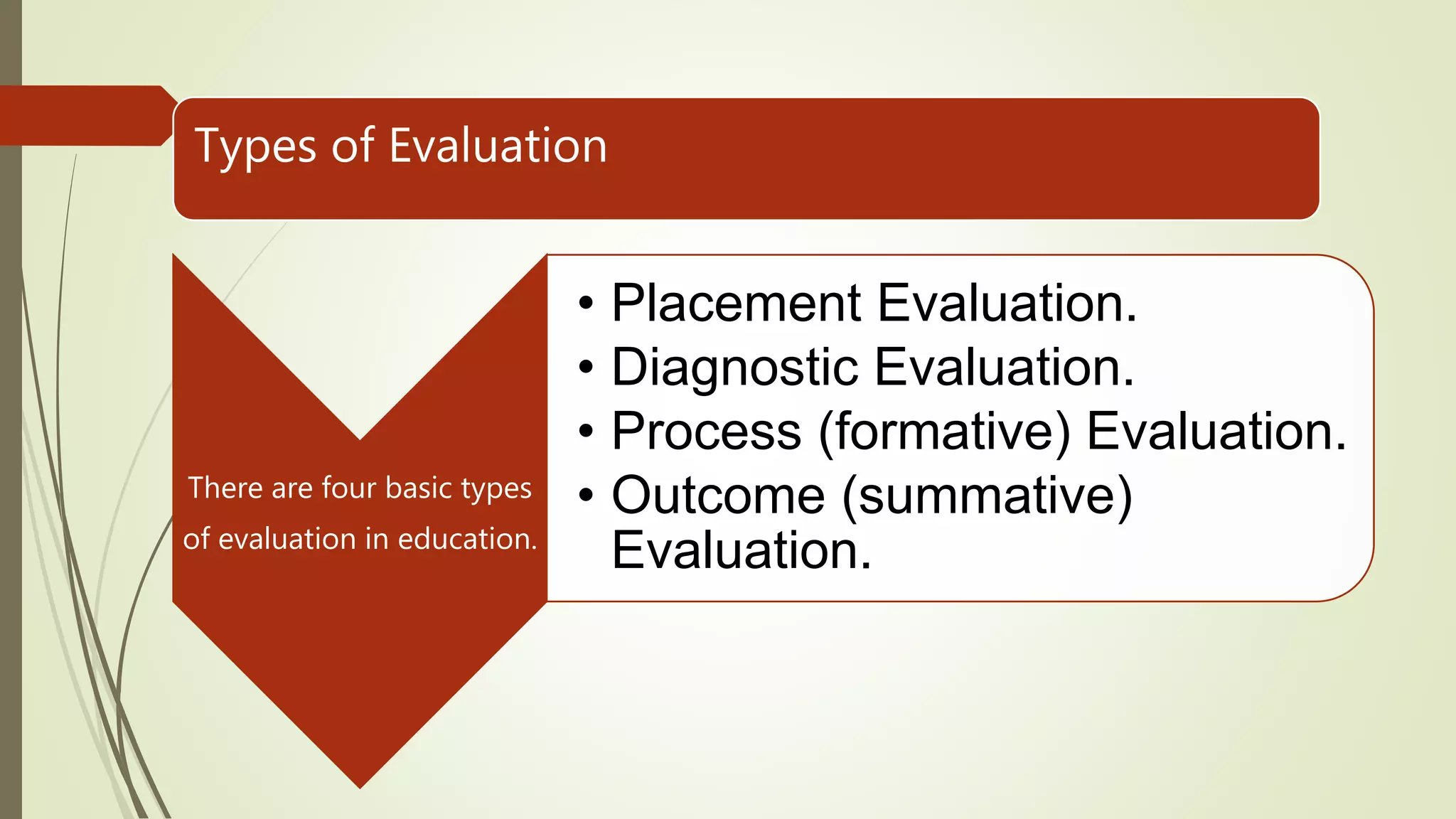
There are four basic types
of evaluation in education.
• Placement Evaluation.
• Diagnostic Evaluation.
• Process (formative) Evaluation.
• Outcome (summative)
Evaluation.
Placement Evaluation
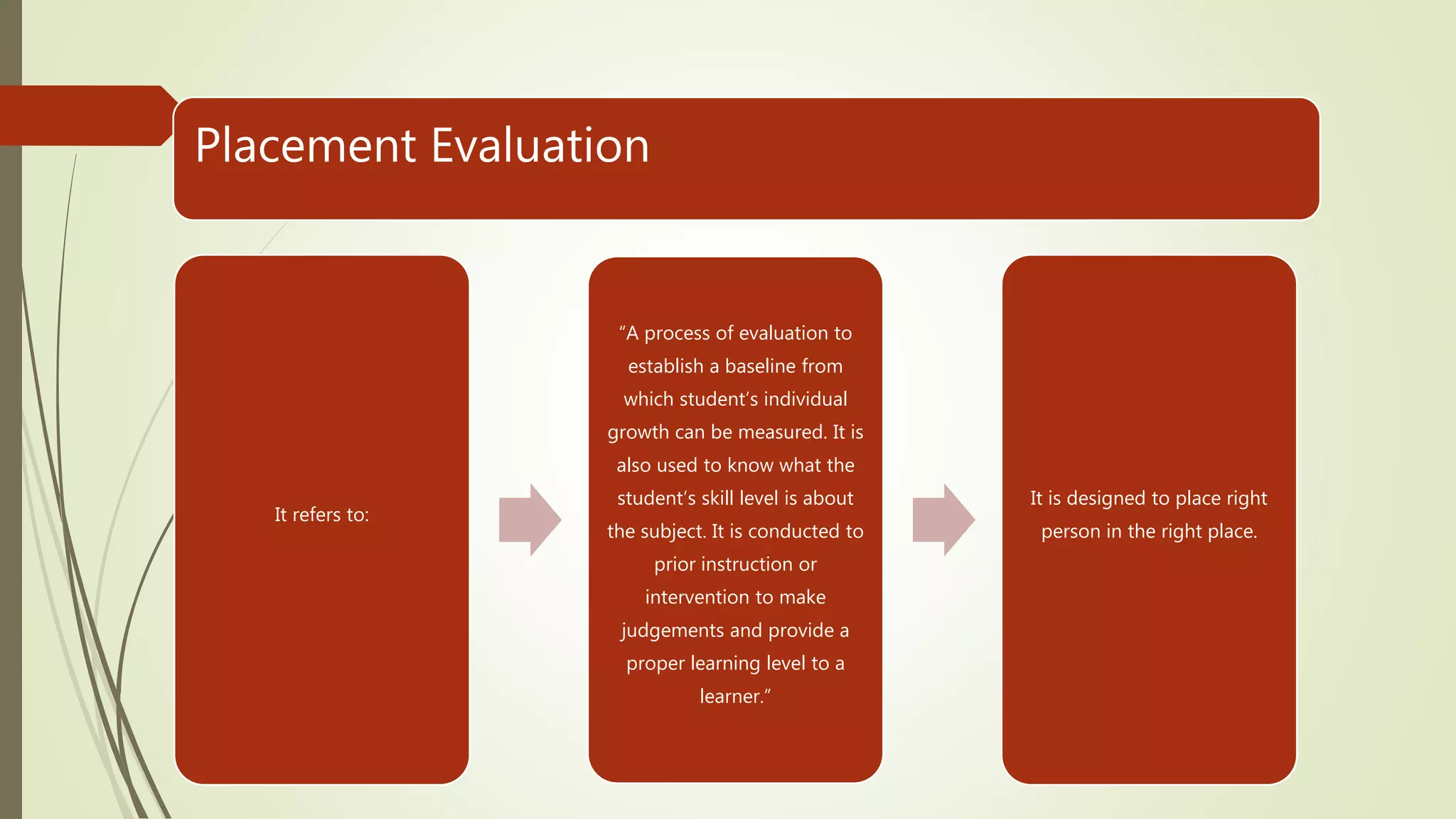
It refers to:
“A process of evaluation to
establish a baseline from
which student’s individual
growth can be measured. It is
also used to know what the
student’s skill level is about
the subject. It is conducted to
prior instruction or
intervention to make
judgements and provide a
proper learning level to a
learner.”
It is designed to place right
person in the right place.
Purposes of Placement Evaluation
To place
students
according to
prior
achievements
and personal
characteristics.
To provide
an
appropriate
instructional
sequence.
To help
teacher to
work on
teaching
more
efficiently.
To assist
learner, to
perform in
certain
circumstance
s.
To make
decisions
more
productive i-
e student
and teacher.
Examples:
• Aptitude test
• Self reported inventories
• Medical entrance test
• Observational techniques
• Agricultural or engineering
entrance exam
DIAGNOSTIC EVALUATION
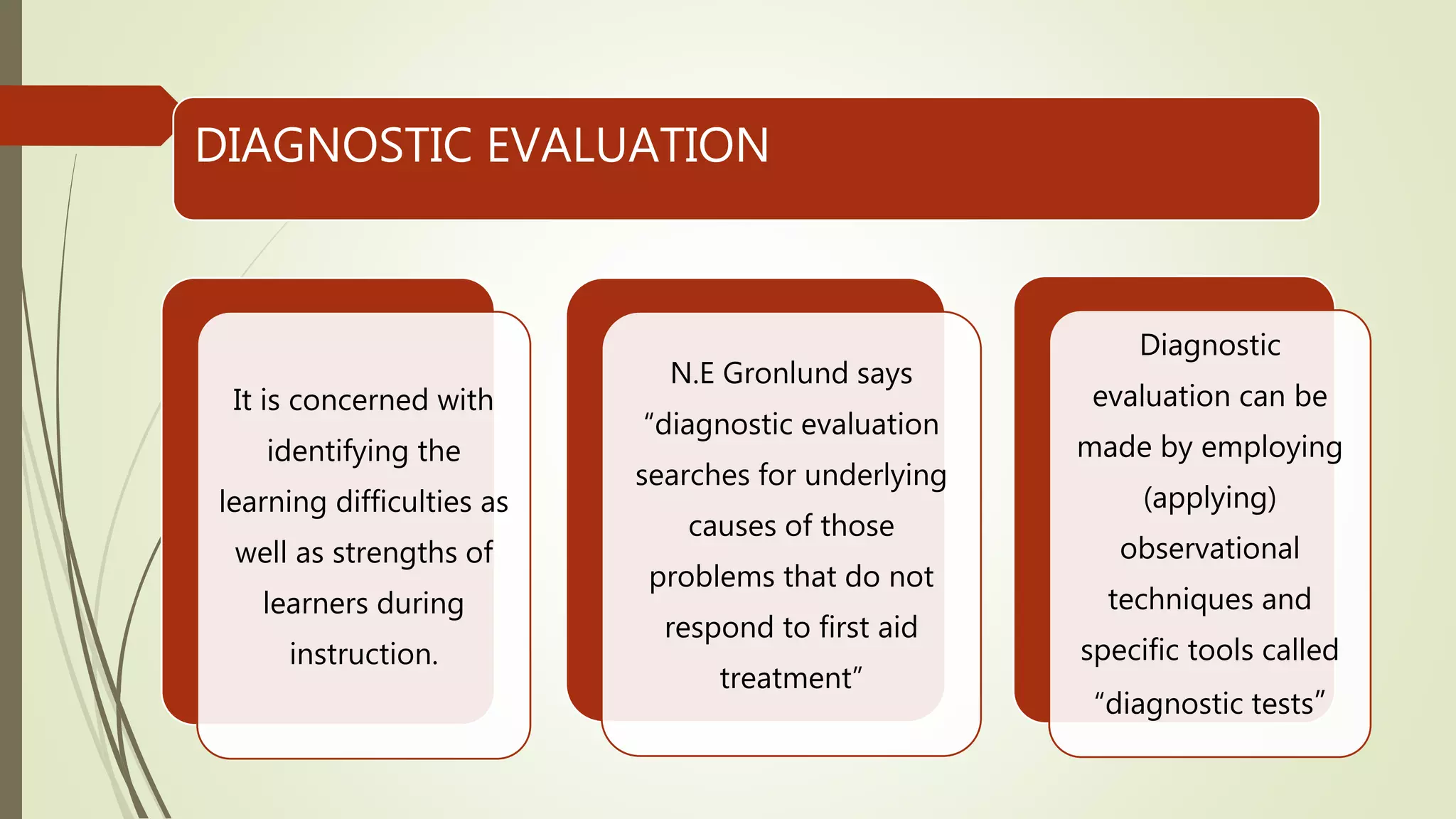
It is concerned with
identifying the
learning difficulties as
well as strengths of
learners during
instruction.
N.E Gronlund says
“diagnostic evaluation
searches for underlying
causes of those
problems that do not
respond to first aid
treatment”
Diagnostic
evaluation can be
made by employing
(applying)
observational
techniques and
specific tools called
“diagnostic tests”
Purposes of Diagnostic Evaluation
To identify
learning
weaknesses
of a learner.
To determine
specific areas
of strengths
of an
individual.
To provide
excel
assistance
and
instructions.
To evaluate
accordingly
with equity.
To develop
skills to think
out of the
box rather
than limits a
learner in
boundary.
PROCESS OR FORMATIVE EVALUATION
“It is an ongoing evaluation that prevents problem before
they occur or arise. It is used to monitor learning progress
during period of instruction”
The main objective of it is to provide continuous feedback
to both teacher and student concerning learning
successes and failures while instruction is in process.
Purposes of Process Evaluation
To identify specific
learning errors that
need correction.
To provide feedback to teacher
to modify instruction or
prescribing group or an
individual remedial work.
To help teacher to
ascertain student’s
progress time to time.
To develop appraisal
of achievement as well
as improvement.
To make learner’s
participation desirable
in learning process.
Examples:
• Monthly tests
• Class tests
• Mid terms
• Presentations
• Project work
• Home assignments
Outcome or Summative Evaluation
This type of evaluation
is defined as: “the
evaluation occurs at the
end of a course of
instruction to know that
at what extent the
objectives previously
fixed have been
accomplished is known
as outcome or
summative evaluation”
In other words the
evaluation of pupils’
achievement at the end
of a course. It is
generally the work of
standardized tests to
assign grades to the
pupils.
Purposes of outcome evaluation
To indicates the degree of content that students has mastered.
To judge the appropriateness of instructional objectives of the
course or program.
To promote learners to next higher classes.
To compare content with other on the basis of standard criteria.
To make a final judgement about both course and pupil.
Examples:
• Final terms
• Semester exams
• Research seminars.
• Job Interviews
• Performance test.
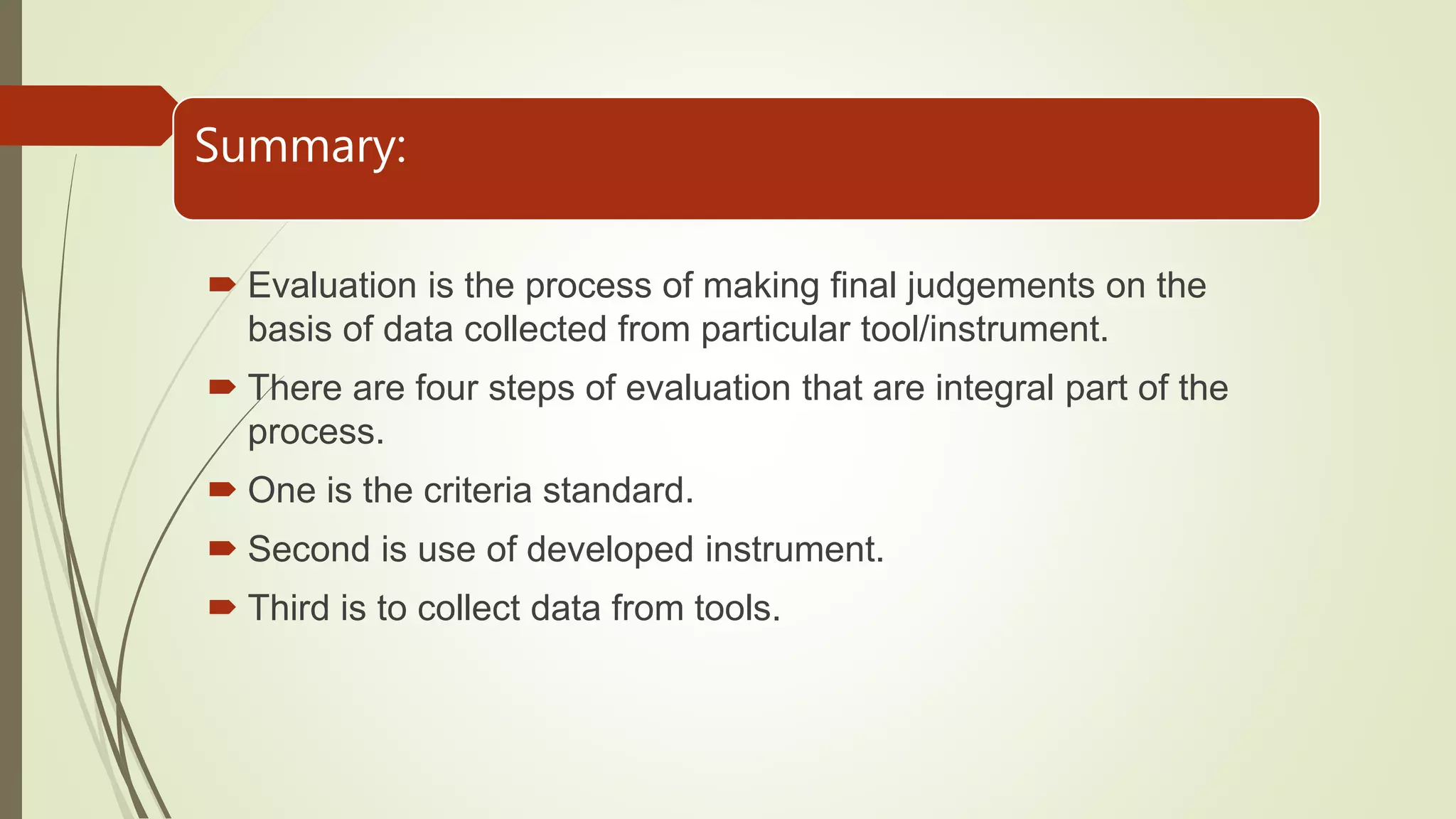
Summary:
 Evaluation is the process of making final judgements on the
basis of data collected from particular tool/instrument.
 There are four steps of evaluation that are integral part of the
process.
 One is the criteria standard.
 Second is use of developed instrument.
 Third is to collect data from tools.
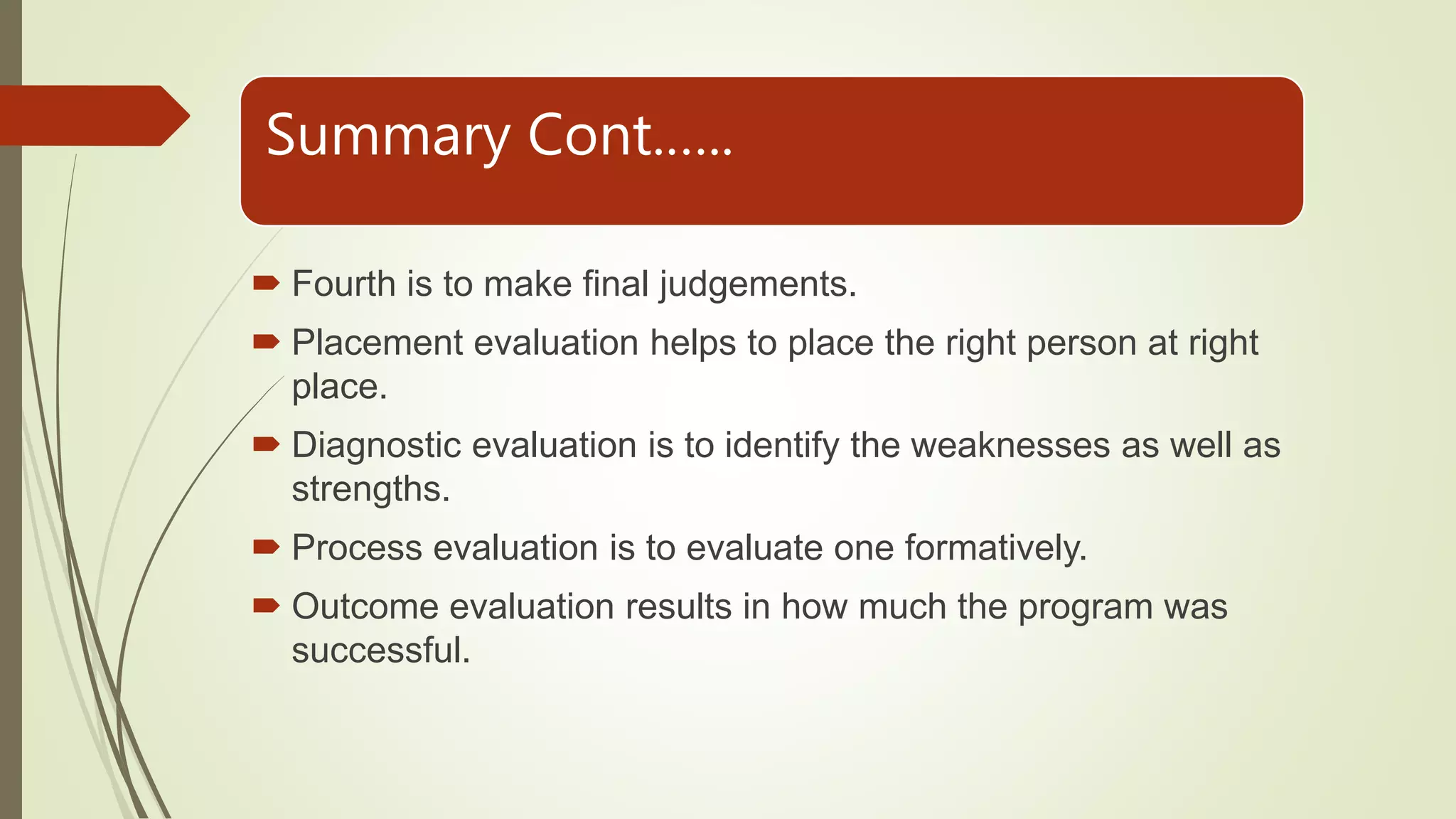
Summary Cont.…..
 Fourth is to make final judgements.
 Placement evaluation helps to place the right person at right
place.
 Diagnostic evaluation is to identify the weaknesses as well as
strengths.
 Process evaluation is to evaluate one formatively.
 Outcome evaluation results in how much the program was
successful.
THANK
YOU


Types of Evaluation

  • 2.
    Types of Evaluation Assignedby: Dr. Amjad Ali Arain Course title: Test Development And Evaluation Seat no: 2K16/BEDEL/10. Name of student: Aneeqa Hashmi
  • 3.
    OBJECTIVES OF MYPRESENTATION: By the end of this presentation students will be able to: Define the term evaluation. Enlist four steps of evaluation. Describe the four basic types of evaluation. Illustrate the purposes of evaluation and its types. Discuss types of evaluation with different examples.
  • 5.
    Evaluation • The processof obtaining information (data) and using it to form judgements, which in turn are used in decision making. • Evaluation is a systematic, detailed and thorough process of assessing knowledge and skills, behavior and attitude of learner to make some decisions. Definitions;
  • 6.
    Steps of Evaluation Formulationof judgments and taking of appropriate action Interpretation of measurement data Development and use of measuring instruments The criteria (acceptable level of performance) of the educational objectives
  • 7.
    Types of Evaluation Thereare four basic types of evaluation in education. • Placement Evaluation. • Diagnostic Evaluation. • Process (formative) Evaluation. • Outcome (summative) Evaluation.
  • 8.
    Placement Evaluation It refersto: “A process of evaluation to establish a baseline from which student’s individual growth can be measured. It is also used to know what the student’s skill level is about the subject. It is conducted to prior instruction or intervention to make judgements and provide a proper learning level to a learner.” It is designed to place right person in the right place.
  • 9.
    Purposes of PlacementEvaluation To place students according to prior achievements and personal characteristics. To provide an appropriate instructional sequence. To help teacher to work on teaching more efficiently. To assist learner, to perform in certain circumstance s. To make decisions more productive i- e student and teacher.
  • 10.
    Examples: • Aptitude test •Self reported inventories • Medical entrance test • Observational techniques • Agricultural or engineering entrance exam
  • 11.
    DIAGNOSTIC EVALUATION It isconcerned with identifying the learning difficulties as well as strengths of learners during instruction. N.E Gronlund says “diagnostic evaluation searches for underlying causes of those problems that do not respond to first aid treatment” Diagnostic evaluation can be made by employing (applying) observational techniques and specific tools called “diagnostic tests”
  • 12.
    Purposes of DiagnosticEvaluation To identify learning weaknesses of a learner. To determine specific areas of strengths of an individual. To provide excel assistance and instructions. To evaluate accordingly with equity. To develop skills to think out of the box rather than limits a learner in boundary.
  • 13.
    PROCESS OR FORMATIVEEVALUATION “It is an ongoing evaluation that prevents problem before they occur or arise. It is used to monitor learning progress during period of instruction” The main objective of it is to provide continuous feedback to both teacher and student concerning learning successes and failures while instruction is in process.
  • 15.
    Purposes of ProcessEvaluation To identify specific learning errors that need correction. To provide feedback to teacher to modify instruction or prescribing group or an individual remedial work. To help teacher to ascertain student’s progress time to time. To develop appraisal of achievement as well as improvement. To make learner’s participation desirable in learning process.
  • 16.
    Examples: • Monthly tests •Class tests • Mid terms • Presentations • Project work • Home assignments
  • 17.
    Outcome or SummativeEvaluation This type of evaluation is defined as: “the evaluation occurs at the end of a course of instruction to know that at what extent the objectives previously fixed have been accomplished is known as outcome or summative evaluation” In other words the evaluation of pupils’ achievement at the end of a course. It is generally the work of standardized tests to assign grades to the pupils.
  • 19.
    Purposes of outcomeevaluation To indicates the degree of content that students has mastered. To judge the appropriateness of instructional objectives of the course or program. To promote learners to next higher classes. To compare content with other on the basis of standard criteria. To make a final judgement about both course and pupil.
  • 20.
    Examples: • Final terms •Semester exams • Research seminars. • Job Interviews • Performance test.
  • 21.
    Summary:  Evaluation isthe process of making final judgements on the basis of data collected from particular tool/instrument.  There are four steps of evaluation that are integral part of the process.  One is the criteria standard.  Second is use of developed instrument.  Third is to collect data from tools.
  • 22.
    Summary Cont.…..  Fourthis to make final judgements.  Placement evaluation helps to place the right person at right place.  Diagnostic evaluation is to identify the weaknesses as well as strengths.  Process evaluation is to evaluate one formatively.  Outcome evaluation results in how much the program was successful.
  • 23.