
Prof. A.R. Shah 
Sr. Reader 
Civil Engg. Dept. 
Faculty of Tech & Engg 
M.S. University of Baroda 
& 
In-Charge of Environmental Laboratory 
 Co-ordinator 
 Env. AUDIT SCHEME FOR SHEDULE –I INDUSTRIES OF GUJARAT 
STATE 
 Member Of Governing Council 
For 
Gujarat Env. Management Institute (Gemi) 
 In-Charge Of U.G. & P.G Course In Env. Engg 
 In-Charge Of P.G. Diploma In Env. Science Course.
1.0 CONCEPT OF REUSE 
 Continued population growth, increased water 
demand, increased contamination of both surface 
water and ground water, uneven distribution of 
water resources, decreased fresh water sources, 
increased costs of fresh water, periodic droughts 
etc. have forced water management agencies to 
search for new sources of water supply and 
advanced waste water treatment methods for 
municipal and industrial waste water so as to 
develop the reuse of water as a viable option of 
water conservation.
 Reuse refers to the process by which water used 
for one purpose or by one industrial process is 
used again by another purpose or by another 
different industrial process. 
 Recycling is the use of effluent with or without 
treatment for the intake of the same use of 
water.
 Water reclamation recycling and reuse represent 
significant components of the hydrological cycle 
in urban, industrial and agricultural areas. A 
conceptional overview of the cycling of water 
from surface and ground water sources to water 
treatment facilities, irrigation, municipal and 
industrial application and to water reclamation 
and reuse facilities is shown in following figure:
THE ROLE OF ENGINEERED TREATMENT, RECLAMATION 
AND REUSE FACILITIES IN THE CYCLING OF WATER 
THROUGH THE HYDROLOGIC CYCLE
REUSE OPTIONS AND APPLICATION 
1. IRRIGATION REUSE 
Agriculture irrigation is the largest current use of reclaimed water. This reuse 
category offers significant future opportunities for water reuse. Landscape 
irrigation, includes the irrigation of parks and gardens, play grounds, golf 
courses, freeway medians, landscaped areas, commercial office and industrial 
developments and landscaped area around residencies. 
Many landscape irrigation projects involve dual distribution system- one 
distribution network for potable water and another for reclaimed water.
2. INDUSTRIAL REUSE 
There are many possible industrial uses of renovated waste water are 
subjected to the wide variety of treatments systems that might have to be 
employed 
3. RECREATIONAL REUSE 
Reuse of waster water in recreational lakes must satisfy both health standard 
and standard that will make the lake acceptable from the recreational stand 
point. 
4. GROND WATER RECHARGE 
One of the reuse application for the reclaimed water is ground water 
recharge via either spreading basins or direct injection to ground water 
aquifers.
 REUSE FOR CONSTRUCTION 
 REUSE FOR CENTRALLY AIR CONDITIONED PLANTS 
 REUSE FOR SOIL COMPACTION 
 REUSE FOR REFUSE COMPACTION 
 REUSE FOR SALT WATER INTRUSION 
 REUSE FR OILFIELD REPRESSURIZATION 
etc……etc……..etc………………
 Establishment of facility performance standards 
 Information search on source characteristics and continuity 
 Performance on economical and technical studies 
 Testing of unmixed or segregated wastes 
 Testing of selection material of waster recycle and 
management mix proportion with other material 
 Assessment of regulation 
 Estimation of material, procedure and plan 
 Development of monitoring and maintenance 
 Pre-implementation life cycle cost estimation 
 Monitoring maintenance and periodic assessment
Treatment methods for reuse of 
waste water 
 Screening and settling 
 Biological processes 
 Aerobic processes 
 Anaerobic processes 
 Advanced processes 
 Coagulation and flocculation 
 Solid removal 
 Removal of organics’ 
 Reverse osmosis 
 Ion exchange 
 Softening by lime and soda ash or by zeolite process 
 Ultraviolet radiation 
 Chlorination 
 Ultra filtration 
 Ozonation
CASE STUDY NO : 1 
LIMITED REUSE OF DOMESTIC WASTEWATER FOR 
GARDENING AND OTHER PURPOSES (EXCEPT 
POTABLE ) FOR NEARBY AREAS OF SEWAGE 
PUMPING STATIONS OF BARODA CITY
CASE STUDY NO : 2 
REUSE OF TREATED 
SEWAGE FROM NEW 
SEWAGE TREATMENT 
PLANT AT ATLADARA FOR 
INDUSTRIAL AREAS ON THE 
DOWNSREAM
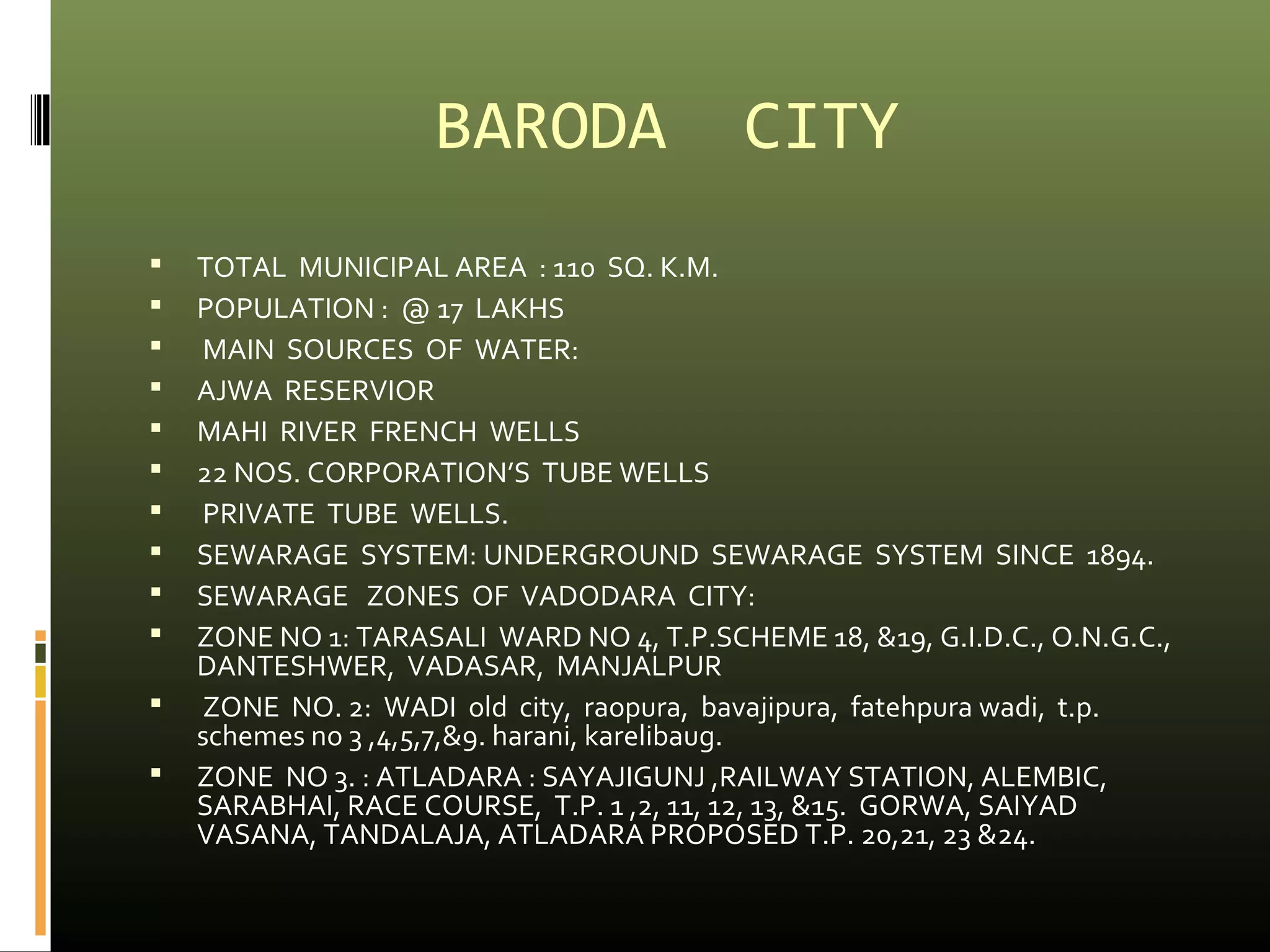
BARODA CITY 
 TOTAL MUNICIPAL AREA : 110 SQ. K.M. 
 POPULATION : @ 17 LAKHS 
 MAIN SOURCES OF WATER: 
 AJWA RESERVIOR 
 MAHI RIVER FRENCH WELLS 
 22 NOS. CORPORATION’S TUBE WELLS 
 PRIVATE TUBE WELLS. 
 SEWARAGE SYSTEM: UNDERGROUND SEWARAGE SYSTEM SINCE 1894. 
 SEWARAGE ZONES OF VADODARA CITY: 
 ZONE NO 1: TARASALI WARD NO 4, T.P.SCHEME 18, &19, G.I.D.C., O.N.G.C., 
DANTESHWER, VADASAR, MANJALPUR 
 ZONE NO. 2: WADI old city, raopura, bavajipura, fatehpura wadi, t.p. 
schemes no 3 ,4,5,7,&9. harani, karelibaug. 
 ZONE NO 3. : ATLADARA : SAYAJIGUNJ ,RAILWAY STATION, ALEMBIC, 
SARABHAI, RACE COURSE, T.P. 1 ,2, 11, 12, 13, &15. GORWA, SAIYAD 
VASANA, TANDALAJA, ATLADARA PROPOSED T.P. 20,21, 23 &24.
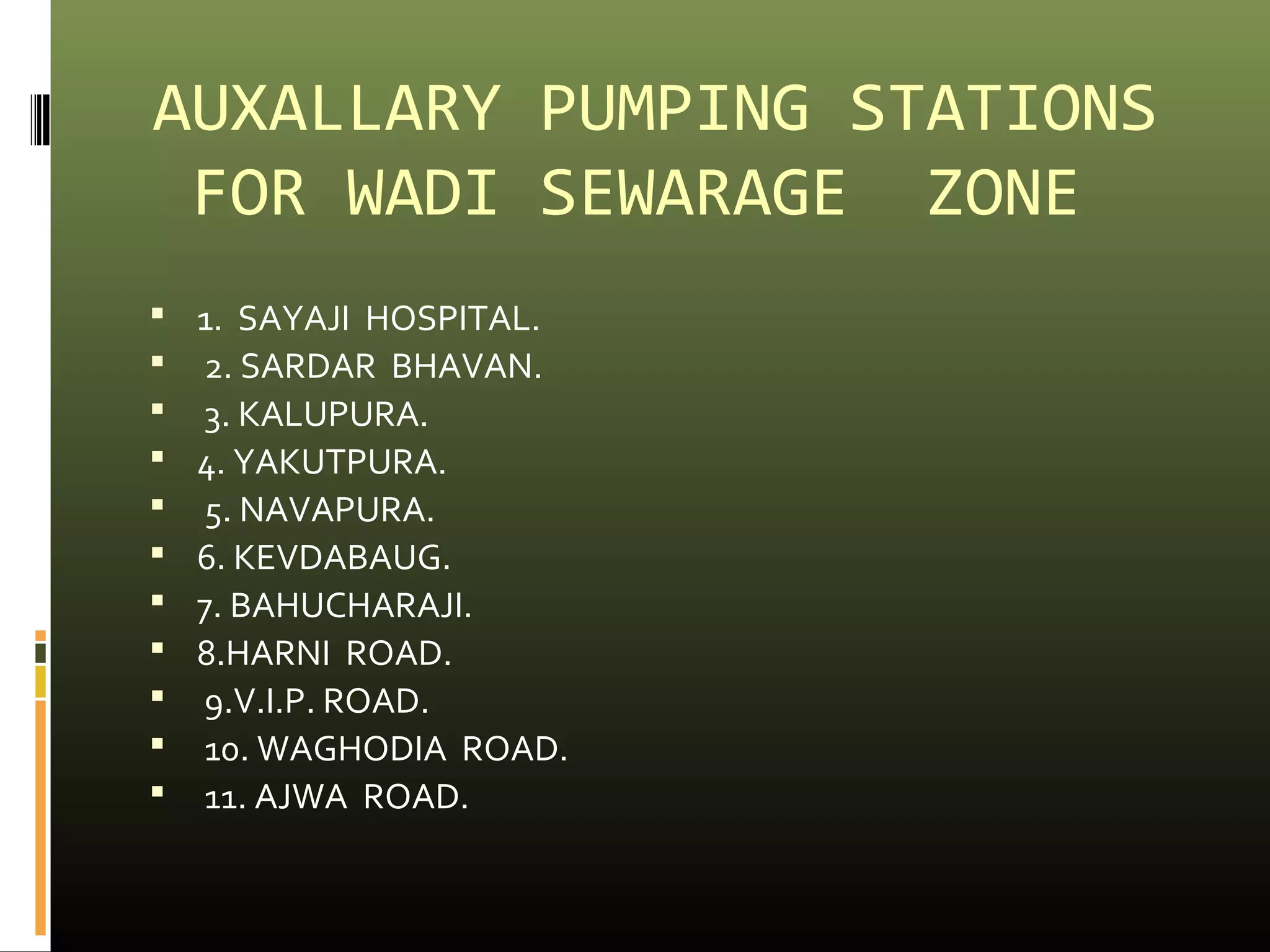
AUXALLARY PUMPING STATIONS 
FOR WADI SEWARAGE ZONE 
 1. SAYAJI HOSPITAL. 
 2. SARDAR BHAVAN. 
 3. KALUPURA. 
 4. YAKUTPURA. 
 5. NAVAPURA. 
 6. KEVDABAUG. 
 7. BAHUCHARAJI. 
 8.HARNI ROAD. 
 9.V.I.P. ROAD. 
 10. WAGHODIA ROAD. 
 11. AJWA ROAD.
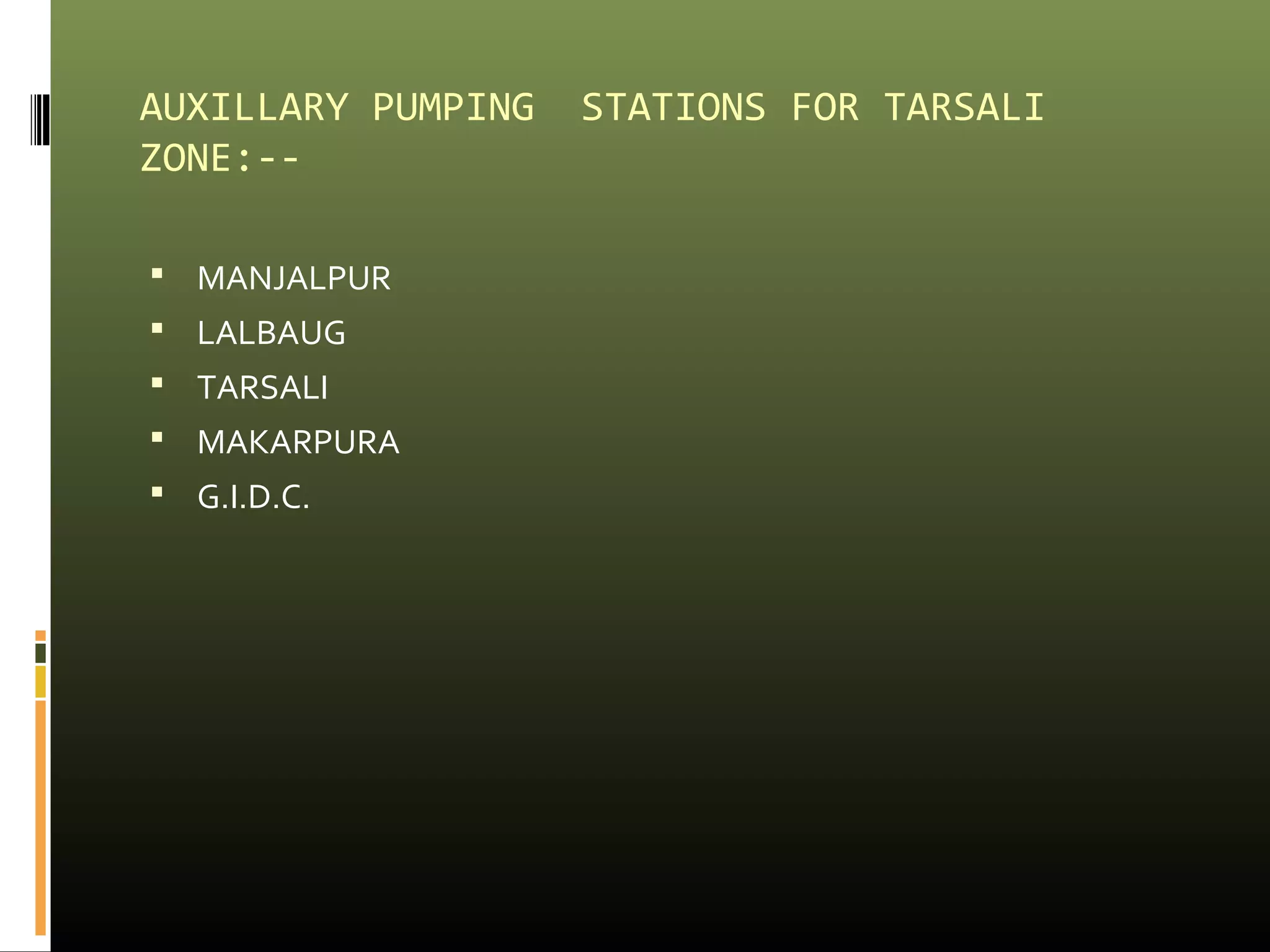
AUXILLARY PUMPING STATIONS FOR TARSALI 
ZONE:-- 
 MANJALPUR 
 LALBAUG 
 TARSALI 
 MAKARPURA 
 G.I.D.C.
AUXALLARY PUMPING STATIONS FOR 
ATLADARA SEWARAGE ZONE 
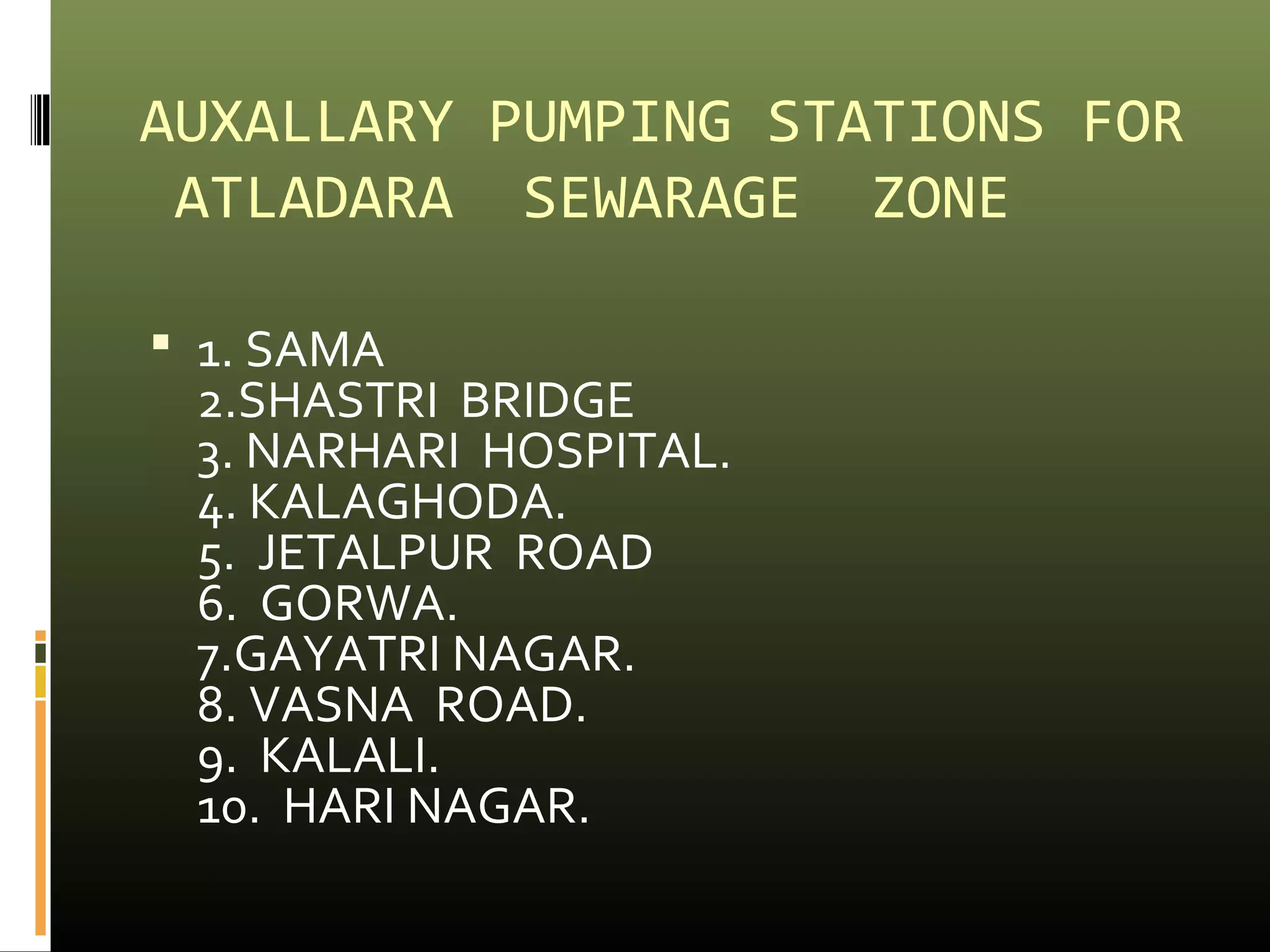
 1. SAMA 
2.SHASTRI BRIDGE 
3. NARHARI HOSPITAL. 
4. KALAGHODA. 
5. JETALPUR ROAD 
6. GORWA. 
7.GAYATRI NAGAR. 
8. VASNA ROAD. 
9. KALALI. 
10. HARI NAGAR.
SEWAGE TREATMENT PLANTS 
IN BARODA CITY 
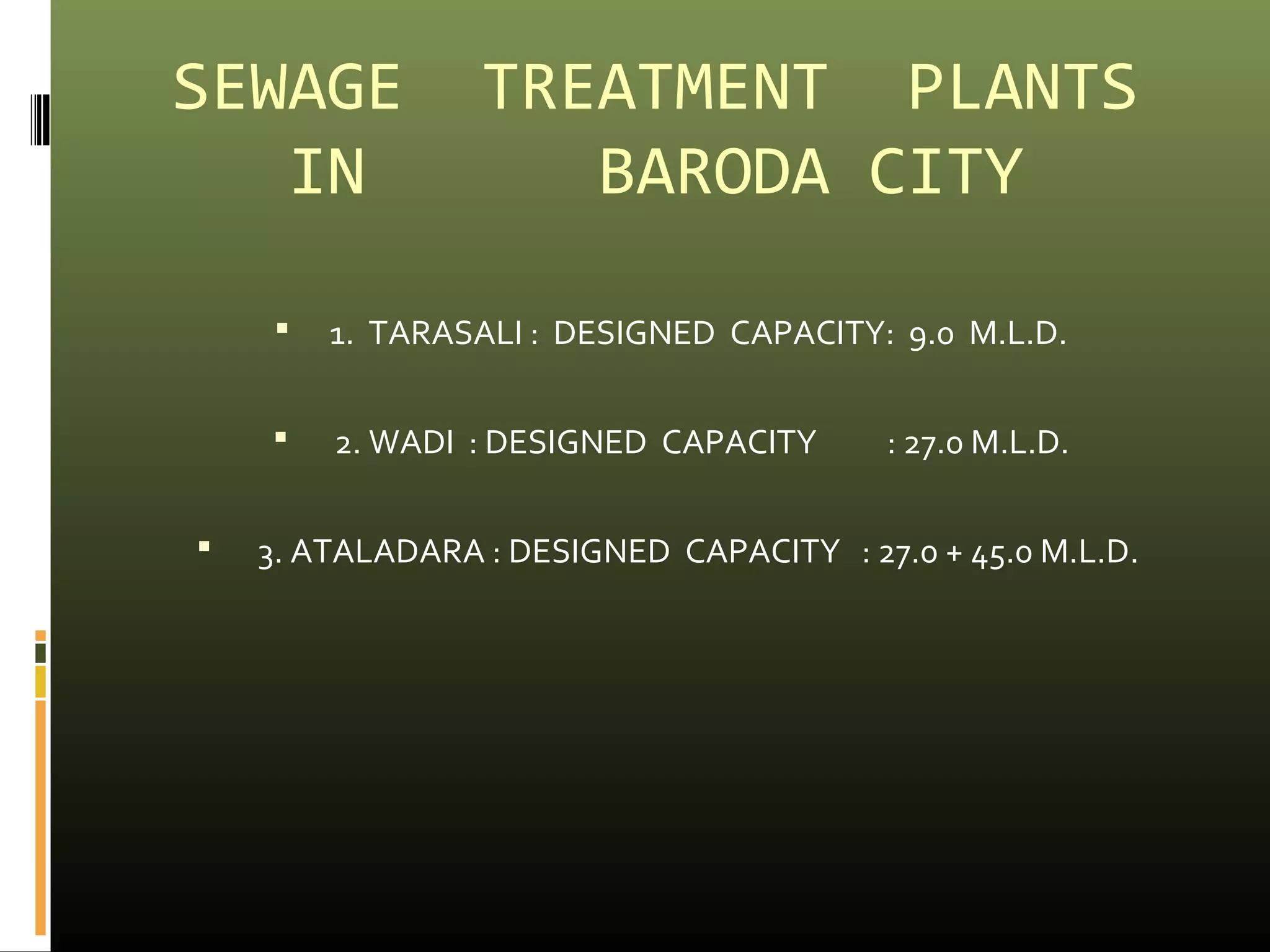
 1. TARASALI : DESIGNED CAPACITY: 9.0 M.L.D. 
 2. WADI : DESIGNED CAPACITY : 27.0 M.L.D. 
 3. ATALADARA : DESIGNED CAPACITY : 27.0 + 45.0 M.L.D.
AUXULARY PUMPING STATIONS 
SELECTED FOR CASE STUDY 
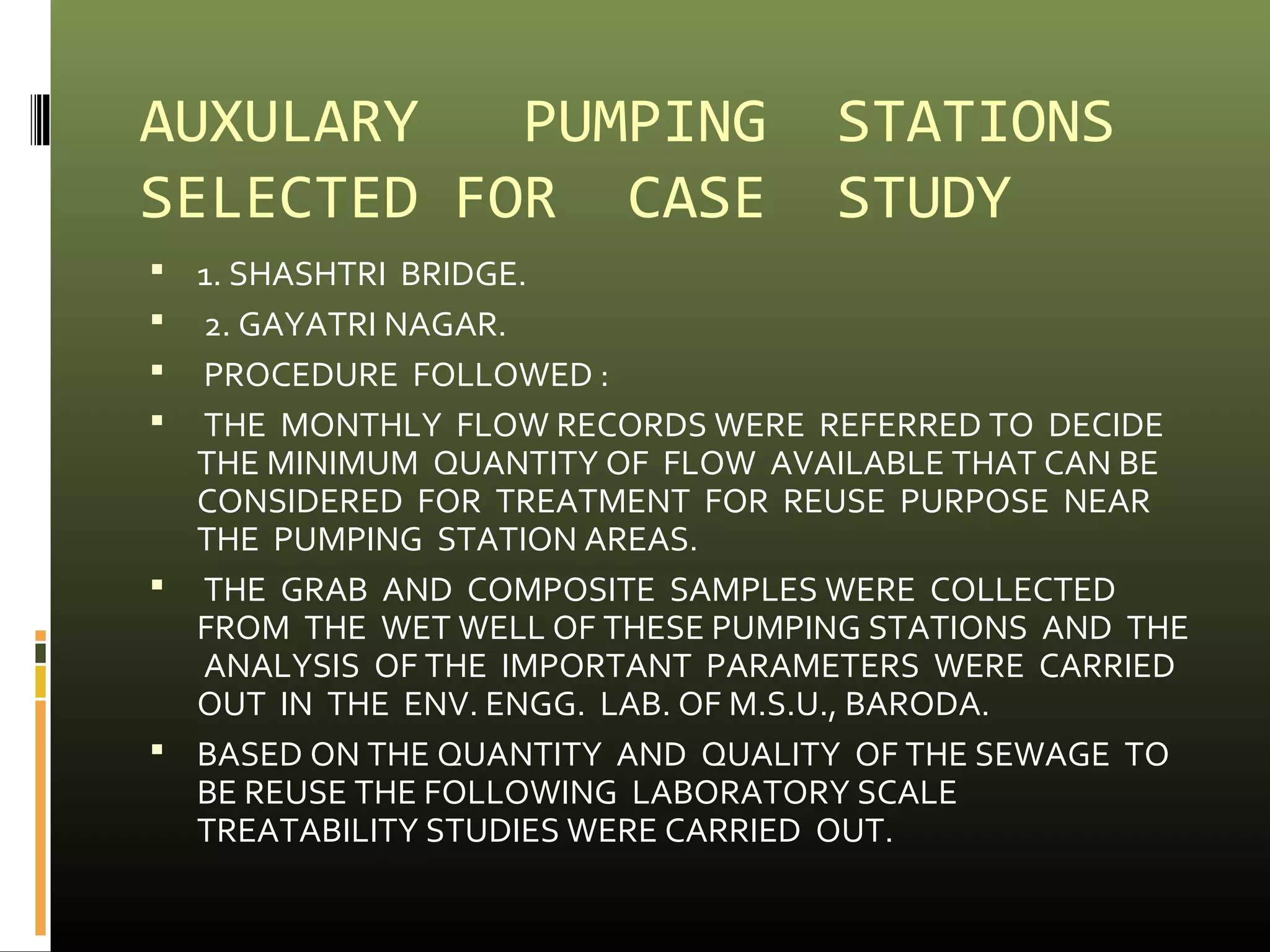
 1. SHASHTRI BRIDGE. 
 2. GAYATRI NAGAR. 
 PROCEDURE FOLLOWED : 
 THE MONTHLY FLOW RECORDS WERE REFERRED TO DECIDE 
THE MINIMUM QUANTITY OF FLOW AVAILABLE THAT CAN BE 
CONSIDERED FOR TREATMENT FOR REUSE PURPOSE NEAR 
THE PUMPING STATION AREAS. 
 THE GRAB AND COMPOSITE SAMPLES WERE COLLECTED 
FROM THE WET WELL OF THESE PUMPING STATIONS AND THE 
ANALYSIS OF THE IMPORTANT PARAMETERS WERE CARRIED 
OUT IN THE ENV. ENGG. LAB. OF M.S.U., BARODA. 
 BASED ON THE QUANTITY AND QUALITY OF THE SEWAGE TO 
BE REUSE THE FOLLOWING LABORATORY SCALE 
TREATABILITY STUDIES WERE CARRIED OUT.
PROPOSED TREATMENTS : 
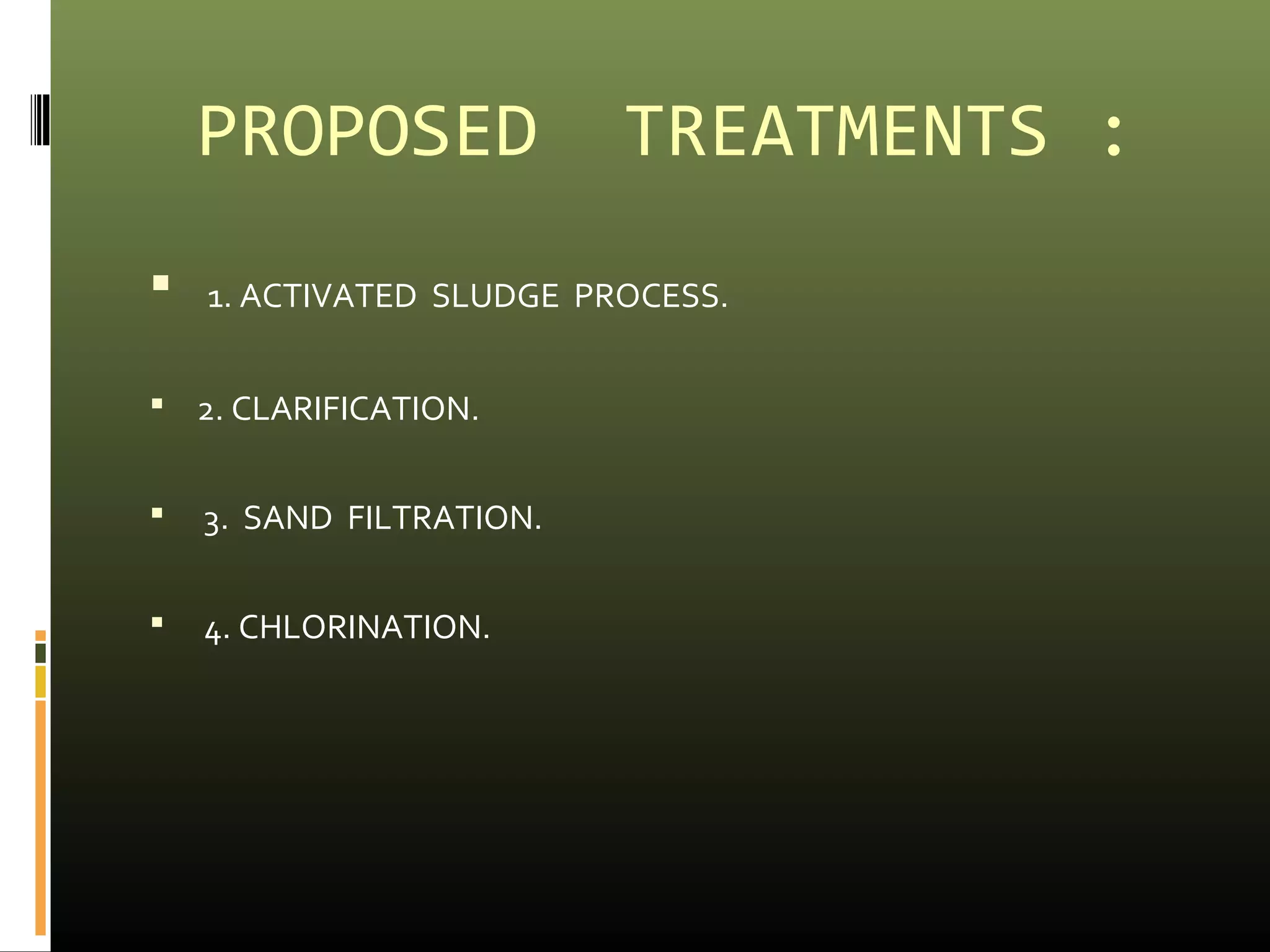
 1. ACTIVATED SLUDGE PROCESS. 
 2. CLARIFICATION. 
 3. SAND FILTRATION. 
 4. CHLORINATION.
MOBILE SMALL PACAGE 
S.T.P. 
 DESIGN OF SMALL PACAGE S.T.P. OF 10 M3 AND 50 M3 
CAPACITY WERE CARRIED OUT.
COST ESTIMATE FOR 10 M3 PLANT.
COST ESTIMATE FOR 50 M3 PLANT.
CASE STUDY NO 2.: 
 FEASIBILITY STUDY FOR INDUSTRIAL REUSE OF 
TREATED EFFLUENT FROM SEWAGE TREATMENT 
PLANT.. 
 43.0 M.L.D CAPACITY NEW S.T.P. ON THE NEW PRINCIPAL OF 
UPFLOW ANAEROBIC SLUDGE BLANKET TECHNIQUE WAS 
SELECTED FOR THE STUDY PURPOSE. 
 PROCESS FLOW DIAGARAM OF THE S.T.P. IS AS FOLLOWS :
METHODOLOGY FOR CASE :2. 
 COMPOSITE SAMPLES FROM OUT LET OF S.S.T. WERE 
COLLECTED AND ANALYSED AND THE RESULTS ARE GIVEN IN 
THIS TABLE:--- 
 THE RESULTS WERE COMPARED WITH STANDARDS FOR 
DRINKING WATER ( IS 10500 AND W.H.O.) , COOLING; 
IRRIGATION WATER AS PER IS 2490.
TREATABILITY STUDIES:--- 
 TREATABILITY STUDIES WERE CARRIED OUT MAINLY FOR 
MPN, AND BACTERIAL COUNT, BOD, COD, S.S., TOTAL 
HARDNESS, CARBONATE HARDNESS AND COLOUR AND 
ODOUR. 
 VARIOUS OPTIONS OF LABORATORY TREATMENTS WERE 
CARRIED OUT FROM THE FOLLOWING :---- 
 COAGULATION, FLOCCULATION SEDIMENTATION AND 
FILTRATION. 
 CHLORINATION. 
 SOFTENING BY ION EXCHANGE COLUMN. 
 SOFTENING BY LIME-SODA ASH PROCESS. 
 U.V. RAY TREATMENT. 
 OZINATION.
RESULTS OF TREATMENTS:----
REUSE OF WASTEWATER 
 types of waste:-- 
 Solid 
 Liquid 
 Gaseous 
 Domestic 
 Industrial 
 Types of reuses:- 
 Direct and Indirect & Recycling. 
 Potable and non potable.
MANAGEMENT OF INDUSTRIAL REUSE 
W.W. WITHIN THE PREMISES: 
 1. DETERMINATION OF FRESH WATER SUPLY AND WASTE WATER AS A WHOLE 
 2.DISTRIBUTION OF WATER WITHIN THE INDUSTRY AND COLLECTION OF W.W. FORM VARIOUS 
STEAMS IN THE SAME. 
 3. PROPER SEGREGATIONS, OPTIMISATION AND DISCHARGING IN TO THE W.W. TREATMENT 
PLANT. 
 4. PROPER DESIGNING OF W.W.TREATMENT PLANT. 
 5. PROPER DECISIONS FOR TYPE OF REUSE TO BE PARCTICED FOR REUSE OF TREATED W.W. FROM 
EFFLUENT TREATMENT PLANT. (SAY FOR IRRIGATION, GREEN BELT, TREE PLANTATIONS ETC. IN 
THE PREMISES.) 
 6. PROPER DESIGNING FOR THE REQUIREMENTS OF SOIL TYPE IN EACH AREA OF THE INDUSTRY. 
 7.PROPER DECISION ABOUT THE TREES TO PLANTED AND NURRESERIES AND LOANS TO BE 
GROWN. 
 8. PROPER ASSESSMENT OF REQUIREMENTS OF WATER OF EACH PORTION OF THE PLANTETION. 
 9.PROPER GESIGNING OF TREATED W.W. DISTRIBUTION SYSTEM. 
 10. PROPER EXECUTION SCHEDULE OF CONSTRUCTION OF FACTORY, 
WATER SUPLY LINES, W.W. COLLECTION LINES, E.T.P, COSTRUCTION OF RETURN 
TREATED W.W. LINES., PLANTATIONS OF TREES ETC. 
. 11. CONTROL ON QUANTITY AND QUALITY OF WATER AND W.W. AND PERFORMANCE OF E.T.P.
 “THANK YOU ALL”….

Scope of reuse of sewage for baroda city

  • 2.
    Prof. A.R. Shah Sr. Reader Civil Engg. Dept. Faculty of Tech & Engg M.S. University of Baroda & In-Charge of Environmental Laboratory  Co-ordinator  Env. AUDIT SCHEME FOR SHEDULE –I INDUSTRIES OF GUJARAT STATE  Member Of Governing Council For Gujarat Env. Management Institute (Gemi)  In-Charge Of U.G. & P.G Course In Env. Engg  In-Charge Of P.G. Diploma In Env. Science Course.
  • 3.
    1.0 CONCEPT OFREUSE  Continued population growth, increased water demand, increased contamination of both surface water and ground water, uneven distribution of water resources, decreased fresh water sources, increased costs of fresh water, periodic droughts etc. have forced water management agencies to search for new sources of water supply and advanced waste water treatment methods for municipal and industrial waste water so as to develop the reuse of water as a viable option of water conservation.
  • 4.
     Reuse refersto the process by which water used for one purpose or by one industrial process is used again by another purpose or by another different industrial process.  Recycling is the use of effluent with or without treatment for the intake of the same use of water.
  • 5.
     Water reclamationrecycling and reuse represent significant components of the hydrological cycle in urban, industrial and agricultural areas. A conceptional overview of the cycling of water from surface and ground water sources to water treatment facilities, irrigation, municipal and industrial application and to water reclamation and reuse facilities is shown in following figure:
  • 6.
    THE ROLE OFENGINEERED TREATMENT, RECLAMATION AND REUSE FACILITIES IN THE CYCLING OF WATER THROUGH THE HYDROLOGIC CYCLE
  • 7.
    REUSE OPTIONS ANDAPPLICATION 1. IRRIGATION REUSE Agriculture irrigation is the largest current use of reclaimed water. This reuse category offers significant future opportunities for water reuse. Landscape irrigation, includes the irrigation of parks and gardens, play grounds, golf courses, freeway medians, landscaped areas, commercial office and industrial developments and landscaped area around residencies. Many landscape irrigation projects involve dual distribution system- one distribution network for potable water and another for reclaimed water.
  • 8.
    2. INDUSTRIAL REUSE There are many possible industrial uses of renovated waste water are subjected to the wide variety of treatments systems that might have to be employed 3. RECREATIONAL REUSE Reuse of waster water in recreational lakes must satisfy both health standard and standard that will make the lake acceptable from the recreational stand point. 4. GROND WATER RECHARGE One of the reuse application for the reclaimed water is ground water recharge via either spreading basins or direct injection to ground water aquifers.
  • 9.
     REUSE FORCONSTRUCTION  REUSE FOR CENTRALLY AIR CONDITIONED PLANTS  REUSE FOR SOIL COMPACTION  REUSE FOR REFUSE COMPACTION  REUSE FOR SALT WATER INTRUSION  REUSE FR OILFIELD REPRESSURIZATION etc……etc……..etc………………
  • 10.
     Establishment offacility performance standards  Information search on source characteristics and continuity  Performance on economical and technical studies  Testing of unmixed or segregated wastes  Testing of selection material of waster recycle and management mix proportion with other material  Assessment of regulation  Estimation of material, procedure and plan  Development of monitoring and maintenance  Pre-implementation life cycle cost estimation  Monitoring maintenance and periodic assessment
  • 11.
    Treatment methods forreuse of waste water  Screening and settling  Biological processes  Aerobic processes  Anaerobic processes  Advanced processes  Coagulation and flocculation  Solid removal  Removal of organics’  Reverse osmosis  Ion exchange  Softening by lime and soda ash or by zeolite process  Ultraviolet radiation  Chlorination  Ultra filtration  Ozonation
  • 12.
    CASE STUDY NO: 1 LIMITED REUSE OF DOMESTIC WASTEWATER FOR GARDENING AND OTHER PURPOSES (EXCEPT POTABLE ) FOR NEARBY AREAS OF SEWAGE PUMPING STATIONS OF BARODA CITY
  • 13.
    CASE STUDY NO: 2 REUSE OF TREATED SEWAGE FROM NEW SEWAGE TREATMENT PLANT AT ATLADARA FOR INDUSTRIAL AREAS ON THE DOWNSREAM
  • 14.
    BARODA CITY TOTAL MUNICIPAL AREA : 110 SQ. K.M.  POPULATION : @ 17 LAKHS  MAIN SOURCES OF WATER:  AJWA RESERVIOR  MAHI RIVER FRENCH WELLS  22 NOS. CORPORATION’S TUBE WELLS  PRIVATE TUBE WELLS.  SEWARAGE SYSTEM: UNDERGROUND SEWARAGE SYSTEM SINCE 1894.  SEWARAGE ZONES OF VADODARA CITY:  ZONE NO 1: TARASALI WARD NO 4, T.P.SCHEME 18, &19, G.I.D.C., O.N.G.C., DANTESHWER, VADASAR, MANJALPUR  ZONE NO. 2: WADI old city, raopura, bavajipura, fatehpura wadi, t.p. schemes no 3 ,4,5,7,&9. harani, karelibaug.  ZONE NO 3. : ATLADARA : SAYAJIGUNJ ,RAILWAY STATION, ALEMBIC, SARABHAI, RACE COURSE, T.P. 1 ,2, 11, 12, 13, &15. GORWA, SAIYAD VASANA, TANDALAJA, ATLADARA PROPOSED T.P. 20,21, 23 &24.
  • 15.
    AUXALLARY PUMPING STATIONS FOR WADI SEWARAGE ZONE  1. SAYAJI HOSPITAL.  2. SARDAR BHAVAN.  3. KALUPURA.  4. YAKUTPURA.  5. NAVAPURA.  6. KEVDABAUG.  7. BAHUCHARAJI.  8.HARNI ROAD.  9.V.I.P. ROAD.  10. WAGHODIA ROAD.  11. AJWA ROAD.
  • 16.
    AUXILLARY PUMPING STATIONSFOR TARSALI ZONE:--  MANJALPUR  LALBAUG  TARSALI  MAKARPURA  G.I.D.C.
  • 18.
    AUXALLARY PUMPING STATIONSFOR ATLADARA SEWARAGE ZONE  1. SAMA 2.SHASTRI BRIDGE 3. NARHARI HOSPITAL. 4. KALAGHODA. 5. JETALPUR ROAD 6. GORWA. 7.GAYATRI NAGAR. 8. VASNA ROAD. 9. KALALI. 10. HARI NAGAR.
  • 19.
    SEWAGE TREATMENT PLANTS IN BARODA CITY  1. TARASALI : DESIGNED CAPACITY: 9.0 M.L.D.  2. WADI : DESIGNED CAPACITY : 27.0 M.L.D.  3. ATALADARA : DESIGNED CAPACITY : 27.0 + 45.0 M.L.D.
  • 20.
    AUXULARY PUMPING STATIONS SELECTED FOR CASE STUDY  1. SHASHTRI BRIDGE.  2. GAYATRI NAGAR.  PROCEDURE FOLLOWED :  THE MONTHLY FLOW RECORDS WERE REFERRED TO DECIDE THE MINIMUM QUANTITY OF FLOW AVAILABLE THAT CAN BE CONSIDERED FOR TREATMENT FOR REUSE PURPOSE NEAR THE PUMPING STATION AREAS.  THE GRAB AND COMPOSITE SAMPLES WERE COLLECTED FROM THE WET WELL OF THESE PUMPING STATIONS AND THE ANALYSIS OF THE IMPORTANT PARAMETERS WERE CARRIED OUT IN THE ENV. ENGG. LAB. OF M.S.U., BARODA.  BASED ON THE QUANTITY AND QUALITY OF THE SEWAGE TO BE REUSE THE FOLLOWING LABORATORY SCALE TREATABILITY STUDIES WERE CARRIED OUT.
  • 21.
    PROPOSED TREATMENTS :  1. ACTIVATED SLUDGE PROCESS.  2. CLARIFICATION.  3. SAND FILTRATION.  4. CHLORINATION.
  • 22.
    MOBILE SMALL PACAGE S.T.P.  DESIGN OF SMALL PACAGE S.T.P. OF 10 M3 AND 50 M3 CAPACITY WERE CARRIED OUT.
  • 23.
    COST ESTIMATE FOR10 M3 PLANT.
  • 24.
    COST ESTIMATE FOR50 M3 PLANT.
  • 25.
    CASE STUDY NO2.:  FEASIBILITY STUDY FOR INDUSTRIAL REUSE OF TREATED EFFLUENT FROM SEWAGE TREATMENT PLANT..  43.0 M.L.D CAPACITY NEW S.T.P. ON THE NEW PRINCIPAL OF UPFLOW ANAEROBIC SLUDGE BLANKET TECHNIQUE WAS SELECTED FOR THE STUDY PURPOSE.  PROCESS FLOW DIAGARAM OF THE S.T.P. IS AS FOLLOWS :
  • 26.
    METHODOLOGY FOR CASE:2.  COMPOSITE SAMPLES FROM OUT LET OF S.S.T. WERE COLLECTED AND ANALYSED AND THE RESULTS ARE GIVEN IN THIS TABLE:---  THE RESULTS WERE COMPARED WITH STANDARDS FOR DRINKING WATER ( IS 10500 AND W.H.O.) , COOLING; IRRIGATION WATER AS PER IS 2490.
  • 27.
    TREATABILITY STUDIES:--- TREATABILITY STUDIES WERE CARRIED OUT MAINLY FOR MPN, AND BACTERIAL COUNT, BOD, COD, S.S., TOTAL HARDNESS, CARBONATE HARDNESS AND COLOUR AND ODOUR.  VARIOUS OPTIONS OF LABORATORY TREATMENTS WERE CARRIED OUT FROM THE FOLLOWING :----  COAGULATION, FLOCCULATION SEDIMENTATION AND FILTRATION.  CHLORINATION.  SOFTENING BY ION EXCHANGE COLUMN.  SOFTENING BY LIME-SODA ASH PROCESS.  U.V. RAY TREATMENT.  OZINATION.
  • 28.
  • 29.
    REUSE OF WASTEWATER  types of waste:--  Solid  Liquid  Gaseous  Domestic  Industrial  Types of reuses:-  Direct and Indirect & Recycling.  Potable and non potable.
  • 30.
    MANAGEMENT OF INDUSTRIALREUSE W.W. WITHIN THE PREMISES:  1. DETERMINATION OF FRESH WATER SUPLY AND WASTE WATER AS A WHOLE  2.DISTRIBUTION OF WATER WITHIN THE INDUSTRY AND COLLECTION OF W.W. FORM VARIOUS STEAMS IN THE SAME.  3. PROPER SEGREGATIONS, OPTIMISATION AND DISCHARGING IN TO THE W.W. TREATMENT PLANT.  4. PROPER DESIGNING OF W.W.TREATMENT PLANT.  5. PROPER DECISIONS FOR TYPE OF REUSE TO BE PARCTICED FOR REUSE OF TREATED W.W. FROM EFFLUENT TREATMENT PLANT. (SAY FOR IRRIGATION, GREEN BELT, TREE PLANTATIONS ETC. IN THE PREMISES.)  6. PROPER DESIGNING FOR THE REQUIREMENTS OF SOIL TYPE IN EACH AREA OF THE INDUSTRY.  7.PROPER DECISION ABOUT THE TREES TO PLANTED AND NURRESERIES AND LOANS TO BE GROWN.  8. PROPER ASSESSMENT OF REQUIREMENTS OF WATER OF EACH PORTION OF THE PLANTETION.  9.PROPER GESIGNING OF TREATED W.W. DISTRIBUTION SYSTEM.  10. PROPER EXECUTION SCHEDULE OF CONSTRUCTION OF FACTORY, WATER SUPLY LINES, W.W. COLLECTION LINES, E.T.P, COSTRUCTION OF RETURN TREATED W.W. LINES., PLANTATIONS OF TREES ETC. . 11. CONTROL ON QUANTITY AND QUALITY OF WATER AND W.W. AND PERFORMANCE OF E.T.P.
  • 31.
     “THANK YOUALL”….