1 
Membrane Separation Processes for 
Wastewater Treatment: An Overview 
Dr. Z.V.P. Murthy 
Professor 
Department of Chemical Engineering 
Sardar Vallabhbhai National Institute of Technology 
Surat – 395007, Gujarat. 
October 09, 2009 
Presentation at the AICTE sponsored One-week Short-Term Training Programme on Treatment and Disposal of 
Wastewaters, October 5-9, 2009, SVNIT, Surat
2 
Outline of Presentation 
 Introduction 
 Various Membrane Separation Processes 
 Membrane Modules 
 Case Study
3
!
4 
 !
!	#
#
$#
%
# 
	 
 #
# #
# #
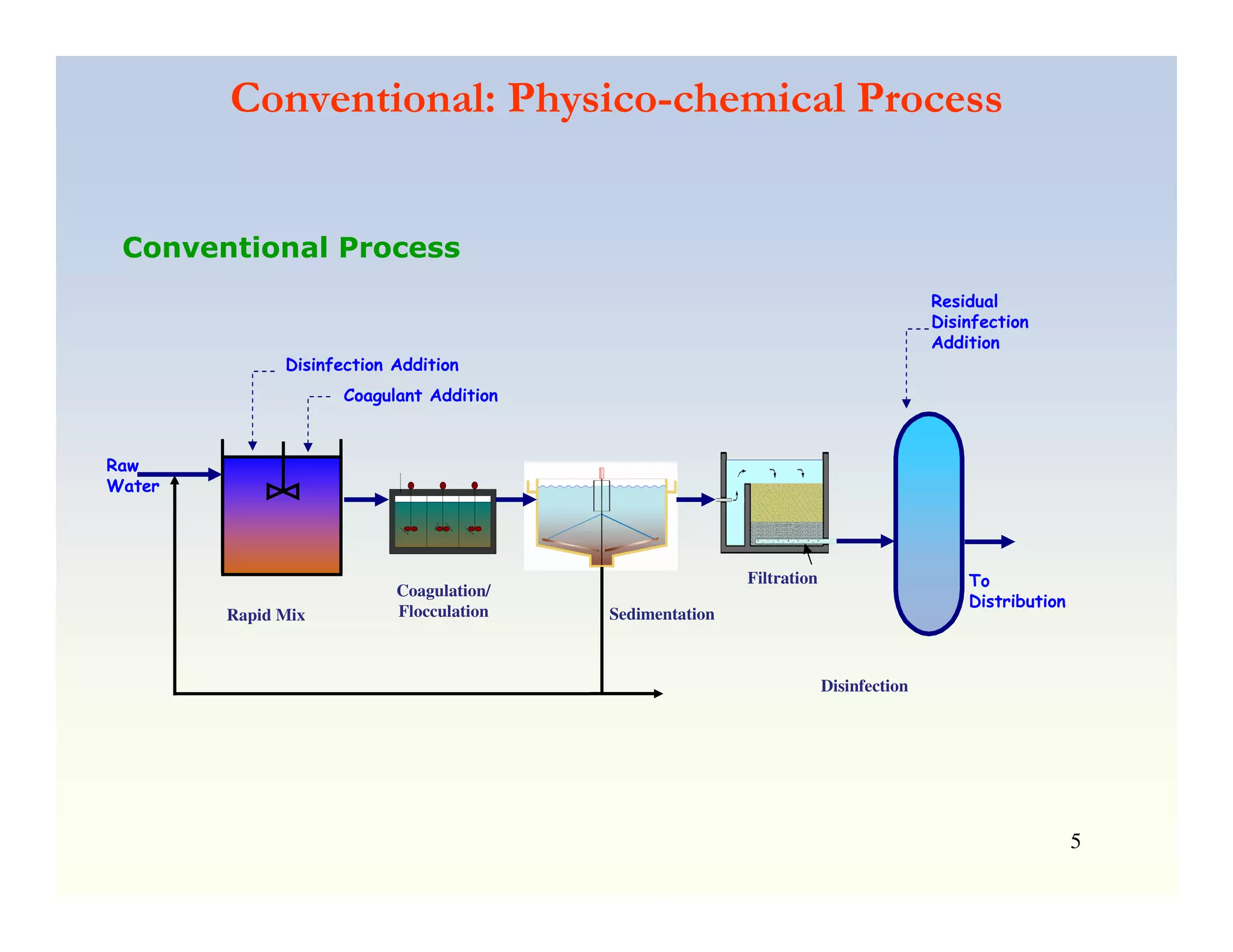
5
$%
'
%
Rapid Mix 
Coagulation/ 
Flocculation Sedimentation 
Filtration 
Disinfection
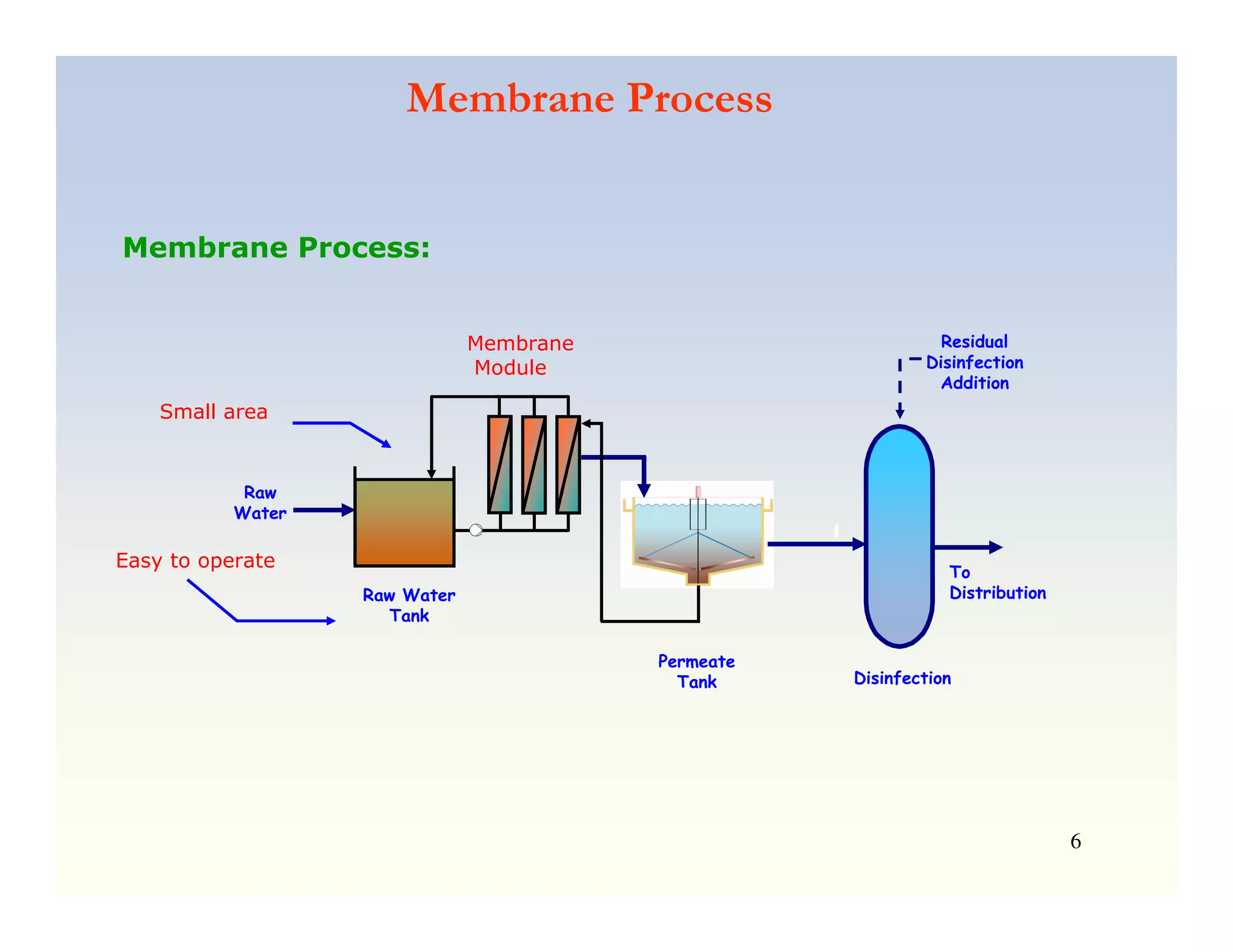
6
'
%
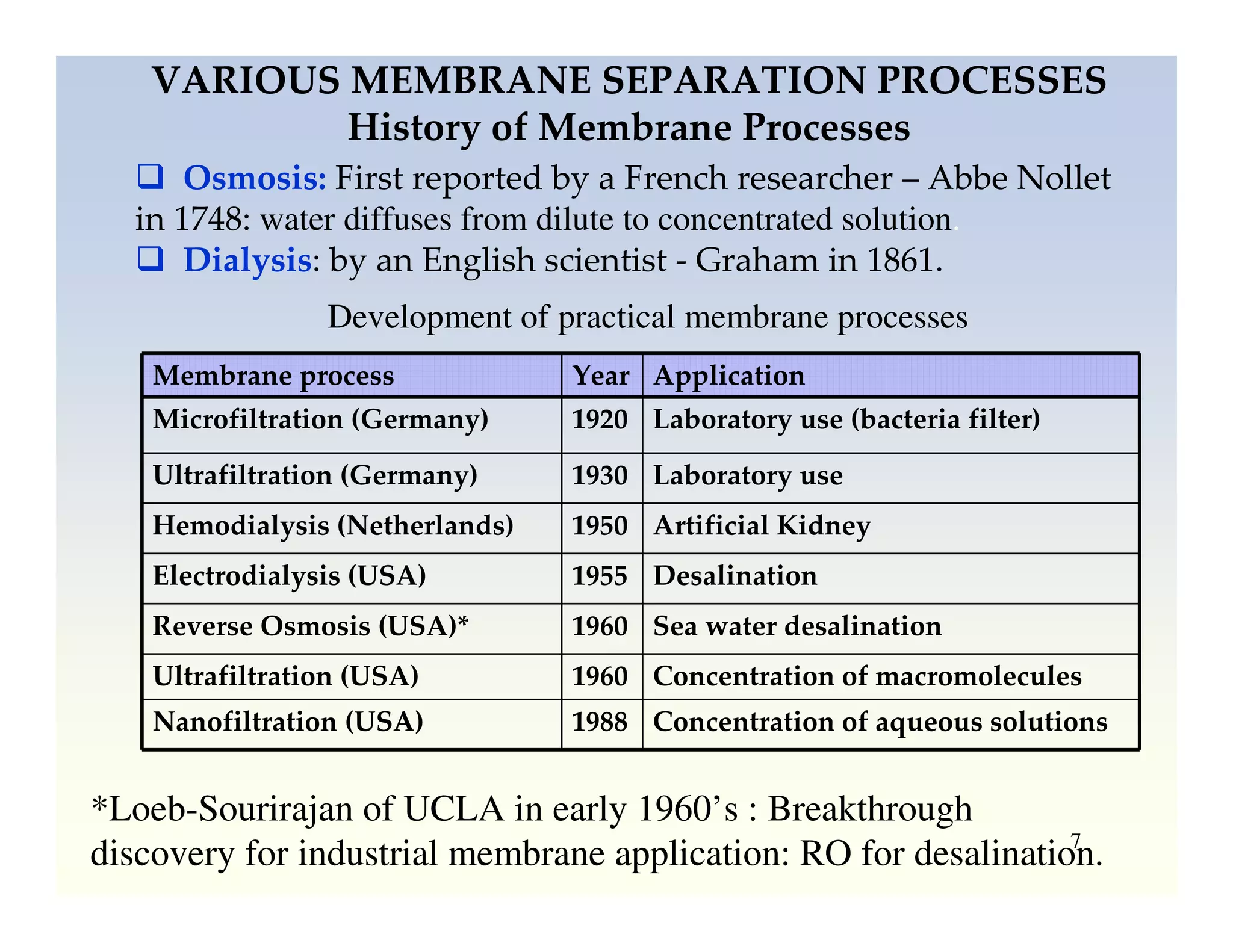
Development of practical membrane processes 
  *' #$., - 
/
0 /' #$1,  2/ 

 /  ' #$11   
3'4 #$5, 6/  
  ' #$5,    
7
water diffuses from dilute to concentrated solution.
( ) ((  
	   *' #$+, - ' 
!
' #$%%  
*Loeb-Sourirajan of UCLA in early 1960’s : Breakthrough 
discovery for industrial membrane application: RO for desalination.
/	 
 
	  
 !
	#
$	
#		


 % 
#		
		

	# 
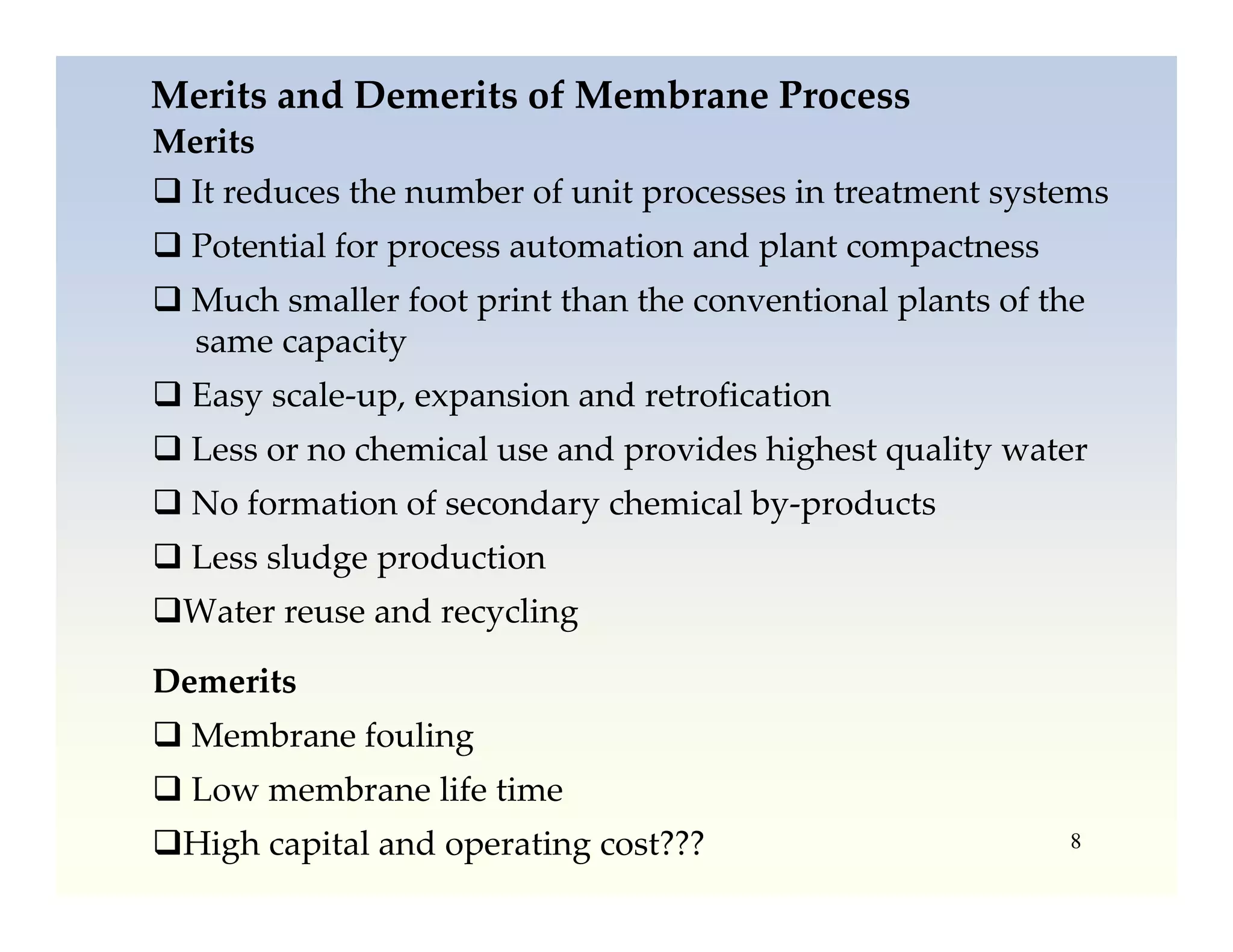
8
'(
	

	#
	 
 )		


*
+ 
 
  	#	
		#
)
	
	 
,
%
#	 
 )	+ 
# 
- 


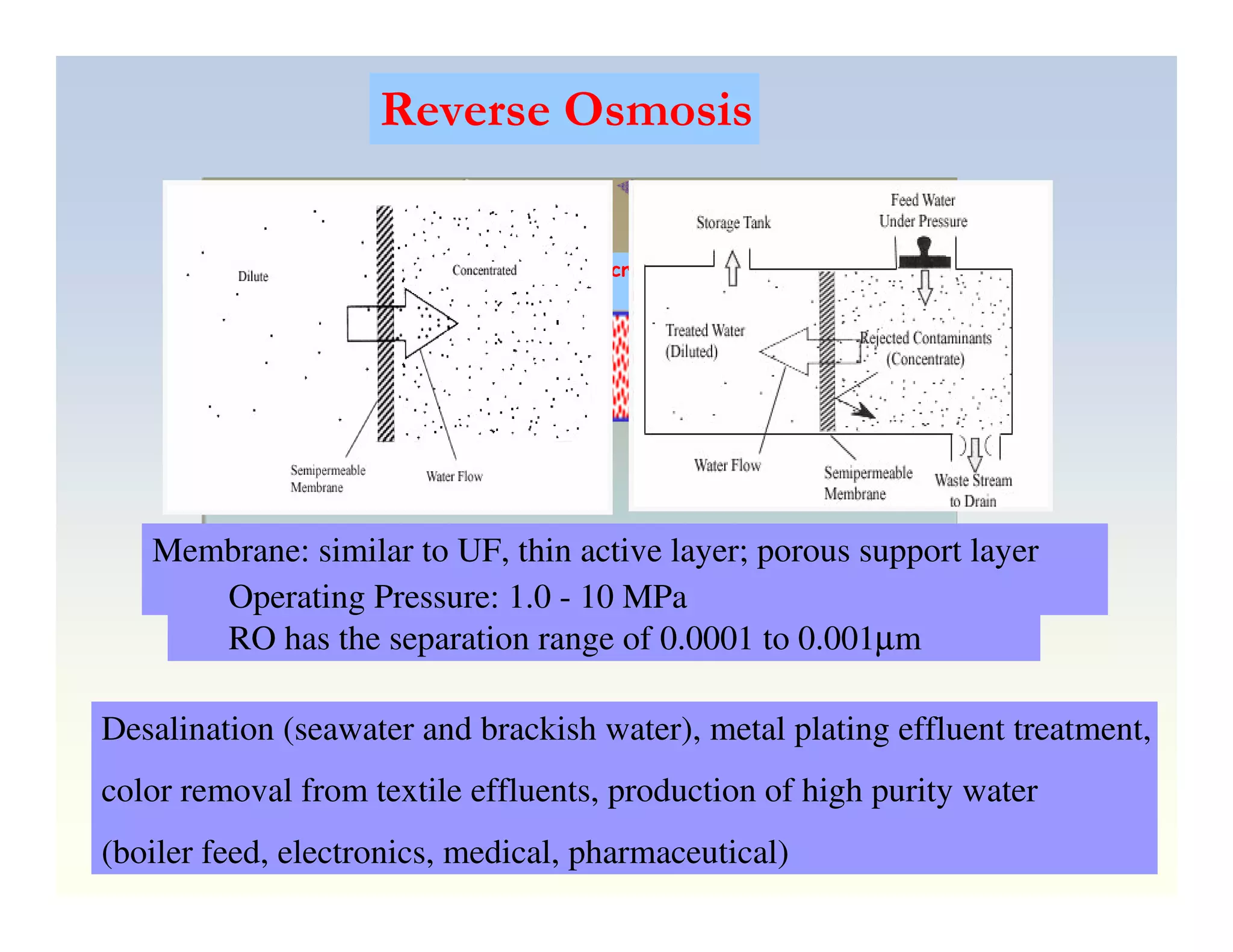
	...
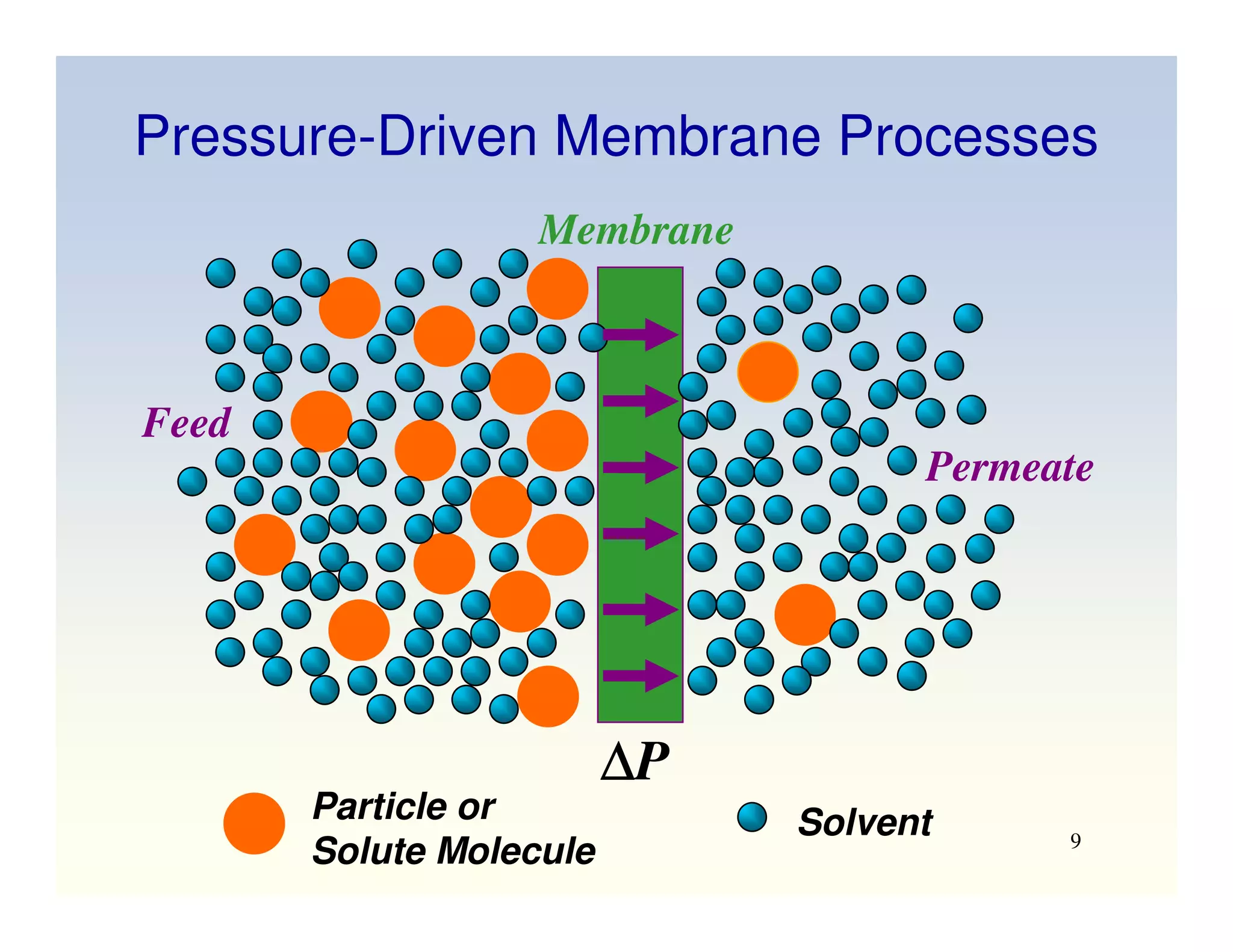
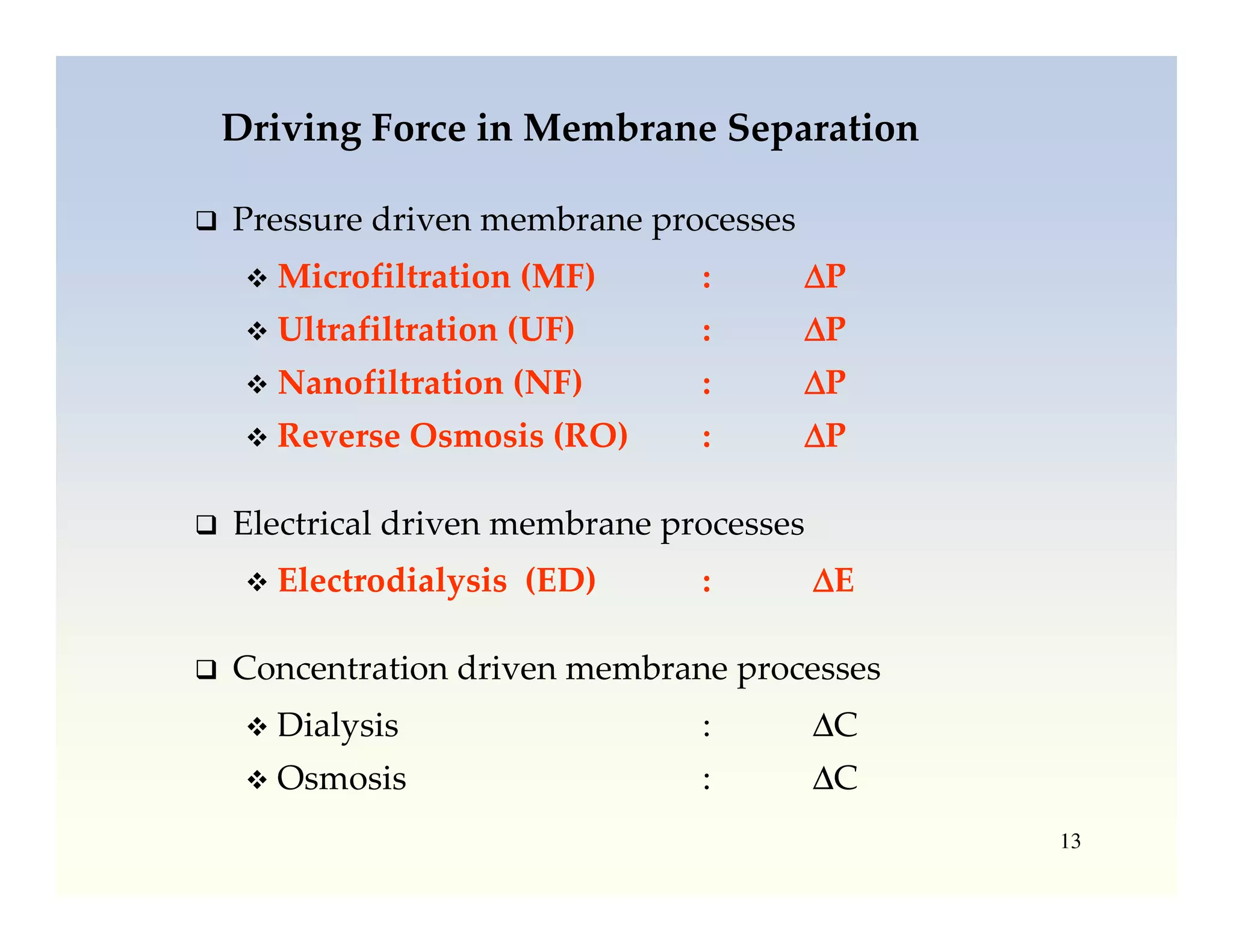
Pressure-Driven Membrane Processes 
Permeate 
9 
Membrane 
Particle or Solvent 
Solute Molecule 
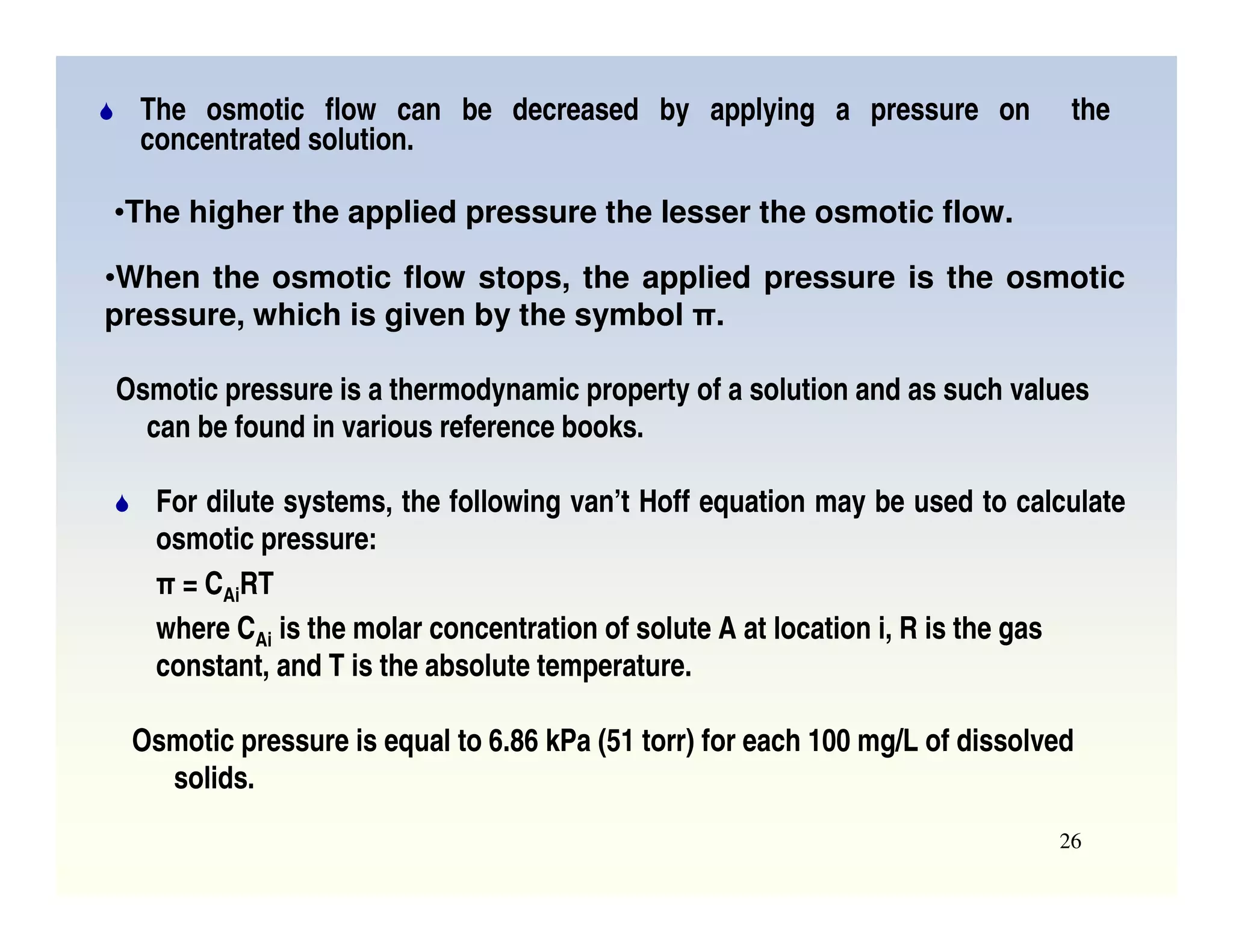
Feed 
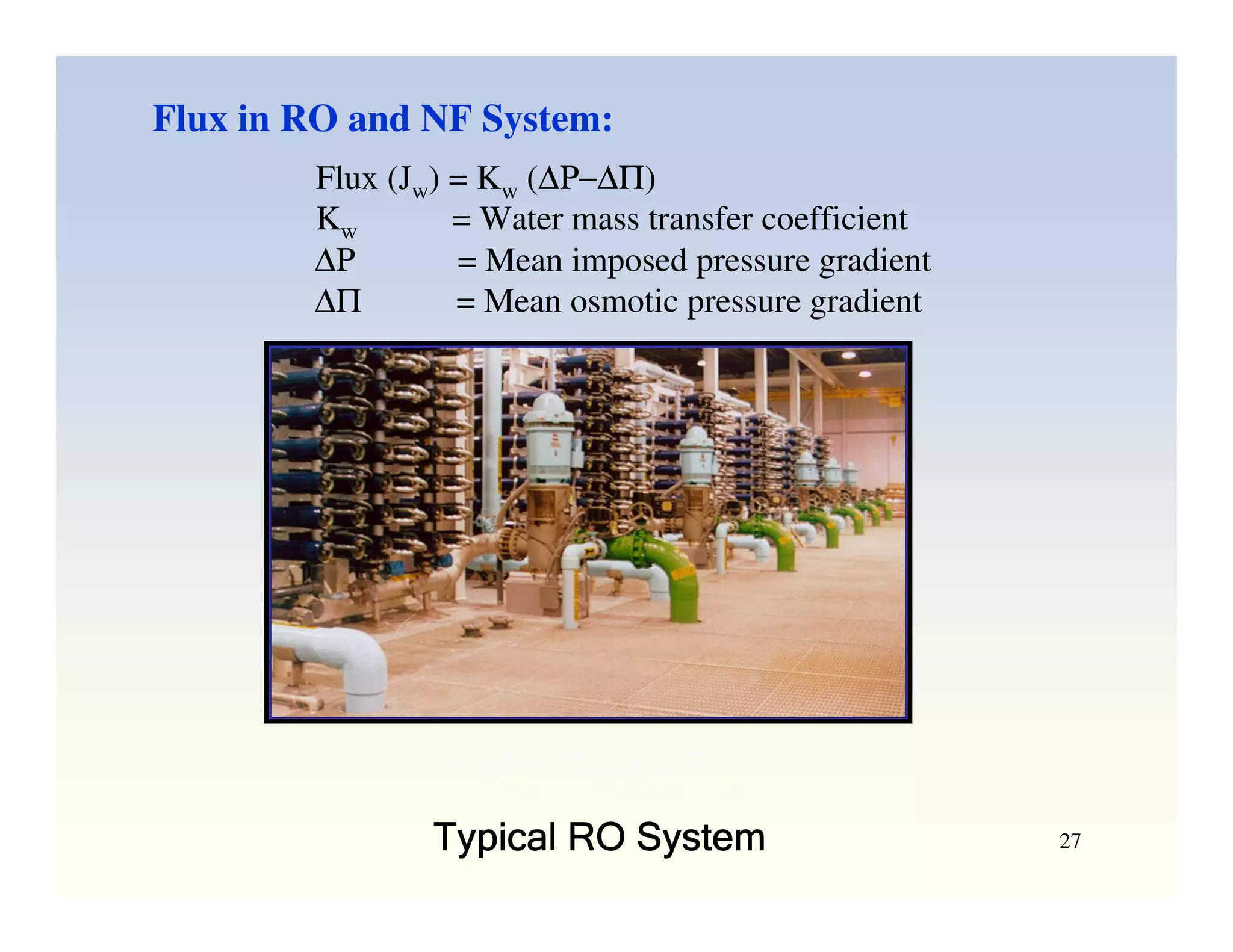
DP
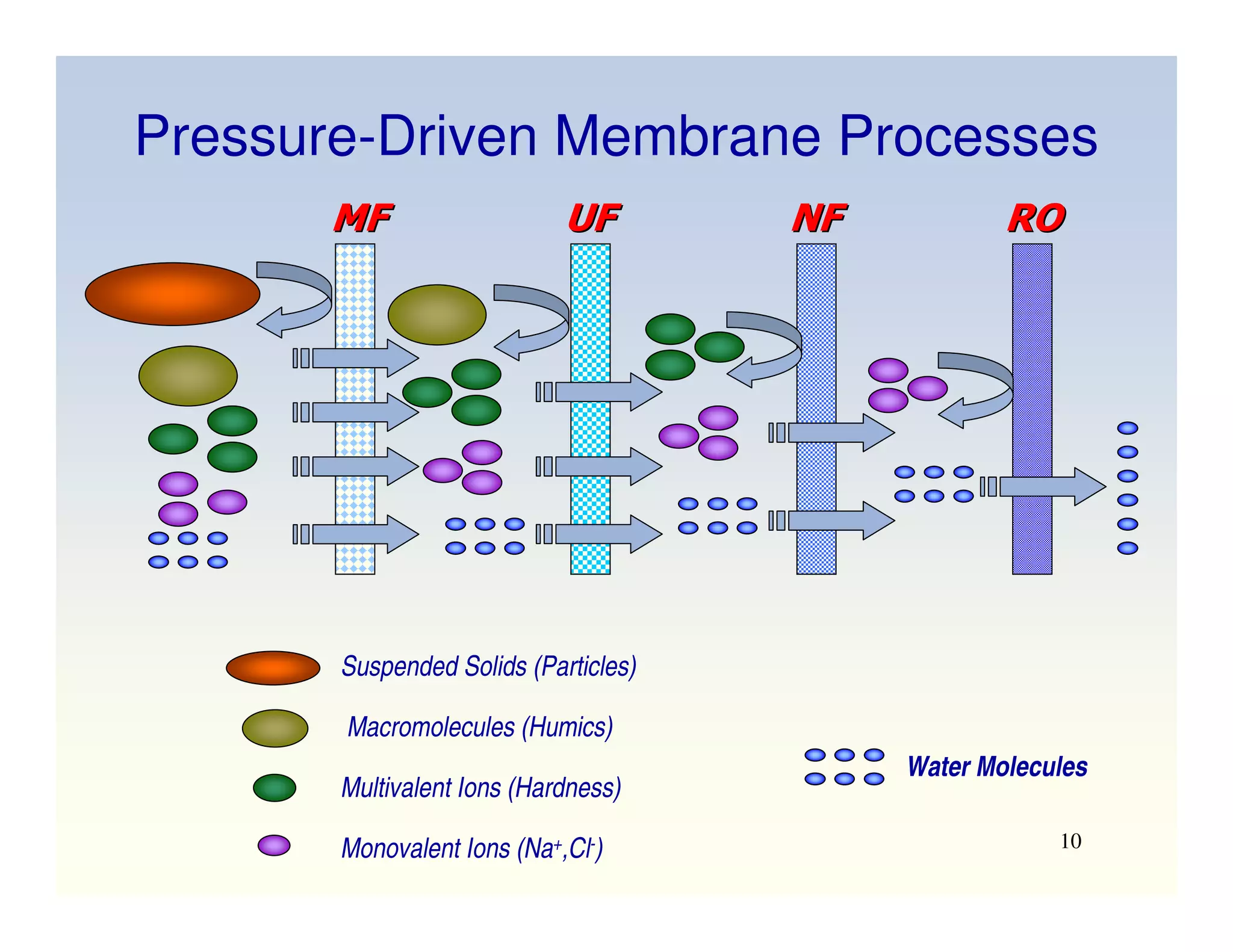
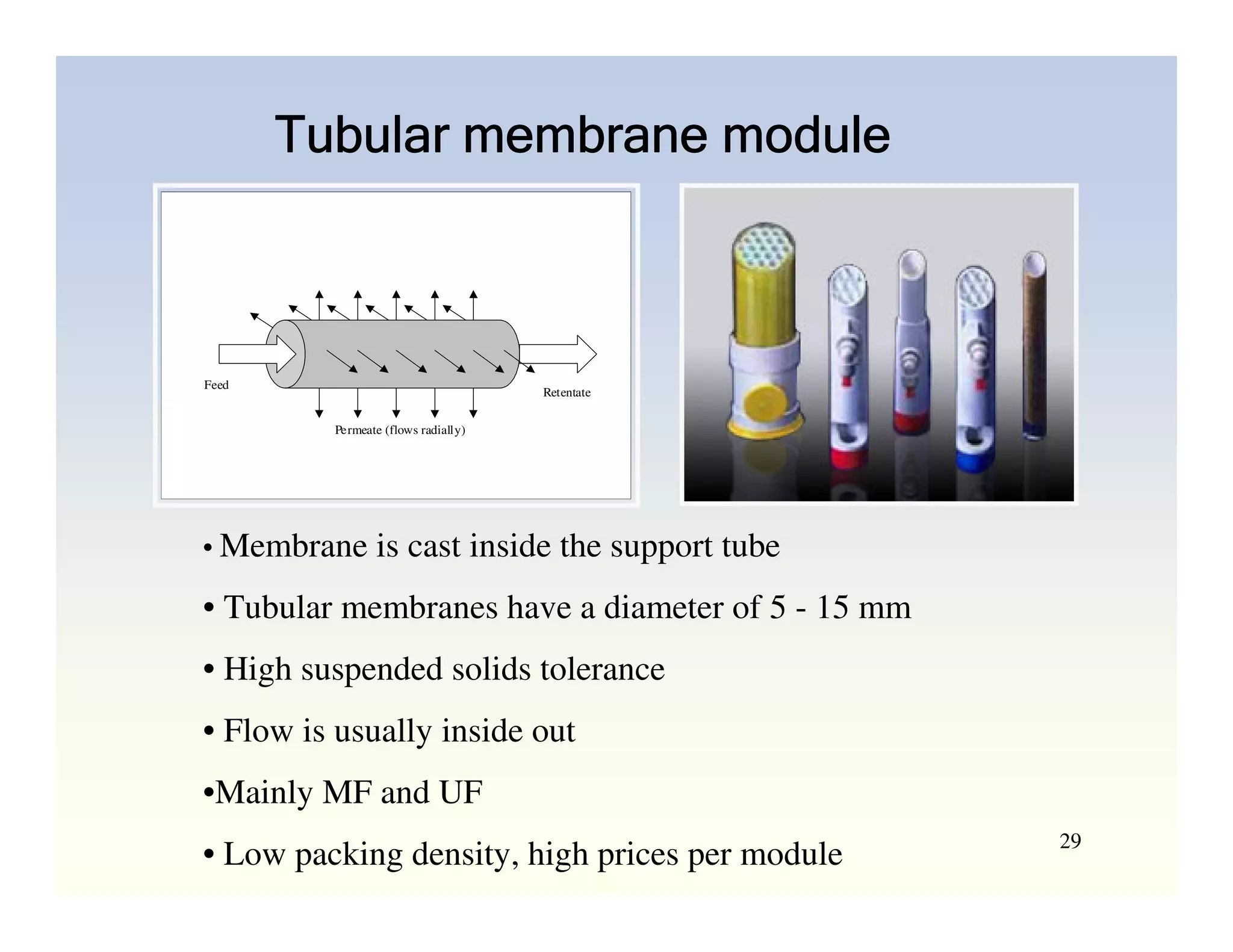
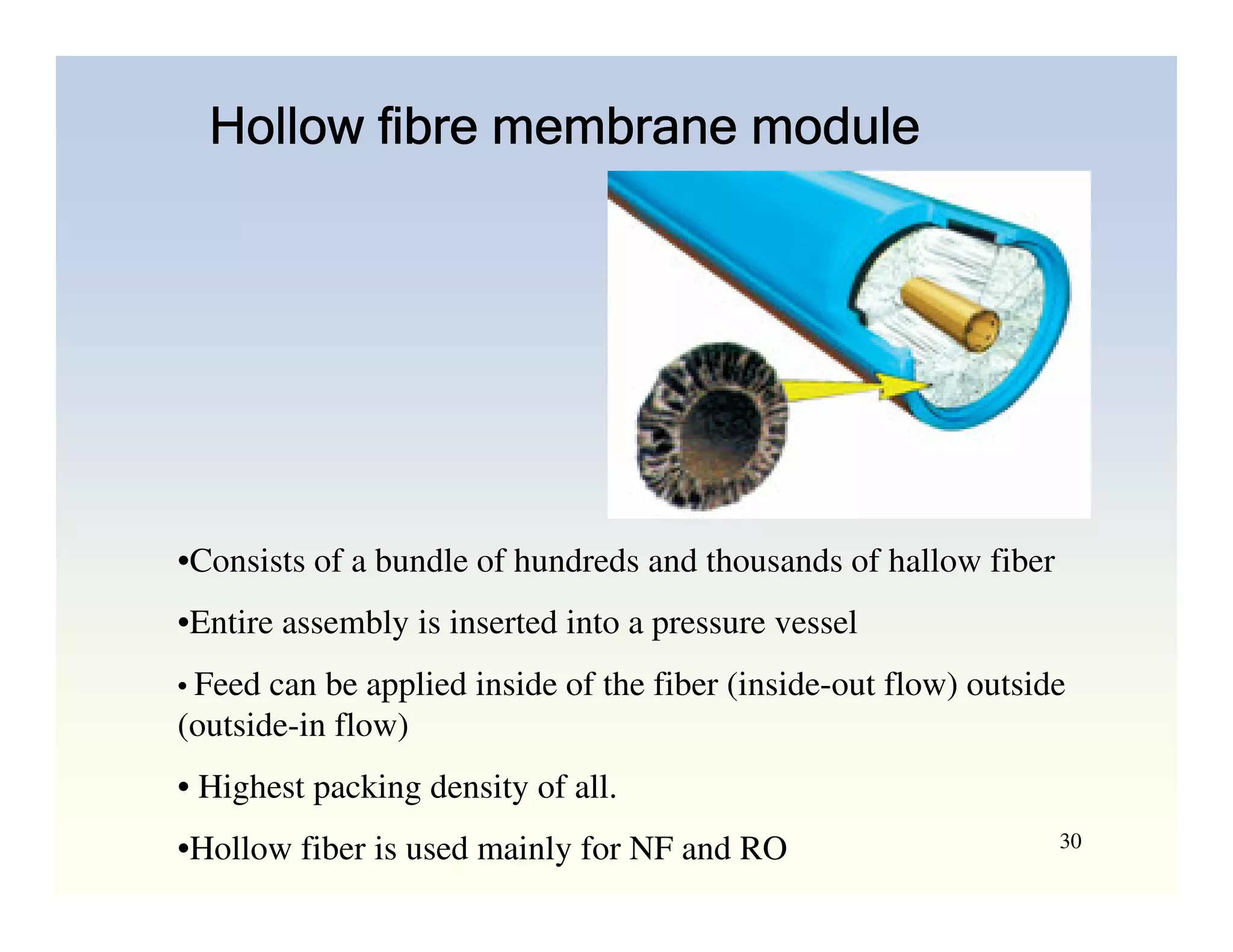
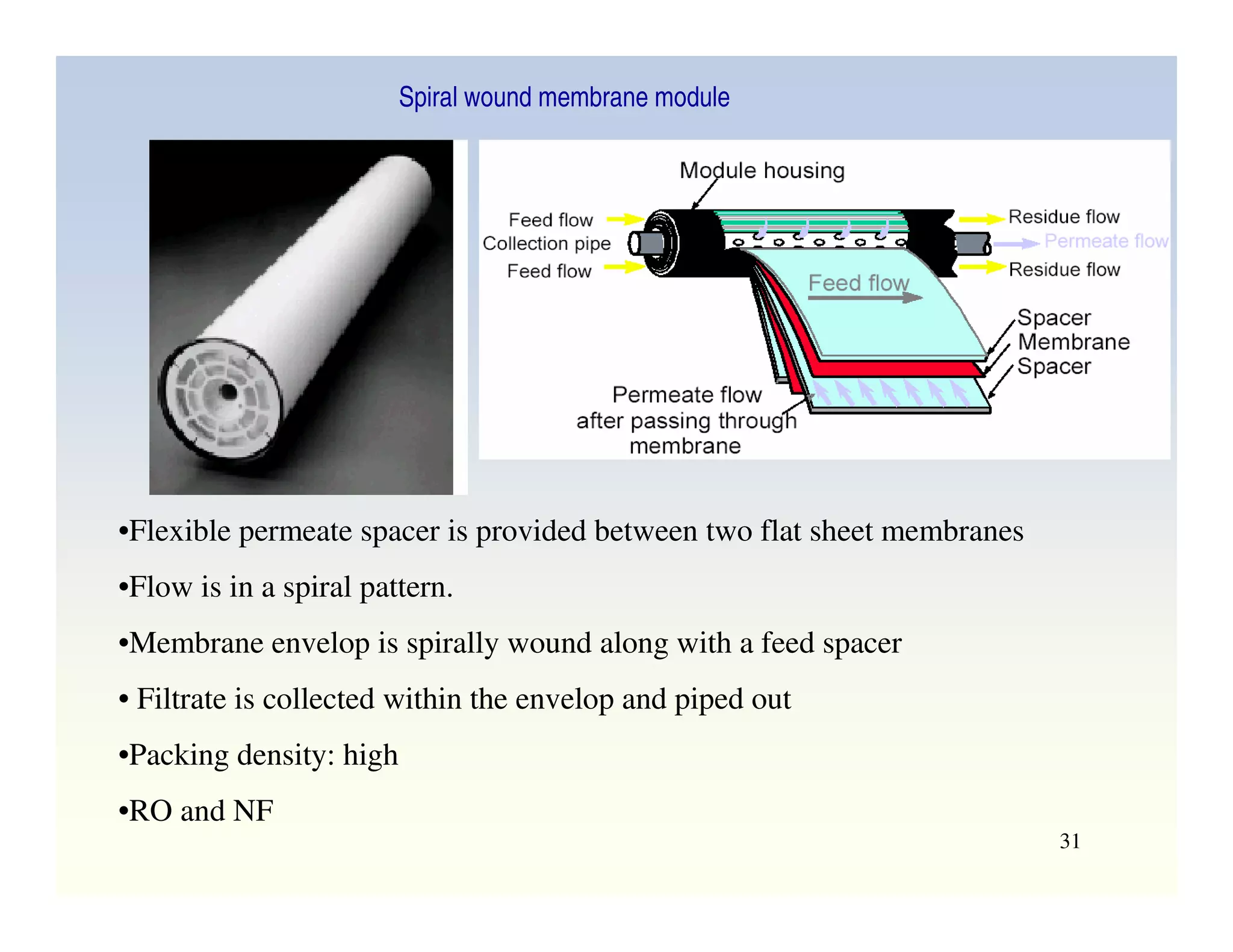
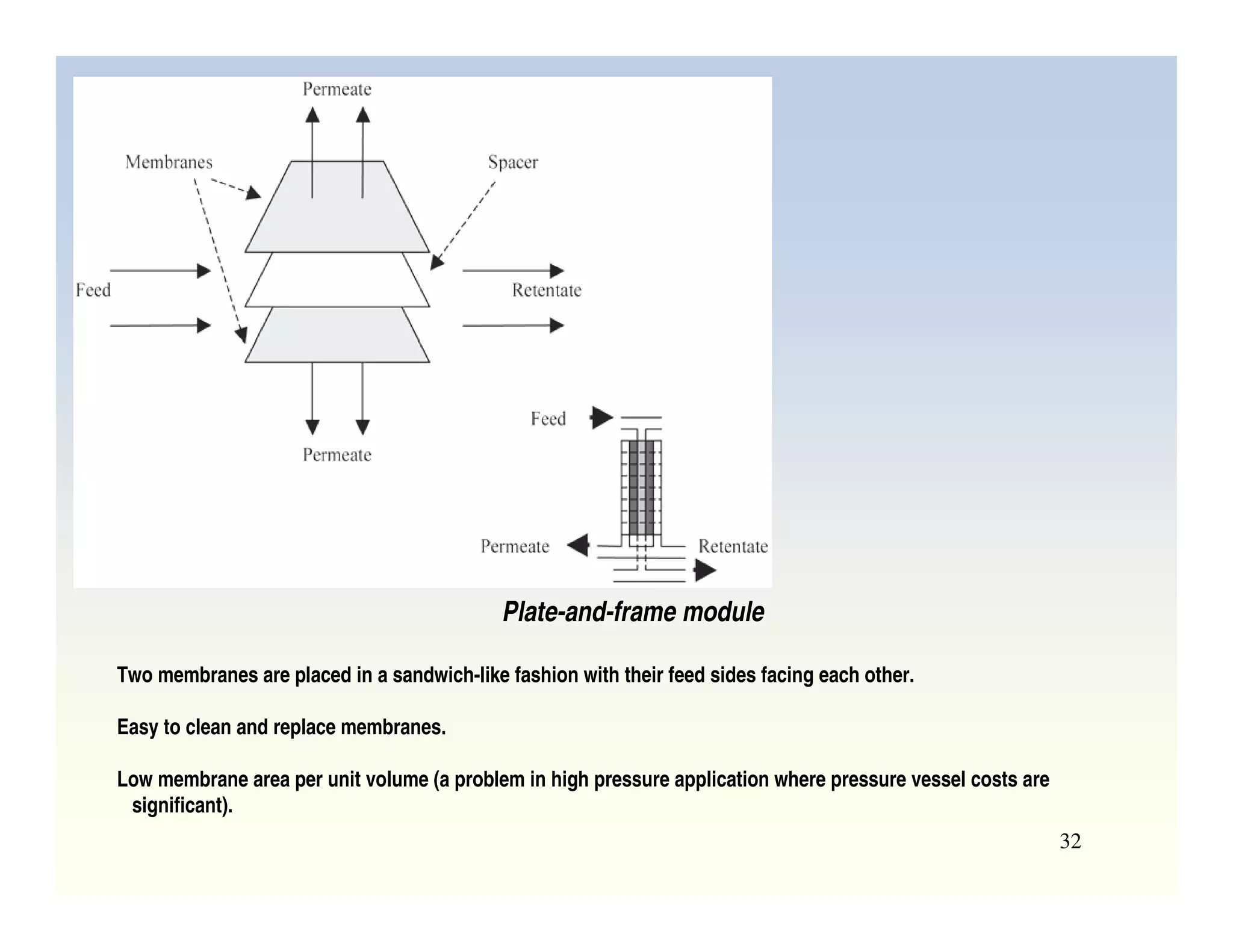
Pressure-Driven Membrane Processes 
    
10 
Suspended Solids (Particles) 
Macromolecules (Humics) 
Multivalent Ions (Hardness) 
Monovalent Ions (Na+,Cl-) 
Water Molecules
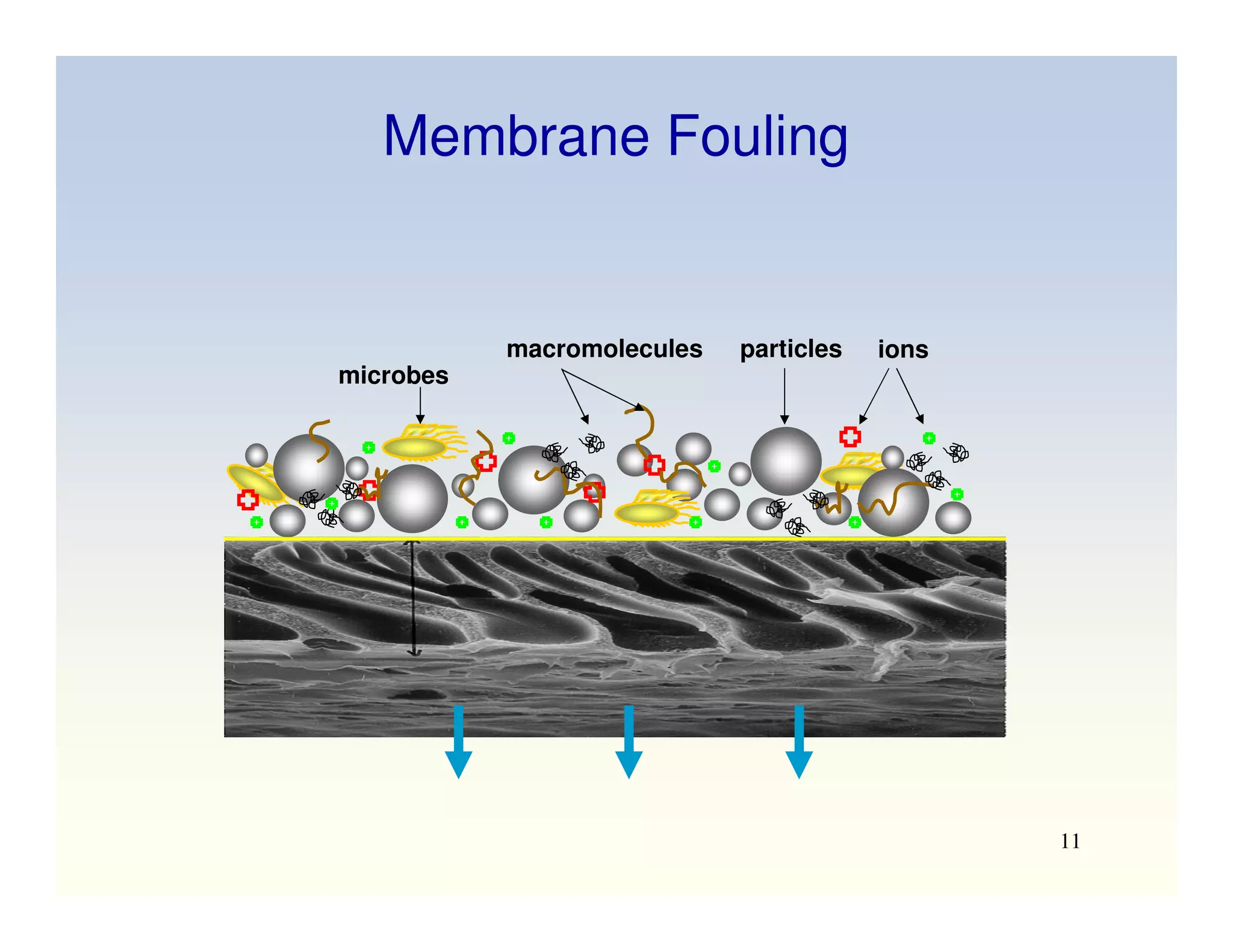
11 
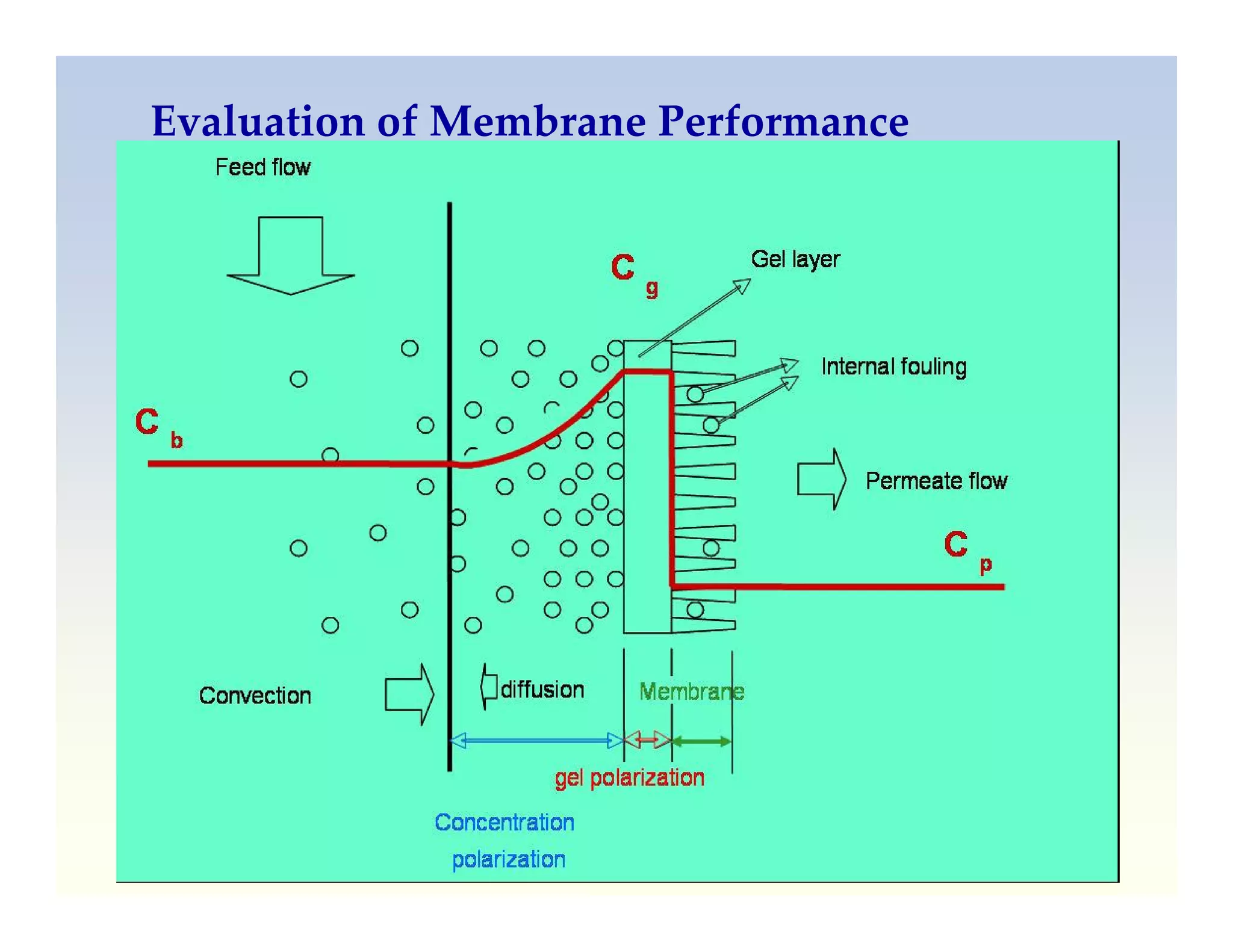
Membrane Fouling 
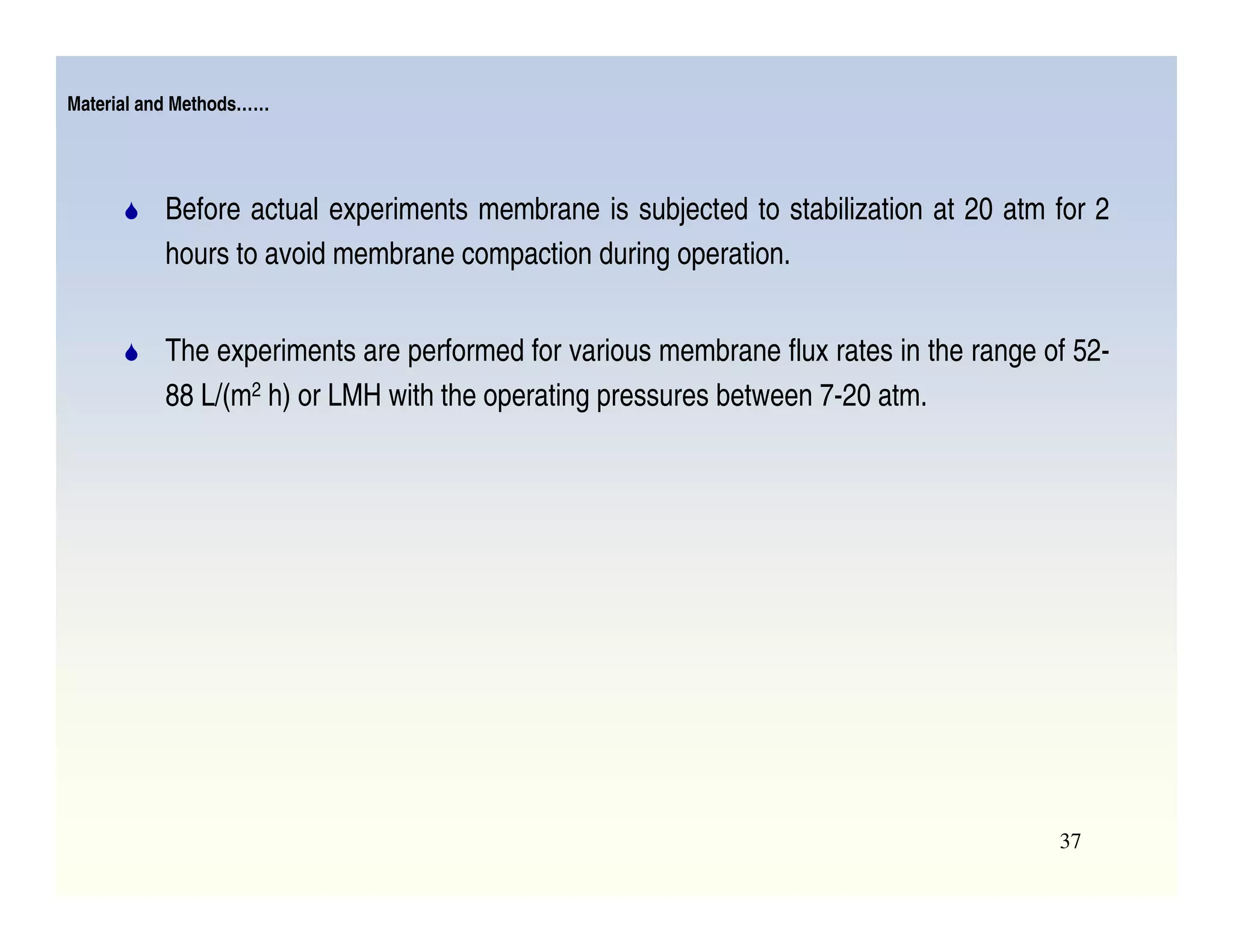
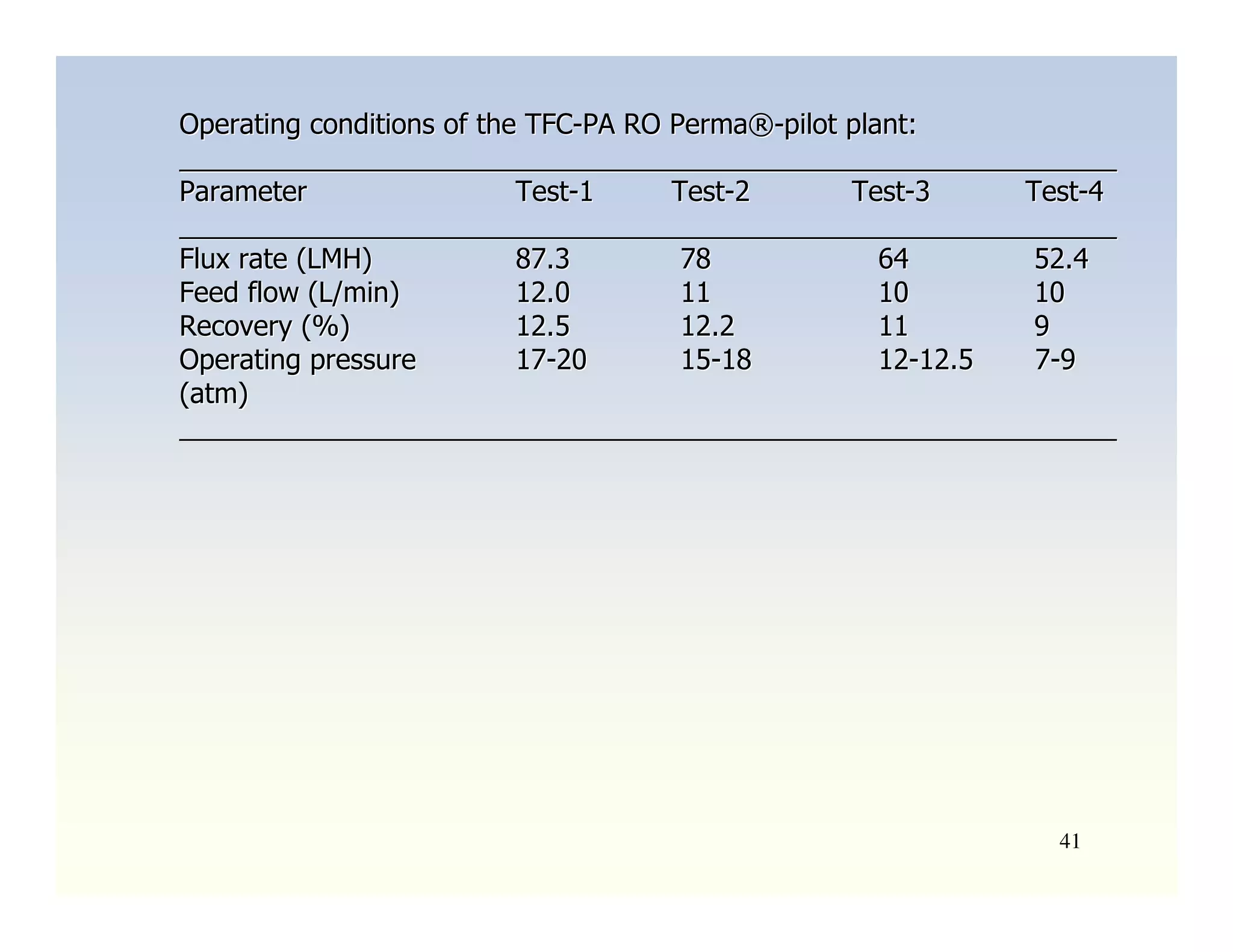
macromolecules particles ions 
microbes
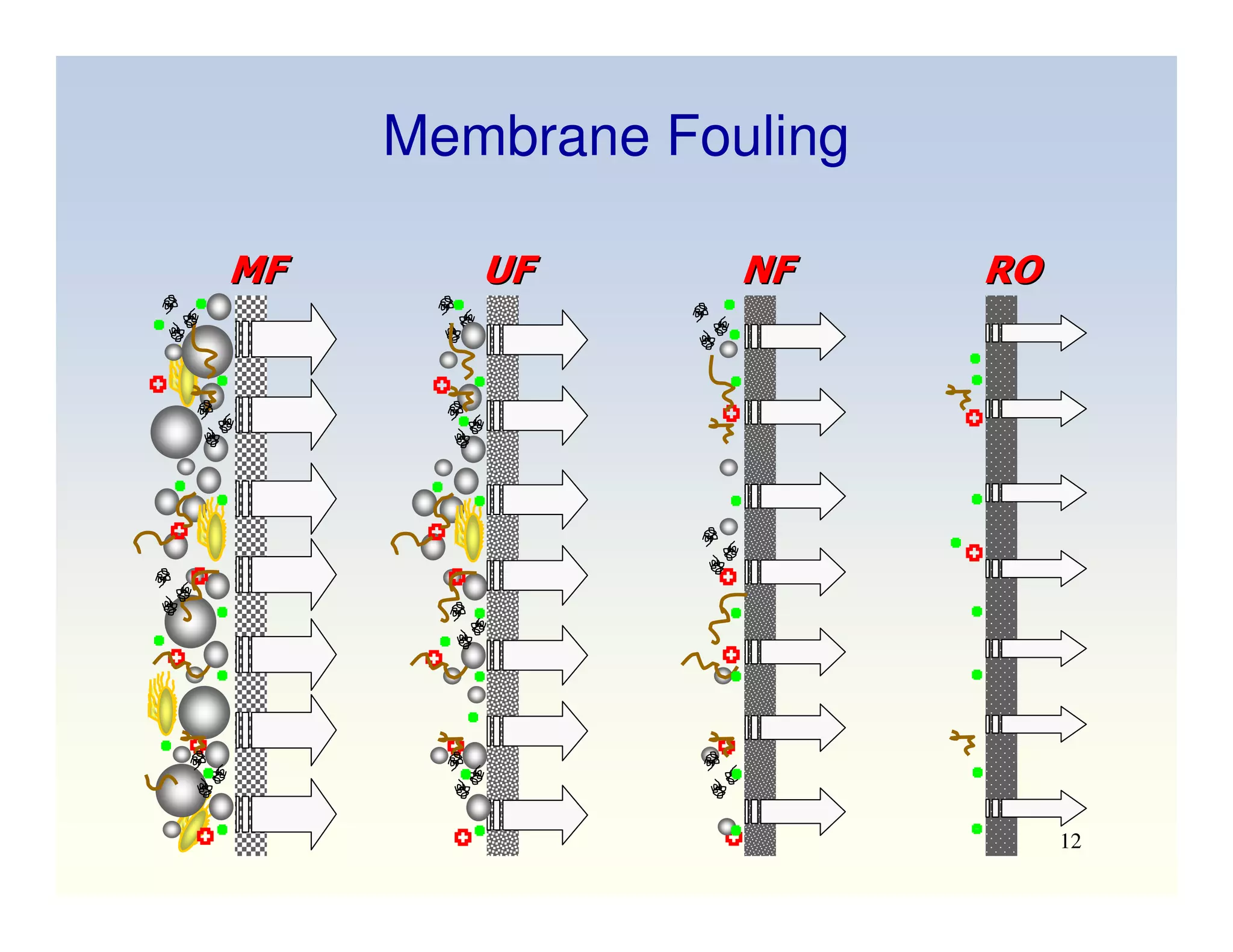
12 
Membrane Fouling
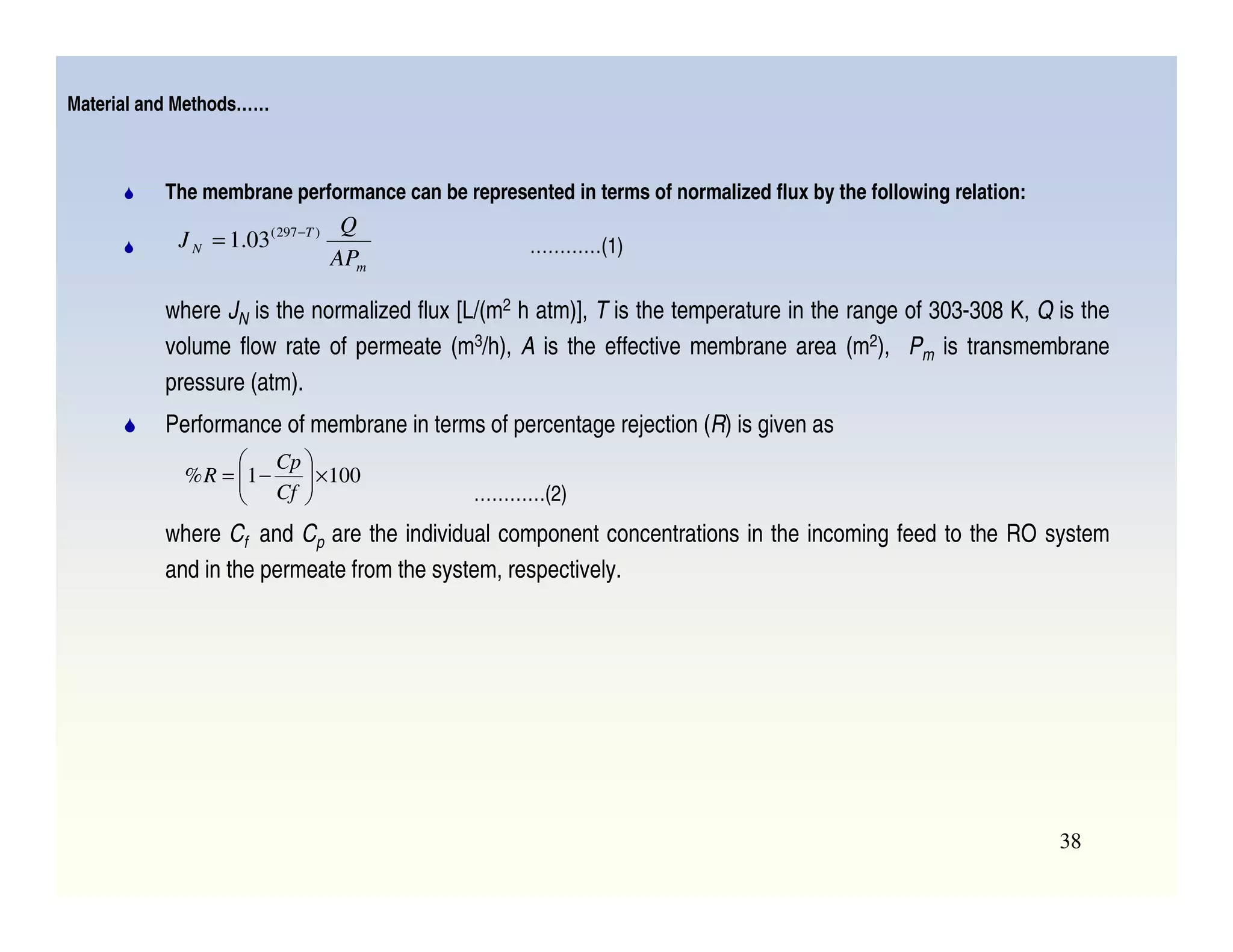
13 
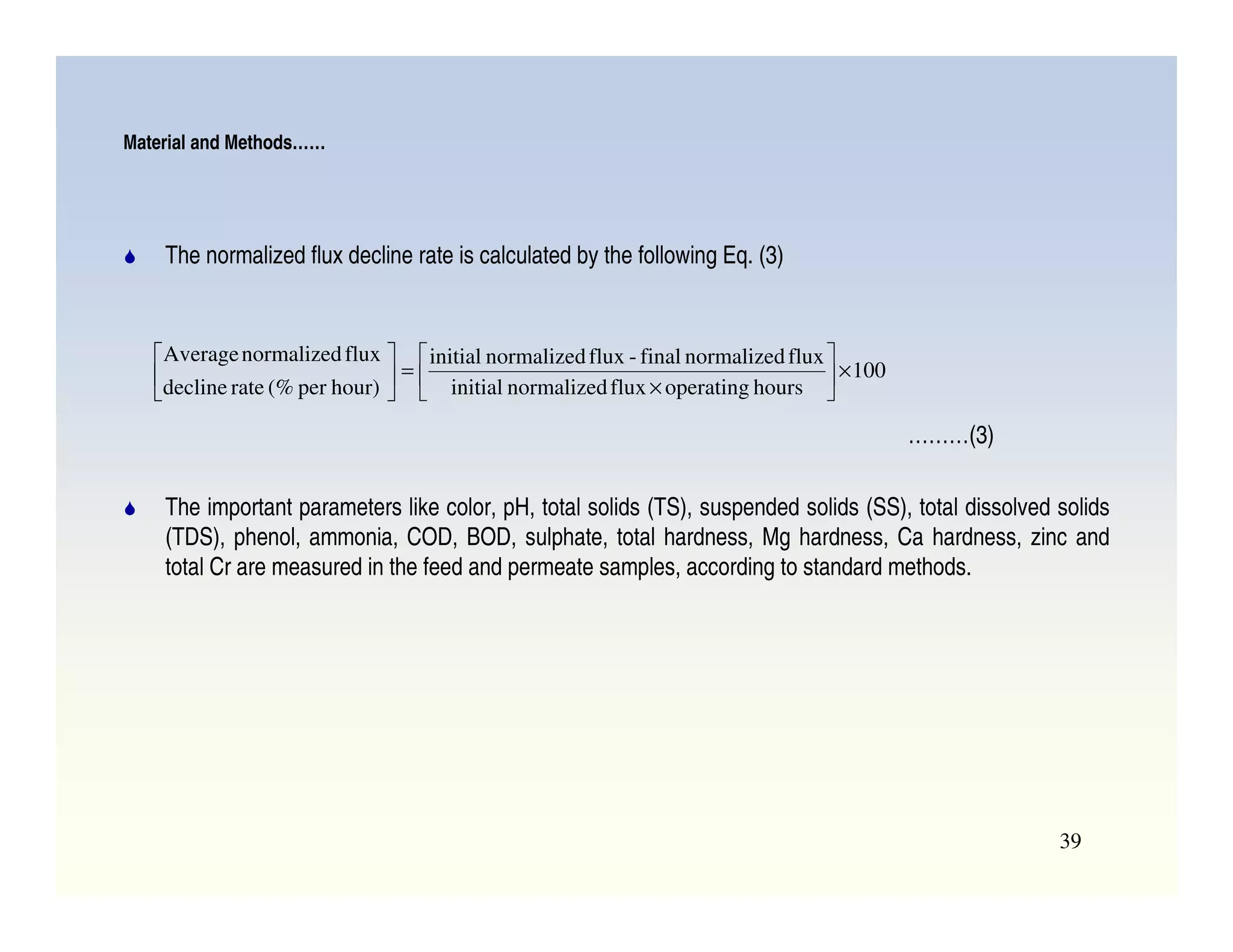
387	( 
 $

	 
	  	7'  D
 
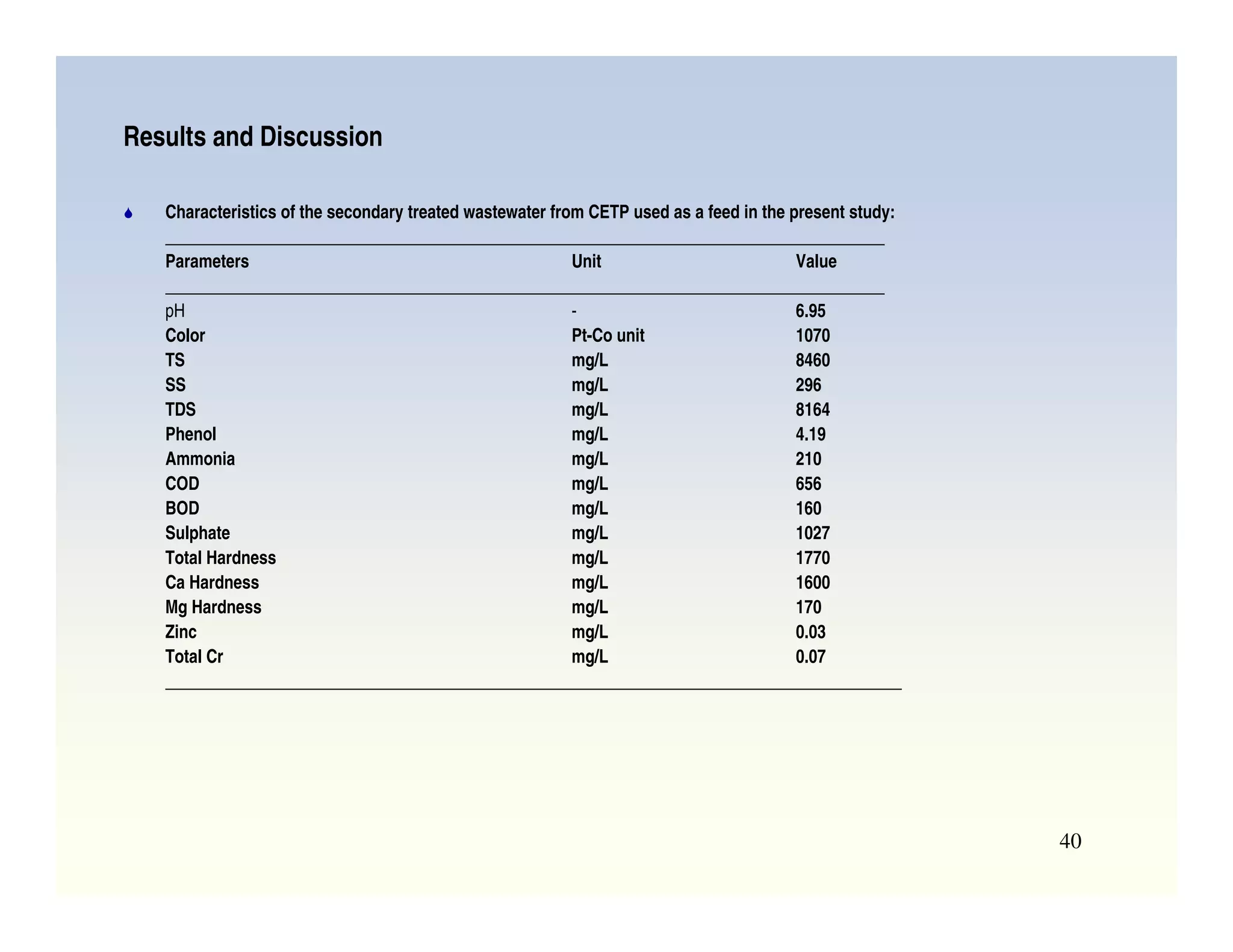
   7'  D
7'  D
 
 3'  D


 /  
'  D
 
 /	


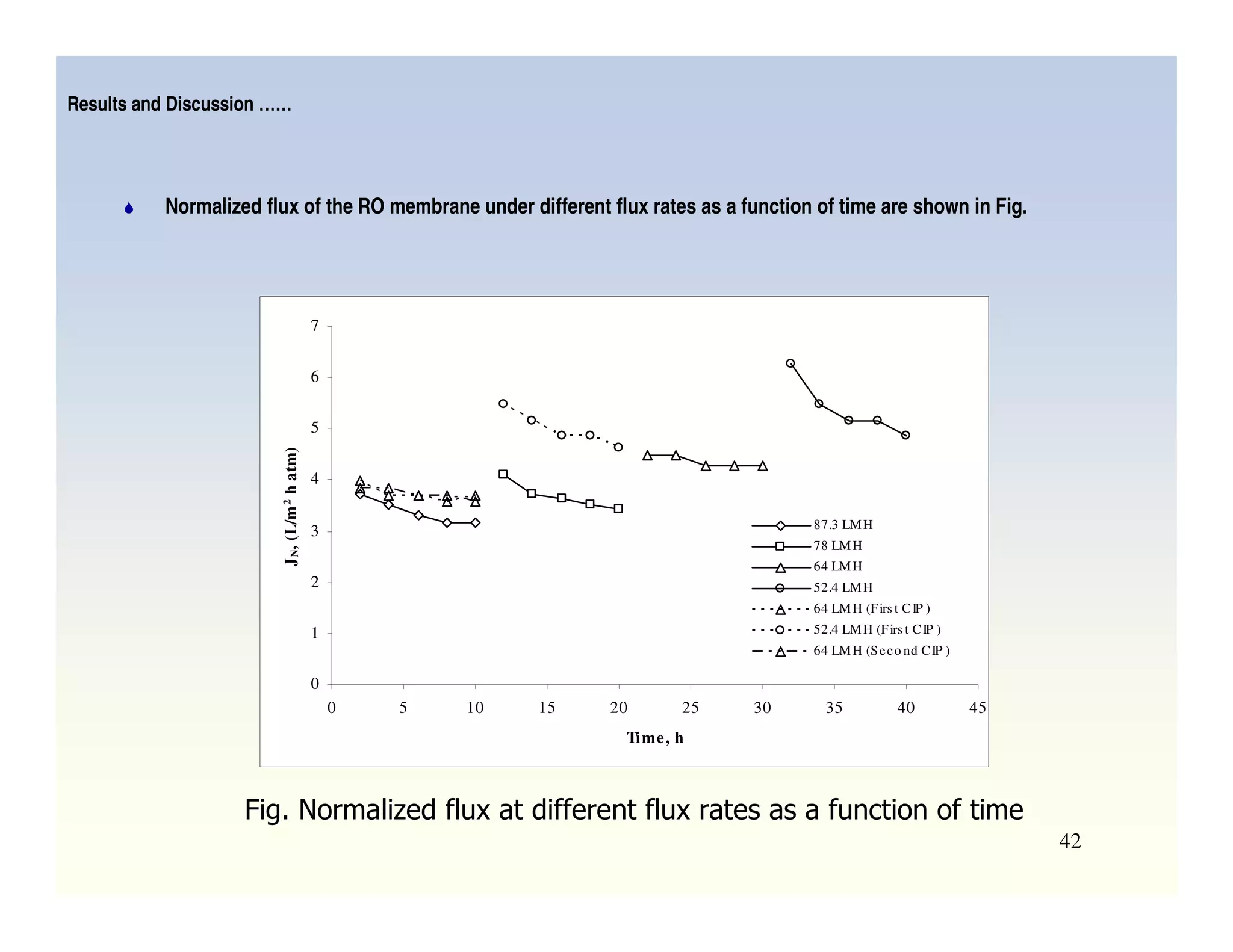
 0
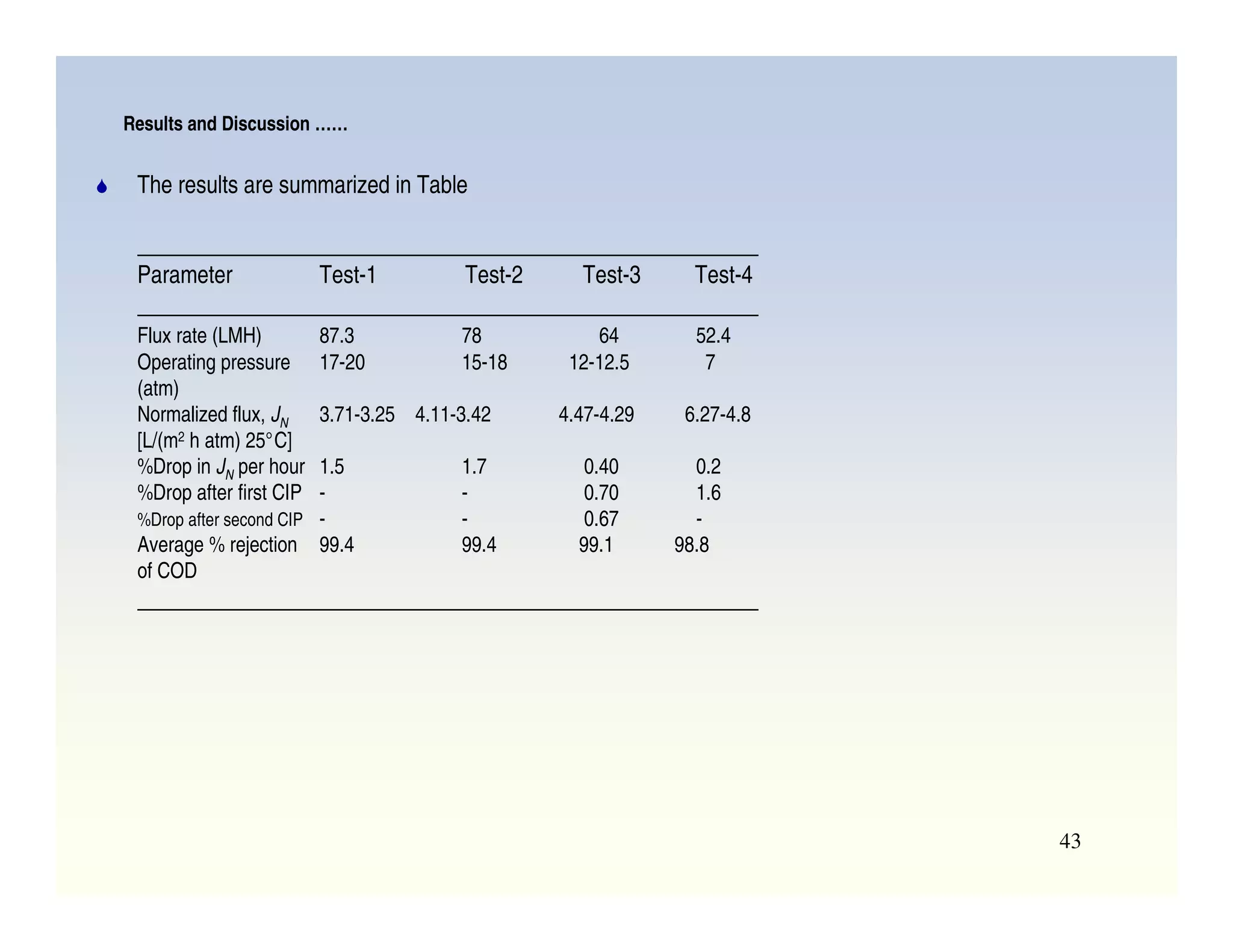
D/ 
 1 	  D/
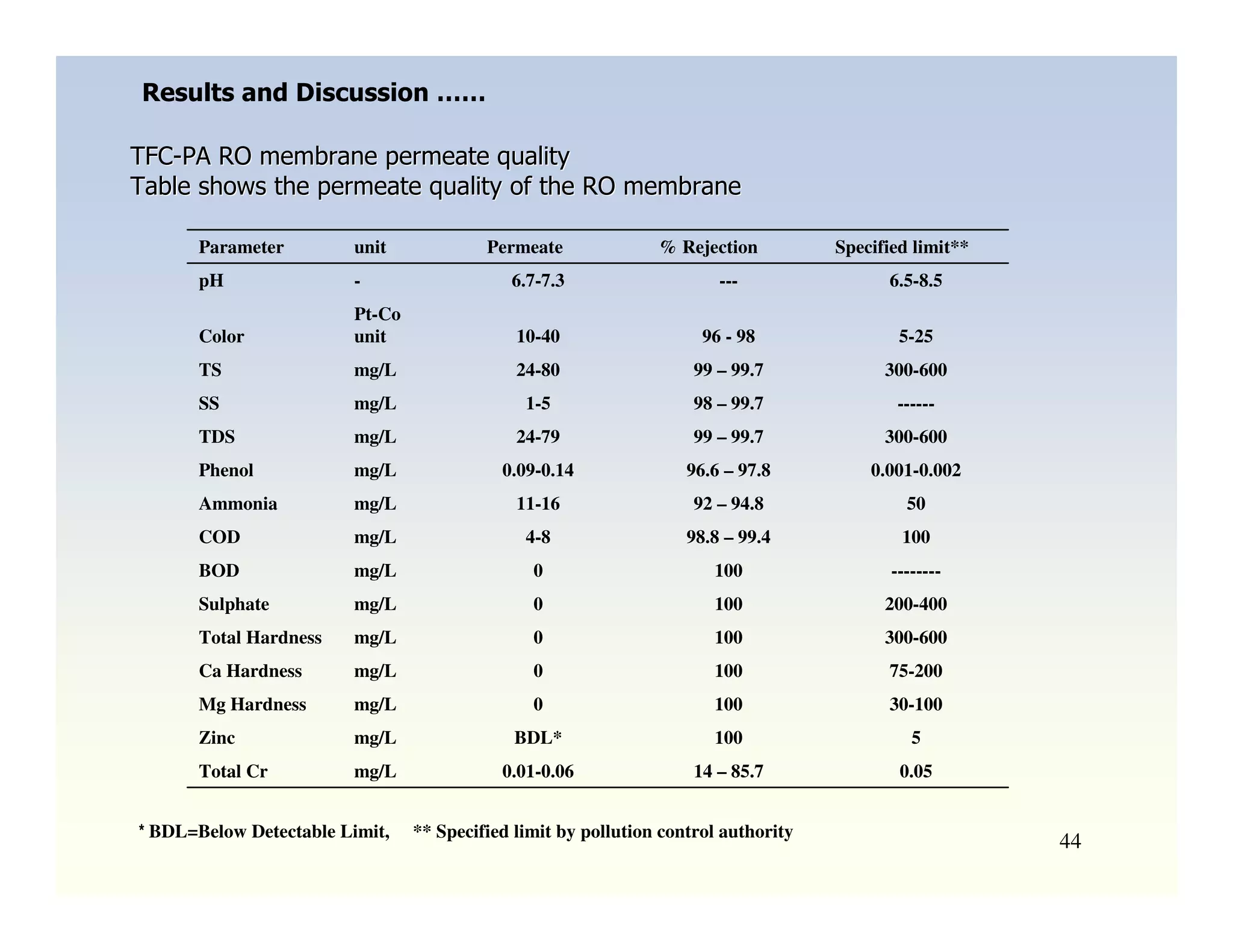
14 

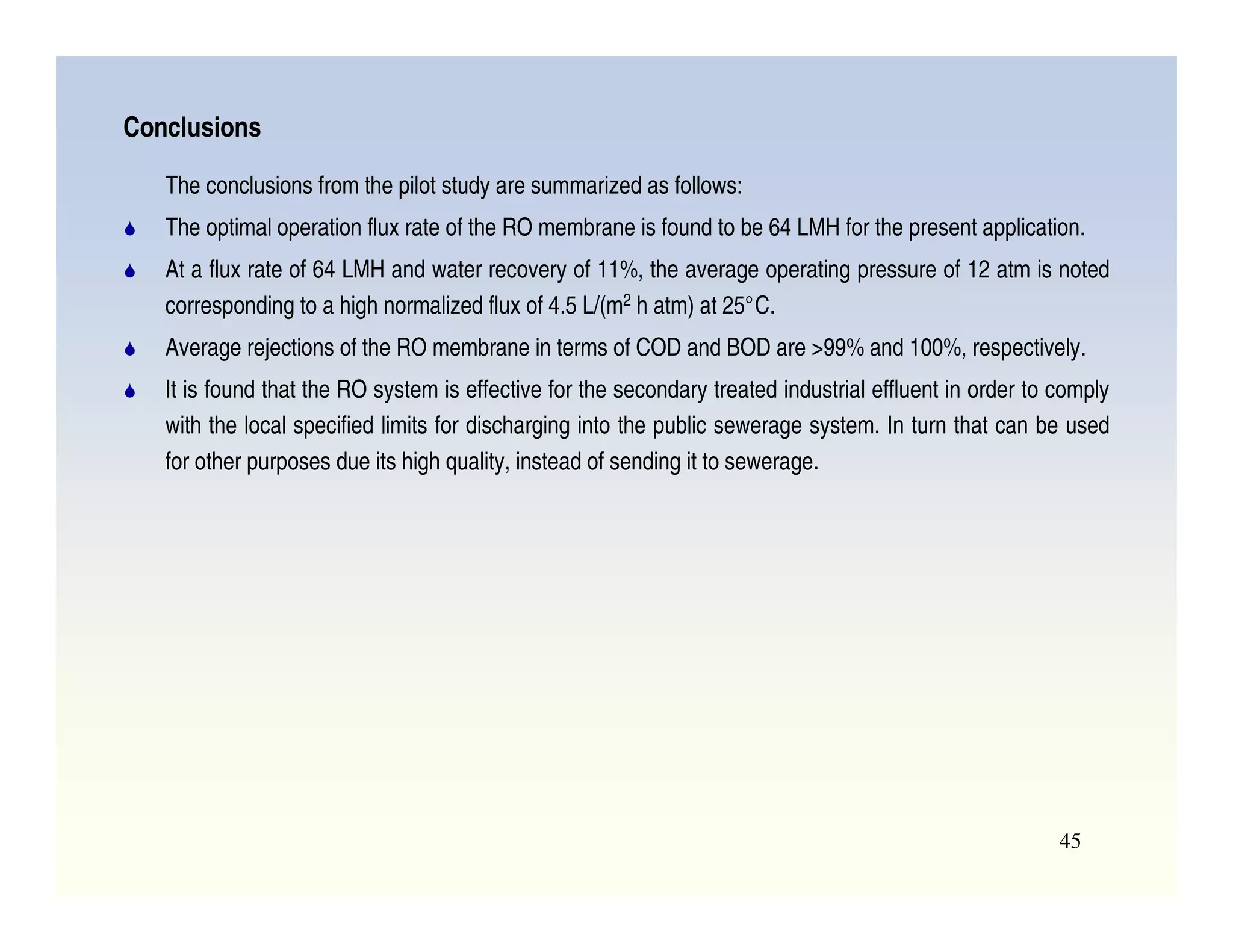
3 	
 
 Flux: The volume of treated water obtained per unit time per 
unit membrane surface area. Higher flux is often desirable. 
(m3/m2/h or m/h) (MF/UF) 
P 
t R 
J 
= D 
× 
m 
J :Flux, 
P: trans-membrane pressure, 
: viscosity, 
Rt: total membrane resistance
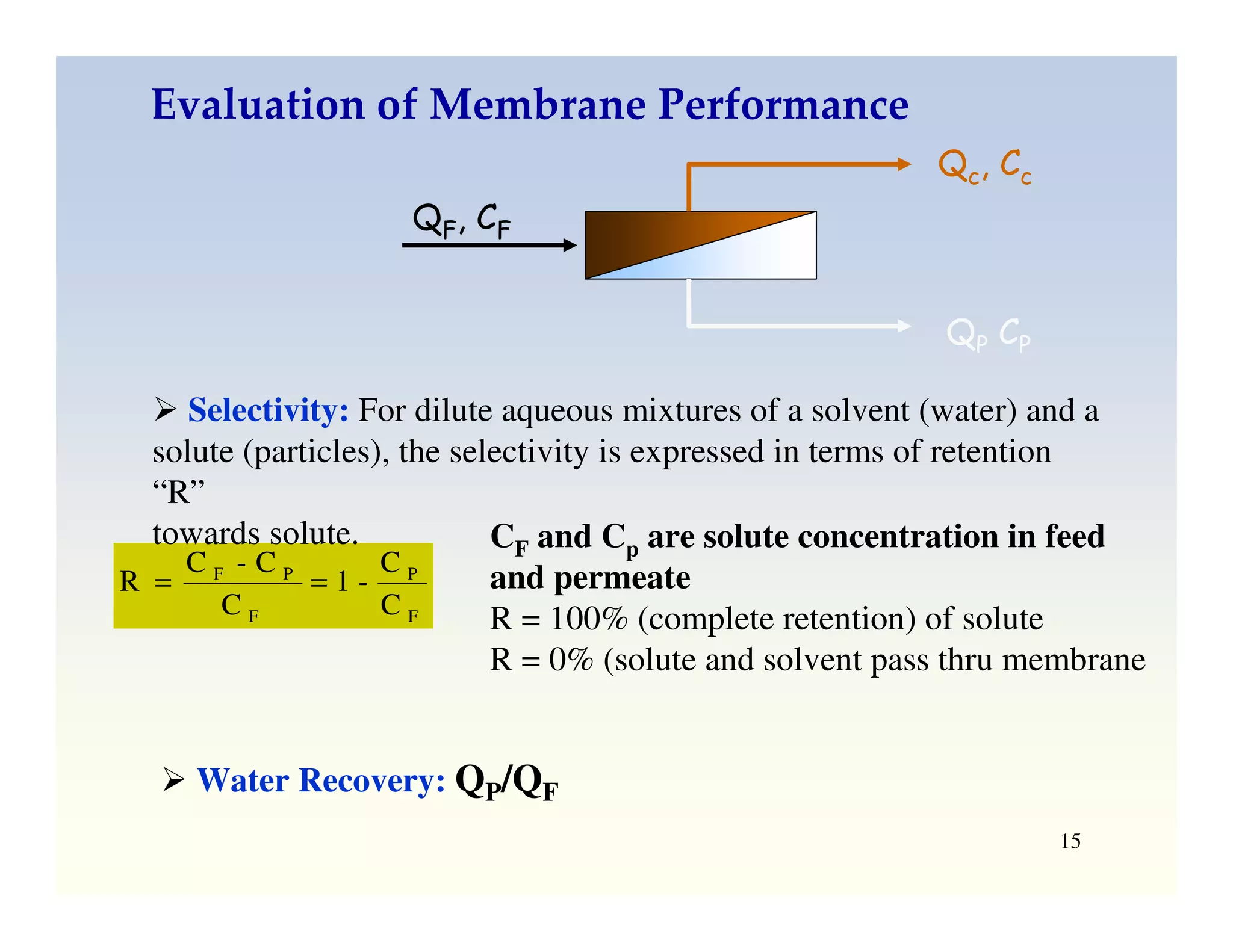
Selectivity: For dilute aqueous mixtures of a solvent (water) and a 
solute (particles), the selectivity is expressed in terms of retention 
“R” 
towards solute. CF and Cp are solute concentration in feed 
15 

3 	
 
P 
F 
C - C 
R = F P 
= 
F 
C 
C 
1 - 
C 
and permeate 
R = 100% (complete retention) of solute 
R = 0% (solute and solvent pass thru membrane 
 Water Recovery: QP/QF 
'(
')(
) 
'* *
16

Sttp ppt msp_overview_09-10-2009_zvpm

  • 1.
    1 Membrane SeparationProcesses for Wastewater Treatment: An Overview Dr. Z.V.P. Murthy Professor Department of Chemical Engineering Sardar Vallabhbhai National Institute of Technology Surat – 395007, Gujarat. October 09, 2009 Presentation at the AICTE sponsored One-week Short-Term Training Programme on Treatment and Disposal of Wastewaters, October 5-9, 2009, SVNIT, Surat
  • 2.
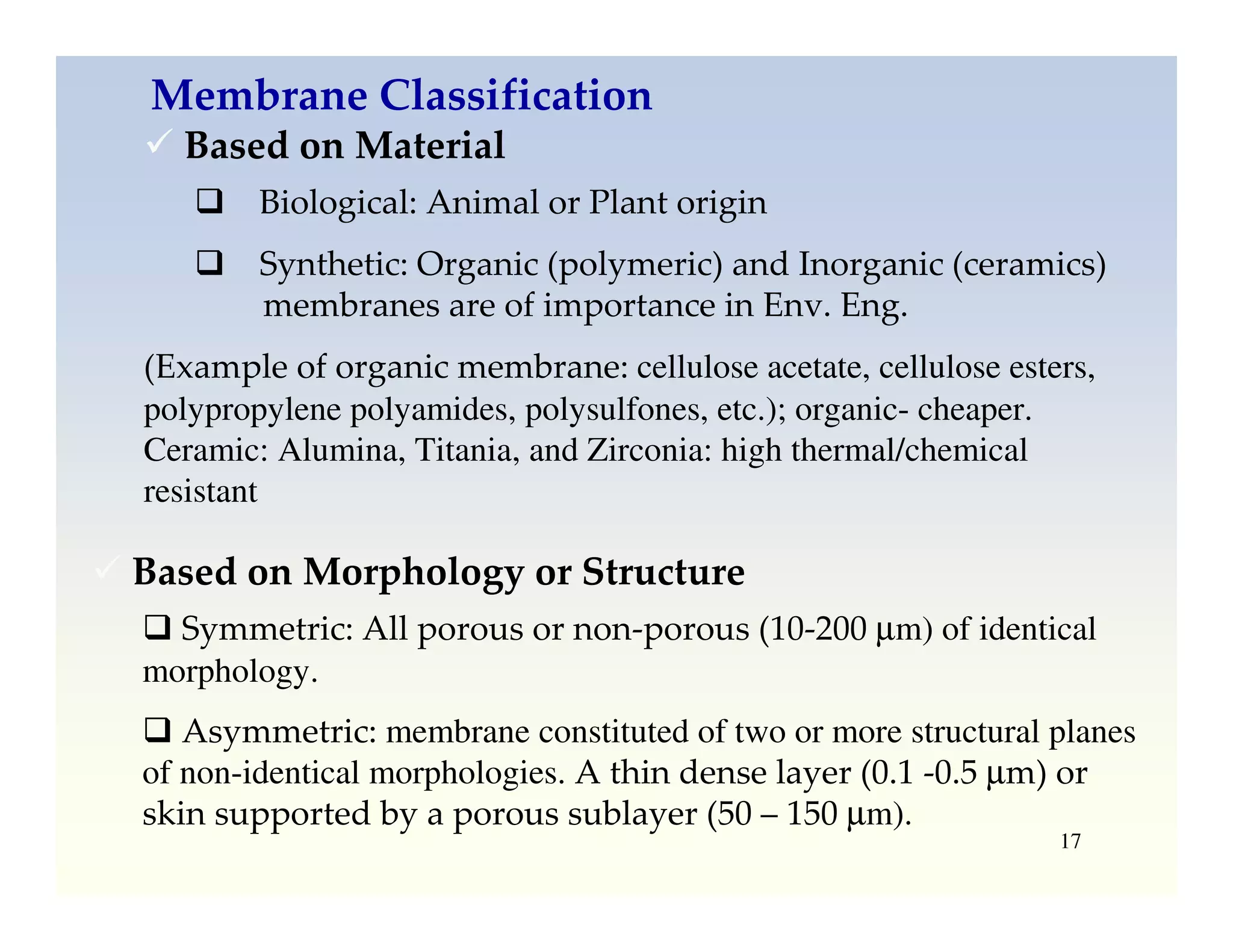
    2 Outline ofPresentation Introduction Various Membrane Separation Processes Membrane Modules Case Study
  • 3.
  • 6.
  • 7.
  • 9.
  • 10.
  • 11.
  • 12.
  • 13.
    # #
  • 14.
  • 16.
  • 17.
  • 18.
  • 19.
  • 20.
    Rapid Mix Coagulation/ Flocculation Sedimentation Filtration Disinfection
  • 21.
  • 22.
  • 23.
  • 24.
    Development of practicalmembrane processes *' #$., - /
  • 25.
    0 /' #$1, 2/ / ' #$11 3'4 #$5, 6/ ' #$5, 7
  • 26.
    water diffuses fromdilute to concentrated solution.
  • 27.
    ( ) (( *' #$+, - ' !
  • 28.
    ' #$%% *Loeb-Sourirajan of UCLA in early 1960’s : Breakthrough discovery for industrial membrane application: RO for desalination.
  • 29.
    / ! #
  • 30.
    $ # % # # 8
  • 31.
  • 32.
    + # #
  • 33.
  • 34.
    % # ) + # - ...
  • 35.
    Pressure-Driven Membrane Processes Permeate 9 Membrane Particle or Solvent Solute Molecule Feed DP
  • 36.
    Pressure-Driven Membrane Processes 10 Suspended Solids (Particles) Macromolecules (Humics) Multivalent Ions (Hardness) Monovalent Ions (Na+,Cl-) Water Molecules
  • 37.
    11 Membrane Fouling macromolecules particles ions microbes
  • 38.
  • 39.
    13 387 ( $ 7' D 7' D
  • 40.
    7' D 3' D / ' D / 0
  • 41.
    D/ 1 D/
  • 42.
    14 3 Flux: The volume of treated water obtained per unit time per unit membrane surface area. Higher flux is often desirable. (m3/m2/h or m/h) (MF/UF) P t R J = D × m J :Flux, P: trans-membrane pressure, : viscosity, Rt: total membrane resistance
  • 43.
    Selectivity: For diluteaqueous mixtures of a solvent (water) and a solute (particles), the selectivity is expressed in terms of retention “R” towards solute. CF and Cp are solute concentration in feed 15 3 P F C - C R = F P = F C C 1 - C and permeate R = 100% (complete retention) of solute R = 0% (solute and solvent pass thru membrane Water Recovery: QP/QF '(
  • 44.
  • 45.
  • 46.
  • 47.
    17 / 2 $ 3
  • 48.
  • 49.
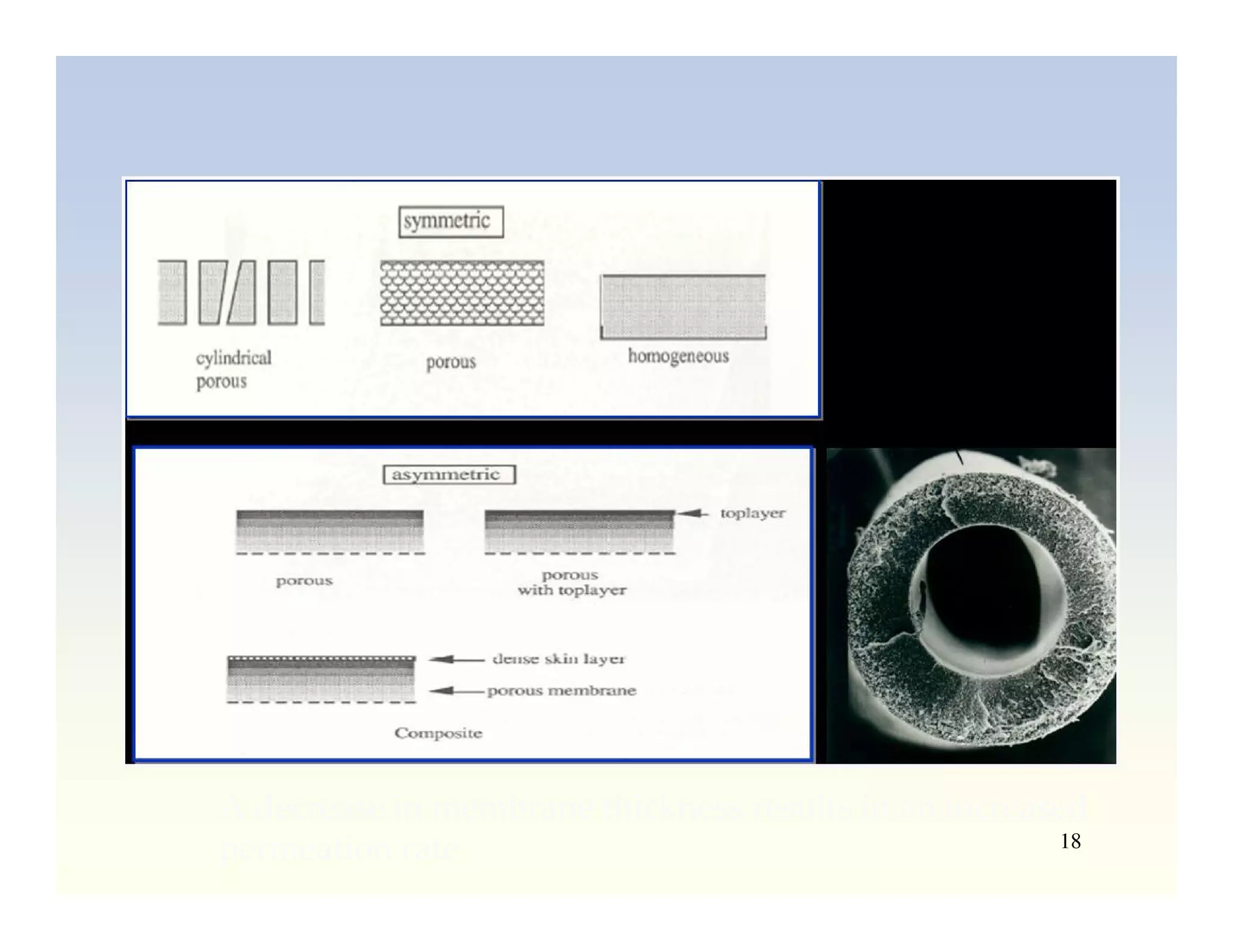
    5 ! 4 5 # 4( # cellulose acetate, cellulose esters, polypropylene polyamides, polysulfones, etc.); organic- cheaper. Ceramic: Alumina, Titania, and Zirconia: high thermal/chemical resistant / (0 8 3
  • 50.
  • 51.
    membrane constituted oftwo or more structural planes of non-identical morphologies.
  • 52.
  • 53.
  • 54.
  • 55.
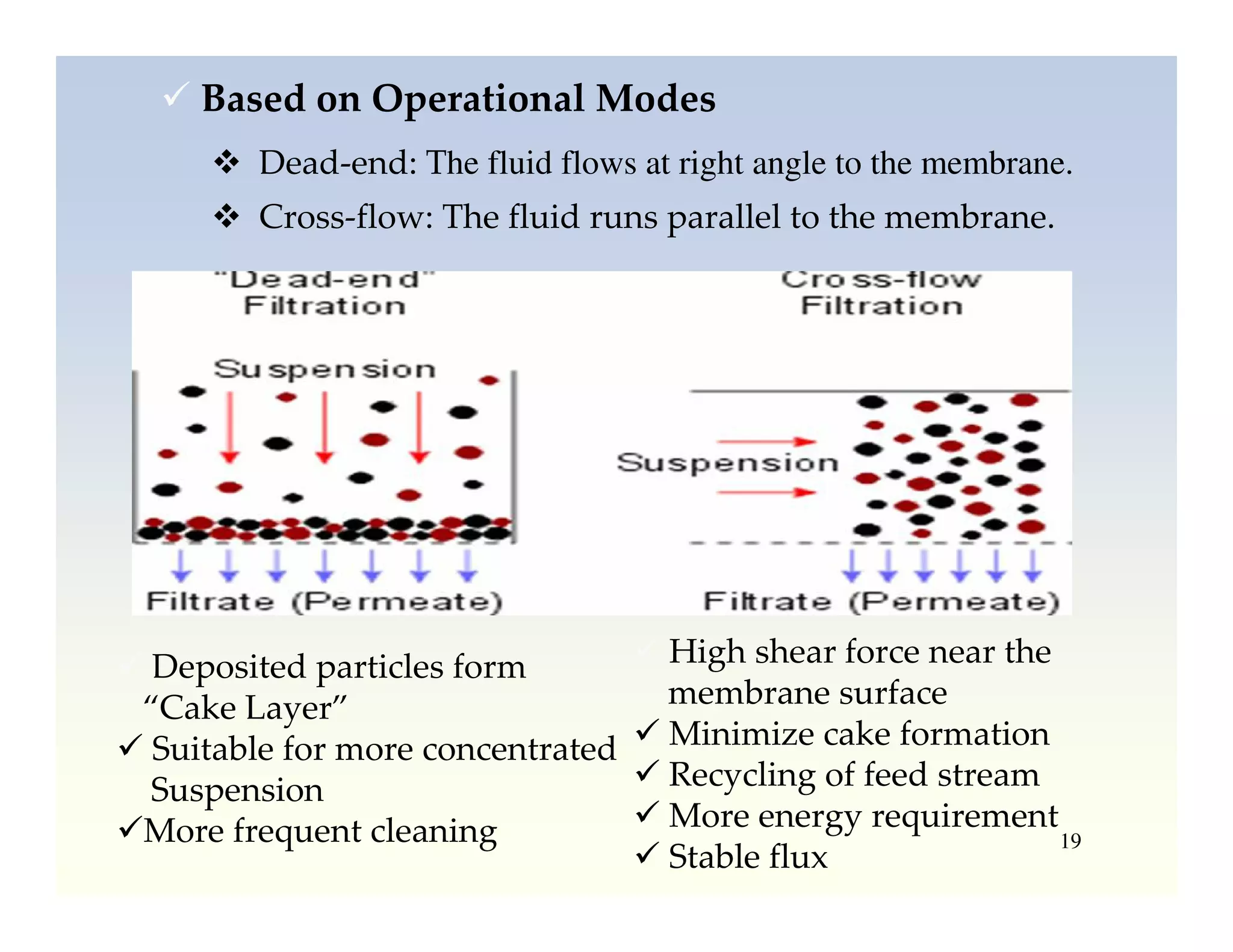
    19 /( / 0 :he fluid flows at right angle to the membrane. / # + :# 0 # ;/ 9)
  • 56.
    3 # 3 % #* - # # % = 9#
  • 57.
  • 58.
    * 3 #(
  • 59.
  • 60.
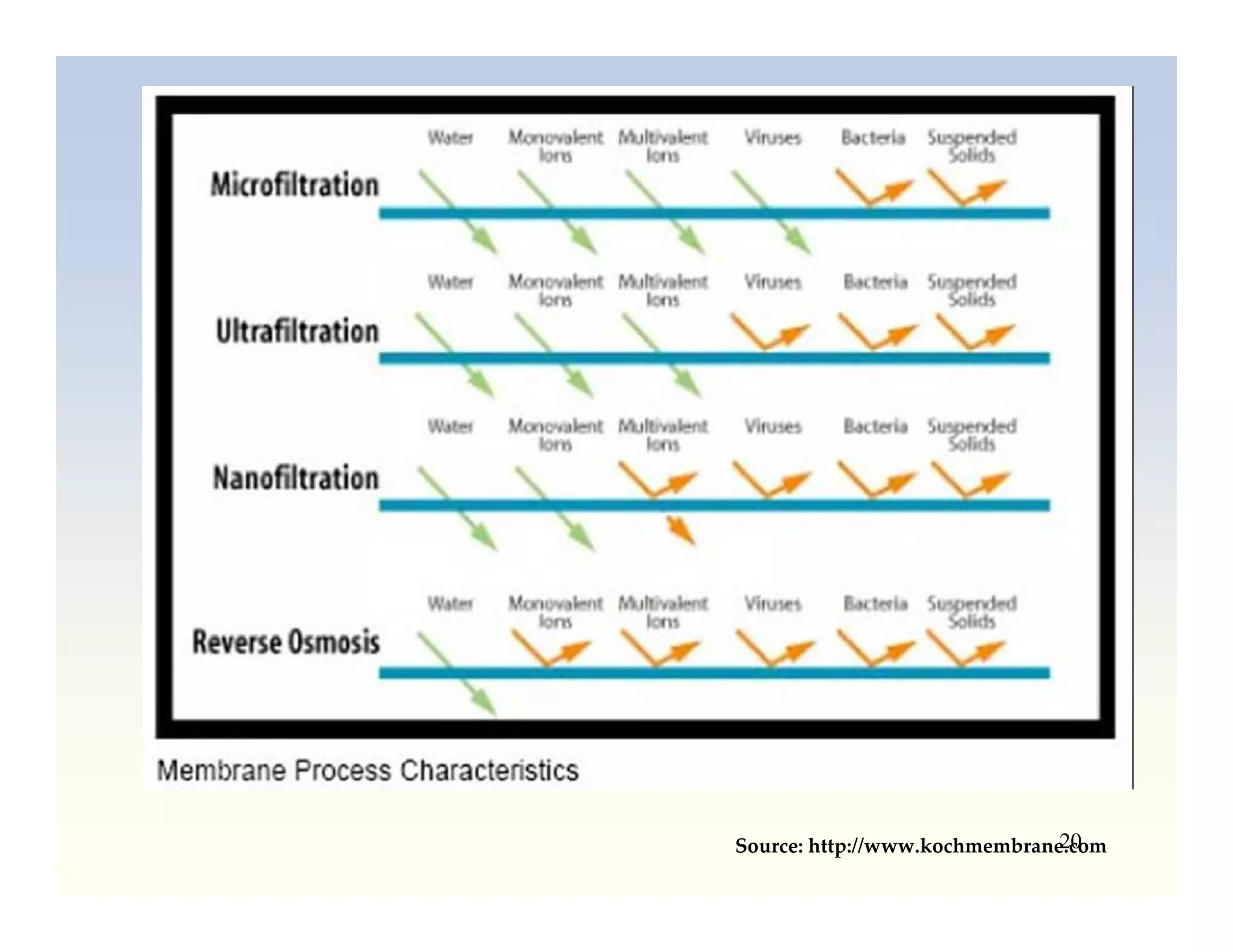
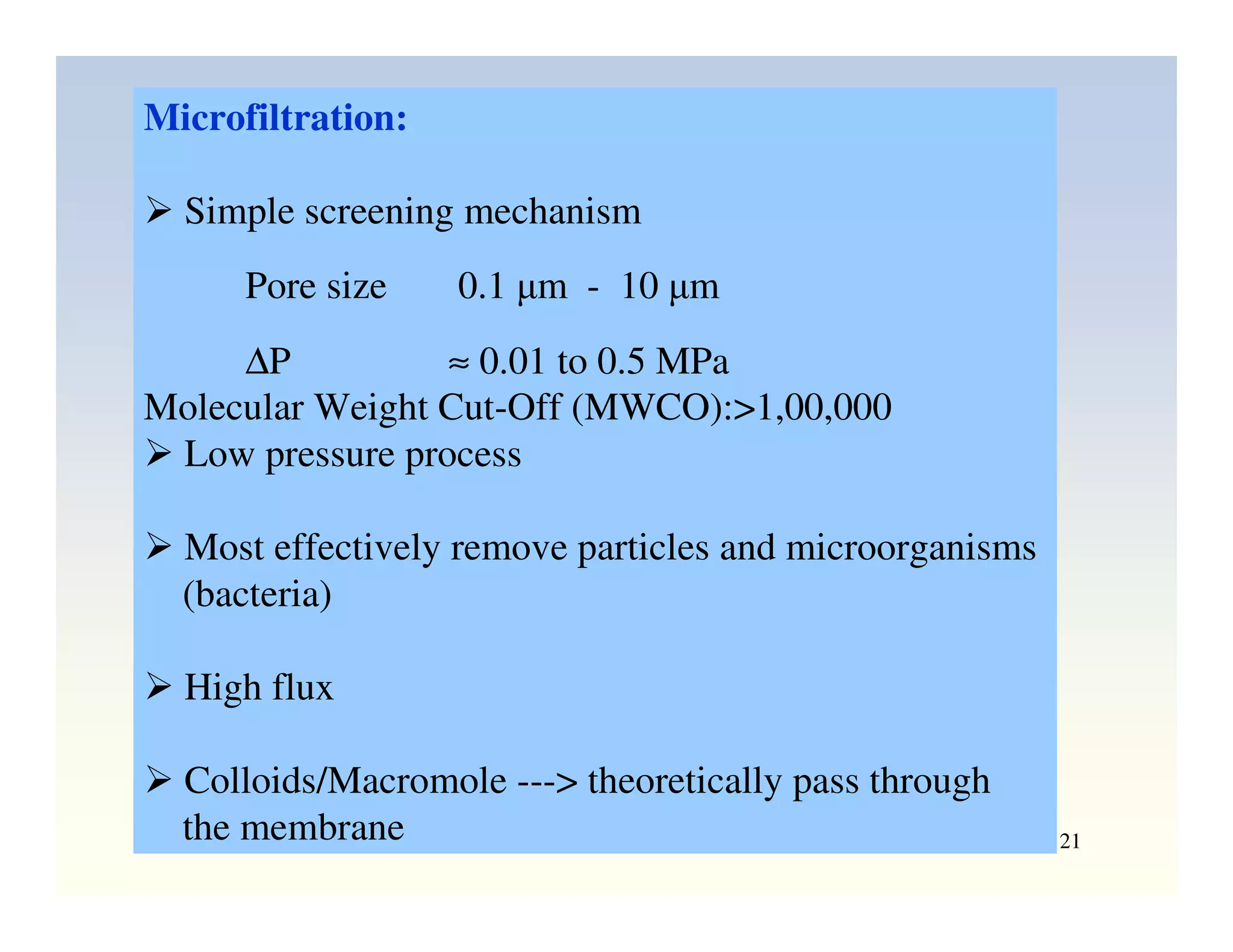
    21 Microfiltration: Simple screening mechanism Pore size 0.1 m - 10 m DP » 0.01 to 0.5 MPa
  • 61.
    Molecular Weight Cut-Off(MWCO):1,00,000 Low pressure process Most effectively remove particles and microorganisms (bacteria) +#
  • 62.
  • 63.
  • 64.
  • 65.
  • 66.
    # Highflux Colloids/Macromole --- theoretically pass through the membrane
  • 67.
    22 +#
  • 68.
  • 69.
  • 70.
    / !
  • 71.
  • 72.
  • 73.
  • 74.
  • 75.
  • 76.
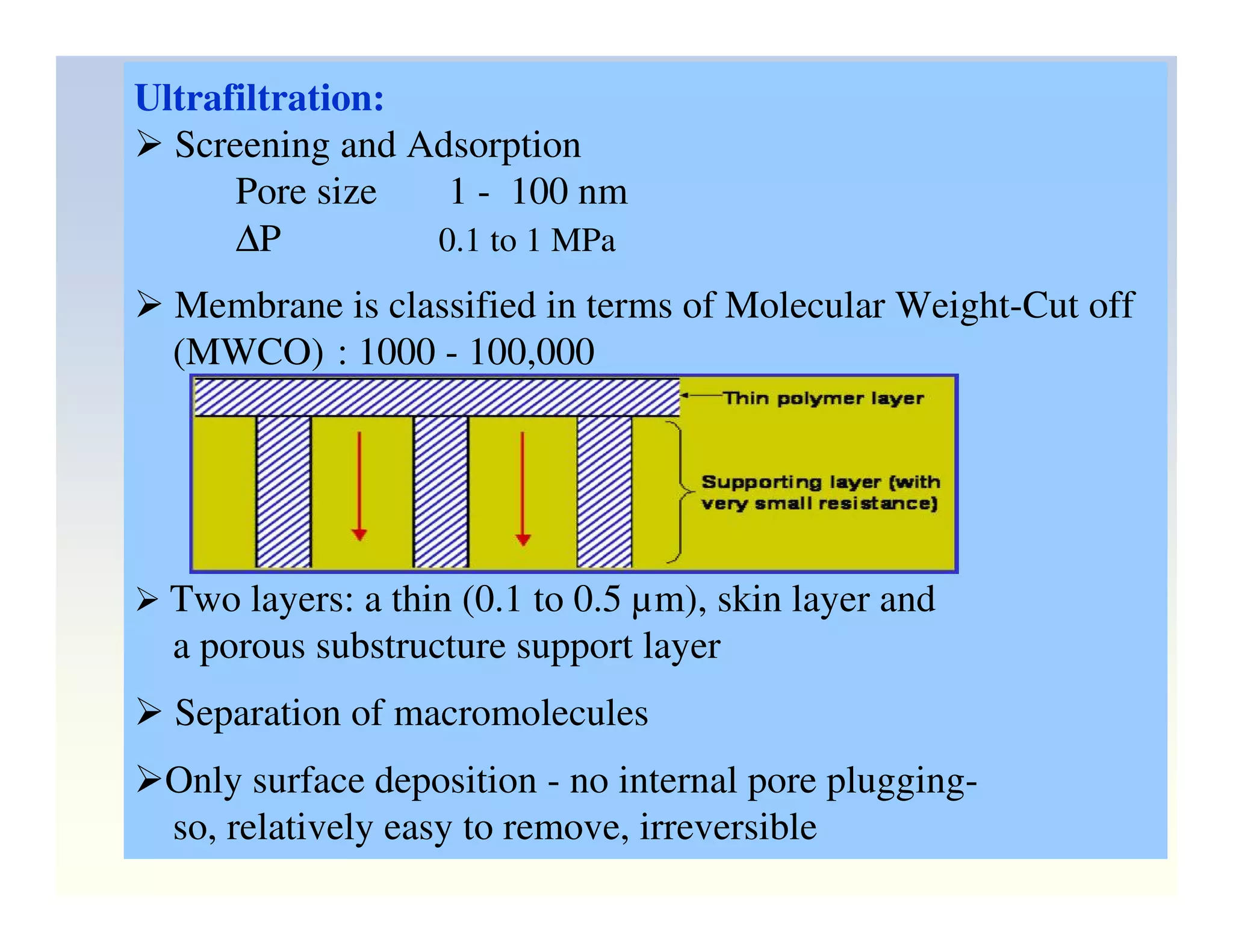
    Ultrafiltration: Screeningand Adsorption Pore size 1 - 100 nm DP 0.1 to 1 MPa Membrane is classified in terms of Molecular Weight-Cut off (MWCO) : 1000 - 100,000 ((=:(' #?,,, + #,?,,, 1 #,,?,,, #+ #,,,?,,, +% Two layers: a thin (0.1 to 0.5 μm), skin layer and a porous substructure support layer Separation of macromolecules Only surface deposition - no internal pore plugging-so, relatively easy to remove, irreversible
  • 77.
  • 78.
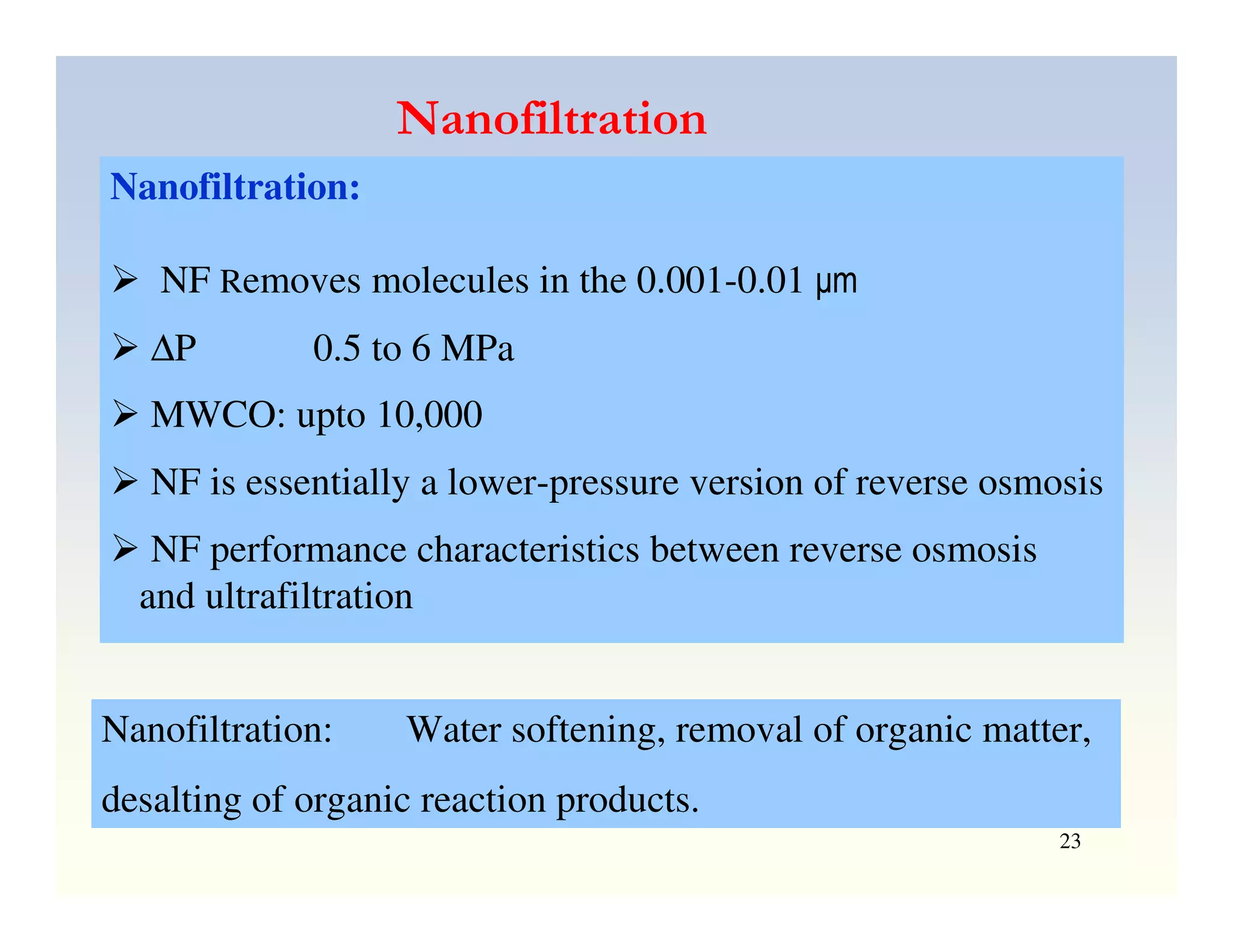
    Nanofiltration: NFRemoves molecules in the 0.001-0.01 m DP 0.5 to 6 MPa MWCO: upto 10,000 NF is essentially a lower-pressure version of reverse osmosis NF performance characteristics between reverse osmosis and ultrafiltration Nanofiltration: Water softening, removal of organic matter, desalting of organic reaction products.
  • 79.
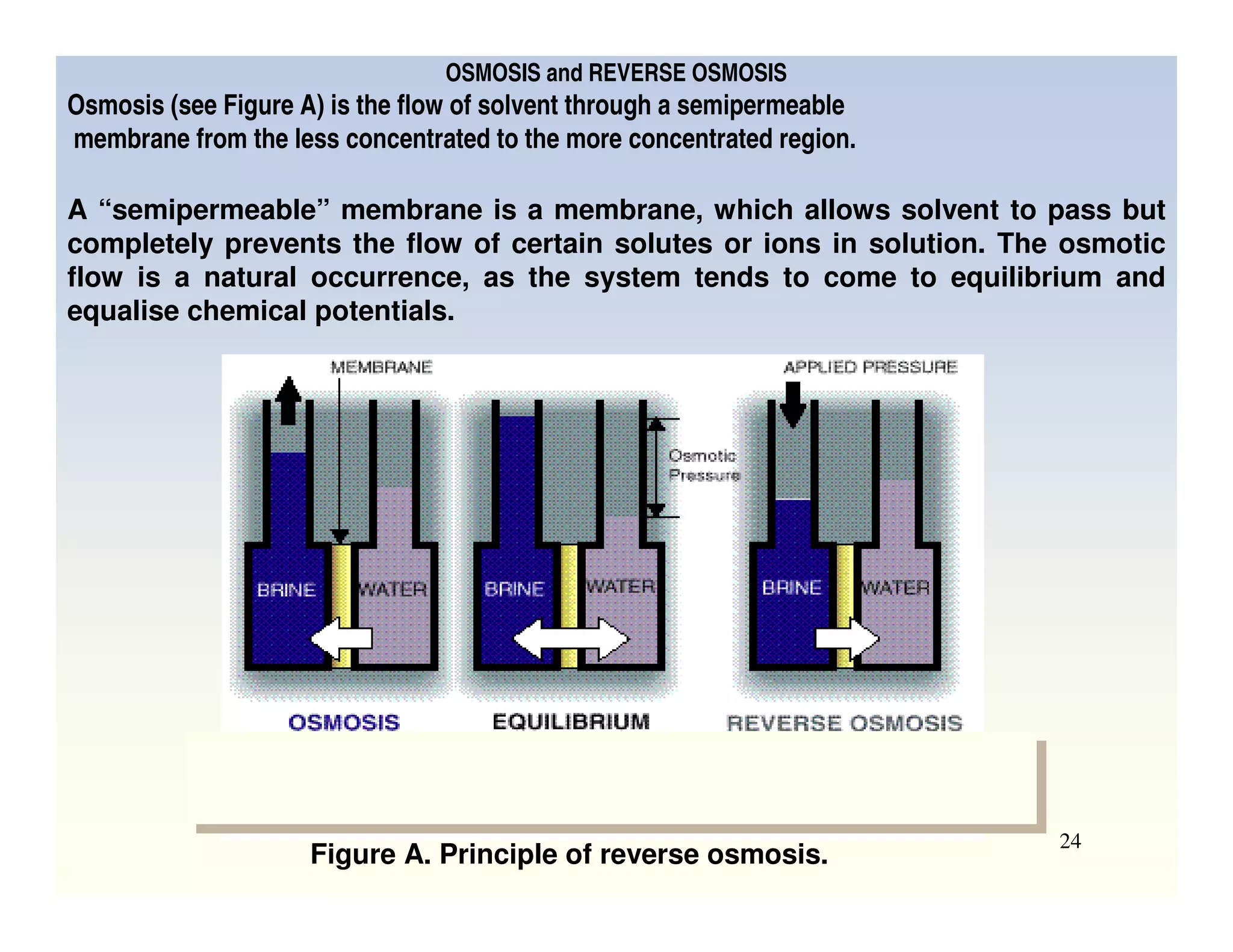
    24 OSMOSIS andREVERSE OSMOSIS Osmosis (see Figure A) is the flow of solvent through a semipermeable membrane from the less concentrated to the more concentrated region. A “semipermeable” membrane is a membrane, which allows solvent to pass but completely prevents the flow of certain solutes or ions in solution. The osmotic flow is a natural occurrence, as the system tends to come to equilibrium and equalise chemical potentials. Figure A. Principle of reverse osmosis.
  • 80.
  • 81.
  • 82.
  • 83.
  • 84.
  • 85.
    Membrane: similar toUF, thin active layer; porous support layer Operating Pressure: 1.0 - 10 MPa RO has the separation range of 0.0001 to 0.001mm Desalination (seawater and brackish water), metal plating effluent treatment, color removal from textile effluents, production of high purity water (boiler feed, electronics, medical, pharmaceutical)
  • 86.
    The osmotic flowcan be decreased by applying a pressure on the concentrated solution. •The higher the applied pressure the lesser the osmotic flow. •When the osmotic flow stops, the applied pressure is the osmotic pressure, which is given by the symbol . Osmotic pressure is a thermodynamic property of a solution and as such values 26 can be found in various reference books. For dilute systems, the following van’t Hoff equation may be used to calculate osmotic pressure: = CAiRT where CAi is the molar concentration of solute A at location i, R is the gas constant, and T is the absolute temperature. Osmotic pressure is equal to 6.86 kPa (51 torr) for each 100 mg/L of dissolved solids.
  • 87.
    27 Flux inRO and NF System: Flux (Jw) = Kw (DR-DP) Kw = Water mass transfer coefficient DR = Mean imposed pressure gradient DP = Mean osmotic pressure gradient Collier County, FL
  • 88.
    28 MEMBRANE MODULES Membrane module refers to the device which houses the membrane element: • Tubular membrane module • Hollow fibre membrane module •Spiral wound membrane module • Plate and frame membrane module
  • 89.
    29 Feed Retentate Permeate (flows radially) •Membrane is cast inside the support tube • Tubular membranes have a diameter of 5 - 15 mm • High suspended solids tolerance • Flow is usually inside out •Mainly MF and UF • Low packing density, high prices per module
  • 90.
    30 •Consists of a bundle of hundreds and thousands of hallow fiber •Entire assembly is inserted into a pressure vessel • Feed can be applied inside of the fiber (inside-out flow) outside (outside-in flow) • Highest packing density of all. •Hollow fiber is used mainly for NF and RO
  • 91.
    31 Spiral woundmembrane module •Flexible permeate spacer is provided between two flat sheet membranes •Flow is in a spiral pattern. •Membrane envelop is spirally wound along with a feed spacer • Filtrate is collected within the envelop and piped out •Packing density: high •RO and NF
  • 92.
    32 Plate-and-frame module Two membranes are placed in a sandwich-like fashion with their feed sides facing each other. Easy to clean and replace membranes. Low membrane area per unit volume (a problem in high pressure application where pressure vessel costs are significant).
  • 93.
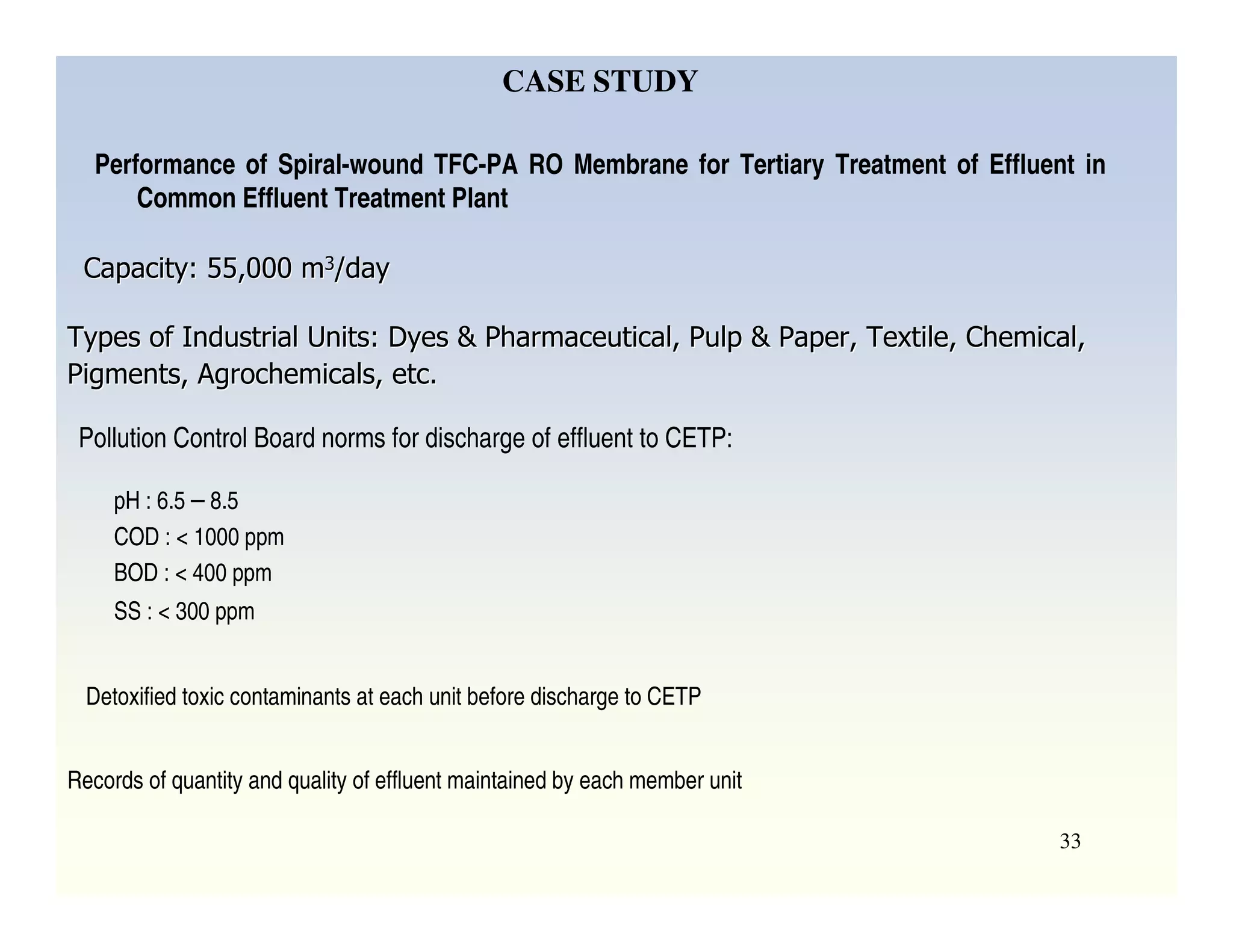
    33 CASE STUDY Performance of Spiral-wound TFC-PA RO Membrane for Tertiary Treatment of Effluent in Common Effluent Treatment Plant
  • 96.
    ! ! # Pollution ControlBoard norms for discharge of effluent to CETP: pH : 6.5 $ 8.5 COD : 1000 ppm BOD : 400 ppm SS : 300 ppm Detoxified toxic contaminants at each unit before discharge to CETP Records of quantity and quality of effluent maintained by each member unit
  • 97.
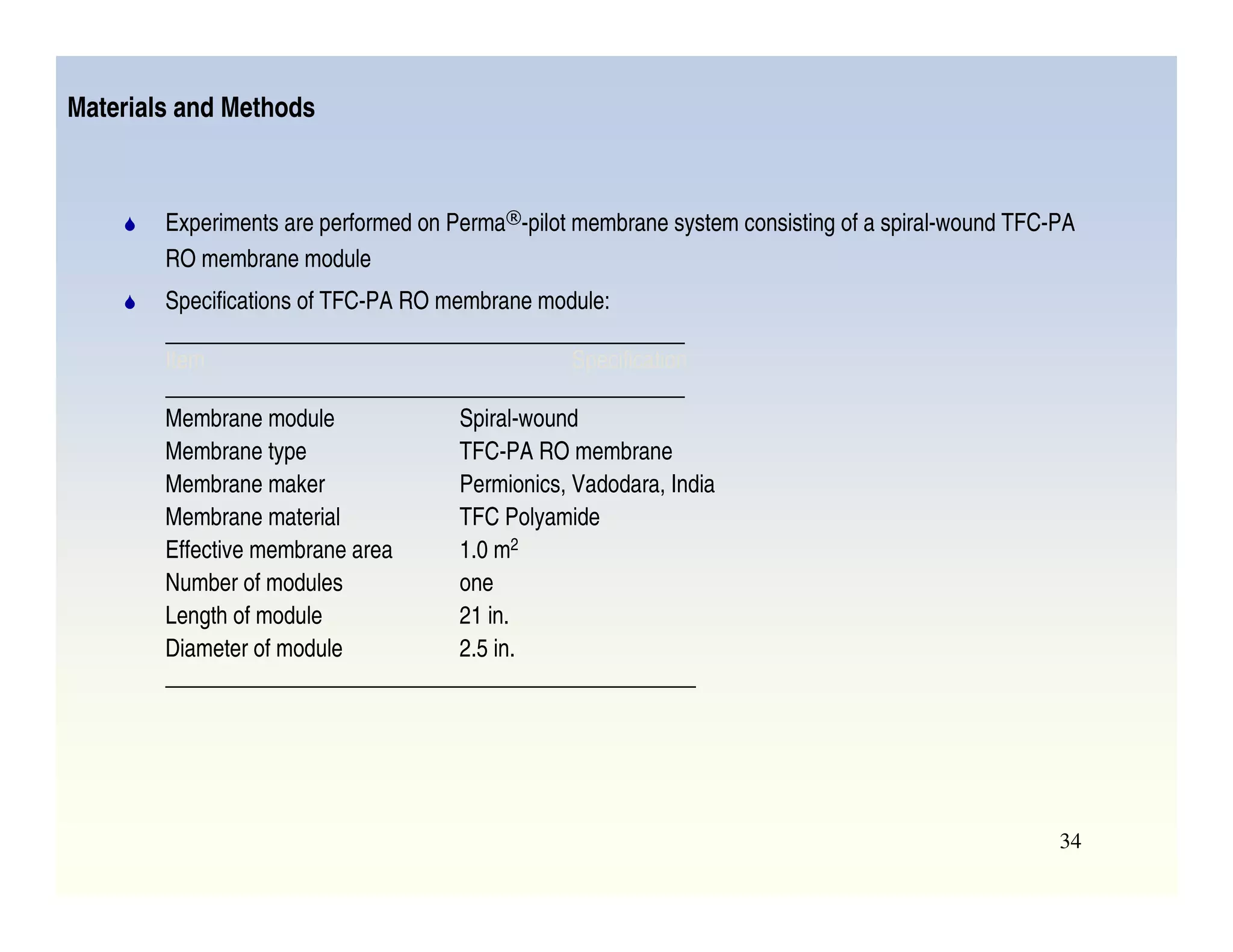
    34 Materials andMethods Experiments are performed on Perma%-pilot membrane system consisting of a spiral-wound TFC-PA RO membrane module Specifications of TFC-PA RO membrane module: ______________________________________________ Item Specification ______________________________________________ Membrane module Spiral-wound Membrane type TFC-PA RO membrane Membrane maker Permionics, Vadodara, India Membrane material TFC Polyamide Effective membrane area 1.0 m2 Number of modules one Length of module 21 in. Diameter of module 2.5 in. _______________________________________________
  • 98.
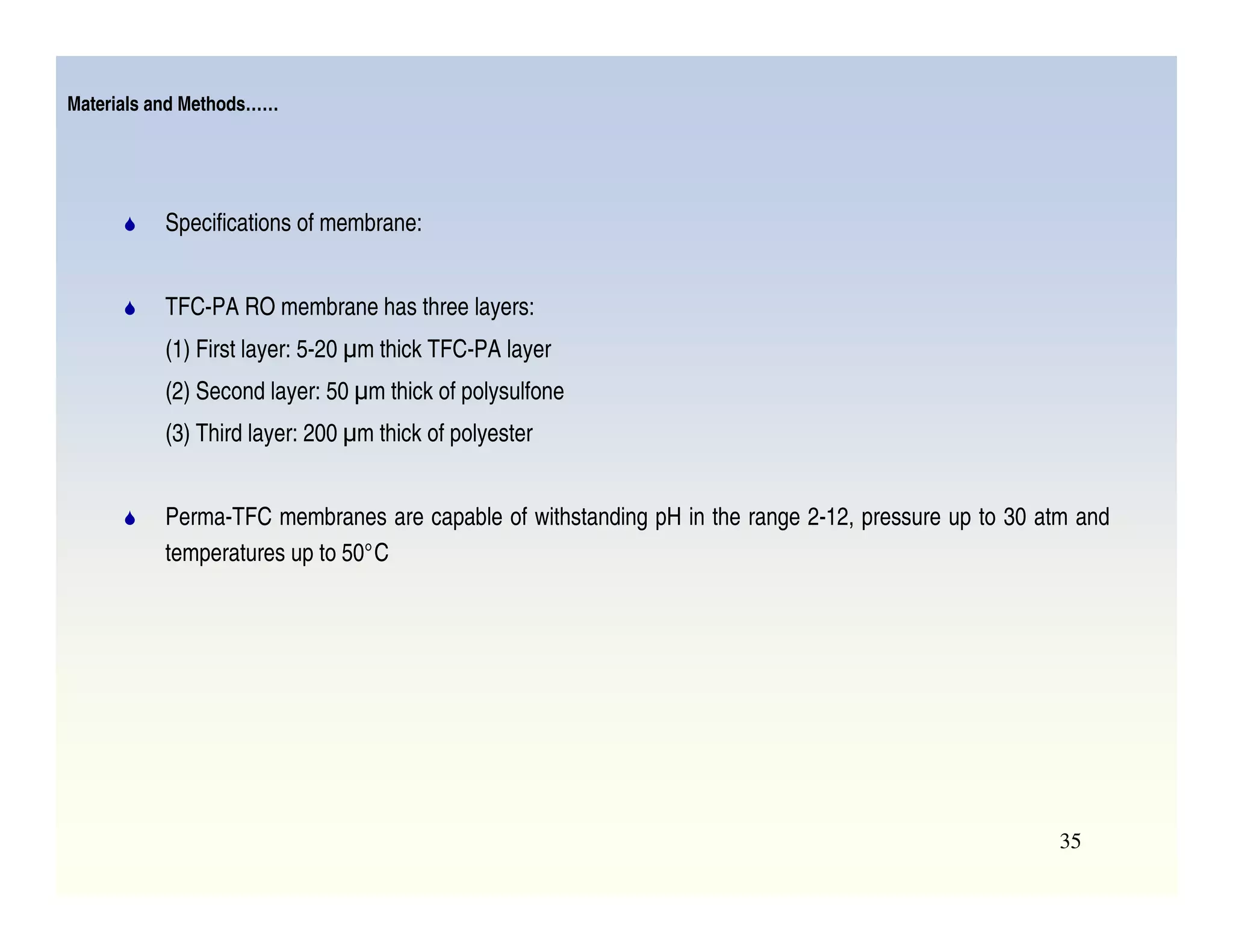
    35 Materials andMethods…… Specifications of membrane: TFC-PA RO membrane has three layers: (1) First layer: 5-20 m thick TFC-PA layer (2) Second layer: 50 m thick of polysulfone (3) Third layer: 200 m thick of polyester Perma-TFC membranes are capable of withstanding pH in the range 2-12, pressure up to 30 atm and temperatures up to 50°C
  • 99.
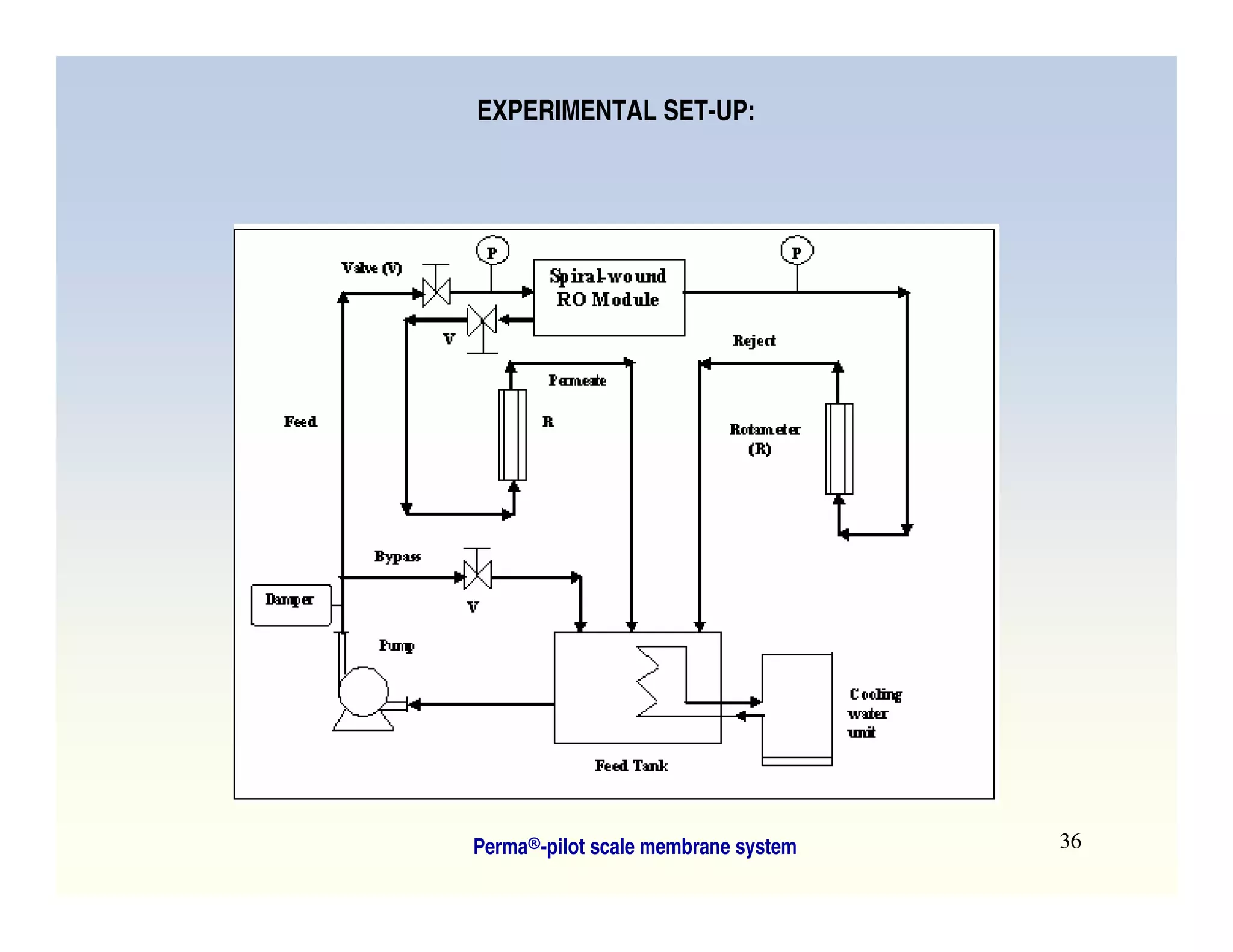
    36 EXPERIMENTAL SET-UP: Perma-pilot scale membrane system
  • 100.
    Material and Methods…… Before actual experiments membrane is subjected to stabilization at 20 atm for 2 37 hours to avoid membrane compaction during operation. The experiments are performed for various membrane flux rates in the range of 52- 88 L/(m2 h) or LMH with the operating pressures between 7-20 atm.
  • 101.
    38 Material andMethods…… The membrane performance can be represented in terms of normalized flux by the following relation: J = 1.03(297- T ) Q …………(1) N AP m where JN is the normalized flux [L/(m2 h atm)], T is the temperature in the range of 303-308 K, Q is the volume flow rate of permeate (m3/h), A is the effective membrane area (m2), Pm is transmembrane pressure (atm). Performance of membrane in terms of percentage rejection (R) is given as …………(2) = - Cp 100 1 % ´ Cf R where Cf and Cp are the individual component concentrations in the incoming feed to the RO system and in the permeate from the system, respectively.
  • 102.
    39 Material andMethods…… The normalized flux decline rate is calculated by the following Eq. (3) ………(3) 100 initial normalized flux - final normalized flux ´ initial normalized flux operating hours Average normalized flux decline rate (% per hour) ´
  • 103.
  • 104.
    The important parameterslike color, pH, total solids (TS), suspended solids (SS), total dissolved solids (TDS), phenol, ammonia, COD, BOD, sulphate, total hardness, Mg hardness, Ca hardness, zinc and total Cr are measured in the feed and permeate samples, according to standard methods.
  • 105.
    40 Results andDiscussion Characteristics of the secondary treated wastewater from CETP used as a feed in the present study: ____________________________________________________________________________________ Parameters Unit Value ____________________________________________________________________________________ pH - 6.95 Color Pt-Co unit 1070 TS mg/L 8460 SS mg/L 296 TDS mg/L 8164 Phenol mg/L 4.19 Ammonia mg/L 210 COD mg/L 656 BOD mg/L 160 Sulphate mg/L 1027 Total Hardness mg/L 1770 Ca Hardness mg/L 1600 Mg Hardness mg/L 170 Zinc mg/L 0.03 Total Cr mg/L 0.07 ______________________________________________________________________________________
  • 106.
    '! ('! () *' %) +++++++++++++++++++++++++++++++++++++++++++++++++++++++++++++ ), )- ) ). +++++++++++++++++++++++++++++++++++++++++++++++++++++++++++++ ( /0123 45# 54 6. -#. ( 7 /0 3 ,-#
  • 107.
  • 108.
  • 109.
    *8 /93 ,-# ,-#-,, : '! ,5)-
  • 110.
    , ),4 ,-),-# 5): / 3 +++++++++++++++++++++++++++++++++++++++++++++++++++++++++++++ 41
  • 111.
    42 Results andDiscussion …… Normalized flux of the RO membrane under different flux rates as a function of time are shown in Fig. 7 6 5 4 3 2 1 0 0 5 10 15 20 25 30 35 40 45 Time, h JN, (L/m2 h atm) 87.3 LMH 78 LMH 64 LMH 52.4 LMH 64 LMH (Firs t CIP ) 52.4 LMH (Firs t CIP ) 64 LMH (Seco nd CIP ) (!# ; (!# ;
  • 112.
    43 Results andDiscussion …… The results are summarized in Table _______________________________________________________ Parameter Test-1 Test-2 Test-3 Test-4 _______________________________________________________ Flux rate (LMH) 87.3 78 64 52.4 Operating pressure 17-20 15-18 12-12.5 7 (atm) Normalized flux, JN 3.71-3.25 4.11-3.42 4.47-4.29 6.27-4.8 [L/(m2 h atm) 25°C] %Drop in JN per hour 1.5 1.7 0.40 0.2 %Drop after first CIP - - 0.70 1.6 %Drop after second CIP - - 0.67 - Average % rejection 99.4 99.4 99.1 98.8 of COD _______________________________________________________
  • 113.
  • 114.
    () *' = = 7 *' = Parameterunit Permeate % Rejection Specified limit** pH - 6.7-7.3 --- 6.5-8.5 10-40 96 - 98 5-25 Pt-Co Color unit TS mg/L 24-80 99 – 99.7 300-600 SS mg/L 1-5 98 – 99.7 ------ TDS mg/L 24-79 99 – 99.7 300-600 Phenol mg/L 0.09-0.14 96.6 – 97.8 0.001-0.002 Ammonia mg/L 11-16 92 – 94.8 50 COD mg/L 4-8 98.8 – 99.4 100 BOD mg/L 0 100 -------- Sulphate mg/L 0 100 200-400 Total Hardness mg/L 0 100 300-600 Ca Hardness mg/L 0 100 75-200 Mg Hardness mg/L 0 100 30-100 Zinc mg/L BDL* 100 5 Total Cr mg/L 0.01-0.06 14 – 85.7 0.05 * BDL=Below Detectable Limit, ** Specified limit by pollution control authority
  • 115.
    45 Conclusions Theconclusions from the pilot study are summarized as follows: The optimal operation flux rate of the RO membrane is found to be 64 LMH for the present application. At a flux rate of 64 LMH and water recovery of 11%, the average operating pressure of 12 atm is noted corresponding to a high normalized flux of 4.5 L/(m2 h atm) at 25°C. Average rejections of the RO membrane in terms of COD and BOD are 99% and 100%, respectively. It is found that the RO system is effective for the secondary treated industrial effluent in order to comply with the local specified limits for discharging into the public sewerage system. In turn that can be used for other purposes due its high quality, instead of sending it to sewerage.
  • 116.
    46 References: 1.Membrane processes for water and wastewater treatment by S.S. Khanal, Department of Civil Engineering, Construction and Environmental Engineering, Iowa State University, USA. 2. Emerging Applications for Water Treatment and Potable Water Reuse by T.Y. Cath, Environmental Science and Engineering Division, Colorado School of Mines, USA. 3. Z.V.P. Murthy, L.B. Chaudhari, Performance of Spiral-wound TFC-PA RO membrane for tertiary treatment of effluent in common effluent treatment plant, Proceedings of the “2nd International Conference on Engineering for Waste Valorisation (WasteEng08)”, University of Patras, Greece, June 3 - 5, 2008, pp 229-230.