SSeemmiinnaarr oonn 
BBiioollooggiiccaall WWaasstteewwaatteerr 
TTrreeaattmmeenntt PPrroocceesssseess 
PPaasstt,, PPrreesseenntt aanndd FFuuttuurree 
Dr. Ajit P. Annachhatre 
Environmental Engineering Program 
Asian Institute of Technology
KKeeyywwoorrddss 
 Wastewater 
 Biological Processes 
 Treatment Processes 
 Applications 
 Ongoing Research Activities
11..WWaasstteewwaatteerr 
 Domestic Wastewater 
 Industrial Wastewater 
• Present State of Wastewater
DDoommeessttiicc WWaasstteewwaatteerr 
 over 80 % - untreated in Asian mega cities 
 major components- COD = 250-1000 mg/L 
Total N = 20-90 mg/L 
Total P = 4-15 mg/L 
 effects of discharging into natural 
receiving bodies 
 oxygen demand by carbon and nitrogen
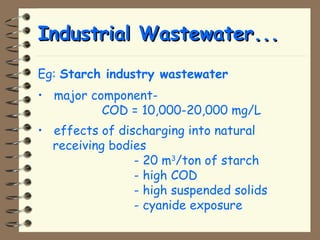
IInndduussttrriiaall WWaasstteewwaatteerr...... 
Eg: Starch industry wastewater 
• major component- 
COD = 10,000-20,000 mg/L 
• effects of discharging into natural 
receiving bodies 
- 20 m3/ton of starch 
- high COD 
- high suspended solids 
- cyanide exposure
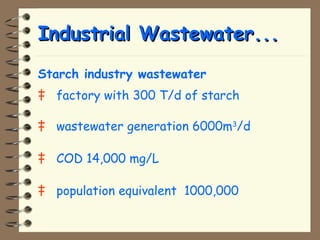
IInndduussttrriiaall WWaasstteewwaatteerr...... 
Starch industry wastewater 
‡ factory with 300 T/d of starch 
‡ wastewater generation 6000m3/d 
‡ COD 14,000 mg/L 
‡ population equivalent 1000,000
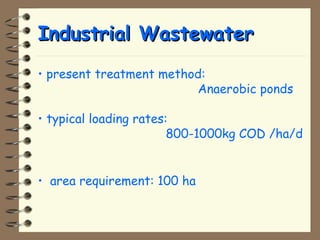
IInndduussttrriiaall WWaasstteewwaatteerr 
• present treatment method: 
Anaerobic ponds 
• typical loading rates: 
800-1000kg COD /ha/d 
• area requirement: 100 ha
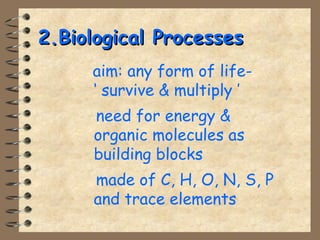
22..BBiioollooggiiccaall PPrroocceesssseess 
 aim: any form of life- 
‘ survive  multiply ’ 
 need for energy  
organic molecules as 
building blocks 
 made of C, H, O, N, S, P 
and trace elements
BBiioollooggiiccaall PPrroocceesssseess...... 
 cell: derives energy from 
oxidation of reduced food 
sources 
(carbohydrate, protein  
fats)
MMiiccrroooorrggaanniissmmss 
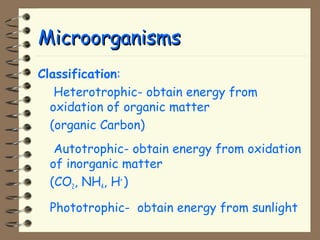
Classification: 
 Heterotrophic- obtain energy from 
oxidation of organic matter 
(organic Carbon) 
 Autotrophic- obtain energy from oxidation 
of inorganic matter 
(CO2, NH4, H+ ) 
 Phototrophic- obtain energy from sunlight
BBiioocchheemmiiccaall PPaatthhwwaayyss 
 oxidation of organic molecules inside the 
cell can occur aerobic or anaerobic manner 
 generalized pathways for aerobic  
anaerobic fermentation
BBiioocchheemmiiccaall PPaatthhwwaayyss 
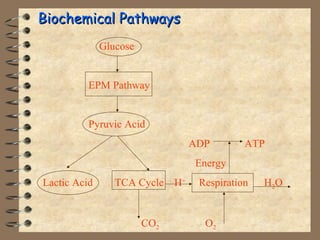
Glucose 
EPM Pathway 
Pyruvic Acid 
ADP ATP 
Energy 
Lactic Acid TCA Cycle H+ Respiration H2O 
CO2 O2
BBiioocchheemmiiccaall PPaatthhwwaayyss 
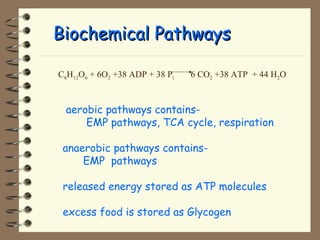
C6H12O6 + 6O2 +38 ADP + 38 Pi 6 CO2 +38 ATP + 44 H2O 
 aerobic pathways contains- 
EMP pathways, TCA cycle, respiration 
 anaerobic pathways contains- 
EMP pathways 
 released energy stored as ATP molecules 
 excess food is stored as Glycogen
Biological growth 
- exponential growth (batch) 
- Monod kinetics 
- Haldane kinetics 
under toxic conditions
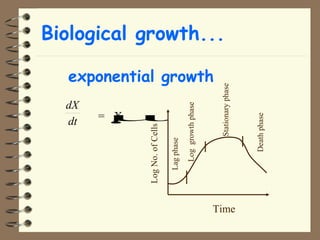
exponential growth 
Biological growth... 
dX 
dt = mX 
Log No. of Cells 
Time 
Lag phase 
Log growth phase 
Stationary phase 
Death phase
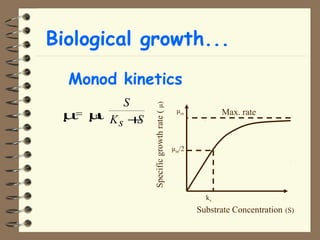
Biological growth... 
 Monod kinetics 
m = mm 
S 
Ks +S 
Substrate Concentration (S) 
Specific growth rate ( μ) 
μ Max. rate m 
μm/2 
ks
Biological growth... 
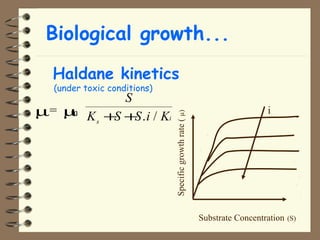
 Haldane kinetics 
(under toxic conditions) 
m = mm 
S 
Ks +S +S.i / Ki 
Substrate Concentration (S) 
Specific growth rate ( μ) 
i
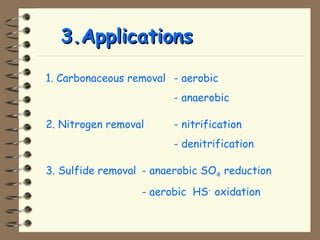
33..AApppplliiccaattiioonnss 
1. Carbonaceous removal - aerobic 
- anaerobic 
2. Nitrogen removal - nitrification 
- denitrification 
3. Sulfide removal - anaerobic SO4 reduction 
- aerobic HS- oxidation
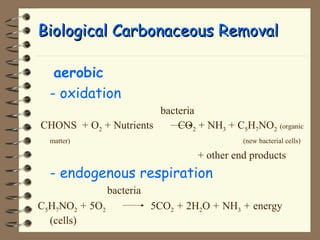
BBiioollooggiiccaall CCaarrbboonnaacceeoouuss RReemmoovvaall 
 aerobic 
- oxidation 
bacteria 
CHONS + O2 + Nutrients CO2 + NH3 + C5H7NO2 (organic 
matter) (new bacterial cells) 
+ other end products 
- endogenous respiration 
bacteria 
C5H7NO2 + 5O2 5CO2 + 2H2O + NH3 + energy 
(cells)
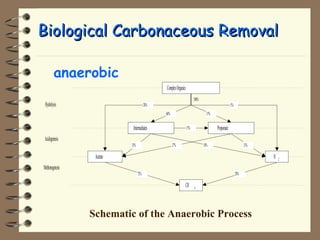
BBiioollooggiiccaall CCaarrbboonnaacceeoouuss RReemmoovvaall 
 anaerobic 
100% 
20% 5% 
60% 15% 
15% 
35% 17% 10% 13% 
72% 28% 
Schematic of the Anaerobic Process 
Hydrolysis 
Acidogenesis 
Methenogenesis 
Complex Organics 
Intermediates Propionate 
H 2 Acetate 
CH 4
BBiioollooggiiccaall NNiittrrooggeenn RReemmoovvaall 
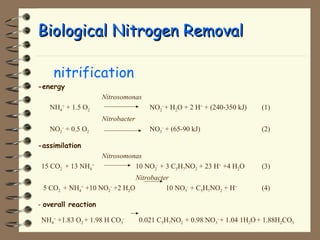
 nitrification 
-energy 
Nitrosomonas 
NH4 
+ + 1.5 O2 NO2 
- + H2O + 2 H+ + (240-350 kJ) (1) 
Nitrobacter 
NO2 
- + 0.5 O2 NO3 
- + (65-90 kJ) (2) 
-assimilation 
Nitrosomonas 
15 CO2 + 13 NH4 
+ 10 NO2 
- + 3 C5H7NO2 + 23 H+ +4 H2O (3) 
Nitrobacter 
5 CO2 + NH4 
+ +10 NO2 
- +2 H2O 10 NO3 
- + C5H7NO2 + H+ (4) 
- overall reaction 
NH4 
+ +1.83 O2 + 1.98 H CO3 
- 0.021 C5H7NO2 + 0.98 NO3 
- + 1.04 1H2O + 1.88H2CO3
BBiioollooggiiccaall NNiittrrooggeenn RReemmoovvaall 
 factors affecting nitrification 
* temperature 
* substrate concentration 
* dissolved oxygen 
* pH 
* toxic and inhibitory substances 
é 
ù 
NH N T 
N O 
m = m - - 
( 0.095( 15) )[1 0.83(7.2 )] 
DO 
4 e pH 
é 
m K NH úû 
- - N 
K DO 
4 
ù 
êë 
+ 
× úû 
êë 
+ -
BBiioollooggiiccaall NNiittrrooggeenn RReemmoovvaall 
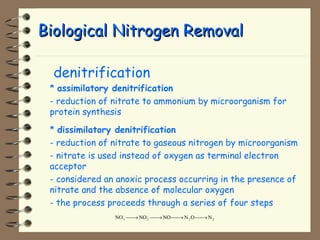
 denitrification 
* assimilatory denitrification 
- reduction of nitrate to ammonium by microorganism for 
protein synthesis 
* dissimilatory denitrification 
- reduction of nitrate to gaseous nitrogen by microorganism 
- nitrate is used instead of oxygen as terminal electron 
acceptor 
- considered an anoxic process occurring in the presence of 
nitrate and the absence of molecular oxygen 
- the process proceeds through a series of four steps 
NO NO NO N O N 3 - 
2 - 
2 2 ¾¾® ¾¾® ¾¾® ¾¾®
BBiioollooggiiccaall NNiittrrooggeenn RReemmoovvaall 
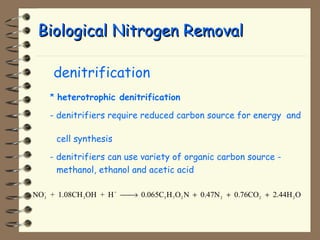
 denitrification 
* heterotrophic denitrification 
- denitrifiers require reduced carbon source for energy and 
cell synthesis 
- denitrifiers can use variety of organic carbon source - 
methanol, ethanol and acetic acid 
NO - 
+ 1.08CH OH + H + 
0.065C H O N 0.47N 0.76CO 2.44H O 3 
3 
5 7 2 2 2 2 ¾¾® + + +
BBiioollooggiiccaall NNiittrrooggeenn RReemmoovvaall 
 factors affecting denitrification 
* temperature 
* dissolved oxygen 
* pH
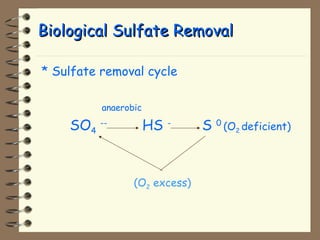
BBiioollooggiiccaall SSuullffaattee RReemmoovvaall 
* Sulfate removal cycle 
anaerobic 
SO4 -- HS - S 0 (O2 deficient) 
(O2 excess)
44..TTrreeaattmmeenntt PPrroocceesssseess 
 pond treatment 
 activated sludge process 
 biofilm process
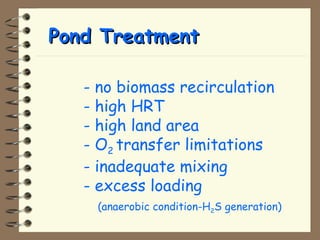
PPoonndd TTrreeaattmmeenntt 
- no biomass recirculation 
- high HRT 
- high land area 
- O2 transfer limitations 
- inadequate mixing 
- excess loading 
(anaerobic condition-H2S generation)
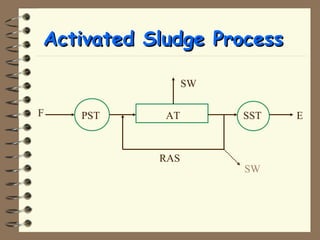
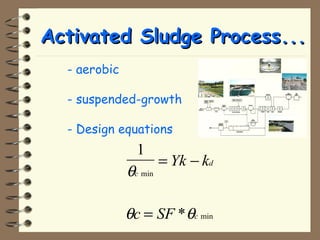
AAccttiivvaatteedd SSlluuddggee PPrroocceessss 
F PST AT SST 
E 
RAS 
SW 
SW
AAccttiivvaatteedd SSlluuddggee PPrroocceessss...... 
- aerobic 
- suspended-growth 
- Design equations 
1 
q 
c 
Yk k 
min 
= - 
q q 
d 
c 
c SF 
* min 
=
AAccttiivvaatteedd SSlluuddggee PPrroocceessss...... 
typical values of cell residence time (qc ) 
- qc for C removal ~ 3-10 days 
- qc for N removal ~ 5-30 days 
- loading rates ~ 2-3 kg COD/m3/d 
- drawbacks: O2 requirements, inlet conc.
BBiiooffiillmm PPrroocceesssseess 
advantages of biofilm processes: 
- higher process productivity 
(loading rates) 
- higher biomass holdup 
- higher mean cell residence time 
- no need for biomass recirculation 
- creates suitable environment for each 
type of bacteria 
- sustains toxic loads
BBiiooffiillmm PPrroocceesssseess...... 
• types of biofilms: aerobic, anaerobic, anoxic 
• process of biofilm formation 
- formation of diffuse electrical double 
layer due to electrostatic forces and 
thermal motion 
- transfer of microorganism to surface 
- microbial adhesion 
- biofilm formation
BBiiooffiillmm PPrroocceesssseess...... 
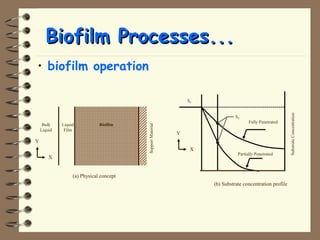
• biofilm operation 
X 
Y 
Liquid Biofilm 
Film 
Bulk 
Liquid 
Support Material 
(a) Physical concept 
Fully Penetrated 
SS 
Partially Penetrated 
Sb 
Substrate Concentration 
X 
Y 
(b) Substrate concentration profile
BBiiooffiillmm PPrroocceesssseess...... 
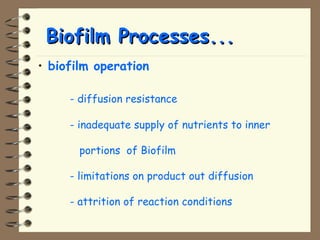
• biofilm operation 
- diffusion resistance 
- inadequate supply of nutrients to inner 
portions of Biofilm 
- limitations on product out diffusion 
- attrition of reaction conditions
BBiiooffiillmm PPrroocceesssseess...... 
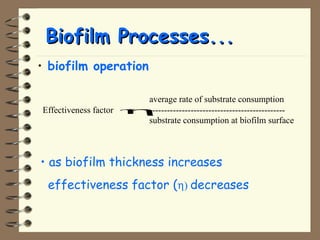
• biofilm operation 
average rate of substrate consumption 
Effectiveness factor h = ---------------------------------------------- 
substrate consumption at biofilm surface 
• as biofilm thickness increases 
effectiveness factor (h) decreases
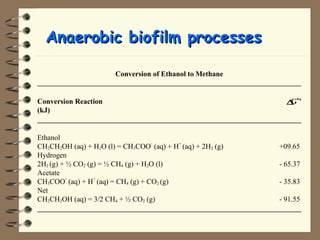
AAnnaaeerroobbiicc bbiiooffiillmm pprroocceesssseess 
Conversion of Ethanol to Methane 
Conversion Reaction DGo’ 
(kJ) 
Ethanol 
CH2CH2OH (aq) + H2O (l) = CH3COO- (aq) + H+ (aq) + 2H2 (g) +09.65 
Hydrogen 
2H2 (g) + ½ CO2 (g) = ½ CH4 (g) + H2O (l) - 65.37 
Acetate 
CH3COO- (aq) + H+ (aq) = CH4 (g) + CO2 (g) - 35.83 
Net 
CH2CH2OH (aq) = 3/2 CH4 + ½ CO2 (g) - 91.55
AAnnaaeerroobbiicc bbiiooffiillmm pprroocceesssseess...... 
• importance of H partial pressure 
• loading rates 10-15 kg COD/m3/d 
against 2-5 kg COD/m3/d in 
suspended growth processes
OOnnggooiinngg RReesseeaarrcchh AAccttiivviittiieess 
Biological Processes 
aerobic anoxic anaerobic 
nitrification denitrification SO4 
2-- reduction 
HS- oxidation detoxification
OOnnggooiinngg RReesseeaarrcchh AAccttiivviittiieess 
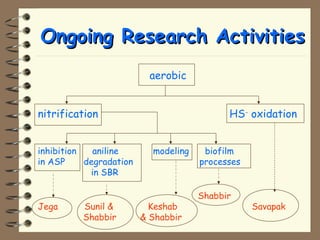
aerobic 
nitrification HS- oxidation 
inhibition aniline modeling biofilm 
in ASP degradation processes 
in SBR 
Shabbir 
Jega Sunil  Keshab Savapak 
Shabbir  Shabbir
OOnnggooiinngg RReesseeaarrcchh AAccttiivviittiieess 
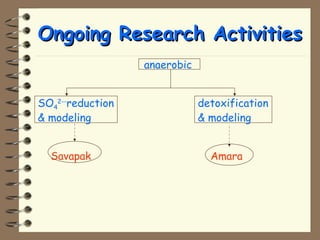
anaerobic 
SO4 
2--reduction detoxification 
 modeling  modeling 
Savapak Amara
OOnnggooiinngg RReesseeaarrcchh AAccttiivviittiieess 
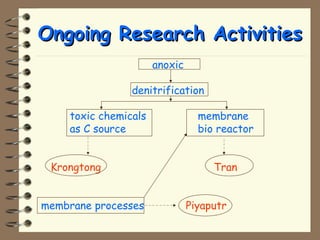
anoxic 
denitrification 
toxic chemicals membrane 
as C source bio reactor 
Krongtong Tran 
membrane processes Piyaputr
Study of nitrification process 
inside a spherical biofloc particle 
based on biofilm kinetics. 
 determination of effectiveness 
factor for substrate consumption 
and thus the substrate removal 
rates.
Mathematical model consists of a system 
of second order differential equations 
based on steady state material balance 
and appropriate boundary conditions. 
 Model is solved numerically using a 
computer program developed in Macsyma 
2.3, which uses 4th order Runge-Kutta 
method for solving system of ODEs
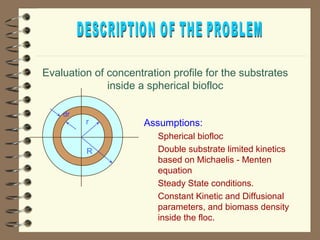
Evaluation of concentration profile for the substrates 
r 
R 
dr 
inside a spherical biofloc 
Assumptions: 
 Spherical biofloc 
 Double substrate limited kinetics 
based on Michaelis - Menten 
equation 
 Steady State conditions. 
 Constant Kinetic and Diffusional 
parameters, and biomass density 
inside the floc.
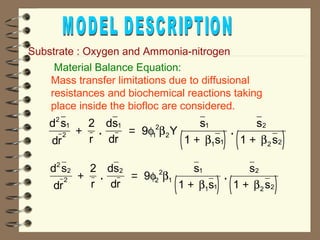
Substrate : Oxygen and Ammonia-nitrogen 
 Material Balance Equation: 
Mass transfer limitations due to diffusional 
resistances and biochemical reactions taking 
place inside the biofloc are considered. 
. f b . 
( ) ( ) 
d s 
dr 
2 
r 
ds 
dr 
9 Y s 
1 s 
s 
1 s 
2 
1 
2 
1 
2 
1 
2 
1 
b b 
1 1 
2 
2 2 
+ = 
+ + 
. f b . 
( ) ( ) 
d s 
dr 
2 
r 
ds 
dr 
9 s 
1 s 
s 
1 s 
2 
2 
2 
2 
2 
2 
1 
1 
b b 
1 1 
2 
2 2 
+ = 
+ +
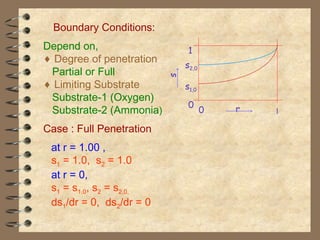
Boundary Conditions: 
Depend on, 
¨ Degree of penetration 
Partial or Full 
¨ Limiting Substrate 
Substrate-1 (Oxygen) 
Substrate-2 (Ammonia) 
Case : Full Penetration 
at r = 1.00 , 
s1 = 1.0, s2 = 1.0 
at r = 0, 
s1 = s1,0, s2 = s2,0, 
ds1/dr = 0, ds2/dr = 0 
1 
0 0 
r 
s s2,0 
s1,0 
1
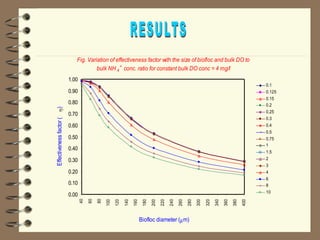
Fig. Variation of effectiveness factor with the size of biofloc and bulk DO to 
bulk NH 4 
+ conc. ratio for constant bulk DO conc = 4 mg/l 
1.00 
0.90 
0.80 
0.70 
0.60 
0.50 
0.40 
0.30 
0.20 
0.10 
0.00 
40 
60 
80 
100 
120 
140 
160 
180 
200 
220 
240 
260 
280 
300 
320 
340 
360 
380 
400 
Biofloc diameter (mm) 
Effectiveness factor ( ) 
0.1 
0.125 
0.15 
0.2 
0.25 
0.3 
0.4 
0.5 
0.75 
1 
1.5 
2 
3 
4 
6 
8 
10
OOnnggooiinngg RReesseeaarrcchh AAccttiivviittiieess 
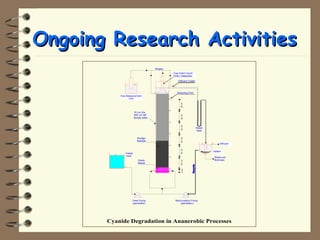
Gas Solid Liquid 
(GSL) Separator 
Effluent Outlet 
Feed Pump 
(peristaltic) 
Sampling Port 
Recirculation Pump 
(peristaltic) 
U Water 
Seal 
Biogas 
Gas Measurement 
Unit 
10 cm dia. 
300 cm tall 
Acrylic tube 
Effluent 
Settler 
Wash-out 
Biomass 
Sludge 
Blanket 
Glass 
Beeds 
Feeds 
Tank 
Cyanide Degradation in Ananerobic Processes
OOnnggooiinngg RReesseeaarrcchh AAccttiivviittiieess 
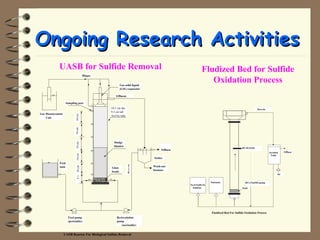
Gas solid liquid 
(GSL) separator 
Effluent 
Sludge 
blanket 
UASB Reactor For Biological Sulfate Removal 
Effluen 
Settler 
Wash-out 
biomass 
Feed 
tank 
Recycle 
10.3 cm dia. 
9.3 cm tall 
Acrylic tube 
Biogas 
Gas Measurement 
Unit 
Sampling port 
10 cm 10 cm 10 cm 10 cm 10 cm 
Glass 
beads 
Feed pump 
(peristaltic) 
Recirculation 
pump 
(peristaltic) 
8.5 
Fludized Bed for Sulfide 
Oxidation Process 
HCl (NaOH)-pump 
Fluidized Bed For Sulfide Oxidation Process 
Na2S/NaHCO3 
Solution 
Nutrients 
Aeration 
Tank 
Sand 
Air 
Effluen 
t 
pH electrode 
Recycle 
UASB for Sulfide Removal
OOnnggooiinngg RReesseeaarrcchh AAccttiivviittiieess 
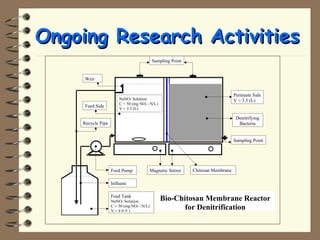
Feed Pump 
Influent 
Feed Tank 
NaNO3 Solution 
C = 50 (mg NO3 
-- N/L) 
V = 4.0 (L) 
Chitosan Membrane 
Stirrer 
Sampling Point 
Magnetic Stirrer 
Denitrifying 
Bacteria 
Weir 
Feed Side 
Recycle Pipe 
Permeate Side 
NaNO3 Solution V = 3.5 (L) 
C = 50 (mg NO3 
-- N/L) 
V = 3.5 (L) 
Sampling Point 
Bio-Chitosan Membrane Reactor 
for Denitrification
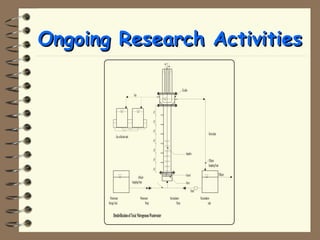
OOnnggooiinngg RReesseeaarrcchh AAccttiivviittiieess 
Effluent 
Recirculate 
Recirculation 
tank 
Gas collection tank 
Wastewater 
Storage Tank 
Wastewater 
Pump 
Recirculation 
Pump 
Gas 
Clarifier 
Impeller 
Gravel 
Timer 
Sieve 
Effluent 
Sampling Point 
Influent 
Sampling Point 
10 cm 10 cm 10 cm 10 cm 10 cm 10 cm 10 cm 
Denitrification of Toxic Nitrogenous Wastewater
TTHHEE EENNDD

Biological wastewater treatment processes

  • 1.
    SSeemmiinnaarr oonn BBiioollooggiiccaallWWaasstteewwaatteerr TTrreeaattmmeenntt PPrroocceesssseess PPaasstt,, PPrreesseenntt aanndd FFuuttuurree Dr. Ajit P. Annachhatre Environmental Engineering Program Asian Institute of Technology
  • 2.
    KKeeyywwoorrddss Wastewater Biological Processes Treatment Processes Applications Ongoing Research Activities
  • 3.
    11..WWaasstteewwaatteerr DomesticWastewater Industrial Wastewater • Present State of Wastewater
  • 4.
    DDoommeessttiicc WWaasstteewwaatteerr over 80 % - untreated in Asian mega cities major components- COD = 250-1000 mg/L Total N = 20-90 mg/L Total P = 4-15 mg/L effects of discharging into natural receiving bodies oxygen demand by carbon and nitrogen
  • 5.
    IInndduussttrriiaall WWaasstteewwaatteerr...... Eg:Starch industry wastewater • major component- COD = 10,000-20,000 mg/L • effects of discharging into natural receiving bodies - 20 m3/ton of starch - high COD - high suspended solids - cyanide exposure
  • 6.
    IInndduussttrriiaall WWaasstteewwaatteerr...... Starchindustry wastewater ‡ factory with 300 T/d of starch ‡ wastewater generation 6000m3/d ‡ COD 14,000 mg/L ‡ population equivalent 1000,000
  • 7.
    IInndduussttrriiaall WWaasstteewwaatteerr •present treatment method: Anaerobic ponds • typical loading rates: 800-1000kg COD /ha/d • area requirement: 100 ha
  • 8.
    22..BBiioollooggiiccaall PPrroocceesssseess aim: any form of life- ‘ survive multiply ’ need for energy organic molecules as building blocks made of C, H, O, N, S, P and trace elements
  • 9.
    BBiioollooggiiccaall PPrroocceesssseess...... cell: derives energy from oxidation of reduced food sources (carbohydrate, protein fats)
  • 10.
    MMiiccrroooorrggaanniissmmss Classification: Heterotrophic- obtain energy from oxidation of organic matter (organic Carbon) Autotrophic- obtain energy from oxidation of inorganic matter (CO2, NH4, H+ ) Phototrophic- obtain energy from sunlight
  • 11.
    BBiioocchheemmiiccaall PPaatthhwwaayyss oxidation of organic molecules inside the cell can occur aerobic or anaerobic manner generalized pathways for aerobic anaerobic fermentation
  • 12.
    BBiioocchheemmiiccaall PPaatthhwwaayyss Glucose EPM Pathway Pyruvic Acid ADP ATP Energy Lactic Acid TCA Cycle H+ Respiration H2O CO2 O2
  • 13.
    BBiioocchheemmiiccaall PPaatthhwwaayyss C6H12O6+ 6O2 +38 ADP + 38 Pi 6 CO2 +38 ATP + 44 H2O aerobic pathways contains- EMP pathways, TCA cycle, respiration anaerobic pathways contains- EMP pathways released energy stored as ATP molecules excess food is stored as Glycogen
  • 14.
    Biological growth -exponential growth (batch) - Monod kinetics - Haldane kinetics under toxic conditions
  • 15.
    exponential growth Biologicalgrowth... dX dt = mX Log No. of Cells Time Lag phase Log growth phase Stationary phase Death phase
  • 16.
    Biological growth... Monod kinetics m = mm S Ks +S Substrate Concentration (S) Specific growth rate ( μ) μ Max. rate m μm/2 ks
  • 17.
    Biological growth... Haldane kinetics (under toxic conditions) m = mm S Ks +S +S.i / Ki Substrate Concentration (S) Specific growth rate ( μ) i
  • 18.
    33..AApppplliiccaattiioonnss 1. Carbonaceousremoval - aerobic - anaerobic 2. Nitrogen removal - nitrification - denitrification 3. Sulfide removal - anaerobic SO4 reduction - aerobic HS- oxidation
  • 19.
    BBiioollooggiiccaall CCaarrbboonnaacceeoouuss RReemmoovvaall aerobic - oxidation bacteria CHONS + O2 + Nutrients CO2 + NH3 + C5H7NO2 (organic matter) (new bacterial cells) + other end products - endogenous respiration bacteria C5H7NO2 + 5O2 5CO2 + 2H2O + NH3 + energy (cells)
  • 20.
    BBiioollooggiiccaall CCaarrbboonnaacceeoouuss RReemmoovvaall anaerobic 100% 20% 5% 60% 15% 15% 35% 17% 10% 13% 72% 28% Schematic of the Anaerobic Process Hydrolysis Acidogenesis Methenogenesis Complex Organics Intermediates Propionate H 2 Acetate CH 4
  • 21.
    BBiioollooggiiccaall NNiittrrooggeenn RReemmoovvaall nitrification -energy Nitrosomonas NH4 + + 1.5 O2 NO2 - + H2O + 2 H+ + (240-350 kJ) (1) Nitrobacter NO2 - + 0.5 O2 NO3 - + (65-90 kJ) (2) -assimilation Nitrosomonas 15 CO2 + 13 NH4 + 10 NO2 - + 3 C5H7NO2 + 23 H+ +4 H2O (3) Nitrobacter 5 CO2 + NH4 + +10 NO2 - +2 H2O 10 NO3 - + C5H7NO2 + H+ (4) - overall reaction NH4 + +1.83 O2 + 1.98 H CO3 - 0.021 C5H7NO2 + 0.98 NO3 - + 1.04 1H2O + 1.88H2CO3
  • 22.
    BBiioollooggiiccaall NNiittrrooggeenn RReemmoovvaall factors affecting nitrification * temperature * substrate concentration * dissolved oxygen * pH * toxic and inhibitory substances é ù NH N T N O m = m - - ( 0.095( 15) )[1 0.83(7.2 )] DO 4 e pH é m K NH úû - - N K DO 4 ù êë + × úû êë + -
  • 23.
    BBiioollooggiiccaall NNiittrrooggeenn RReemmoovvaall denitrification * assimilatory denitrification - reduction of nitrate to ammonium by microorganism for protein synthesis * dissimilatory denitrification - reduction of nitrate to gaseous nitrogen by microorganism - nitrate is used instead of oxygen as terminal electron acceptor - considered an anoxic process occurring in the presence of nitrate and the absence of molecular oxygen - the process proceeds through a series of four steps NO NO NO N O N 3 - 2 - 2 2 ¾¾® ¾¾® ¾¾® ¾¾®
  • 24.
    BBiioollooggiiccaall NNiittrrooggeenn RReemmoovvaall denitrification * heterotrophic denitrification - denitrifiers require reduced carbon source for energy and cell synthesis - denitrifiers can use variety of organic carbon source - methanol, ethanol and acetic acid NO - + 1.08CH OH + H + 0.065C H O N 0.47N 0.76CO 2.44H O 3 3 5 7 2 2 2 2 ¾¾® + + +
  • 25.
    BBiioollooggiiccaall NNiittrrooggeenn RReemmoovvaall factors affecting denitrification * temperature * dissolved oxygen * pH
  • 26.
    BBiioollooggiiccaall SSuullffaattee RReemmoovvaall * Sulfate removal cycle anaerobic SO4 -- HS - S 0 (O2 deficient) (O2 excess)
  • 27.
    44..TTrreeaattmmeenntt PPrroocceesssseess pond treatment activated sludge process biofilm process
  • 28.
    PPoonndd TTrreeaattmmeenntt -no biomass recirculation - high HRT - high land area - O2 transfer limitations - inadequate mixing - excess loading (anaerobic condition-H2S generation)
  • 29.
  • 30.
    AAccttiivvaatteedd SSlluuddggee PPrroocceessss...... - aerobic - suspended-growth - Design equations 1 q c Yk k min = - q q d c c SF * min =
  • 31.
    AAccttiivvaatteedd SSlluuddggee PPrroocceessss...... typical values of cell residence time (qc ) - qc for C removal ~ 3-10 days - qc for N removal ~ 5-30 days - loading rates ~ 2-3 kg COD/m3/d - drawbacks: O2 requirements, inlet conc.
  • 32.
    BBiiooffiillmm PPrroocceesssseess advantagesof biofilm processes: - higher process productivity (loading rates) - higher biomass holdup - higher mean cell residence time - no need for biomass recirculation - creates suitable environment for each type of bacteria - sustains toxic loads
  • 33.
    BBiiooffiillmm PPrroocceesssseess...... •types of biofilms: aerobic, anaerobic, anoxic • process of biofilm formation - formation of diffuse electrical double layer due to electrostatic forces and thermal motion - transfer of microorganism to surface - microbial adhesion - biofilm formation
  • 34.
    BBiiooffiillmm PPrroocceesssseess...... •biofilm operation X Y Liquid Biofilm Film Bulk Liquid Support Material (a) Physical concept Fully Penetrated SS Partially Penetrated Sb Substrate Concentration X Y (b) Substrate concentration profile
  • 35.
    BBiiooffiillmm PPrroocceesssseess...... •biofilm operation - diffusion resistance - inadequate supply of nutrients to inner portions of Biofilm - limitations on product out diffusion - attrition of reaction conditions
  • 36.
    BBiiooffiillmm PPrroocceesssseess...... •biofilm operation average rate of substrate consumption Effectiveness factor h = ---------------------------------------------- substrate consumption at biofilm surface • as biofilm thickness increases effectiveness factor (h) decreases
  • 37.
    AAnnaaeerroobbiicc bbiiooffiillmm pprroocceesssseess Conversion of Ethanol to Methane Conversion Reaction DGo’ (kJ) Ethanol CH2CH2OH (aq) + H2O (l) = CH3COO- (aq) + H+ (aq) + 2H2 (g) +09.65 Hydrogen 2H2 (g) + ½ CO2 (g) = ½ CH4 (g) + H2O (l) - 65.37 Acetate CH3COO- (aq) + H+ (aq) = CH4 (g) + CO2 (g) - 35.83 Net CH2CH2OH (aq) = 3/2 CH4 + ½ CO2 (g) - 91.55
  • 38.
    AAnnaaeerroobbiicc bbiiooffiillmm pprroocceesssseess...... • importance of H partial pressure • loading rates 10-15 kg COD/m3/d against 2-5 kg COD/m3/d in suspended growth processes
  • 39.
    OOnnggooiinngg RReesseeaarrcchh AAccttiivviittiieess Biological Processes aerobic anoxic anaerobic nitrification denitrification SO4 2-- reduction HS- oxidation detoxification
  • 40.
    OOnnggooiinngg RReesseeaarrcchh AAccttiivviittiieess aerobic nitrification HS- oxidation inhibition aniline modeling biofilm in ASP degradation processes in SBR Shabbir Jega Sunil Keshab Savapak Shabbir Shabbir
  • 41.
    OOnnggooiinngg RReesseeaarrcchh AAccttiivviittiieess anaerobic SO4 2--reduction detoxification modeling modeling Savapak Amara
  • 42.
    OOnnggooiinngg RReesseeaarrcchh AAccttiivviittiieess anoxic denitrification toxic chemicals membrane as C source bio reactor Krongtong Tran membrane processes Piyaputr
  • 43.
    Study of nitrificationprocess inside a spherical biofloc particle based on biofilm kinetics. determination of effectiveness factor for substrate consumption and thus the substrate removal rates.
  • 44.
    Mathematical model consistsof a system of second order differential equations based on steady state material balance and appropriate boundary conditions. Model is solved numerically using a computer program developed in Macsyma 2.3, which uses 4th order Runge-Kutta method for solving system of ODEs
  • 45.
    Evaluation of concentrationprofile for the substrates r R dr inside a spherical biofloc Assumptions: Spherical biofloc Double substrate limited kinetics based on Michaelis - Menten equation Steady State conditions. Constant Kinetic and Diffusional parameters, and biomass density inside the floc.
  • 46.
    Substrate : Oxygenand Ammonia-nitrogen Material Balance Equation: Mass transfer limitations due to diffusional resistances and biochemical reactions taking place inside the biofloc are considered. . f b . ( ) ( ) d s dr 2 r ds dr 9 Y s 1 s s 1 s 2 1 2 1 2 1 2 1 b b 1 1 2 2 2 + = + + . f b . ( ) ( ) d s dr 2 r ds dr 9 s 1 s s 1 s 2 2 2 2 2 2 1 1 b b 1 1 2 2 2 + = + +
  • 47.
    Boundary Conditions: Dependon, ¨ Degree of penetration Partial or Full ¨ Limiting Substrate Substrate-1 (Oxygen) Substrate-2 (Ammonia) Case : Full Penetration at r = 1.00 , s1 = 1.0, s2 = 1.0 at r = 0, s1 = s1,0, s2 = s2,0, ds1/dr = 0, ds2/dr = 0 1 0 0 r s s2,0 s1,0 1
  • 48.
    Fig. Variation ofeffectiveness factor with the size of biofloc and bulk DO to bulk NH 4 + conc. ratio for constant bulk DO conc = 4 mg/l 1.00 0.90 0.80 0.70 0.60 0.50 0.40 0.30 0.20 0.10 0.00 40 60 80 100 120 140 160 180 200 220 240 260 280 300 320 340 360 380 400 Biofloc diameter (mm) Effectiveness factor ( ) 0.1 0.125 0.15 0.2 0.25 0.3 0.4 0.5 0.75 1 1.5 2 3 4 6 8 10
  • 49.
    OOnnggooiinngg RReesseeaarrcchh AAccttiivviittiieess Gas Solid Liquid (GSL) Separator Effluent Outlet Feed Pump (peristaltic) Sampling Port Recirculation Pump (peristaltic) U Water Seal Biogas Gas Measurement Unit 10 cm dia. 300 cm tall Acrylic tube Effluent Settler Wash-out Biomass Sludge Blanket Glass Beeds Feeds Tank Cyanide Degradation in Ananerobic Processes
  • 50.
    OOnnggooiinngg RReesseeaarrcchh AAccttiivviittiieess Gas solid liquid (GSL) separator Effluent Sludge blanket UASB Reactor For Biological Sulfate Removal Effluen Settler Wash-out biomass Feed tank Recycle 10.3 cm dia. 9.3 cm tall Acrylic tube Biogas Gas Measurement Unit Sampling port 10 cm 10 cm 10 cm 10 cm 10 cm Glass beads Feed pump (peristaltic) Recirculation pump (peristaltic) 8.5 Fludized Bed for Sulfide Oxidation Process HCl (NaOH)-pump Fluidized Bed For Sulfide Oxidation Process Na2S/NaHCO3 Solution Nutrients Aeration Tank Sand Air Effluen t pH electrode Recycle UASB for Sulfide Removal
  • 51.
    OOnnggooiinngg RReesseeaarrcchh AAccttiivviittiieess Feed Pump Influent Feed Tank NaNO3 Solution C = 50 (mg NO3 -- N/L) V = 4.0 (L) Chitosan Membrane Stirrer Sampling Point Magnetic Stirrer Denitrifying Bacteria Weir Feed Side Recycle Pipe Permeate Side NaNO3 Solution V = 3.5 (L) C = 50 (mg NO3 -- N/L) V = 3.5 (L) Sampling Point Bio-Chitosan Membrane Reactor for Denitrification
  • 52.
    OOnnggooiinngg RReesseeaarrcchh AAccttiivviittiieess Effluent Recirculate Recirculation tank Gas collection tank Wastewater Storage Tank Wastewater Pump Recirculation Pump Gas Clarifier Impeller Gravel Timer Sieve Effluent Sampling Point Influent Sampling Point 10 cm 10 cm 10 cm 10 cm 10 cm 10 cm 10 cm Denitrification of Toxic Nitrogenous Wastewater
  • 53.