WATER DISTRIBUTION SYSTEM
Presented by:-
KALPESH SOLANKI
Course Content
 Introduction
 Layout of distribution networks
 Methods of water distribution
 Storage capacity of ESR
 Underground service reservoir
Introduction
 The purpose of distribution system is to deliver
water to consumer with appropriate quality, quantity
and pressure.
 Distribution system is used to describe collectively
the facilities used to supply water from its source to
the point of usage.
 The system also includes pumps, reservoirs, pipe
fittings, instruments for pressure measurement, flow
leak detectors etc.
Requirements of Good
Distribution System
 It should be capable of supplying water at all the
intended places with sufficient pressure head.
 It should convey the treated water up to the
consumer with the same degree of purity.
 It should be capable of supplying the requisite
amount of water during fire fighting.
 The initial cost of distribution system should be as
low as possible.
 The layout should be such that no consumer would
be without water supply, during the repair of any
section of the system.
 All the distribution pipes should be preferably laid
one metre away or above the sewer lines.
 It should be fairly water-tight as to keep losses due
to leakage to the minimum.
Components of distribution system
 Pipe lines of various sizes
 Valves –
 Line valves, Sluice valves, Globe valves,
Butterfly valves, Air valves, Air release valve, Air
inlet valve, check valves,
 Hydrants
 Storage reservoirs and Distribution service
 Flow measuring device
Layouts of Distribution Network
 The distribution pipes are generally laid below the
road pavements, and as such their layouts generally
follow the layouts of roads.
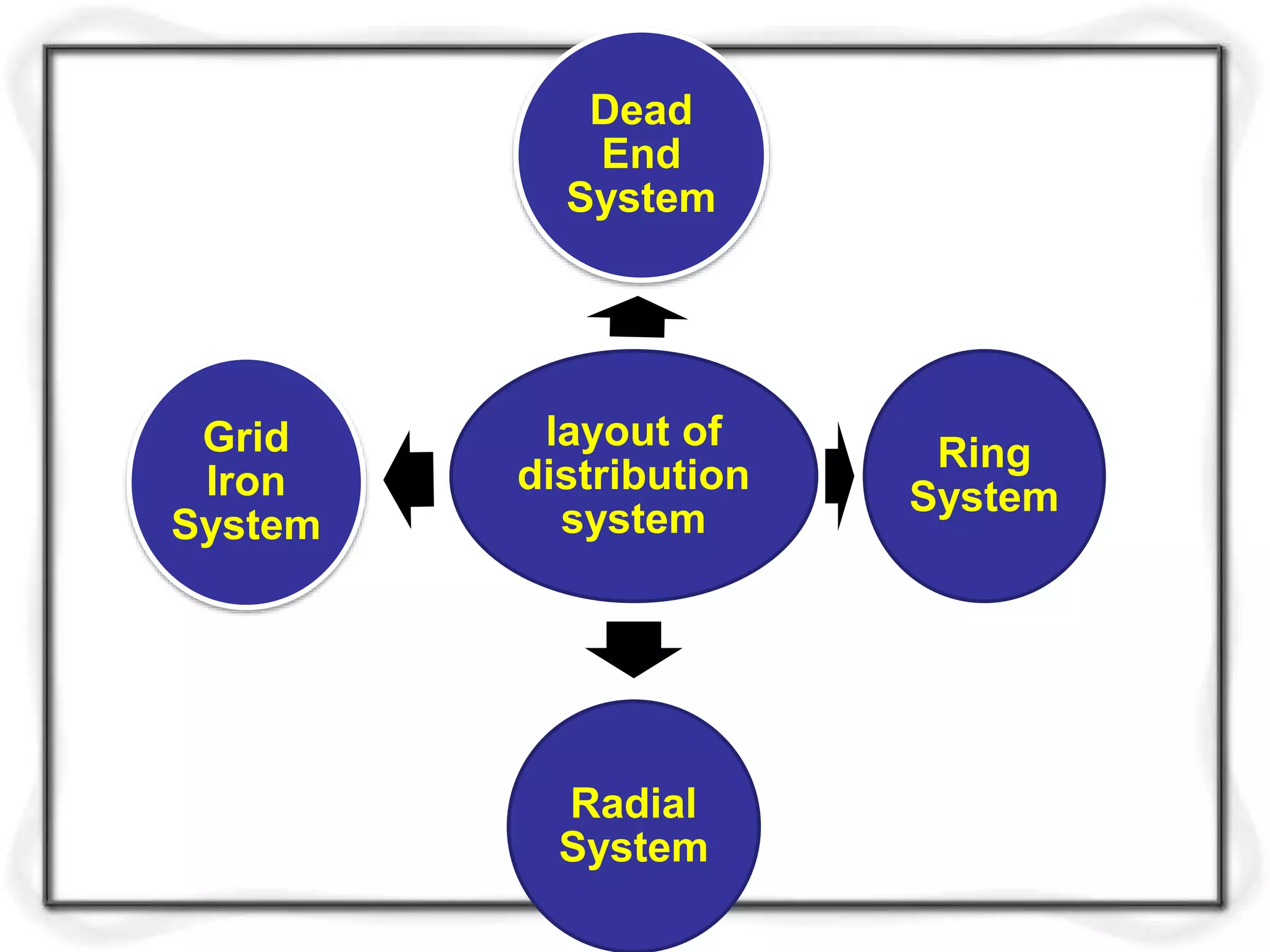
 There are, in general, four different types of pipe
networks; any one of which either singly or in
combinations, can be used for a particular place.
layout of
distribution
system
Dead
End
System
Ring
System
Radial
System
Grid
Iron
System
Dead End System
 It is suitable for old towns and cities having no
definite pattern of roads.
Advantages
 Relatively cheap.
 Distribution network can be solved easily and
accurately calculate the discharges and pressure
easier due to less number of valves.
 laying of pipe is simple and can be extended easily
Disadvantages
 Due to many dead ends, stagnation of water occurs
in pipes.
 The system is less successful in maintaining
satisfactory pressure is remote parts.
 Discharge available for fire fighting is limited.
 Large number of scour valves are required also staff
is required to operate this valves
Radial System
 The area is divided into different zones.
 The water is pumped into the distribution reservoir
kept in the middle of each zone.
 The supply pipes are laid radially ending towards
the periphery.
Advantages:
It gives quick service.
Calculation of pipe sizes is easy.
Grid Iron System
 It is suitable for cities with rectangular layout, where
the water mains and branches are laid in rectangles.
Advantages
 Since the water reaches every point from more than
one route, the friction losses and the sizes of the
pipes are reduced.
 In case of fire, more quantity of water can be
diverted towards the affected area by closing the
valves of nearby localities.
 In the cases of a breakdown in some section, water
is available from some other direction.
Disadvantages
 Exact calculation of sizes of pipes is not possible
due to provision of valves on all branches.
 Construction cost higher.
 The design is difficult and costlier.
 This system requires more length of pipelines and
larger number of cutoff valves
Ring System
 The supply main is laid all along the peripheral roads
and sub mains branch out from the mains.
 This system also follows the grid iron system with
the flow pattern similar in character to that of dead
end system.
 So, determination of the size of pipes is easy.
Advantages
 Water can be supplied to any point from at least two
directions.
Methods of water distribution
 For efficient distribution system adequate water
pressure required at various points.
 Depending upon the level of source, topography of
the area and other local conditions the water may be
forced into distribution system by following ways -
Gravity system
Pumping
system
Combined
gravity and
pumping
system
Methods of water
distribution
Gravity system
 Suitable when source of supply is at sufficient
height.
 Most reliable and economical distribution system.
 The water head available at the consumer is just
minimum required.
 The remaining head is consumed in the frictional
and other losses.
W.T.P
Pumping system
 Treated water is directly pumped in to the distribution
main with out storing.
 Also called pumping without storage system.
 High lifts pumps are required.
 If power supply fails, complete stoppage of water
supply.
 This method is not generally used.
Combined gravity and pumping
system
 Most common system.
 Treated water is pumped and stored in an elevated
distribution reservoir.
 Then supplies to consumer by action of gravity.
 The excess water during low demand periods get
stored in reservoir and get supplied during high
demand period.
 Economical, efficient and reliable system.
Distribution Reservoirs
 Distribution reservoirs, also called service
reservoirs, are the storage reservoirs, which store
the treated water for supplying water during
emergencies (such as during fires, repairs, etc.) and
also to help in absorbing the hourly fluctuations in
the normal water demand.
Functions of Distribution Reservoirs
 to absorb the hourly variations in demand.
 to maintain constant pressure in the distribution
mains.
 water stored can be supplied during emergencies.
Location and Height of Distribution Reservoirs
 should be located as close as possible to the centre
of demand.
 water level in the reservoir must be at a sufficient
elevation to permit gravity flow at an adequate
pressure.
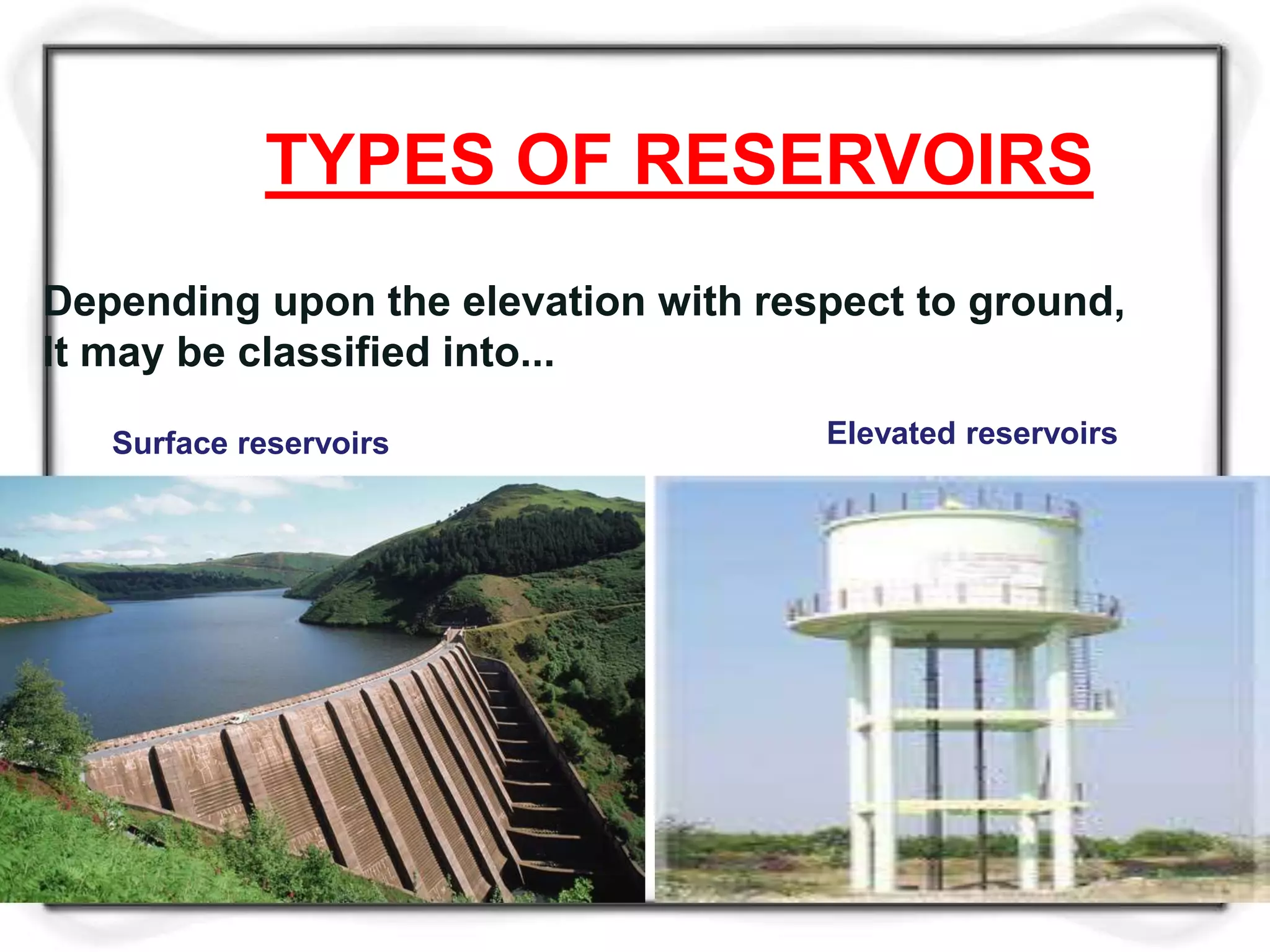
TYPES OF RESERVOIRS
Depending upon the elevation with respect to ground,
It may be classified into...
Elevated reservoirsSurface reservoirs
Surface reservoirs
 These also called ground reservoir.
 Mostly circular or rectangular tank.
 Under ground reservoirs are preferred especially
when the size is large.
 These reservoirs are constructed on high natural
grounds and are usually made of stones, bricks,
plain or reinforced cement concrete.
 The side walls are designed to take up the pressure
of the water, when the reservoir is full and the earth
pressure when it is empty.
 The position of ground water table is also
considered while designing these reservoirs.
 The floors of these reservoirs may constructed with
R.C.C slab or square stone blocks resting on
columns.
 To obtain water tightness bitumen compounds are
used at all construction joints.
 At the top of roof about 60cm thick earth layer is
deposited and maintained green lawns to protect the
reservoir from cold and heat.
 For aeration of water and inspection, ventilation
pipes and stairs are provided.
Under Ground Reservoir
Elevated Storage Reservoir (ESR)
 Elevated Storage Reservoirs (ESRs) also referred to
as Overhead Tanks are required at distribution areas
which are not governed and controlled by the gravity
system of distribution.
 These are rectangular, circular or elliptical in shape.
 If the topography of the town not suitable for under
gravity, the elevated tank or reservoir are used.
 They are constructed where combine gravity and
pumping system of water distribution is adopted.
 These tanks may be steel or RCC.
 Now RCC is commonly preferred.
The accessories of ESR are-
 Inlet and outlet pipe, overflow pipe discharging into
a drain
 Float gauge, indicating depth of water.
 Automatic device to stop pumping when the tank is
full.
 A manhole and ladder.
 Ventilator for circulation of fresh air.
Elevated Service Reservoirs
TYPES OF TANKS
R.C.C. Tanks
G.I. Tanks
H.D.P.E Tanks
R.C.C TANKS:
R.C.C tanks are very popular because
1) They have long life
2) Very little maintenance
3) decent appearance
G.I. TANKS:
G.I. tanks are generally in rectangular or square in
shape. Now a days G.I. tanks are not preferring
because
1) Life of the tank is short
2) Corrosion of metal
3) maintenance cost may be more
HDPE TANKS:
Now a days HDPE tanks are very popular for storing
less quantity of water and hence useful for
residential purpose. The following are the
advantages of HDPE tanks:
1) Handling is easy because of light weight
2) Cheap in cost
3) Maintenance cost is low
4) Cleaning of tanks are easy
Storage Capacity of Distribution
Reservoirs
The total storage capacity of a
distribution reservoir is the summation
of:
 Balancing Storage
 Fire Storage
 Breakdown Storage
Balancing Storage:
The quantity of water required to be stored in the
reservoir for equalising or balancing fluctuating
demand against constant supply is known as the
balancing storage (or equalising or operating
storage).
This balancing storage can be worked out by means
of
1. Mass curve method
2. Using hydrograph of the inflow and outflow
3. Analytical tabular solution
Mass curve method
A mass curve is the plot of accumulated inflow or
outflow versus time.
Breakdown Storage:
 The breakdown storage or often called emergency
storage is the storage preserved in order to tide over
the emergencies posed by the failure of pumps,
electricity, or any other mechanism driving the
pumps.
 A value of about 25% of the total storage capacity of
reservoirs, or 1.5 to 2 times of the average hourly
supply, may be considered as enough provision for
accounting this storage.
Fire Storage:
 The third component of the total reservoir storage is
the fire storage.
 This provision takes care of the requirements of
water for extinguishing fires.
 A provision of 1 to 4 per person per day is sufficient
to meet the requirement.
 When reserve storage is elevated, amount of fire
reserve may be determined by
 R= (F-P) T
where,
R= Reserve storage (liters)
F= Fire demand, liters/min
P= Reserve fire pumping capacity, liters/min
T= Duration of the fire in min
The total reservoir storage can finally be
worked out by adding all the three storages.
References:
 w & wwe by Prof. B.R.SHAH (GEC Modasa, book- Mahajan
publication)
 https://s3.amazonaws.com/ppt-download/waterdistribution-
170217175318.pptx?response-content-
disposition=attachment&Signature=6uVfZpEsZcy2RRn5j2k6N4yD9
48%3D&Expires=1489682813&AWSAccessKeyId=AKIAJ6D6SEMX
SASXHDAQ
 https://s3.amazonaws.com/ppt-download/waterdistributionsystem-
120411061916-phpapp01.pptx?response-content-
disposition=attachment&Signature=euxfbGUhuFjkIPd54KiUsdGYyq
Q%3D&Expires=1489682801&AWSAccessKeyId=AKIAJ6D6SEMX
SASXHDAQ
THANK
YOU

Water distribution system by kalpesh solanki

  • 1.
  • 3.
    Course Content  Introduction Layout of distribution networks  Methods of water distribution  Storage capacity of ESR  Underground service reservoir
  • 4.
    Introduction  The purposeof distribution system is to deliver water to consumer with appropriate quality, quantity and pressure.  Distribution system is used to describe collectively the facilities used to supply water from its source to the point of usage.  The system also includes pumps, reservoirs, pipe fittings, instruments for pressure measurement, flow leak detectors etc.
  • 5.
    Requirements of Good DistributionSystem  It should be capable of supplying water at all the intended places with sufficient pressure head.  It should convey the treated water up to the consumer with the same degree of purity.  It should be capable of supplying the requisite amount of water during fire fighting.  The initial cost of distribution system should be as low as possible.
  • 6.
     The layoutshould be such that no consumer would be without water supply, during the repair of any section of the system.  All the distribution pipes should be preferably laid one metre away or above the sewer lines.  It should be fairly water-tight as to keep losses due to leakage to the minimum.
  • 7.
    Components of distributionsystem  Pipe lines of various sizes  Valves –  Line valves, Sluice valves, Globe valves, Butterfly valves, Air valves, Air release valve, Air inlet valve, check valves,  Hydrants  Storage reservoirs and Distribution service  Flow measuring device
  • 8.
    Layouts of DistributionNetwork  The distribution pipes are generally laid below the road pavements, and as such their layouts generally follow the layouts of roads.  There are, in general, four different types of pipe networks; any one of which either singly or in combinations, can be used for a particular place.
  • 9.
  • 10.
    Dead End System It is suitable for old towns and cities having no definite pattern of roads.
  • 12.
    Advantages  Relatively cheap. Distribution network can be solved easily and accurately calculate the discharges and pressure easier due to less number of valves.  laying of pipe is simple and can be extended easily
  • 13.
    Disadvantages  Due tomany dead ends, stagnation of water occurs in pipes.  The system is less successful in maintaining satisfactory pressure is remote parts.  Discharge available for fire fighting is limited.  Large number of scour valves are required also staff is required to operate this valves
  • 14.
    Radial System  Thearea is divided into different zones.  The water is pumped into the distribution reservoir kept in the middle of each zone.  The supply pipes are laid radially ending towards the periphery.
  • 15.
    Advantages: It gives quickservice. Calculation of pipe sizes is easy.
  • 17.
    Grid Iron System It is suitable for cities with rectangular layout, where the water mains and branches are laid in rectangles.
  • 18.
    Advantages  Since thewater reaches every point from more than one route, the friction losses and the sizes of the pipes are reduced.  In case of fire, more quantity of water can be diverted towards the affected area by closing the valves of nearby localities.  In the cases of a breakdown in some section, water is available from some other direction.
  • 19.
    Disadvantages  Exact calculationof sizes of pipes is not possible due to provision of valves on all branches.  Construction cost higher.  The design is difficult and costlier.  This system requires more length of pipelines and larger number of cutoff valves
  • 20.
    Ring System  Thesupply main is laid all along the peripheral roads and sub mains branch out from the mains.  This system also follows the grid iron system with the flow pattern similar in character to that of dead end system.  So, determination of the size of pipes is easy.
  • 21.
    Advantages  Water canbe supplied to any point from at least two directions.
  • 22.
    Methods of waterdistribution  For efficient distribution system adequate water pressure required at various points.  Depending upon the level of source, topography of the area and other local conditions the water may be forced into distribution system by following ways -
  • 23.
  • 24.
    Gravity system  Suitablewhen source of supply is at sufficient height.  Most reliable and economical distribution system.  The water head available at the consumer is just minimum required.  The remaining head is consumed in the frictional and other losses.
  • 25.
  • 26.
    Pumping system  Treatedwater is directly pumped in to the distribution main with out storing.  Also called pumping without storage system.  High lifts pumps are required.  If power supply fails, complete stoppage of water supply.  This method is not generally used.
  • 29.
    Combined gravity andpumping system  Most common system.  Treated water is pumped and stored in an elevated distribution reservoir.  Then supplies to consumer by action of gravity.  The excess water during low demand periods get stored in reservoir and get supplied during high demand period.  Economical, efficient and reliable system.
  • 31.
    Distribution Reservoirs  Distributionreservoirs, also called service reservoirs, are the storage reservoirs, which store the treated water for supplying water during emergencies (such as during fires, repairs, etc.) and also to help in absorbing the hourly fluctuations in the normal water demand.
  • 32.
    Functions of DistributionReservoirs  to absorb the hourly variations in demand.  to maintain constant pressure in the distribution mains.  water stored can be supplied during emergencies. Location and Height of Distribution Reservoirs  should be located as close as possible to the centre of demand.  water level in the reservoir must be at a sufficient elevation to permit gravity flow at an adequate pressure.
  • 34.
    TYPES OF RESERVOIRS Dependingupon the elevation with respect to ground, It may be classified into... Elevated reservoirsSurface reservoirs
  • 35.
    Surface reservoirs  Thesealso called ground reservoir.  Mostly circular or rectangular tank.  Under ground reservoirs are preferred especially when the size is large.  These reservoirs are constructed on high natural grounds and are usually made of stones, bricks, plain or reinforced cement concrete.
  • 36.
     The sidewalls are designed to take up the pressure of the water, when the reservoir is full and the earth pressure when it is empty.  The position of ground water table is also considered while designing these reservoirs.  The floors of these reservoirs may constructed with R.C.C slab or square stone blocks resting on columns.
  • 37.
     To obtainwater tightness bitumen compounds are used at all construction joints.  At the top of roof about 60cm thick earth layer is deposited and maintained green lawns to protect the reservoir from cold and heat.  For aeration of water and inspection, ventilation pipes and stairs are provided.
  • 38.
  • 39.
    Elevated Storage Reservoir(ESR)  Elevated Storage Reservoirs (ESRs) also referred to as Overhead Tanks are required at distribution areas which are not governed and controlled by the gravity system of distribution.  These are rectangular, circular or elliptical in shape.  If the topography of the town not suitable for under gravity, the elevated tank or reservoir are used.
  • 40.
     They areconstructed where combine gravity and pumping system of water distribution is adopted.  These tanks may be steel or RCC.  Now RCC is commonly preferred.
  • 41.
    The accessories ofESR are-  Inlet and outlet pipe, overflow pipe discharging into a drain  Float gauge, indicating depth of water.  Automatic device to stop pumping when the tank is full.  A manhole and ladder.  Ventilator for circulation of fresh air.
  • 43.
    Elevated Service Reservoirs TYPESOF TANKS R.C.C. Tanks G.I. Tanks H.D.P.E Tanks
  • 44.
    R.C.C TANKS: R.C.C tanksare very popular because 1) They have long life 2) Very little maintenance 3) decent appearance
  • 46.
    G.I. TANKS: G.I. tanksare generally in rectangular or square in shape. Now a days G.I. tanks are not preferring because 1) Life of the tank is short 2) Corrosion of metal 3) maintenance cost may be more
  • 47.
    HDPE TANKS: Now adays HDPE tanks are very popular for storing less quantity of water and hence useful for residential purpose. The following are the advantages of HDPE tanks: 1) Handling is easy because of light weight 2) Cheap in cost 3) Maintenance cost is low 4) Cleaning of tanks are easy
  • 49.
    Storage Capacity ofDistribution Reservoirs The total storage capacity of a distribution reservoir is the summation of:  Balancing Storage  Fire Storage  Breakdown Storage
  • 50.
    Balancing Storage: The quantityof water required to be stored in the reservoir for equalising or balancing fluctuating demand against constant supply is known as the balancing storage (or equalising or operating storage). This balancing storage can be worked out by means of 1. Mass curve method 2. Using hydrograph of the inflow and outflow 3. Analytical tabular solution
  • 51.
    Mass curve method Amass curve is the plot of accumulated inflow or outflow versus time.
  • 52.
    Breakdown Storage:  Thebreakdown storage or often called emergency storage is the storage preserved in order to tide over the emergencies posed by the failure of pumps, electricity, or any other mechanism driving the pumps.  A value of about 25% of the total storage capacity of reservoirs, or 1.5 to 2 times of the average hourly supply, may be considered as enough provision for accounting this storage.
  • 53.
    Fire Storage:  Thethird component of the total reservoir storage is the fire storage.  This provision takes care of the requirements of water for extinguishing fires.  A provision of 1 to 4 per person per day is sufficient to meet the requirement.
  • 54.
     When reservestorage is elevated, amount of fire reserve may be determined by  R= (F-P) T where, R= Reserve storage (liters) F= Fire demand, liters/min P= Reserve fire pumping capacity, liters/min T= Duration of the fire in min The total reservoir storage can finally be worked out by adding all the three storages.
  • 55.
    References:  w &wwe by Prof. B.R.SHAH (GEC Modasa, book- Mahajan publication)  https://s3.amazonaws.com/ppt-download/waterdistribution- 170217175318.pptx?response-content- disposition=attachment&Signature=6uVfZpEsZcy2RRn5j2k6N4yD9 48%3D&Expires=1489682813&AWSAccessKeyId=AKIAJ6D6SEMX SASXHDAQ  https://s3.amazonaws.com/ppt-download/waterdistributionsystem- 120411061916-phpapp01.pptx?response-content- disposition=attachment&Signature=euxfbGUhuFjkIPd54KiUsdGYyq Q%3D&Expires=1489682801&AWSAccessKeyId=AKIAJ6D6SEMX SASXHDAQ
  • 56.