DISTRIBUTION SYSTEM OF
WATER
Prof.Vaibhav D.Kamble
B.E.Civil, M.E.(Civil- Environmental Engineering)
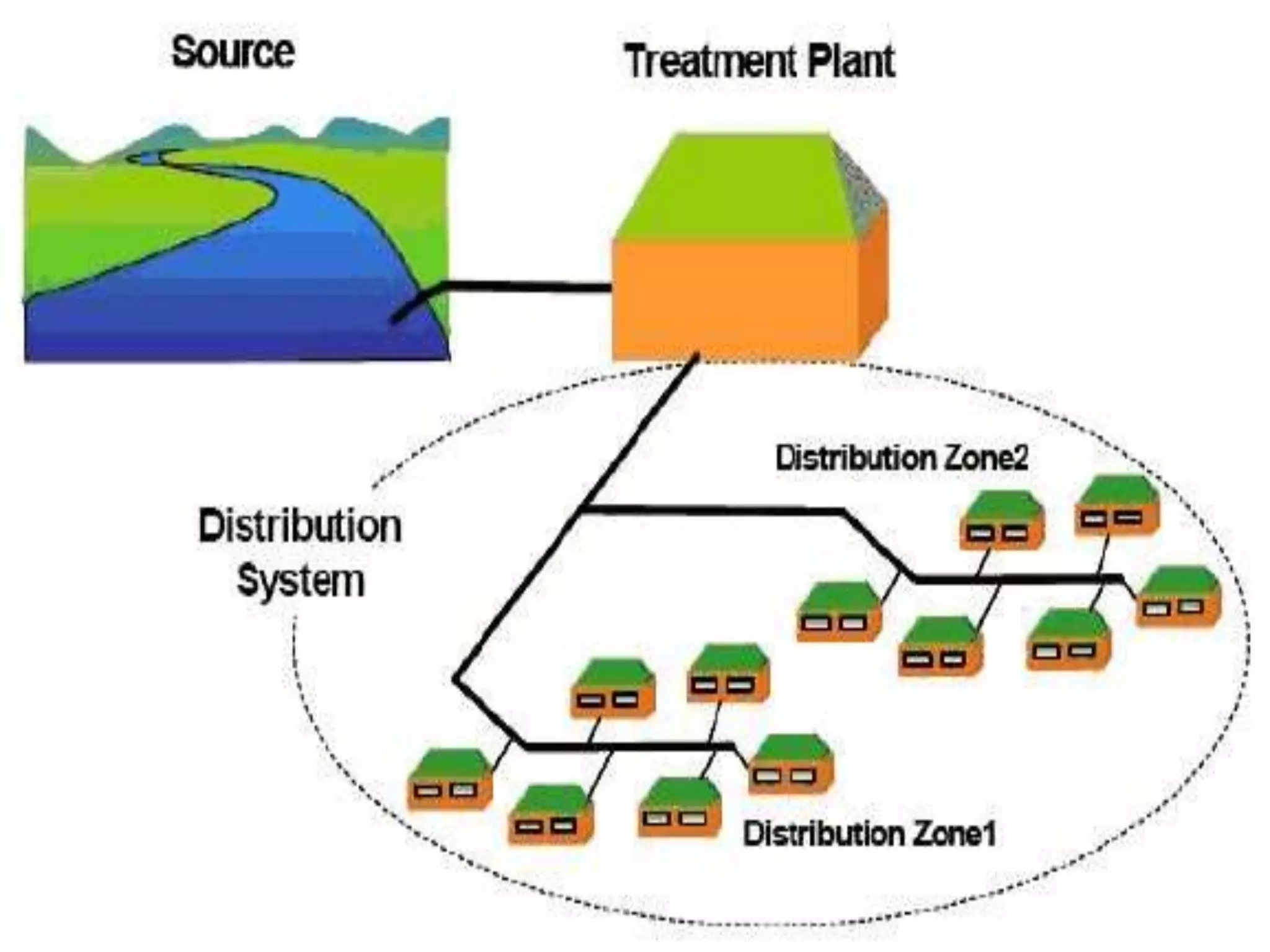
Distribution System

Main Function- Carrying the water from
the treatment plant to the individual
homes
Distribution System
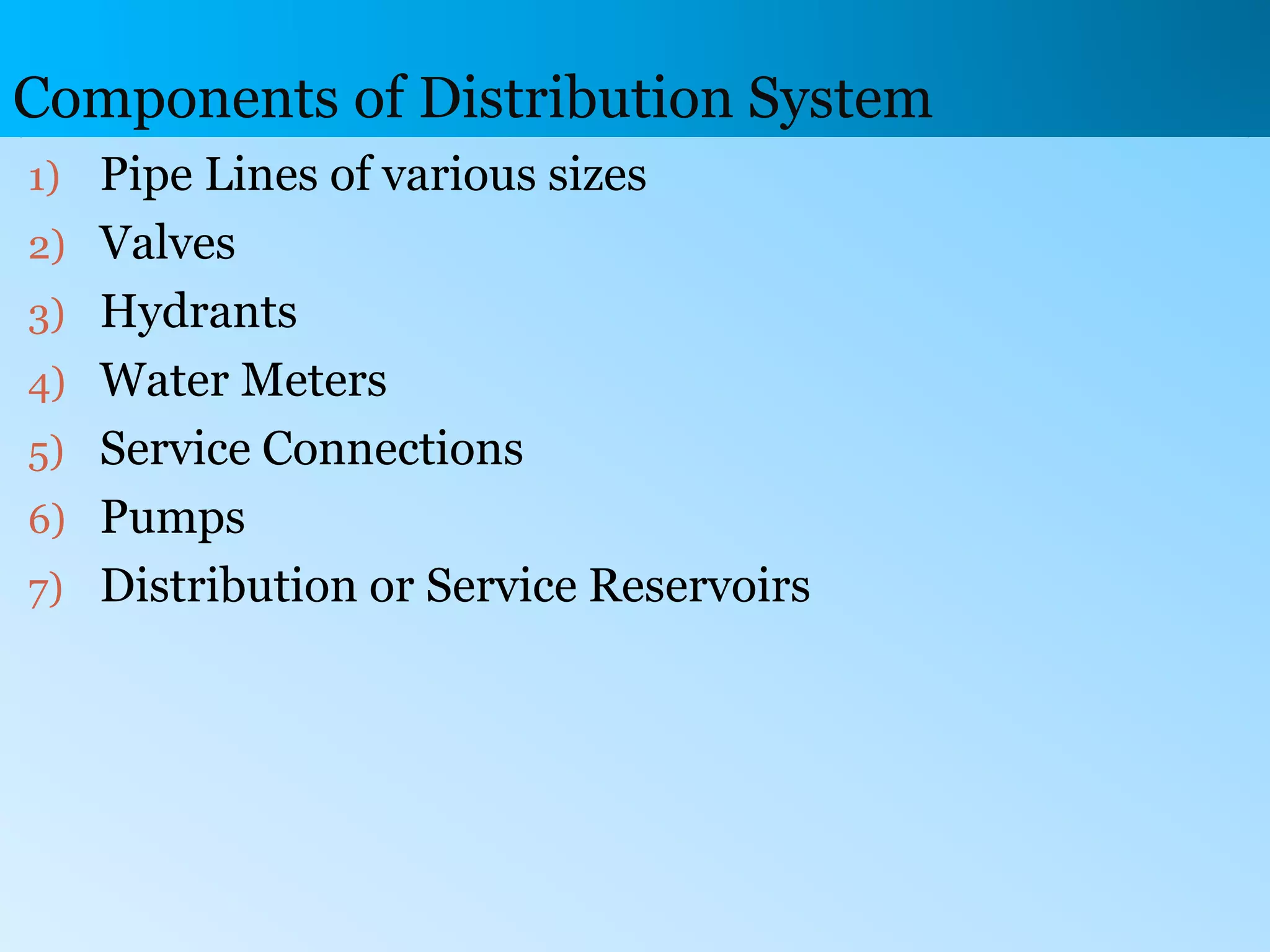
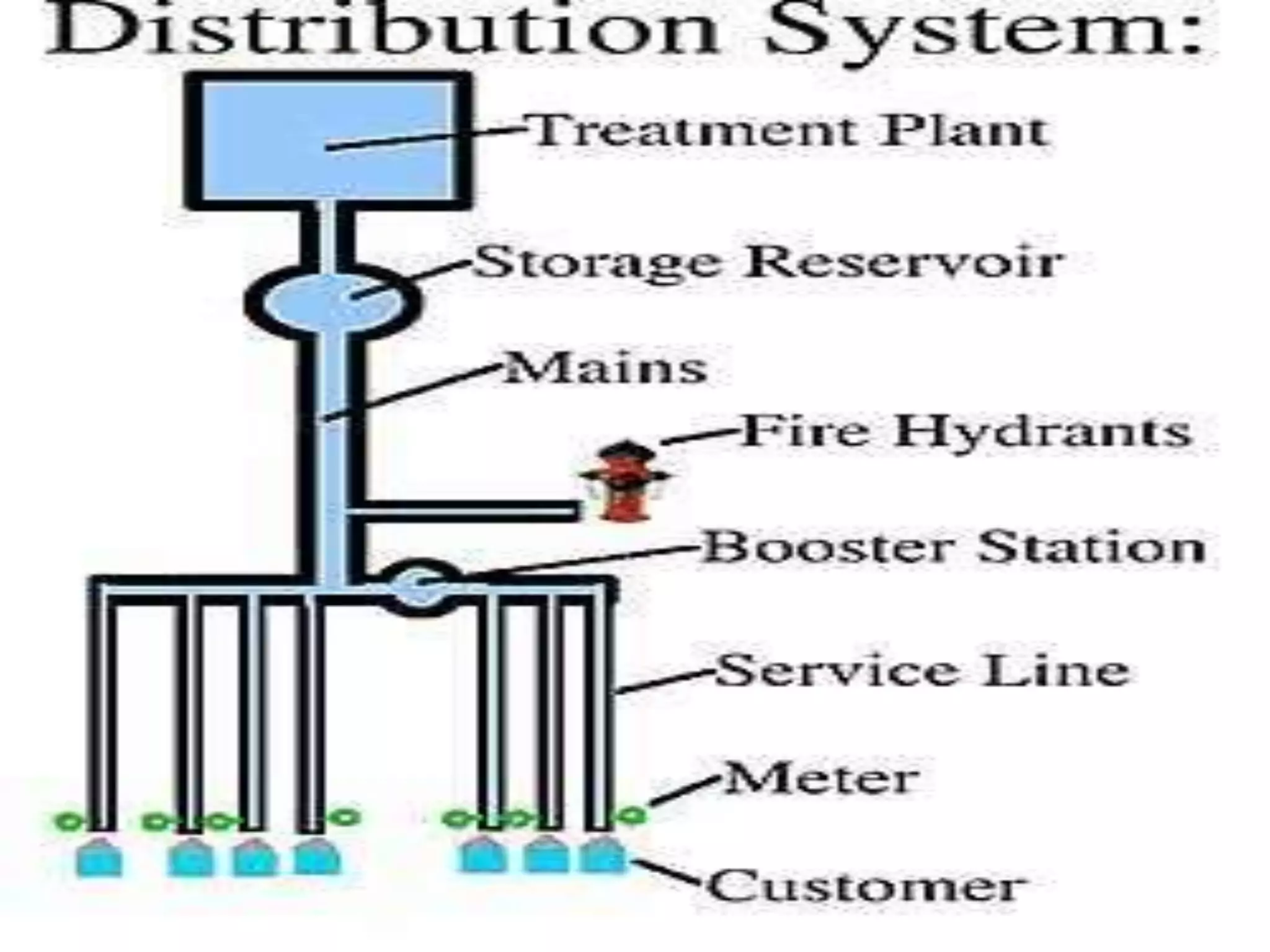
Components of Distribution System
1) Pipe Lines of various sizes
2) Valves
3) Hydrants
4) Water Meters
5) Service Connections
6) Pumps
7) Distribution or Service Reservoirs
Fire Hydrants
Fire Hydrants
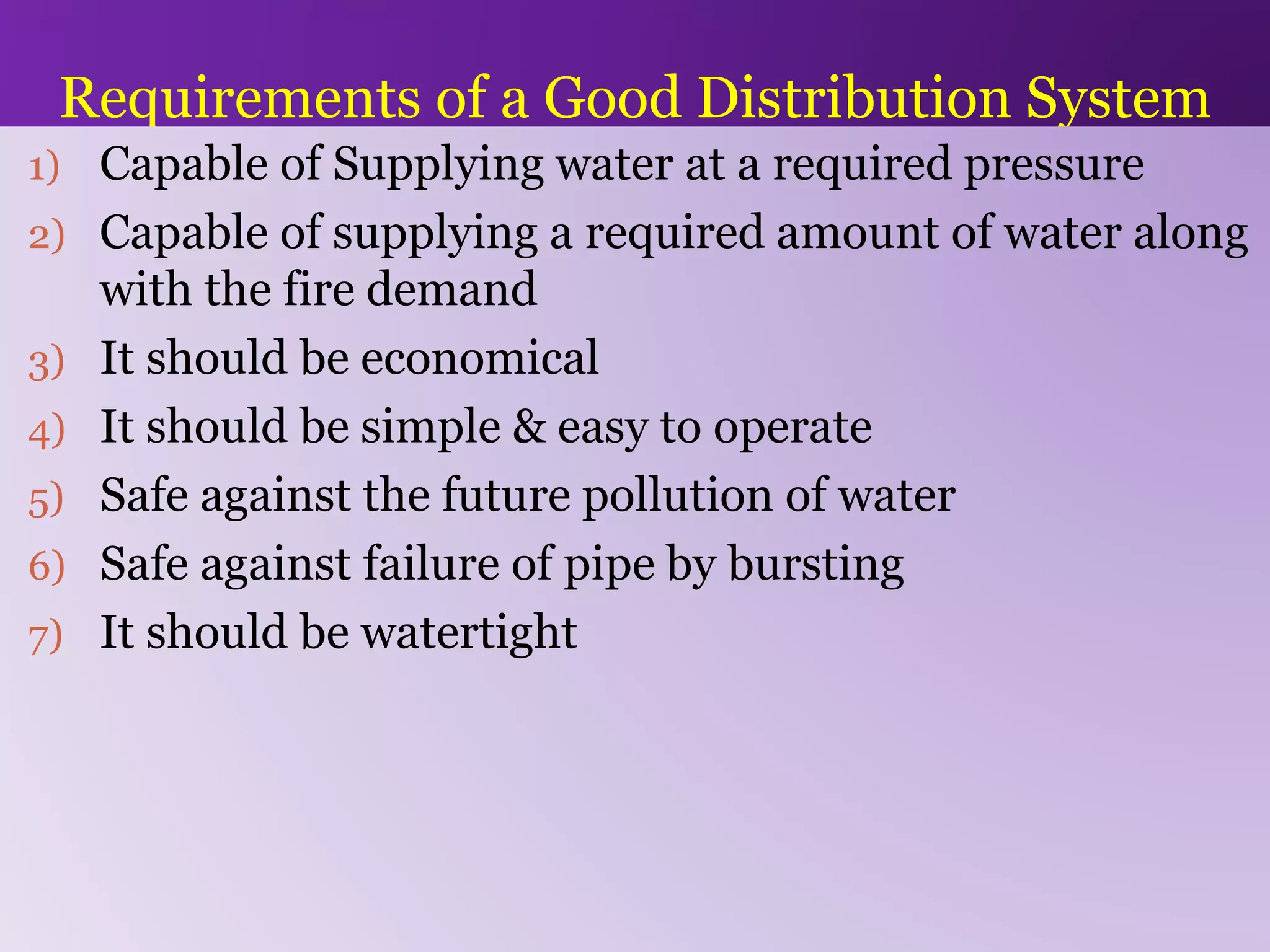
Requirements of a Good Distribution System
1) Capable of Supplying water at a required pressure
2) Capable of supplying a required amount of water along
with the fire demand
3) It should be economical
4) It should be simple & easy to operate
5) Safe against the future pollution of water
6) Safe against failure of pipe by bursting
7) It should be watertight
LAYOUT OF DISTRIBUTION
NETWORKS
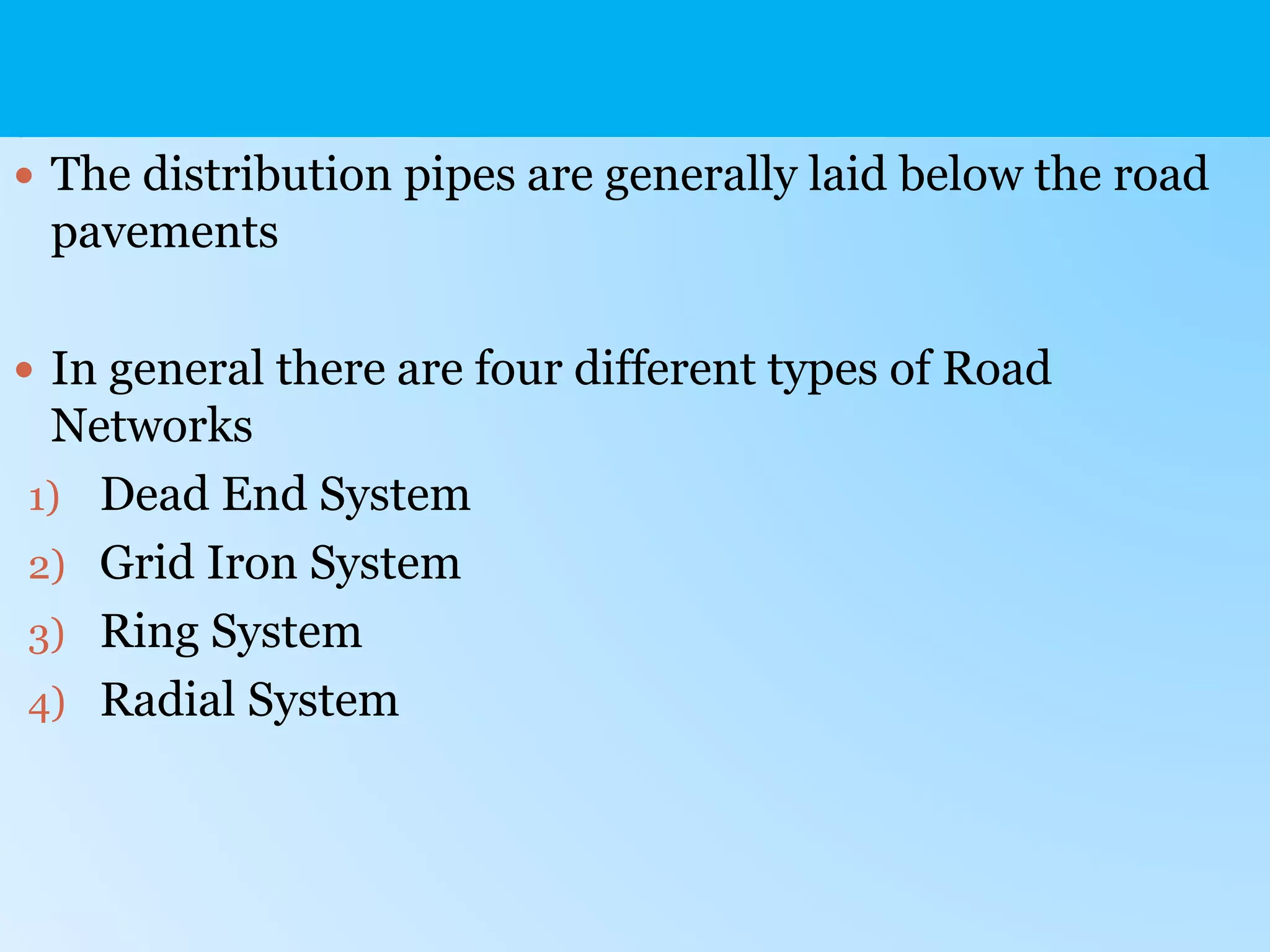
 The distribution pipes are generally laid below the road
pavements
 In general there are four different types of Road
Networks
1) Dead End System
2) Grid Iron System
3) Ring System
4) Radial System
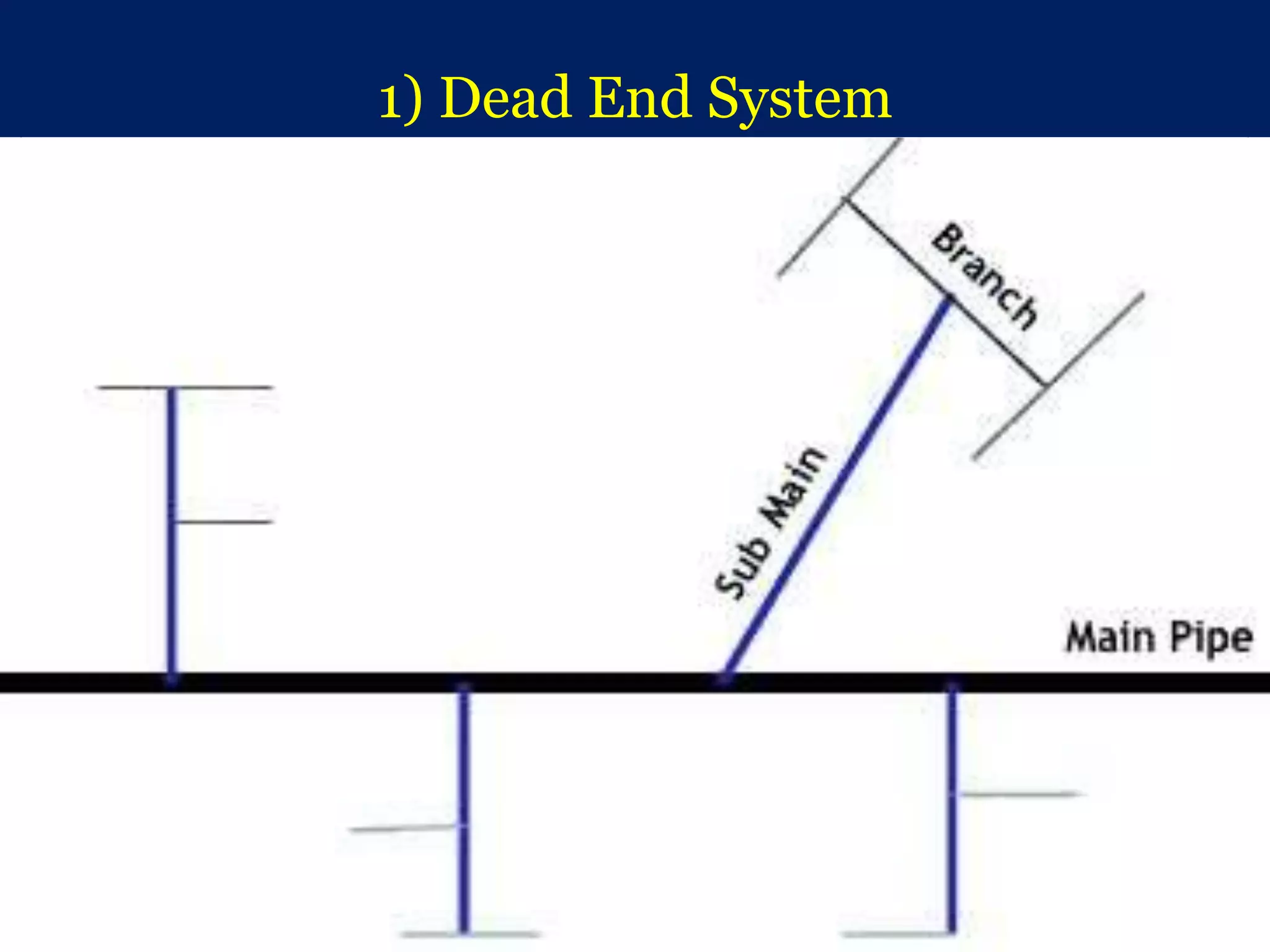
1) Dead End System
 Also called as Tree System
 There are main supply pipe from which originates a
number of sub main pipes(generally at right angles)
 Each submain are then divided into several branch pipes
called as laterals
 From the laterals service connections are given to the
individual homes
1) Dead End System
1) Dead End System
Advantages
1) The distribution network can be solved easily
2) Lesser number of cut off valves are required
3) Shorter pipe lengths are required & Laying of pipe is
easy
4) It is cheap and simple & can be expanded easily
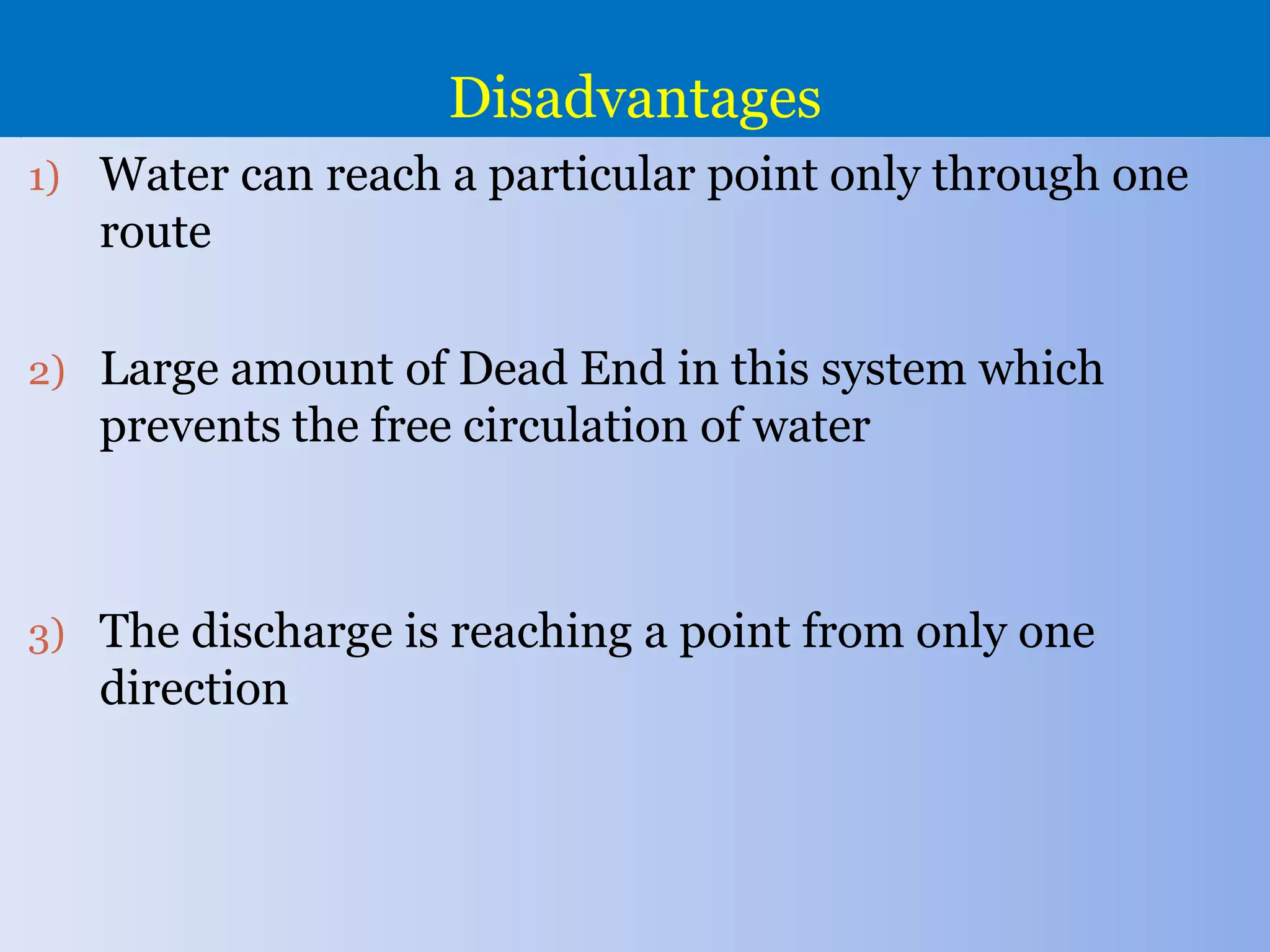
Disadvantages
1) Water can reach a particular point only through one
route
2) Large amount of Dead End in this system which
prevents the free circulation of water
3) The discharge is reaching a point from only one
direction
Application
 This type of layout may have to be adopted for older
towns which have already developed in an inadequate
manner without properly planned roads
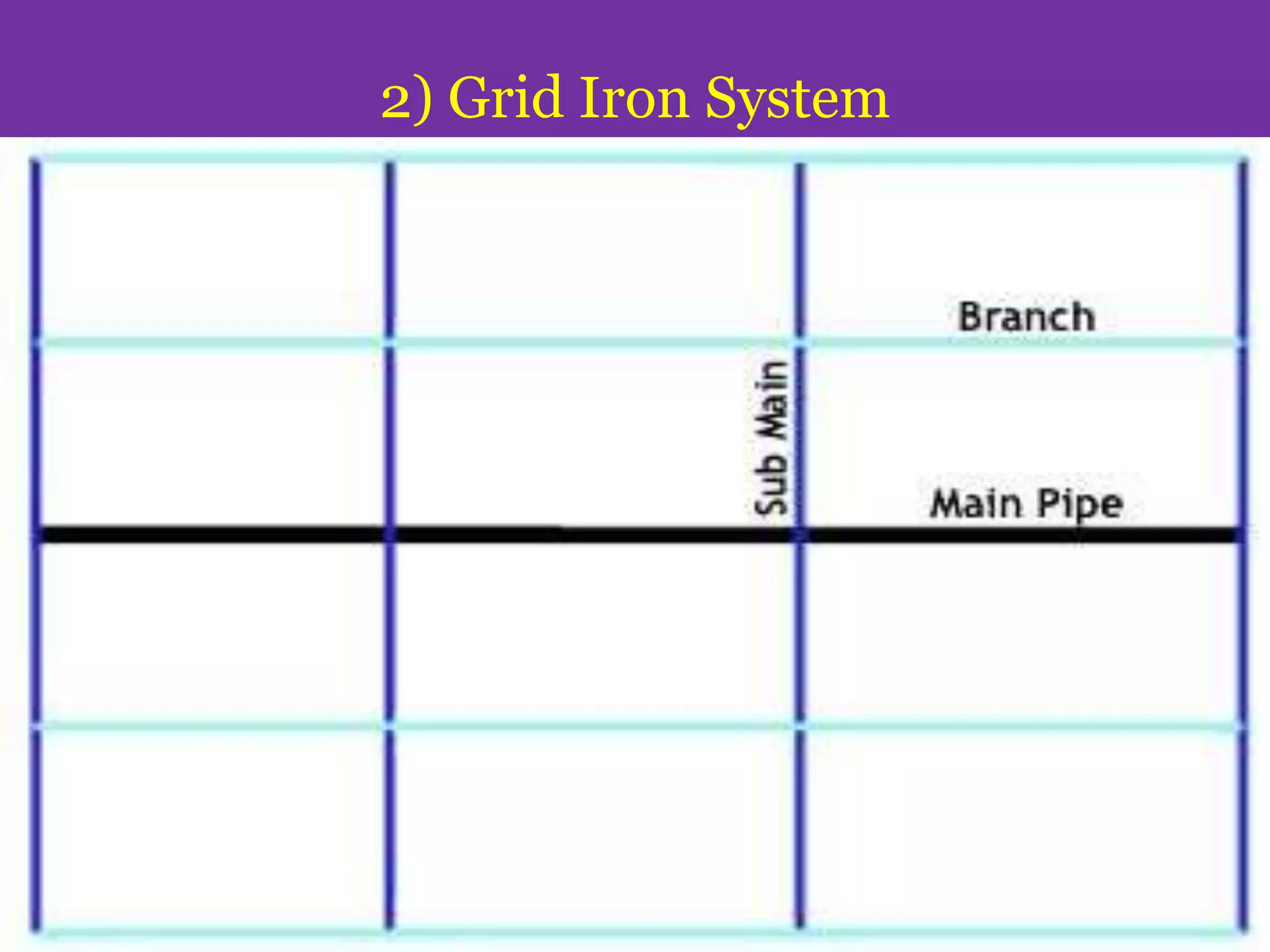
2) Grid Iron System
 Also known as Interlaced or Reticulation System
 Mains, Sub mains, Branches, Laterals all are
interconnected with each other
 The principles of Grid iron system can be applied to Dead
end system by closing the loops
2) Grid Iron System
2) Grid Iron System
Advantages
1) Water reaches at required places through more than
one route
2) In case of repair very small area will not get the
complete and continuous nature of water supply
3) Because of different inter connections the dead ends
are completely eliminated
4) During fire more water can be diverted towards the
affected point
Disadvantages
1) Requires more length of pipe lines & a large number of
cut off valves
2) Construction is costlier
3) The design is difficult and costlier
Application
More suitable for well planned towns or cities and has
been used in chandigarh
3) Ring System
 Sometimes called as Circular system
 A closed ring either circular or rectangular of the main
pipes is formed around the areas to be served

3) Ring System
3) Ring System
Application
 Very suitable for the towns and cities having a well
planned roads
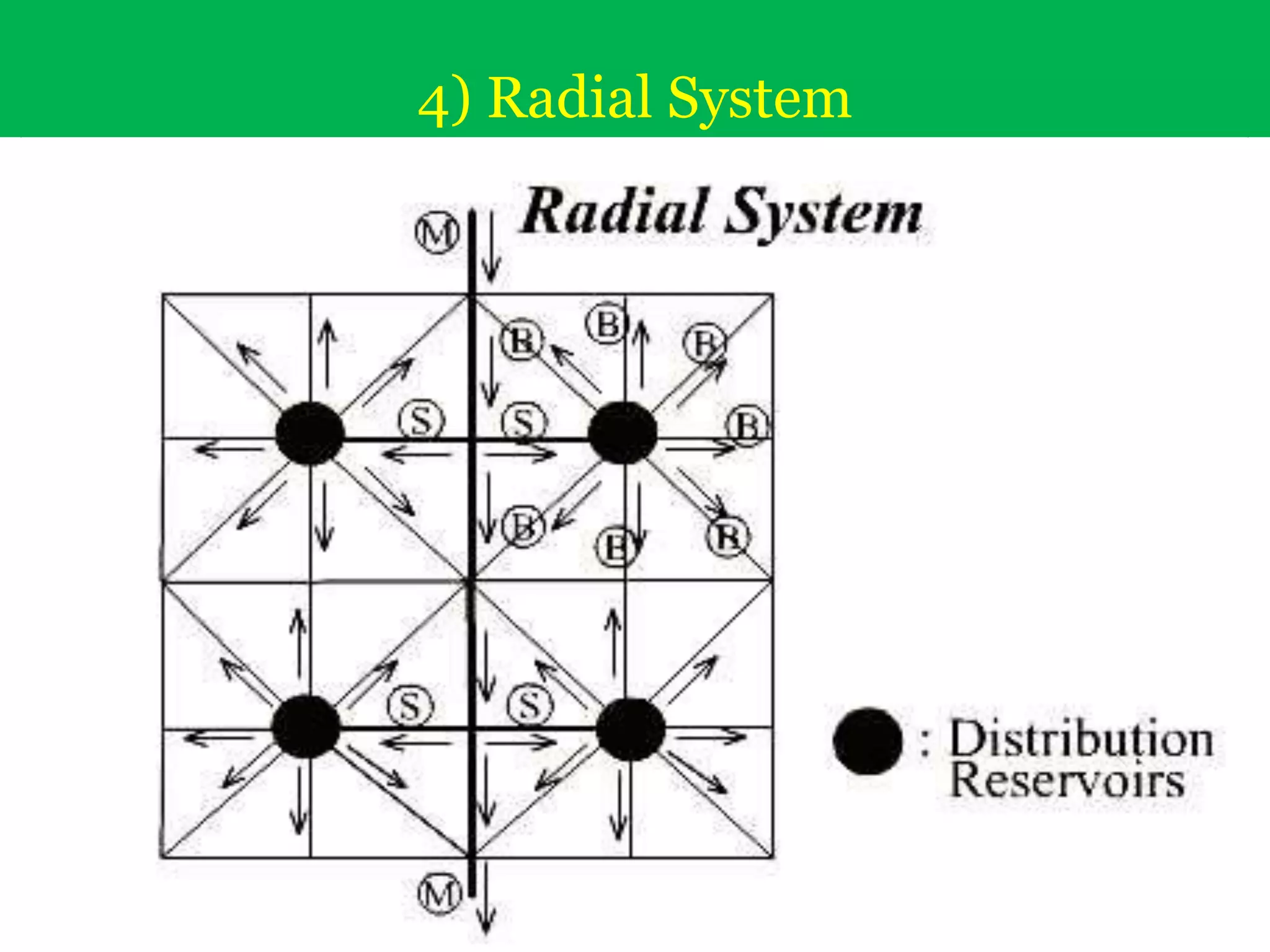
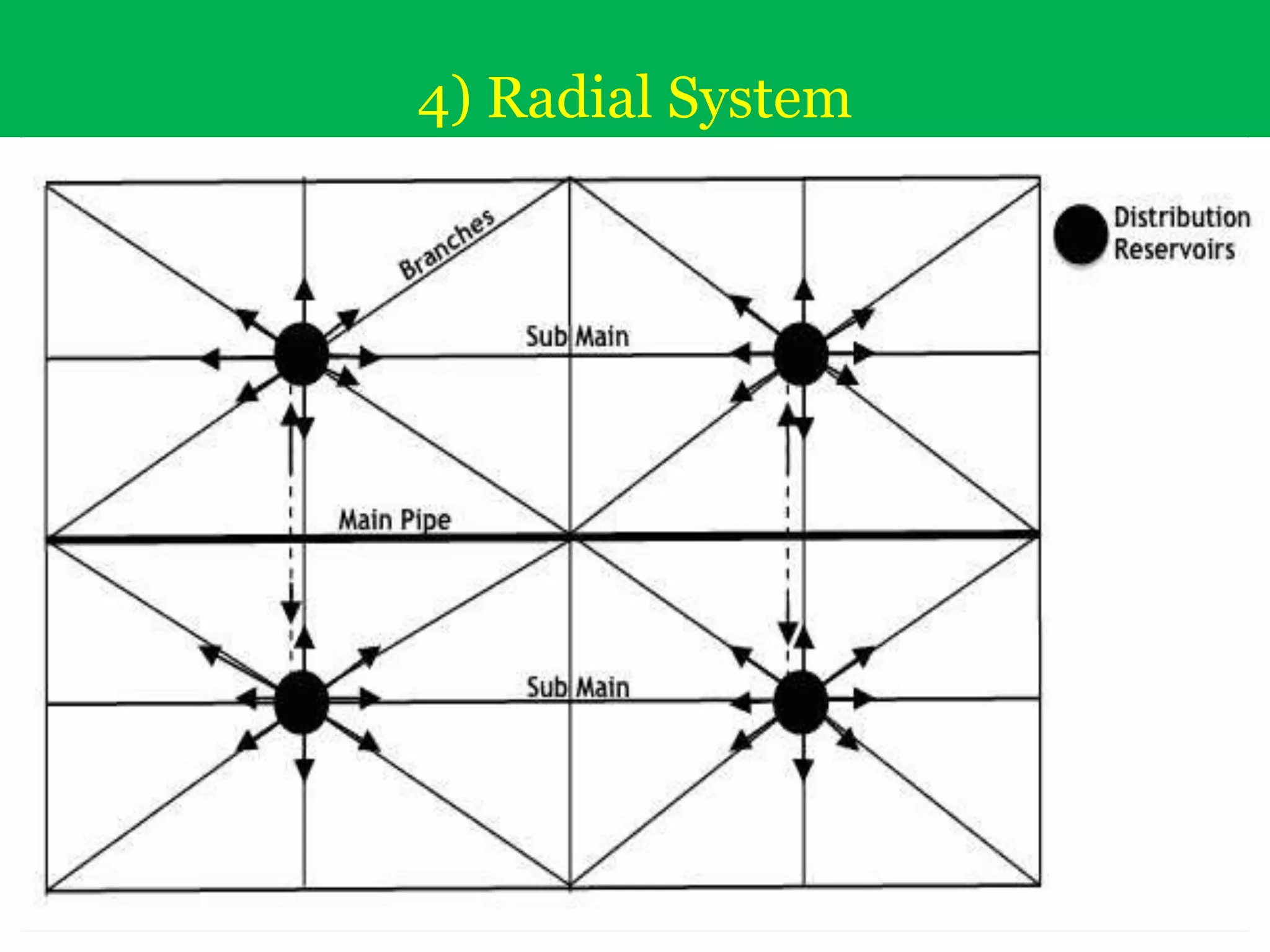
4) Radial System
 This system is adopted for the town or cities which is
having a radial system of road networks
 Placing the distribution reservoirs at the centre
4) Radial System
4) Radial System
METHODS OF DISTRIBUTION
 The water may be forced in the distribution system in the
following three ways;
1) By Gravitational System
2) By pumping system
3) By combined gravity and pumping system
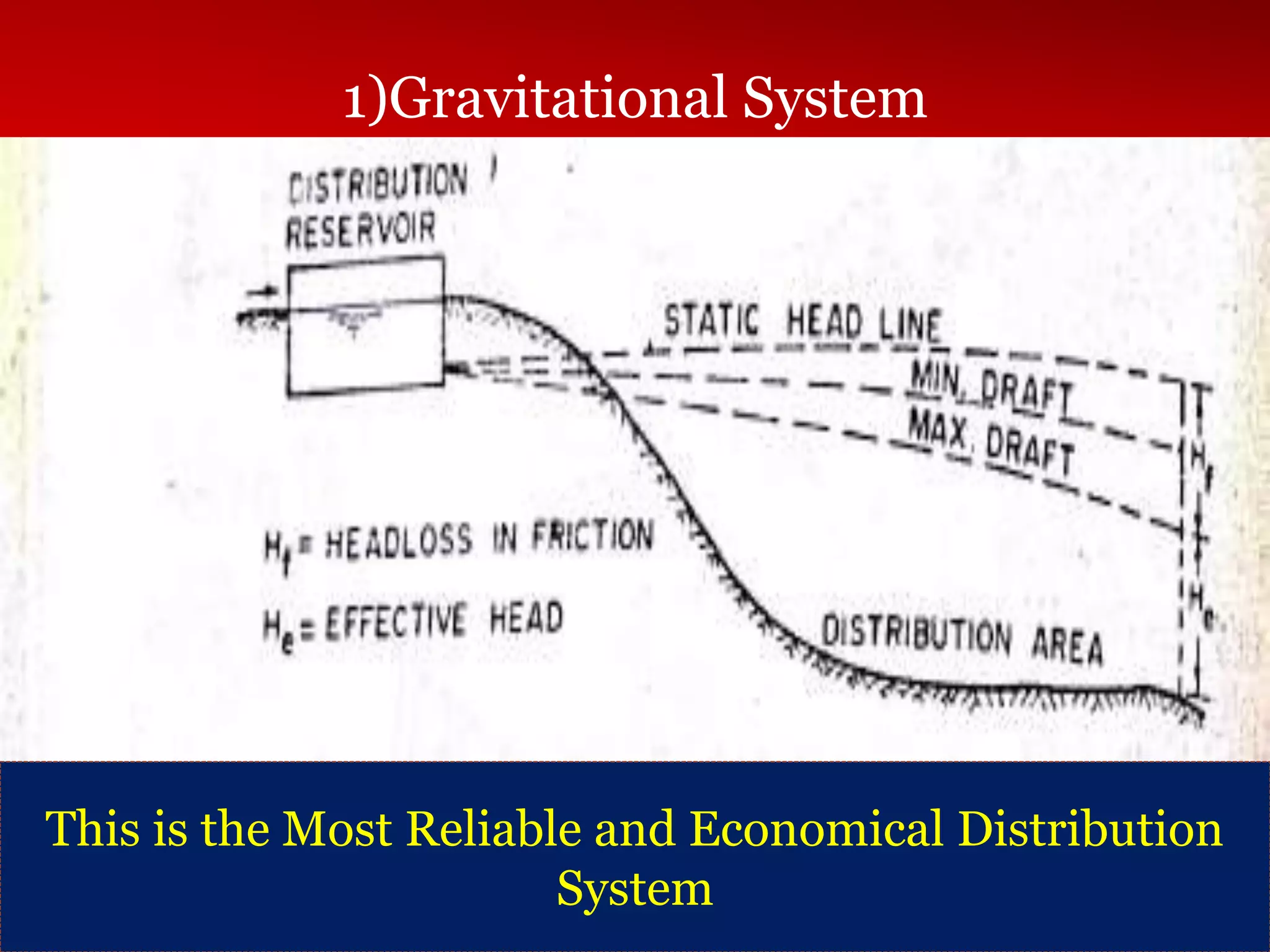
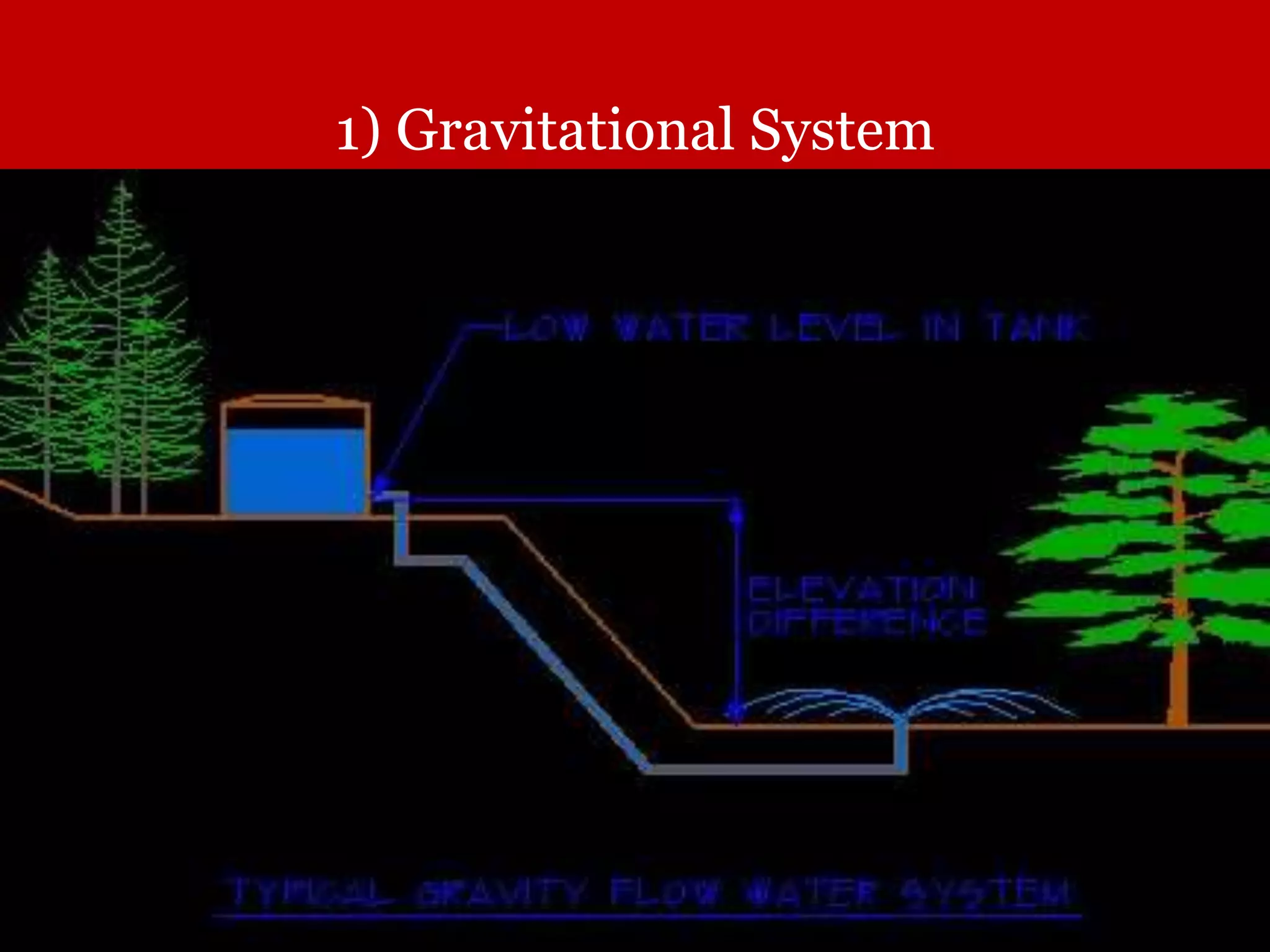
1)Gravitational System
This is the Most Reliable and Economical Distribution
System
1) Gravitational System
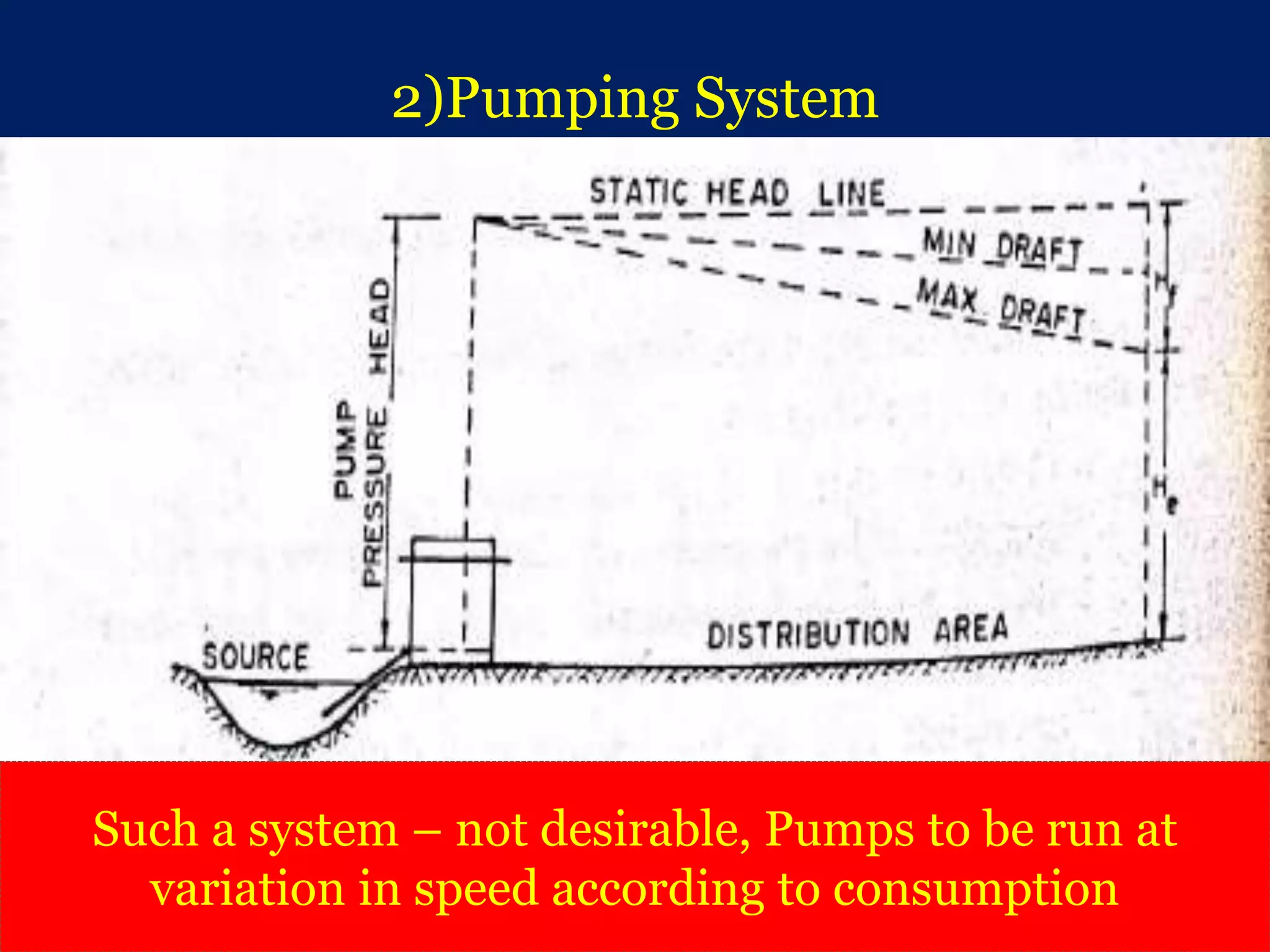
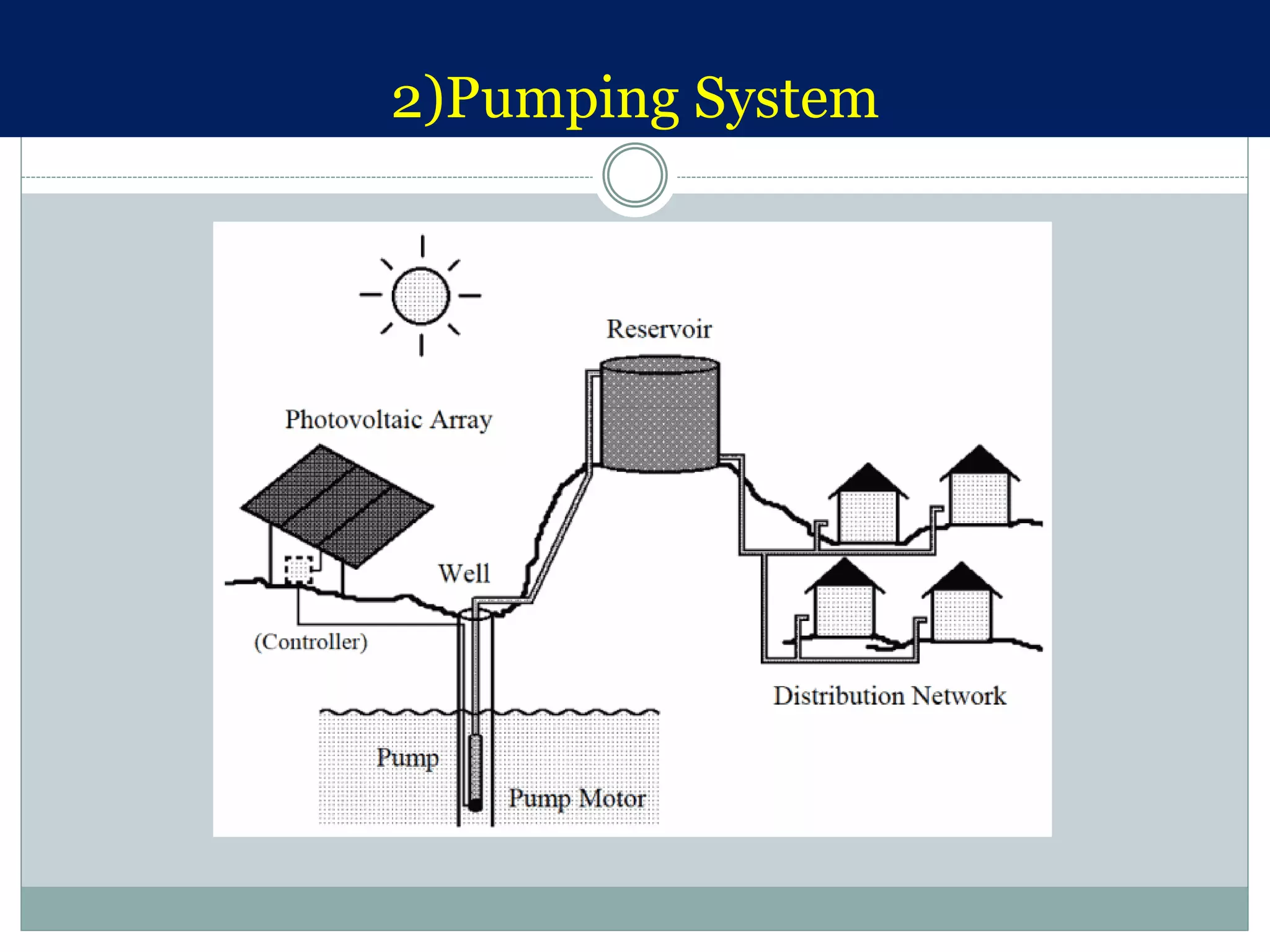
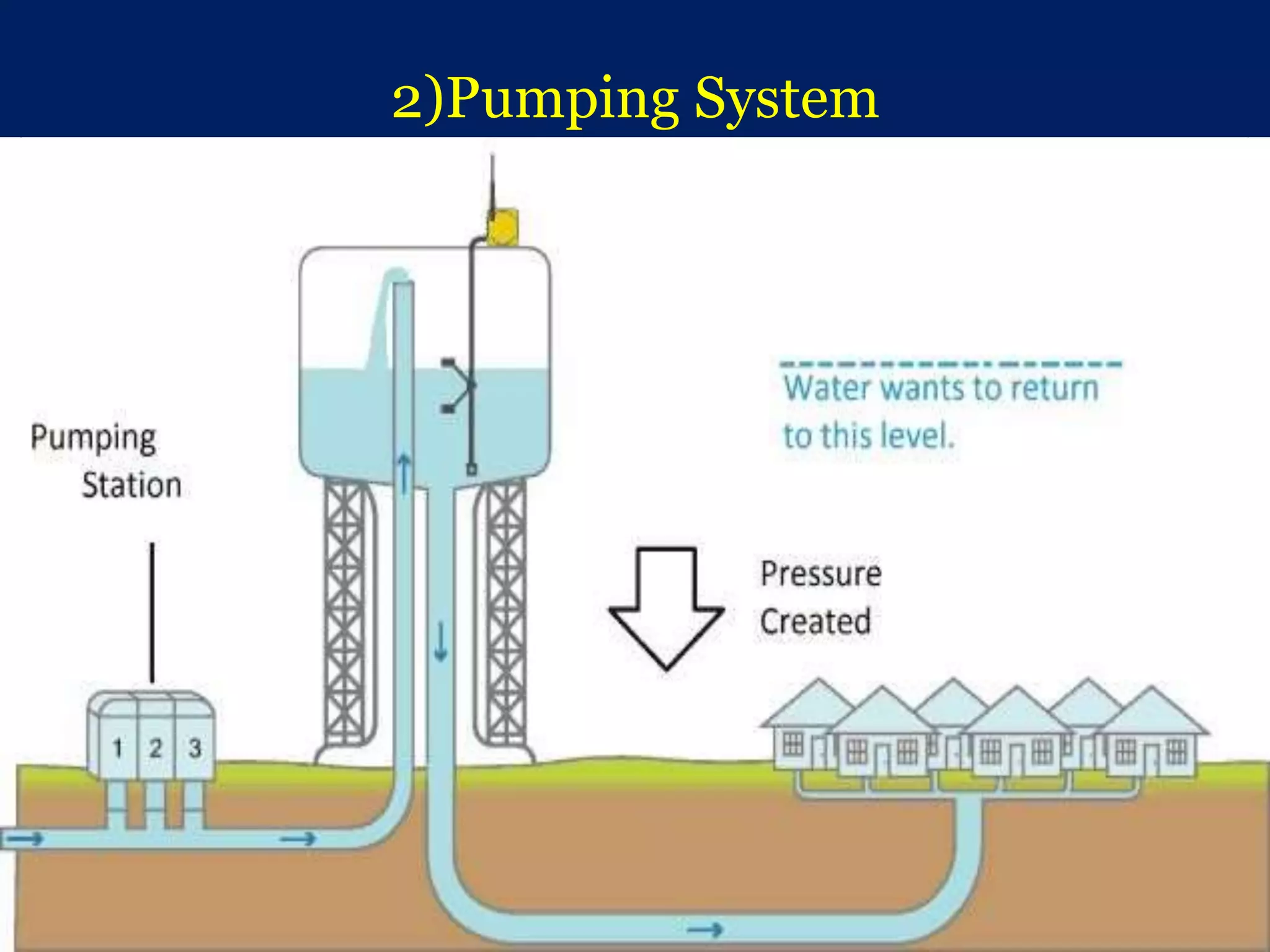
2)Pumping System
Such a system – not desirable, Pumps to be run at
variation in speed according to consumption
2)Pumping System
2)Pumping System
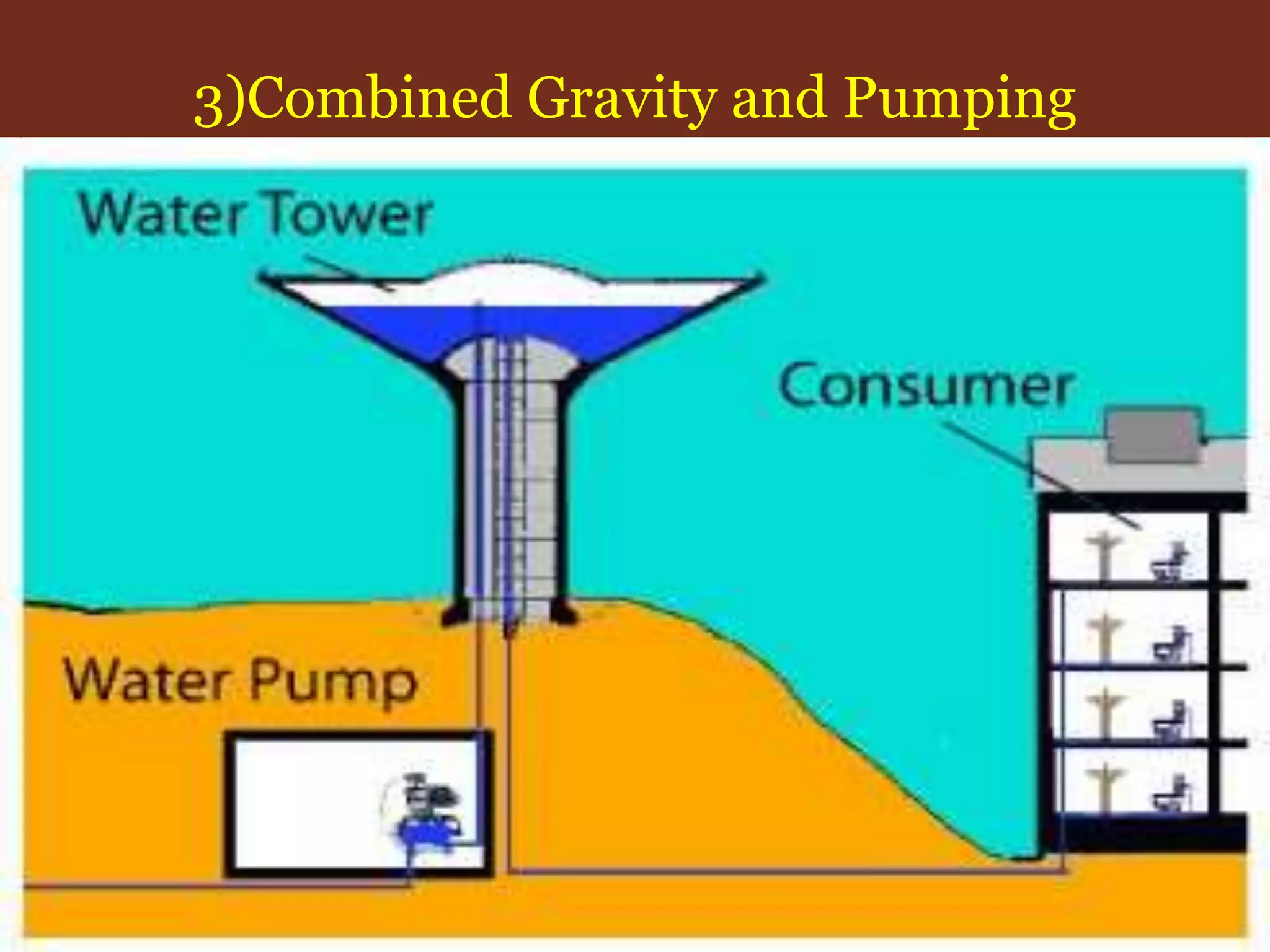
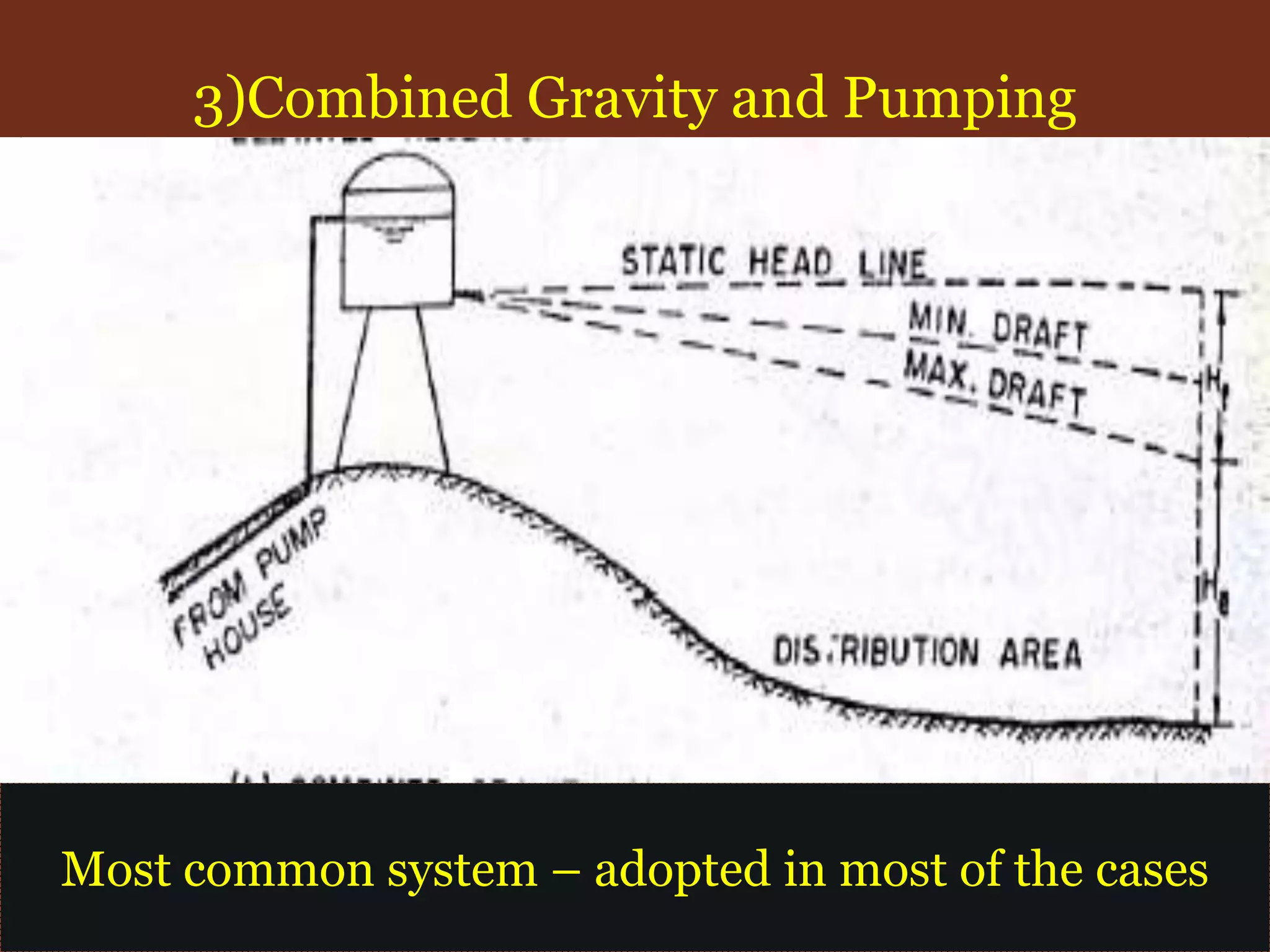
3)Combined Gravity and Pumping
Most common system – adopted in most of the cases
3) Combined System3)Combined Gravity and Pumping
3) Combined System
3)Combined Gravity and Pumping
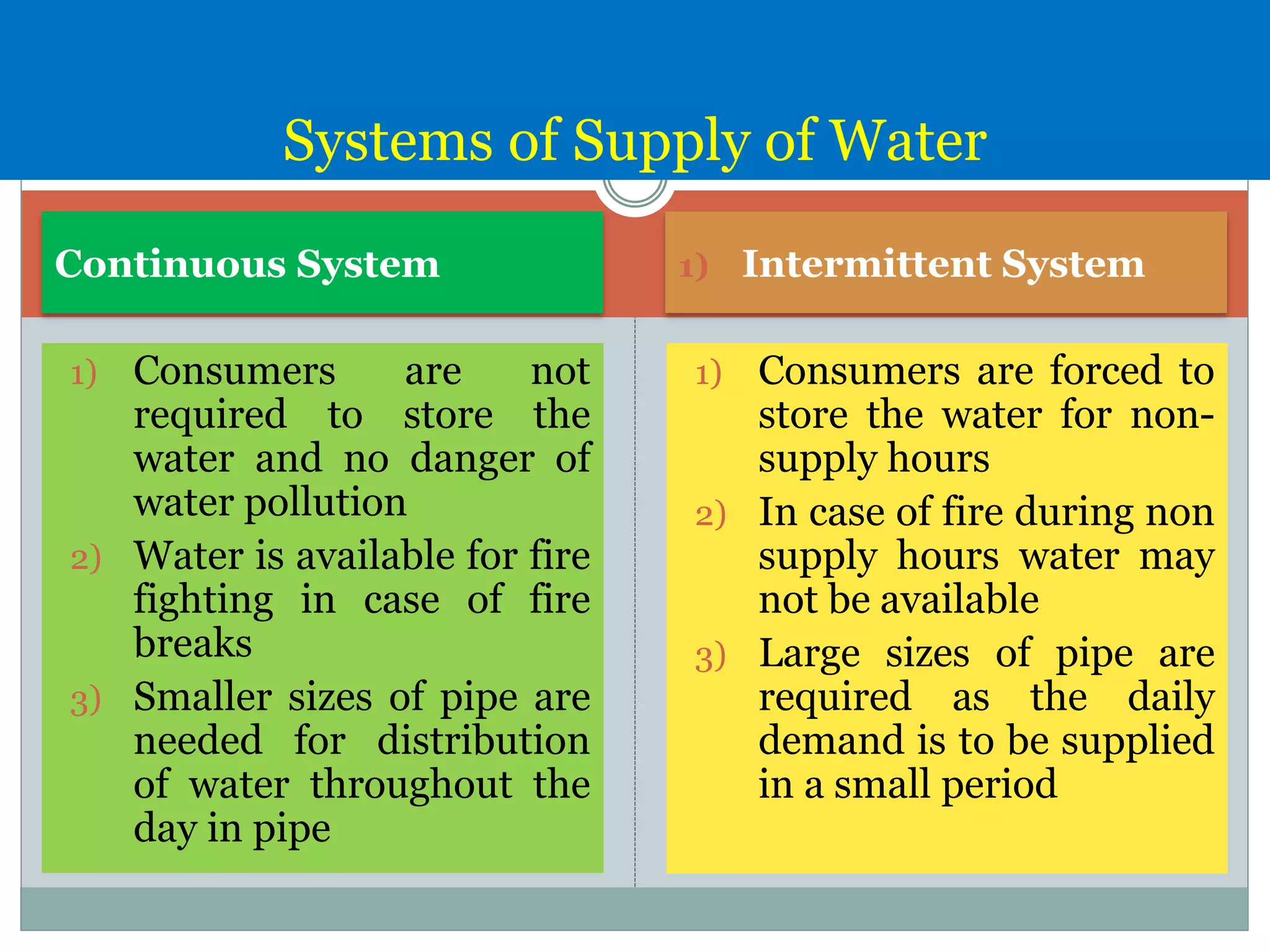
Continuous System 1) Intermittent System
1) Consumers are not
required to store the
water and no danger of
water pollution
2) Water is available for fire
fighting in case of fire
breaks
3) Smaller sizes of pipe are
needed for distribution
of water throughout the
day in pipe
1) Consumers are forced to
store the water for non-
supply hours
2) In case of fire during non
supply hours water may
not be available
3) Large sizes of pipe are
required as the daily
demand is to be supplied
in a small period
Systems of Supply of Water
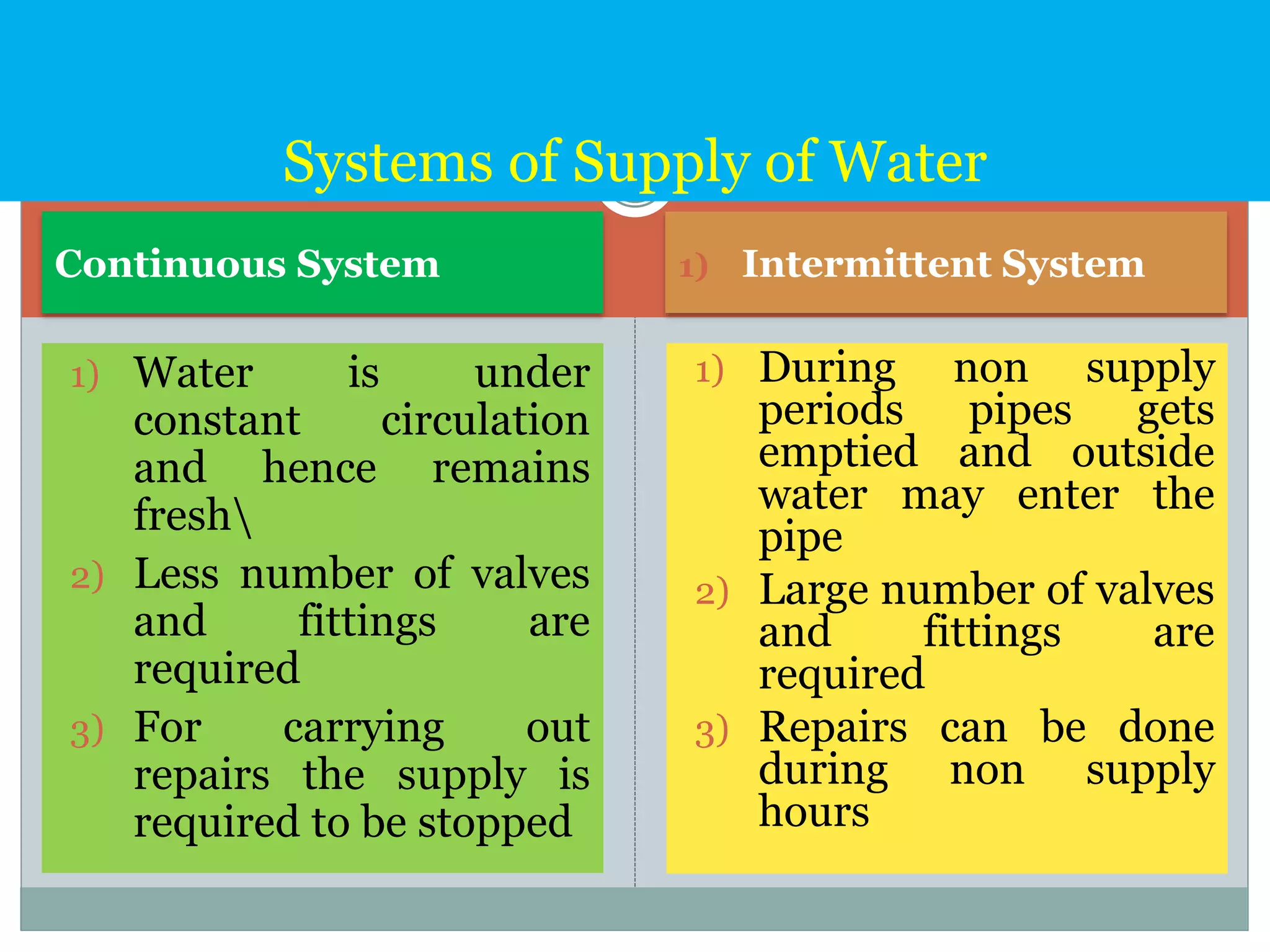
Continuous System 1) Intermittent System
1) Water is under
constant circulation
and hence remains
fresh
2) Less number of valves
and fittings are
required
3) For carrying out
repairs the supply is
required to be stopped
1) During non supply
periods pipes gets
emptied and outside
water may enter the
pipe
2) Large number of valves
and fittings are
required
3) Repairs can be done
during non supply
hours
Systems of Supply of Water
DISTRIBUTION RESERVOIRS
Distribution Reservoirs
 Also called as Service Reservoirs
 Storage reservoirs which stores the treated water for
supplying water during emergencies ( such as during
fires, break downs, repairs etc.)
 Also helps in absorbing the hourly fluctuations in
demand
Main Functions
1) They absorb the hourly variation in demand and allow
the water treatment units and pumps to operate at a
constant rate
2) They help in maintaining constant pressure in the
distribution mains
3) The water stored in this reservoirs can be supplied
during emergencies
4) They lead to an overall economy by reducing the sizes
of pumps, pipe lines and treatment units
Types of Distribution Reservoirs
 Made up of steel, R.C.C. or masonry
 Depending upon their elevation with respect to the
ground they may be classified into following two types
1) Surface reservoirs
2) Elevated reservoirs
Surface Reservoirs
Surface Reservoirs
Elevated Reservoirs
Elevated Reservoirs
Elevated Reservoirs
Effect of Location on Distribution Reservoir

Water distribution System In Water Supply Schemes

  • 1.
    DISTRIBUTION SYSTEM OF WATER Prof.VaibhavD.Kamble B.E.Civil, M.E.(Civil- Environmental Engineering)
  • 2.
    Distribution System  Main Function-Carrying the water from the treatment plant to the individual homes
  • 4.
  • 5.
    Components of DistributionSystem 1) Pipe Lines of various sizes 2) Valves 3) Hydrants 4) Water Meters 5) Service Connections 6) Pumps 7) Distribution or Service Reservoirs
  • 7.
  • 8.
  • 9.
    Requirements of aGood Distribution System 1) Capable of Supplying water at a required pressure 2) Capable of supplying a required amount of water along with the fire demand 3) It should be economical 4) It should be simple & easy to operate 5) Safe against the future pollution of water 6) Safe against failure of pipe by bursting 7) It should be watertight
  • 10.
  • 11.
     The distributionpipes are generally laid below the road pavements  In general there are four different types of Road Networks 1) Dead End System 2) Grid Iron System 3) Ring System 4) Radial System
  • 12.
    1) Dead EndSystem  Also called as Tree System  There are main supply pipe from which originates a number of sub main pipes(generally at right angles)  Each submain are then divided into several branch pipes called as laterals  From the laterals service connections are given to the individual homes
  • 13.
  • 14.
  • 15.
    Advantages 1) The distributionnetwork can be solved easily 2) Lesser number of cut off valves are required 3) Shorter pipe lengths are required & Laying of pipe is easy 4) It is cheap and simple & can be expanded easily
  • 16.
    Disadvantages 1) Water canreach a particular point only through one route 2) Large amount of Dead End in this system which prevents the free circulation of water 3) The discharge is reaching a point from only one direction
  • 17.
    Application  This typeof layout may have to be adopted for older towns which have already developed in an inadequate manner without properly planned roads
  • 18.
    2) Grid IronSystem  Also known as Interlaced or Reticulation System  Mains, Sub mains, Branches, Laterals all are interconnected with each other  The principles of Grid iron system can be applied to Dead end system by closing the loops
  • 19.
  • 20.
  • 21.
    Advantages 1) Water reachesat required places through more than one route 2) In case of repair very small area will not get the complete and continuous nature of water supply 3) Because of different inter connections the dead ends are completely eliminated 4) During fire more water can be diverted towards the affected point
  • 22.
    Disadvantages 1) Requires morelength of pipe lines & a large number of cut off valves 2) Construction is costlier 3) The design is difficult and costlier
  • 23.
    Application More suitable forwell planned towns or cities and has been used in chandigarh
  • 24.
    3) Ring System Sometimes called as Circular system  A closed ring either circular or rectangular of the main pipes is formed around the areas to be served 
  • 25.
  • 26.
  • 27.
    Application  Very suitablefor the towns and cities having a well planned roads
  • 28.
    4) Radial System This system is adopted for the town or cities which is having a radial system of road networks  Placing the distribution reservoirs at the centre
  • 29.
  • 30.
  • 31.
  • 32.
     The watermay be forced in the distribution system in the following three ways; 1) By Gravitational System 2) By pumping system 3) By combined gravity and pumping system
  • 33.
    1)Gravitational System This isthe Most Reliable and Economical Distribution System
  • 34.
  • 35.
  • 36.
    2)Pumping System Such asystem – not desirable, Pumps to be run at variation in speed according to consumption
  • 37.
  • 38.
  • 39.
    3)Combined Gravity andPumping Most common system – adopted in most of the cases
  • 40.
    3) Combined System3)CombinedGravity and Pumping
  • 41.
    3) Combined System 3)CombinedGravity and Pumping
  • 42.
    Continuous System 1)Intermittent System 1) Consumers are not required to store the water and no danger of water pollution 2) Water is available for fire fighting in case of fire breaks 3) Smaller sizes of pipe are needed for distribution of water throughout the day in pipe 1) Consumers are forced to store the water for non- supply hours 2) In case of fire during non supply hours water may not be available 3) Large sizes of pipe are required as the daily demand is to be supplied in a small period Systems of Supply of Water
  • 43.
    Continuous System 1)Intermittent System 1) Water is under constant circulation and hence remains fresh 2) Less number of valves and fittings are required 3) For carrying out repairs the supply is required to be stopped 1) During non supply periods pipes gets emptied and outside water may enter the pipe 2) Large number of valves and fittings are required 3) Repairs can be done during non supply hours Systems of Supply of Water
  • 44.
  • 45.
    Distribution Reservoirs  Alsocalled as Service Reservoirs  Storage reservoirs which stores the treated water for supplying water during emergencies ( such as during fires, break downs, repairs etc.)  Also helps in absorbing the hourly fluctuations in demand
  • 46.
    Main Functions 1) Theyabsorb the hourly variation in demand and allow the water treatment units and pumps to operate at a constant rate 2) They help in maintaining constant pressure in the distribution mains 3) The water stored in this reservoirs can be supplied during emergencies 4) They lead to an overall economy by reducing the sizes of pumps, pipe lines and treatment units
  • 47.
    Types of DistributionReservoirs  Made up of steel, R.C.C. or masonry  Depending upon their elevation with respect to the ground they may be classified into following two types 1) Surface reservoirs 2) Elevated reservoirs
  • 48.
  • 49.
  • 50.
  • 51.
  • 52.
  • 53.
    Effect of Locationon Distribution Reservoir