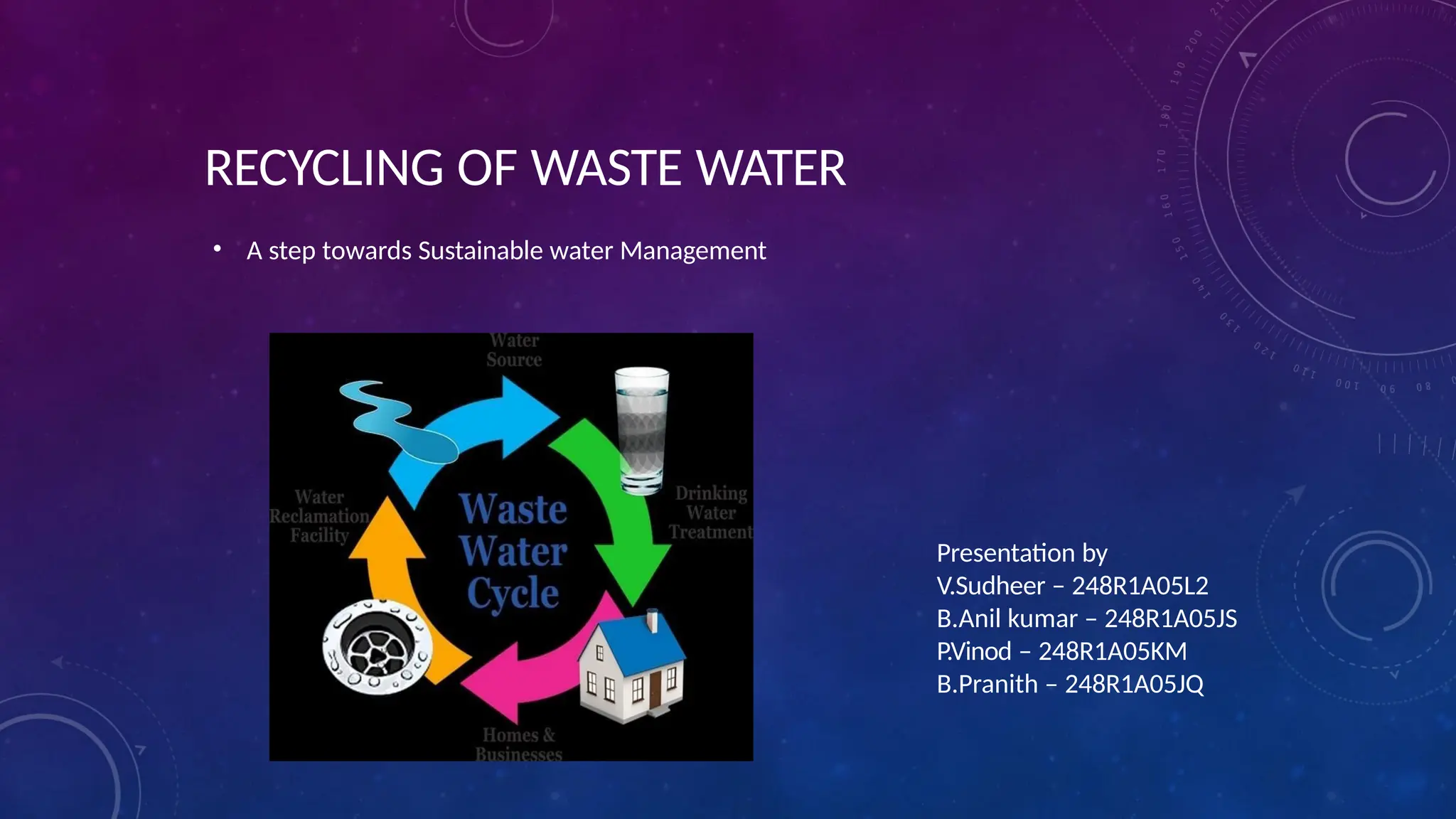
RECYCLING OF WASTEWATER
• A step towards Sustainable water Management
Presentation by
V.Sudheer – 248R1A05L2
B.Anil kumar – 248R1A05JS
P.Vinod – 248R1A05KM
B.Pranith – 248R1A05JQ
2.
INTRODUCTION
Wastewater is anywater that has been adversely affected in quality by external influence. Wastewater can
originate from a combination of domestic, industrial, commercial or agricultural activities, surface runoff
and from sewer inflow or infiltration.
Water recycling is reusing treated wastewater for beneficial purposes such as agricultural and landscape
irrigation, industrial processes, toilet flushing, and replenishing a ground water basin (referred to as ground
water recharge).
3.
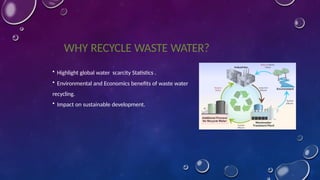
WHY RECYCLE WASTEWATER?
• Highlight global water scarcity Statistics .
• Environmental and Economics benefits of waste water
recycling.
• Impact on sustainable development.
4.
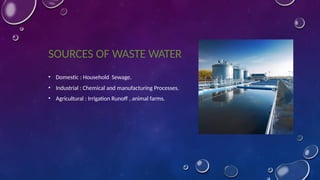
SOURCES OF WASTEWATER
• Domestic : Household Sewage.
• Industrial : Chemical and manufacturing Processes.
• Agricultural : Irrigation Runoff , animal farms.
5.
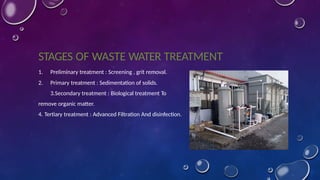
STAGES OF WASTEWATER TREATMENT
1. Preliminary treatment : Screening , grit removal.
2. Primary treatment : Sedimentation of solids.
3.Secondary treatment : Biological treatment To
remove organic matter.
4. Tertiary treatment : Advanced Filtration And disinfection.
6.
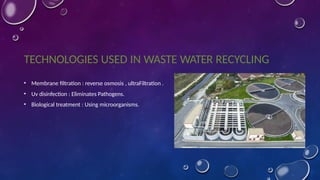
TECHNOLOGIES USED INWASTE WATER RECYCLING
• Membrane filtration : reverse osmosis , ultraFiltration .
• Uv disinfection : Eliminates Pathogens.
• Biological treatment : Using microorganisms.
7.
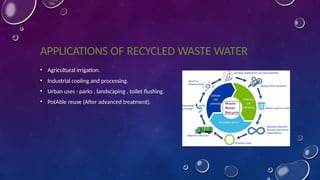
APPLICATIONS OF RECYCLEDWASTE WATER
• Agricultural irrigation.
• Industrial cooling and processing.
• Urban uses : parks , landscaping , toilet flushing.
• PotAble reuse (After advanced treatment).
8.
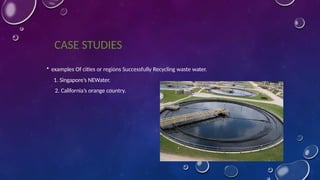
CASE STUDIES
• examplesOf cities or regions Successfully Recycling waste water.
1. Singapore’s NEWater.
2. California’s orange country.
9.
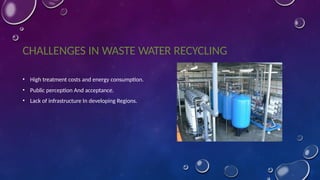
CHALLENGES IN WASTEWATER RECYCLING
• High treatment costs and energy consumption.
• Public perception And acceptance.
• Lack of infrastructure In developing Regions.
10.
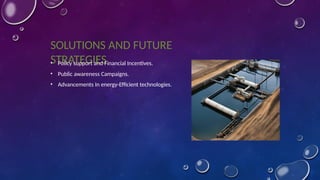
SOLUTIONS AND FUTURE
STRATEGIES
•Policy support and Financial Incentives.
• Public awareness Campaigns.
• Advancements In energy-Efficient technologies.
CONCLUSION
• Summarize Theimportance of Waste water recycling.
• Emphasize The need For collective Efforts In Technology , policy And behaviour change.