
DEPARTMENT OF
CIVIL ENGINEERING
Classification of Roads
Road Patterns
Er. Ramprasad Kumawat
M.Tech
Classification of Roads
 Types of roads
 The roads are generally classified into two
categories, depending on whether they can
be used during different seasons of the year:
 (i) All-weather roads and
 (ii) Fair-weather roads
 All-weather roads are those which are
negotiable during all seasons of the year,
except at major river crossings where some
interruption to traffic is permissible up to a
certain extent, but the road pavement should
be negotiable during all weathers.
 On 'fair weather roads' the traffic may be
interrupted during monsoon season at
causeways where streams may overflow
across the road.
 Based on the type of the carriageway or the
road pavement, the roads are classified
as`paved roads' and `un-paved roads'.
 The roads with a hard pavement surface on
the carriageway are called 'paved roads'.
 The roads without a hard pavement surface
on the carriageway are called 'unpaved
roads'.
 Earth roads and gravel roads may be called
unpaved roads.
 Based on the type of pavement surfacing
provided, the roads may be classified as
`surfaced roads' and `un-surfaced roads'.
 Road pavements with any type of bituminous
surface or cement concrete are called
surfaced roads.
 The roads which are not provided with a
bituminous or cement concrete surfacing are
called un-surfaced roads.
Methods of classification of roads
 The roads are generally classified based on
the following:
 (a) Traffic volume
 (b) Load transported or tonnage
 (c) Location and function
 The classification based on traffic volume or
tonnage has been arbitrarily fixed by different
agencies and there may not be a common
agreement regarding the limits for each of
classification group. Based on the traffic volume
or flow, the roads are classified as heavy,
medium and low volume roads.
 These terms are relative and so the limits under
each class should be clearly defined and
expressed as vehicles per day or 'annual average
daily traffic', etc.
 Likewise the classification based on load or
tonnage is also relative and the roads may be
classified as class L II etc. or class A, B etc. and
the limits may be expressed in terms of tones per
day.
 The classification based on location and
function should therefore be a more
acceptable classification method for a
country as they may be defined clearly.
Road classification based on
location and function
 Road classification as per Nagpur road
plan:
 The Nagpur Road Plan classified the roads in
India based on location and function into
following five categories and described
below:
 (i) National Highways (NH)
 (ii) State Highways (SH)
 (iii)Major District Roads (MDR)
 (iv) Other District Roads (ODR) and
 (v) Village Roads (VR)
(i) National Highways (NH)
 National Highways (NH) are main highways
running through the length and breadth of
India, connecting major ports, foreign
highways, capitals of large states and large
industrial and tourist centres including roads
required for strategic movements for the
defence of India.
 All the national highways are assigned the
respective numbers.
 For example, NH-1 is the national
highway connecting Delhi, Ambala,
Jalandhar and Amritsar (up to Pakistan
border);
 NH-4 connects Thane, Pune, Belgaum,
Hubli, Bangalore, Chittoor and Chennai.
(ii)State Highways (SH)
 State Highways (SH) are arterial roads of a
state, connecting the national highways of
adjacent state, district head quarters and
important cities within the state and serve as
the main arteries for traffic to and from
district roads.
 These highways are considered as main
arteries of commerce by road within a state
or a similar geographical unit.
(iii) Major District Roads (MDR)
 Major District Roads (MDR) are important
roads within a district serving areas of
production and markets and connecting with
other major roads or main highways of a
district.
 The MDR has lower speed and geometric
design specifications than NH/SH.
(iv) Other District Roads (ODR)
 Other District Roads (ODR) are roads
serving rural areas of production and
providing them with outlet to market centres,
taluk head quarters, block development head
quarters or other main roads.
 These are of lower design specifications than
MDR.
(v) Village Roads (VR)
 Village Roads (VR) are roads connecting
villages or groups of villages with each other
to the nearest road of a higher category.
 It was specified that these village roads
should be in essence farm tracks, but it was
desired that the prevalent practice of leaving
such tracks to develop and maintain by
themselves should be replaced by a plan for
a designed and regulated system.
Road classification as per third 20-year
road development plan, 1981 - 2001
 The road classification system was modified
in the third 20-year road development plan.
 The roads in the country are now classified
into three classes, for the purpose of
transport planning, functional identification,
earmarking administrative jurisdictions and
assigning priorities on a road net work.
 (i) Primary system
 (ii) Secondary system and
 (iii) Tertiary system or rural roads
 Primary system consists of two categories
of highways:
 (a) Expressways and
 (b) National Highways (NH)
(i) Expressways
 Expressways are a separate class of
highways with, Superior facilities and design
standards and are meant as through routes
having very high volume of traffic.
 The expressways are to be provided with
divided carriageways, controlled access,
grade separations at cross roads and fencing.
 These highways should permit only fast
moving vehicles.
 Expressways may be owned by the Central
Government or a State Government,
depending on whether the route is a National
Highway or State Highway.
(ii) The National Highways form the other
main category of primary system in the
country.
 The Secondary system consists of two
categories of roads:
 (a) State Highways (SH) and
 (b) Major District Roads (MDR)
 The Tertiary systems are rural roads and
these consist of two categories of roads:
 (a) Other District Road (ODR)
 (b) Village Roads (VR)
 The definitions of NH, SH, MDR, ODR and
VR are the same as given under classification
of roads by Nagpur Road Plan.
Classification of urban roads
 The road systems within urban areas are
classified as Urban Roads and will form a
separate category of roads to be taken care
by the respective urban authorities.
 The lengths of urban roads are not included
in the targets of the Third Twenty Year Road
Development Plan 1981-2001.
 The urban roads are classified as:
 (a) Arterial roads
 (b) Sub-arterial roads
 (c) Collector streets and
 (d) Local streets
 Arterials and sub-arterials are urban roads
primarily for through traffic on a continuous
route, but the sub-arterials have a lower level
of traffic mobility than the arterials.
 Collector streets provide access to arterial
roads and they collect and distribute traffic
from and to local streets which provide
access to abutting property.
Road Patterns
 The various road Patterns may be
classified as follows:
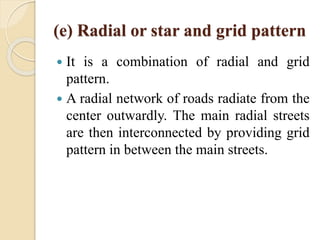
 (a) Rectangular or block pattern
 (b) Radial or star and block pattern
 (c) Hexagonal pattern
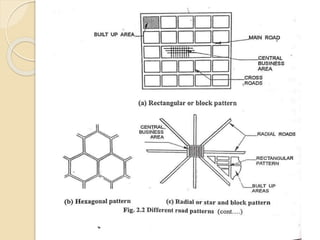
 (d) Radial or star and circular pattern
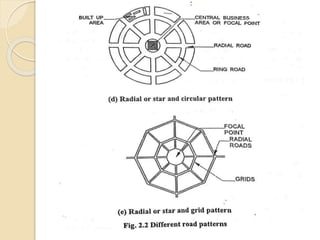
 (e) Radial or star and grid pattern
(a)&(b) Rectangular &
Block pattern
 In this pattern, the whole area is divided into
rectangular blocks of plots, with streets
intersecting at right angles.
 The main road which passes through the center
of the area should be sufficiently wide and other
branch roads may be comparatively narrow.
 The main road is provided a direct approach to
outside the city.
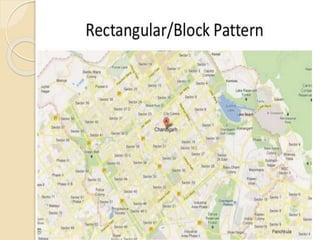
 This pattern has been adopted in the city roads
of Chandigarh.
 Advantages:
 1) The rectangular plots may be further divided
into small rectangular blocks for construction
of buildings placed back to back, having roads
on their front.
 2) In this pattern has been adopted for the city
roads.
 3) The construction and maintenance of roads
of this pattern is comparatively easier.
 Limitations:
 This pattern is not very much convenient
because at the intersections, the vehicles face
each other.
(c) Hexagonal pattern
 This pattern is a network of roads that
grow in such a manner in various
directions forming hexagons.
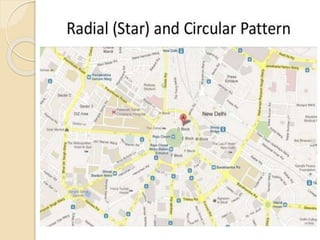
(d) Radial or star and circular
pattern
 In this pattern, the entire area is divided
into a network of roads radiating from the
business outwardly.
 In between radiating main roads, the built-
up area may be planned with rectangular
block.
 Advantage:
 1) Reduces level of congestion at the primary
bottleneck location.
 2) Prevents traffic from accessing local flow
routes in the direction of the event venue that
operate in favor of egress traffic flow.
 3) If one is block then other side traffic can
move.
 Limitations:
 1) Proves particularly effective if two-lane
ramp traffic does not have to merge at
downstream end of ramp.
(e) Radial or star and grid pattern
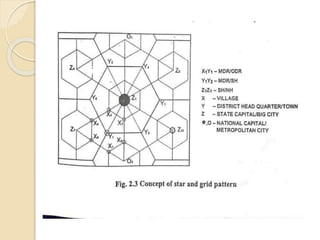
 It is a combination of radial and grid
pattern.
 A radial network of roads radiate from the
center outwardly. The main radial streets
are then interconnected by providing grid
pattern in between the main streets.
THANKS!
Gmail:
ramkumawat001@gmail.com

Classification of Roads and Road patterns

  • 1.
    DEPARTMENT OF CIVIL ENGINEERING Classificationof Roads Road Patterns Er. Ramprasad Kumawat M.Tech
  • 2.
    Classification of Roads Types of roads  The roads are generally classified into two categories, depending on whether they can be used during different seasons of the year:  (i) All-weather roads and  (ii) Fair-weather roads
  • 3.
     All-weather roadsare those which are negotiable during all seasons of the year, except at major river crossings where some interruption to traffic is permissible up to a certain extent, but the road pavement should be negotiable during all weathers.  On 'fair weather roads' the traffic may be interrupted during monsoon season at causeways where streams may overflow across the road.
  • 4.
     Based onthe type of the carriageway or the road pavement, the roads are classified as`paved roads' and `un-paved roads'.  The roads with a hard pavement surface on the carriageway are called 'paved roads'.  The roads without a hard pavement surface on the carriageway are called 'unpaved roads'.  Earth roads and gravel roads may be called unpaved roads.
  • 5.
     Based onthe type of pavement surfacing provided, the roads may be classified as `surfaced roads' and `un-surfaced roads'.  Road pavements with any type of bituminous surface or cement concrete are called surfaced roads.  The roads which are not provided with a bituminous or cement concrete surfacing are called un-surfaced roads.
  • 6.
    Methods of classificationof roads  The roads are generally classified based on the following:  (a) Traffic volume  (b) Load transported or tonnage  (c) Location and function
  • 7.
     The classificationbased on traffic volume or tonnage has been arbitrarily fixed by different agencies and there may not be a common agreement regarding the limits for each of classification group. Based on the traffic volume or flow, the roads are classified as heavy, medium and low volume roads.  These terms are relative and so the limits under each class should be clearly defined and expressed as vehicles per day or 'annual average daily traffic', etc.  Likewise the classification based on load or tonnage is also relative and the roads may be classified as class L II etc. or class A, B etc. and the limits may be expressed in terms of tones per day.
  • 8.
     The classificationbased on location and function should therefore be a more acceptable classification method for a country as they may be defined clearly.
  • 9.
    Road classification basedon location and function  Road classification as per Nagpur road plan:  The Nagpur Road Plan classified the roads in India based on location and function into following five categories and described below:  (i) National Highways (NH)  (ii) State Highways (SH)  (iii)Major District Roads (MDR)  (iv) Other District Roads (ODR) and  (v) Village Roads (VR)
  • 10.
    (i) National Highways(NH)  National Highways (NH) are main highways running through the length and breadth of India, connecting major ports, foreign highways, capitals of large states and large industrial and tourist centres including roads required for strategic movements for the defence of India.
  • 11.
     All thenational highways are assigned the respective numbers.  For example, NH-1 is the national highway connecting Delhi, Ambala, Jalandhar and Amritsar (up to Pakistan border);  NH-4 connects Thane, Pune, Belgaum, Hubli, Bangalore, Chittoor and Chennai.
  • 12.
    (ii)State Highways (SH) State Highways (SH) are arterial roads of a state, connecting the national highways of adjacent state, district head quarters and important cities within the state and serve as the main arteries for traffic to and from district roads.  These highways are considered as main arteries of commerce by road within a state or a similar geographical unit.
  • 13.
    (iii) Major DistrictRoads (MDR)  Major District Roads (MDR) are important roads within a district serving areas of production and markets and connecting with other major roads or main highways of a district.  The MDR has lower speed and geometric design specifications than NH/SH.
  • 14.
    (iv) Other DistrictRoads (ODR)  Other District Roads (ODR) are roads serving rural areas of production and providing them with outlet to market centres, taluk head quarters, block development head quarters or other main roads.  These are of lower design specifications than MDR.
  • 15.
    (v) Village Roads(VR)  Village Roads (VR) are roads connecting villages or groups of villages with each other to the nearest road of a higher category.  It was specified that these village roads should be in essence farm tracks, but it was desired that the prevalent practice of leaving such tracks to develop and maintain by themselves should be replaced by a plan for a designed and regulated system.
  • 16.
    Road classification asper third 20-year road development plan, 1981 - 2001  The road classification system was modified in the third 20-year road development plan.  The roads in the country are now classified into three classes, for the purpose of transport planning, functional identification, earmarking administrative jurisdictions and assigning priorities on a road net work.  (i) Primary system  (ii) Secondary system and  (iii) Tertiary system or rural roads
  • 17.
     Primary systemconsists of two categories of highways:  (a) Expressways and  (b) National Highways (NH)
  • 18.
    (i) Expressways  Expresswaysare a separate class of highways with, Superior facilities and design standards and are meant as through routes having very high volume of traffic.  The expressways are to be provided with divided carriageways, controlled access, grade separations at cross roads and fencing.  These highways should permit only fast moving vehicles.
  • 19.
     Expressways maybe owned by the Central Government or a State Government, depending on whether the route is a National Highway or State Highway. (ii) The National Highways form the other main category of primary system in the country.
  • 20.
     The Secondarysystem consists of two categories of roads:  (a) State Highways (SH) and  (b) Major District Roads (MDR)  The Tertiary systems are rural roads and these consist of two categories of roads:  (a) Other District Road (ODR)  (b) Village Roads (VR)  The definitions of NH, SH, MDR, ODR and VR are the same as given under classification of roads by Nagpur Road Plan.
  • 21.
    Classification of urbanroads  The road systems within urban areas are classified as Urban Roads and will form a separate category of roads to be taken care by the respective urban authorities.  The lengths of urban roads are not included in the targets of the Third Twenty Year Road Development Plan 1981-2001.
  • 22.
     The urbanroads are classified as:  (a) Arterial roads  (b) Sub-arterial roads  (c) Collector streets and  (d) Local streets
  • 23.
     Arterials andsub-arterials are urban roads primarily for through traffic on a continuous route, but the sub-arterials have a lower level of traffic mobility than the arterials.  Collector streets provide access to arterial roads and they collect and distribute traffic from and to local streets which provide access to abutting property.
  • 24.
    Road Patterns  Thevarious road Patterns may be classified as follows:  (a) Rectangular or block pattern  (b) Radial or star and block pattern  (c) Hexagonal pattern  (d) Radial or star and circular pattern  (e) Radial or star and grid pattern
  • 25.
    (a)&(b) Rectangular & Blockpattern  In this pattern, the whole area is divided into rectangular blocks of plots, with streets intersecting at right angles.  The main road which passes through the center of the area should be sufficiently wide and other branch roads may be comparatively narrow.  The main road is provided a direct approach to outside the city.  This pattern has been adopted in the city roads of Chandigarh.
  • 27.
     Advantages:  1)The rectangular plots may be further divided into small rectangular blocks for construction of buildings placed back to back, having roads on their front.  2) In this pattern has been adopted for the city roads.  3) The construction and maintenance of roads of this pattern is comparatively easier.  Limitations:  This pattern is not very much convenient because at the intersections, the vehicles face each other.
  • 28.
    (c) Hexagonal pattern This pattern is a network of roads that grow in such a manner in various directions forming hexagons.
  • 29.
    (d) Radial orstar and circular pattern  In this pattern, the entire area is divided into a network of roads radiating from the business outwardly.  In between radiating main roads, the built- up area may be planned with rectangular block.
  • 31.
     Advantage:  1)Reduces level of congestion at the primary bottleneck location.  2) Prevents traffic from accessing local flow routes in the direction of the event venue that operate in favor of egress traffic flow.  3) If one is block then other side traffic can move.  Limitations:  1) Proves particularly effective if two-lane ramp traffic does not have to merge at downstream end of ramp.
  • 32.
    (e) Radial orstar and grid pattern  It is a combination of radial and grid pattern.  A radial network of roads radiate from the center outwardly. The main radial streets are then interconnected by providing grid pattern in between the main streets.
  • 36.