ASSIGNMENT 
SUBMITTED TO SUBMITTED BY 
ANUPAMA TEACHER VISHNU.B 
LECTURER IN SOCIAL SCIENCE OPTION: SOCIAL SCIENCE 
FMTC MYLAPURE FMTC MYLAPURE 
1 | LOCAL SELF GOVERNMENTS
LOCAL SELF 
GOVERNMENTS 
INDEX 
content Page no 
1 Introduction 4-5 
2 | LOCAL SELF GOVERNMENTS
2 Need of Lsg’s 5 
3 Decentralization in India 5-6 
4 73rd and 74th acts 6-8 
5 Organizational structure 9-11 
6 conclusion 12 
7 reference 13 
INTRODUCTION 
Democracy is the basic core of India’s Socio – Political and 
Economic setup. Democracy means the rule of the people where 
people can participate in the administrative process of the nation 
3 | LOCAL SELF GOVERNMENTS
without any fear or discrimination. India has the largest democratic 
set up in the world in which more than hundred crores of people 
participate in the political and economic system of the nation. 
Transferring power to the people is the back bone of Indian 
democracy. Democracy ensures equality, justice, and freedom to the 
people in order to express their will in nation making. Democracy is 
accepted world – widely as the best form of government. 
People’s Planning is an ideal concept in every sense of the 
term. The aim of planning in India is rapid economic growth, 
abolition of poverty and unemployment, reduction of inequalities, 
industrialization and establishment of a socialist pattern of society. 
The people’s involvement in planning process is 
through Panchayati Raj Institutions. The Panchayati Raj Institutions 
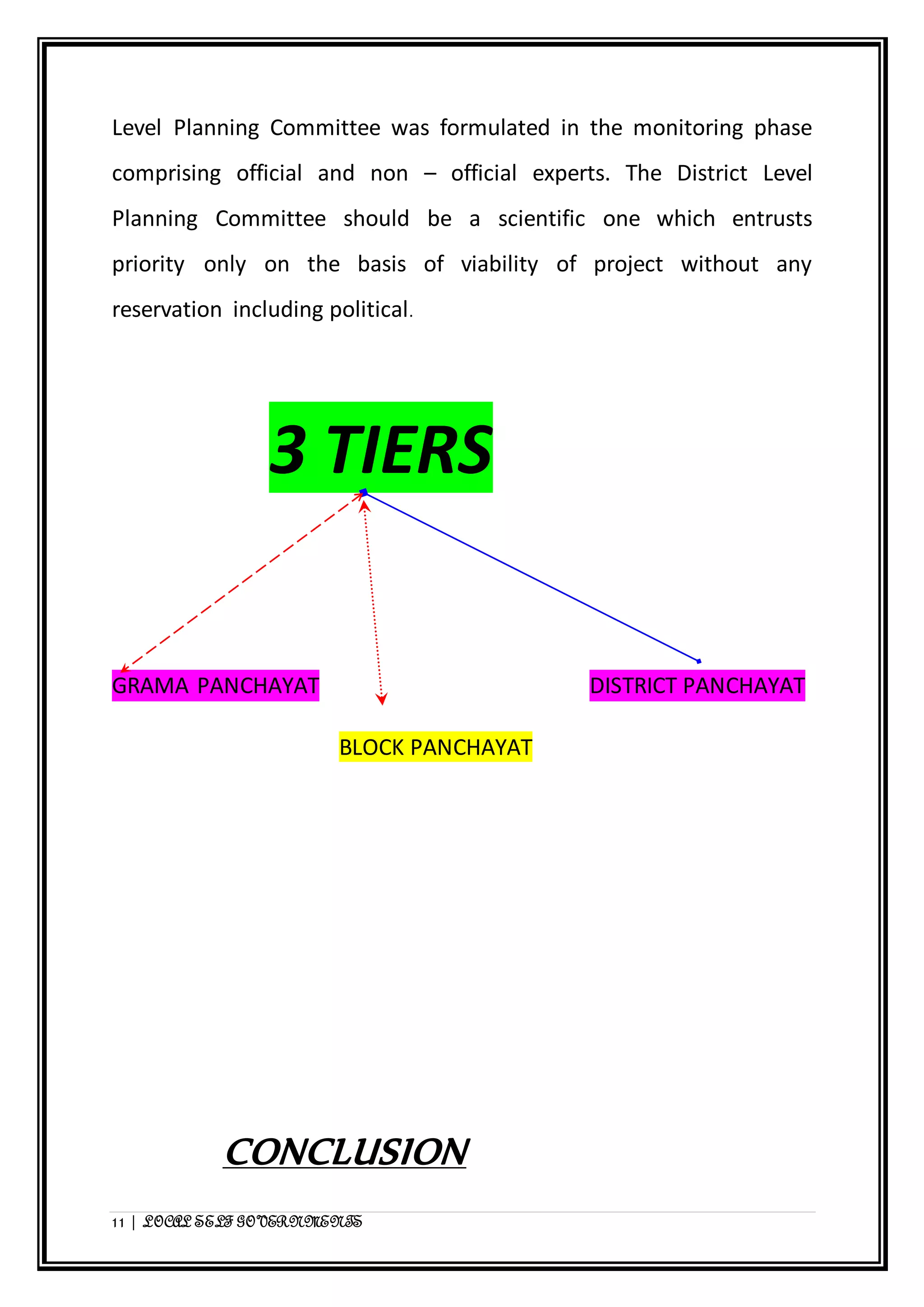
installed in the State have three tiers viz., the Gram Panchayat, Block 
panchayat, and the District Panchayat and the Nagarapalika 
Institutions – Municipalities And Corporation. 
NEED OF LSGs 
Local self government stands close to the people and solve the 
problems of common people speedily and closely. It effectively 
4 | LOCAL SELF GOVERNMENTS
protects the interests of the people. Decentralization and planning 
are implemented mainly through the local government. 
S. M. Vijayanand, Principal Secretary, Department of Local Self 
Governments of Kerala(2002) opined that ‘ Kerala was a pioneer in 
big- bang decentralization, a path breaker in methodology and as a 
result the quantum of corruption has come down to the tune of 10% 
at the Panchayat level vis-à-vis the PWD construction costs. 
DECENTRALISATION IN INDIA 
Decentralization is the transfer of decision making powers 
to more directly concerned, lower levels of Government and 
administrative authority. The interest in decentralization as a 
mechanism for transforming society is not new. In the second half of 
the twentieth century, practically every country has experimented 
with some form of decentralization or local government reform with 
varying aims and outcomes. 
OBJECTIVES OF DECENTRALIZATION 
5 | LOCAL SELF GOVERNMENTS
Generally the objectives of decentralization as put forward by 
the countries are: 
 Promotion of a more balanced development in the country 
 Design of more realistic projects and programme which take 
into account local potentials and constraints 
 More effective co- ordination of development activities at 
various spatial levels through disaggregation of planning 
functions. 
 Strengthening of local political and increasing people’s 
participation in development 
 Boosted mobilization of local resources 
73RD AND 74TH CONSTITUTIONAL AMENDMENTS 
The history of panchayati raj in India, on April 24, 1993, 
73rd and 74th Constitutional Amendment Act of 1992 came into 
force to provide constitutional status to the PRIs are popularly 
known as the Panchayati Raj and Nagarapalika Constitution 
Amendment Act . The Amendment of 1993 added a new path 
relating to panchayat in the Constitution under the Article 243 to 
provide for the following. 
6 | LOCAL SELF GOVERNMENTS
 Grama Sabha in Villages 
 Direct election to all seats 
 Reservation to SC/ST 
 1/3 reservation to women 
 Devolution of powers and responsibilities by state legislature 
upon panchayat. 
 To levy and collect appropriate taxes, duties, tolls and fees. 
 Setting up of a finance commission 
The passage of the 73rd and 74th Amendments marks a 
new era in the federal democratic setup of the country and provides 
a constitutional status to the PRIs. Consequent upon the enactment 
of the Acts, almost all the states and union territories except Jammu 
& Kashmir NCT Delhi and Uttaranchal have enacted legislation. 
All the States except Arunachal Pradesh, NCT Delhi and 
Pondicherry have held election. As a result, 2, 32,278 panchayats at 
village level; 6022 panchayats at intermediate level and 535 
panchayats at district level have been constituted in the country. 
These panchayats are being manned by about 29.2 lacks elected 
representatives of panchayats at all level. This is the broadest 
7 | LOCAL SELF GOVERNMENTS
representative base that exists in any country of the world – 
Developed or under developed. 
Organizational Structure and responsibility of 
Local Bodies in Kerala: - 3 Tier System 
Grama Panchayats 
At the bottom level, there is the Grama Panchayat.According to 
the Kerala Panchayati Raj Act, 1994; there should be a Grama 
Panchayat for a village or a group of villages. The total number of the 
members of Grama Panchayat will be decided on the basis of 
population .It varies from panchayat to panchayat. All members are 
elected directly by the people. A fixed number of seats should be 
reserved for SC/STs depending on their population. One – third of 
the total seats of the Grama Panchayat should be reserved for 
women. The members of the Grama Panchayat will elect its 
president and vice president from along themselves. They have close 
interaction with the people at mass level. They are entrusted to 
prepare the blue print of the plan incorporating the assessed needs 
of the area. 
The Grama Panchayat is the ‘Constitutional Local Body’ 
functioning at the village level. According to the Panchayati Raj Act, 
8 | LOCAL SELF GOVERNMENTS
Grama Panchayat as to summon the Grama Sabha consisting of the 
entire voters at the ward level at least twice in a year. The elected 
representative of the ward has to attend the Grama Sabha and 
collect the proposals of the needs raised by the people. He is 
answerable to the Grama Sabha to the activities of the panchayat . 
Role of Grama Sabha:- 
The Grama Sabha is the most important institutional mechanism 
for people’s participation in decentralization. The sponsors of the 
People’s plan fruitfully utilized this constitutional arrangement for 
drafting the blue print of the people’s plan at the lowest level, the 
Grama Sabha. The Grama Sabha is made the soul of the Panchayati 
Raj Institutions in the states. It will approve the annual budget and 
the plans of developmental programmes, annual statement of 
accounts seek clarification from the President or members about the 
works undertaken by the panchayats. 
Block Panchayat 
9 | LOCAL SELF GOVERNMENTS
Section 8 of the Kerala Panchayati Raj Act states that 
there should be a block panchayat at the block level. It occupies the 
middle position between the Grama Panchayat and the District 
Panchayat. A fixed number of seats of the block panchayat should 
be reserved for SC/STs depending upon their population in the block 
panchayat area. The members of the block panchayat will elect its 
president and vice – president from themselves. At the block 
panchayat level, another expert committee and the elected 
representatives are entrusted to codify the draft of the People’s Plan 
prepared by the Grama Panchayat under their jurisdiction. The State 
Government appoints an expert committee from time to time at 
block level. 
District Panchayat:- 
There are 14 District Panchayats in the State. These District 
Panchayats have to codify draft the district level plan document by 
reviewing plan documents prepared and submitted by their 
respective Block Panchayats. At the district level, they have to 
prepare a single district plan document by codifying the entire block 
level documents. There are municipalities and municipal 
corporations also. Therefore, at the district level, codified single plan 
document has two corollas, one meant for Panchayati Raj System 
and other for the Nagarapalika System. For this purpose, a District 
10 | LOCAL SELF GOVERNMENTS
Level Planning Committee was formulated in the monitoring phase 
comprising official and non – official experts. The District Level 
Planning Committee should be a scientific one which entrusts 
priority only on the basis of viability of project without any 
reservation including political. 
3 TIERS 
GRAMA PANCHAYAT DISTRICT PANCHAYAT 
BLOCK PANCHAYAT 
CONCLUSION 
11 | LOCAL SELF GOVERNMENTS
Today local governance is seen as an integral part of 
our federal system and involves devolution of 
functions, funds and functionaries to panchayats and 
other local governments. A study among major States 
in India leads one firm conclusion that no state except 
Kerala has devolved powers and resources. So it is very 
important to make the local governments as self 
sufficient for ensuring democracy and make the dream 
of our Father of The Nation into reality – self sufficient 
local government. 
REFERENCES 
12 | LOCAL SELF GOVERNMENTS
Oomen M.A : Deepening Decentralised Governance In Rural 
India: Lessons from The People’s Plan Initiatives Of 
Kerala (2004) 
Vijayanand S.M : Status of Panchayati Raj in Kerala (2002) 
Biju M.R : Decentralization – An Indian Experience.(2008) 
Mohanan .S : Resource mobilization in people’s planning: 
a case study( 2001) 
Aiyer Mani Shankar : ‘Panchayati Raj: the way forwar‘,Economic 
And Political Weekly 3 August, (2002) 
corrected by 
Anupama M R 
Lr in social science 
13 | LOCAL SELF GOVERNMENTS

Vishnu.b assignment.local self governments (1)

  • 1.
    ASSIGNMENT SUBMITTED TOSUBMITTED BY ANUPAMA TEACHER VISHNU.B LECTURER IN SOCIAL SCIENCE OPTION: SOCIAL SCIENCE FMTC MYLAPURE FMTC MYLAPURE 1 | LOCAL SELF GOVERNMENTS
  • 2.
    LOCAL SELF GOVERNMENTS INDEX content Page no 1 Introduction 4-5 2 | LOCAL SELF GOVERNMENTS
  • 3.
    2 Need ofLsg’s 5 3 Decentralization in India 5-6 4 73rd and 74th acts 6-8 5 Organizational structure 9-11 6 conclusion 12 7 reference 13 INTRODUCTION Democracy is the basic core of India’s Socio – Political and Economic setup. Democracy means the rule of the people where people can participate in the administrative process of the nation 3 | LOCAL SELF GOVERNMENTS
  • 4.
    without any fearor discrimination. India has the largest democratic set up in the world in which more than hundred crores of people participate in the political and economic system of the nation. Transferring power to the people is the back bone of Indian democracy. Democracy ensures equality, justice, and freedom to the people in order to express their will in nation making. Democracy is accepted world – widely as the best form of government. People’s Planning is an ideal concept in every sense of the term. The aim of planning in India is rapid economic growth, abolition of poverty and unemployment, reduction of inequalities, industrialization and establishment of a socialist pattern of society. The people’s involvement in planning process is through Panchayati Raj Institutions. The Panchayati Raj Institutions installed in the State have three tiers viz., the Gram Panchayat, Block panchayat, and the District Panchayat and the Nagarapalika Institutions – Municipalities And Corporation. NEED OF LSGs Local self government stands close to the people and solve the problems of common people speedily and closely. It effectively 4 | LOCAL SELF GOVERNMENTS
  • 5.
    protects the interestsof the people. Decentralization and planning are implemented mainly through the local government. S. M. Vijayanand, Principal Secretary, Department of Local Self Governments of Kerala(2002) opined that ‘ Kerala was a pioneer in big- bang decentralization, a path breaker in methodology and as a result the quantum of corruption has come down to the tune of 10% at the Panchayat level vis-à-vis the PWD construction costs. DECENTRALISATION IN INDIA Decentralization is the transfer of decision making powers to more directly concerned, lower levels of Government and administrative authority. The interest in decentralization as a mechanism for transforming society is not new. In the second half of the twentieth century, practically every country has experimented with some form of decentralization or local government reform with varying aims and outcomes. OBJECTIVES OF DECENTRALIZATION 5 | LOCAL SELF GOVERNMENTS
  • 6.
    Generally the objectivesof decentralization as put forward by the countries are:  Promotion of a more balanced development in the country  Design of more realistic projects and programme which take into account local potentials and constraints  More effective co- ordination of development activities at various spatial levels through disaggregation of planning functions.  Strengthening of local political and increasing people’s participation in development  Boosted mobilization of local resources 73RD AND 74TH CONSTITUTIONAL AMENDMENTS The history of panchayati raj in India, on April 24, 1993, 73rd and 74th Constitutional Amendment Act of 1992 came into force to provide constitutional status to the PRIs are popularly known as the Panchayati Raj and Nagarapalika Constitution Amendment Act . The Amendment of 1993 added a new path relating to panchayat in the Constitution under the Article 243 to provide for the following. 6 | LOCAL SELF GOVERNMENTS
  • 7.
     Grama Sabhain Villages  Direct election to all seats  Reservation to SC/ST  1/3 reservation to women  Devolution of powers and responsibilities by state legislature upon panchayat.  To levy and collect appropriate taxes, duties, tolls and fees.  Setting up of a finance commission The passage of the 73rd and 74th Amendments marks a new era in the federal democratic setup of the country and provides a constitutional status to the PRIs. Consequent upon the enactment of the Acts, almost all the states and union territories except Jammu & Kashmir NCT Delhi and Uttaranchal have enacted legislation. All the States except Arunachal Pradesh, NCT Delhi and Pondicherry have held election. As a result, 2, 32,278 panchayats at village level; 6022 panchayats at intermediate level and 535 panchayats at district level have been constituted in the country. These panchayats are being manned by about 29.2 lacks elected representatives of panchayats at all level. This is the broadest 7 | LOCAL SELF GOVERNMENTS
  • 8.
    representative base thatexists in any country of the world – Developed or under developed. Organizational Structure and responsibility of Local Bodies in Kerala: - 3 Tier System Grama Panchayats At the bottom level, there is the Grama Panchayat.According to the Kerala Panchayati Raj Act, 1994; there should be a Grama Panchayat for a village or a group of villages. The total number of the members of Grama Panchayat will be decided on the basis of population .It varies from panchayat to panchayat. All members are elected directly by the people. A fixed number of seats should be reserved for SC/STs depending on their population. One – third of the total seats of the Grama Panchayat should be reserved for women. The members of the Grama Panchayat will elect its president and vice president from along themselves. They have close interaction with the people at mass level. They are entrusted to prepare the blue print of the plan incorporating the assessed needs of the area. The Grama Panchayat is the ‘Constitutional Local Body’ functioning at the village level. According to the Panchayati Raj Act, 8 | LOCAL SELF GOVERNMENTS
  • 9.
    Grama Panchayat asto summon the Grama Sabha consisting of the entire voters at the ward level at least twice in a year. The elected representative of the ward has to attend the Grama Sabha and collect the proposals of the needs raised by the people. He is answerable to the Grama Sabha to the activities of the panchayat . Role of Grama Sabha:- The Grama Sabha is the most important institutional mechanism for people’s participation in decentralization. The sponsors of the People’s plan fruitfully utilized this constitutional arrangement for drafting the blue print of the people’s plan at the lowest level, the Grama Sabha. The Grama Sabha is made the soul of the Panchayati Raj Institutions in the states. It will approve the annual budget and the plans of developmental programmes, annual statement of accounts seek clarification from the President or members about the works undertaken by the panchayats. Block Panchayat 9 | LOCAL SELF GOVERNMENTS
  • 10.
    Section 8 ofthe Kerala Panchayati Raj Act states that there should be a block panchayat at the block level. It occupies the middle position between the Grama Panchayat and the District Panchayat. A fixed number of seats of the block panchayat should be reserved for SC/STs depending upon their population in the block panchayat area. The members of the block panchayat will elect its president and vice – president from themselves. At the block panchayat level, another expert committee and the elected representatives are entrusted to codify the draft of the People’s Plan prepared by the Grama Panchayat under their jurisdiction. The State Government appoints an expert committee from time to time at block level. District Panchayat:- There are 14 District Panchayats in the State. These District Panchayats have to codify draft the district level plan document by reviewing plan documents prepared and submitted by their respective Block Panchayats. At the district level, they have to prepare a single district plan document by codifying the entire block level documents. There are municipalities and municipal corporations also. Therefore, at the district level, codified single plan document has two corollas, one meant for Panchayati Raj System and other for the Nagarapalika System. For this purpose, a District 10 | LOCAL SELF GOVERNMENTS
  • 11.
    Level Planning Committeewas formulated in the monitoring phase comprising official and non – official experts. The District Level Planning Committee should be a scientific one which entrusts priority only on the basis of viability of project without any reservation including political. 3 TIERS GRAMA PANCHAYAT DISTRICT PANCHAYAT BLOCK PANCHAYAT CONCLUSION 11 | LOCAL SELF GOVERNMENTS
  • 12.
    Today local governanceis seen as an integral part of our federal system and involves devolution of functions, funds and functionaries to panchayats and other local governments. A study among major States in India leads one firm conclusion that no state except Kerala has devolved powers and resources. So it is very important to make the local governments as self sufficient for ensuring democracy and make the dream of our Father of The Nation into reality – self sufficient local government. REFERENCES 12 | LOCAL SELF GOVERNMENTS
  • 13.
    Oomen M.A :Deepening Decentralised Governance In Rural India: Lessons from The People’s Plan Initiatives Of Kerala (2004) Vijayanand S.M : Status of Panchayati Raj in Kerala (2002) Biju M.R : Decentralization – An Indian Experience.(2008) Mohanan .S : Resource mobilization in people’s planning: a case study( 2001) Aiyer Mani Shankar : ‘Panchayati Raj: the way forwar‘,Economic And Political Weekly 3 August, (2002) corrected by Anupama M R Lr in social science 13 | LOCAL SELF GOVERNMENTS