WASTE WATER REUSE 
ADITYA GHUMARE 
PGD-ACM NICMAR, Pune.
OUTLINE 
• Introduction 
– The Hydrologic Cycle and reclaimed water 
– Need for Wastewater Reuse 
• Wastewater Reclamation Technologies 
• Wastewater Reuse Applications 
– Historical Examples 
– Agricultural and Landscape Irrigation 
– Industrial Reuse 
– Groundwater Recharge 
– Planned Indirect & Potable Water Reuse 
• Public Health and Environmental Considerations 
– Constituents in Reclaimed Water 
– Public Health Issues 
– Environmental Health Issues 
– What level of treatment is necessary?
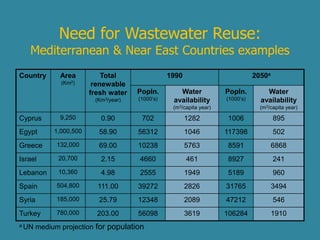
Need for Wastewater Reuse: 
Mediterranean & Near East Countries examples 
Country Area 
(Km2) 
Total 
renewable 
fresh water 
(Km3/year) 
1990 2050a 
Popln. 
(1000’s) 
Water 
availability 
(m3/capita year) 
Popln. 
(1000’s) 
Water 
availability 
(m3/capita year) 
Cyprus 9,250 0.90 702 1282 1006 895 
Egypt 1,000,500 58.90 56312 1046 117398 502 
Greece 132,000 69.00 10238 5763 8591 6868 
Israel 20,700 2.15 4660 461 8927 241 
Lebanon 10,360 4.98 2555 1949 5189 960 
Spain 504,800 111.00 39272 2826 31765 3494 
Syria 185,000 25.79 12348 2089 47212 546 
Turkey 780,000 203.00 56098 3619 106284 1910 
a UN medium projection for population
Need for Wastewater Reuse: 
Mediterranean Basin & Near East Countries 
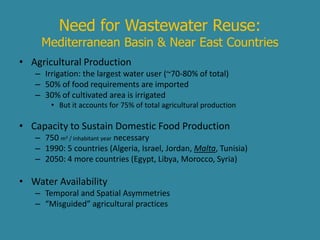
• Agricultural Production 
– Irrigation: the largest water user (~70-80% of total) 
– 50% of food requirements are imported 
– 30% of cultivated area is irrigated 
• But it accounts for 75% of total agricultural production 
• Capacity to Sustain Domestic Food Production 
– 750 m3 / inhabitant year necessary 
– 1990: 5 countries (Algeria, Israel, Jordan, Malta, Tunisia) 
– 2050: 4 more countries (Egypt, Libya, Morocco, Syria) 
• Water Availability 
– Temporal and Spatial Asymmetries 
– “Misguided” agricultural practices
Wastewater Reclamation Technologies 
Conventional Methods 
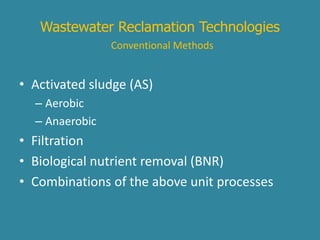
• Activated sludge (AS) 
– Aerobic 
– Anaerobic 
• Filtration 
• Biological nutrient removal (BNR) 
• Combinations of the above unit processes
Wastewater Reclamation Technologies 
Advanced Treatment Methods 
(Example: Denver, Colorado, USA; 1 MGD plant, direct injection) 
Lime 
Unchlorinated 
secondary 
effluent 
Rapid 
Mix 
Flocculation Clarification 
CO2 
Re-carbonation Ballast pond 
Filtration 
Backwash 
water return 
Ultraviolet 
Disinfection Carbon 
Adsorption 
Reverse Osmosis 
OR 
Ultra-filtration 
Air 
Stripping 
Ozonation Chlorination
Wastewater Reclamation Technologies 
Advanced Treatment Example 
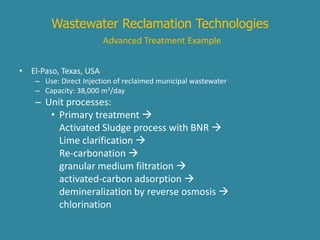
• El-Paso, Texas, USA 
– Use: Direct Injection of reclaimed municipal wastewater 
– Capacity: 38,000 m3/day 
– Unit processes: 
• Primary treatment  
Activated Sludge process with BNR  
Lime clarification  
Re-carbonation  
granular medium filtration  
activated-carbon adsorption  
demineralization by reverse osmosis  
chlorination
Wastewater Reclamation Technologies 
Sustainability Issues 
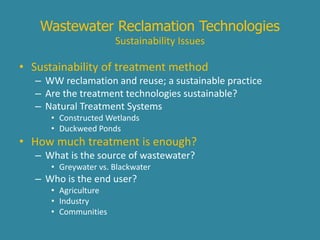
• Sustainability of treatment method 
– WW reclamation and reuse; a sustainable practice 
– Are the treatment technologies sustainable? 
– Natural Treatment Systems 
• Constructed Wetlands 
• Duckweed Ponds 
• How much treatment is enough? 
– What is the source of wastewater? 
• Greywater vs. Blackwater 
– Who is the end user? 
• Agriculture 
• Industry 
• Communities
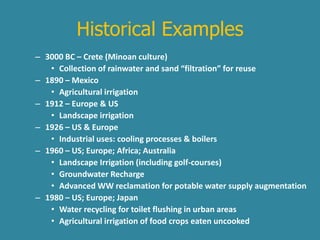
Historical Examples 
– 3000 BC – Crete (Minoan culture) 
• Collection of rainwater and sand “filtration” for reuse 
– 1890 – Mexico 
• Agricultural irrigation 
– 1912 – Europe & US 
• Landscape irrigation 
– 1926 – US & Europe 
• Industrial uses: cooling processes & boilers 
– 1960 – US; Europe; Africa; Australia 
• Landscape Irrigation (including golf-courses) 
• Groundwater Recharge 
• Advanced WW reclamation for potable water supply augmentation 
– 1980 – US; Europe; Japan 
• Water recycling for toilet flushing in urban areas 
• Agricultural irrigation of food crops eaten uncooked
Uses of Reclaimed Water 
• Agricultural Irrigation 
• Landscape Irrigation 
• Industrial Recycling and Reuse 
• Groundwater Recharge 
• Recreational / Environmental Uses 
• Non-Potable Urban Uses 
• Potable Reuse
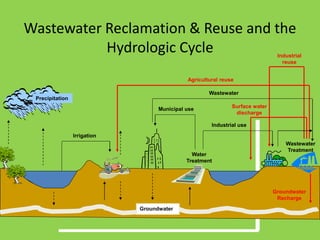
Wastewater Reclamation & Reuse and the 
Hydrologic Cycle 
Groundwater 
Recharge 
Agricultural reuse 
Surface water 
discharge 
Industrial 
reuse 
Municipal use 
Groundwater 
Irrigation 
Wastewater 
Water 
Industrial use 
Treatment 
Wastewater 
Treatment 
Precipitation
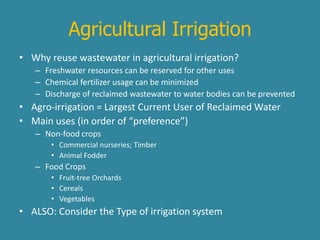
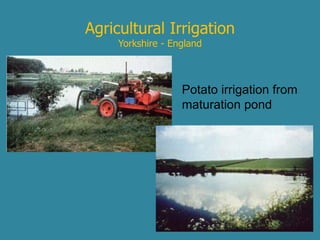
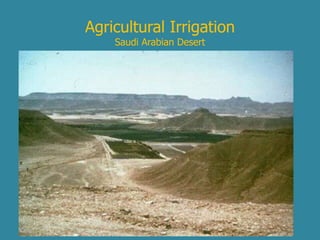
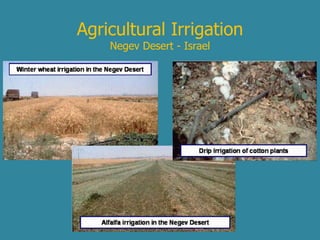
Agricultural Irrigation 
• Why reuse wastewater in agricultural irrigation? 
– Freshwater resources can be reserved for other uses 
– Chemical fertilizer usage can be minimized 
– Discharge of reclaimed wastewater to water bodies can be prevented 
• Agro-irrigation = Largest Current User of Reclaimed Water 
• Main uses (in order of “preference”) 
– Non-food crops 
• Commercial nurseries; Timber 
• Animal Fodder 
– Food Crops 
• Fruit-tree Orchards 
• Cereals 
• Vegetables 
• ALSO: Consider the Type of irrigation system
Agricultural Irrigation 
Yorkshire - England 
Potato irrigation from 
maturation pond
Agricultural Irrigation 
Saudi Arabian Desert
Agricultural Irrigation 
Negev Desert - Israel
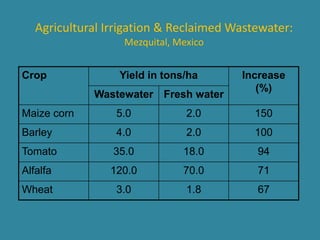
Agricultural Irrigation & Reclaimed Wastewater: 
Mezquital, Mexico 
Crop Yield in tons/ha Increase 
(%) 
Wastewater Fresh water 
Maize corn 5.0 2.0 150 
Barley 4.0 2.0 100 
Tomato 35.0 18.0 94 
Alfalfa 120.0 70.0 71 
Wheat 3.0 1.8 67
Landscape Irrigation 
& Recreational / Environmental Uses 
• Landscape Irrigation 
– Parks 
– School yards 
– Highway medians 
– Golf courses 
– Cemeteries 
– Residential 
• Recreational / Environmental Uses 
– Lakes & ponds 
– Marsh enhancement 
– Fisheries
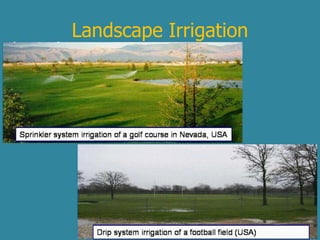
Landscape Irrigation
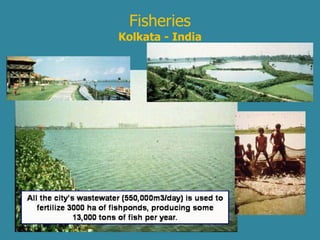
Fisheries 
Kolkata - India
Examples from India 
• Thermax India, Pune has developed the waste 
water treatment process in their Cinchwad 
plant that can make the industrial waste water 
potable 
• GMR IT park at Chennai has system that 
utilizes the waste water from sinks to flush the 
toilets
Industrial Reuse & Urban Uses 
• Industrial Recycling and Reuse 
– Cooling water 
– Boiler feed 
– Process water 
– Heavy construction 
• Non-Potable Urban Uses 
– Fire protection 
– Air conditioning 
– Toilet flushing 
• Potable Reuse 
– Blending in water supply reservoirs (Namibia example) 
– Pipe-to-pipe water supply
Groundwater Recharge 
• Groundwater replenishment 
– The following must be considered: 
• the quality of the recharge water; 
• the recharge method used; 
• the physical characteristics of the aquifer layers; 
• the water residence time; 
• the amount of blending with other sources; 
• Saltwater intrusion control 
• Subsidence control
Constituents in Reclaimed Water 
• Conventional (measured in mg/L; used in designing conventional WWTPs) 
– TSS 
– BOD; COD 
– TOC 
– Nitrogen (Ammonia; Nitrate; Nitrite) 
– Phosphorus 
– Microorganisms: Bacteria; Viruses ; Protozoan cysts & oocysts 
• Non-conventional (to be removed or reduced by advanced treatment 
processes) 
– Refractory organics 
– Surfactants 
– Metals 
– TDS 
• Emerging (measured in μg/L; long-term health concerns possible; not easy 
to remove) 
– Pharmaceuticals 
– Antibiotics (veterinary & human) 
– Home-care, industrial, and household products 
– Hormones (steroids) and Endocrine Disrupters
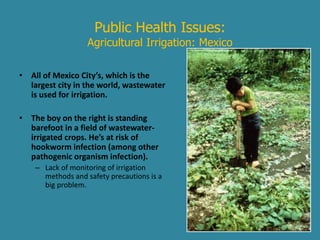
Public Health Issues: 
Agricultural Irrigation: Mexico 
• All of Mexico City’s, which is the 
largest city in the world, wastewater 
is used for irrigation. 
• The boy on the right is standing 
barefoot in a field of wastewater-irrigated 
crops. He’s at risk of 
hookworm infection (among other 
pathogenic organism infection). 
– Lack of monitoring of irrigation 
methods and safety precautions is a 
big problem.
Public Health & Environmental Issues: 
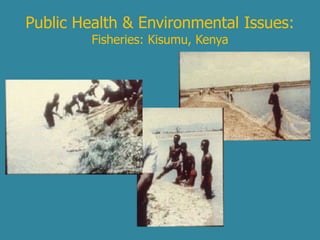
Fisheries: Kisumu, Kenya
Public Health & Environmental Issues: 
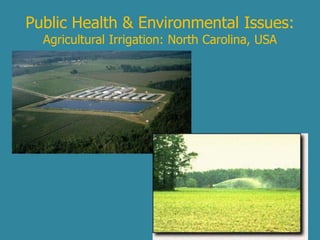
Agricultural Irrigation: North Carolina, USA
Public Health & Environmental Issues: 
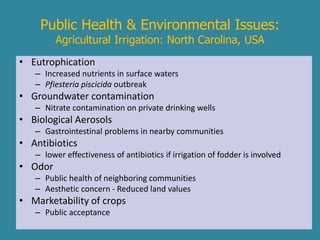
Agricultural Irrigation: North Carolina, USA 
• Eutrophication 
– Increased nutrients in surface waters 
– Pfiesteria piscicida outbreak 
• Groundwater contamination 
– Nitrate contamination on private drinking wells 
• Biological Aerosols 
– Gastrointestinal problems in nearby communities 
• Antibiotics 
– lower effectiveness of antibiotics if irrigation of fodder is involved 
• Odor 
– Public health of neighboring communities 
– Aesthetic concern - Reduced land values 
• Marketability of crops 
– Public acceptance
Environmental Health Issues: 
Agricultural Irrigation 
• The most relevant reclaimed water qualities for 
irrigation are 
– Salinity 
• Increased osmotic pressure on plants 
– Specific Ion Toxicity 
• Worse in hot and arid regions (due to high evapotranspiration) 
– Nutrients 
• Reclaimed wastewater must be applied according to agronomic 
scales (i.e. in the EU: Directive 91/676/EEC : “230 kg nitrogen / ha 
year on agricultural land cropped by grass, grass catch crops or beets 
and other crops being under-sown by grass with low nitrate leaching 
potential”)
CONCLUSION 
•Wastewater reclamation and reuse is imperative for 
future. 
•If wastewater reuse is exercised properly (treatment, 
end user, safety measures, education), and if public 
misapprehension is expelled, the benefits that can be 
reaped are great and will far outweigh any associated 
costs. 
•However, if this important water resource is 
improperly managed, then the risks to both the public 
health and to the environment can be enormous.
THANK YOU

Waste water reuse1

  • 1.
    WASTE WATER REUSE ADITYA GHUMARE PGD-ACM NICMAR, Pune.
  • 2.
    OUTLINE • Introduction – The Hydrologic Cycle and reclaimed water – Need for Wastewater Reuse • Wastewater Reclamation Technologies • Wastewater Reuse Applications – Historical Examples – Agricultural and Landscape Irrigation – Industrial Reuse – Groundwater Recharge – Planned Indirect & Potable Water Reuse • Public Health and Environmental Considerations – Constituents in Reclaimed Water – Public Health Issues – Environmental Health Issues – What level of treatment is necessary?
  • 4.
    Need for WastewaterReuse: Mediterranean & Near East Countries examples Country Area (Km2) Total renewable fresh water (Km3/year) 1990 2050a Popln. (1000’s) Water availability (m3/capita year) Popln. (1000’s) Water availability (m3/capita year) Cyprus 9,250 0.90 702 1282 1006 895 Egypt 1,000,500 58.90 56312 1046 117398 502 Greece 132,000 69.00 10238 5763 8591 6868 Israel 20,700 2.15 4660 461 8927 241 Lebanon 10,360 4.98 2555 1949 5189 960 Spain 504,800 111.00 39272 2826 31765 3494 Syria 185,000 25.79 12348 2089 47212 546 Turkey 780,000 203.00 56098 3619 106284 1910 a UN medium projection for population
  • 5.
    Need for WastewaterReuse: Mediterranean Basin & Near East Countries • Agricultural Production – Irrigation: the largest water user (~70-80% of total) – 50% of food requirements are imported – 30% of cultivated area is irrigated • But it accounts for 75% of total agricultural production • Capacity to Sustain Domestic Food Production – 750 m3 / inhabitant year necessary – 1990: 5 countries (Algeria, Israel, Jordan, Malta, Tunisia) – 2050: 4 more countries (Egypt, Libya, Morocco, Syria) • Water Availability – Temporal and Spatial Asymmetries – “Misguided” agricultural practices
  • 6.
    Wastewater Reclamation Technologies Conventional Methods • Activated sludge (AS) – Aerobic – Anaerobic • Filtration • Biological nutrient removal (BNR) • Combinations of the above unit processes
  • 7.
    Wastewater Reclamation Technologies Advanced Treatment Methods (Example: Denver, Colorado, USA; 1 MGD plant, direct injection) Lime Unchlorinated secondary effluent Rapid Mix Flocculation Clarification CO2 Re-carbonation Ballast pond Filtration Backwash water return Ultraviolet Disinfection Carbon Adsorption Reverse Osmosis OR Ultra-filtration Air Stripping Ozonation Chlorination
  • 8.
    Wastewater Reclamation Technologies Advanced Treatment Example • El-Paso, Texas, USA – Use: Direct Injection of reclaimed municipal wastewater – Capacity: 38,000 m3/day – Unit processes: • Primary treatment  Activated Sludge process with BNR  Lime clarification  Re-carbonation  granular medium filtration  activated-carbon adsorption  demineralization by reverse osmosis  chlorination
  • 9.
    Wastewater Reclamation Technologies Sustainability Issues • Sustainability of treatment method – WW reclamation and reuse; a sustainable practice – Are the treatment technologies sustainable? – Natural Treatment Systems • Constructed Wetlands • Duckweed Ponds • How much treatment is enough? – What is the source of wastewater? • Greywater vs. Blackwater – Who is the end user? • Agriculture • Industry • Communities
  • 10.
    Historical Examples –3000 BC – Crete (Minoan culture) • Collection of rainwater and sand “filtration” for reuse – 1890 – Mexico • Agricultural irrigation – 1912 – Europe & US • Landscape irrigation – 1926 – US & Europe • Industrial uses: cooling processes & boilers – 1960 – US; Europe; Africa; Australia • Landscape Irrigation (including golf-courses) • Groundwater Recharge • Advanced WW reclamation for potable water supply augmentation – 1980 – US; Europe; Japan • Water recycling for toilet flushing in urban areas • Agricultural irrigation of food crops eaten uncooked
  • 11.
    Uses of ReclaimedWater • Agricultural Irrigation • Landscape Irrigation • Industrial Recycling and Reuse • Groundwater Recharge • Recreational / Environmental Uses • Non-Potable Urban Uses • Potable Reuse
  • 12.
    Wastewater Reclamation &Reuse and the Hydrologic Cycle Groundwater Recharge Agricultural reuse Surface water discharge Industrial reuse Municipal use Groundwater Irrigation Wastewater Water Industrial use Treatment Wastewater Treatment Precipitation
  • 13.
    Agricultural Irrigation •Why reuse wastewater in agricultural irrigation? – Freshwater resources can be reserved for other uses – Chemical fertilizer usage can be minimized – Discharge of reclaimed wastewater to water bodies can be prevented • Agro-irrigation = Largest Current User of Reclaimed Water • Main uses (in order of “preference”) – Non-food crops • Commercial nurseries; Timber • Animal Fodder – Food Crops • Fruit-tree Orchards • Cereals • Vegetables • ALSO: Consider the Type of irrigation system
  • 14.
    Agricultural Irrigation Yorkshire- England Potato irrigation from maturation pond
  • 15.
  • 16.
  • 17.
    Agricultural Irrigation &Reclaimed Wastewater: Mezquital, Mexico Crop Yield in tons/ha Increase (%) Wastewater Fresh water Maize corn 5.0 2.0 150 Barley 4.0 2.0 100 Tomato 35.0 18.0 94 Alfalfa 120.0 70.0 71 Wheat 3.0 1.8 67
  • 18.
    Landscape Irrigation &Recreational / Environmental Uses • Landscape Irrigation – Parks – School yards – Highway medians – Golf courses – Cemeteries – Residential • Recreational / Environmental Uses – Lakes & ponds – Marsh enhancement – Fisheries
  • 19.
  • 20.
  • 21.
    Examples from India • Thermax India, Pune has developed the waste water treatment process in their Cinchwad plant that can make the industrial waste water potable • GMR IT park at Chennai has system that utilizes the waste water from sinks to flush the toilets
  • 22.
    Industrial Reuse &Urban Uses • Industrial Recycling and Reuse – Cooling water – Boiler feed – Process water – Heavy construction • Non-Potable Urban Uses – Fire protection – Air conditioning – Toilet flushing • Potable Reuse – Blending in water supply reservoirs (Namibia example) – Pipe-to-pipe water supply
  • 23.
    Groundwater Recharge •Groundwater replenishment – The following must be considered: • the quality of the recharge water; • the recharge method used; • the physical characteristics of the aquifer layers; • the water residence time; • the amount of blending with other sources; • Saltwater intrusion control • Subsidence control
  • 24.
    Constituents in ReclaimedWater • Conventional (measured in mg/L; used in designing conventional WWTPs) – TSS – BOD; COD – TOC – Nitrogen (Ammonia; Nitrate; Nitrite) – Phosphorus – Microorganisms: Bacteria; Viruses ; Protozoan cysts & oocysts • Non-conventional (to be removed or reduced by advanced treatment processes) – Refractory organics – Surfactants – Metals – TDS • Emerging (measured in μg/L; long-term health concerns possible; not easy to remove) – Pharmaceuticals – Antibiotics (veterinary & human) – Home-care, industrial, and household products – Hormones (steroids) and Endocrine Disrupters
  • 25.
    Public Health Issues: Agricultural Irrigation: Mexico • All of Mexico City’s, which is the largest city in the world, wastewater is used for irrigation. • The boy on the right is standing barefoot in a field of wastewater-irrigated crops. He’s at risk of hookworm infection (among other pathogenic organism infection). – Lack of monitoring of irrigation methods and safety precautions is a big problem.
  • 26.
    Public Health &Environmental Issues: Fisheries: Kisumu, Kenya
  • 27.
    Public Health &Environmental Issues: Agricultural Irrigation: North Carolina, USA
  • 28.
    Public Health &Environmental Issues: Agricultural Irrigation: North Carolina, USA • Eutrophication – Increased nutrients in surface waters – Pfiesteria piscicida outbreak • Groundwater contamination – Nitrate contamination on private drinking wells • Biological Aerosols – Gastrointestinal problems in nearby communities • Antibiotics – lower effectiveness of antibiotics if irrigation of fodder is involved • Odor – Public health of neighboring communities – Aesthetic concern - Reduced land values • Marketability of crops – Public acceptance
  • 29.
    Environmental Health Issues: Agricultural Irrigation • The most relevant reclaimed water qualities for irrigation are – Salinity • Increased osmotic pressure on plants – Specific Ion Toxicity • Worse in hot and arid regions (due to high evapotranspiration) – Nutrients • Reclaimed wastewater must be applied according to agronomic scales (i.e. in the EU: Directive 91/676/EEC : “230 kg nitrogen / ha year on agricultural land cropped by grass, grass catch crops or beets and other crops being under-sown by grass with low nitrate leaching potential”)
  • 30.
    CONCLUSION •Wastewater reclamationand reuse is imperative for future. •If wastewater reuse is exercised properly (treatment, end user, safety measures, education), and if public misapprehension is expelled, the benefits that can be reaped are great and will far outweigh any associated costs. •However, if this important water resource is improperly managed, then the risks to both the public health and to the environment can be enormous.
  • 31.