Unit I Water Distribution System
Water supply
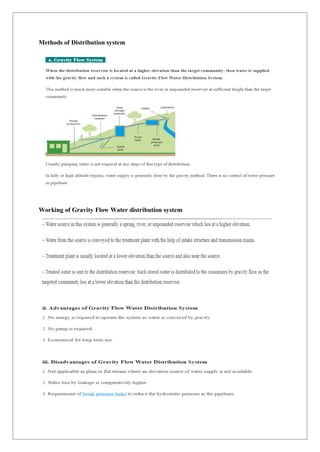
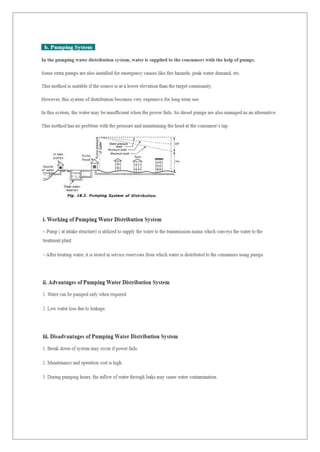
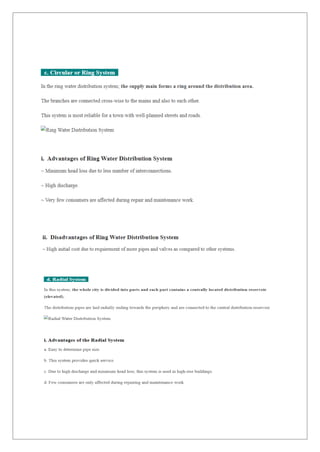
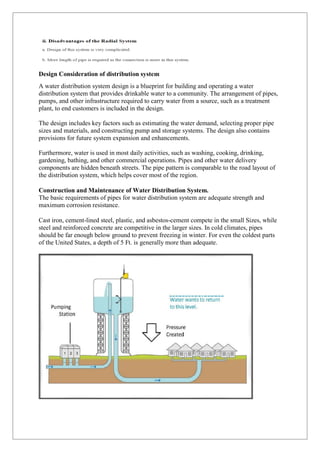
Methods of Distribution system
Working of Gravity Flow Water distribution system
Design Consideration of distribution system
A water distribution system design is a blueprint for building and operating a water
distribution system that provides drinkable water to a community. The arrangement of pipes,
pumps, and other infrastructure required to carry water from a source, such as a treatment
plant, to end customers is included in the design.
The design includes key factors such as estimating the water demand, selecting proper pipe
sizes and materials, and constructing pump and storage systems. The design also contains
provisions for future system expansion and enhancements.
Furthermore, water is used in most daily activities, such as washing, cooking, drinking,
gardening, bathing, and other commercial operations. Pipes and other water delivery
components are hidden beneath streets. The pipe pattern is comparable to the road layout of
the distribution system, which helps cover most of the region.
Construction and Maintenance of Water Distribution System.
The basic requirements of pipes for water distribution system are adequate strength and
maximum corrosion resistance.
Cast iron, cement-lined steel, plastic, and asbestos-cement compete in the small Sizes, while
steel and reinforced concrete are competitive in the larger sizes. In cold climates, pipes
should be far enough below ground to prevent freezing in winter. For even the coldest parts
of the United States, a depth of 5 Ft. is generally more than adequate.
In warm climates, the pipes need to be buried only sufficiently to avoid damage from traffic
loads. Service connections to cast iron or asbestos cement pipe are made by tapping the
distribution main with a special tapping machine which provides a threaded hole 1/2 to 2
inches in diameter.
A corporation cock is then installed with a flexible gooseneck pipe leading to the service
pipe. The gooseneck prevents damage if there is an unequal settlement between the main and
the service pipe.
Service pipes leading from the main to the consumer are usually copper tubing or galvanized
steel. For single-family dwellings, 3/4 to 1-1/4-inches pipe is common for service pipes, but
larger sizes may be needed for apartment houses or business establishments. When a new
pipe is first filled, all hydrants and valves are opened so that air can escape freely.
The filling is done slowly and may require several days for large systems. Excessive
pressures can develop if the air is not properly driven out of the system.
When a steady, uninterrupted stream issues from a hydrant, it is closed. The procedure is
continued until all valves, and hydrants are closed and the system is full of water.
Pumps and Pumping:
A pump is a mechanical device that lifts liquids from a lower level or low-pressure area to a
higher level or high-pressure area. It is a heavy-duty equipment with low suction and high
discharge pressure. This makes it easier to pump a fluid from a certain depth and push the
fluid to the desired height.
A pump is a mechanical device that lifts liquids from a lower level or low-pressure area to a
higher level or high-pressure area. It is a heavy-duty equipment with low suction and high
discharge pressure. This makes it easier to pump a fluid from a certain depth and push the
fluid to the desired height.
Necessity of Pumping
Pumps play a vital role in forcing out the water either directly or through a service reservoir.
In the distribution mains, the pressure has to be boosted or increased at a few intermediate
points. Pumps provide the required pressure so that the water reaches the required height in
multi-storeyed buildings.
Requirement of pumps:
A water supply scheme requires pumps at multiple stages.
1. In the case of groundwater sources and low-levelled surface sources, pumps are
required to lift the water as it cannot flow under gravity.
2. When sufficient slope is not available at a treatment plant to facilitate the gravitational
flow of water, pumps become a necessity.
3. After treatment, the water has to be forced into the distribution mains. Pumps play a
vital role in forcing out the water either directly or through a service reservoir.
4. In the distribution mains, the pressure has to be boosted or increased at a few
intermediate points. Pumps provide the required pressure so that the water reaches the
required height in multi-storeyed buildings.
Pumps Classification:
Many kinds of pumps are used in distribution systems. Pumps that lift surface water and
move it to a nearby treatment plant are called low-lift pumps. These move large volumes of
water at relatively low discharge pressures. Pumps that discharge treated water into arterial
mains are called high-lift pumps. These operate under higher pressures. Pumps that increase
the pressure within the distribution system or raise water into an elevated storage tank are
called booster pumps. Well pumps lift water from underground and discharge it directly into
a distribution system.
Most water distribution pumps are of the centrifugal type, in which a rapidly rotating impeller
adds energy to the water and raises the pressure inside the pump casing. The flow rate
through a centrifugal pump depends on the pressure against which it operates. The higher
the pressure, the lower the flow or discharge. Another kind of pump is the positive-
displacement type. This pump delivers a fixed quantity of water with each cycle of a piston or
rotor. The water is literally pushed or displaced from the pump casing. The flow capacity of a
positive-displacement pump is unaffected by the pressure of the system in which it operates.
1. Centrifugal pumps: Mixed flow and radial flow machines are typically called as
centrifugal pumps. It could be either open or closed based on the amount of
suspended solids present in the water. The closed impeller has plates on each side of
the vanes and the open impeller has a hub with vanes attached to it. The efficiency of
the closed impeller centrifugal pump is more than that of an open impeller centrifugal
pump.
2. Displacement or positive displacement pumps: This pump works on the principle
of mechanically inducing a vacuum in a chamber. Based on this principle, the pump
draws in water which is displaced mechanically and is then forced out of the chamber.
Reciprocating pumps and rotary pumps are the two types of positive-displacement
pumps.
Factors for selecting the type of pump:
The various factors that are needed to be taken into consideration while selecting a pump for
a particular project are as follows:
1. Capacity of the pump
2. Significance of the water supply project
3. Cost of the pumping arrangement
4. Maintenance cost of the project
5. Quantity of water to be pumped
6. Size and orientation of the pump
7. Number of pumping units required for a project
Leakages in water distribution system
Leakage from distribution systems will vary with the care exercised in construction and the
age and condition of the system.
Construction contracts usually specify an allowable leakage in the range from 50 to 250 GPD
(gallon per day) per inch of pipe diameter per mile of pipe.
The test is made by closing off a length of pipe between valves, and all service connections to
the pipe.
Water is introduced through a special inlet, and normal working pressure is maintained for at
least 12 hours while leakage is measured.
In an operating system, the total loss is estimated from the difference between the measured
input to the system and metered deliveries to the customers.
There are several possible methods of locating a specific leak. Patented leak detectors use
audio phones to pick up the sound of escaping water or the disturbance in an electrical held
caused by saturated ground near the leak.
Detection and Prevention of Leakages
Water leaks and structural weaknesses in pipes are a sign that a drinking water network could
soon fail. Leaks reduce the reliability of the water supply network and if undetected, such
leaks may contribute to future pipe failures. Another important point is that such leakages
trigger an important loss of resources, both in terms of water and energy.
As previously mentioned, pump oversizing can contribute to leaks. Pump oversizing often
occurs due to the need to withstand peak loads, but it results in higher energy bills, higher
operating costs, higher wear on all the components of the system, higher maintenance costs,
less system reliability and lower efficient operation. A non-adequate selection added with
other installation and design defects may cause leakage at mechanical joints of the pipes and
pumping system, due to inadequate support, vibrations and valve problems.
Additional pumping system issues include inefficient system operation, excessive
maintenance requirements, erosion of components, and cavitation.
Signs of an oversized system include excessive flow noise, heavily throttled flow control
valves, heavy use of bypass lines, frequent replacement of bearings and seals and intermittent
pump operation. Remedies include VFDs, smaller impeller or impeller trimming or smaller
pumps
Preventive methods of leakage in water supply
There are a number of ways that you can help protect your organization against water leak
damage, and many of them are quick and relatively inexpensive.
Insulate Exposed Pipes
Frozen pipes are one of the largest causes of water leak damage in areas that experience
prolonged periods of cold weather. Adding inexpensive foam insulation to pipes in your
facility can help keep the water in them just above the freezing point, ensuring it can flow
freely and lower the risk of freezing during prolonged periods.
Pipe insulation can also act as a short-term barrier if a leak occurs as well.
Inspect HVAC Units
Leaking or improperly function HVAC units are a major cause of water leaks in commercial
buildings. Clogged pipes and drains, malfunctioning condensate pumps, and even external
piping can cause water to leak within your facility.
If you own your HVAC units, have them inspected and serviced regularly, especially after a
major weather event. Unseen damage can have a negative impact on your building, causing
leaking and further damage to your facility. Periodic spot-checks of drainage pains and
visible pipes/tubing is helpful as well.
Check for roof and foundation damage
A few missing roof tiles are all it takes to allow water into your building. High winds can
cause roof damage, so it’s important to check after major storms to ensure that your roof will
be ready for the next major weather event.
Likewise, foundation damage will potentially lead to water leaks as well. Regions that have
major thaws and snow melts are particularly susceptible to these types of leaks, so be sure to
check your building’s basement and foundation yearly to identify any potential leak
locations.
While your basement may not be your business’s primary location, you may store material
there that can become damaged when a leak occurs. Unseen water may also lead to mold
conditions, which can cause employee health concerns if left unnoticed.
Install Proactive Leak Detection
Being alerted to a water leak as soon as it’s first detected is a big step towards helping
prevent extensive damage. Room Alert monitors paired with either a Flood Sensor
w/Cable or Flood Sensor (Spot) can easily alert you, or your entire staff, if water is detected
in a sensitive area that you are currently monitoring.
Room Alert can also notify you if humidity is increasing in any areas that you are monitoring
with a Digital Temperature & Humidity Sensor.
Gradually rising humidity rates can often indicate water being present, and if the humidity is
rising in your server room or telecom closet, you could be faced with a costly situation.
Humidity can easily damage sensitive electronics, bringing down your servers, phone system,
and more.

Unit I Water Distribution System.pdf

  • 1.
    Unit I WaterDistribution System Water supply
  • 3.
    Methods of Distributionsystem Working of Gravity Flow Water distribution system
  • 9.
    Design Consideration ofdistribution system A water distribution system design is a blueprint for building and operating a water distribution system that provides drinkable water to a community. The arrangement of pipes, pumps, and other infrastructure required to carry water from a source, such as a treatment plant, to end customers is included in the design. The design includes key factors such as estimating the water demand, selecting proper pipe sizes and materials, and constructing pump and storage systems. The design also contains provisions for future system expansion and enhancements. Furthermore, water is used in most daily activities, such as washing, cooking, drinking, gardening, bathing, and other commercial operations. Pipes and other water delivery components are hidden beneath streets. The pipe pattern is comparable to the road layout of the distribution system, which helps cover most of the region. Construction and Maintenance of Water Distribution System. The basic requirements of pipes for water distribution system are adequate strength and maximum corrosion resistance. Cast iron, cement-lined steel, plastic, and asbestos-cement compete in the small Sizes, while steel and reinforced concrete are competitive in the larger sizes. In cold climates, pipes should be far enough below ground to prevent freezing in winter. For even the coldest parts of the United States, a depth of 5 Ft. is generally more than adequate.
  • 10.
    In warm climates,the pipes need to be buried only sufficiently to avoid damage from traffic loads. Service connections to cast iron or asbestos cement pipe are made by tapping the distribution main with a special tapping machine which provides a threaded hole 1/2 to 2 inches in diameter. A corporation cock is then installed with a flexible gooseneck pipe leading to the service pipe. The gooseneck prevents damage if there is an unequal settlement between the main and the service pipe. Service pipes leading from the main to the consumer are usually copper tubing or galvanized steel. For single-family dwellings, 3/4 to 1-1/4-inches pipe is common for service pipes, but larger sizes may be needed for apartment houses or business establishments. When a new pipe is first filled, all hydrants and valves are opened so that air can escape freely. The filling is done slowly and may require several days for large systems. Excessive pressures can develop if the air is not properly driven out of the system. When a steady, uninterrupted stream issues from a hydrant, it is closed. The procedure is continued until all valves, and hydrants are closed and the system is full of water. Pumps and Pumping: A pump is a mechanical device that lifts liquids from a lower level or low-pressure area to a higher level or high-pressure area. It is a heavy-duty equipment with low suction and high discharge pressure. This makes it easier to pump a fluid from a certain depth and push the fluid to the desired height. A pump is a mechanical device that lifts liquids from a lower level or low-pressure area to a higher level or high-pressure area. It is a heavy-duty equipment with low suction and high discharge pressure. This makes it easier to pump a fluid from a certain depth and push the fluid to the desired height. Necessity of Pumping Pumps play a vital role in forcing out the water either directly or through a service reservoir. In the distribution mains, the pressure has to be boosted or increased at a few intermediate points. Pumps provide the required pressure so that the water reaches the required height in multi-storeyed buildings. Requirement of pumps: A water supply scheme requires pumps at multiple stages. 1. In the case of groundwater sources and low-levelled surface sources, pumps are required to lift the water as it cannot flow under gravity. 2. When sufficient slope is not available at a treatment plant to facilitate the gravitational flow of water, pumps become a necessity.
  • 11.
    3. After treatment,the water has to be forced into the distribution mains. Pumps play a vital role in forcing out the water either directly or through a service reservoir. 4. In the distribution mains, the pressure has to be boosted or increased at a few intermediate points. Pumps provide the required pressure so that the water reaches the required height in multi-storeyed buildings. Pumps Classification: Many kinds of pumps are used in distribution systems. Pumps that lift surface water and move it to a nearby treatment plant are called low-lift pumps. These move large volumes of water at relatively low discharge pressures. Pumps that discharge treated water into arterial mains are called high-lift pumps. These operate under higher pressures. Pumps that increase the pressure within the distribution system or raise water into an elevated storage tank are called booster pumps. Well pumps lift water from underground and discharge it directly into a distribution system. Most water distribution pumps are of the centrifugal type, in which a rapidly rotating impeller adds energy to the water and raises the pressure inside the pump casing. The flow rate through a centrifugal pump depends on the pressure against which it operates. The higher the pressure, the lower the flow or discharge. Another kind of pump is the positive- displacement type. This pump delivers a fixed quantity of water with each cycle of a piston or rotor. The water is literally pushed or displaced from the pump casing. The flow capacity of a positive-displacement pump is unaffected by the pressure of the system in which it operates. 1. Centrifugal pumps: Mixed flow and radial flow machines are typically called as centrifugal pumps. It could be either open or closed based on the amount of suspended solids present in the water. The closed impeller has plates on each side of the vanes and the open impeller has a hub with vanes attached to it. The efficiency of the closed impeller centrifugal pump is more than that of an open impeller centrifugal pump. 2. Displacement or positive displacement pumps: This pump works on the principle of mechanically inducing a vacuum in a chamber. Based on this principle, the pump draws in water which is displaced mechanically and is then forced out of the chamber. Reciprocating pumps and rotary pumps are the two types of positive-displacement pumps.
  • 12.
    Factors for selectingthe type of pump: The various factors that are needed to be taken into consideration while selecting a pump for a particular project are as follows: 1. Capacity of the pump 2. Significance of the water supply project 3. Cost of the pumping arrangement 4. Maintenance cost of the project 5. Quantity of water to be pumped 6. Size and orientation of the pump 7. Number of pumping units required for a project Leakages in water distribution system Leakage from distribution systems will vary with the care exercised in construction and the age and condition of the system. Construction contracts usually specify an allowable leakage in the range from 50 to 250 GPD (gallon per day) per inch of pipe diameter per mile of pipe. The test is made by closing off a length of pipe between valves, and all service connections to the pipe. Water is introduced through a special inlet, and normal working pressure is maintained for at least 12 hours while leakage is measured. In an operating system, the total loss is estimated from the difference between the measured input to the system and metered deliveries to the customers. There are several possible methods of locating a specific leak. Patented leak detectors use audio phones to pick up the sound of escaping water or the disturbance in an electrical held caused by saturated ground near the leak. Detection and Prevention of Leakages Water leaks and structural weaknesses in pipes are a sign that a drinking water network could soon fail. Leaks reduce the reliability of the water supply network and if undetected, such leaks may contribute to future pipe failures. Another important point is that such leakages trigger an important loss of resources, both in terms of water and energy. As previously mentioned, pump oversizing can contribute to leaks. Pump oversizing often occurs due to the need to withstand peak loads, but it results in higher energy bills, higher operating costs, higher wear on all the components of the system, higher maintenance costs, less system reliability and lower efficient operation. A non-adequate selection added with
  • 13.
    other installation anddesign defects may cause leakage at mechanical joints of the pipes and pumping system, due to inadequate support, vibrations and valve problems. Additional pumping system issues include inefficient system operation, excessive maintenance requirements, erosion of components, and cavitation. Signs of an oversized system include excessive flow noise, heavily throttled flow control valves, heavy use of bypass lines, frequent replacement of bearings and seals and intermittent pump operation. Remedies include VFDs, smaller impeller or impeller trimming or smaller pumps Preventive methods of leakage in water supply There are a number of ways that you can help protect your organization against water leak damage, and many of them are quick and relatively inexpensive. Insulate Exposed Pipes Frozen pipes are one of the largest causes of water leak damage in areas that experience prolonged periods of cold weather. Adding inexpensive foam insulation to pipes in your facility can help keep the water in them just above the freezing point, ensuring it can flow freely and lower the risk of freezing during prolonged periods. Pipe insulation can also act as a short-term barrier if a leak occurs as well. Inspect HVAC Units Leaking or improperly function HVAC units are a major cause of water leaks in commercial buildings. Clogged pipes and drains, malfunctioning condensate pumps, and even external piping can cause water to leak within your facility. If you own your HVAC units, have them inspected and serviced regularly, especially after a major weather event. Unseen damage can have a negative impact on your building, causing leaking and further damage to your facility. Periodic spot-checks of drainage pains and visible pipes/tubing is helpful as well. Check for roof and foundation damage A few missing roof tiles are all it takes to allow water into your building. High winds can cause roof damage, so it’s important to check after major storms to ensure that your roof will be ready for the next major weather event. Likewise, foundation damage will potentially lead to water leaks as well. Regions that have major thaws and snow melts are particularly susceptible to these types of leaks, so be sure to check your building’s basement and foundation yearly to identify any potential leak locations. While your basement may not be your business’s primary location, you may store material there that can become damaged when a leak occurs. Unseen water may also lead to mold conditions, which can cause employee health concerns if left unnoticed. Install Proactive Leak Detection Being alerted to a water leak as soon as it’s first detected is a big step towards helping prevent extensive damage. Room Alert monitors paired with either a Flood Sensor
  • 14.
    w/Cable or FloodSensor (Spot) can easily alert you, or your entire staff, if water is detected in a sensitive area that you are currently monitoring. Room Alert can also notify you if humidity is increasing in any areas that you are monitoring with a Digital Temperature & Humidity Sensor. Gradually rising humidity rates can often indicate water being present, and if the humidity is rising in your server room or telecom closet, you could be faced with a costly situation. Humidity can easily damage sensitive electronics, bringing down your servers, phone system, and more.