Solid Waste Management 
10/9/2014 SWM 1
10/9/2014 SWM 2
What are solid wastes? 
 All wastes happening from human and animal 
activities 
 Normally solid 
 Discarded as useless or unwanted 
 Urban community, Agricultural, Industrial and 
Mineral wastes 
10/9/2014 SWM 3
10/9/2014 SWM 4
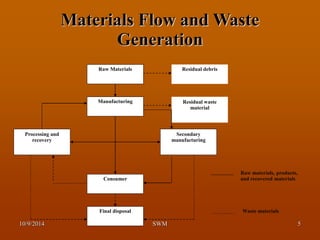
Materials Flow and Waste 
Generation 
Raw Materials 
Manufacturing 
Secondary 
manufacturing 
Processing and 
recovery 
Consumer 
Final disposal 
Residual debris 
Residual waste 
material 
Raw materials, products, 
and recovered materials 
Waste materials 
10/9/2014 SWM 5
Solid Waste Management 
 The discipline associated with the control of 
generation, storage, collection, transfer and 
transport, processing, and disposal of solid 
wastes in a manner that is in accord with the 
best principles of public health, economics, 
engineering, conservation, aesthetics, and 
other environmental considerations, and that is 
also responsive to public attitudes. 
10/9/2014 SWM 6
10/9/2014 SWM 7
Solid Waste Management 
(continued) 
 Complex interdisciplinary relationships among 
political science, city and regional planning, 
geography, economics, public health, 
sociology, demography, communications, and 
conservation, as well as engineering and 
materials science 
10/9/2014 SWM 8
Interrelationships between the functional elements in a solid 
waste management system 
Waste generation 
Waste handling, separation, storage, and 
processing at the source 
Collection 
Separation and processing and 
transformation of solid waste 
Transfer and 
transport 
Disposal 
10/9/2014 9 
SWM
Waste handling, separation, storage, 
and processing at the source 
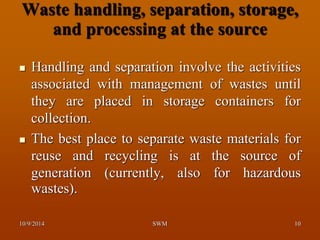
 Handling and separation involve the activities 
associated with management of wastes until 
they are placed in storage containers for 
collection. 
 The best place to separate waste materials for 
reuse and recycling is at the source of 
generation (currently, also for hazardous 
wastes). 
10/9/2014 SWM 10
Collection 
 Include the gathering and the transport of these 
materials 
 In large cities, where the haul distance to the 
point of disposal is greater than 15 miles, the 
haul may have significant economic 
implications. 
 Transfer and transport facilities are normally 
used where long distances are involved 
10/9/2014 SWM 11
Separation and processing and 
transformation of solid waste 
 Separated wastes are recovered by three means, i.e. 
curbside collection, drop off, and buy back centres. 
 Processing includes; e.g. the separation of bulky items, 
size reduction by shredding, separation of ferrous 
metals using magnets. 
 Transformation processes are used to reduce the 
volume and weight of waste requiring disposal and to 
recover conversion products and energy. 
10/9/2014 SWM 12
Transfer and Transport 
1. The transfer of wastes from the smaller 
collection vehicle to the larger transport 
equipment 
2. The subsequent transport of the wastes, 
usually over long distances, to a processing 
or disposal site 
10/9/2014 SWM 13
Disposal 
 Landfilling or landspreading is the ultimate 
fate of all solid wastes. 
 A modern sanitary landfill is not a dump; it is 
an engineered facility used for disposing of 
solid wastes without creating nuisances or 
hazards to public health or safety. 
 EIA is required for all new landfill sites. 
10/9/2014 SWM 14
Integrated Solid Waste 
Management 
“The selection and application of suitable 
techniques, technologies, and management 
programs to achieve specific waste 
management objectives and goals” 
10/9/2014 SWM 15
Hierarchy of Integrated Solid Waste 
Management 
 Source reduction: the most effective way to reduce 
waste quantity 
 Recycling: involves the separation and collection; the 
preparation for reuse, reprocessing; the reuse, 
reprocessing 
 Waste transformation: the physical, chemical, or 
biological alteration of wastes 
 Landfilling: the least desirable but indispensable 
mean for dealing with wastes 
10/9/2014 SWM 16
Sources, Types, and 
Composition of Industrial 
Solid Wastes 
10/9/2014 SWM 17
Sources of Solid Wastes 
 Residential 
 Commercial 
 Institutional 
 Construction and Demolition 
 Municipal services 
 Treatment plant sites 
 Industrial 
 Agricultural 
Municipal solid waste 
(MSW) 
10/9/2014 SWM 18
Plastic Materials 
 Polyethylene terephthalate (PETE/1) 
 High-density polyethylene (HDPE/2) 
 Polyvinyl chloride (PVC/3) 
 Low-density polyethylene (LDPE/4) 
 Polypropylene (PP/5) 
 Polystyrene (PS/6) 
 Other multilayered plastic materials (7) 
10/9/2014 SWM 19
Hazardous Wastes 
“Wastes or combinations of wastes 
that pose a substantial present or 
potential hazard to human health or 
living organisms” 
10/9/2014 SWM 20
Industrial Solid Waste Excluding Process 
Wastes 
10/9/2014 SWM 21
Industrial Solid Waste Excluding Process 
Wastes (cont.) 
10/9/2014 SWM 22
10/9/2014 SWM 23
10/9/2014 SWM 24
Determination of the Composition 
of MSW in the Field 
 Residential MSW: 200 lb (90.72kg) of samples is 
considered enough. To obtain a sample, the load is 
first quartered. One part is then selected for 
additional quartering until a sample size of about 
200 lb (90.72kg) is obtained. 
 Commercial and Industrial MSW: Samples 
need to be taken directly from the source, not from 
a mixed waste load in a collection vehicle. 
10/9/2014 SWM 25
Physical, Chemical, and 
Biological Properties of 
MSW 
10/9/2014 SWM 26
Physical Properties of MSW 
 Specific weight 
 Moisture content 
 Particle size and size distribution 
 Field capacity 
 Compacted waste porosity 
10/9/2014 SWM 27
10/9/2014 SWM 28
Chemical Properties of MSW 
 The four most important properties if solid 
wastes are to be used as fuel are; 
1. Proximate analysis 
2. Fusing point of ash 
3. Ultimate analysis (major elements) 
4. Energy content 
 The major and trace elements are required 
if the MSW is to be composted or used as 
10/9/2014 feedstock SWM 29
Proximate Analysis 
 Moisture (moisture lost after heated at 
105°C for 1 hr.) 
 Volatile combustible matter (additional loss 
of weight after ignited at 950°C) 
 Fixed carbon (combustible residue after 
volatile matter removal) 
 Ash (weight of residue after combustion) 
10/9/2014 SWM 30
Ultimate Analysis of Solid Waste 
Components 
 Involves the determination of the percent 
C, H, O, N, S, and ash 
 Due to the chlorinated compounds 
emission, the determination of halogens is 
often included. 
 Moreover, they are used to define the 
proper mix of waste materials to achieve 
suitable C/N ratios for biological 
conversion processes. 
10/9/2014 SWM 31
10/9/2014 SWM 32
Energy Content of Solid Waste 
Components 
Determined by; 
1. A full scale boiler as a calorimeter 
2. A laboratory bomb calorimeter 
3. Calculation, if the elemental 
composition is known 
1 
Btu lb C H O ) 40S 10N 
/ 145 610( 2 2      
8 
10/9/2014 SWM 33
10/9/2014 SWM 34
10/9/2014 SWM 35
Physical Transformations 
1. Component separation 
2. Mechanical volume reduction 
3. Mechanical size reduction 
10/9/2014 SWM 36
Chemical Transformations 
1. Combustion (chemical oxidation) 
2. Pyrolysis 
3. Gasification 
10/9/2014 SWM 37
10/9/2014 SWM 38
Biological Transformations 
 Aerobic Composting 
 Anaerobic Digestion 
10/9/2014 SWM 39
10/9/2014 SWM 40
10/9/2014 SWM 41
Waste Handling and 
Separation, Storage, and 
Processing at The Source 
10/9/2014 SWM 42
Waste Handling and Separation 
at Commercial and Industrial 
Facilities 
 Relatively large containers mounted on 
rollers are utilised before being emptied. 
 Solid wastes from industrial facilities are 
handled in the same way as those from the 
commercial facilities. 
10/9/2014 SWM 43
Storage of Solid Wastes at 
The Source 
 Effects of Storage on Waste Components; 
biological decomposition, absorption of 
fluids, contamination of waste components 
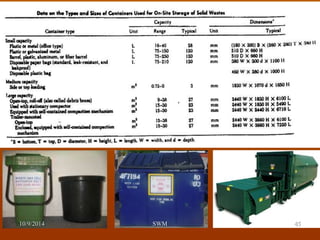
 Types of Containers 
10/9/2014 SWM 44
10/9/2014 SWM 45
10/9/2014 SWM 46
Processing of Solid Wastes at 
the Source 
 Grinding of Food Wastes 
 Separation of Wastes 
 Compaction 
 Composting 
 Combustion 
10/9/2014 SWM 47
Collection of Solid Waste 
10/9/2014 SWM 48
Introduction 
 Difficulties arise from the complexity 
of the sources of solid wastes. 
 Due to the high costs of fuel and labour, 
~50-70% of total money spent for 
collection, transportation, and disposal 
in 1992 was used on the collection 
phase. 
10/9/2014 SWM 49
Definition of Collection 
“Gathering or picking up of solid wastes, 
including the hauling to and unloading at 
the site” 
10/9/2014 SWM 50
10/9/2014 SWM 51
10/9/2014 SWM 52
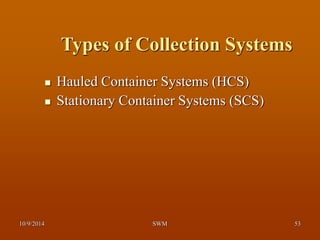
Types of Collection Systems 
 Hauled Container Systems (HCS) 
 Stationary Container Systems (SCS) 
10/9/2014 SWM 53
HCS: Conventional Mode 
10/9/2014 SWM 54
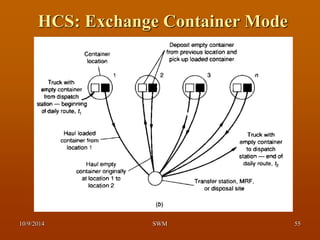
HCS: Exchange Container Mode 
10/9/2014 SWM 55
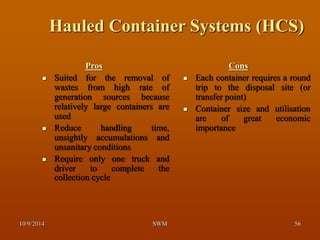
Hauled Container Systems (HCS) 
Pros 
 Suited for the removal of 
wastes from high rate of 
generation sources because 
relatively large containers are 
used 
 Reduce handling time, 
unsightly accumulations and 
unsanitary conditions 
 Require only one truck and 
driver to complete the 
collection cycle 
Cons 
 Each container requires a round 
trip to the disposal site (or 
transfer point) 
 Container size and utilisation 
are of great economic 
importance 
10/9/2014 SWM 56
10/9/2014 SWM 57
Personnel Requirements for HCS 
 Usually, a single collector-driver is used 
 A driver and helper should be used, in 
some cases, for safety reasons or where 
hazardous wastes are to be handled 
10/9/2014 SWM 58
SCS 
10/9/2014 SWM 59
Stationary Container Systems (SCS) 
 Can be used for the collection of all types of wastes 
 There are two main types: mechanically loaded and 
manually loaded 
 Internal compaction mechanisms are widely use thanks 
to their economical advantages 
10/9/2014 SWM 60
Transfer Operations 
Can be economical when; 
1. Small, manually loaded collection vehicles are 
used for residential wastes and long haul 
distances are involved 
2. Extremely large quantities of wastes must be 
hauled over long distances 
3. One transfer station can be used by a number of 
collection vehicles 
10/9/2014 SWM 61
Personnel Requirements for SCS 
Mechanically 
 The same as for HCS 
 A driver and two helpers 
are used if the containers 
are at the inaccessible 
locations, e.g. congested 
downtown commercial 
area 
Manually 
 The number of collectors 
varies from 1 to 3 
10/9/2014 SWM 62
Separation and Processing 
and Transformation of Solid 
Waste 
10/9/2014 SWM 63
Uses for recovered materials 
 Direct reuse 
 Raw materials for remanufacturing and 
reprocessing 
 Feedstock for biological and chemical 
conversion products 
 Fuel source 
 Land reclamation 
10/9/2014 SWM 64
Unit Operations Used For The 
Separation and Processing of Waste 
Materials 
 To modify the physical characteristics of the 
waste 
 To remove specific components and 
contaminants 
 To process and prepare the separated materials 
for subsequent uses 
10/9/2014 SWM 65
Shredders (a) hammermill (b) fail mill (c) shear shredder 
Trommel 
10/9/2014 SWM 66
Magnetic Separators 
Baler 
10/9/2014 SWM Can Crusher 67
Facilities for Handling, Moving, and Storing Waste Materials 
10/9/2014 SWM 68
10/9/2014 SWM 69
10/9/2014 SWM 70
10/9/2014 SWM 71
Waste Transformation Through 
Combustion 
10/9/2014 SWM 72
Waste Transformation through 
Aerobic Composting 
10/9/2014 SWM 73
Objectives of Composting 
1. To stabilise the biodegradable organic 
materials 
2. To destroy pathogens, insect eggs, etc. 
3. To retain the maximum nutrient (N,P,K) 
4. To produce fertilizer 
10/9/2014 SWM 74
Windrow 
Composting 
Static Pile 
Composting 
10/9/2014 SWM 75
Transfer and Transport 
10/9/2014 SWM 76
The Need for Transfer Operations 
 Direct hauling is not feasible 
 Illegal dumping due to the excessive haul 
distances 
 Disposal sites are far from the collection 
routes more than 10 mi 
 Use of small-capacity collection vehicles 
(< 20 yd3) 
 Low-density residential service area 
10/9/2014 SWM 77
The Need for Transfer 
Operations (continued) 
 The use of HCS with small containers for 
commercial sources waste 
 The use of hydraulic or pneumatic 
collection systems 
 Transfer operation is an integral part of 
the operation of a MRF 
10/9/2014 SWM 78
Types of Transfer Station 
Direct-load 
Storage-load 
Combined direct-and 
discharge-load 
Storing 
capacity 
1-3 days 
10/9/2014 SWM 79
Disposal of Solid Wastes 
and Residual Matter 
10/9/2014 SWM 80
10/9/2014 SWM 81
Development and completion 
of a landfill 
Preparation of the 
site for landfilling 
The placement of 
wastes 
Postclosure 
management 
10/9/2014 SWM 82
Concerns with the Landfilling 
of Solid Wastes 
 The uncontrolled release of landfill gases 
 The impact of landfill gases as the greenhouse 
gases 
 The uncontrolled release of leachate 
 The breeding and harbouring of disease 
vectors 
 The adverse effects of the trace gases arising 
from the hazardous materials 
10/9/2014 SWM 83
“The goal for the design and 
operation of a modern landfill 
is to eliminate or minimize the 
impacts associated with these 
concerns.” 
10/9/2014 SWM 84
10/9/2014 SWM 85
10/9/2014 SWM 86
10/9/2014 SWM 87
10/9/2014 SWM 88
10/9/2014 SWM 89
10/9/2014 SWM 90
10/9/2014 SWM 91

Solid waste management

  • 1.
    Solid Waste Management 10/9/2014 SWM 1
  • 2.
  • 3.
    What are solidwastes?  All wastes happening from human and animal activities  Normally solid  Discarded as useless or unwanted  Urban community, Agricultural, Industrial and Mineral wastes 10/9/2014 SWM 3
  • 4.
  • 5.
    Materials Flow andWaste Generation Raw Materials Manufacturing Secondary manufacturing Processing and recovery Consumer Final disposal Residual debris Residual waste material Raw materials, products, and recovered materials Waste materials 10/9/2014 SWM 5
  • 6.
    Solid Waste Management  The discipline associated with the control of generation, storage, collection, transfer and transport, processing, and disposal of solid wastes in a manner that is in accord with the best principles of public health, economics, engineering, conservation, aesthetics, and other environmental considerations, and that is also responsive to public attitudes. 10/9/2014 SWM 6
  • 7.
  • 8.
    Solid Waste Management (continued)  Complex interdisciplinary relationships among political science, city and regional planning, geography, economics, public health, sociology, demography, communications, and conservation, as well as engineering and materials science 10/9/2014 SWM 8
  • 9.
    Interrelationships between thefunctional elements in a solid waste management system Waste generation Waste handling, separation, storage, and processing at the source Collection Separation and processing and transformation of solid waste Transfer and transport Disposal 10/9/2014 9 SWM
  • 10.
    Waste handling, separation,storage, and processing at the source  Handling and separation involve the activities associated with management of wastes until they are placed in storage containers for collection.  The best place to separate waste materials for reuse and recycling is at the source of generation (currently, also for hazardous wastes). 10/9/2014 SWM 10
  • 11.
    Collection  Includethe gathering and the transport of these materials  In large cities, where the haul distance to the point of disposal is greater than 15 miles, the haul may have significant economic implications.  Transfer and transport facilities are normally used where long distances are involved 10/9/2014 SWM 11
  • 12.
    Separation and processingand transformation of solid waste  Separated wastes are recovered by three means, i.e. curbside collection, drop off, and buy back centres.  Processing includes; e.g. the separation of bulky items, size reduction by shredding, separation of ferrous metals using magnets.  Transformation processes are used to reduce the volume and weight of waste requiring disposal and to recover conversion products and energy. 10/9/2014 SWM 12
  • 13.
    Transfer and Transport 1. The transfer of wastes from the smaller collection vehicle to the larger transport equipment 2. The subsequent transport of the wastes, usually over long distances, to a processing or disposal site 10/9/2014 SWM 13
  • 14.
    Disposal  Landfillingor landspreading is the ultimate fate of all solid wastes.  A modern sanitary landfill is not a dump; it is an engineered facility used for disposing of solid wastes without creating nuisances or hazards to public health or safety.  EIA is required for all new landfill sites. 10/9/2014 SWM 14
  • 15.
    Integrated Solid Waste Management “The selection and application of suitable techniques, technologies, and management programs to achieve specific waste management objectives and goals” 10/9/2014 SWM 15
  • 16.
    Hierarchy of IntegratedSolid Waste Management  Source reduction: the most effective way to reduce waste quantity  Recycling: involves the separation and collection; the preparation for reuse, reprocessing; the reuse, reprocessing  Waste transformation: the physical, chemical, or biological alteration of wastes  Landfilling: the least desirable but indispensable mean for dealing with wastes 10/9/2014 SWM 16
  • 17.
    Sources, Types, and Composition of Industrial Solid Wastes 10/9/2014 SWM 17
  • 18.
    Sources of SolidWastes  Residential  Commercial  Institutional  Construction and Demolition  Municipal services  Treatment plant sites  Industrial  Agricultural Municipal solid waste (MSW) 10/9/2014 SWM 18
  • 19.
    Plastic Materials Polyethylene terephthalate (PETE/1)  High-density polyethylene (HDPE/2)  Polyvinyl chloride (PVC/3)  Low-density polyethylene (LDPE/4)  Polypropylene (PP/5)  Polystyrene (PS/6)  Other multilayered plastic materials (7) 10/9/2014 SWM 19
  • 20.
    Hazardous Wastes “Wastesor combinations of wastes that pose a substantial present or potential hazard to human health or living organisms” 10/9/2014 SWM 20
  • 21.
    Industrial Solid WasteExcluding Process Wastes 10/9/2014 SWM 21
  • 22.
    Industrial Solid WasteExcluding Process Wastes (cont.) 10/9/2014 SWM 22
  • 23.
  • 24.
  • 25.
    Determination of theComposition of MSW in the Field  Residential MSW: 200 lb (90.72kg) of samples is considered enough. To obtain a sample, the load is first quartered. One part is then selected for additional quartering until a sample size of about 200 lb (90.72kg) is obtained.  Commercial and Industrial MSW: Samples need to be taken directly from the source, not from a mixed waste load in a collection vehicle. 10/9/2014 SWM 25
  • 26.
    Physical, Chemical, and Biological Properties of MSW 10/9/2014 SWM 26
  • 27.
    Physical Properties ofMSW  Specific weight  Moisture content  Particle size and size distribution  Field capacity  Compacted waste porosity 10/9/2014 SWM 27
  • 28.
  • 29.
    Chemical Properties ofMSW  The four most important properties if solid wastes are to be used as fuel are; 1. Proximate analysis 2. Fusing point of ash 3. Ultimate analysis (major elements) 4. Energy content  The major and trace elements are required if the MSW is to be composted or used as 10/9/2014 feedstock SWM 29
  • 30.
    Proximate Analysis Moisture (moisture lost after heated at 105°C for 1 hr.)  Volatile combustible matter (additional loss of weight after ignited at 950°C)  Fixed carbon (combustible residue after volatile matter removal)  Ash (weight of residue after combustion) 10/9/2014 SWM 30
  • 31.
    Ultimate Analysis ofSolid Waste Components  Involves the determination of the percent C, H, O, N, S, and ash  Due to the chlorinated compounds emission, the determination of halogens is often included.  Moreover, they are used to define the proper mix of waste materials to achieve suitable C/N ratios for biological conversion processes. 10/9/2014 SWM 31
  • 32.
  • 33.
    Energy Content ofSolid Waste Components Determined by; 1. A full scale boiler as a calorimeter 2. A laboratory bomb calorimeter 3. Calculation, if the elemental composition is known 1 Btu lb C H O ) 40S 10N / 145 610( 2 2      8 10/9/2014 SWM 33
  • 34.
  • 35.
  • 36.
    Physical Transformations 1.Component separation 2. Mechanical volume reduction 3. Mechanical size reduction 10/9/2014 SWM 36
  • 37.
    Chemical Transformations 1.Combustion (chemical oxidation) 2. Pyrolysis 3. Gasification 10/9/2014 SWM 37
  • 38.
  • 39.
    Biological Transformations Aerobic Composting  Anaerobic Digestion 10/9/2014 SWM 39
  • 40.
  • 41.
  • 42.
    Waste Handling and Separation, Storage, and Processing at The Source 10/9/2014 SWM 42
  • 43.
    Waste Handling andSeparation at Commercial and Industrial Facilities  Relatively large containers mounted on rollers are utilised before being emptied.  Solid wastes from industrial facilities are handled in the same way as those from the commercial facilities. 10/9/2014 SWM 43
  • 44.
    Storage of SolidWastes at The Source  Effects of Storage on Waste Components; biological decomposition, absorption of fluids, contamination of waste components  Types of Containers 10/9/2014 SWM 44
  • 45.
  • 46.
  • 47.
    Processing of SolidWastes at the Source  Grinding of Food Wastes  Separation of Wastes  Compaction  Composting  Combustion 10/9/2014 SWM 47
  • 48.
    Collection of SolidWaste 10/9/2014 SWM 48
  • 49.
    Introduction  Difficultiesarise from the complexity of the sources of solid wastes.  Due to the high costs of fuel and labour, ~50-70% of total money spent for collection, transportation, and disposal in 1992 was used on the collection phase. 10/9/2014 SWM 49
  • 50.
    Definition of Collection “Gathering or picking up of solid wastes, including the hauling to and unloading at the site” 10/9/2014 SWM 50
  • 51.
  • 52.
  • 53.
    Types of CollectionSystems  Hauled Container Systems (HCS)  Stationary Container Systems (SCS) 10/9/2014 SWM 53
  • 54.
    HCS: Conventional Mode 10/9/2014 SWM 54
  • 55.
    HCS: Exchange ContainerMode 10/9/2014 SWM 55
  • 56.
    Hauled Container Systems(HCS) Pros  Suited for the removal of wastes from high rate of generation sources because relatively large containers are used  Reduce handling time, unsightly accumulations and unsanitary conditions  Require only one truck and driver to complete the collection cycle Cons  Each container requires a round trip to the disposal site (or transfer point)  Container size and utilisation are of great economic importance 10/9/2014 SWM 56
  • 57.
  • 58.
    Personnel Requirements forHCS  Usually, a single collector-driver is used  A driver and helper should be used, in some cases, for safety reasons or where hazardous wastes are to be handled 10/9/2014 SWM 58
  • 59.
  • 60.
    Stationary Container Systems(SCS)  Can be used for the collection of all types of wastes  There are two main types: mechanically loaded and manually loaded  Internal compaction mechanisms are widely use thanks to their economical advantages 10/9/2014 SWM 60
  • 61.
    Transfer Operations Canbe economical when; 1. Small, manually loaded collection vehicles are used for residential wastes and long haul distances are involved 2. Extremely large quantities of wastes must be hauled over long distances 3. One transfer station can be used by a number of collection vehicles 10/9/2014 SWM 61
  • 62.
    Personnel Requirements forSCS Mechanically  The same as for HCS  A driver and two helpers are used if the containers are at the inaccessible locations, e.g. congested downtown commercial area Manually  The number of collectors varies from 1 to 3 10/9/2014 SWM 62
  • 63.
    Separation and Processing and Transformation of Solid Waste 10/9/2014 SWM 63
  • 64.
    Uses for recoveredmaterials  Direct reuse  Raw materials for remanufacturing and reprocessing  Feedstock for biological and chemical conversion products  Fuel source  Land reclamation 10/9/2014 SWM 64
  • 65.
    Unit Operations UsedFor The Separation and Processing of Waste Materials  To modify the physical characteristics of the waste  To remove specific components and contaminants  To process and prepare the separated materials for subsequent uses 10/9/2014 SWM 65
  • 66.
    Shredders (a) hammermill(b) fail mill (c) shear shredder Trommel 10/9/2014 SWM 66
  • 67.
    Magnetic Separators Baler 10/9/2014 SWM Can Crusher 67
  • 68.
    Facilities for Handling,Moving, and Storing Waste Materials 10/9/2014 SWM 68
  • 69.
  • 70.
  • 71.
  • 72.
    Waste Transformation Through Combustion 10/9/2014 SWM 72
  • 73.
    Waste Transformation through Aerobic Composting 10/9/2014 SWM 73
  • 74.
    Objectives of Composting 1. To stabilise the biodegradable organic materials 2. To destroy pathogens, insect eggs, etc. 3. To retain the maximum nutrient (N,P,K) 4. To produce fertilizer 10/9/2014 SWM 74
  • 75.
    Windrow Composting StaticPile Composting 10/9/2014 SWM 75
  • 76.
    Transfer and Transport 10/9/2014 SWM 76
  • 77.
    The Need forTransfer Operations  Direct hauling is not feasible  Illegal dumping due to the excessive haul distances  Disposal sites are far from the collection routes more than 10 mi  Use of small-capacity collection vehicles (< 20 yd3)  Low-density residential service area 10/9/2014 SWM 77
  • 78.
    The Need forTransfer Operations (continued)  The use of HCS with small containers for commercial sources waste  The use of hydraulic or pneumatic collection systems  Transfer operation is an integral part of the operation of a MRF 10/9/2014 SWM 78
  • 79.
    Types of TransferStation Direct-load Storage-load Combined direct-and discharge-load Storing capacity 1-3 days 10/9/2014 SWM 79
  • 80.
    Disposal of SolidWastes and Residual Matter 10/9/2014 SWM 80
  • 81.
  • 82.
    Development and completion of a landfill Preparation of the site for landfilling The placement of wastes Postclosure management 10/9/2014 SWM 82
  • 83.
    Concerns with theLandfilling of Solid Wastes  The uncontrolled release of landfill gases  The impact of landfill gases as the greenhouse gases  The uncontrolled release of leachate  The breeding and harbouring of disease vectors  The adverse effects of the trace gases arising from the hazardous materials 10/9/2014 SWM 83
  • 84.
    “The goal forthe design and operation of a modern landfill is to eliminate or minimize the impacts associated with these concerns.” 10/9/2014 SWM 84
  • 85.
  • 86.
  • 87.
  • 88.
  • 89.
  • 90.
  • 91.