This document discusses scaling and shearing transformations in 2D geometry. Scaling transformations change the size of an object by multiplying its original coordinates by a scaling factor. Scaling can be uniform, changing both x and y coordinates by the same factor, or non-uniform, changing the factors differently. Shearing transformations slant the shape of an object by adding a multiple of one coordinate to the other. There are x-shearing, y-shearing, and combined x-y shearing transformations. Scaling and shearing are examples of non-rigid body transformations that change the shape or size of an object.
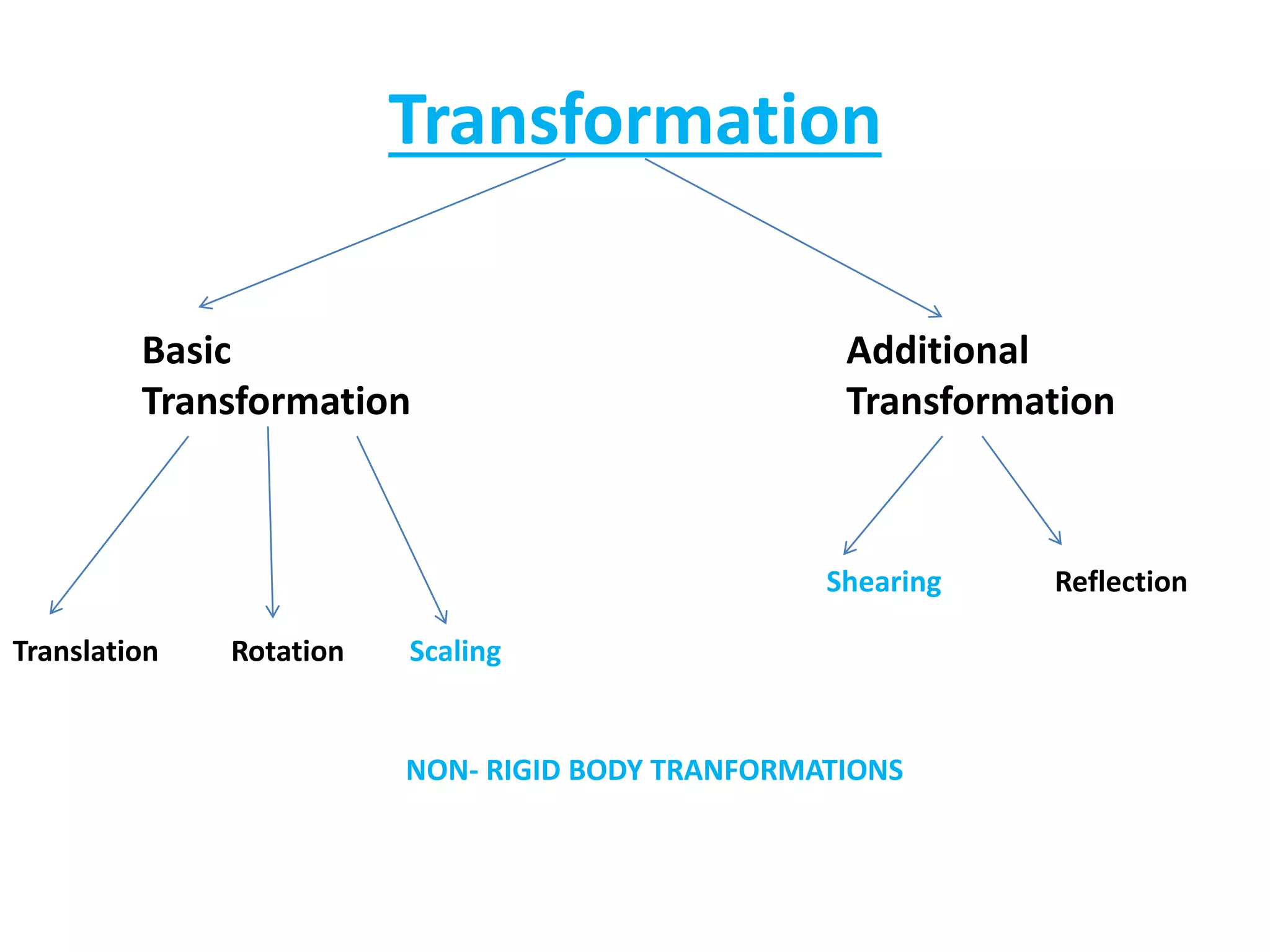
Overview of scaling and shearing, key transformations including translation, rotation, scaling, and shearing with respective mathematical representations.
Scaling
• To changethe size of an object, scaling
transformation is used.
• In the scaling process, we can either expand or
compress the dimensions of the object.
• Scaling can be achieved by multiplying the
original coordinates of the object with the
scaling factor to get the desired result.
• Example-
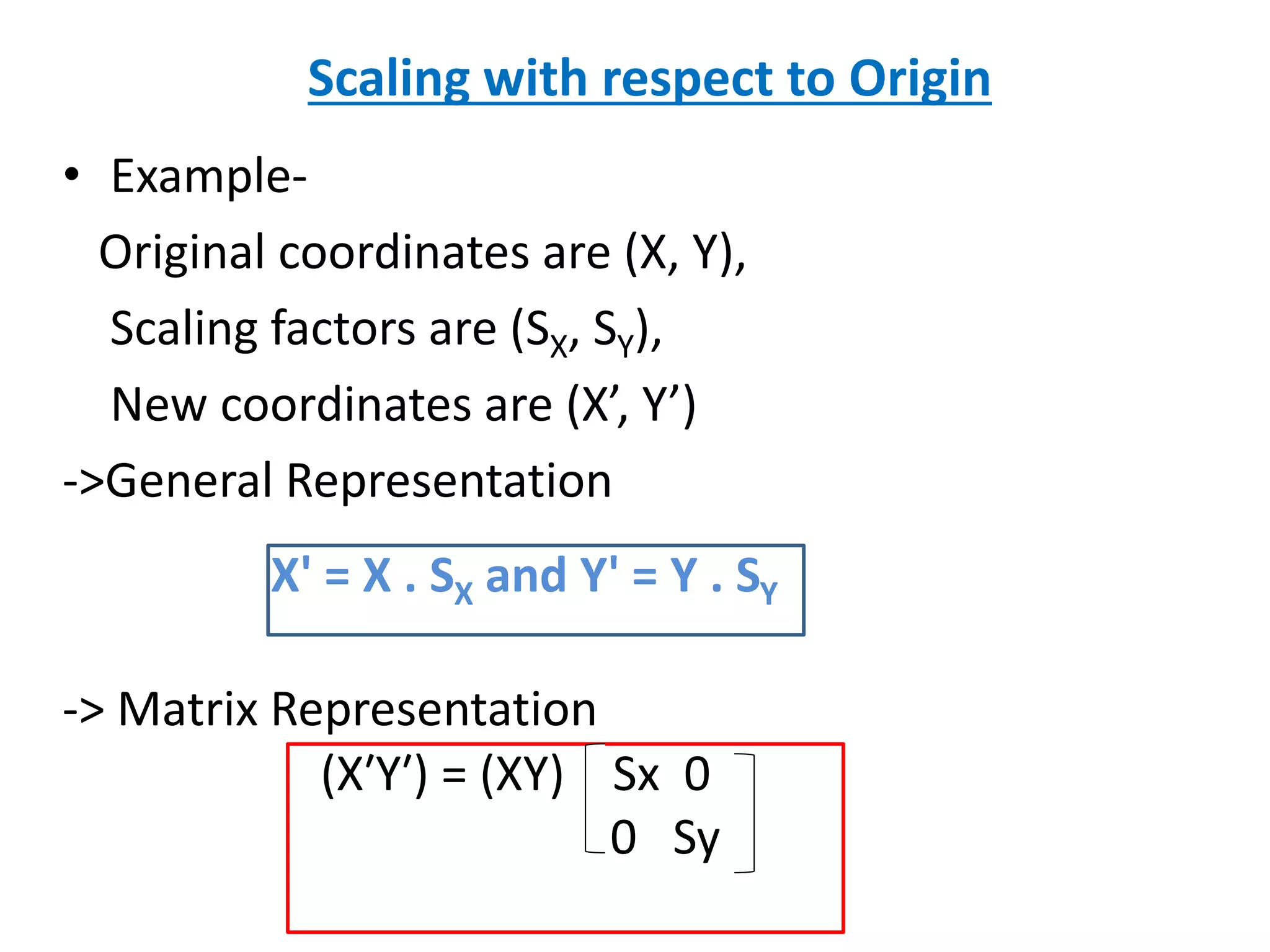
Original coordinatesare (X, Y),
Scaling factors are (SX, SY),
New coordinates are (X’, Y’)
->General Representation
-> Matrix Representation
X' = X . SX and Y' = Y . SY
(X′Y′) = (XY) Sx 0
0 Sy
Scaling with respect to Origin
6.
Scaling with respectto Origin
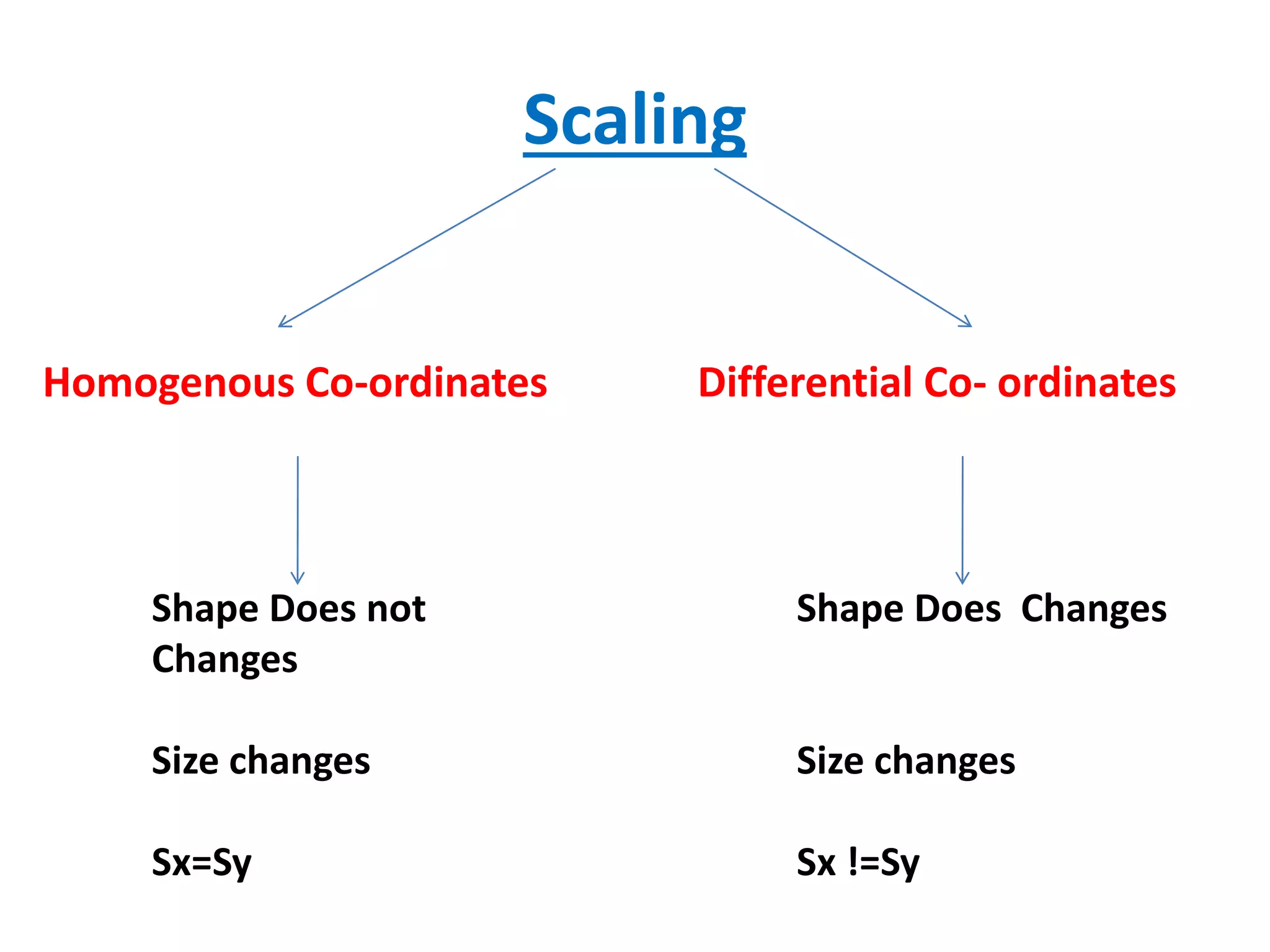
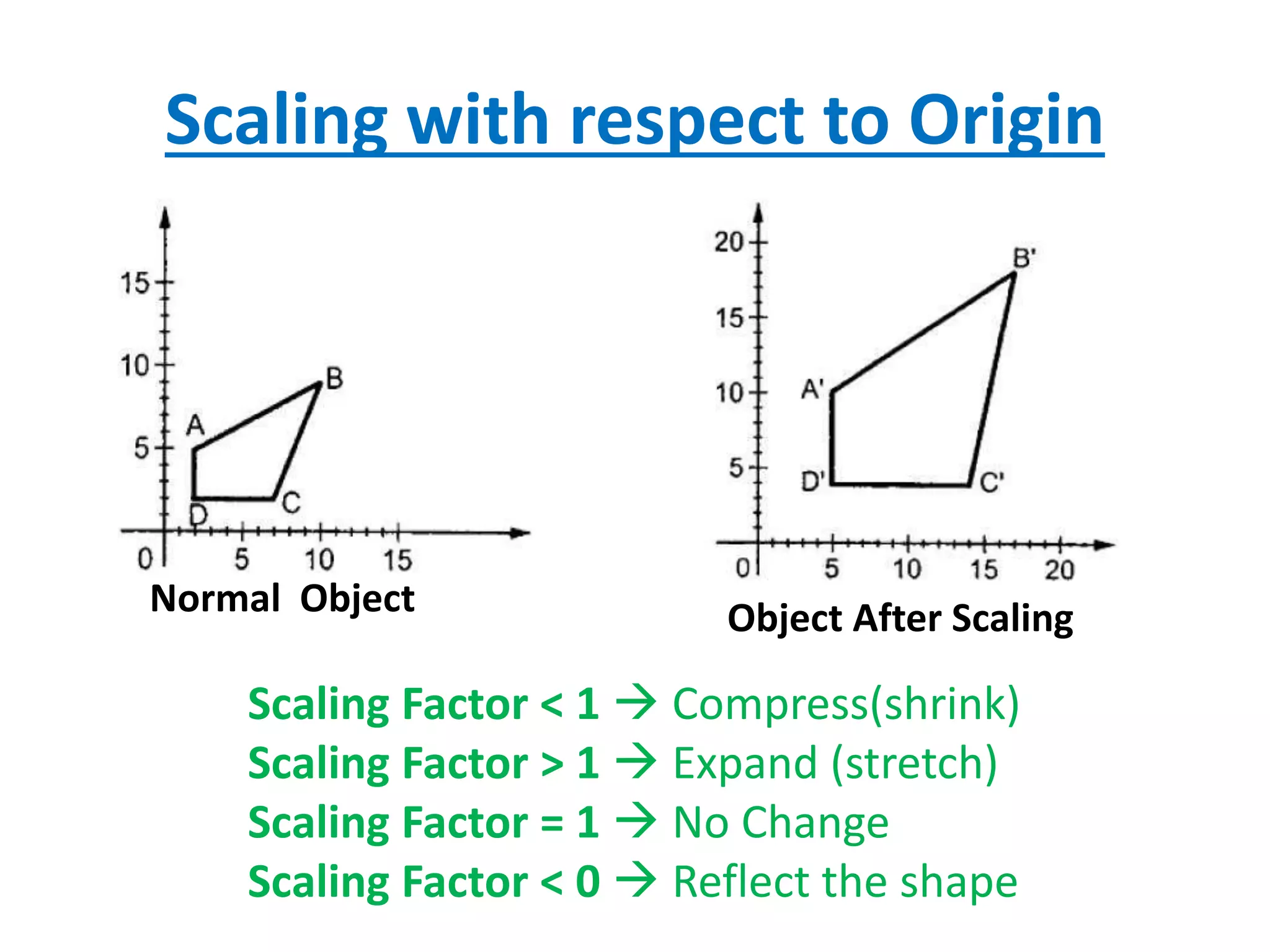
Normal Object Object After Scaling
Scaling Factor < 1 Compress(shrink)
Scaling Factor > 1 Expand (stretch)
Scaling Factor = 1 No Change
Scaling Factor < 0 Reflect the shape
7.
Scaling with respectto Point
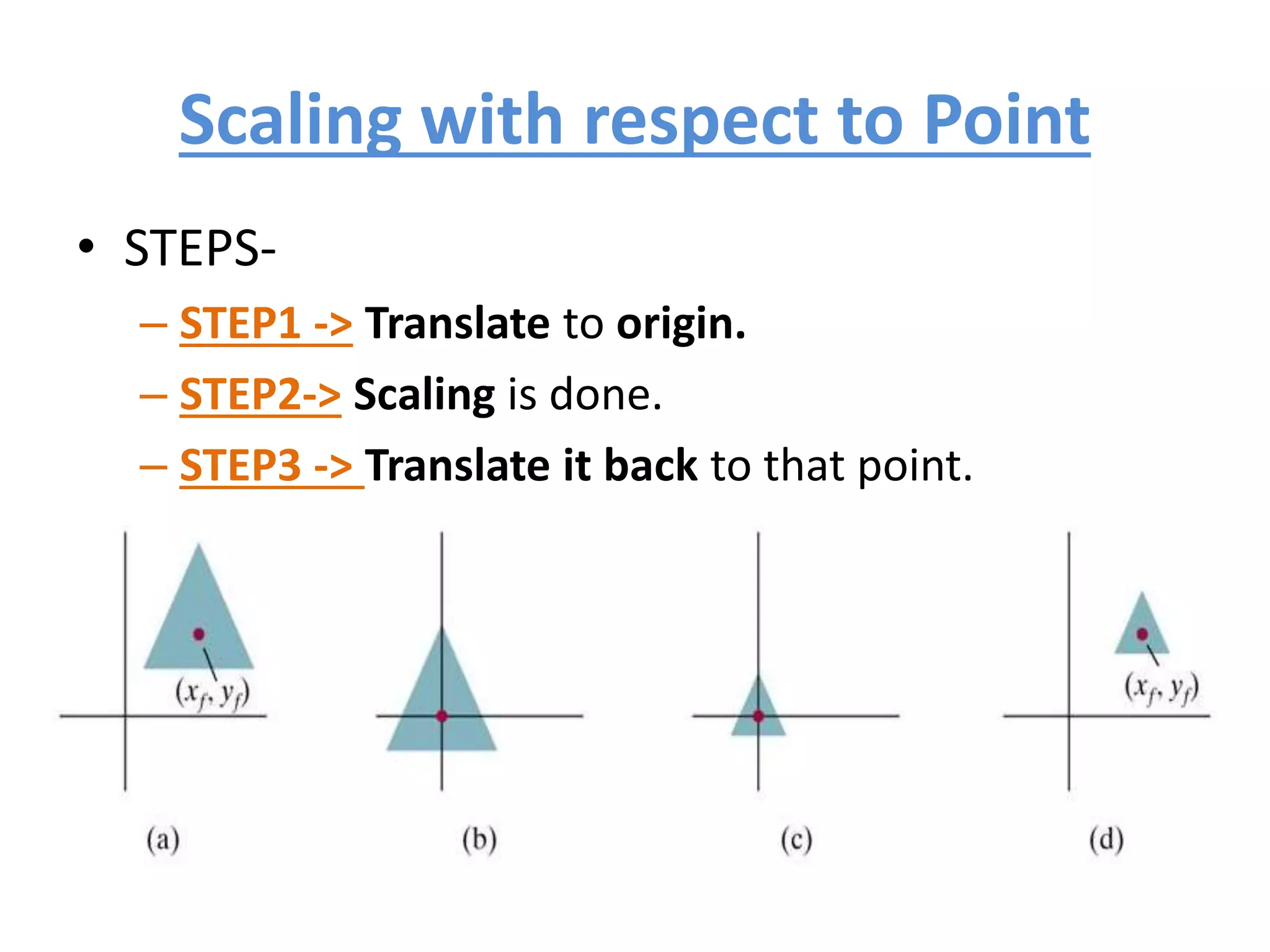
• STEPS-
– STEP1 -> Translate to origin.
– STEP2-> Scaling is done.
– STEP3 -> Translate it back to that point.
8.
Shearing
• Shearing isalso known as Skewing.
• It is a transformation that slants the shape of
an object.
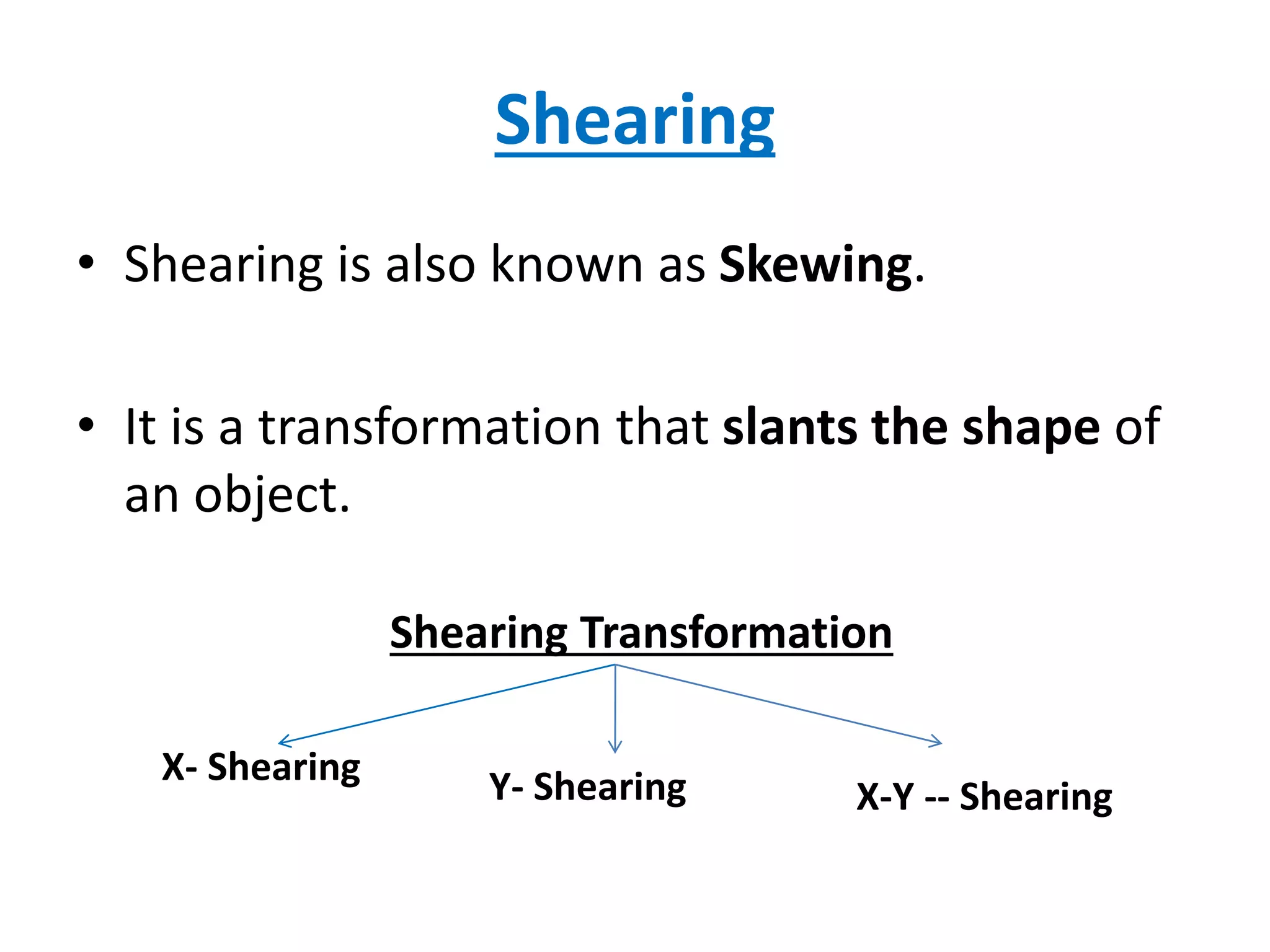
Shearing Transformation
X- Shearing Y- Shearing X-Y -- Shearing
9.
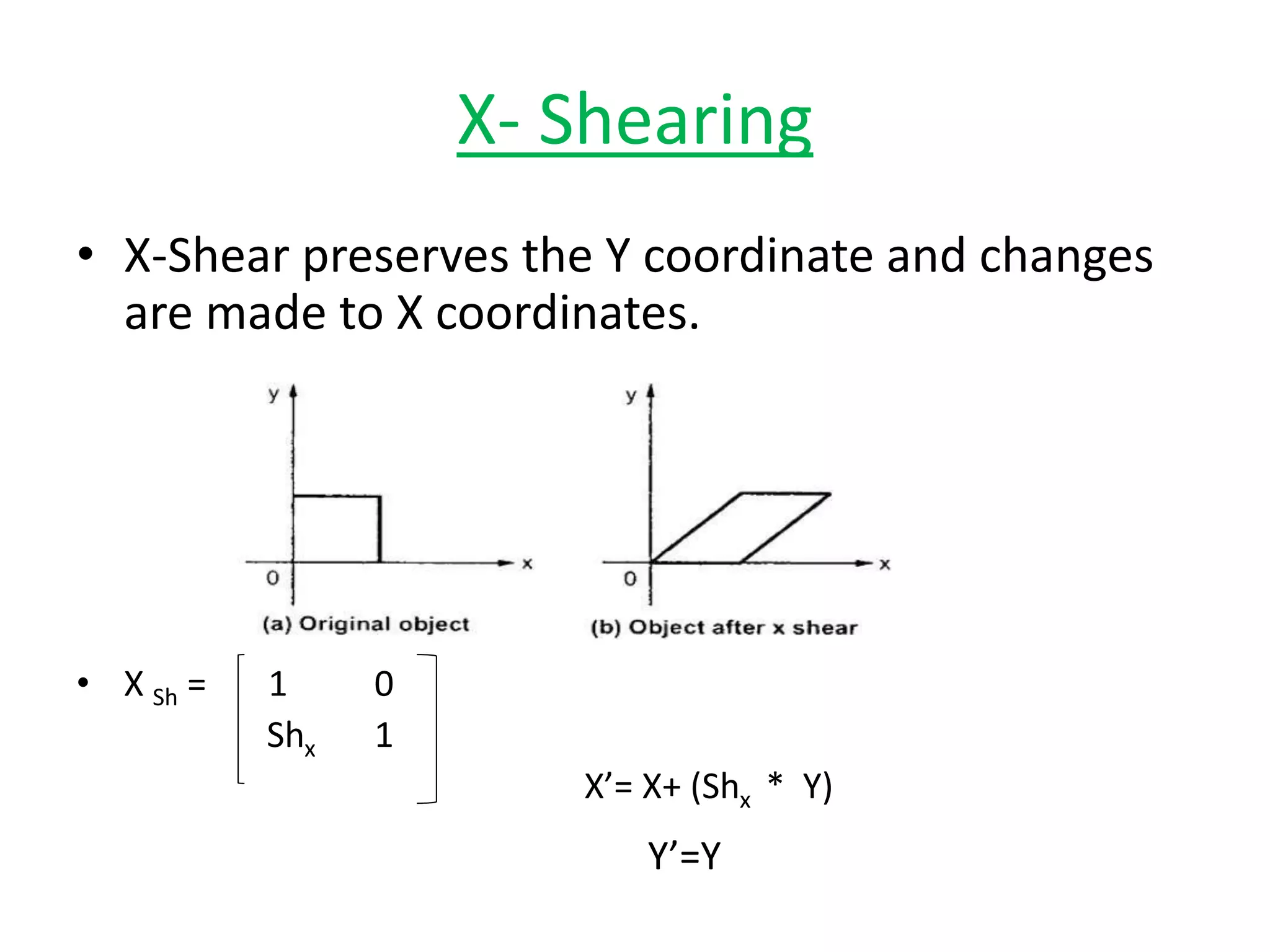
X- Shearing
• X-Shearpreserves the Y coordinate and changes
are made to X coordinates.
• X Sh = 1 0
Shx 1
X’= X+ (Shx * Y)
Y’=Y
10.
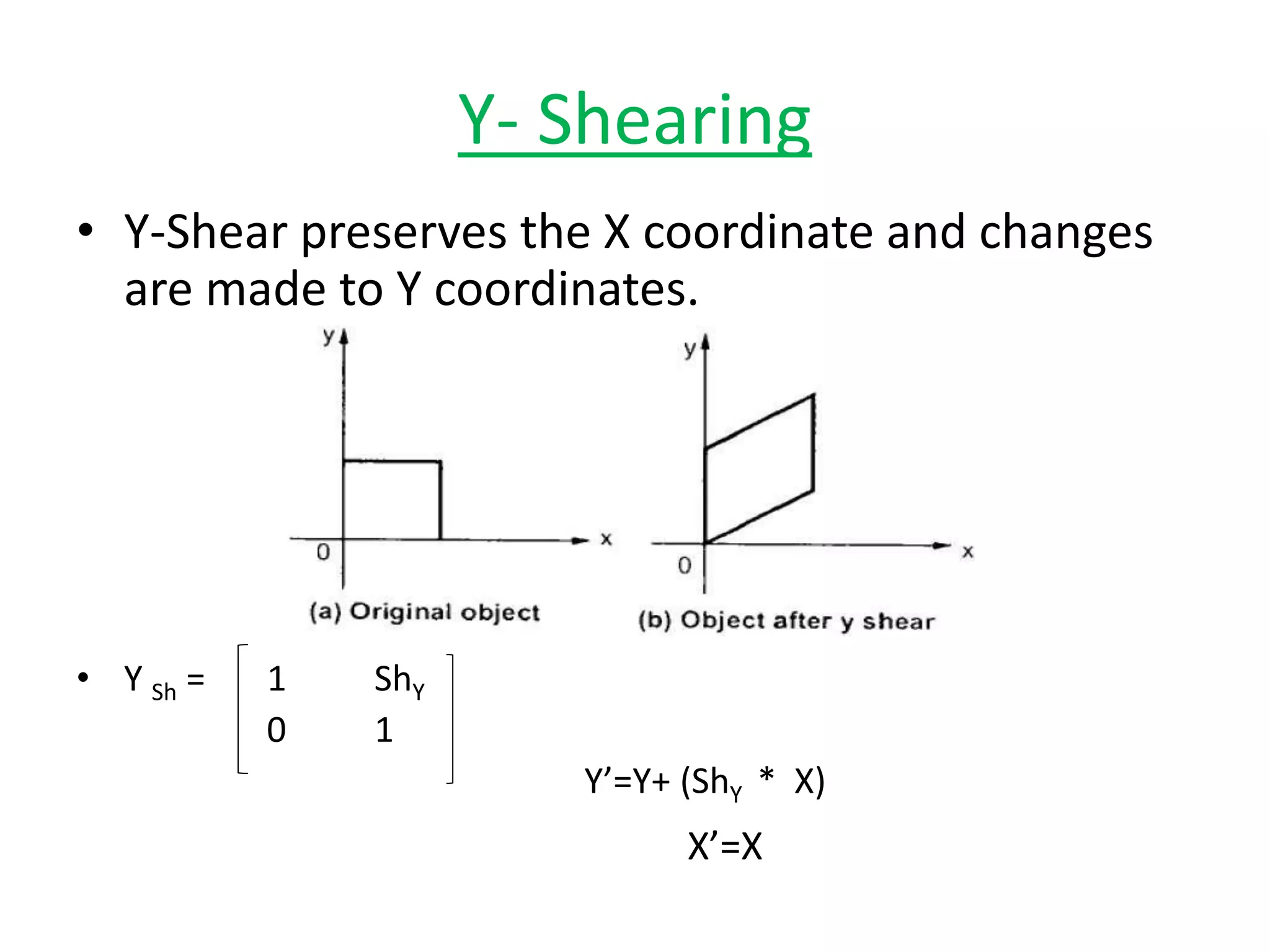
Y- Shearing
• Y-Shearpreserves the X coordinate and changes
are made to Y coordinates.
• Y Sh = 1 ShY
0 1
Y’=Y+ (ShY * X)
X’=X
11.
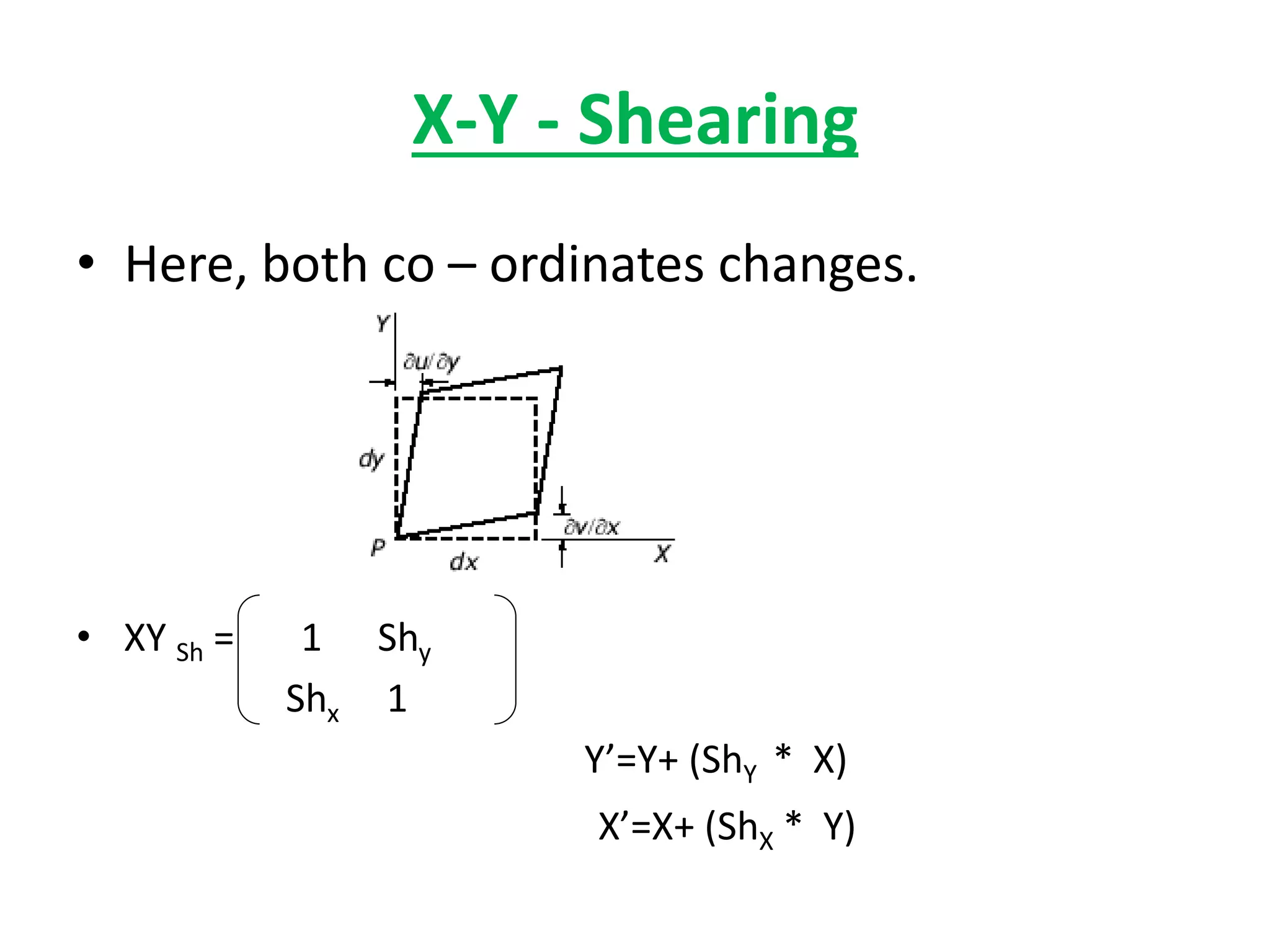
X-Y - Shearing
•Here, both co – ordinates changes.
• XY Sh = 1 Shy
Shx 1
Y’=Y+ (ShY * X)
X’=X+ (ShX * Y)