POLYGON CLIPPING WITH
SUTHERLAND HODGEMAN
ALGORITHM
AND
SCAN LINE FILL ALGORITHM
Clipping
 The primary use of clipping in computer graphics is to remove
objects, lines, or line segments that are outside the viewing pane .
Clip Window: The region against which an object is to be clipped.
 Point Clipping
 Line Clipping (straight-line segments)
 Area Clipping (polygons)
 Text Clipping
Polygon Clipping
 Clipping a polygon fill area needs more than line-clipping of the
polygon edges
-would produce and unconnected set of lines
 Must generate one or more closed polylines, which can be filled with
the assigned colour or pattern
Sutherland–Hodgeman algorithm
 Each edge of the polygon must be tested against each edge of the clip
rectangle; new edges must be added, and existing edges must be
discarded, retained, or divided. Multiple polygons may result from
clipping a single polygon. We need an organized way to deal with all
these cases
FOUR POSSIBLE SCENARIOS AT EACH CLIPPER
Each edge goes through 4 clippers .The rule for each edge for each clipper is:
 If first input vertex is outside, and second is inside, output the intersection and
the second vertex
 If first both input vertices are inside, then just output second vertex
 If first input vertex is inside, and second is outside, output is the intersection
 If both vertices are outside, output is nothing
Steps of Sutherland-Hodgmans polygon
clipping algorithm
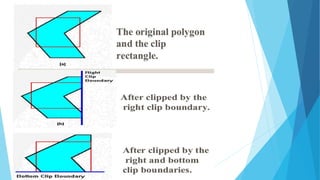
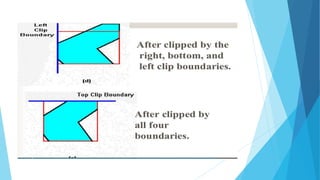
 Polygons can be clipped against each edge of the window one at a
time.
 Vertices which are kept after clipping against one window edge are
saved for clipping against the remaining edges .
 Note that the number of vertices usually changes and will often
increases.
SCAN LINE FILL ALGORITHM
Scan-Line
 A scan line is one line, or row, in a raster scanning
pattern, such as a line of video on a cathode ray
tube display of a television set or computer
monitor.
Scan-line Polygon Fill
For each scan-line :
 Locate the intersection of the scan-line with the edges (y=ys)
 Sort the intersection points from left to right.
 Draw the interiors intersection points pairwise. (a-b), (c-d)
Problem with corners. Same point counted twice or not?
 a,b,c and d are intersected by 2 line segments each.
 Count b,c twice but a and d once. Why?
Solution:
Make a clockwise or counter-clockwise traversal on edges.
Check if y is monotonically increasing or decreasing. If
direction changes, double intersection, otherwise single
intersection.
Scan Line Fill: What happens at edge
end-point?
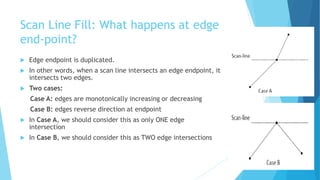
 Edge endpoint is duplicated.
 In other words, when a scan line intersects an edge endpoint, it
intersects two edges.
 Two cases:
Case A: edges are monotonically increasing or decreasing
Case B: edges reverse direction at endpoint
 In Case A, we should consider this as only ONE edge
intersection
 In Case B, we should consider this as TWO edge intersections
Scan Line Fill Algorithm
Basic algorithm:
 Assume scan line start from the left and is outside the polygon.
 When intersect an edge of polygon, start to color each pixel (because
now we’re inside the polygon), when intersect another edge, stop
coloring …
 Odd number of edges: inside
 Even number of edges: outside
THANK YOU

Polygon clipping with sutherland hodgeman algorithm and scan line fill algorithm

  • 1.
    POLYGON CLIPPING WITH SUTHERLANDHODGEMAN ALGORITHM AND SCAN LINE FILL ALGORITHM
  • 2.
    Clipping  The primaryuse of clipping in computer graphics is to remove objects, lines, or line segments that are outside the viewing pane . Clip Window: The region against which an object is to be clipped.  Point Clipping  Line Clipping (straight-line segments)  Area Clipping (polygons)  Text Clipping
  • 3.
    Polygon Clipping  Clippinga polygon fill area needs more than line-clipping of the polygon edges -would produce and unconnected set of lines  Must generate one or more closed polylines, which can be filled with the assigned colour or pattern
  • 4.
    Sutherland–Hodgeman algorithm  Eachedge of the polygon must be tested against each edge of the clip rectangle; new edges must be added, and existing edges must be discarded, retained, or divided. Multiple polygons may result from clipping a single polygon. We need an organized way to deal with all these cases
  • 5.
    FOUR POSSIBLE SCENARIOSAT EACH CLIPPER Each edge goes through 4 clippers .The rule for each edge for each clipper is:  If first input vertex is outside, and second is inside, output the intersection and the second vertex  If first both input vertices are inside, then just output second vertex  If first input vertex is inside, and second is outside, output is the intersection  If both vertices are outside, output is nothing
  • 6.
    Steps of Sutherland-Hodgmanspolygon clipping algorithm  Polygons can be clipped against each edge of the window one at a time.  Vertices which are kept after clipping against one window edge are saved for clipping against the remaining edges .  Note that the number of vertices usually changes and will often increases.
  • 9.
    SCAN LINE FILLALGORITHM
  • 10.
    Scan-Line  A scanline is one line, or row, in a raster scanning pattern, such as a line of video on a cathode ray tube display of a television set or computer monitor.
  • 11.
    Scan-line Polygon Fill Foreach scan-line :  Locate the intersection of the scan-line with the edges (y=ys)  Sort the intersection points from left to right.  Draw the interiors intersection points pairwise. (a-b), (c-d)
  • 12.
    Problem with corners.Same point counted twice or not?  a,b,c and d are intersected by 2 line segments each.  Count b,c twice but a and d once. Why? Solution: Make a clockwise or counter-clockwise traversal on edges. Check if y is monotonically increasing or decreasing. If direction changes, double intersection, otherwise single intersection.
  • 13.
    Scan Line Fill:What happens at edge end-point?  Edge endpoint is duplicated.  In other words, when a scan line intersects an edge endpoint, it intersects two edges.  Two cases: Case A: edges are monotonically increasing or decreasing Case B: edges reverse direction at endpoint  In Case A, we should consider this as only ONE edge intersection  In Case B, we should consider this as TWO edge intersections
  • 14.
    Scan Line FillAlgorithm Basic algorithm:  Assume scan line start from the left and is outside the polygon.  When intersect an edge of polygon, start to color each pixel (because now we’re inside the polygon), when intersect another edge, stop coloring …  Odd number of edges: inside  Even number of edges: outside
  • 15.