1
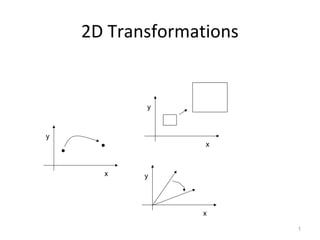
2D Transformations
x
y
x
y
x
y
2
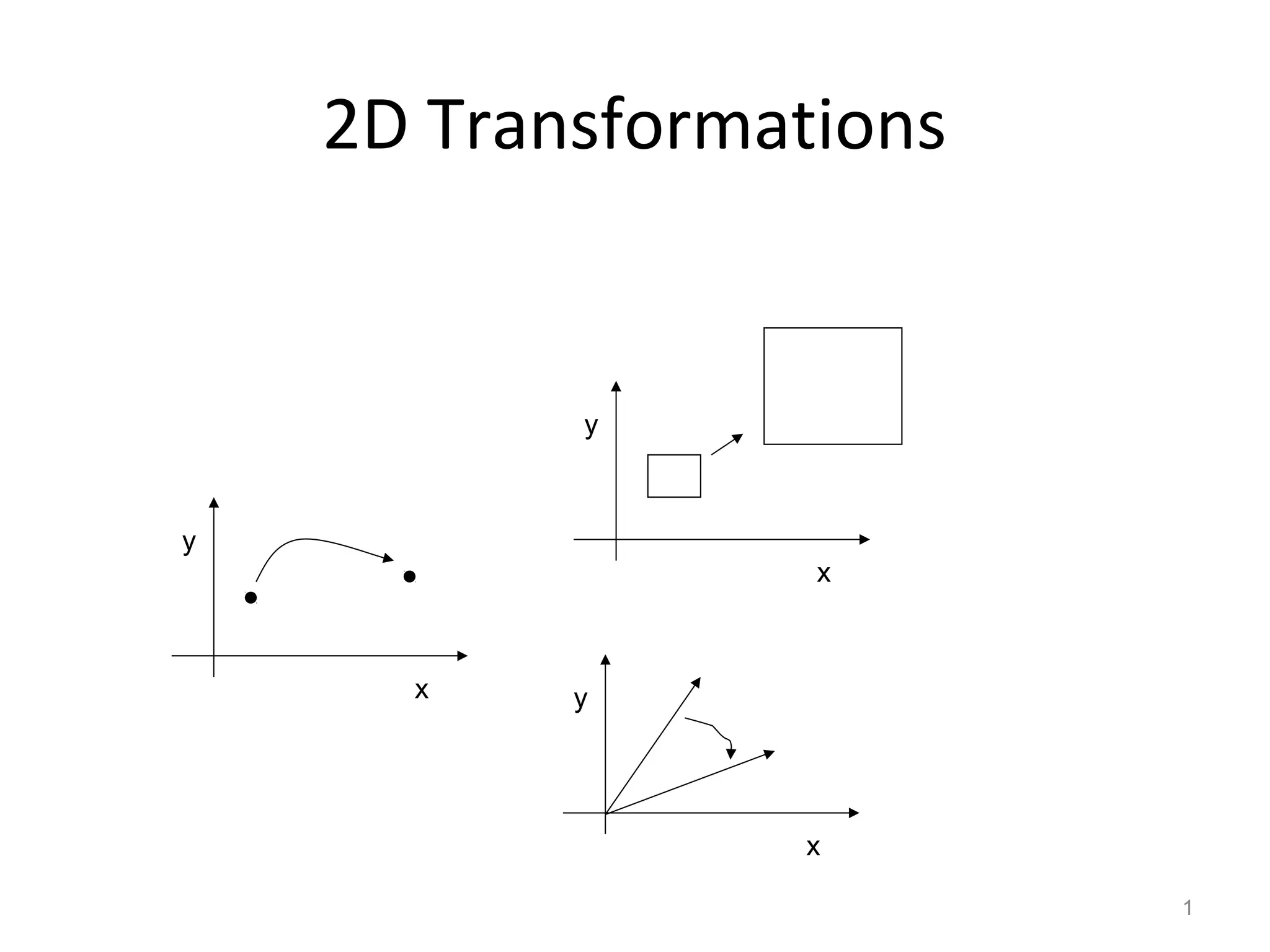
2D Transformations
x
y
x
y
x
y
OpenGl transformations:
glTranslatef (tx, ty, tz);
glRotatef (theta, vx, vy, vz)
glScalef (sx,sy,sz)
……
3
2D Transformation
• Required readings: HB 7-1 to 7-5, 7-8
• Given a 2D object, transformation is to change the
object’s
– Position (translation)
– Size (scaling)
– Orientation (rotation)
– Shapes (shear)
• Apply a sequence of matrix multiplications to the
object vertices
4
Point Representation
• We can use a column vector (a 2x1 matrix) to
represent a 2D point x
y
• A general form of linear transformation can be
written as:
x’ = ax + by + c
OR
y’ = dx + ey + f
X’ a b c x
Y’ = d e f * y
1 0 0 1 1
5
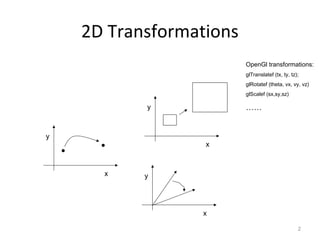
Translation
• Re-position a point along a straight line
• Given a point (x,y), and the translation distance
(tx,ty)
The new point: (x’, y’)
x’ = x + tx
y’ = y + ty (x,y)
(x’,y’)
OR P’ = P + T where P’ = x’ p = x T = tx
y’ y ty
tx
ty
6
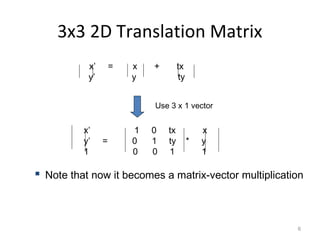
3x3 2D Translation Matrix
x’ = x + tx
y’ y ty
Use 3 x 1 vector
x’ 1 0 tx x
y’ = 0 1 ty * y
1 0 0 1 1
 Note that now it becomes a matrix-vector multiplication
7
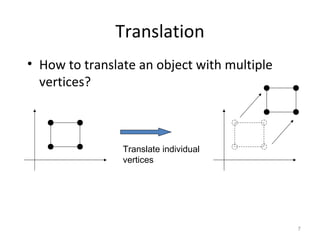
Translation
• How to translate an object with multiple
vertices?
Translate individual
vertices
8
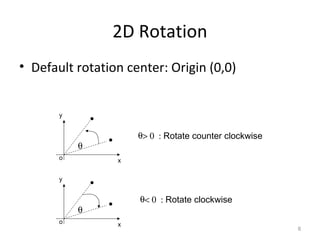
2D Rotation
• Default rotation center: Origin (0,0)
θ
θ> 0 : Rotate counter clockwise
θ< 0 : Rotate clockwise
θ
x
y
o
x
y
o
9
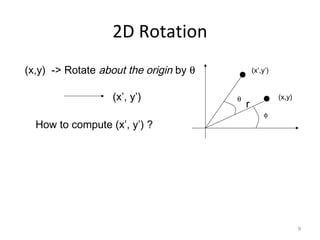
(x,y)
(x’,y’)
θ
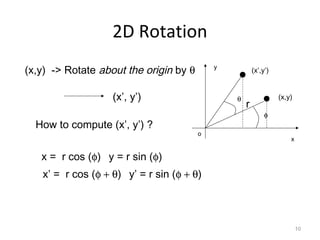
(x,y) -> Rotate about the origin by θ
(x’, y’)
How to compute (x’, y’) ?
φ
r
2D Rotation
10
(x,y)
(x’,y’)
θ
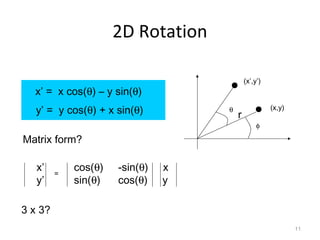
(x,y) -> Rotate about the origin by θ
(x’, y’)
How to compute (x’, y’) ?
φ
x = r cos (φ) y = r sin (φ)
r
x’ = r cos (φ + θ) y’ = r sin (φ + θ)
2D Rotation
x
y
o
11
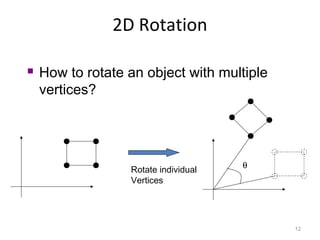
2D Rotation
(x,y)
(x’,y’)
θ
φ
r
x’ = x cos(θ) – y sin(θ)
y’ = y cos(θ) + x sin(θ)
Matrix form?
x’ cos(θ) -sin(θ) x
y’ sin(θ) cos(θ) y
=
3 x 3?
12
 How to rotate an object with multiple
vertices?
Rotate individual
Vertices
θ
2D Rotation
13
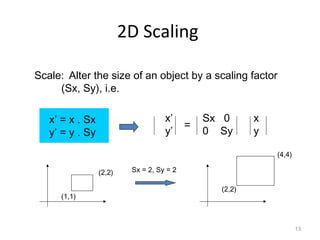
2D Scaling
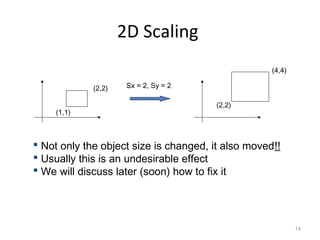
Scale: Alter the size of an object by a scaling factor
(Sx, Sy), i.e.
x’ = x . Sx
y’ = y . Sy
x’ Sx 0 x
y’ 0 Sy y
=
(1,1)
(2,2) Sx = 2, Sy = 2
(2,2)
(4,4)
14
2D Scaling
(1,1)
(2,2) Sx = 2, Sy = 2
(2,2)
(4,4)
 Not only the object size is changed, it also moved!!
 Usually this is an undesirable effect
 We will discuss later (soon) how to fix it
15
Shearing
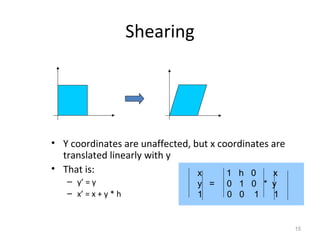
• Y coordinates are unaffected, but x coordinates are
translated linearly with y
• That is:
– y’ = y
– x’ = x + y * h
x 1 h 0 x
y = 0 1 0 * y
1 0 0 1 1
16
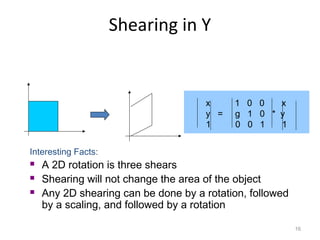
x 1 0 0 x
y = g 1 0 * y
1 0 0 1 1
 A 2D rotation is three shears
 Shearing will not change the area of the object
 Any 2D shearing can be done by a rotation, followed
by a scaling, and followed by a rotation
Interesting Facts:
Shearing in Y
17
Composing Transformation
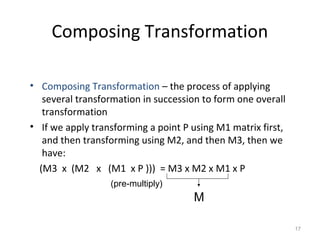
• Composing Transformation – the process of applying
several transformation in succession to form one overall
transformation
• If we apply transforming a point P using M1 matrix first,
and then transforming using M2, and then M3, then we
have:
(M3 x (M2 x (M1 x P ))) = M3 x M2 x M1 x P
M
(pre-multiply)
18
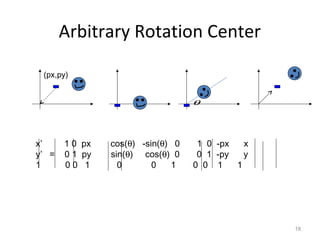
Arbitrary Rotation Center
(px,py)
θ
x’ 1 0 px cos(θ) -sin(θ) 0 1 0 -px x
y’ = 0 1 py sin(θ) cos(θ) 0 0 1 -py y
1 0 0 1 0 0 1 0 0 1 1
19
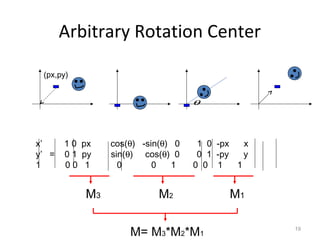
Arbitrary Rotation Center
(px,py)
θ
x’ 1 0 px cos(θ) -sin(θ) 0 1 0 -px x
y’ = 0 1 py sin(θ) cos(θ) 0 0 1 -py y
1 0 0 1 0 0 1 0 0 1 1
M1M2M3
M= M3*M2*M1
20
Composing Transformation
• Matrix multiplication is associative
M3 x M2 x M1 = (M3 x M2) x M1 = M3 x (M2 x M1)
• Transformation products may not be commutative A x B != B x A

2d transformations

  • 1.
  • 2.
    2 2D Transformations x y x y x y OpenGl transformations: glTranslatef(tx, ty, tz); glRotatef (theta, vx, vy, vz) glScalef (sx,sy,sz) ……
  • 3.
    3 2D Transformation • Requiredreadings: HB 7-1 to 7-5, 7-8 • Given a 2D object, transformation is to change the object’s – Position (translation) – Size (scaling) – Orientation (rotation) – Shapes (shear) • Apply a sequence of matrix multiplications to the object vertices
  • 4.
    4 Point Representation • Wecan use a column vector (a 2x1 matrix) to represent a 2D point x y • A general form of linear transformation can be written as: x’ = ax + by + c OR y’ = dx + ey + f X’ a b c x Y’ = d e f * y 1 0 0 1 1
  • 5.
    5 Translation • Re-position apoint along a straight line • Given a point (x,y), and the translation distance (tx,ty) The new point: (x’, y’) x’ = x + tx y’ = y + ty (x,y) (x’,y’) OR P’ = P + T where P’ = x’ p = x T = tx y’ y ty tx ty
  • 6.
    6 3x3 2D TranslationMatrix x’ = x + tx y’ y ty Use 3 x 1 vector x’ 1 0 tx x y’ = 0 1 ty * y 1 0 0 1 1  Note that now it becomes a matrix-vector multiplication
  • 7.
    7 Translation • How totranslate an object with multiple vertices? Translate individual vertices
  • 8.
    8 2D Rotation • Defaultrotation center: Origin (0,0) θ θ> 0 : Rotate counter clockwise θ< 0 : Rotate clockwise θ x y o x y o
  • 9.
    9 (x,y) (x’,y’) θ (x,y) -> Rotateabout the origin by θ (x’, y’) How to compute (x’, y’) ? φ r 2D Rotation
  • 10.
    10 (x,y) (x’,y’) θ (x,y) -> Rotateabout the origin by θ (x’, y’) How to compute (x’, y’) ? φ x = r cos (φ) y = r sin (φ) r x’ = r cos (φ + θ) y’ = r sin (φ + θ) 2D Rotation x y o
  • 11.
    11 2D Rotation (x,y) (x’,y’) θ φ r x’ =x cos(θ) – y sin(θ) y’ = y cos(θ) + x sin(θ) Matrix form? x’ cos(θ) -sin(θ) x y’ sin(θ) cos(θ) y = 3 x 3?
  • 12.
    12  How torotate an object with multiple vertices? Rotate individual Vertices θ 2D Rotation
  • 13.
    13 2D Scaling Scale: Alterthe size of an object by a scaling factor (Sx, Sy), i.e. x’ = x . Sx y’ = y . Sy x’ Sx 0 x y’ 0 Sy y = (1,1) (2,2) Sx = 2, Sy = 2 (2,2) (4,4)
  • 14.
    14 2D Scaling (1,1) (2,2) Sx= 2, Sy = 2 (2,2) (4,4)  Not only the object size is changed, it also moved!!  Usually this is an undesirable effect  We will discuss later (soon) how to fix it
  • 15.
    15 Shearing • Y coordinatesare unaffected, but x coordinates are translated linearly with y • That is: – y’ = y – x’ = x + y * h x 1 h 0 x y = 0 1 0 * y 1 0 0 1 1
  • 16.
    16 x 1 00 x y = g 1 0 * y 1 0 0 1 1  A 2D rotation is three shears  Shearing will not change the area of the object  Any 2D shearing can be done by a rotation, followed by a scaling, and followed by a rotation Interesting Facts: Shearing in Y
  • 17.
    17 Composing Transformation • ComposingTransformation – the process of applying several transformation in succession to form one overall transformation • If we apply transforming a point P using M1 matrix first, and then transforming using M2, and then M3, then we have: (M3 x (M2 x (M1 x P ))) = M3 x M2 x M1 x P M (pre-multiply)
  • 18.
    18 Arbitrary Rotation Center (px,py) θ x’1 0 px cos(θ) -sin(θ) 0 1 0 -px x y’ = 0 1 py sin(θ) cos(θ) 0 0 1 -py y 1 0 0 1 0 0 1 0 0 1 1
  • 19.
    19 Arbitrary Rotation Center (px,py) θ x’1 0 px cos(θ) -sin(θ) 0 1 0 -px x y’ = 0 1 py sin(θ) cos(θ) 0 0 1 -py y 1 0 0 1 0 0 1 0 0 1 1 M1M2M3 M= M3*M2*M1
  • 20.
    20 Composing Transformation • Matrixmultiplication is associative M3 x M2 x M1 = (M3 x M2) x M1 = M3 x (M2 x M1) • Transformation products may not be commutative A x B != B x A