GEOMETRIC TRANFORMATION
2D & 3D
Daffodil International University
Submitted To:
Umme Hafsa Billah
Sr. Lecturer
Daffodil International University
Submitted By:
Nirnay Mukharjee – 143-15-4421
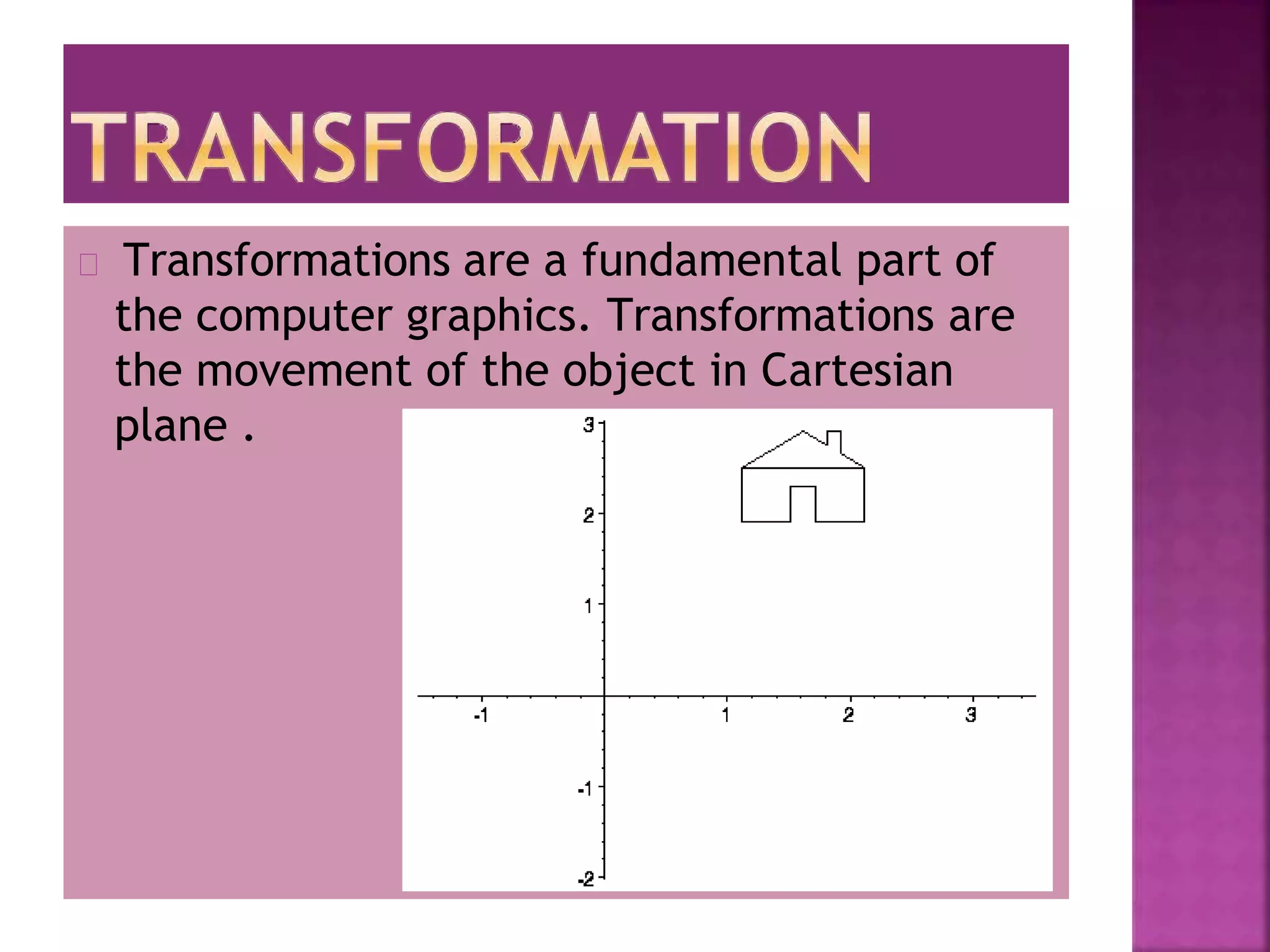
Transformations are a fundamental part of
the computer graphics. Transformations are
the movement of the object in Cartesian
plane .
There are two types of transformation in
computer graphics.
1) 2D transformation
2) 3D transformation
Types of 2D and 3D transformation
1) Translation
2) Rotation
3) Scaling
4) Shearing
5) Mirror reflection
Transformation are used to position
objects , to shape object , to change
even howviewing positions , and
something is viewed.
In simple words transformation is used for
1) Modeling
2) viewing
When the transformation takes place on a 2D
plane .it is called 2D transformation.
2D means two dimensional (x-axis and Y-axis)
Object Transformation in 2D
 Alter the coordinates descriptions an object
 Translation , rotation , scaling , shearing,
 reflection.
 Coordinate system unchanged
Coordinate transformation in 2D
 Produce a different coordinate system
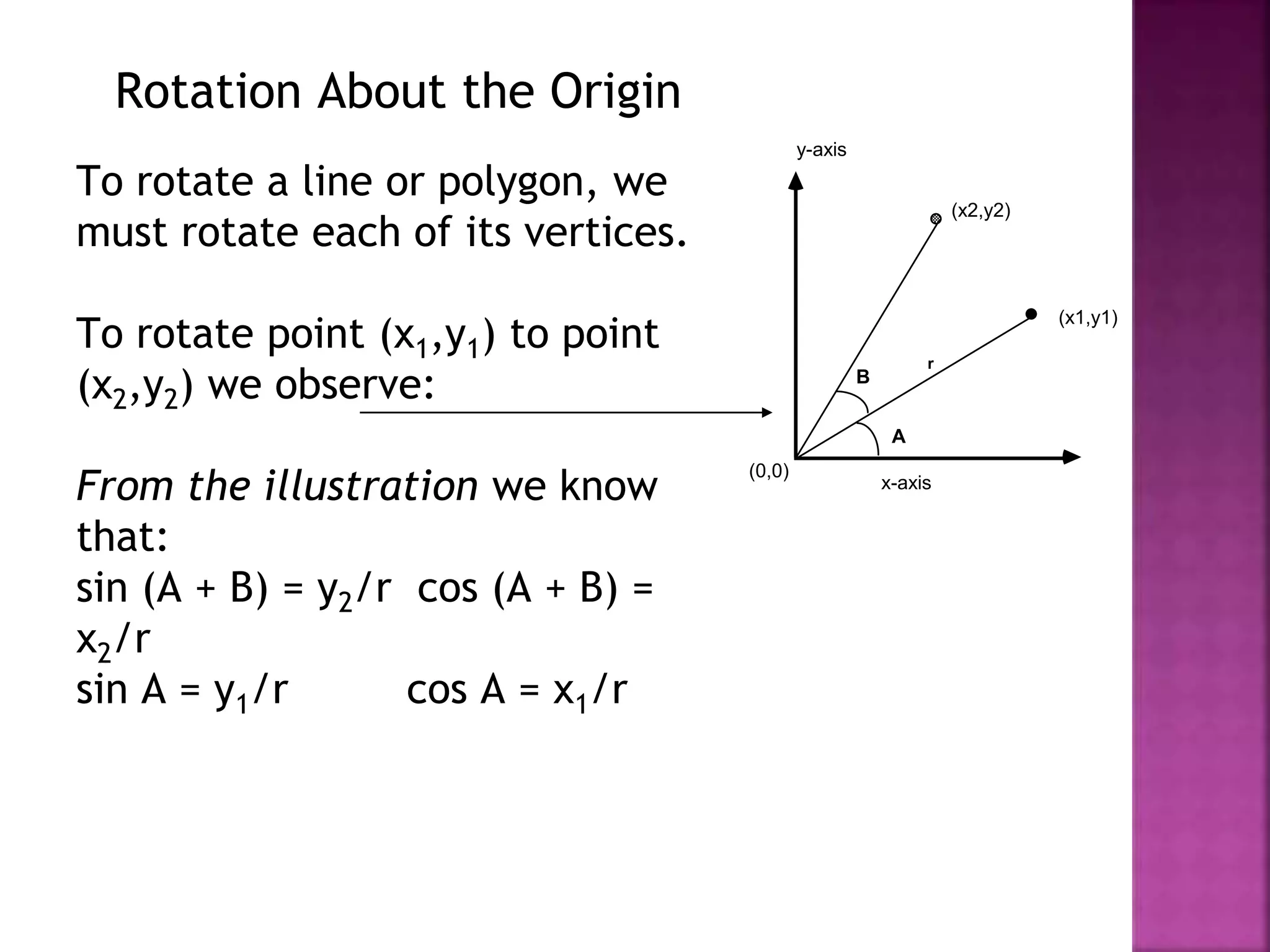
Rotation About the Origin
To rotate a line or polygon, we
must rotate each of its vertices.
To rotate point (x1,y1) to point
(x2,y2) we observe:
From the illustration we know
that:
sin (A + B) = y2/r cos (A + B) =
x2/r
sin A = y1/r cos A = x1/r
x-axis
(x1,y1)
(x2,y2)
A
B
r
(0,0)
y-axis
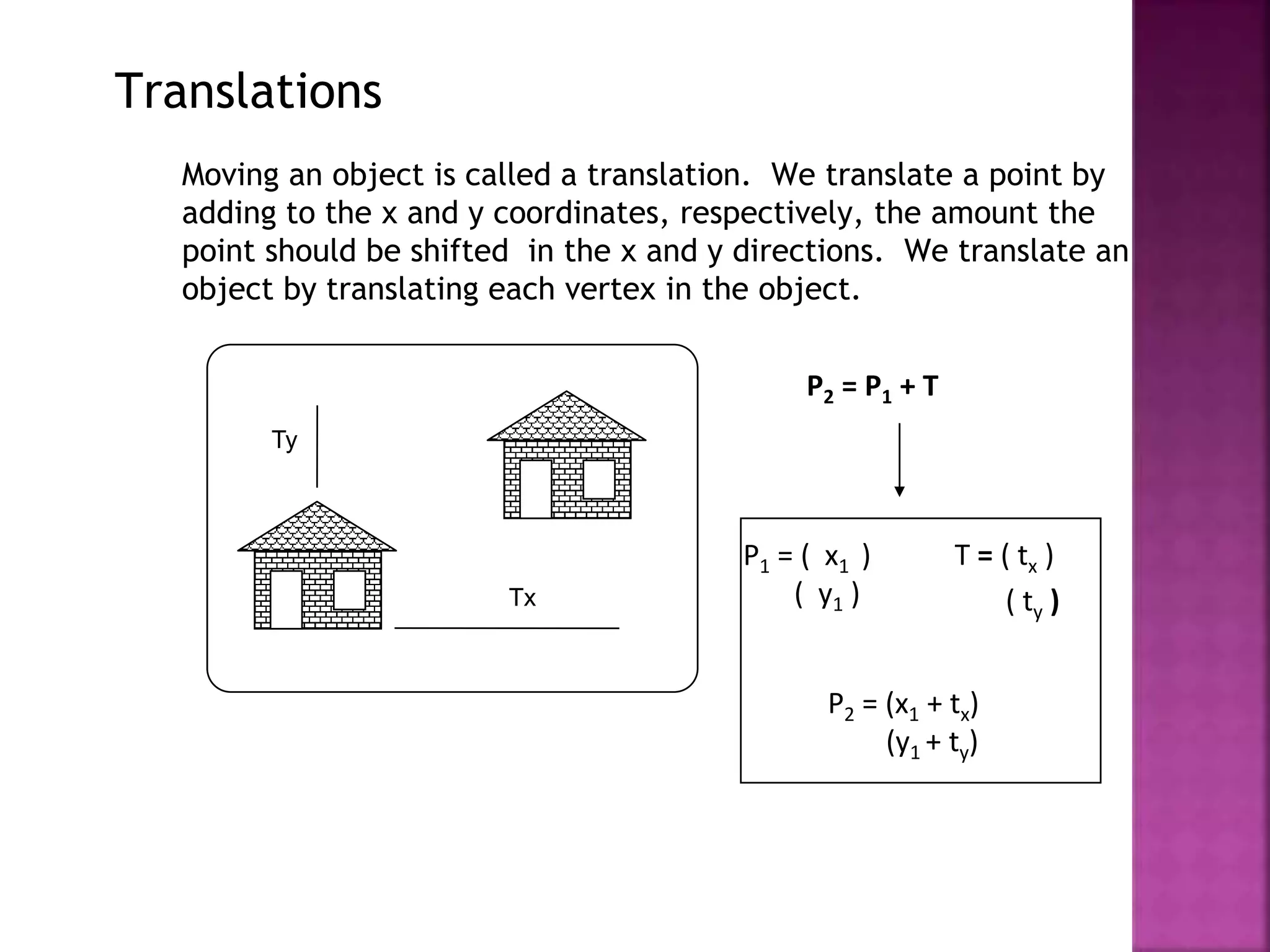
Translations
Moving an object is called a translation. We translate a point by
adding to the x and y coordinates, respectively, the amount the
point should be shifted in the x and y directions. We translate an
object by translating each vertex in the object.
P2 = P1 + T
T = ( tx )
( ty )
P1 = ( x1 )
( y1 )
P2 = (x1 + tx)
(y1 + ty)
Ty
Tx
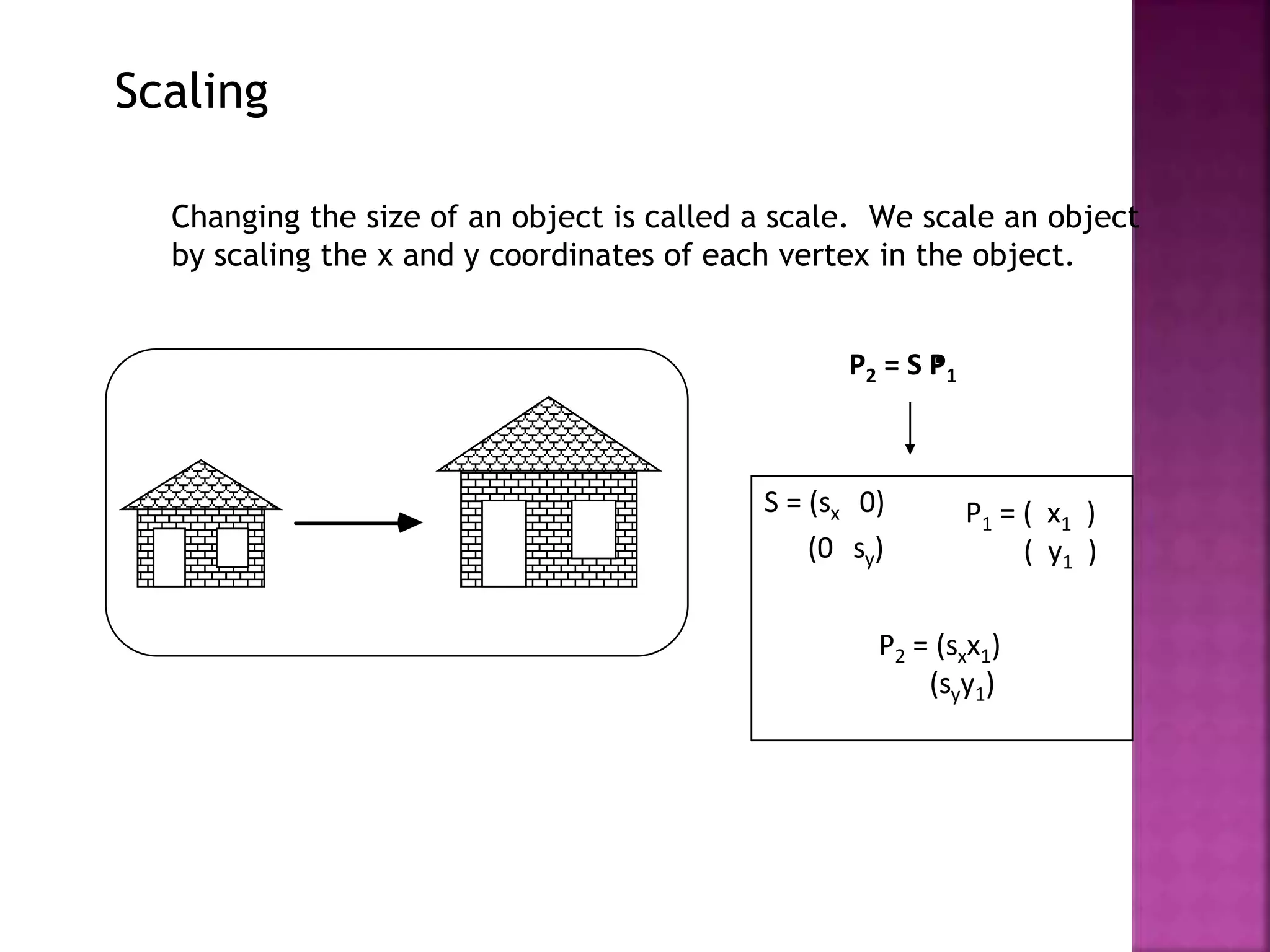
Scaling
Changing the size of an object is called a scale. We scale an object
by scaling the x and y coordinates of each vertex in the object.
P2 = S P1
.
S = (sx 0)
(0 sy)
P1 = ( x1 )
( y1 )
P2 = (sxx1)
(syy1)
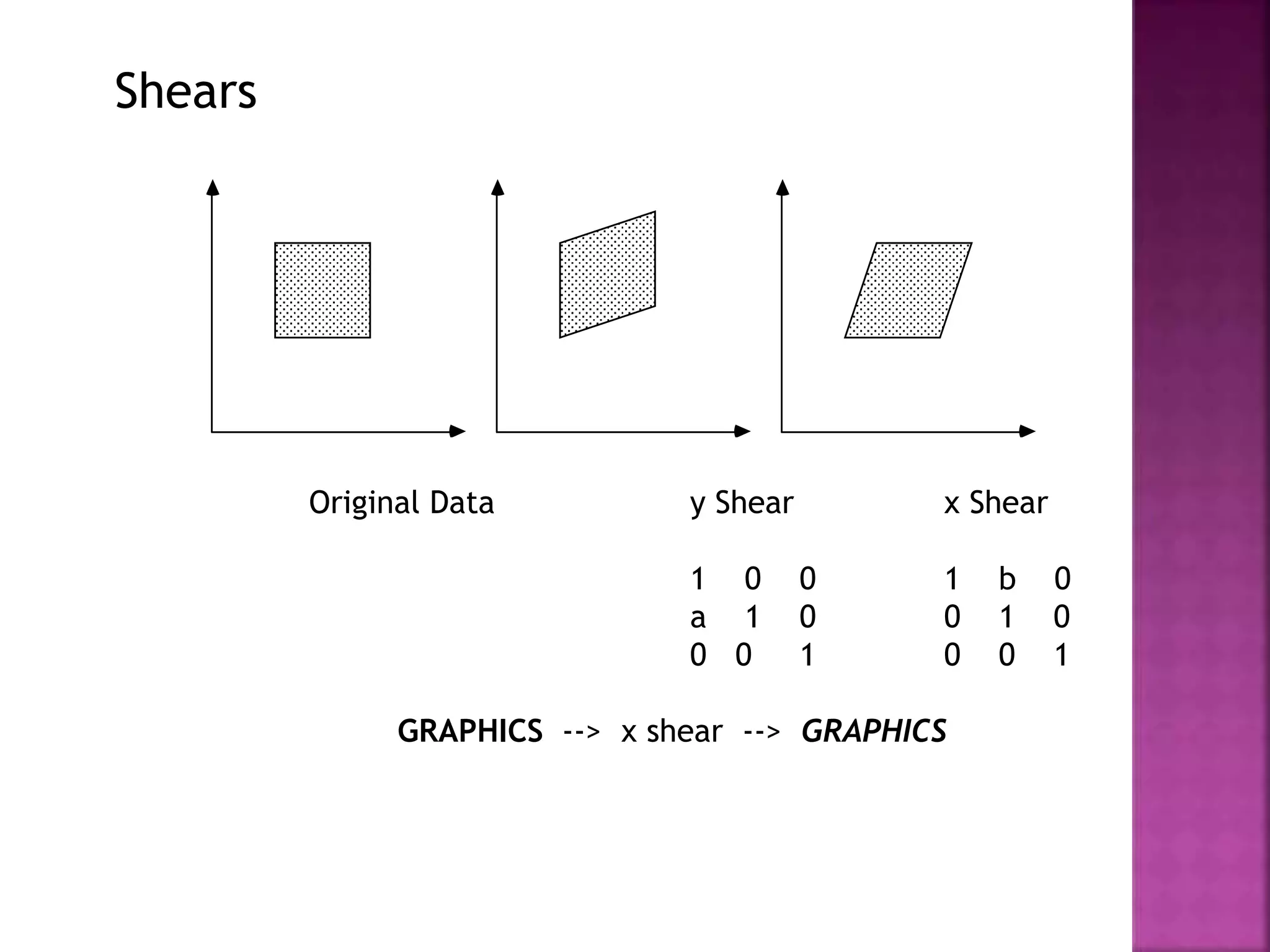
Shears
Original Data y Shear x Shear
1 0 0 1 b 0
a 1 0 0 1 0
0 0 1 0 0 1
GRAPHICS --> x shear --> GRAPHICS
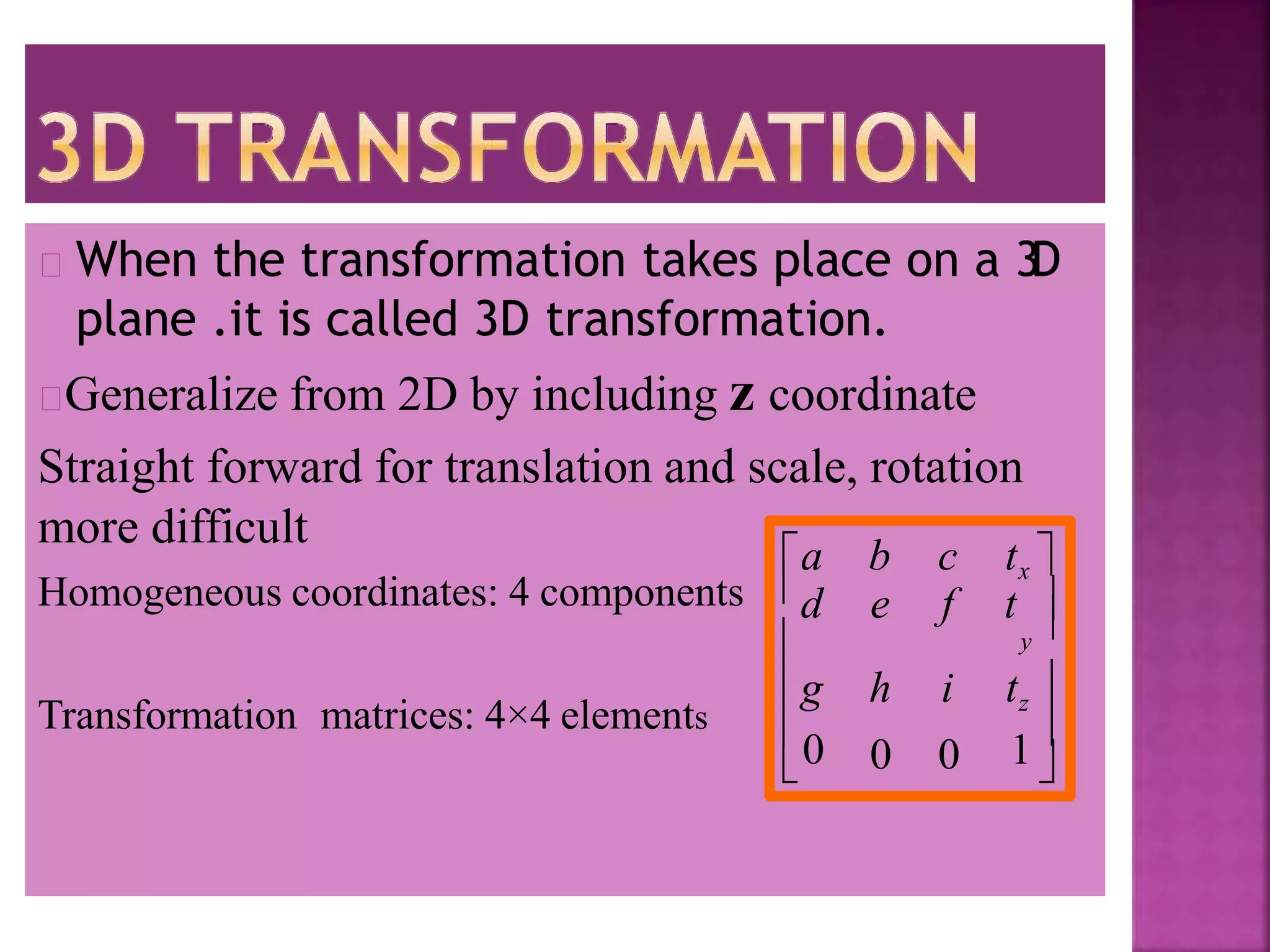
When the transformation takes place on a 3D
plane .it is called 3D transformation.
Generalize from 2D by including z coordinate
Straight forward for translation and scale, rotation
more difficult
Homogeneous coordinates: 4 components
Transformation matrices: 4×4 elements

 10
tz 
a b c tx 
d e f t  y
g h i
0 0
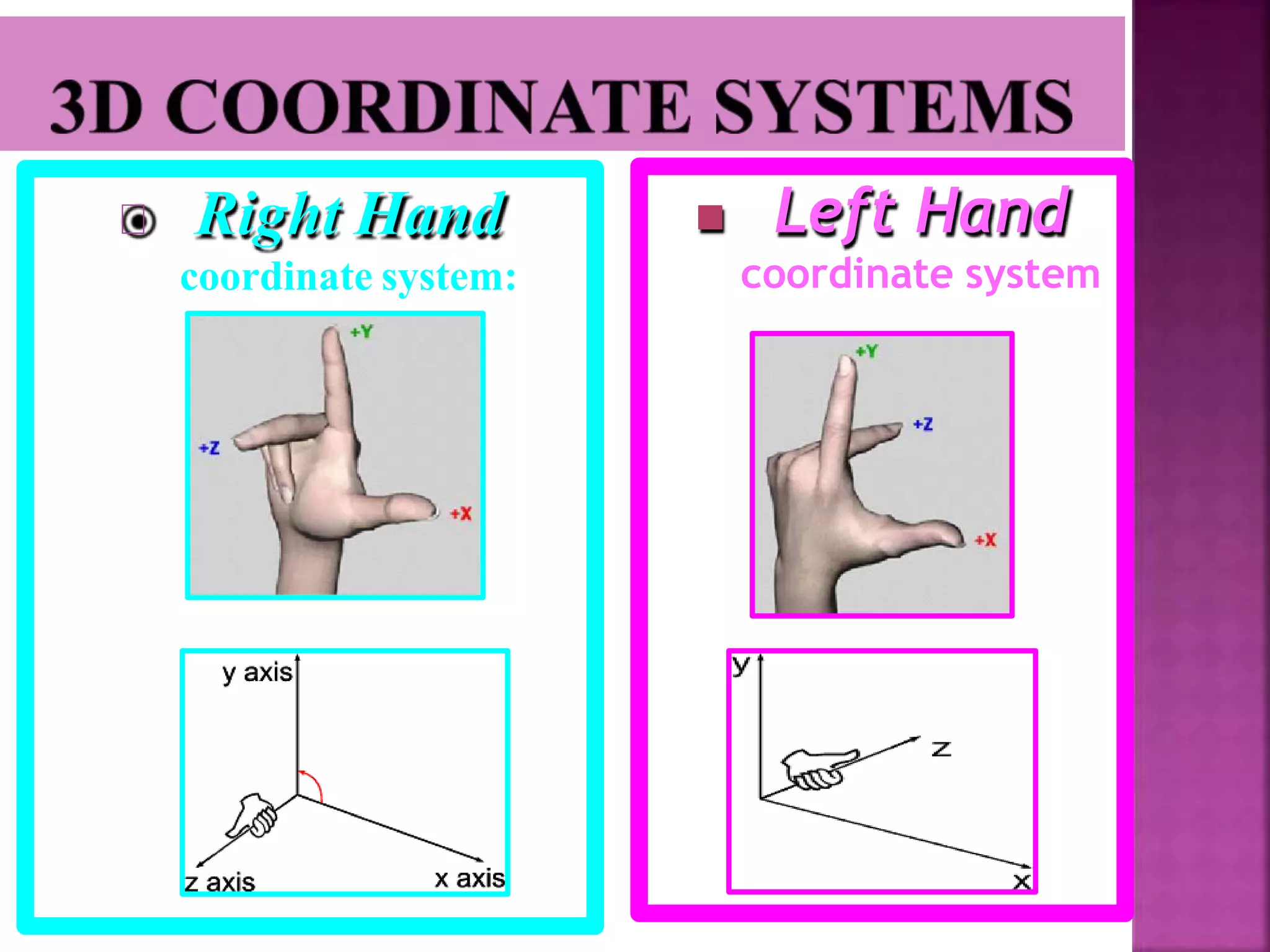
Right Hand
coordinate system:
 Left Hand
coordinate system
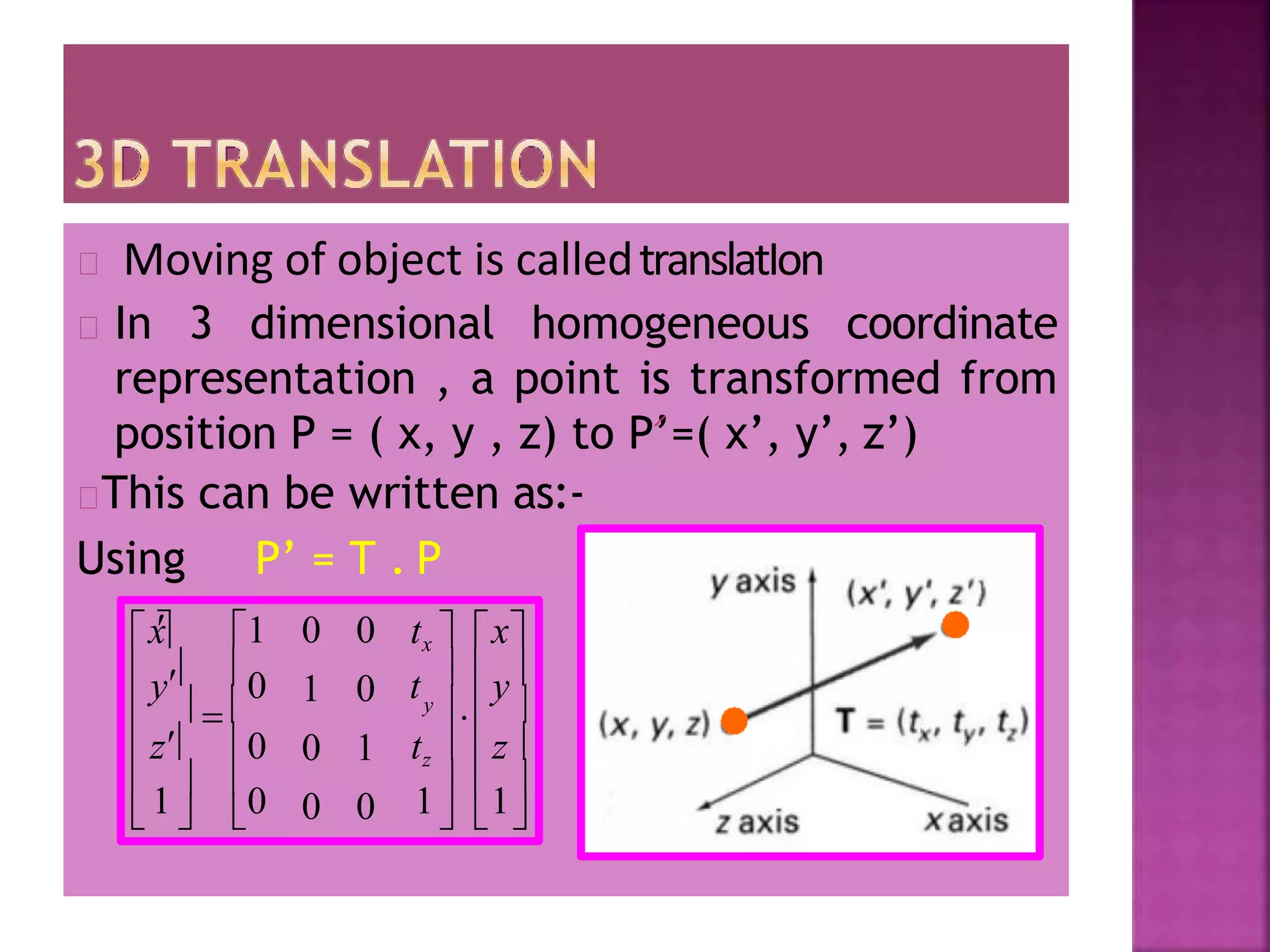
Moving of object is calledtranslatIon
In 3 dimensional homogeneous coordinate
representation , a point is transformed from
position P = ( x, y , z) to P’=( x’, y’, z’)
This can be written as:-
Using P’ = T . P
  
   
   1 1
1 0 0
1 0
0 1
0 0
1  0
t  y
z 0
y 0
x
tz  z
y  
tx  x
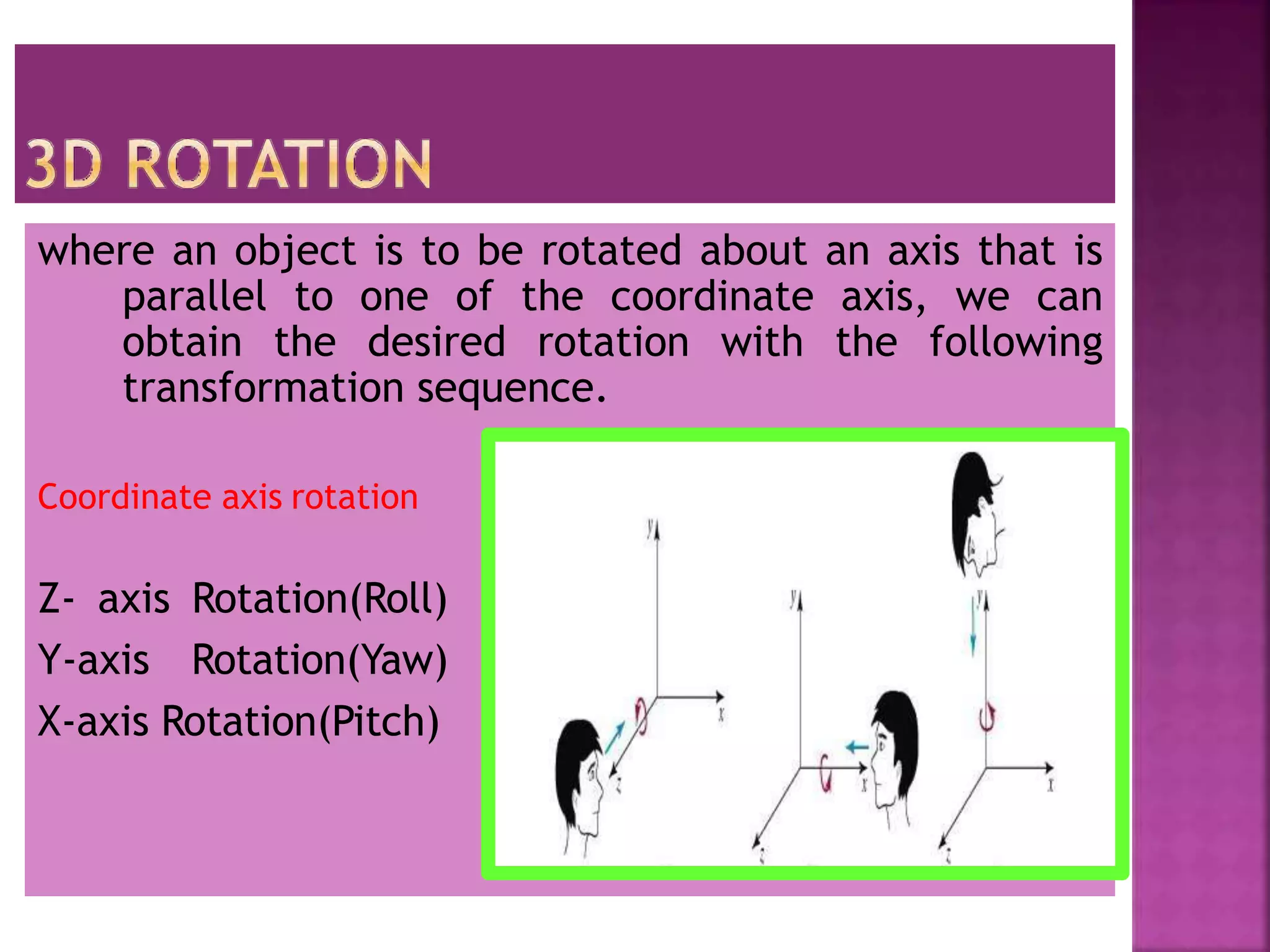
where an object is to be rotated about an axis that is
parallel to one of the coordinate axis, we can
obtain the desired rotation with the following
transformation sequence.
Coordinate axis rotation
Z- axis Rotation(Roll)
Y-axis Rotation(Yaw)
X-axis Rotation(Pitch)
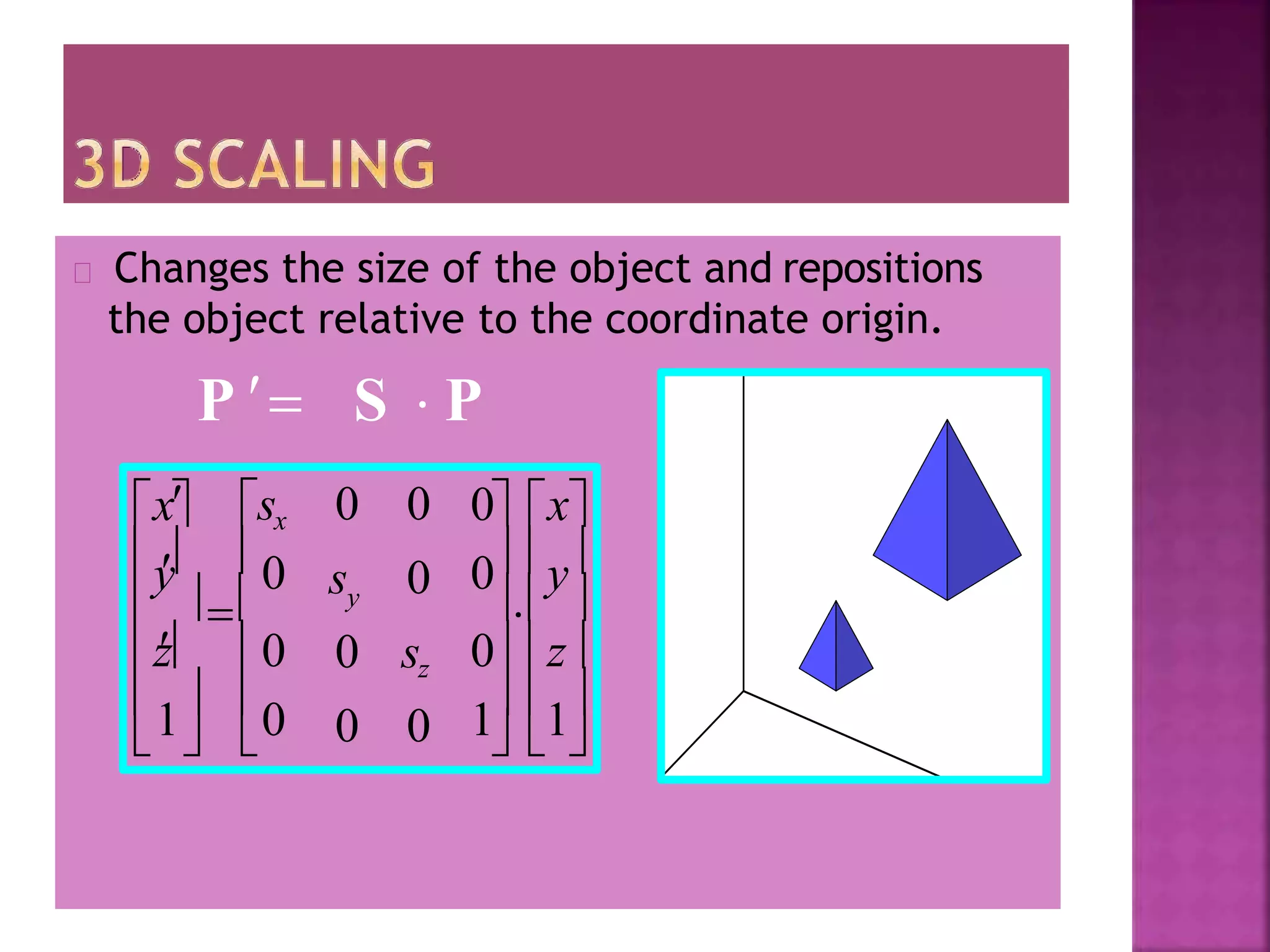
Changes the size of the object and repositions
the object relative to the coordinate origin.
P  S  P
 
  
 
   1 11 0
0 z
0 y
0 x
z 0
y 0
x
y
sx 0 0
s 0
0 sz
0 0
, and
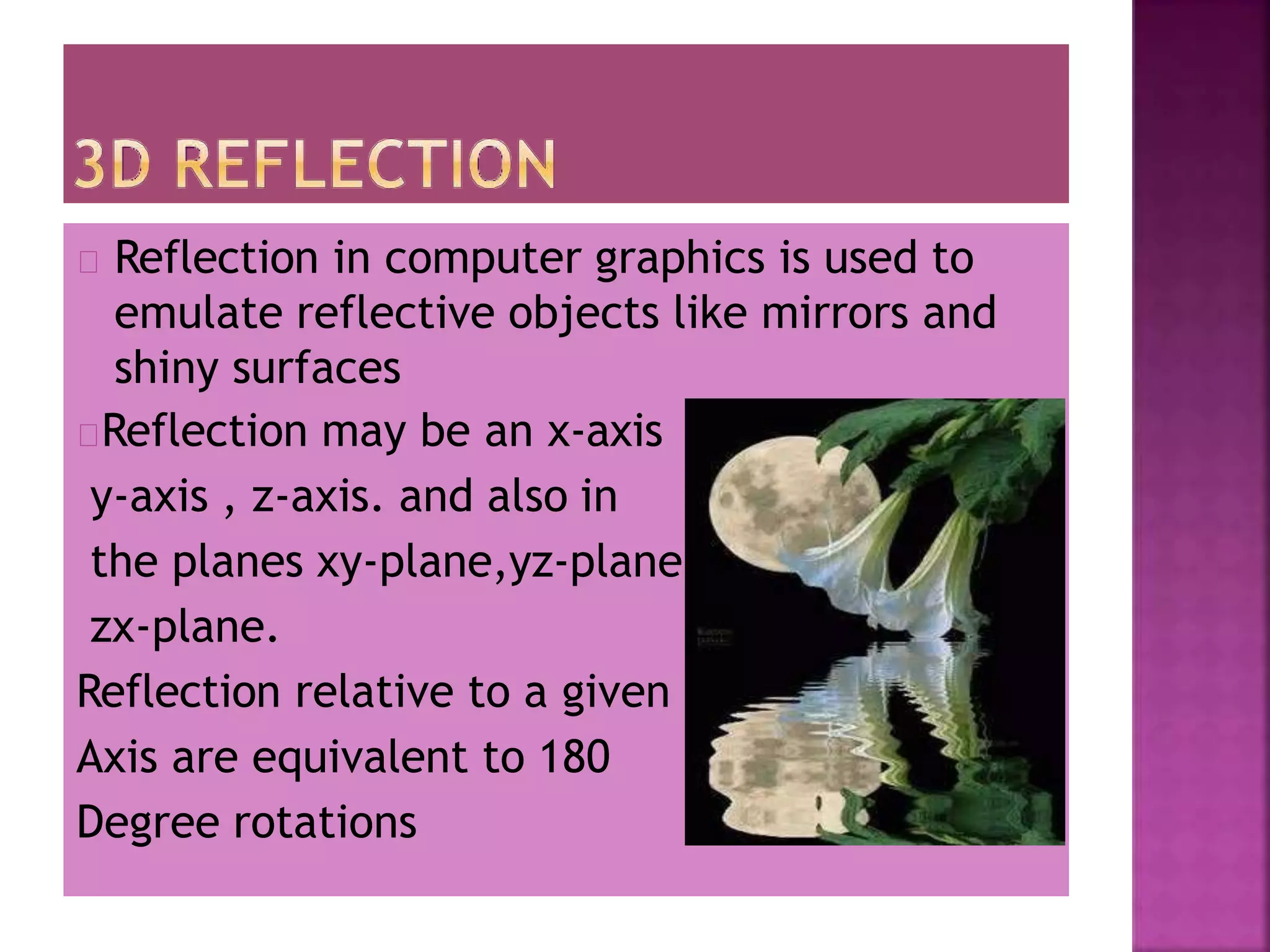
Reflection in computer graphics is used to
emulate reflective objects like mirrors and
shiny surfaces
Reflection may be an x-axis
y-axis , z-axis. and also in
the planes xy-plane,yz-plane
zx-plane.
Reflection relative to a given
Axis are equivalent to 180
Degree rotations
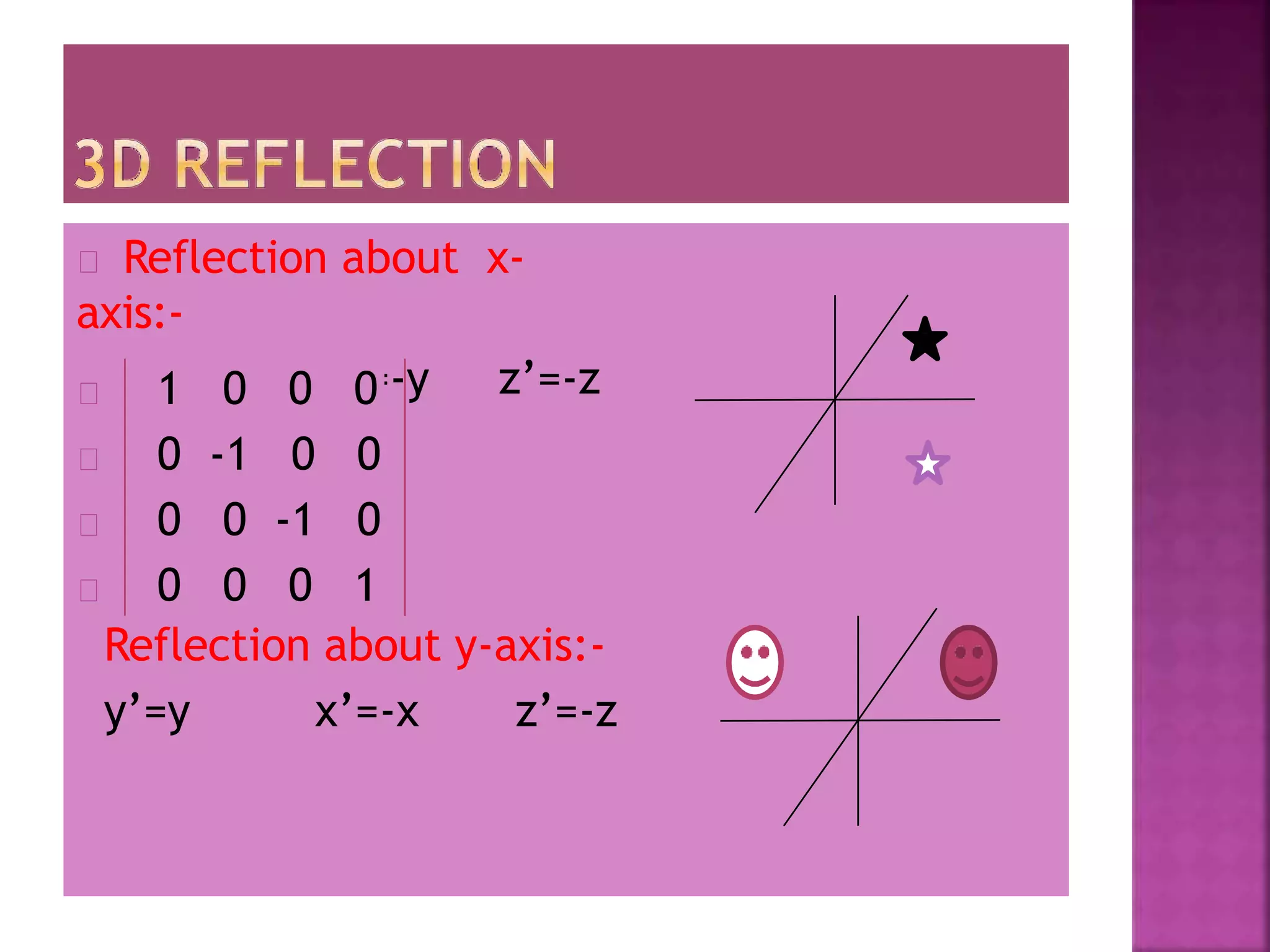
Reflection about x-
axis:-
x’=x y’=-y z’=-z
Reflection about y-axis:-
y’=y x’=-x z’=-z
1 0 0 0
0 -1 0 0
0 0 -1 0
0 0 0 1
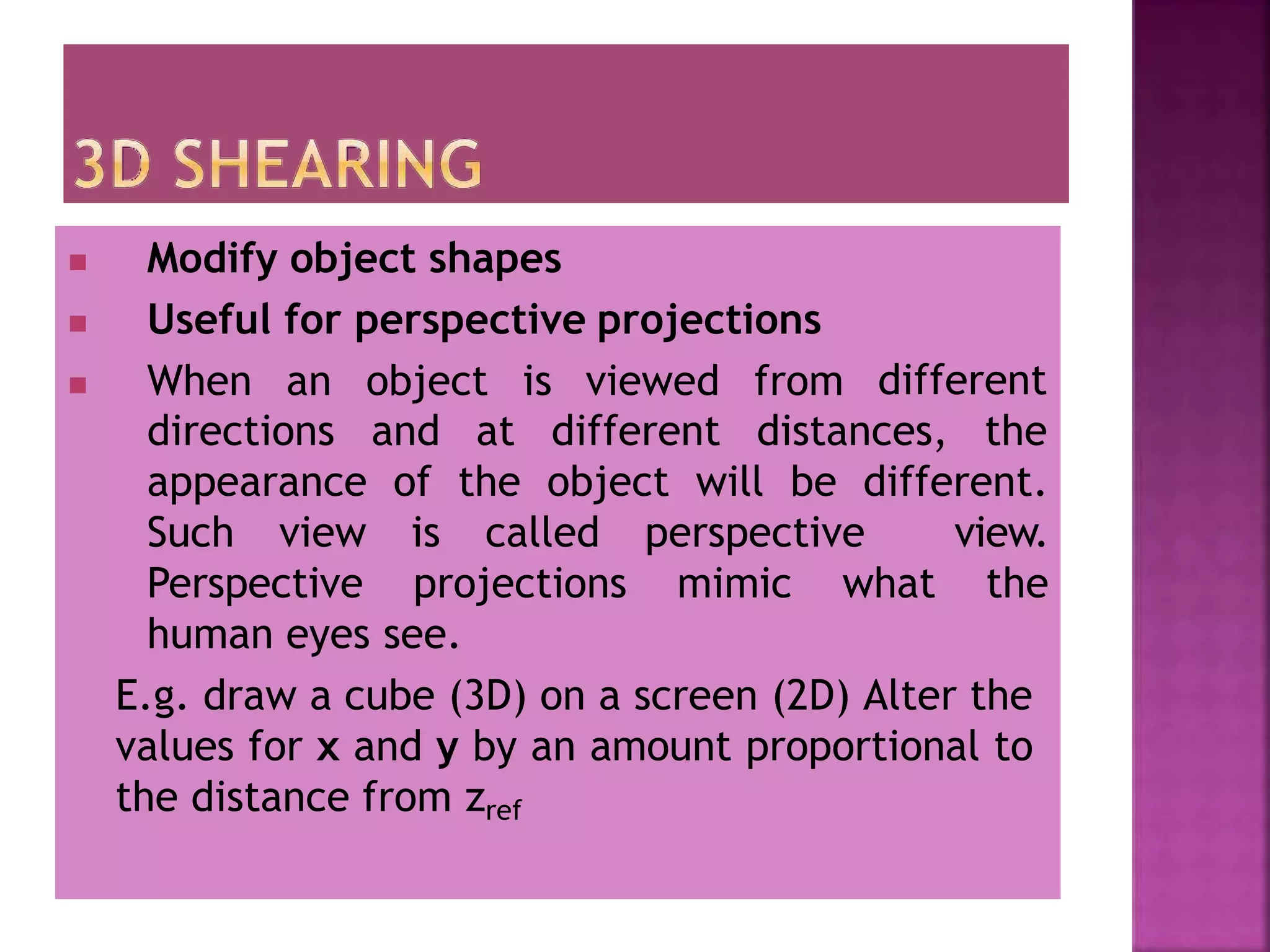
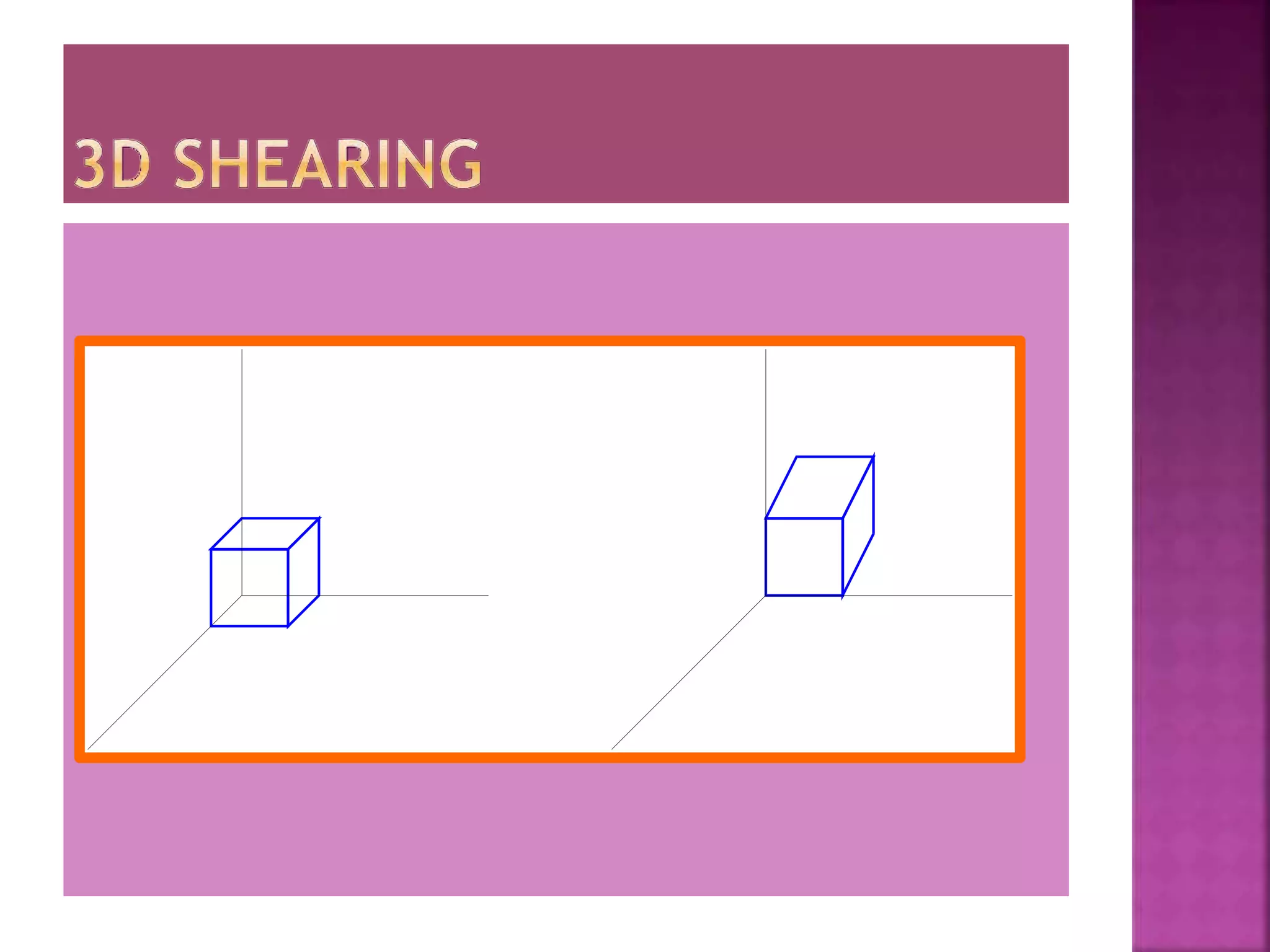
 Modify object shapes
 Useful for perspective projections
 When an object is viewed from different
directions and at different distances, the
appearance of the object will be different.
Such view is called perspective view.
Perspective projections mimic what the
human eyes see.
E.g. draw a cube (3D) on a screen (2D) Alter the
values for x and y by an amount proportional to
the distance from zref
Thank you!!

Computer graphics presentation

  • 1.
  • 2.
    Daffodil International University SubmittedTo: Umme Hafsa Billah Sr. Lecturer Daffodil International University Submitted By: Nirnay Mukharjee – 143-15-4421
  • 3.
    Transformations are afundamental part of the computer graphics. Transformations are the movement of the object in Cartesian plane .
  • 4.
    There are twotypes of transformation in computer graphics. 1) 2D transformation 2) 3D transformation Types of 2D and 3D transformation 1) Translation 2) Rotation 3) Scaling 4) Shearing 5) Mirror reflection
  • 5.
    Transformation are usedto position objects , to shape object , to change even howviewing positions , and something is viewed. In simple words transformation is used for 1) Modeling 2) viewing

  • 6.
    When the transformationtakes place on a 2D plane .it is called 2D transformation. 2D means two dimensional (x-axis and Y-axis) Object Transformation in 2D  Alter the coordinates descriptions an object  Translation , rotation , scaling , shearing,  reflection.  Coordinate system unchanged Coordinate transformation in 2D  Produce a different coordinate system
  • 7.
    Rotation About theOrigin To rotate a line or polygon, we must rotate each of its vertices. To rotate point (x1,y1) to point (x2,y2) we observe: From the illustration we know that: sin (A + B) = y2/r cos (A + B) = x2/r sin A = y1/r cos A = x1/r x-axis (x1,y1) (x2,y2) A B r (0,0) y-axis
  • 8.
    Translations Moving an objectis called a translation. We translate a point by adding to the x and y coordinates, respectively, the amount the point should be shifted in the x and y directions. We translate an object by translating each vertex in the object. P2 = P1 + T T = ( tx ) ( ty ) P1 = ( x1 ) ( y1 ) P2 = (x1 + tx) (y1 + ty) Ty Tx
  • 9.
    Scaling Changing the sizeof an object is called a scale. We scale an object by scaling the x and y coordinates of each vertex in the object. P2 = S P1 . S = (sx 0) (0 sy) P1 = ( x1 ) ( y1 ) P2 = (sxx1) (syy1)
  • 10.
    Shears Original Data yShear x Shear 1 0 0 1 b 0 a 1 0 0 1 0 0 0 1 0 0 1 GRAPHICS --> x shear --> GRAPHICS
  • 11.
    When the transformationtakes place on a 3D plane .it is called 3D transformation. Generalize from 2D by including z coordinate Straight forward for translation and scale, rotation more difficult Homogeneous coordinates: 4 components Transformation matrices: 4×4 elements   10 tz  a b c tx  d e f t  y g h i 0 0
  • 12.
    Right Hand coordinate system: Left Hand coordinate system
  • 13.
    Moving of objectis calledtranslatIon In 3 dimensional homogeneous coordinate representation , a point is transformed from position P = ( x, y , z) to P’=( x’, y’, z’) This can be written as:- Using P’ = T . P           1 1 1 0 0 1 0 0 1 0 0 1  0 t  y z 0 y 0 x tz  z y   tx  x
  • 14.
    where an objectis to be rotated about an axis that is parallel to one of the coordinate axis, we can obtain the desired rotation with the following transformation sequence. Coordinate axis rotation Z- axis Rotation(Roll) Y-axis Rotation(Yaw) X-axis Rotation(Pitch)
  • 15.
    Changes the sizeof the object and repositions the object relative to the coordinate origin. P  S  P           1 11 0 0 z 0 y 0 x z 0 y 0 x y sx 0 0 s 0 0 sz 0 0
  • 16.
    , and Reflection incomputer graphics is used to emulate reflective objects like mirrors and shiny surfaces Reflection may be an x-axis y-axis , z-axis. and also in the planes xy-plane,yz-plane zx-plane. Reflection relative to a given Axis are equivalent to 180 Degree rotations
  • 17.
    Reflection about x- axis:- x’=xy’=-y z’=-z Reflection about y-axis:- y’=y x’=-x z’=-z 1 0 0 0 0 -1 0 0 0 0 -1 0 0 0 0 1
  • 18.
     Modify objectshapes  Useful for perspective projections  When an object is viewed from different directions and at different distances, the appearance of the object will be different. Such view is called perspective view. Perspective projections mimic what the human eyes see. E.g. draw a cube (3D) on a screen (2D) Alter the values for x and y by an amount proportional to the distance from zref
  • 20.