This presentation is compiled by “ Drug Regulations” a
non profit organization which provides free online
resource to the Pharmaceutical Professional.
Visit http://www.drugregulations.org for latest
information from the world of Pharmaceuticals.
3/26/2014 1
 This presentation is compiled from freely
available resources like the websites of
FDA, EMA, WHO.
 “Drug Regulations” is a non profit
organization which provides free online
resource to the Pharmaceutical Professional.
 Visit http://www.drugregulations.org for
latest information from the world of
Pharmaceuticals.
3/26/2014 2
Drug Regulations : Online
Resource for Latest Information
◦ Sampling plays an Important role in implementing GMP’s.
◦ FDA
 211.84 (b) :Testing and approval or rejection of components, drug
product containers, and closures.
 Representative samples of each shipment of each lot shall be collected
for testing or examination. The number of containers to be
sampled, and the amount of material to be taken from each
container, shall be based upon appropriate criteria such as statistical
criteria for component variability, confidence levels, and degree of
precision desired, the past quality history of the supplier, and the
quantity needed for analysis and reserve where required by §211.170.
3/26/2014 3
Drug Regulations : Online
Resource for Latest Information
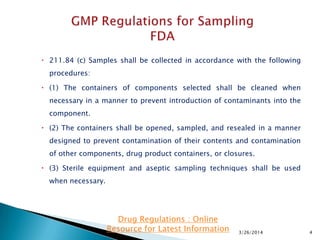
 211.84 (c) Samples shall be collected in accordance with the following
procedures:
 (1) The containers of components selected shall be cleaned when
necessary in a manner to prevent introduction of contaminants into the
component.
 (2) The containers shall be opened, sampled, and resealed in a manner
designed to prevent contamination of their contents and contamination
of other components, drug product containers, or closures.
 (3) Sterile equipment and aseptic sampling techniques shall be used
when necessary.
3/26/2014 4
Drug Regulations : Online
Resource for Latest Information
 211.84 (c) Samples shall be collected in accordance with the following
procedures:
 (4) If it is necessary to sample a component from the top, middle, and
bottom of its container, such sample subdivisions shall not be composited
for testing.
 (5) Sample containers shall be identified so that the following information
can be determined: name of the material sampled, the lot number, the
container from which the sample was taken, the date on which the sample
was taken, and the name of the person who collected the sample.
 (6) Containers from which samples have been taken shall be marked to show
that samples have been removed from them.
3/26/2014 5
Drug Regulations : Online
Resource for Latest Information
 211.110 : Sampling and testing of in-process
materials and drug products.
 (a) To assure batch uniformity and integrity of drug
products, written procedures shall be established and
followed that describe the in-process controls, and
tests, or examinations to be conducted on appropriate
samples of in-process materials of each batch.
3/26/2014 6
Drug Regulations : Online
Resource for Latest Information
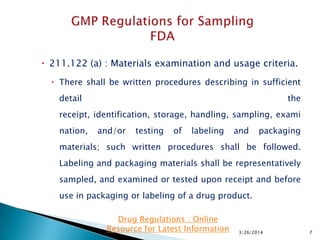
 211.122 (a) : Materials examination and usage criteria.
 There shall be written procedures describing in sufficient
detail the
receipt, identification, storage, handling, sampling, exami
nation, and/or testing of labeling and packaging
materials; such written procedures shall be followed.
Labeling and packaging materials shall be representatively
sampled, and examined or tested upon receipt and before
use in packaging or labeling of a drug product.
3/26/2014 7
Drug Regulations : Online
Resource for Latest Information
 211.165 ( c ) : Testing and release for distribution.
 Any sampling and testing plans shall be described in
written procedures that shall include the method of
sampling and the number of units per batch to be tested;
such written procedure shall be followed.
3/26/2014 8
Drug Regulations : Online
Resource for Latest Information
 EudraLex - Volume 4 Good manufacturing practice (GMP)
Guidelines.
 6.11 The sample taking should be done in accordance with
approved written procedures that describe:
 the method of sampling;
 the equipment to be used;
 the amount of the sample to be taken;
 instructions for any required sub-division of the sample;
 the type and condition of the sample container to be used;
 the identification of containers sampled;
3/26/2014 9
Drug Regulations : Online
Resource for Latest Information
 EudraLex - Volume 4 Good manufacturing practice (GMP)
Guidelines.
 6.11 The sample taking should be done in accordance with
approved written procedures that describe:
 any special precautions to be observed, especially with regard
to the sampling of sterile or noxious materials;
 the storage conditions;
 instructions for the cleaning and storage of sampling
equipment
3/26/2014 10
Drug Regulations : Online Resource for Latest Information
 EudraLex: Volume 4 Good manufacturing practice (GMP) Guidelines. Annex 8
 Personnel who take samples should receive initial and on-going regular
training in the disciplines relevant to correct sampling. This training should
include:
 sampling plans,
 written sampling procedures,
 the techniques and equipment for sampling,
 the risks of cross-contamination,
 the precautions to be taken with regard to unstable and/or sterile substances,
 the importance of considering the visual appearance of materials, containers &
 labels,
 the importance of recording any unexpected or unusual circumstances.
3/26/2014 11
Drug Regulations : Online Resource for Latest Information
 EudraLex: Volume 4 Good manufacturing practice (GMP)
Guidelines. Annex 8 : Starting materials
 The identity of a complete batch of starting materials can
normally only be ensured if
 Individual samples are taken from all the containers
 An identity test performed on each sample
 It is permissible to sample only a proportion of the containers
where a validated procedure has been established to ensure
that no single container of starting material has been
incorrectly labelled.
3/26/2014 12
Drug Regulations : Online Resource for Latest Information
 EudraLex: Volume 4 Good manufacturing practice (GMP)
Guidelines. Annex 8 : Starting materials
 This validation should take account of at least the
following aspects:
 The nature and status of the manufacturer and of the supplier
 Their understanding of the GMP requirements of the
Pharmaceutical Industry;
 The Quality Assurance system of the manufacturer of the
starting material;
3/26/2014 13
Drug Regulations : Online Resource for Latest Information
 EudraLex: Volume 4 Good manufacturing practice (GMP)
Guidelines. Annex 8 : Starting materials
 This validation should take account of at least the
following aspects:
 The manufacturing conditions under which the starting
material is produced and controlled;
 The nature of the starting material and the medicinal products
in which it will be used.
3/26/2014 14
Drug Regulations : Online Resource for Latest Information
 EudraLex: Volume 4 Good manufacturing practice (GMP) Guidelines.
Annex 8 : Starting materials
 Under such a system, it is possible that a validated procedure
exempting identity testing of each incoming container of starting
material could be accepted for:
 starting materials coming from a single product manufacturer or
plant;
 starting materials coming directly from a manufacturer or in the
manufacturer’s sealed container where there is a history of reliability
and regular audits of the manufacturer’s Quality Assurance system
are conducted by the purchaser (the manufacturer of the medicinal
product) or by an officially accredited body.)
3/26/2014 15
 EudraLex: Volume 4 Good manufacturing practice (GMP)
Guidelines. Annex 8 : Starting materials
 It is improbable that a procedure could be satisfactorily
validated for:
 Starting materials supplied by intermediaries such as
brokers where the source of manufacture is unknown or
not audited;
 Starting materials for use in parenteral products
3/26/2014 16
Drug Regulations : Online Resource for Latest Information
 EudraLex: Volume 4 Good manufacturing practice (GMP) Guidelines. Annex 8
: Starting materials
 The quality of a batch of starting materials may be assessed by taking and
testing a representative sample.
 The samples taken for identity testing could be used for this purpose.
 The number of samples taken for the preparation of a representative sample
should be determined statistically and specified in a sampling plan.
 The number of individual samples which may be blended to form a composite
sample should also be defined, taking into account the nature of the
material, knowledge of the supplier and the homogeneity of the composite
sample.
3/26/2014 17
Drug Regulations : Online Resource for Latest Information
 EudraLex: Volume 4 Good manufacturing practice (GMP)
Guidelines. Annex 8 : Packaging Materials
 The sampling plan for packaging materials should take account
of at least the following:
 The quantity received, the quality required, the nature of the
material (e.g. primary packaging materials and/or printed
packaging materials), the production methods, and
 what is known of the Quality Assurance system of the packaging
materials manufacturer based on audits.
 The number of samples taken should be determined statistically
and specified in a sampling plan.
3/26/2014 18
 Imagine, for example, an experiment to test the
effects of a new education technique on
schoolchildren.
 It would be impossible to select the entire school age
population of a country, divide them into groups and
perform research.
 A research group sampling the diversity of flowers in
the African savannah could not count every single
flower, because it would take many years.
Drug Regulations : Online Resource for Latest Information
 A population is generally a large collection of
individuals or objects that is the main focus of a
scientific query or analysis.
 However, due to the large sizes of populations, we
often cannot test every individual or object in the
population because it is too expensive and time-
consuming.
 This is the reason why we rely on sampling
techniques.
Drug Regulations : Online Resource for Latest Information
 This is where statistical sampling comes in
 The idea of trying to take a representative
section of the population,
 Perform the experiment and
 Extrapolate it back to the population as a whole.
Drug Regulations : Online Resource for Latest Information
 A sample group can be defined as a subset of a population.
 The population, or target population, is the total population about
which information is required.
 The "study population" is the population from which sample is to be
drawn.
 Commonly, the population is found to be very large and in any
study, studying all population is often impractical or impossible.
 Therefore, sample unit gives us a manageable and representative
subset of population.
Drug Regulations : Online Resource for Latest Information
Population:
 A set which includes all measurements of interest
◦ (The collection of all responses, measurements, or counts that are of
interest)
Sample:
 A subset of the population
Populationsample
Drug Regulations : Online Resource for Latest Information
 Choosing of sample size depends on non-
statistical considerations and statistical
considerations.
 The non-statistical considerations may include
availability of
resources, manpower, budget, ethics and
sampling frame.
Drug Regulations : Online Resource for Latest Information
 The statistical considerations will include
following three criteria
◦ The level of Precision
◦ The confidence level
◦ Degree of Variability
Drug Regulations : Online Resource for Latest Information
 Also called sampling error,
 Range in which the true value of the population
is estimated to be.
 Expressed in percentage points.
Drug Regulations : Online Resource for Latest Information
 The confidence interval is the statistical measure of the number of
times out of 100 that results can be expected to be within a specified
range.
 For example, a confidence interval of 90% means that results of an
action will probably meet expectations 90% of the time.
 The basic idea described in Central Limit Theorem is that when a
population is repeatedly sampled, the average value of an attribute
obtained is equal to the true population value.
 In other words, if a confidence interval is 95%, it means 95 out of 100
samples will have the true population value within range of precision.
Drug Regulations : Online Resource for Latest Information
 Depending upon the target population and attributes under
consideration, the degree of variability varies considerably.
 The more heterogeneous a population is, the larger the
sample size is required to get an optimum level of precision.
 A proportion of 55% indicates a high level of variability than
either 10% or 80%.
 This is because 10% and 80% means that a large majority does
not or does, respectively, have the attribute under
consideration.
Drug Regulations : Online Resource for Latest Information
 Let's suppose we have five chocolates bars and total 8 friends to
distribute these 5 chocolates to.
 How we are going to do this so the whole distribution process is with a
minimum of bias?
 We may write down names of each friend on a separate small piece of
paper;
 Fold all small pieces of papers so no one know what name is on any
paper.
 Then ask someone to pick 5 names and give chocolates to first 5 names.
 This will remove the bias without hurting any friend's feelings.
 The way we did this is randomization.
 In randomized controlled trials, the research participants
are assigned by chance, rather than by choice, to either the
experimental group or the control group.
 Randomization reduces bias as much as possible.
 Randomization is designed to "control" (reduce or
eliminate if possible) bias by all means.
 The fundamental goal of randomization is to acertain that
each treatment is equally likely to be assigned to any given
experimental unit.
 Different options to perform randomization.
 Can be achieved by use of random number
tables given in most statistical textbooks or
 Computers can also be used to generate
random numbers.
 There are two types of sampling risks
 Risk of incorrect acceptance of the research
hypothesis.
 Risk for incorrect rejection of hypothesis
 Risks pertain to the possibility that when a test is
conducted to a sample, the results and conclusions
may be different from the results and conclusions
when the test is conducted to the entire population.
 Risk of incorrect acceptance
◦ Risk that the sample can yield a conclusion that
supports a theory about the population when it is
actually not existent in the population.
 Risk of incorrect rejection
◦ Risk that the sample can yield a conclusion that
rejects a theory about the population when in
fact, the theory holds true in the population.
 Sampling distribution is the probability distribution of a
sample of a population instead of the entire population.
 From a given population take all possible samples of size n
 Compute a statistic (say mean) of all these samples.
 Probability distribution of this statistic, will give sampling
distribution
 Sampling distributions are important.
 Feasibility of an experiment dictates the sample size
 Sample size determines the properties of
sampling distribution.
 Generally the population is assumed to be
normally distributed.
 For a large sample size, the sampling
distribution will also be nearly be normal.
 In case of normal distribution of sample
sampling distribution can be totally determined
by two values
◦ the mean and
◦ the standard deviation.
 These two parameters are important to compute
for the sampling distribution if we are given the
normal distribution of the entire population.
 Non-Probability Sampling
◦ In non-probability sampling, the choice of sample group is
left to the researcher and thus element of bias always
shows up in such studies.
 Probability Sampling
◦ In probability sampling, the selection of the sample is made
using deliberate, unbiased process, so that each sample
unit in a group has an equal chance of being selected.
◦ This forms the basis of random sampling.
Drug Regulations : Online Resource for Latest Information
Basic Business Statistics, 8e
© 2002 Prentice-Hall, Inc.
Chap 1-38
Quota
Samples
Non-Probability
Samples
Judgement Chunk
Probability Samples
Simple
Random
Systematic
Stratified
Cluster
 Probability sampling is most commonly used
 Randomization is performed to choose samples
 Provides each sample an equal chance of being
selected
 Minimizes or eliminates bias altogether
Drug Regulations : Online Resource for Latest Information
 Each member or object of the
population has an equal chance of
being selected.
 The entire process of sampling is done
in a single step
 Each subject/object is selected
independently of the other members of
the population.
 Lottery or use of random number
generator
Drug Regulations : Online Resource for Latest Information
Probability Sampling :Random Sampling
Table of Random Numbars
6 8 4 2 5 7 9 5 4 1 2 5 6 3 2 1 4 0
5 8 2 0 3 2 1 5 4 7 8 5 9 6 2 0 2 4
3 6 2 3 3 3 2 5 4 7 8 9 1 2 0 3 2 5
9 8 5 2 6 3 0 1 7 4 2 4 5 0 3 6 8 6
 Advantages
◦ Ease of assembling the sample.
◦ Fair way of selecting a sample from a given population
◦ Every member/object has equal opportunities of being selected.
◦ Representativeness of the population.
◦ Theoretically, the only thing that can compromise its
representativeness is luck.
◦ If the sample is not representative of the population, the random
variation is called sampling error.
into a unified procedure for lot acceptance through
the use of its switching rules.
 Disadvantages
◦ Need of a complete list of all the members/objects of
the population.
◦ List of the population must be complete and up-to-date.
◦ List is usually not available for large populations.
◦ In cases as such, it is wiser to use other sampling
techniques.
Drug Regulations : Online Resource for Latest Information
 A probability sampling technique
 Entire population is divided into different
subgroups or strata
 Then randomly select the final
subjects/objects proportionally from the
different strata.
 Common strata
◦ Age, Gender, Socioeconomic
status, Religion, nationality and educational
attainment.
◦ Initial , Middle, End
◦ Top , Middle , Bottom
◦ Coolest spot , Hottest spot, Dead Spot
◦ Near Exist , Near entry
 Highlights a specific subgroup within the population
 Observes existing relationships between two or more subgroups
 Representatively samples even the smallest and most inaccessible
subgroups in the population.
 Strata must be non-overlapping
 Overlapping strata will grant some individuals/objects higher
chances of being selected.
 Use simple probability sampling within the different strata.
 Higher statistical precision compared to simple random sampling.
◦ Variability within the subgroups is lower compared to the variations when dealing
with the entire population.
 Requires a small sample size which can save a lot of time, money and
effort
Drug Regulations : Online Resource for Latest Information
 Sample size of each stratum is proportionate to the
population size
 Each stratum has the same sampling fraction.
 Same sampling fraction for each stratum regardless of
the differences in population size of the strata
Stratum A B C
Population
Size
100 200 300
Sample
Fraction
1/2 1/2 1/2
Final
Sample Size
50 100 150
Drug Regulations : Online Resource for Latest Information
 The only difference between proportionate and
disproportionate stratified random sampling is their
sampling fractions.
 With disproportionate sampling, the different strata have
different sampling fractions.
 The precision of this design is highly dependent on the
sampling fraction allocation of the researcher.
 A stratum could either be overrepresented or
underrepresented which may result in skewed results.
Drug Regulations : Online Resource for Latest Information
 Involves randomly picking the the first item or subject
from the population.
 Then, select each nth subject/object from the list.
◦ 100th and then every 500th bottle from a packing line
◦ Initial & sample after every 30 minutes from a tableting press
◦ Initial & every 500th vial from a tunnel sterilizer
◦ Sample from every 5th container of API
 Very easy and can be done manually
 The results are representative of the population unless
certain characteristics of the population are repeated for
every nth individual, which is highly unlikely.
Drug Regulations : Online Resource for Latest Information
 Modified systematic random sampling
technique
 Involves first identify the needed sample size
 Then, dividing the total number of the
population with the sample size to obtain the
sampling fraction.
 The sampling fraction is then used as the
constant difference between subjects/objects
Drug Regulations : Online Resource for Latest Information
 Advantages
◦ Simplicity.
◦ Adds a degree of system or process into the random
selection of subjects/objects
◦ Assurance that the population will be evenly sampled.
◦ There exists a chance in simple random sampling that
allows a clustered selection of subjects.
◦ This is systematically eliminated in systematic
sampling.
Drug Regulations : Online Resource for Latest Information
 Disadvantages
◦ The process of selection can interact with a hidden
periodic trait within the population.
◦ If the sampling technique coincides with the
periodicity of the trait, the sampling technique will no
longer be random and representativeness of the
sample is compromised.
Drug Regulations : Online Resource for Latest Information
 All subjects/objects are not selected
from the entire population right off
 There are several steps in gathering
sample population.
 First select groups or clusters,
 Then from each cluster, select
individual subjects/objects
◦ Either simple random
◦ Systematic random sampling.
 The entire cluster and not just a
subset from it can be included
Drug Regulations : Online Resource for Latest Information
 The most common cluster used in research is a geographical
cluster.
 For example, consider a survey of academic performance of high
school students in Spain.
 The entire population of Spain can be divided into different clusters.
(cities).
 Then a number of clusters can be sampled by simple or systematic
random sampling.
 Then, from the selected clusters (randomly selected cities)
◦ All the high school students can be taken as subjects or
◦ A number of subjects from each cluster through simple or systematic random
sampling.
Drug Regulations : Online Resource for Latest Information
Section 4
Section 5
Section 3
Section 2Section 1
 Gives all the clusters equal chances of being
selected.
 One-Stage Cluster Sample
◦ One-stage cluster sample occurs when all the high school
students from all the randomly selected clusters as used
as sample.
 Two-Stage Cluster Sample
◦ Two-stage cluster sample is obtained when only a number
of students from each cluster are sampled by using simple
or systematic random sampling.
Drug Regulations : Online Resource for Latest Information
 Difference Between Cluster Sampling and Stratified Sampling
 The main difference lies with the inclusion of the cluster or
strata.
 In stratified random sampling, all the strata of the
population is sampled
 In cluster sampling, only randomly selected number of
clusters from the collection of clusters of the entire
population are sampled.
 Therefore, only a number of clusters are sampled, all the
other clusters are left unrepresented.
Drug Regulations : Online Resource for Latest Information
 This technique is the least representative of the
population.
 Overrepresented or underrepresented cluster
which can skew the results
 Possibility of high sampling error.
◦ Limited clusters included in the sample leaving off a
significant proportion of the population unsampled.
Drug Regulations : Online Resource for Latest Information
 A sampling technique where the samples are
gathered in a process that does not give all the
individuals in the population equal chances of
being selected.
Drug Regulations : Online Resource for Latest Information
 Convenience Sampling
◦ Most common of all sampling techniques.
◦ Samples are selected because they are accessible
 Consecutive Sampling
◦ Very similar to convenience sampling except that it seeks to
include ALL accessible subjects as part of the sample.
 Quota Sampling
◦ equal or proportionate representation of subjects/objects
depending on which trait is considered as basis of the quota.
Drug Regulations : Online Resource for Latest Information
 Judgmental Sampling
◦ Also known as purposive sampling.
◦ Subjects/objects are chosen to be part of the sample with a
specific purpose in mind.
 Snowball Sampling
◦ Usually done when there is a very small population size.
◦ Initial subject identifies another potential subject who also meets
the criteria of the research.
Drug Regulations : Online Resource for Latest Information
 When to Use Non-Probability Sampling
◦ To demonstrate that a particular trait exists in the population
◦ In a qualitative, pilot or exploratory study
◦ When randomization is impossible like when the population is
almost limitless
◦ When the results will not be used to create generalizations
pertaining to the entire population
◦ When the budget, time and workforce are limited
◦ In an initial study which will be carried out again using a
randomized, probability sampling.
Drug Regulations : Online Resource for Latest Information
 Military standard 105 (MIL-STD-105)
 Premier attribute sampling standard
 Led to a number of derivative standards
 Army discontinued support on February 27, 1995,
 Other standards
◦ American National Standards Institute (ANSI),
◦ International Organization for Standardization (ISO),
◦ International Electro technical Commission,
 Developed their own derivatives of 105 as civilian standards.
Drug Regulations : Online Resource for Latest Information
 Not a sampling plan but a sampling system
 Combines several individual sampling plans
 Motivates the producer to sustain quality at levels less that or equal to
the Acceptable Quality Level
 Procedure for switching between plans is essential to system
 Designed to take corrective action when quality fails below prescribed
levels
 Rewards in terms of reduced sample size for Quality Improvement.
 The standard ties together sets of three attribute sampling plans, each
at a different level of severity, into a unified procedure for lot
acceptance through the use of its switching rules.
Drug Regulations : Online Resource for Latest Information
 These action rules determine the level of severity to be
employed depending on the level of quality previously
submitted
 Inspection of succession of lots is intended to move among
the specified set of tightened , normal & reduced sampling
samples as quality level degenerate or improve over time.
 Switching between tightened and normal plans is made
mandatory by the standard, whereas use of reduced plans is
optional.
Drug Regulations : Online Resource for Latest Information
 The MIL-STD-105E system, as such, does not allow for
application of individual plans without use of the
switching rules, because such an approach can lead to
serious loss of protection from that achieved when the
system is properly applied
 Quality levels are specified in terms of AQL for the
producer, whereas consumer protection is afforded by
the switching rules, which lead to tighter plans when
quality is poor
Drug Regulations : Online Resource for Latest Information
 The D and E versions of MIL-STD-105 exhibit minor
editorial changes, though the sampling tables are
essentially the same;
 However the rule for discontinuing inspection was
modified from 10 lots to 5 rejections while on
tightened inspection.
 Unfortunately the standard is misused by selection &
use of normal plans only disregarding the tightened &
reduced plans & the switching rules.
 The operation of MIL-STD-105E is straightforward
 Lot sizes are linked to sample size by a system of code
letters.
 Matched sets of single, double, and multiple plans
provide a complete choice among these types of plans
in application.
 The average sample size of double and multiple plans
can be arrived at from the average sample number
curves provided.
 MIL-STD-105E also contains tables presenting the average
outgoing quality limit (AOQL) resulting from the use of its
normal plans together with 100% inspection of rejected lots.
 Complete sets of operating characteristic curves and
probability points of the normal and tightened plans are
contained in the standard
 The standard is written in terms of inspection for defectives
(expressed in percentage defective) and also for defects
(expressed in defects per 100 units)
 The approach and operation of the scheme is the same
for both, so they will be used interchangeably here for
economy of presentation.
 Their measures of performance, however, are based on
different probability distributions (binomial for
percentage defective and Poisson for defects per 100
units) so they must be addressed separately where
operating characteristics and other measures are
concerned.
 An ASTM standard that maintains the MIL-STD- 105E
content as closely as possible was created by ASTM
committee E11 in 2005.
 It is intended to provide a source for use in
conjunction with ASTM and other standards which
directly reference MILSTD-105E. It is best used in a
testing or laboratory environment and with
methodology in support of other standards
 The ANSI=ASQ Z1.4 standard (2008) is an American national
standard with direct lineage to MIL-STD-105E and is
recommended by the U.S. Department of Defense as the
replacement to MIL-STD-105E. It is best used in-house and
in domestic transactions. It differs from MIL-STD-105E and
E2234-09 in its definition of what constitutes a rejectable
item. The definitions and terminology employed in this
standard are in accord with ANSI=ASQ A3534-2:2006
(Statistics-Vocabulary and Symbols-Part 2, Applied
Statistics)
 The following two definitions are particularly important in
applying the standard
 Defect: A departure of a quality characteristic from its
intended level or state that occurs with a severity sufficient
to cause an associated product or service not to satisfy
intended normal, or foreseeable usage requirements.
 Nonconformity: A departure of a quality characteristic from
its intended level or state that occurs with severity sufficient
to cause an associated product or service not to meet a
specification requirement.
 These acceptance sampling plans for attributes are given in
terms of the percentage or proportion of product in a lot or
batch that departs from some requirement. The general
terminology used within the document is given in terms of
percentage of nonconforming units or number of
nonconformities, because these terms are likely to constitute
the most widely used criteria for acceptance sampling. Its
format is very similar to the MIL-STD-105E and E2234
standards.
 This presentation was compiled from freely
available resources like the websites of
FDA, EMA, WHO.
 “Drug Regulations” is a non profit
organization which provides free online
resource to the Pharmaceutical Professional.
 Visit http://www.drugregulations.org for
latest information from the world of
Pharmaceuticals.
3/26/2014 75
Drug Regulations : Online
Resource for Latest Information

Sampling of pharmaceuticals

  • 1.
    This presentation iscompiled by “ Drug Regulations” a non profit organization which provides free online resource to the Pharmaceutical Professional. Visit http://www.drugregulations.org for latest information from the world of Pharmaceuticals. 3/26/2014 1
  • 2.
     This presentationis compiled from freely available resources like the websites of FDA, EMA, WHO.  “Drug Regulations” is a non profit organization which provides free online resource to the Pharmaceutical Professional.  Visit http://www.drugregulations.org for latest information from the world of Pharmaceuticals. 3/26/2014 2 Drug Regulations : Online Resource for Latest Information
  • 3.
    ◦ Sampling playsan Important role in implementing GMP’s. ◦ FDA  211.84 (b) :Testing and approval or rejection of components, drug product containers, and closures.  Representative samples of each shipment of each lot shall be collected for testing or examination. The number of containers to be sampled, and the amount of material to be taken from each container, shall be based upon appropriate criteria such as statistical criteria for component variability, confidence levels, and degree of precision desired, the past quality history of the supplier, and the quantity needed for analysis and reserve where required by §211.170. 3/26/2014 3 Drug Regulations : Online Resource for Latest Information
  • 4.
     211.84 (c)Samples shall be collected in accordance with the following procedures:  (1) The containers of components selected shall be cleaned when necessary in a manner to prevent introduction of contaminants into the component.  (2) The containers shall be opened, sampled, and resealed in a manner designed to prevent contamination of their contents and contamination of other components, drug product containers, or closures.  (3) Sterile equipment and aseptic sampling techniques shall be used when necessary. 3/26/2014 4 Drug Regulations : Online Resource for Latest Information
  • 5.
     211.84 (c)Samples shall be collected in accordance with the following procedures:  (4) If it is necessary to sample a component from the top, middle, and bottom of its container, such sample subdivisions shall not be composited for testing.  (5) Sample containers shall be identified so that the following information can be determined: name of the material sampled, the lot number, the container from which the sample was taken, the date on which the sample was taken, and the name of the person who collected the sample.  (6) Containers from which samples have been taken shall be marked to show that samples have been removed from them. 3/26/2014 5 Drug Regulations : Online Resource for Latest Information
  • 6.
     211.110 :Sampling and testing of in-process materials and drug products.  (a) To assure batch uniformity and integrity of drug products, written procedures shall be established and followed that describe the in-process controls, and tests, or examinations to be conducted on appropriate samples of in-process materials of each batch. 3/26/2014 6 Drug Regulations : Online Resource for Latest Information
  • 7.
     211.122 (a): Materials examination and usage criteria.  There shall be written procedures describing in sufficient detail the receipt, identification, storage, handling, sampling, exami nation, and/or testing of labeling and packaging materials; such written procedures shall be followed. Labeling and packaging materials shall be representatively sampled, and examined or tested upon receipt and before use in packaging or labeling of a drug product. 3/26/2014 7 Drug Regulations : Online Resource for Latest Information
  • 8.
     211.165 (c ) : Testing and release for distribution.  Any sampling and testing plans shall be described in written procedures that shall include the method of sampling and the number of units per batch to be tested; such written procedure shall be followed. 3/26/2014 8 Drug Regulations : Online Resource for Latest Information
  • 9.
     EudraLex -Volume 4 Good manufacturing practice (GMP) Guidelines.  6.11 The sample taking should be done in accordance with approved written procedures that describe:  the method of sampling;  the equipment to be used;  the amount of the sample to be taken;  instructions for any required sub-division of the sample;  the type and condition of the sample container to be used;  the identification of containers sampled; 3/26/2014 9 Drug Regulations : Online Resource for Latest Information
  • 10.
     EudraLex -Volume 4 Good manufacturing practice (GMP) Guidelines.  6.11 The sample taking should be done in accordance with approved written procedures that describe:  any special precautions to be observed, especially with regard to the sampling of sterile or noxious materials;  the storage conditions;  instructions for the cleaning and storage of sampling equipment 3/26/2014 10 Drug Regulations : Online Resource for Latest Information
  • 11.
     EudraLex: Volume4 Good manufacturing practice (GMP) Guidelines. Annex 8  Personnel who take samples should receive initial and on-going regular training in the disciplines relevant to correct sampling. This training should include:  sampling plans,  written sampling procedures,  the techniques and equipment for sampling,  the risks of cross-contamination,  the precautions to be taken with regard to unstable and/or sterile substances,  the importance of considering the visual appearance of materials, containers &  labels,  the importance of recording any unexpected or unusual circumstances. 3/26/2014 11 Drug Regulations : Online Resource for Latest Information
  • 12.
     EudraLex: Volume4 Good manufacturing practice (GMP) Guidelines. Annex 8 : Starting materials  The identity of a complete batch of starting materials can normally only be ensured if  Individual samples are taken from all the containers  An identity test performed on each sample  It is permissible to sample only a proportion of the containers where a validated procedure has been established to ensure that no single container of starting material has been incorrectly labelled. 3/26/2014 12 Drug Regulations : Online Resource for Latest Information
  • 13.
     EudraLex: Volume4 Good manufacturing practice (GMP) Guidelines. Annex 8 : Starting materials  This validation should take account of at least the following aspects:  The nature and status of the manufacturer and of the supplier  Their understanding of the GMP requirements of the Pharmaceutical Industry;  The Quality Assurance system of the manufacturer of the starting material; 3/26/2014 13 Drug Regulations : Online Resource for Latest Information
  • 14.
     EudraLex: Volume4 Good manufacturing practice (GMP) Guidelines. Annex 8 : Starting materials  This validation should take account of at least the following aspects:  The manufacturing conditions under which the starting material is produced and controlled;  The nature of the starting material and the medicinal products in which it will be used. 3/26/2014 14 Drug Regulations : Online Resource for Latest Information
  • 15.
     EudraLex: Volume4 Good manufacturing practice (GMP) Guidelines. Annex 8 : Starting materials  Under such a system, it is possible that a validated procedure exempting identity testing of each incoming container of starting material could be accepted for:  starting materials coming from a single product manufacturer or plant;  starting materials coming directly from a manufacturer or in the manufacturer’s sealed container where there is a history of reliability and regular audits of the manufacturer’s Quality Assurance system are conducted by the purchaser (the manufacturer of the medicinal product) or by an officially accredited body.) 3/26/2014 15
  • 16.
     EudraLex: Volume4 Good manufacturing practice (GMP) Guidelines. Annex 8 : Starting materials  It is improbable that a procedure could be satisfactorily validated for:  Starting materials supplied by intermediaries such as brokers where the source of manufacture is unknown or not audited;  Starting materials for use in parenteral products 3/26/2014 16 Drug Regulations : Online Resource for Latest Information
  • 17.
     EudraLex: Volume4 Good manufacturing practice (GMP) Guidelines. Annex 8 : Starting materials  The quality of a batch of starting materials may be assessed by taking and testing a representative sample.  The samples taken for identity testing could be used for this purpose.  The number of samples taken for the preparation of a representative sample should be determined statistically and specified in a sampling plan.  The number of individual samples which may be blended to form a composite sample should also be defined, taking into account the nature of the material, knowledge of the supplier and the homogeneity of the composite sample. 3/26/2014 17 Drug Regulations : Online Resource for Latest Information
  • 18.
     EudraLex: Volume4 Good manufacturing practice (GMP) Guidelines. Annex 8 : Packaging Materials  The sampling plan for packaging materials should take account of at least the following:  The quantity received, the quality required, the nature of the material (e.g. primary packaging materials and/or printed packaging materials), the production methods, and  what is known of the Quality Assurance system of the packaging materials manufacturer based on audits.  The number of samples taken should be determined statistically and specified in a sampling plan. 3/26/2014 18
  • 19.
     Imagine, forexample, an experiment to test the effects of a new education technique on schoolchildren.  It would be impossible to select the entire school age population of a country, divide them into groups and perform research.  A research group sampling the diversity of flowers in the African savannah could not count every single flower, because it would take many years. Drug Regulations : Online Resource for Latest Information
  • 20.
     A populationis generally a large collection of individuals or objects that is the main focus of a scientific query or analysis.  However, due to the large sizes of populations, we often cannot test every individual or object in the population because it is too expensive and time- consuming.  This is the reason why we rely on sampling techniques. Drug Regulations : Online Resource for Latest Information
  • 21.
     This iswhere statistical sampling comes in  The idea of trying to take a representative section of the population,  Perform the experiment and  Extrapolate it back to the population as a whole. Drug Regulations : Online Resource for Latest Information
  • 22.
     A samplegroup can be defined as a subset of a population.  The population, or target population, is the total population about which information is required.  The "study population" is the population from which sample is to be drawn.  Commonly, the population is found to be very large and in any study, studying all population is often impractical or impossible.  Therefore, sample unit gives us a manageable and representative subset of population. Drug Regulations : Online Resource for Latest Information
  • 23.
    Population:  A setwhich includes all measurements of interest ◦ (The collection of all responses, measurements, or counts that are of interest) Sample:  A subset of the population Populationsample Drug Regulations : Online Resource for Latest Information
  • 24.
     Choosing ofsample size depends on non- statistical considerations and statistical considerations.  The non-statistical considerations may include availability of resources, manpower, budget, ethics and sampling frame. Drug Regulations : Online Resource for Latest Information
  • 25.
     The statisticalconsiderations will include following three criteria ◦ The level of Precision ◦ The confidence level ◦ Degree of Variability Drug Regulations : Online Resource for Latest Information
  • 26.
     Also calledsampling error,  Range in which the true value of the population is estimated to be.  Expressed in percentage points. Drug Regulations : Online Resource for Latest Information
  • 27.
     The confidenceinterval is the statistical measure of the number of times out of 100 that results can be expected to be within a specified range.  For example, a confidence interval of 90% means that results of an action will probably meet expectations 90% of the time.  The basic idea described in Central Limit Theorem is that when a population is repeatedly sampled, the average value of an attribute obtained is equal to the true population value.  In other words, if a confidence interval is 95%, it means 95 out of 100 samples will have the true population value within range of precision. Drug Regulations : Online Resource for Latest Information
  • 28.
     Depending uponthe target population and attributes under consideration, the degree of variability varies considerably.  The more heterogeneous a population is, the larger the sample size is required to get an optimum level of precision.  A proportion of 55% indicates a high level of variability than either 10% or 80%.  This is because 10% and 80% means that a large majority does not or does, respectively, have the attribute under consideration. Drug Regulations : Online Resource for Latest Information
  • 29.
     Let's supposewe have five chocolates bars and total 8 friends to distribute these 5 chocolates to.  How we are going to do this so the whole distribution process is with a minimum of bias?  We may write down names of each friend on a separate small piece of paper;  Fold all small pieces of papers so no one know what name is on any paper.  Then ask someone to pick 5 names and give chocolates to first 5 names.  This will remove the bias without hurting any friend's feelings.  The way we did this is randomization.
  • 30.
     In randomizedcontrolled trials, the research participants are assigned by chance, rather than by choice, to either the experimental group or the control group.  Randomization reduces bias as much as possible.  Randomization is designed to "control" (reduce or eliminate if possible) bias by all means.  The fundamental goal of randomization is to acertain that each treatment is equally likely to be assigned to any given experimental unit.
  • 31.
     Different optionsto perform randomization.  Can be achieved by use of random number tables given in most statistical textbooks or  Computers can also be used to generate random numbers.
  • 32.
     There aretwo types of sampling risks  Risk of incorrect acceptance of the research hypothesis.  Risk for incorrect rejection of hypothesis  Risks pertain to the possibility that when a test is conducted to a sample, the results and conclusions may be different from the results and conclusions when the test is conducted to the entire population.
  • 33.
     Risk ofincorrect acceptance ◦ Risk that the sample can yield a conclusion that supports a theory about the population when it is actually not existent in the population.  Risk of incorrect rejection ◦ Risk that the sample can yield a conclusion that rejects a theory about the population when in fact, the theory holds true in the population.
  • 34.
     Sampling distributionis the probability distribution of a sample of a population instead of the entire population.  From a given population take all possible samples of size n  Compute a statistic (say mean) of all these samples.  Probability distribution of this statistic, will give sampling distribution  Sampling distributions are important.  Feasibility of an experiment dictates the sample size
  • 35.
     Sample sizedetermines the properties of sampling distribution.  Generally the population is assumed to be normally distributed.  For a large sample size, the sampling distribution will also be nearly be normal.
  • 36.
     In caseof normal distribution of sample sampling distribution can be totally determined by two values ◦ the mean and ◦ the standard deviation.  These two parameters are important to compute for the sampling distribution if we are given the normal distribution of the entire population.
  • 37.
     Non-Probability Sampling ◦In non-probability sampling, the choice of sample group is left to the researcher and thus element of bias always shows up in such studies.  Probability Sampling ◦ In probability sampling, the selection of the sample is made using deliberate, unbiased process, so that each sample unit in a group has an equal chance of being selected. ◦ This forms the basis of random sampling. Drug Regulations : Online Resource for Latest Information
  • 38.
    Basic Business Statistics,8e © 2002 Prentice-Hall, Inc. Chap 1-38 Quota Samples Non-Probability Samples Judgement Chunk Probability Samples Simple Random Systematic Stratified Cluster
  • 39.
     Probability samplingis most commonly used  Randomization is performed to choose samples  Provides each sample an equal chance of being selected  Minimizes or eliminates bias altogether Drug Regulations : Online Resource for Latest Information
  • 40.
     Each memberor object of the population has an equal chance of being selected.  The entire process of sampling is done in a single step  Each subject/object is selected independently of the other members of the population.  Lottery or use of random number generator Drug Regulations : Online Resource for Latest Information
  • 41.
  • 42.
    Table of RandomNumbars 6 8 4 2 5 7 9 5 4 1 2 5 6 3 2 1 4 0 5 8 2 0 3 2 1 5 4 7 8 5 9 6 2 0 2 4 3 6 2 3 3 3 2 5 4 7 8 9 1 2 0 3 2 5 9 8 5 2 6 3 0 1 7 4 2 4 5 0 3 6 8 6
  • 43.
     Advantages ◦ Easeof assembling the sample. ◦ Fair way of selecting a sample from a given population ◦ Every member/object has equal opportunities of being selected. ◦ Representativeness of the population. ◦ Theoretically, the only thing that can compromise its representativeness is luck. ◦ If the sample is not representative of the population, the random variation is called sampling error. into a unified procedure for lot acceptance through the use of its switching rules.
  • 44.
     Disadvantages ◦ Needof a complete list of all the members/objects of the population. ◦ List of the population must be complete and up-to-date. ◦ List is usually not available for large populations. ◦ In cases as such, it is wiser to use other sampling techniques. Drug Regulations : Online Resource for Latest Information
  • 45.
     A probabilitysampling technique  Entire population is divided into different subgroups or strata  Then randomly select the final subjects/objects proportionally from the different strata.  Common strata ◦ Age, Gender, Socioeconomic status, Religion, nationality and educational attainment. ◦ Initial , Middle, End ◦ Top , Middle , Bottom ◦ Coolest spot , Hottest spot, Dead Spot ◦ Near Exist , Near entry
  • 46.
     Highlights aspecific subgroup within the population  Observes existing relationships between two or more subgroups  Representatively samples even the smallest and most inaccessible subgroups in the population.  Strata must be non-overlapping  Overlapping strata will grant some individuals/objects higher chances of being selected.  Use simple probability sampling within the different strata.  Higher statistical precision compared to simple random sampling. ◦ Variability within the subgroups is lower compared to the variations when dealing with the entire population.  Requires a small sample size which can save a lot of time, money and effort Drug Regulations : Online Resource for Latest Information
  • 47.
     Sample sizeof each stratum is proportionate to the population size  Each stratum has the same sampling fraction.  Same sampling fraction for each stratum regardless of the differences in population size of the strata Stratum A B C Population Size 100 200 300 Sample Fraction 1/2 1/2 1/2 Final Sample Size 50 100 150 Drug Regulations : Online Resource for Latest Information
  • 48.
     The onlydifference between proportionate and disproportionate stratified random sampling is their sampling fractions.  With disproportionate sampling, the different strata have different sampling fractions.  The precision of this design is highly dependent on the sampling fraction allocation of the researcher.  A stratum could either be overrepresented or underrepresented which may result in skewed results. Drug Regulations : Online Resource for Latest Information
  • 49.
     Involves randomlypicking the the first item or subject from the population.  Then, select each nth subject/object from the list. ◦ 100th and then every 500th bottle from a packing line ◦ Initial & sample after every 30 minutes from a tableting press ◦ Initial & every 500th vial from a tunnel sterilizer ◦ Sample from every 5th container of API  Very easy and can be done manually  The results are representative of the population unless certain characteristics of the population are repeated for every nth individual, which is highly unlikely. Drug Regulations : Online Resource for Latest Information
  • 50.
     Modified systematicrandom sampling technique  Involves first identify the needed sample size  Then, dividing the total number of the population with the sample size to obtain the sampling fraction.  The sampling fraction is then used as the constant difference between subjects/objects Drug Regulations : Online Resource for Latest Information
  • 51.
     Advantages ◦ Simplicity. ◦Adds a degree of system or process into the random selection of subjects/objects ◦ Assurance that the population will be evenly sampled. ◦ There exists a chance in simple random sampling that allows a clustered selection of subjects. ◦ This is systematically eliminated in systematic sampling. Drug Regulations : Online Resource for Latest Information
  • 52.
     Disadvantages ◦ Theprocess of selection can interact with a hidden periodic trait within the population. ◦ If the sampling technique coincides with the periodicity of the trait, the sampling technique will no longer be random and representativeness of the sample is compromised. Drug Regulations : Online Resource for Latest Information
  • 53.
     All subjects/objectsare not selected from the entire population right off  There are several steps in gathering sample population.  First select groups or clusters,  Then from each cluster, select individual subjects/objects ◦ Either simple random ◦ Systematic random sampling.  The entire cluster and not just a subset from it can be included Drug Regulations : Online Resource for Latest Information
  • 54.
     The mostcommon cluster used in research is a geographical cluster.  For example, consider a survey of academic performance of high school students in Spain.  The entire population of Spain can be divided into different clusters. (cities).  Then a number of clusters can be sampled by simple or systematic random sampling.  Then, from the selected clusters (randomly selected cities) ◦ All the high school students can be taken as subjects or ◦ A number of subjects from each cluster through simple or systematic random sampling. Drug Regulations : Online Resource for Latest Information
  • 55.
    Section 4 Section 5 Section3 Section 2Section 1
  • 56.
     Gives allthe clusters equal chances of being selected.  One-Stage Cluster Sample ◦ One-stage cluster sample occurs when all the high school students from all the randomly selected clusters as used as sample.  Two-Stage Cluster Sample ◦ Two-stage cluster sample is obtained when only a number of students from each cluster are sampled by using simple or systematic random sampling. Drug Regulations : Online Resource for Latest Information
  • 57.
     Difference BetweenCluster Sampling and Stratified Sampling  The main difference lies with the inclusion of the cluster or strata.  In stratified random sampling, all the strata of the population is sampled  In cluster sampling, only randomly selected number of clusters from the collection of clusters of the entire population are sampled.  Therefore, only a number of clusters are sampled, all the other clusters are left unrepresented. Drug Regulations : Online Resource for Latest Information
  • 58.
     This techniqueis the least representative of the population.  Overrepresented or underrepresented cluster which can skew the results  Possibility of high sampling error. ◦ Limited clusters included in the sample leaving off a significant proportion of the population unsampled. Drug Regulations : Online Resource for Latest Information
  • 59.
     A samplingtechnique where the samples are gathered in a process that does not give all the individuals in the population equal chances of being selected. Drug Regulations : Online Resource for Latest Information
  • 60.
     Convenience Sampling ◦Most common of all sampling techniques. ◦ Samples are selected because they are accessible  Consecutive Sampling ◦ Very similar to convenience sampling except that it seeks to include ALL accessible subjects as part of the sample.  Quota Sampling ◦ equal or proportionate representation of subjects/objects depending on which trait is considered as basis of the quota. Drug Regulations : Online Resource for Latest Information
  • 61.
     Judgmental Sampling ◦Also known as purposive sampling. ◦ Subjects/objects are chosen to be part of the sample with a specific purpose in mind.  Snowball Sampling ◦ Usually done when there is a very small population size. ◦ Initial subject identifies another potential subject who also meets the criteria of the research. Drug Regulations : Online Resource for Latest Information
  • 62.
     When toUse Non-Probability Sampling ◦ To demonstrate that a particular trait exists in the population ◦ In a qualitative, pilot or exploratory study ◦ When randomization is impossible like when the population is almost limitless ◦ When the results will not be used to create generalizations pertaining to the entire population ◦ When the budget, time and workforce are limited ◦ In an initial study which will be carried out again using a randomized, probability sampling. Drug Regulations : Online Resource for Latest Information
  • 63.
     Military standard105 (MIL-STD-105)  Premier attribute sampling standard  Led to a number of derivative standards  Army discontinued support on February 27, 1995,  Other standards ◦ American National Standards Institute (ANSI), ◦ International Organization for Standardization (ISO), ◦ International Electro technical Commission,  Developed their own derivatives of 105 as civilian standards. Drug Regulations : Online Resource for Latest Information
  • 64.
     Not asampling plan but a sampling system  Combines several individual sampling plans  Motivates the producer to sustain quality at levels less that or equal to the Acceptable Quality Level  Procedure for switching between plans is essential to system  Designed to take corrective action when quality fails below prescribed levels  Rewards in terms of reduced sample size for Quality Improvement.  The standard ties together sets of three attribute sampling plans, each at a different level of severity, into a unified procedure for lot acceptance through the use of its switching rules. Drug Regulations : Online Resource for Latest Information
  • 65.
     These actionrules determine the level of severity to be employed depending on the level of quality previously submitted  Inspection of succession of lots is intended to move among the specified set of tightened , normal & reduced sampling samples as quality level degenerate or improve over time.  Switching between tightened and normal plans is made mandatory by the standard, whereas use of reduced plans is optional. Drug Regulations : Online Resource for Latest Information
  • 66.
     The MIL-STD-105Esystem, as such, does not allow for application of individual plans without use of the switching rules, because such an approach can lead to serious loss of protection from that achieved when the system is properly applied  Quality levels are specified in terms of AQL for the producer, whereas consumer protection is afforded by the switching rules, which lead to tighter plans when quality is poor Drug Regulations : Online Resource for Latest Information
  • 67.
     The Dand E versions of MIL-STD-105 exhibit minor editorial changes, though the sampling tables are essentially the same;  However the rule for discontinuing inspection was modified from 10 lots to 5 rejections while on tightened inspection.  Unfortunately the standard is misused by selection & use of normal plans only disregarding the tightened & reduced plans & the switching rules.
  • 68.
     The operationof MIL-STD-105E is straightforward  Lot sizes are linked to sample size by a system of code letters.  Matched sets of single, double, and multiple plans provide a complete choice among these types of plans in application.  The average sample size of double and multiple plans can be arrived at from the average sample number curves provided.
  • 69.
     MIL-STD-105E alsocontains tables presenting the average outgoing quality limit (AOQL) resulting from the use of its normal plans together with 100% inspection of rejected lots.  Complete sets of operating characteristic curves and probability points of the normal and tightened plans are contained in the standard  The standard is written in terms of inspection for defectives (expressed in percentage defective) and also for defects (expressed in defects per 100 units)
  • 70.
     The approachand operation of the scheme is the same for both, so they will be used interchangeably here for economy of presentation.  Their measures of performance, however, are based on different probability distributions (binomial for percentage defective and Poisson for defects per 100 units) so they must be addressed separately where operating characteristics and other measures are concerned.
  • 71.
     An ASTMstandard that maintains the MIL-STD- 105E content as closely as possible was created by ASTM committee E11 in 2005.  It is intended to provide a source for use in conjunction with ASTM and other standards which directly reference MILSTD-105E. It is best used in a testing or laboratory environment and with methodology in support of other standards
  • 72.
     The ANSI=ASQZ1.4 standard (2008) is an American national standard with direct lineage to MIL-STD-105E and is recommended by the U.S. Department of Defense as the replacement to MIL-STD-105E. It is best used in-house and in domestic transactions. It differs from MIL-STD-105E and E2234-09 in its definition of what constitutes a rejectable item. The definitions and terminology employed in this standard are in accord with ANSI=ASQ A3534-2:2006 (Statistics-Vocabulary and Symbols-Part 2, Applied Statistics)
  • 73.
     The followingtwo definitions are particularly important in applying the standard  Defect: A departure of a quality characteristic from its intended level or state that occurs with a severity sufficient to cause an associated product or service not to satisfy intended normal, or foreseeable usage requirements.  Nonconformity: A departure of a quality characteristic from its intended level or state that occurs with severity sufficient to cause an associated product or service not to meet a specification requirement.
  • 74.
     These acceptancesampling plans for attributes are given in terms of the percentage or proportion of product in a lot or batch that departs from some requirement. The general terminology used within the document is given in terms of percentage of nonconforming units or number of nonconformities, because these terms are likely to constitute the most widely used criteria for acceptance sampling. Its format is very similar to the MIL-STD-105E and E2234 standards.
  • 75.
     This presentationwas compiled from freely available resources like the websites of FDA, EMA, WHO.  “Drug Regulations” is a non profit organization which provides free online resource to the Pharmaceutical Professional.  Visit http://www.drugregulations.org for latest information from the world of Pharmaceuticals. 3/26/2014 75 Drug Regulations : Online Resource for Latest Information