Presented By :
Vaishali D. Dandge
M.Pharm, Quality Assurance, 1st Sem
Guided By :
Monika Jadhao Mam
Subject : Quality Management System
Vidya Bharti College Of Pharmacy, Amravati
June 21
VAISHALI DANDGE
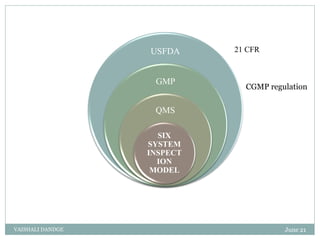
USFDA
GMP
QMS
SIX
SYSTEM
INSPECT
ION
MODEL
CGMP regulation
21 CFR
June 21
VAISHALI DANDGE
QUALITY MANAGEMENT
SYSTEM :
 A QMS is a collection of business processes focused on consistently meeting
customer requirements and enhancing their satisfaction.
 It is expressed as organizational goals and aspirations, policies, processes,
documented information and resources needed to implement and maintain it.
 Early QMS emphasized predictable outcomes of an industrial product
production line, using simple statistics and random sampling.
June 21
VAISHALI DANDGE
SIX SYSTEM INSPECTION MODEL
A model that can help pharmaceutical manufacturers comply with cGMP
regulation.
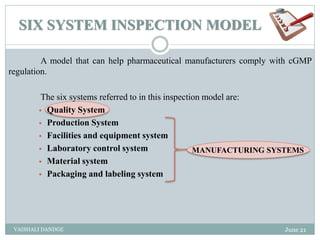
The six systems referred to in this inspection model are:
 Quality System
 Production System
 Facilities and equipment system
 Laboratory control system
 Material system
 Packaging and labeling system
MANUFACTURING SYSTEMS
June 21
VAISHALI DANDGE
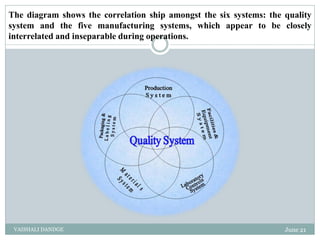
The diagram shows the correlation ship amongst the six systems: the quality
system and the five manufacturing systems, which appear to be closely
interrelated and inseparable during operations.
June 21
VAISHALI DANDGE
INTRODUCTION
 The FDA's Drug Manufacturing Inspection Compliance Program, which
contains instructions to FDA personnel for conducting inspections, is a
systems-based approach to inspection and is very consistent with the robust
quality system model presented in this guidance.
 The quality system provides the foundation for the manufacturing systems
that are linked and function within it. The quality system model described in
this guidance does not consider the five manufacturing systems as discrete
entities, but instead integrates them into appropriate sections of the model.
 Those familiar with the six-system inspection approach will see organizational
differences in this guidance; however, the inter-relationship should be readily
apparent.
June 21
VAISHALI DANDGE
 One of the important themes of the systems based inspection compliance program
is that you have the ability to assess whether each of the systems is in a state of
control.
 The quality system model presented in this guidance will also serve to help firms
achieve this state of control.
 Pharmaceutical manufacturers should implement modern quality systems with
risk management approaches to meet the requirements of the Agency's current
good manufacturing practice (cGMP) as per regulations 21 Code of Federal
Regulations (CFR) parts 210 and 211.
June 21
VAISHALI DANDGE
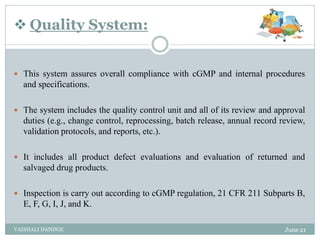
 Quality System:
 This system assures overall compliance with cGMP and internal procedures
and specifications.
 The system includes the quality control unit and all of its review and approval
duties (e.g., change control, reprocessing, batch release, annual record review,
validation protocols, and reports, etc.).
 It includes all product defect evaluations and evaluation of returned and
salvaged drug products.
 Inspection is carry out according to cGMP regulation, 21 CFR 211 Subparts B,
E, F, G, I, J, and K.
June 21
VAISHALI DANDGE
Subpart B - Organization and Personnel
 Responsibilities of quality control unit.
 Personnel qualifications.
 Personnel responsibilities.
 Consultants.
Subpart E - Control of Components and Drug Product Containers and
Closures
 General requirements.
 Receipt and storage of untested components, drug product containers, and
closures.
 Testing and approval or rejection of components, drug product containers,
and closures.
 Use of approved components, drug product containers, and closures.
 Retesting of approved components, drug product containers, and closures.
 Rejected components, drug product containers, and closures.
 Drug product containers and closures.
June 21
VAISHALI DANDGE
Subpart F - Production and Process Controls
 Written procedures; deviations.
 Charge-in of components.
 Calculation of yield.
 Equipment identification.
 Sampling and testing of in-process materials and drug products.
 Time limitations on production.
 Control of microbiological contamination.
 Reprocessing.
Subpart G - Packaging and Labeling Control
 Materials examination and usage criteria.
 Labeling issuance.
 Packaging and labeling operations.
 Tamper-evident packaging requirements for over-the-counter (OTC) human
drug products.
 Drug product inspection.
 Expiration dating.
June 21
VAISHALI DANDGE
Subpart I - Laboratory Controls
 General requirement.
 Testing and release for distribution.
 Stability testing.
 Special testing requirements.
 Reserve samples.
 Laboratory animals.
 Penicillin contamination.
Subpart J - Records and Reports
 General requirements.

 Equipment cleaning and use log.
 Component, drug product container, closure, and labeling records.
 Master production and control records.
 Batch production and control records.
 Production record review.
 Laboratory records.
 Distribution records.
 Complaint files.
Subpart K - Returned and Salvaged Drug Products
 Returned drug products.
 Drug product salvaging.
June 21
VAISHALI DANDGE
 Production System
 This system includes measures and activities to control the manufacture of
drugs and drug products including
 batch compounding
 dosage form production
 in-process sampling and testing
 process validation
 It also includes establishing, following, and documenting performance of
approved manufacturing procedures.
 Inspection is carry out according to the cGMP regulation, 21 CFR 211
Subparts B, F, and J.
June 21
VAISHALI DANDGE
 According to the cGMP :
 Quality and manufacturing process and procedures (and changes to them) must
be defined, approved and controlled.
 Batch numbering and maintaining proper traceability is required/process
validation is required.
– Track batch, equipment use records and labeling used,
personnel, raw material controls are traceable.
 Verification of all steps including sign-off are required for critical process
steps.
 Verification/ validation of computerized processes.
 All batch records must be reviewed and have QA approval before the product
is released.
June 21
VAISHALI DANDGE
 21 CFR 211 Subparts B, F, and J :
Subpart F - Production and Process Controls
 Written procedures; deviations.
 Charge-in of components.
 Calculation of yield.
 Equipment identification.
 Sampling and testing of in-process materials and drug products.
 Time limitations on production.
 Control of microbiological contamination.
 Reprocessing.
June 21
VAISHALI DANDGE
 FACILITIES AND EQUIPMENT
SYSTEM
 This system includes the measures and activities which provide an appropriate
physical environment and resources used in the production of the drugs or drug
products.
 It includes:
a) Buildings and facilities along with maintenance;
b) Equipment qualifications (installation and operation); equipment calibration
and preventative maintenance; and cleaning and validation of cleaning
processes as appropriate. Process performance qualification will be evaluated
as part of the inspection of the overall process validation which is done within
the system where the process is employed;
c) Utilities that are not intended to be incorporated into the product such as
HVAC, compressed gases, steam and water systems.
 Inspection is carry out according to the cGMP regulation, 21 CFR 211
Subparts B, C, D, and J.
June 21
VAISHALI DANDGE
 21 CFR 211 Subparts B, C, D, and J:
Subpart C - Buildings and Facilities
 Design and construction features.
 Lighting.
 Ventilation, air filtration, air heating and cooling.
 Plumbing.
 Sewage and refuse.
 Washing and toilet facilities.
 Sanitation.
 Maintenance.
Subpart D – Equipment
 Equipment design, size, and location.
 Equipment construction.
 Equipment cleaning and maintenance.
 Automatic, mechanical, and electronic equipment.
 Filters.
June 21
VAISHALI DANDGE
 Laboratory Control System:
 This system includes measures and activities related to
 Laboratory procedures
 Testing
 Analytical methods development
 Validation or verification
 The stability program
 Inspection is carry out according to the cGMP regulation, 21 CFR 211
Subparts B, I, J, and K.
June 21
VAISHALI DANDGE
 21 CFR 211 Subparts B, I, J, and K:
Subpart I - Laboratory Controls
 General requirements.
 Testing and release for distribution.
 Stability testing.
 Special testing requirements.
 Reserve samples.
 Laboratory animals.
 Penicillin contamination.
Subpart K - Returned and Salvaged Drug Products
 Returned drug products.
 Drug product salvaging.
June 21
VAISHALI DANDGE
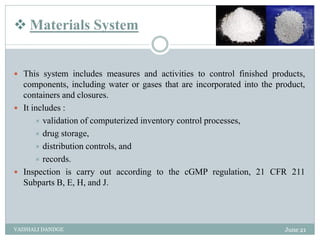
 Materials System
 This system includes measures and activities to control finished products,
components, including water or gases that are incorporated into the product,
containers and closures.
 It includes :
 validation of computerized inventory control processes,
 drug storage,
 distribution controls, and
 records.
 Inspection is carry out according to the cGMP regulation, 21 CFR 211
Subparts B, E, H, and J.
June 21
VAISHALI DANDGE
 Component
• Any ingredient intended for use in the manufacture of a drug product,
including those that may not appear in such drug product, 21 CFR 210.3(b)(3)
• Ex. excipients, water, gases, etc., even if not in final product
 Active Ingredient
• Any component that is intended to furnish pharmacological activity or other
direct effect in the diagnosis, cure, mitigation, or to affect the structure or any
function of the body of man or other animal, 21 CFR 210.3 (b)(7)
 Inactive ingredient (excipient)
• Any component other than an active component, 21 CFR 210.3(b)(8)
June 21
VAISHALI DANDGE
 21 CFR 211 Subparts B, E, H, and J
Subpart E - Control of Components and Drug Product Containers and Closures
 General requirements.
 Receipt and storage of untested components, drug product containers, and
closures.
 Testing and approval or rejection of components, drug product containers,
and closures.
 Use of approved components, drug product containers, and closures.
 Retesting of approved components, drug product containers, and closures.
 Rejected components, drug product containers, and closures.
 Drug product containers and closures.
Subpart H - Holding and Distribution
 Warehousing procedures.
 Distribution procedures
June 21
VAISHALI DANDGE
Packaging and
Labeling System
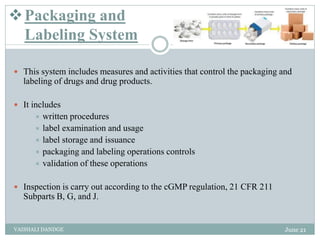
 This system includes measures and activities that control the packaging and
labeling of drugs and drug products.
 It includes
 written procedures
 label examination and usage
 label storage and issuance
 packaging and labeling operations controls
 validation of these operations
 Inspection is carry out according to the cGMP regulation, 21 CFR 211
Subparts B, G, and J.
June 21
VAISHALI DANDGE
 21 CFR 211 Subparts B, G, and J:
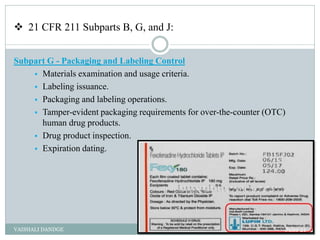
Subpart G - Packaging and Labeling Control
 Materials examination and usage criteria.
 Labeling issuance.
 Packaging and labeling operations.
 Tamper-evident packaging requirements for over-the-counter (OTC)
human drug products.
 Drug product inspection.
 Expiration dating.
June 21
VAISHALI DANDGE
Objectives of Inspection
1. To detect and remove the faulty raw materials before it undergoes
production.
2. To detect the faulty products in production whenever it is detected.
3. To bring facts to the notice of managers before they become serious to enable
them discover weaknesses and overcome the problem.
4. To prevent the substandard reaching the customer and reducing complaints.
5. To promote reputation for quality and reliability of product.
June 21
VAISHALI DANDGE
Purpose of Inspection
1. To distinguish good lots from bad lots.
2. To distinguish good pieces from bad pieces.
3. To determine if the process is changing.
4. To determine if the process is approaching the specification limits.
5. To rate quality of product.
6. To rate accuracy of inspectors.
7. To measure the precision of the measuring instrument.
8. To secure products-design information.
9. To measure process capability.
June 21
VAISHALI DANDGE
Reference:
https://www.accessdata.fda.gov/scripts/cdrh/cfdocs/cfcfr/cfrsearch.cfm?cfrpart=2
11
June 21
VAISHALI DANDGE
June 21
VAISHALI DANDGE

Six system inspection model

  • 1.
    Presented By : VaishaliD. Dandge M.Pharm, Quality Assurance, 1st Sem Guided By : Monika Jadhao Mam Subject : Quality Management System Vidya Bharti College Of Pharmacy, Amravati June 21 VAISHALI DANDGE
  • 2.
  • 3.
    QUALITY MANAGEMENT SYSTEM : A QMS is a collection of business processes focused on consistently meeting customer requirements and enhancing their satisfaction.  It is expressed as organizational goals and aspirations, policies, processes, documented information and resources needed to implement and maintain it.  Early QMS emphasized predictable outcomes of an industrial product production line, using simple statistics and random sampling. June 21 VAISHALI DANDGE
  • 4.
    SIX SYSTEM INSPECTIONMODEL A model that can help pharmaceutical manufacturers comply with cGMP regulation. The six systems referred to in this inspection model are:  Quality System  Production System  Facilities and equipment system  Laboratory control system  Material system  Packaging and labeling system MANUFACTURING SYSTEMS June 21 VAISHALI DANDGE
  • 5.
    The diagram showsthe correlation ship amongst the six systems: the quality system and the five manufacturing systems, which appear to be closely interrelated and inseparable during operations. June 21 VAISHALI DANDGE
  • 6.
    INTRODUCTION  The FDA'sDrug Manufacturing Inspection Compliance Program, which contains instructions to FDA personnel for conducting inspections, is a systems-based approach to inspection and is very consistent with the robust quality system model presented in this guidance.  The quality system provides the foundation for the manufacturing systems that are linked and function within it. The quality system model described in this guidance does not consider the five manufacturing systems as discrete entities, but instead integrates them into appropriate sections of the model.  Those familiar with the six-system inspection approach will see organizational differences in this guidance; however, the inter-relationship should be readily apparent. June 21 VAISHALI DANDGE
  • 7.
     One ofthe important themes of the systems based inspection compliance program is that you have the ability to assess whether each of the systems is in a state of control.  The quality system model presented in this guidance will also serve to help firms achieve this state of control.  Pharmaceutical manufacturers should implement modern quality systems with risk management approaches to meet the requirements of the Agency's current good manufacturing practice (cGMP) as per regulations 21 Code of Federal Regulations (CFR) parts 210 and 211. June 21 VAISHALI DANDGE
  • 8.
     Quality System: This system assures overall compliance with cGMP and internal procedures and specifications.  The system includes the quality control unit and all of its review and approval duties (e.g., change control, reprocessing, batch release, annual record review, validation protocols, and reports, etc.).  It includes all product defect evaluations and evaluation of returned and salvaged drug products.  Inspection is carry out according to cGMP regulation, 21 CFR 211 Subparts B, E, F, G, I, J, and K. June 21 VAISHALI DANDGE
  • 9.
    Subpart B -Organization and Personnel  Responsibilities of quality control unit.  Personnel qualifications.  Personnel responsibilities.  Consultants. Subpart E - Control of Components and Drug Product Containers and Closures  General requirements.  Receipt and storage of untested components, drug product containers, and closures.  Testing and approval or rejection of components, drug product containers, and closures.  Use of approved components, drug product containers, and closures.  Retesting of approved components, drug product containers, and closures.  Rejected components, drug product containers, and closures.  Drug product containers and closures. June 21 VAISHALI DANDGE
  • 10.
    Subpart F -Production and Process Controls  Written procedures; deviations.  Charge-in of components.  Calculation of yield.  Equipment identification.  Sampling and testing of in-process materials and drug products.  Time limitations on production.  Control of microbiological contamination.  Reprocessing. Subpart G - Packaging and Labeling Control  Materials examination and usage criteria.  Labeling issuance.  Packaging and labeling operations.  Tamper-evident packaging requirements for over-the-counter (OTC) human drug products.  Drug product inspection.  Expiration dating. June 21 VAISHALI DANDGE
  • 11.
    Subpart I -Laboratory Controls  General requirement.  Testing and release for distribution.  Stability testing.  Special testing requirements.  Reserve samples.  Laboratory animals.  Penicillin contamination. Subpart J - Records and Reports  General requirements.  Equipment cleaning and use log.  Component, drug product container, closure, and labeling records.  Master production and control records.  Batch production and control records.  Production record review.  Laboratory records.  Distribution records.  Complaint files. Subpart K - Returned and Salvaged Drug Products  Returned drug products.  Drug product salvaging. June 21 VAISHALI DANDGE
  • 12.
     Production System This system includes measures and activities to control the manufacture of drugs and drug products including  batch compounding  dosage form production  in-process sampling and testing  process validation  It also includes establishing, following, and documenting performance of approved manufacturing procedures.  Inspection is carry out according to the cGMP regulation, 21 CFR 211 Subparts B, F, and J. June 21 VAISHALI DANDGE
  • 13.
     According tothe cGMP :  Quality and manufacturing process and procedures (and changes to them) must be defined, approved and controlled.  Batch numbering and maintaining proper traceability is required/process validation is required. – Track batch, equipment use records and labeling used, personnel, raw material controls are traceable.  Verification of all steps including sign-off are required for critical process steps.  Verification/ validation of computerized processes.  All batch records must be reviewed and have QA approval before the product is released. June 21 VAISHALI DANDGE
  • 14.
     21 CFR211 Subparts B, F, and J : Subpart F - Production and Process Controls  Written procedures; deviations.  Charge-in of components.  Calculation of yield.  Equipment identification.  Sampling and testing of in-process materials and drug products.  Time limitations on production.  Control of microbiological contamination.  Reprocessing. June 21 VAISHALI DANDGE
  • 15.
     FACILITIES ANDEQUIPMENT SYSTEM  This system includes the measures and activities which provide an appropriate physical environment and resources used in the production of the drugs or drug products.  It includes: a) Buildings and facilities along with maintenance; b) Equipment qualifications (installation and operation); equipment calibration and preventative maintenance; and cleaning and validation of cleaning processes as appropriate. Process performance qualification will be evaluated as part of the inspection of the overall process validation which is done within the system where the process is employed; c) Utilities that are not intended to be incorporated into the product such as HVAC, compressed gases, steam and water systems.  Inspection is carry out according to the cGMP regulation, 21 CFR 211 Subparts B, C, D, and J. June 21 VAISHALI DANDGE
  • 16.
     21 CFR211 Subparts B, C, D, and J: Subpart C - Buildings and Facilities  Design and construction features.  Lighting.  Ventilation, air filtration, air heating and cooling.  Plumbing.  Sewage and refuse.  Washing and toilet facilities.  Sanitation.  Maintenance. Subpart D – Equipment  Equipment design, size, and location.  Equipment construction.  Equipment cleaning and maintenance.  Automatic, mechanical, and electronic equipment.  Filters. June 21 VAISHALI DANDGE
  • 17.
     Laboratory ControlSystem:  This system includes measures and activities related to  Laboratory procedures  Testing  Analytical methods development  Validation or verification  The stability program  Inspection is carry out according to the cGMP regulation, 21 CFR 211 Subparts B, I, J, and K. June 21 VAISHALI DANDGE
  • 18.
     21 CFR211 Subparts B, I, J, and K: Subpart I - Laboratory Controls  General requirements.  Testing and release for distribution.  Stability testing.  Special testing requirements.  Reserve samples.  Laboratory animals.  Penicillin contamination. Subpart K - Returned and Salvaged Drug Products  Returned drug products.  Drug product salvaging. June 21 VAISHALI DANDGE
  • 19.
     Materials System This system includes measures and activities to control finished products, components, including water or gases that are incorporated into the product, containers and closures.  It includes :  validation of computerized inventory control processes,  drug storage,  distribution controls, and  records.  Inspection is carry out according to the cGMP regulation, 21 CFR 211 Subparts B, E, H, and J. June 21 VAISHALI DANDGE
  • 20.
     Component • Anyingredient intended for use in the manufacture of a drug product, including those that may not appear in such drug product, 21 CFR 210.3(b)(3) • Ex. excipients, water, gases, etc., even if not in final product  Active Ingredient • Any component that is intended to furnish pharmacological activity or other direct effect in the diagnosis, cure, mitigation, or to affect the structure or any function of the body of man or other animal, 21 CFR 210.3 (b)(7)  Inactive ingredient (excipient) • Any component other than an active component, 21 CFR 210.3(b)(8) June 21 VAISHALI DANDGE
  • 21.
     21 CFR211 Subparts B, E, H, and J Subpart E - Control of Components and Drug Product Containers and Closures  General requirements.  Receipt and storage of untested components, drug product containers, and closures.  Testing and approval or rejection of components, drug product containers, and closures.  Use of approved components, drug product containers, and closures.  Retesting of approved components, drug product containers, and closures.  Rejected components, drug product containers, and closures.  Drug product containers and closures. Subpart H - Holding and Distribution  Warehousing procedures.  Distribution procedures June 21 VAISHALI DANDGE
  • 22.
    Packaging and Labeling System This system includes measures and activities that control the packaging and labeling of drugs and drug products.  It includes  written procedures  label examination and usage  label storage and issuance  packaging and labeling operations controls  validation of these operations  Inspection is carry out according to the cGMP regulation, 21 CFR 211 Subparts B, G, and J. June 21 VAISHALI DANDGE
  • 23.
     21 CFR211 Subparts B, G, and J: Subpart G - Packaging and Labeling Control  Materials examination and usage criteria.  Labeling issuance.  Packaging and labeling operations.  Tamper-evident packaging requirements for over-the-counter (OTC) human drug products.  Drug product inspection.  Expiration dating. June 21 VAISHALI DANDGE
  • 24.
    Objectives of Inspection 1.To detect and remove the faulty raw materials before it undergoes production. 2. To detect the faulty products in production whenever it is detected. 3. To bring facts to the notice of managers before they become serious to enable them discover weaknesses and overcome the problem. 4. To prevent the substandard reaching the customer and reducing complaints. 5. To promote reputation for quality and reliability of product. June 21 VAISHALI DANDGE
  • 25.
    Purpose of Inspection 1.To distinguish good lots from bad lots. 2. To distinguish good pieces from bad pieces. 3. To determine if the process is changing. 4. To determine if the process is approaching the specification limits. 5. To rate quality of product. 6. To rate accuracy of inspectors. 7. To measure the precision of the measuring instrument. 8. To secure products-design information. 9. To measure process capability. June 21 VAISHALI DANDGE
  • 26.
  • 27.