IMPURITY PROFILING
SRINIVASA RAO COLLEGE OF PHARMACY, P.M.PALEM, VISAKHAPATNAM
By
K.Naga Jyothi
(Regd.No:616233704006)
M.Pharmacy 2nd year(3rd semester)
Pharmaceutical analysis and quality assurance
Contents :
Introduction
Definitions
 Sources of impurities
 Threshold for impurities
 Identification of impurities
 References
Introduction :
 In the field of pharmaceutical chemistry, impurities are considered to be
extraneous materials present in the therapeutically active pharmaceutical
compounds. They are expected to have unusually potent, toxic or unexpected
pharmacological effects which are detrimental to human health.
 Now a days , not only purity profile but also impurity profile has become
mandatory according to various regulatory authorities .
 In the pharmaceutical world , an impurity is considered as any other
inorganic or organic material , or residual solvents other than the drug
substances , or ingredients , arise out of synthesis or unwanted chemicals
remains with APIs .
Definition :
 The description , characterization and quantitation of identified and
unidentified impurities present in the drug substances is known as impurity
profile.
 IMPURITIES in pharmaceuticals are unwanted chemicals, that even in small
amounts may influence the efficacy and safety of the pharmaceutical products.
Other definitions :
 Identified impurity
 Unidentified impurity
 Specified impurity
 Unspecified impurity
 Potential impurity
Sources of impurities :
 A list of impurities which are likely to be present in a given pharmaceutical
substance can be easily complied from the knowledge of the raw materials
employed , the manufacturing process and stability of the final product.
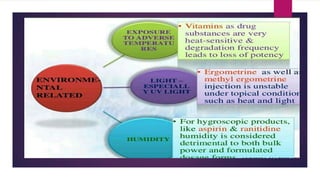
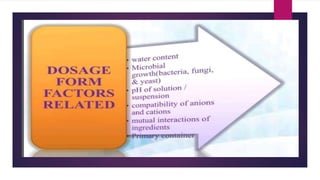
 Impurities may also arise from physical contamination and improper storage
conditions.
 The various sources of impurities in pharmaceutical substances are as
follow.
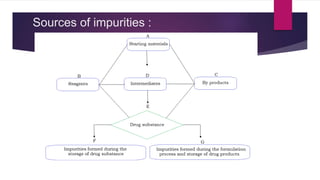
Sources of impurities :
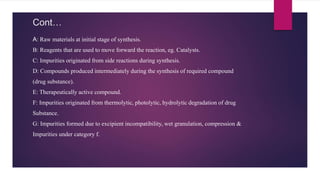
Cont…
A: Raw materials at initial stage of synthesis.
B: Reagents that are used to move forward the reaction, eg. Catalysts.
C: Impurities originated from side reactions during synthesis.
D: Compounds produced intermediately during the synthesis of required compound
(drug substance).
E: Therapeutically active compound.
F: Impurities originated from thermolytic, photolytic, hydrolytic degradation of drug
Substance.
G: Impurities formed due to excipient incompatibility, wet granulation, compression &
Impurities under category f.
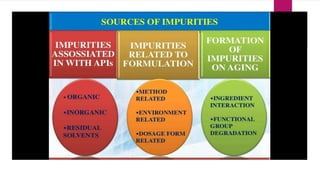
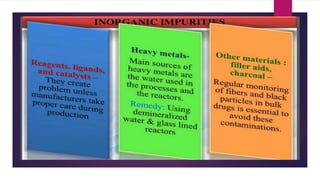
Inorganic impurities :
Inorganic impurities can be formed from the manufacturing process.
They are generally known and identified compounds such as
reagents, ligands, catalysts, heavy metals, other residual metals,
inorganic salts and other materials like filter aids, carbon etc.
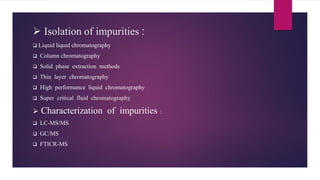
 Isolation of impurities :
 Liquid liquid chromatography
 Column chromatography
 Solid phase extraction methods
 Thin layer chromatography
 High performance liquid chromatography
 Super critical fluid chromatography
 Characterization of impurities :
 LC-MS/MS
 GC/MS
 FTICR-MS
 Reference :
 AHUJA S, CHIRAL SEPARATIONS BY LIQUID CHROMATOGRAPHY. WASHINGTON, DC,
USA: AMERICAN CHEMICAL SOCIETY; 1991.
 ZIEF M, CRANE L, EDITORS. CHROMATOGRAPHIC CHLRAL SEPARATIONS. NEW YORK,
USA: MARCEL DEKKER; 1987.
 ALLENMARK SG. CHROMATOGRAPHIC ENANTIOSEPARATION: METHODS AND
APPLICATION. CHICHESTER, WEST SUSSEX, UK: ELLIS HORWOOD; 1989.
 SOUTER RW. CHROMATOGRAPHIC SEPARATION OF STEREOISOMERS. BOCA RATON,
FLORIDA, USA: CRC PRESS; 1985.
 KRSTULOVIC AM, CHIRAL SEPARATIONS BY HPLC: APPLICATION TO
PHARMACEUTICAL COMPOUNDS. CHICHESTER, WEST SUSSEX, UK: ELLIS HORWOOD;
1989.
 SANDOR GOROG, THE CHANGING FACE OF PHARMACEUTICAL ANALYSIS, TRAC-
TREND. ANAL. CHEM, 26, 2007, 12-17.
 GÖRÖG S. ULTRAVIOLET-VISIBLE SPECTROPHOTOMETRY IN PHARMACEUTI-
 Impurities in new drug substances, ICH harmonised tripartite guideline Q3B (R2), current step 4
version, 2006, 6.
 Satinder ahuja, hand book of isolation and characterization of impurities in pharmaceuticals,
2005, 8.
 Impurities in new drug substances, ich harmonised tripartite guideline q3a (r2), current step 4
version, 2008,2.
 Arup k. Basak, andre S. Raw, ali H. Al hakim, scott furness, nashed I. Samaan, devinder S. Gill,
hasmukh B. Patel, roslyn F, powers, lawrence yu, pharmaceutical impurities: regulatory perspective
for abbreviated new drug applications, adv. Drug delivery rev, 59, 2007, 64-72.
 Radhika rajagopalan, review of regulatory guidance on impurities, separation science and
technology, 5, 2004, 27-37.
 Sanjay b. Bari, bharati R. Kadam, yogini S. Jaiswal, atul A. Shirkhedkar, impurity profile:
significance in active pharmaceutical ingredient, eurasian J. Anal. Chem, 2, 2007, 32-53.
 Habilitationsschrift, optimal synthesis and design of advanced chromatographic process concepts,
chapter-1, 1.
Impurity Profile

Impurity Profile

  • 1.
    IMPURITY PROFILING SRINIVASA RAOCOLLEGE OF PHARMACY, P.M.PALEM, VISAKHAPATNAM By K.Naga Jyothi (Regd.No:616233704006) M.Pharmacy 2nd year(3rd semester) Pharmaceutical analysis and quality assurance
  • 2.
    Contents : Introduction Definitions  Sourcesof impurities  Threshold for impurities  Identification of impurities  References
  • 3.
    Introduction :  Inthe field of pharmaceutical chemistry, impurities are considered to be extraneous materials present in the therapeutically active pharmaceutical compounds. They are expected to have unusually potent, toxic or unexpected pharmacological effects which are detrimental to human health.  Now a days , not only purity profile but also impurity profile has become mandatory according to various regulatory authorities .  In the pharmaceutical world , an impurity is considered as any other inorganic or organic material , or residual solvents other than the drug substances , or ingredients , arise out of synthesis or unwanted chemicals remains with APIs .
  • 4.
    Definition :  Thedescription , characterization and quantitation of identified and unidentified impurities present in the drug substances is known as impurity profile.  IMPURITIES in pharmaceuticals are unwanted chemicals, that even in small amounts may influence the efficacy and safety of the pharmaceutical products.
  • 5.
    Other definitions : Identified impurity  Unidentified impurity  Specified impurity  Unspecified impurity  Potential impurity
  • 7.
    Sources of impurities:  A list of impurities which are likely to be present in a given pharmaceutical substance can be easily complied from the knowledge of the raw materials employed , the manufacturing process and stability of the final product.  Impurities may also arise from physical contamination and improper storage conditions.  The various sources of impurities in pharmaceutical substances are as follow.
  • 8.
  • 9.
    Cont… A: Raw materialsat initial stage of synthesis. B: Reagents that are used to move forward the reaction, eg. Catalysts. C: Impurities originated from side reactions during synthesis. D: Compounds produced intermediately during the synthesis of required compound (drug substance). E: Therapeutically active compound. F: Impurities originated from thermolytic, photolytic, hydrolytic degradation of drug Substance. G: Impurities formed due to excipient incompatibility, wet granulation, compression & Impurities under category f.
  • 15.
    Inorganic impurities : Inorganicimpurities can be formed from the manufacturing process. They are generally known and identified compounds such as reagents, ligands, catalysts, heavy metals, other residual metals, inorganic salts and other materials like filter aids, carbon etc.
  • 24.
     Isolation ofimpurities :  Liquid liquid chromatography  Column chromatography  Solid phase extraction methods  Thin layer chromatography  High performance liquid chromatography  Super critical fluid chromatography  Characterization of impurities :  LC-MS/MS  GC/MS  FTICR-MS
  • 25.
     Reference : AHUJA S, CHIRAL SEPARATIONS BY LIQUID CHROMATOGRAPHY. WASHINGTON, DC, USA: AMERICAN CHEMICAL SOCIETY; 1991.  ZIEF M, CRANE L, EDITORS. CHROMATOGRAPHIC CHLRAL SEPARATIONS. NEW YORK, USA: MARCEL DEKKER; 1987.  ALLENMARK SG. CHROMATOGRAPHIC ENANTIOSEPARATION: METHODS AND APPLICATION. CHICHESTER, WEST SUSSEX, UK: ELLIS HORWOOD; 1989.  SOUTER RW. CHROMATOGRAPHIC SEPARATION OF STEREOISOMERS. BOCA RATON, FLORIDA, USA: CRC PRESS; 1985.  KRSTULOVIC AM, CHIRAL SEPARATIONS BY HPLC: APPLICATION TO PHARMACEUTICAL COMPOUNDS. CHICHESTER, WEST SUSSEX, UK: ELLIS HORWOOD; 1989.  SANDOR GOROG, THE CHANGING FACE OF PHARMACEUTICAL ANALYSIS, TRAC- TREND. ANAL. CHEM, 26, 2007, 12-17.  GÖRÖG S. ULTRAVIOLET-VISIBLE SPECTROPHOTOMETRY IN PHARMACEUTI-
  • 26.
     Impurities innew drug substances, ICH harmonised tripartite guideline Q3B (R2), current step 4 version, 2006, 6.  Satinder ahuja, hand book of isolation and characterization of impurities in pharmaceuticals, 2005, 8.  Impurities in new drug substances, ich harmonised tripartite guideline q3a (r2), current step 4 version, 2008,2.  Arup k. Basak, andre S. Raw, ali H. Al hakim, scott furness, nashed I. Samaan, devinder S. Gill, hasmukh B. Patel, roslyn F, powers, lawrence yu, pharmaceutical impurities: regulatory perspective for abbreviated new drug applications, adv. Drug delivery rev, 59, 2007, 64-72.  Radhika rajagopalan, review of regulatory guidance on impurities, separation science and technology, 5, 2004, 27-37.  Sanjay b. Bari, bharati R. Kadam, yogini S. Jaiswal, atul A. Shirkhedkar, impurity profile: significance in active pharmaceutical ingredient, eurasian J. Anal. Chem, 2, 2007, 32-53.  Habilitationsschrift, optimal synthesis and design of advanced chromatographic process concepts, chapter-1, 1.