


• PRESENTD BY :-
• PATIL PRANJAY SADASHIV.
• FIRST YEAR M.PHARM.
• DEPARTMENT OF QUALITY ASSURANCE.
H. R. Patel Institute of Pharmaceutical Education
and Research, Shirpur
CONTENT..
 Introduction
 Specification
 Test procedures
 Distribution record
 Electronic data Handling
 Controlled Documents
 Uncontrolled Documents
INTRODUCTION
Documentation is an integral part of
good manufacturing practices .It defines a
system of information and control so that risks
so inherent in ministerpretation and /or error
in oral communication are minimized.
Information on when,where,who,why,& how
to complete tasks
SPECIFICATION
specification may be defined as a set
of parameters along with their acceptance
limits.expected to be met by a particular
material, piece of equipment or any such
object. In case of pharmaceutical products , we
need specification for active and inactive
starting material.
TYPES OF SPECIFICATION
1) Specification for active and inactive starting
material
2) Secification for packing material
3) Specification for Intermediate and Bulk
product
4) Specification for Finished Product
1)SPECIFICATION FOR ACTIVE AND INACTIVE STARTING
MATERIAL
i. Name of the material
ii. Code number refernce
iii. Name of approved supplier and original manufacturer
iv. Direction for sampling and testing or refernce to the procedure
v. Storage condition and safety precaution if any
2)SPECIFICATION FOR PACKING MATERIAL
i. Name of material
ii. Code number reference
iii. Sampling instruction
iv. Storage condition
v. Frequency of re-examination of stored components
3) SPECIFICATION FOR INTERMEDIAT AND BULK PRODUCT
i. Specification for intermediat and bulk product should
available if this are purches for dispatch are use in the
evaluation of the finished product
ii. This specification should be similiar to starting material or
finished products as applicable
4) SPECIFICATION FOR FINISHED PRODUCT
i. Name of the product
ii. Code number reference
iii. Names of the active ingredient
iv. The formula or refence to the formula
v. Shelf life
vi. The qualitative and quatitative requirments with
acceptances limits
TEST PROCEDURE
Test procedure must be described
in a sufficiently detailed manner to enable
any official laboratory to verify compliance of
the medicinal product upto the end of shelf
life. controle method must be validated in
accordance with the note for guidance.
CONTINUE..
 The test procedure may use either an official refernce
substance (europian pharmacopeia ,national pharmacopeia
,WHO).
 Accepte for those official included in the europian
pharmacopeia eg.sterility test.
DISTRIBUTION RECORDS
Distribution records shall contain the name and strength of
the product and description of the dosage form, name and
address of the consignee, date and quality shipped, and lot
or control number of the drug product. For compressed
medical gas products, distribution records are not required to
contain lot or control numbers.
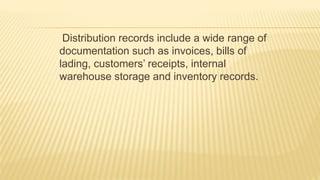
Distribution records include a wide range of
documentation such as invoices, bills of
lading, customers’ receipts, internal
warehouse storage and inventory records.
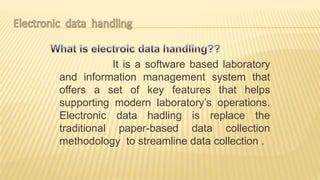
It is a software based laboratory
and information management system that
offers a set of key features that helps
supporting modern laboratory’s operations.
Electronic data hadling is replace the
traditional paper-based data collection
methodology to streamline data collection .
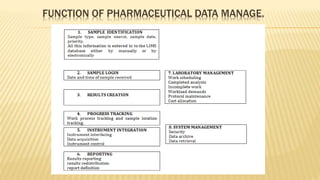
FUNCTION OF PHARMACEUTICAL DATA MANAGE.
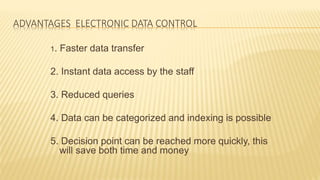
ADVANTAGES ELECTRONIC DATA CONTROL
1. Faster data transfer
2. Instant data access by the staff
3. Reduced queries
4. Data can be categorized and indexing is possible
5. Decision point can be reached more quickly, this
will save both time and money
DISADVANTAGES OF EDC
1. Installation of software in each PC which is costlier
2. Availability of Internet connections in remote areas
where trial is being conducted
3. Data security is a major problem if public internet is
being used
4. Regular validation of electronic devices
5. Regulatory compliance
SHARE POINT OF DOCUMENT
CONTROL DOCUMENT
Each manufacturer shall establish and maintain procedure
to control all document that are required by this part. The
procedure shall provide for the following.
a) Document aprroval and distribution
b) Document changes
DOCUMENT APPROVAL AND DISTRTBUTION
 Each manufacturer shall designate an individual
to review for adequacy and approve prior to
issuance all document established to meet the
requirement of this part.
 The approval, including the data and signature of
the individual approving the document ,shall be
documented.
DOCUMENT CHANGES
 Changes to document shall be reviewed
and approved by an individual in the same
function or organization that performed the
original review and approval.
 Approved changes shall be communicated
to the appropriate personnel in a timely
manner.
UNCONTROLLED DOCUMENT
Uncontrolled copy shall be
prepared by photocopy of master copy with
stamping of “ UNCOTROLLED COPY” in red
colour and signed/ dated by QA on each
page of the document at center on the
matter .
CONTINUE
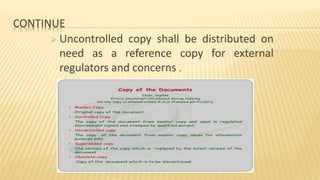
 Uncontrolled copy shall be distributed on
need as a reference copy for external
regulators and concerns .
REFRANCE..
1) Pharmaceutical Quality Assurance by Manohar
A. Potdar published by Nirali prakashan 5th
edition 2016
2) Asian Journal of Pharmaceutical and Clinical
Research by M.N.Raviteja & N.Vishal Gupta
Vol 6, Suppl 2, 2013
3) Pharmaceutical Quality Assurance and
Management by K P Bhusari , U D Shihari and D
C Goupale published Nirali prakashan 2nd
edition 2014
CONTINUE..
4) www. Wikipedia.com
5)www.Google.com
Documentation  in pharmaceutical industry

Documentation in pharmaceutical industry

  • 1.
    • PRESENTD BY:- • PATIL PRANJAY SADASHIV. • FIRST YEAR M.PHARM. • DEPARTMENT OF QUALITY ASSURANCE. H. R. Patel Institute of Pharmaceutical Education and Research, Shirpur
  • 2.
    CONTENT..  Introduction  Specification Test procedures  Distribution record  Electronic data Handling  Controlled Documents  Uncontrolled Documents
  • 3.
    INTRODUCTION Documentation is anintegral part of good manufacturing practices .It defines a system of information and control so that risks so inherent in ministerpretation and /or error in oral communication are minimized. Information on when,where,who,why,& how to complete tasks
  • 4.
    SPECIFICATION specification may bedefined as a set of parameters along with their acceptance limits.expected to be met by a particular material, piece of equipment or any such object. In case of pharmaceutical products , we need specification for active and inactive starting material.
  • 5.
    TYPES OF SPECIFICATION 1)Specification for active and inactive starting material 2) Secification for packing material 3) Specification for Intermediate and Bulk product 4) Specification for Finished Product
  • 6.
    1)SPECIFICATION FOR ACTIVEAND INACTIVE STARTING MATERIAL i. Name of the material ii. Code number refernce iii. Name of approved supplier and original manufacturer iv. Direction for sampling and testing or refernce to the procedure v. Storage condition and safety precaution if any
  • 7.
    2)SPECIFICATION FOR PACKINGMATERIAL i. Name of material ii. Code number reference iii. Sampling instruction iv. Storage condition v. Frequency of re-examination of stored components
  • 8.
    3) SPECIFICATION FORINTERMEDIAT AND BULK PRODUCT i. Specification for intermediat and bulk product should available if this are purches for dispatch are use in the evaluation of the finished product ii. This specification should be similiar to starting material or finished products as applicable
  • 9.
    4) SPECIFICATION FORFINISHED PRODUCT i. Name of the product ii. Code number reference iii. Names of the active ingredient iv. The formula or refence to the formula v. Shelf life vi. The qualitative and quatitative requirments with acceptances limits
  • 10.
    TEST PROCEDURE Test proceduremust be described in a sufficiently detailed manner to enable any official laboratory to verify compliance of the medicinal product upto the end of shelf life. controle method must be validated in accordance with the note for guidance.
  • 11.
    CONTINUE..  The testprocedure may use either an official refernce substance (europian pharmacopeia ,national pharmacopeia ,WHO).  Accepte for those official included in the europian pharmacopeia eg.sterility test.
  • 12.
    DISTRIBUTION RECORDS Distribution recordsshall contain the name and strength of the product and description of the dosage form, name and address of the consignee, date and quality shipped, and lot or control number of the drug product. For compressed medical gas products, distribution records are not required to contain lot or control numbers.
  • 13.
    Distribution records includea wide range of documentation such as invoices, bills of lading, customers’ receipts, internal warehouse storage and inventory records.
  • 14.
    It is asoftware based laboratory and information management system that offers a set of key features that helps supporting modern laboratory’s operations. Electronic data hadling is replace the traditional paper-based data collection methodology to streamline data collection .
  • 15.
  • 16.
    ADVANTAGES ELECTRONIC DATACONTROL 1. Faster data transfer 2. Instant data access by the staff 3. Reduced queries 4. Data can be categorized and indexing is possible 5. Decision point can be reached more quickly, this will save both time and money
  • 17.
    DISADVANTAGES OF EDC 1.Installation of software in each PC which is costlier 2. Availability of Internet connections in remote areas where trial is being conducted 3. Data security is a major problem if public internet is being used 4. Regular validation of electronic devices 5. Regulatory compliance
  • 18.
  • 19.
    CONTROL DOCUMENT Each manufacturershall establish and maintain procedure to control all document that are required by this part. The procedure shall provide for the following. a) Document aprroval and distribution b) Document changes
  • 20.
    DOCUMENT APPROVAL ANDDISTRTBUTION  Each manufacturer shall designate an individual to review for adequacy and approve prior to issuance all document established to meet the requirement of this part.  The approval, including the data and signature of the individual approving the document ,shall be documented.
  • 21.
    DOCUMENT CHANGES  Changesto document shall be reviewed and approved by an individual in the same function or organization that performed the original review and approval.  Approved changes shall be communicated to the appropriate personnel in a timely manner.
  • 22.
    UNCONTROLLED DOCUMENT Uncontrolled copyshall be prepared by photocopy of master copy with stamping of “ UNCOTROLLED COPY” in red colour and signed/ dated by QA on each page of the document at center on the matter .
  • 23.
    CONTINUE  Uncontrolled copyshall be distributed on need as a reference copy for external regulators and concerns .
  • 24.
    REFRANCE.. 1) Pharmaceutical QualityAssurance by Manohar A. Potdar published by Nirali prakashan 5th edition 2016 2) Asian Journal of Pharmaceutical and Clinical Research by M.N.Raviteja & N.Vishal Gupta Vol 6, Suppl 2, 2013 3) Pharmaceutical Quality Assurance and Management by K P Bhusari , U D Shihari and D C Goupale published Nirali prakashan 2nd edition 2014
  • 25.