FINISHED PRODUCT RELEASE,
QUALITY REVIEW, QUALITY AUDIT
AND BATCH RELEASE DOCUMENT
Prepared By: S.SUSENA
( M. Pharm Sem-2)
Q.A . Department
Guided by: Nansri saha
S. S. J. Pharmacy College
Agenda:
 Finished Product Release
 WHO Guideline
 SOP on Releasing of Finished Product
 Sampling & Testing
 Quality Review
 Quality Audit
 Batch Release Document
2
FINISHED PRODUCT RELEASE:
• A Product in the marketable pack is
classified as finished product.
• Practically a transportable pack, i.e. a
shipper containing the salable pack (in
retail) is considered the finished product
3
WHO Guidelines :
• Finished product should be held in
quarantine until their final release, after
which they should be stored as usable stock
under conditions established by the
manufacturer.
• Product failing to meet the established
specifications or any other relevant quality
criteria should be rejected.
4
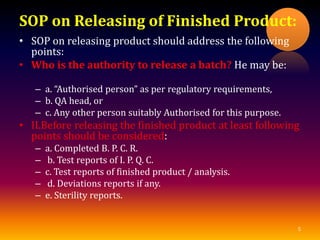
SOP on Releasing of Finished Product:
• SOP on releasing product should address the following
points:
• Who is the authority to release a batch? He may be:
– a. “Authorised person” as per regulatory requirements,
– b. QA head, or
– c. Any other person suitably Authorised for this purpose.

• II.Before releasing the finished product at least following
points should be considered:
– a. Completed B. P. C. R.
– b. Test reports of I. P. Q. C.
– c. Test reports of finished product / analysis.
– d. Deviations reports if any.
– e. Sterility reports.
5
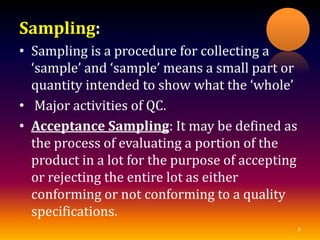
Sampling:
• Sampling is a procedure for collecting a
‘sample’ and ‘sample’ means a small part or
quantity intended to show what the ‘whole’
• Major activities of QC.
• Acceptance Sampling: It may be defined as
the process of evaluating a portion of the
product in a lot for the purpose of accepting
or rejecting the entire lot as either
conforming or not conforming to a quality
specifications.
6
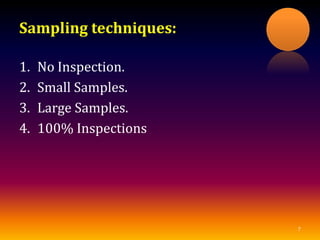
Sampling techniques:
1. No Inspection.
2. Small Samples.
3. Large Samples.
4. 100% Inspections
7
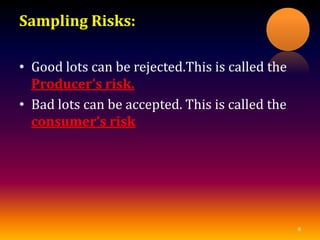
Sampling Risks:
• Good lots can be rejected.This is called the
Producer’s risk.
• Bad lots can be accepted. This is called the
consumer’s risk
8
Sampling Plans:
• Attributer Plans : A random sample is
taken from the lot and each unit is classified
as acceptable or defective.
• Variable Plans : A sample is taken and a
measurement of a specified quality
characteristics is made on each unit from
lot.
9
5/19/2013
Free template from www.brainybetty.com
(copyright 2007)
10
DOCUMENTS RELATED TO FINISHED PRODUCT
RELEASE
• Laboratory investigation and report form
• Finished good cards
• Stability Data
• Master document Change control form
• Retention sample log book
• Test sample log book
• QA inspection Sheet
• Finished Product specification& test report
• Calibration policies and related reports
• Reference substance specification report
• Laboratory Work Book
• Managing Analytical reagent
• Stability& trail testing procedure
• Laboratory Waste management
• Laboratory Results- Out of specification investigation reports
11
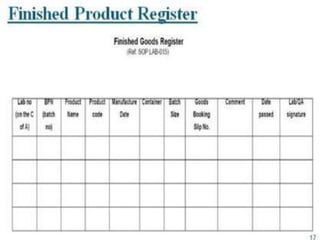
Finished Product Register:
• LAB NO:
• BATCH PRODUCTION
• Product name
• Manuf.date
• Container
• Batch size
• Goods booking slip no:
• Comment
• Date passed
• Lab/ Qa sign
12
5/19/2013
Free template from www.brainybetty.com
(copyright 2007)
13
5/19/2013
Free template from www.brainybetty.com
(copyright 2007)
14
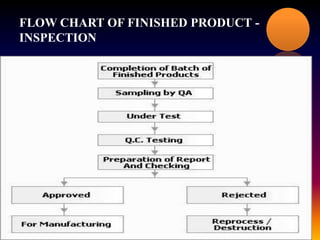
FLOW CHART OF FINISHED PRODUCT -
INSPECTION
5/19/2013
Free template from www.brainybetty.com
(copyright 2007)
15
Quality Review
• Before a finished product is released for sale
or distribution, the complete production
and control records must be reviewed and
assured satisfaction about the entire
process of production and control.
• This is considered to be the last stage in the
control process before the product moves
out of the manufacturing premises
16
Problems in Investigations:
• Investigating Officer
• Training Planning
• Witness Interviews
17
Investigating Officer Training:
• Formal training by the Inspector
• Investigation requirements
• Judge Advocate participation
18
Advance Planning:
• Road map - Where do you want to go?
• Brainstorm with Inspector
a. Identify document needs
b. Prepare witness list
c. Prepare questions
19
Witness Interviews:
• Use outline of questions
• Ask the tough questions
• Listen to the answers and follow-up
• Follow procedural requirements
• Explain absence of necessary witnesses
20
Quality review should be seen as a 3 phase
process:
• Phase 1-Preparation:
• This phase precedes the actual review
meeting
• It is the responsibility of the chairman and
presenter to organize the quality review and
notify all those invited.
21
Phase 2- The review meeting:
22
• The central phase of the quality review process is
the review meeting itself
• During the review meeting the emphasis should
be on error detection, in line with the criteria,
and only limited discussion of corrective action
should occur
Phase 3- The Follow-Up
• Following the quality review meeting there
should be a follow-up period during which
the errors identified at the review that were
committed to the follow-up action list are
rectified and signed off
23
QUALITY AUDIT
• It is defined as “A systematic and
independent examination to determine
whether quality activities and related
results comply with planned arrangements
and whether these arrangements are
implemented effectively and are suitable to
achieve objectives
24
OVERVIEW OF TYPICAL AUDIT
ACTIVITIES
• INITIATING THE AUDIT
• CONDUCTING DOCUMENT REVIEW
• PREPARING FOR ON-SITE AUDIT ACTIVITIES
• CONDUCTING ON-SITE AUDIT ACTIVITIES
• PREPARING, APPROVING AND DISTRIBUTING THE
AUDIT REPORT.
• COMPLETING THE AUDIT
• CONDUCTING THE AUDIT FOLLOW-UP. 25
PRINCIPLES OF AUDITING
• ETHICAL CONDUCT:
• FAIR PRESENTATION:
• DUE PROFESSIONAL CARE:
• INDEPENDENCE:
• EVIDENCE BASED APPROACH
26
• TYPES OF AUDIT:
• Firstly the audits may be classified as :
1. Internal auditing.
2. External auditing
) 27
INTERNAL AUDITING:
• Internal Quality Audit will be conducted by
a team of Pharmaceutical Laboratory
personnel drawn from all laboratory areas.
• EXTERNAL AUDITING: carried out by a
company on its vendors or subcontractors.
There is no legal requirement to conduct
such audits, but the need is implicit, since
manufacturers are required to have a
thorough knowledge of their suppliers.
28
GOALS OF GMP AUDITING
• -Determine whether QA, production activities
and systems comply with GMPs, regulatory
agency requirements and site requirements.
• -Facilitate early detection of problems.
• -Help determine the depth of the identified
problem in the area as well as across the
company.
• -Investigate and determine the root cause of
the problem/deficiency. 29
ROLE OF AUDITOR:
• There are two necessary components for an
audit to be successful.
– The first is an auditor with the right skills,
education and experience.
– The second is the audit process itself.
• The auditor is a key component of the audit.
To increase the effectiveness of the audit,
the auditor must have good auditing
practices and techniques that will:
30
AUDIT CHECK- LIST
1 .Documentation work.
2 .QA/QC Issues.
3.SOP Manuals.
4 .Building and Facilities.
5.Failure Investigation.
6.Process Validation Program.
7.Master Records.
8.Production and In-Process controls.
9.Packaging and labelling of API’s and Intermediates.
10.Equipment Processing.
11.Storage and Distribution.
12.Material Management.
13.House keeping facilities.
31
BATCH RELEASE DOCUMENT
• All relevant paperwork for a particular
batch, including samples of printed cartons,
leaflet, shipper labels, Line Openings, Line
Clearances records, etc. and collecting them
together.
• There should be written procedure for the
distribution of each batch of a product to
facilitate recall of the batch
32
• The distribution record should include at least
the following data:
• name, address and number of the customer that
the product is shipped to: -
• delivery order delivered date and number:-
• name, dosage form and strength of the product-
• Quantity-
• Product batch number-
• Expiry date-
• Special storage requirement or precautionary
measures to handle the product. . 33
CONCLUSION:
• Here by conclude that finished product is a
medical product which has under gone all
stages of production including packaging
• Quality reviews are planned and
documented inspections of a review item
• Audit checks are the information gathering
activity which potentially identifies the
problems in implementation of quality
standard in an organization
34
REFERENCES:
1. Quality assurance and quality management in
pharmaceutical industry by Y.Anjaneyulu and
R.Marayya.
2. GMP for Pharmaceuticals, by Manohar A Potdar.
3. Quality Manual, by D. H. Shah
4. Good Manufacturing Practices for Pharmaceuticals, vol.
109 , Marcel Dekkar Inc., N. Y.
5. www. who.int
6. www.pharmaquality.com
7. www.fda.com
35
Finished product  release, quality review, quality audit and batch release  document

Finished product release, quality review, quality audit and batch release document

  • 1.
    FINISHED PRODUCT RELEASE, QUALITYREVIEW, QUALITY AUDIT AND BATCH RELEASE DOCUMENT Prepared By: S.SUSENA ( M. Pharm Sem-2) Q.A . Department Guided by: Nansri saha S. S. J. Pharmacy College
  • 2.
    Agenda:  Finished ProductRelease  WHO Guideline  SOP on Releasing of Finished Product  Sampling & Testing  Quality Review  Quality Audit  Batch Release Document 2
  • 3.
    FINISHED PRODUCT RELEASE: •A Product in the marketable pack is classified as finished product. • Practically a transportable pack, i.e. a shipper containing the salable pack (in retail) is considered the finished product 3
  • 4.
    WHO Guidelines : •Finished product should be held in quarantine until their final release, after which they should be stored as usable stock under conditions established by the manufacturer. • Product failing to meet the established specifications or any other relevant quality criteria should be rejected. 4
  • 5.
    SOP on Releasingof Finished Product: • SOP on releasing product should address the following points: • Who is the authority to release a batch? He may be: – a. “Authorised person” as per regulatory requirements, – b. QA head, or – c. Any other person suitably Authorised for this purpose. • II.Before releasing the finished product at least following points should be considered: – a. Completed B. P. C. R. – b. Test reports of I. P. Q. C. – c. Test reports of finished product / analysis. – d. Deviations reports if any. – e. Sterility reports. 5
  • 6.
    Sampling: • Sampling isa procedure for collecting a ‘sample’ and ‘sample’ means a small part or quantity intended to show what the ‘whole’ • Major activities of QC. • Acceptance Sampling: It may be defined as the process of evaluating a portion of the product in a lot for the purpose of accepting or rejecting the entire lot as either conforming or not conforming to a quality specifications. 6
  • 7.
    Sampling techniques: 1. NoInspection. 2. Small Samples. 3. Large Samples. 4. 100% Inspections 7
  • 8.
    Sampling Risks: • Goodlots can be rejected.This is called the Producer’s risk. • Bad lots can be accepted. This is called the consumer’s risk 8
  • 9.
    Sampling Plans: • AttributerPlans : A random sample is taken from the lot and each unit is classified as acceptable or defective. • Variable Plans : A sample is taken and a measurement of a specified quality characteristics is made on each unit from lot. 9
  • 10.
    5/19/2013 Free template fromwww.brainybetty.com (copyright 2007) 10
  • 11.
    DOCUMENTS RELATED TOFINISHED PRODUCT RELEASE • Laboratory investigation and report form • Finished good cards • Stability Data • Master document Change control form • Retention sample log book • Test sample log book • QA inspection Sheet • Finished Product specification& test report • Calibration policies and related reports • Reference substance specification report • Laboratory Work Book • Managing Analytical reagent • Stability& trail testing procedure • Laboratory Waste management • Laboratory Results- Out of specification investigation reports 11
  • 12.
    Finished Product Register: •LAB NO: • BATCH PRODUCTION • Product name • Manuf.date • Container • Batch size • Goods booking slip no: • Comment • Date passed • Lab/ Qa sign 12
  • 13.
    5/19/2013 Free template fromwww.brainybetty.com (copyright 2007) 13
  • 14.
    5/19/2013 Free template fromwww.brainybetty.com (copyright 2007) 14
  • 15.
    FLOW CHART OFFINISHED PRODUCT - INSPECTION 5/19/2013 Free template from www.brainybetty.com (copyright 2007) 15
  • 16.
    Quality Review • Beforea finished product is released for sale or distribution, the complete production and control records must be reviewed and assured satisfaction about the entire process of production and control. • This is considered to be the last stage in the control process before the product moves out of the manufacturing premises 16
  • 17.
    Problems in Investigations: •Investigating Officer • Training Planning • Witness Interviews 17
  • 18.
    Investigating Officer Training: •Formal training by the Inspector • Investigation requirements • Judge Advocate participation 18
  • 19.
    Advance Planning: • Roadmap - Where do you want to go? • Brainstorm with Inspector a. Identify document needs b. Prepare witness list c. Prepare questions 19
  • 20.
    Witness Interviews: • Useoutline of questions • Ask the tough questions • Listen to the answers and follow-up • Follow procedural requirements • Explain absence of necessary witnesses 20
  • 21.
    Quality review shouldbe seen as a 3 phase process: • Phase 1-Preparation: • This phase precedes the actual review meeting • It is the responsibility of the chairman and presenter to organize the quality review and notify all those invited. 21
  • 22.
    Phase 2- Thereview meeting: 22 • The central phase of the quality review process is the review meeting itself • During the review meeting the emphasis should be on error detection, in line with the criteria, and only limited discussion of corrective action should occur
  • 23.
    Phase 3- TheFollow-Up • Following the quality review meeting there should be a follow-up period during which the errors identified at the review that were committed to the follow-up action list are rectified and signed off 23
  • 24.
    QUALITY AUDIT • Itis defined as “A systematic and independent examination to determine whether quality activities and related results comply with planned arrangements and whether these arrangements are implemented effectively and are suitable to achieve objectives 24
  • 25.
    OVERVIEW OF TYPICALAUDIT ACTIVITIES • INITIATING THE AUDIT • CONDUCTING DOCUMENT REVIEW • PREPARING FOR ON-SITE AUDIT ACTIVITIES • CONDUCTING ON-SITE AUDIT ACTIVITIES • PREPARING, APPROVING AND DISTRIBUTING THE AUDIT REPORT. • COMPLETING THE AUDIT • CONDUCTING THE AUDIT FOLLOW-UP. 25
  • 26.
    PRINCIPLES OF AUDITING •ETHICAL CONDUCT: • FAIR PRESENTATION: • DUE PROFESSIONAL CARE: • INDEPENDENCE: • EVIDENCE BASED APPROACH 26
  • 27.
    • TYPES OFAUDIT: • Firstly the audits may be classified as : 1. Internal auditing. 2. External auditing ) 27
  • 28.
    INTERNAL AUDITING: • InternalQuality Audit will be conducted by a team of Pharmaceutical Laboratory personnel drawn from all laboratory areas. • EXTERNAL AUDITING: carried out by a company on its vendors or subcontractors. There is no legal requirement to conduct such audits, but the need is implicit, since manufacturers are required to have a thorough knowledge of their suppliers. 28
  • 29.
    GOALS OF GMPAUDITING • -Determine whether QA, production activities and systems comply with GMPs, regulatory agency requirements and site requirements. • -Facilitate early detection of problems. • -Help determine the depth of the identified problem in the area as well as across the company. • -Investigate and determine the root cause of the problem/deficiency. 29
  • 30.
    ROLE OF AUDITOR: •There are two necessary components for an audit to be successful. – The first is an auditor with the right skills, education and experience. – The second is the audit process itself. • The auditor is a key component of the audit. To increase the effectiveness of the audit, the auditor must have good auditing practices and techniques that will: 30
  • 31.
    AUDIT CHECK- LIST 1.Documentation work. 2 .QA/QC Issues. 3.SOP Manuals. 4 .Building and Facilities. 5.Failure Investigation. 6.Process Validation Program. 7.Master Records. 8.Production and In-Process controls. 9.Packaging and labelling of API’s and Intermediates. 10.Equipment Processing. 11.Storage and Distribution. 12.Material Management. 13.House keeping facilities. 31
  • 32.
    BATCH RELEASE DOCUMENT •All relevant paperwork for a particular batch, including samples of printed cartons, leaflet, shipper labels, Line Openings, Line Clearances records, etc. and collecting them together. • There should be written procedure for the distribution of each batch of a product to facilitate recall of the batch 32
  • 33.
    • The distributionrecord should include at least the following data: • name, address and number of the customer that the product is shipped to: - • delivery order delivered date and number:- • name, dosage form and strength of the product- • Quantity- • Product batch number- • Expiry date- • Special storage requirement or precautionary measures to handle the product. . 33
  • 34.
    CONCLUSION: • Here byconclude that finished product is a medical product which has under gone all stages of production including packaging • Quality reviews are planned and documented inspections of a review item • Audit checks are the information gathering activity which potentially identifies the problems in implementation of quality standard in an organization 34
  • 35.
    REFERENCES: 1. Quality assuranceand quality management in pharmaceutical industry by Y.Anjaneyulu and R.Marayya. 2. GMP for Pharmaceuticals, by Manohar A Potdar. 3. Quality Manual, by D. H. Shah 4. Good Manufacturing Practices for Pharmaceuticals, vol. 109 , Marcel Dekkar Inc., N. Y. 5. www. who.int 6. www.pharmaquality.com 7. www.fda.com 35