INTRODUCTION
• Documentation isan essential part of the quality assurance
system which contains Correct, complete, current, and consistent
information which effectively meet customer and stakeholder'
requirements
• Documentation ensure that all personnel concerned with
manufacture should know what to do and when to do it; to ensure
whether or not to release a batch of a drug for sale etc.
3.
General steps fordocumentation
(Good Documentation Practices)
• Documents should be designed, prepared, reviewed and distributed with
care.
• Documents should be approved, signed and dated by the appropriate
responsible persons.
• In Documents: the title, nature and purpose should be clearly stated. They
should be laid out in an orderly fashion and be easy to check.
• The reproduction of working documents from master documents must
not allow any error
4.
General steps fordocumentation
(Good Documentation Practices)
• Documents should be regularly reviewed and kept up to date.
• Where documents require the entry of data, these entries should be clear, legible and
indelible. Sufficient space should be provided for such entries.
• Records should be retained for at least one year after the expiry date of the finished
product.
• Data (and records for storage) may be recorded by electronic data processing systems or
by photographic or other reliable means.
• Master formulae and detailed standard operating procedures relating to the system in use
should be available and the accuracy of the records should be checked.
• If documentation is handled by electronic data-processing methods, only authorized
persons access should be restricted by passwords or other means.
5.
Documents required
Labels
• Labelsapplied to containers, equipment or premises should be clear and in
the company’s agreed format. It is often helpful in addition to the wording
on the labels to use colors to indicate status.
• Information on label
the name of the drug product;
a list of the active ingredients (if applicable, showing the amount of each present and a
statement of the net contents (e.g. number of dosage units, weight, volume);
the batch number assigned by the manufacturer;
the expiry date in an clear form;
Any special storage conditions or handling precautions that may be necessary;
directions for use, and warnings and precautions that may be necessary;
The name and address of the manufacturer or the company or the person responsible
for placing the product on the market.
6.
Documents required
Specification andTesting procedures
• Specification and Testing procedures described in documents
should be validated with the available facilities and equipment
before they are adopted for routine testing with appropriately
authorized and dated specifications, including tests on identity,
content, purity and quality, for starting and packaging materials
and for finished products; and for intermediate or bulk products.
• Specifications for water, solvents and reagents
• specification should be approved, signed and dated, and maintained by
quality control, quality assurance unit or documentation centre.
• Periodic revisions of the specifications
7.
Specifications for startingmaterials
• Specifications for starting, primary and printed packaging materials
should provide, if applicable, a description of the materials, including:
(a) the designated name and internal code reference.
(b) The reference, if any, to a pharmacopoeia monograph.
(c) Qualitative and quantitative requirements with acceptance limits.
(d) The supplier and the original producer of the materials.
(e) Directions for sampling and testing, or a reference to procedures.
(d) Storage conditions and precautions.
8.
Specifications for intermediateand bulk
products
• specifications should be similar to specifications for starting
materials or for finished products, as appropriate.
9.
Specifications for finishedproducts
• Specifications for finished products should include:
(a) The designated name of the product and the code reference, where
applicable;
(b) The designated name (s) of the active ingredient (s)
(c) The formula or a reference to the formula;
(d) A description of the dosage form and package details;
(e) Directions for sampling and testing or a reference to procedures;
(f) The qualitative and quantitative requirements, with acceptance limits;
(g) The storage conditions and precautions, where applicable;
(h) The shelf-life.
10.
Master formula
• Aformally authorized master formula should exist for each product and batch size to be
manufactured.
• The master formula should include:
(a) The name of the product, with a product reference code relating to its specification;
(b) A description of the dosage forms, strength of the product and batch size
(c) A list of all starting materials to be used with the amount of each, described using the
designated name
(d) A statement of the expected final yield with the acceptable limits,
(e) A statement of the processing location and the principal equipment to be used;
(f ) The methods, or reference to the methods, to be used for preparing and operating the
critical equipment, e.g. cleaning (especially after a change in product), assembling, calibrating,
sterilizing, use;
(g) Detailed step-wise processing instructions
(h) Where necessary, the requirements for storage of the products, including the container, the
labeling, and any special storage conditions;
(i) Any special precautions to be observed.
11.
Packaging instructions
• Packagingmaterial should be compatible with the material and/or with the
drug product it contains.
• Instructions Include each product, pack size and type and contains
(a) The name of the product.
(b) A description of its pharmaceutical form, strength, method of
application.
(c) The pack size expressed in terms of the number, weight or volume of
the product in the final container
(d) Packaging materials required for a standard batch size including
quantities, sizes and types, with the code or reference number relating to the
specifications for each packaging material; batch number and expiry date of
the product have been marked.
12.
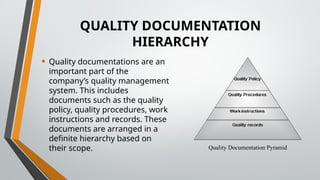
QUALITY DOCUMENTATION
HIERARCHY
• Qualitydocumentations are an
important part of the
company’s quality management
system. This includes
documents such as the quality
policy, quality procedures, work
instructions and records. These
documents are arranged in a
definite hierarchy based on
their scope. Quality Documentation Pyramid
13.
Quality policy/ Manual
•Describes the quality system and what is to be done as an
organization to implement it. Also answers the question of why
this quality system is being implemented. In the pharmaceutical
industry, this part will include the regulations to be followed by the
company such as USFDA guidelines/ICH guidelines/Schedule M
requirements/WHO-GMP requirements etc.
14.
Quality Procedures
• Describeshow the quality system will be implemented, methods
to be used, who should do what, when, and where. More detailed
than policy document.
15.
Work Instructions
• Specificto departments, and spell out details of how each task is
to be done. Detailed instructions are given, and may include
diagrams, job sheets etc. In the pharma. industry, this is
represented by SOPs.
16.
Records
• Evidence documentsthat prove that quality policy, procedures and
work instructions have been implemented as directed. In the
pharmaceutical field, this includes batch manufacturing records,
QC test reports, validation documents etc.





![supriya.k_ppt[1].pptx documentation for QA and QC](https://cdn.slidesharecdn.com/ss_thumbnails/supriya-250809112814-eb4e6f1f-thumbnail.jpg?width=640&height=640&fit=bounds)


