



This presentation is compiled by “ Drug Regulations” a
non profit organization which provides free online
resource to the Pharmaceutical Professional.
Visit http://www.drugregulations.org for latest
information from the world of Pharmaceuticals.
4/15/2016 1
 This presentation is compiled from freely
available resources like the websites of FDA,
specifically the draft guidance issued by FDA
titled Data Integrity & compliance with cGMP
 “Drug Regulations” is a non profit organization
which provides free online resource to the
Pharmaceutical Professional.
 Visit http://www.drugregulations.org for latest
information from the world of Pharmaceuticals.
4/15/2016 2
Drug Regulations : Online
Resource for Latest Information
4/15/2016 3
Drug Regulations : Online Resource for Latest
Information
 The purpose of this guidance is to clarify
the role of data integrity
 in
 current good manufacturing practice
(CGMP) for drugs, as required in 21 CFR
parts 210, 211, and 212.
4/15/2016 4
Drug Regulations : Online Resource for Latest
Information
 Part 210
 Covers Current Good Manufacturing
Practice in Manufacturing, Processing,
Packing, or Holding of Drugs;
4/15/2016 5
Drug Regulations : Online Resource for Latest
Information
 Part 211
 Covers Current Good Manufacturing
Practice for Finished Pharmaceuticals;
4/15/2016 6
Drug Regulations : Online Resource for Latest
Information
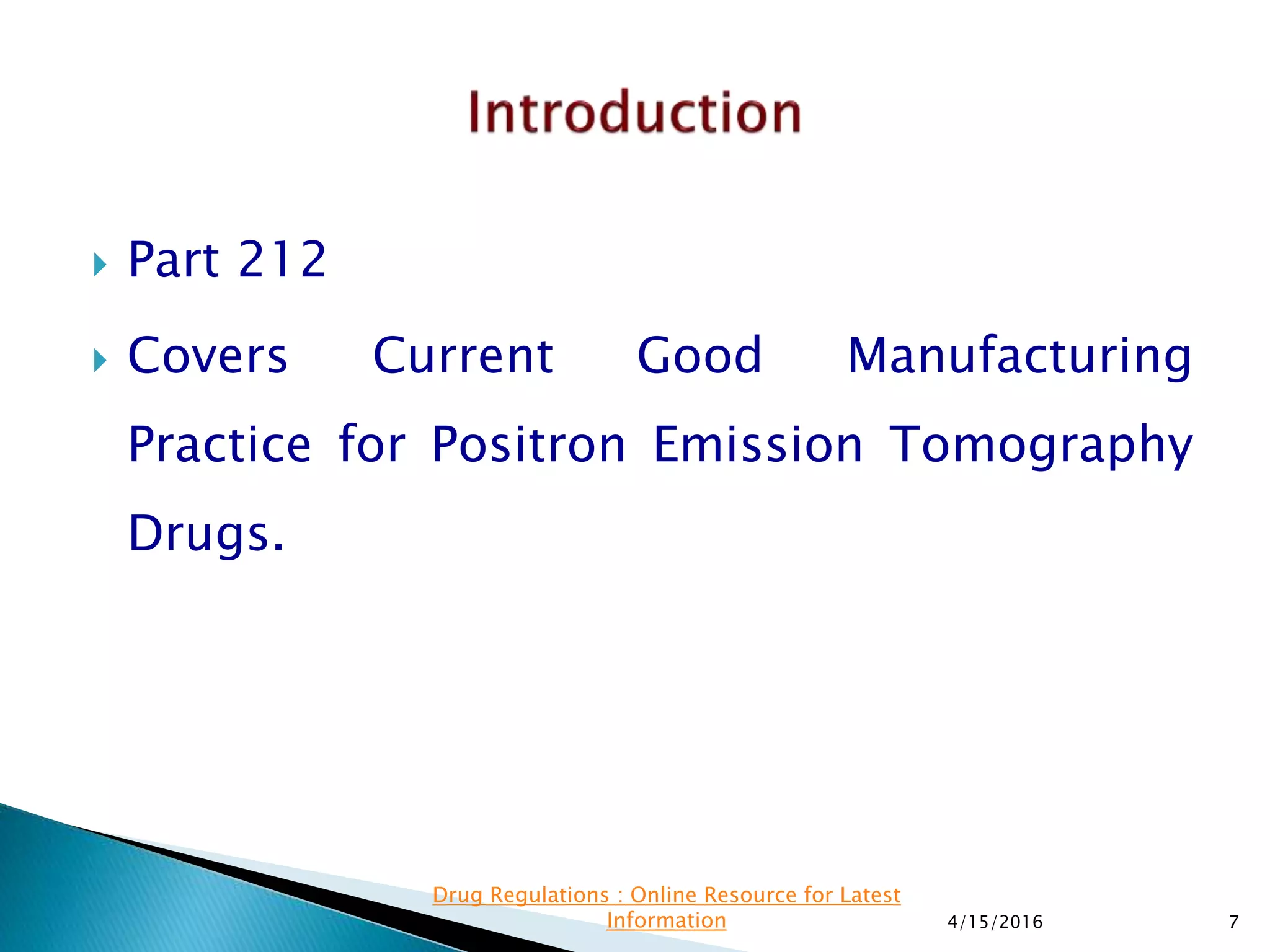
 Part 212
 Covers Current Good Manufacturing
Practice for Positron Emission Tomography
Drugs.
4/15/2016 7
Drug Regulations : Online Resource for Latest
Information
 This guidance provides the
 Agency’s current thinking on the creation
and handling of data in accordance with
CGMP requirements.
4/15/2016 8
Drug Regulations : Online Resource for Latest
Information
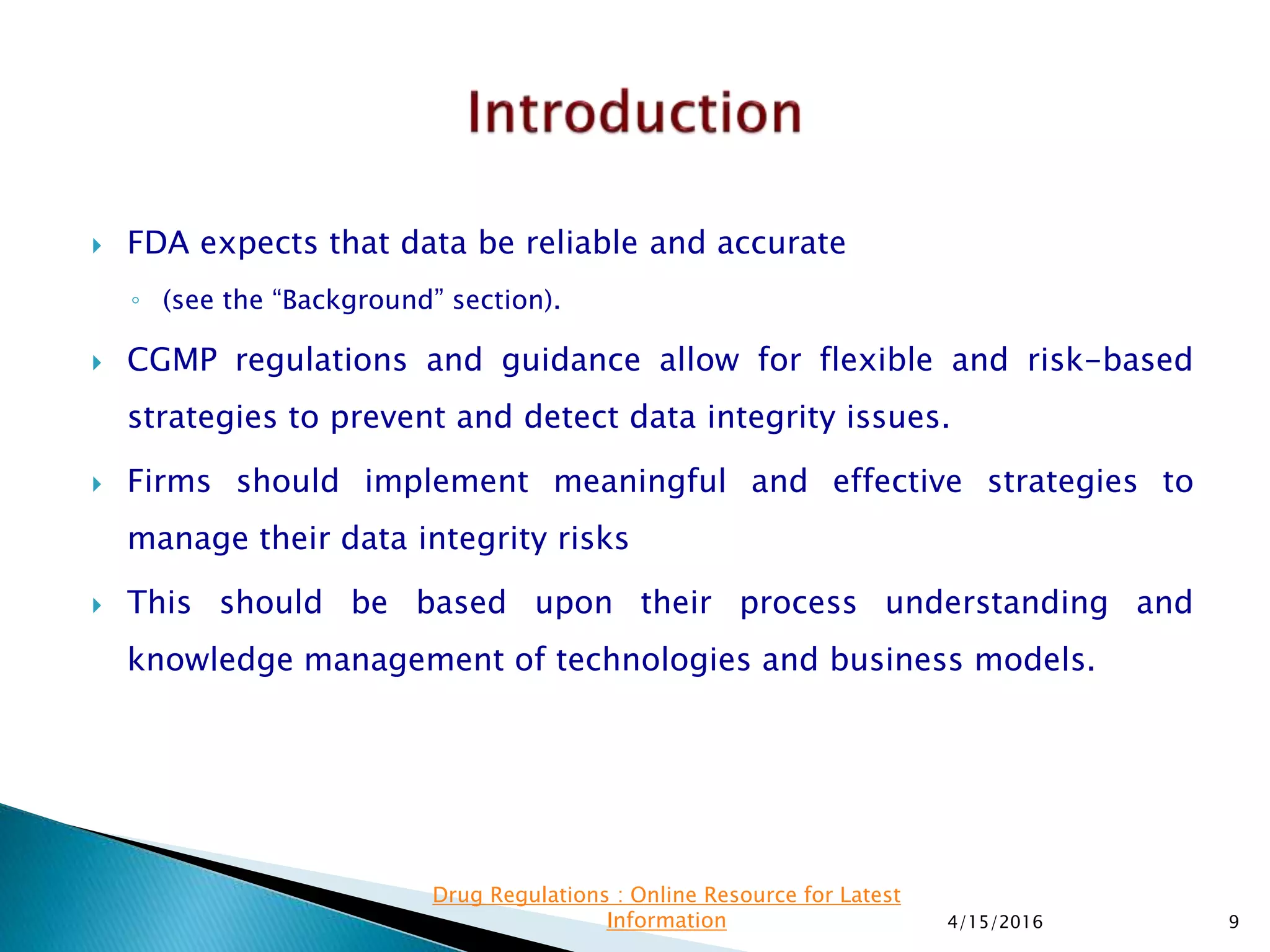
 FDA expects that data be reliable and accurate
◦ (see the “Background” section).
 CGMP regulations and guidance allow for flexible and risk-based
strategies to prevent and detect data integrity issues.
 Firms should implement meaningful and effective strategies to
manage their data integrity risks
 This should be based upon their process understanding and
knowledge management of technologies and business models.
4/15/2016 9
Drug Regulations : Online Resource for Latest
Information
4/15/2016 10
Drug Regulations : Online Resource for Latest
Information
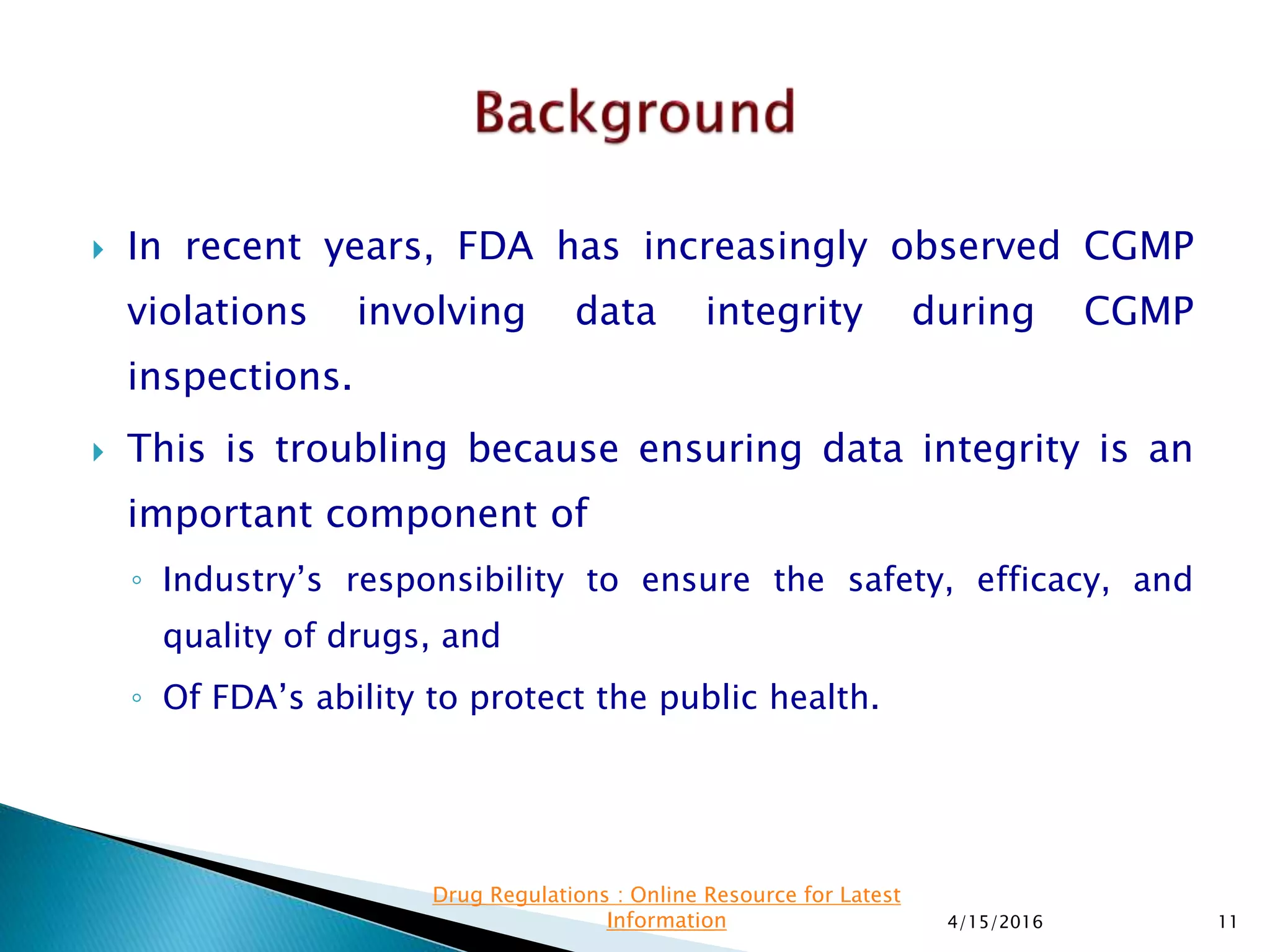
 In recent years, FDA has increasingly observed CGMP
violations involving data integrity during CGMP
inspections.
 This is troubling because ensuring data integrity is an
important component of
◦ Industry’s responsibility to ensure the safety, efficacy, and
quality of drugs, and
◦ Of FDA’s ability to protect the public health.
4/15/2016 11
Drug Regulations : Online Resource for Latest
Information
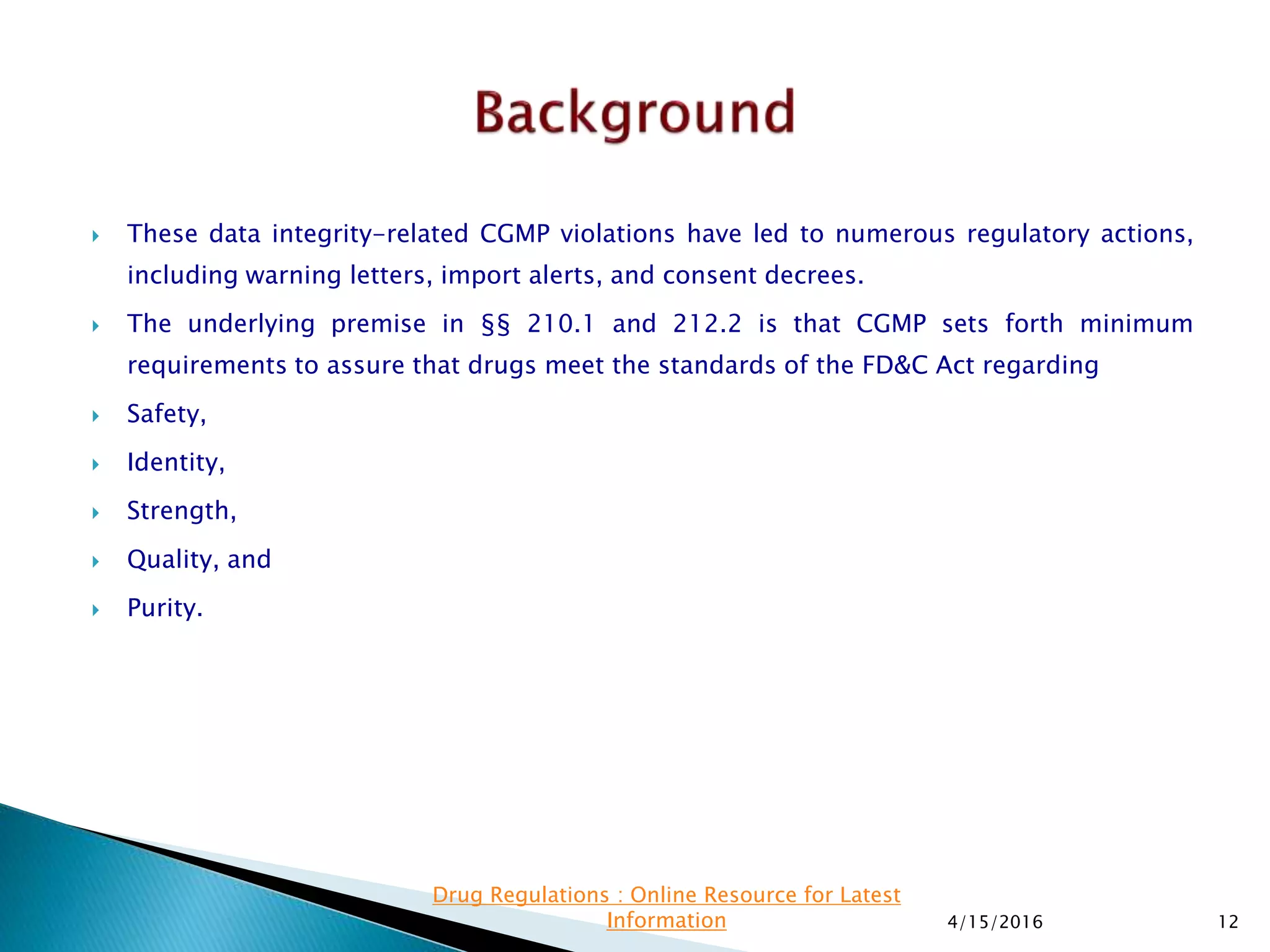
 These data integrity-related CGMP violations have led to numerous regulatory actions,
including warning letters, import alerts, and consent decrees.
 The underlying premise in §§ 210.1 and 212.2 is that CGMP sets forth minimum
requirements to assure that drugs meet the standards of the FD&C Act regarding
 Safety,
 Identity,
 Strength,
 Quality, and
 Purity.
4/15/2016 12
Drug Regulations : Online Resource for Latest
Information
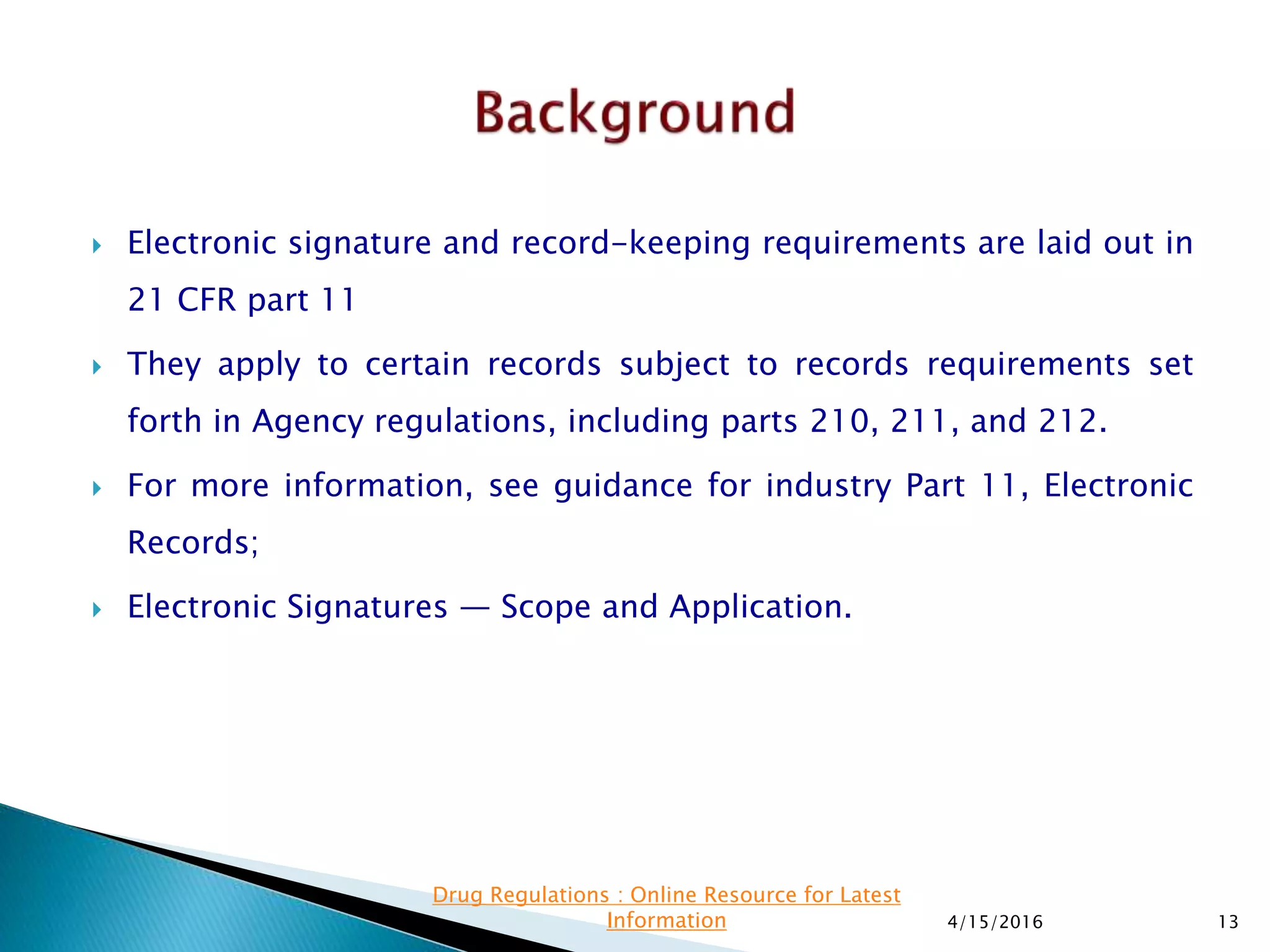
 Electronic signature and record-keeping requirements are laid out in
21 CFR part 11
 They apply to certain records subject to records requirements set
forth in Agency regulations, including parts 210, 211, and 212.
 For more information, see guidance for industry Part 11, Electronic
Records;
 Electronic Signatures — Scope and Application.
4/15/2016 13
Drug Regulations : Online Resource for Latest
Information
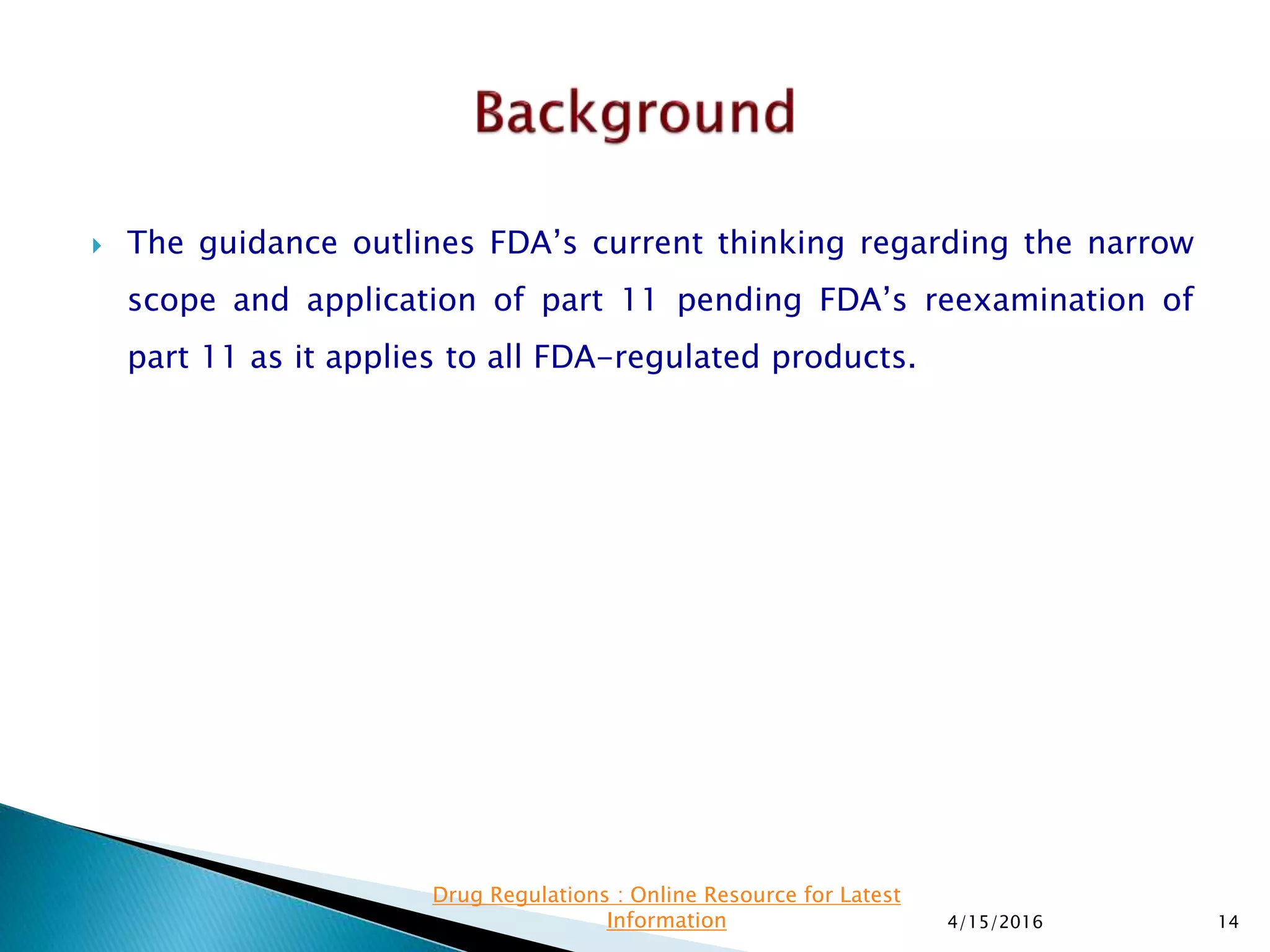
 The guidance outlines FDA’s current thinking regarding the narrow
scope and application of part 11 pending FDA’s reexamination of
part 11 as it applies to all FDA-regulated products.
4/15/2016 14
Drug Regulations : Online Resource for Latest
Information
4/15/2016 15
Drug Regulations : Online Resource for Latest
Information
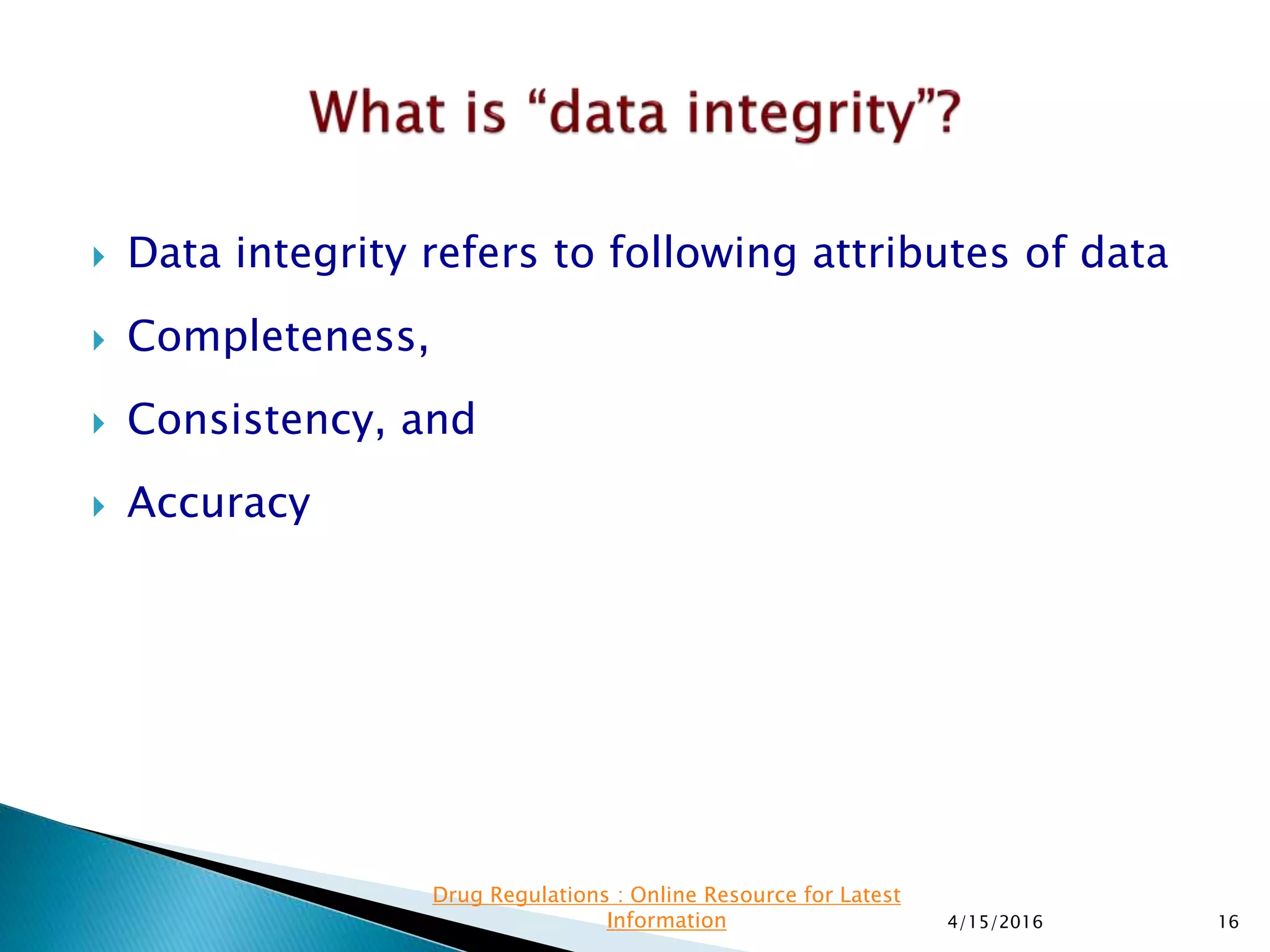
 Data integrity refers to following attributes of data
 Completeness,
 Consistency, and
 Accuracy
4/15/2016 16
Drug Regulations : Online Resource for Latest
Information
 This data should be (ALCOA)
◦ Attributable,
◦ Legible,
◦ Contemporaneously recorded,
◦ Original or a true copy, and
◦ Accurate
4/15/2016 17
Drug Regulations : Online Resource for Latest
Information
 Metadata is the contextual information
required to understand data.
 A data value is by itself meaningless
without additional information about the
data.
 Metadata is often described as data about
data.
4/15/2016 18
Drug Regulations : Online Resource for Latest
Information
 Metadata is structured information that
describes, explains, or otherwise makes it
easier to retrieve, use, or manage data.
4/15/2016 19
Drug Regulations : Online Resource for Latest
Information
 For example, the number “23” is meaningless without
metadata, such as an indication of the unit “mg.”
 Among other things, metadata for a particular piece of
data could include
◦ Date/time stamp for when the data were acquired
◦ User ID of the person who conducted the test or analysis that
generated the data
◦ Instrument ID used to acquire the data
◦ Audit trails
4/15/2016 20
Drug Regulations : Online Resource for Latest
Information
 Data should be maintained throughout the record’s
retention period
 This should be done with all associated metadata
required to reconstruct the CGMP activity
◦ (e.g., §§ 211.188 and 211.194).
 The relationships between data and their metadata
should be preserved in a secure and traceable
manner.
4/15/2016 21
Drug Regulations : Online Resource for Latest
Information
 Audit trail means
◦ A secure
◦ Computer-generated
◦ Time-stamped
◦ Electronic record
 This record should allow for reconstruction of the
course of events relating to the creation,
modification, or deletion of an electronic record.
4/15/2016 22
Drug Regulations : Online Resource for Latest
Information
 An audit trail is a chronology of the record.
 “who,
 what,
 when, and
 why”
4/15/2016 23
Drug Regulations : Online Resource for Latest
Information
 For example,
 The audit trail for a high performance liquid
chromatography (HPLC) run could include
◦ The user name,
◦ Date/time of the run,
◦ The integration parameters used, and
◦ Details of a reprocessing, if any,
◦ Change justification for the reprocessing.
4/15/2016 24
Drug Regulations : Online Resource for Latest
Information
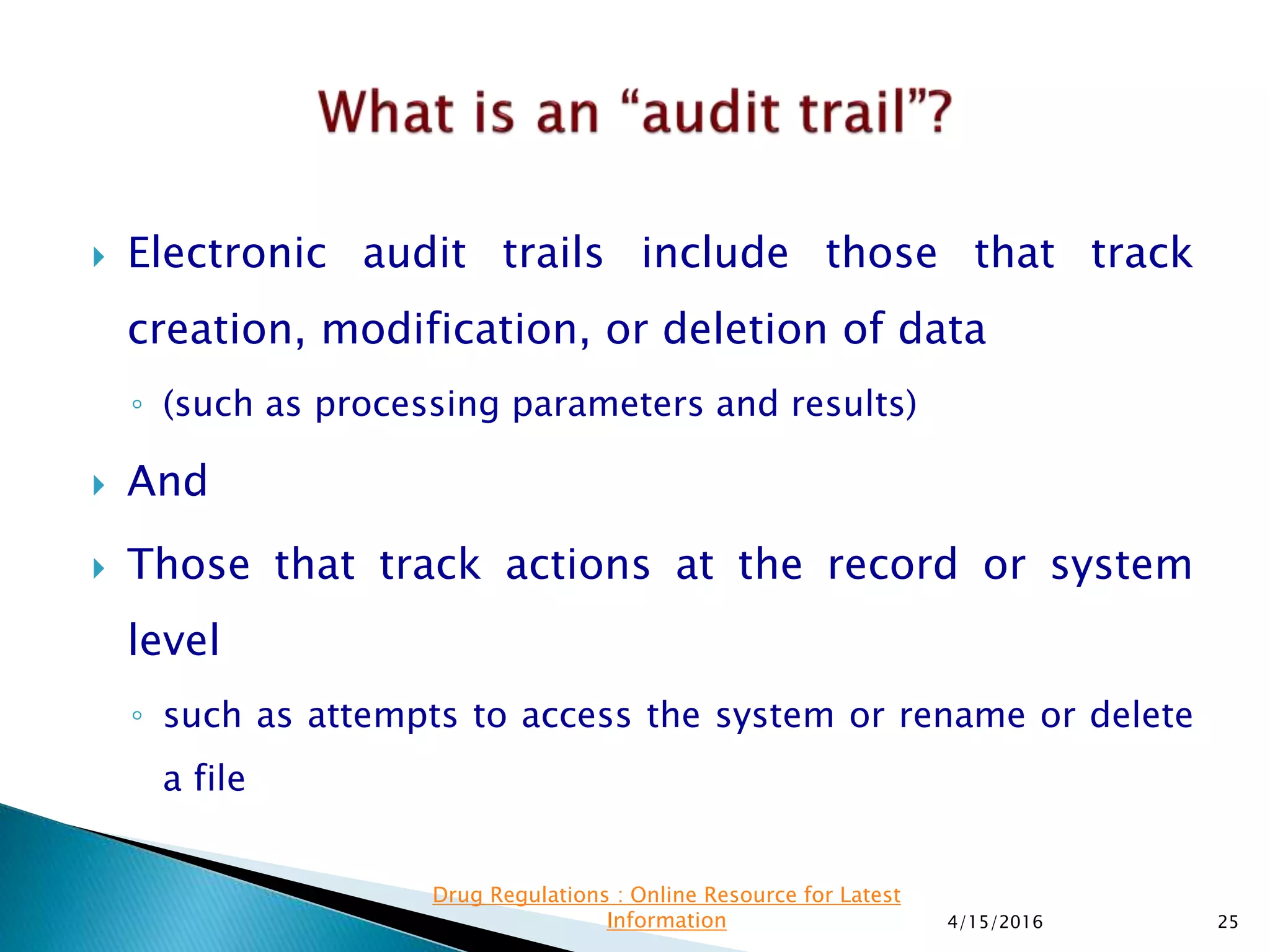
 Electronic audit trails include those that track
creation, modification, or deletion of data
◦ (such as processing parameters and results)
 And
 Those that track actions at the record or system
level
◦ such as attempts to access the system or rename or delete
a file
4/15/2016 25
Drug Regulations : Online Resource for Latest
Information
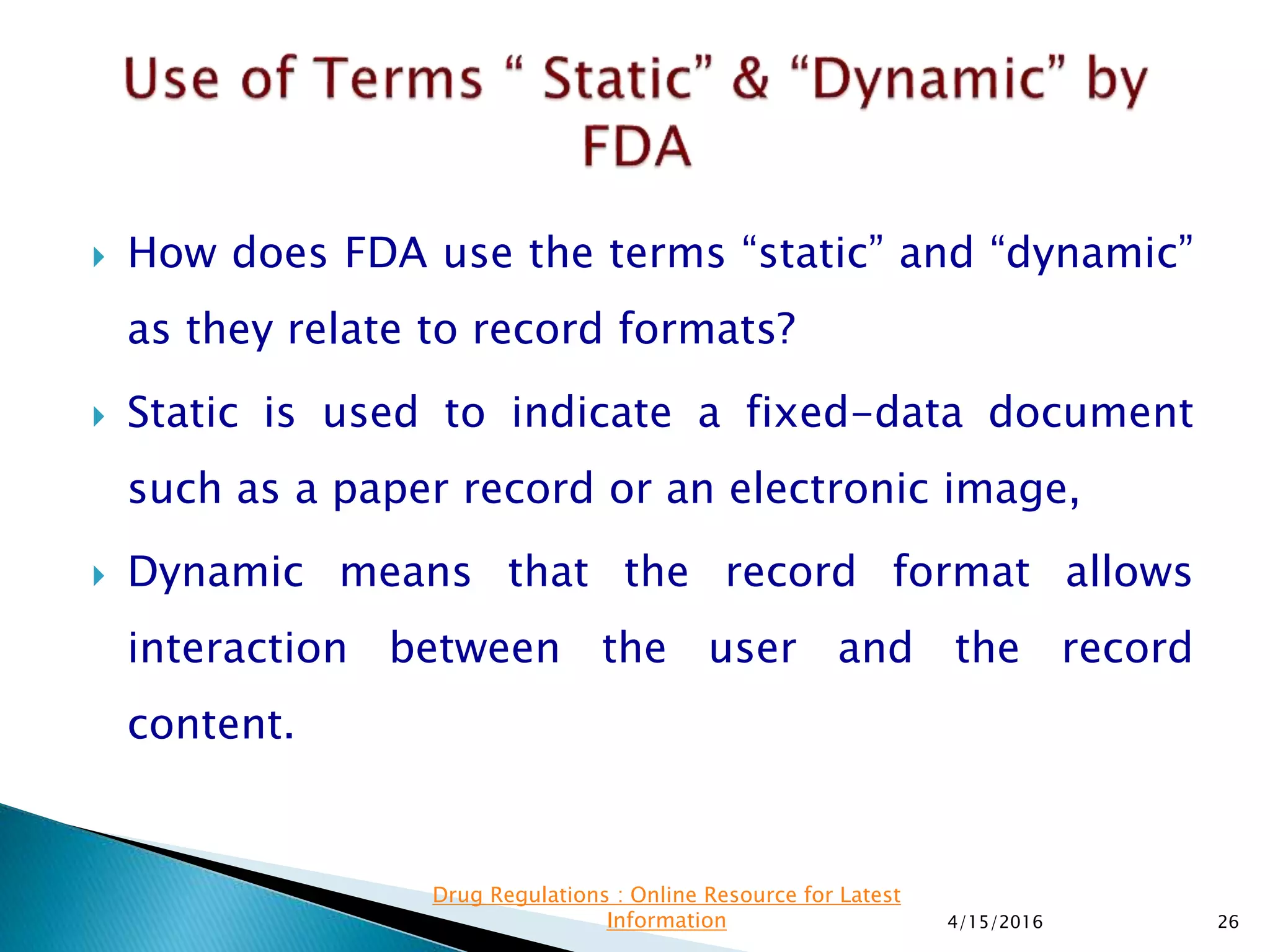
 How does FDA use the terms “static” and “dynamic”
as they relate to record formats?
 Static is used to indicate a fixed-data document
such as a paper record or an electronic image,
 Dynamic means that the record format allows
interaction between the user and the record
content.
4/15/2016 26
Drug Regulations : Online Resource for Latest
Information
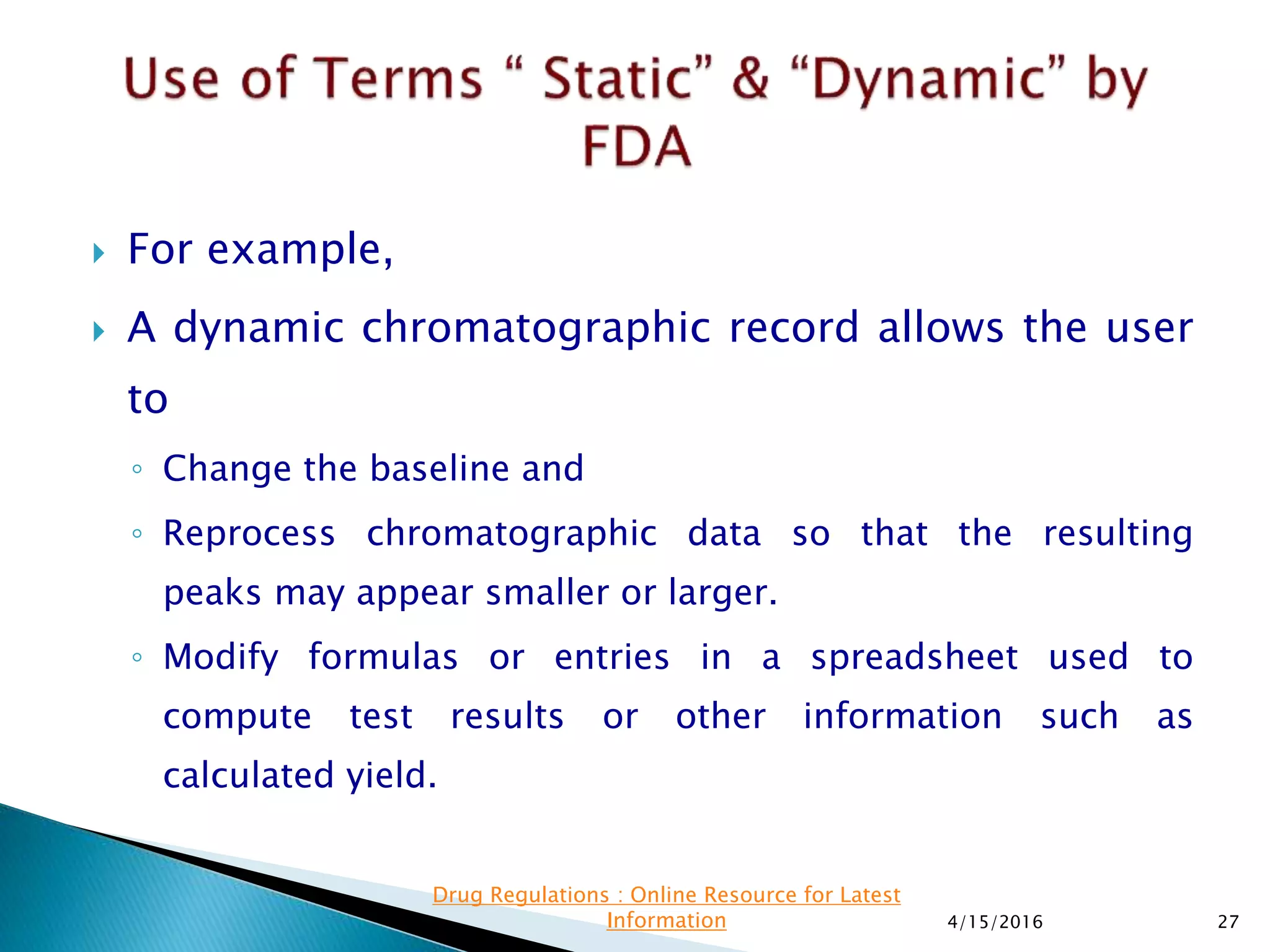
 For example,
 A dynamic chromatographic record allows the user
to
◦ Change the baseline and
◦ Reprocess chromatographic data so that the resulting
peaks may appear smaller or larger.
◦ Modify formulas or entries in a spreadsheet used to
compute test results or other information such as
calculated yield.
4/15/2016 27
Drug Regulations : Online Resource for Latest
Information
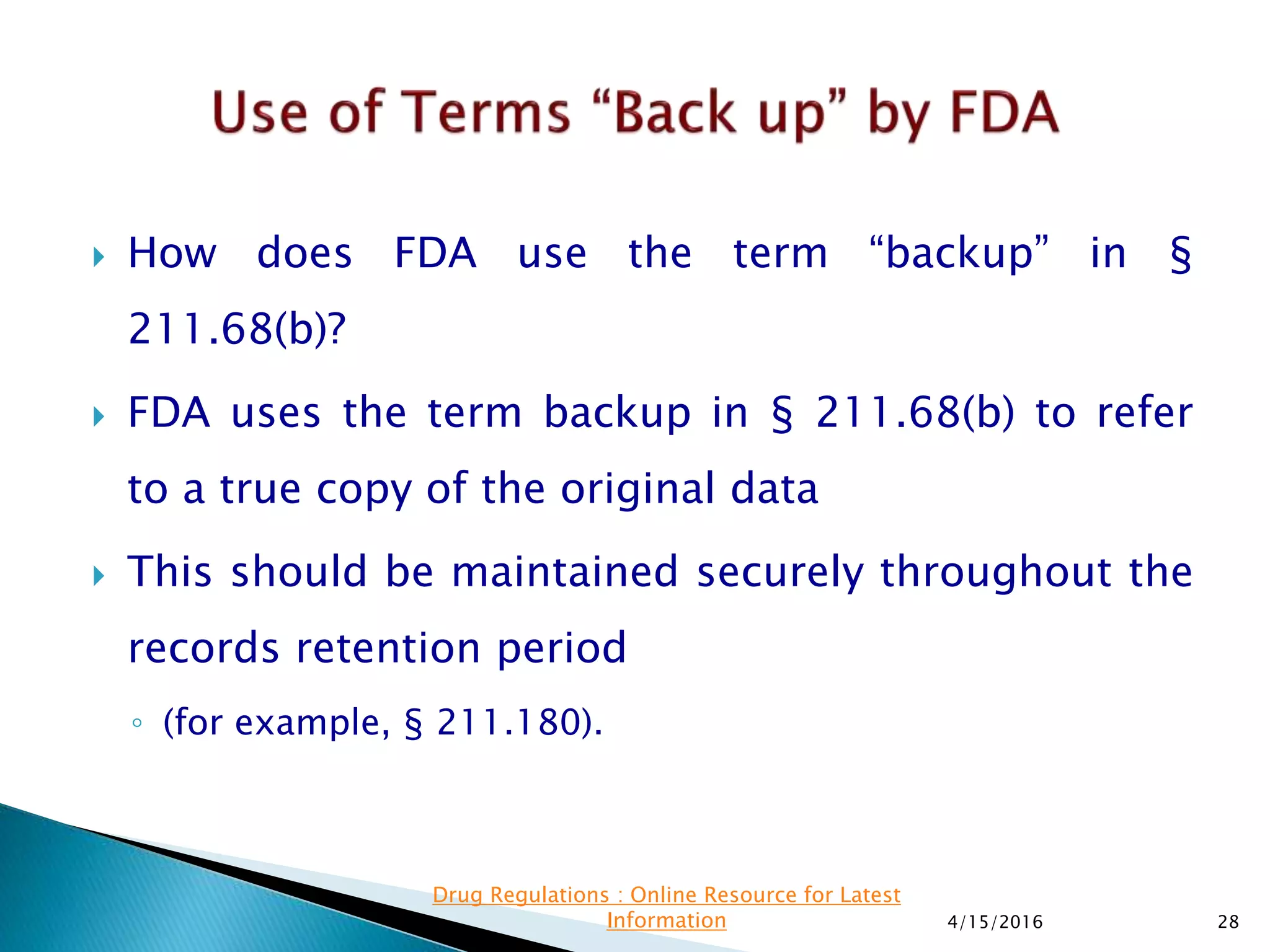
 How does FDA use the term “backup” in §
211.68(b)?
 FDA uses the term backup in § 211.68(b) to refer
to a true copy of the original data
 This should be maintained securely throughout the
records retention period
◦ (for example, § 211.180).
4/15/2016 28
Drug Regulations : Online Resource for Latest
Information
 The backup file should
◦ contain the data
 (which includes associated metadata)
 and
◦ Should be in the original format or in a format compatible
with the original format.
4/15/2016 29
Drug Regulations : Online Resource for Latest
Information
 This should not be confused with backup copies
 These are created during normal computer use
 They are temporarily maintained for disaster recovery
◦ (e.g., in case of a computer crash or other interruption).
 Such temporary backup copies would not satisfy the
requirement in § 211.68(b) to maintain a backup file of
data.
4/15/2016 30
Drug Regulations : Online Resource for Latest
Information
 What are the “systems” in “computer or related
systems” in § 211.68?
 The American National Standards Institute (ANSI)
defines systems as following organized to
accomplish a set of specific functions.
◦ People,
◦ Machines, and
◦ Methods
4/15/2016 31
Drug Regulations : Online Resource for Latest
Information
 Computer or related systems can refer to
◦ Computer hardware
◦ Software
◦ Peripheral devices
◦ Networks
◦ Cloud infrastructure
◦ Operators
◦ Associated documents
 (e.g., user manuals and standard operating procedures).
4/15/2016 32
Drug Regulations : Online Resource for Latest
Information
 When is it permissible to exclude CGMP data from
decision making?
 Any data created as part of a CGMP record must be
◦ Evaluated by the quality unit as part of release criteria
 (see §§ 211.22 and 212.70) and
◦ Maintained for CGMP purposes
 (e.g., § 211.180).
4/15/2016 33
Drug Regulations : Online Resource for Latest
Information
 Electronic data generated to fulfill CGMP
requirements should include relevant metadata.
4/15/2016 34
Drug Regulations : Online Resource for Latest
Information
 To exclude data from the release criteria decision-
making process, there must be a valid,
documented, scientific justification for its
exclusion: See
◦ The guidance for industry Investigating Out-of-
Specification (OOS) Test Results for Pharmaceutical
Production, and
◦ §§ 211.188, 211.192, and 212.71(b)).
4/15/2016 35
Drug Regulations : Online Resource for Latest
Information
 The requirements for record retention and review
do not differ depending on the data format;
 Paper-based and electronic data record-keeping
systems are subject to the same requirements.
4/15/2016 36
Drug Regulations : Online Resource for Latest
Information
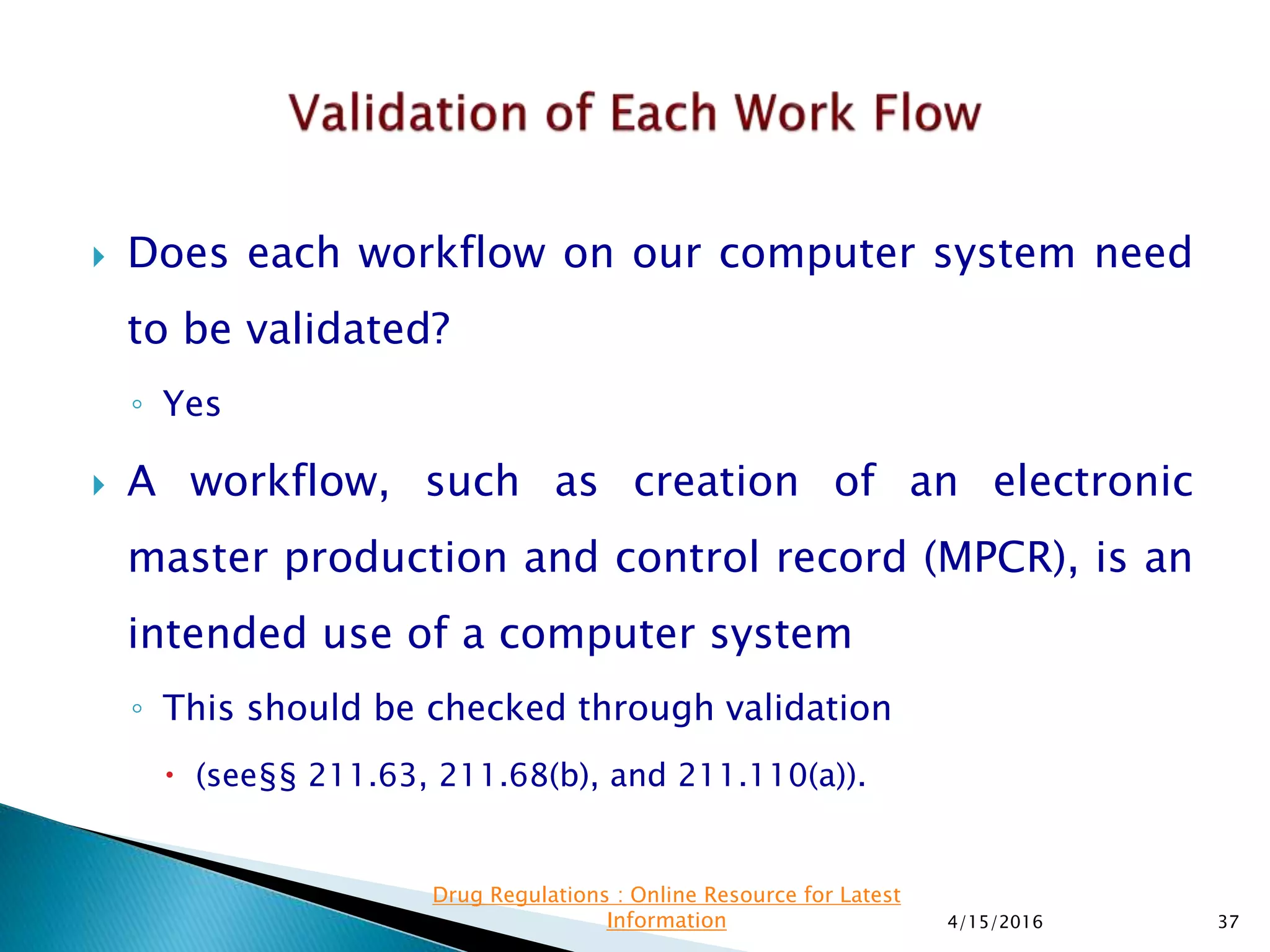
 Does each workflow on our computer system need
to be validated?
◦ Yes
 A workflow, such as creation of an electronic
master production and control record (MPCR), is an
intended use of a computer system
◦ This should be checked through validation
 (see§§ 211.63, 211.68(b), and 211.110(a)).
4/15/2016 37
Drug Regulations : Online Resource for Latest
Information
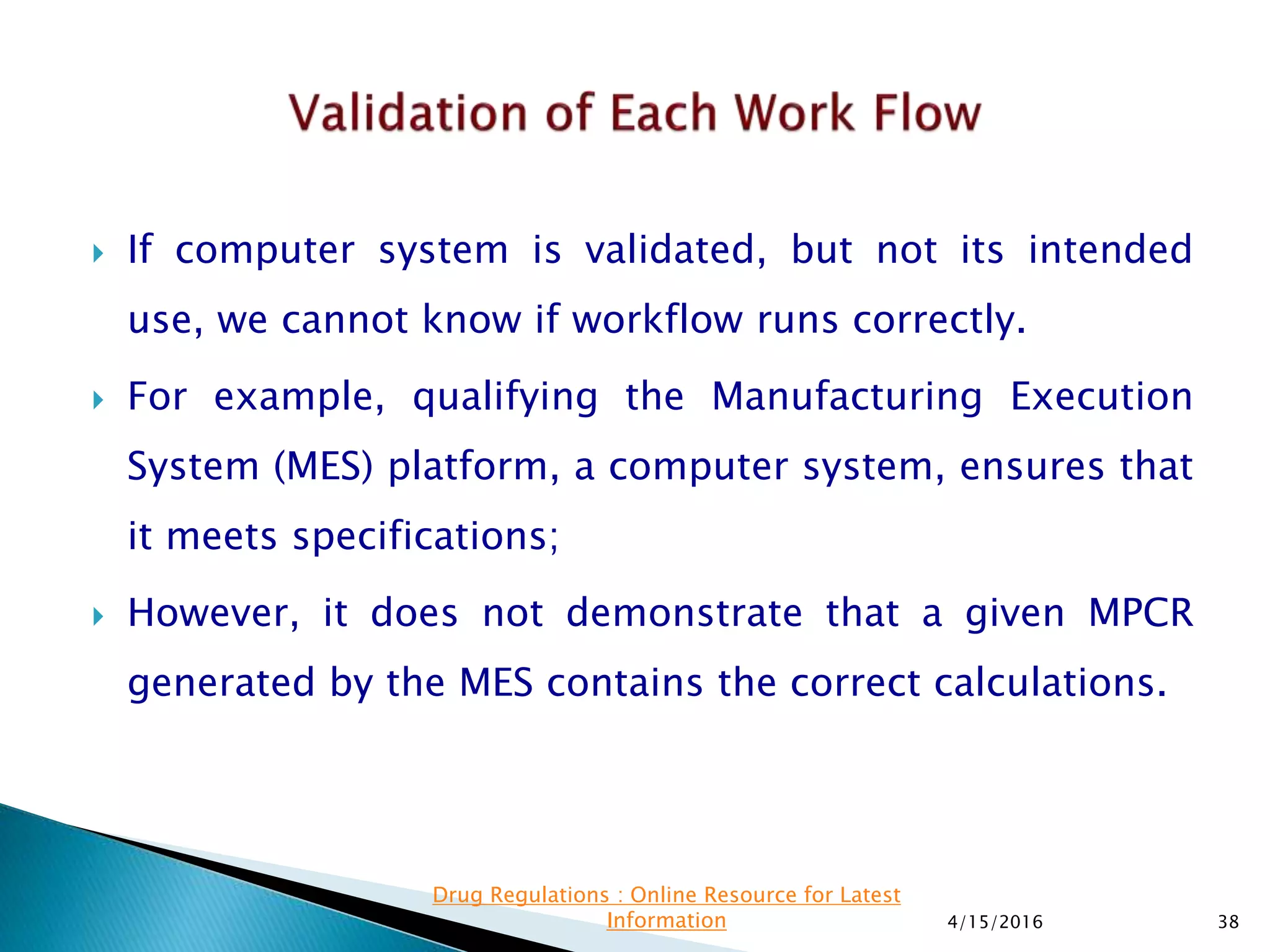
 If computer system is validated, but not its intended
use, we cannot know if workflow runs correctly.
 For example, qualifying the Manufacturing Execution
System (MES) platform, a computer system, ensures that
it meets specifications;
 However, it does not demonstrate that a given MPCR
generated by the MES contains the correct calculations.
4/15/2016 38
Drug Regulations : Online Resource for Latest
Information
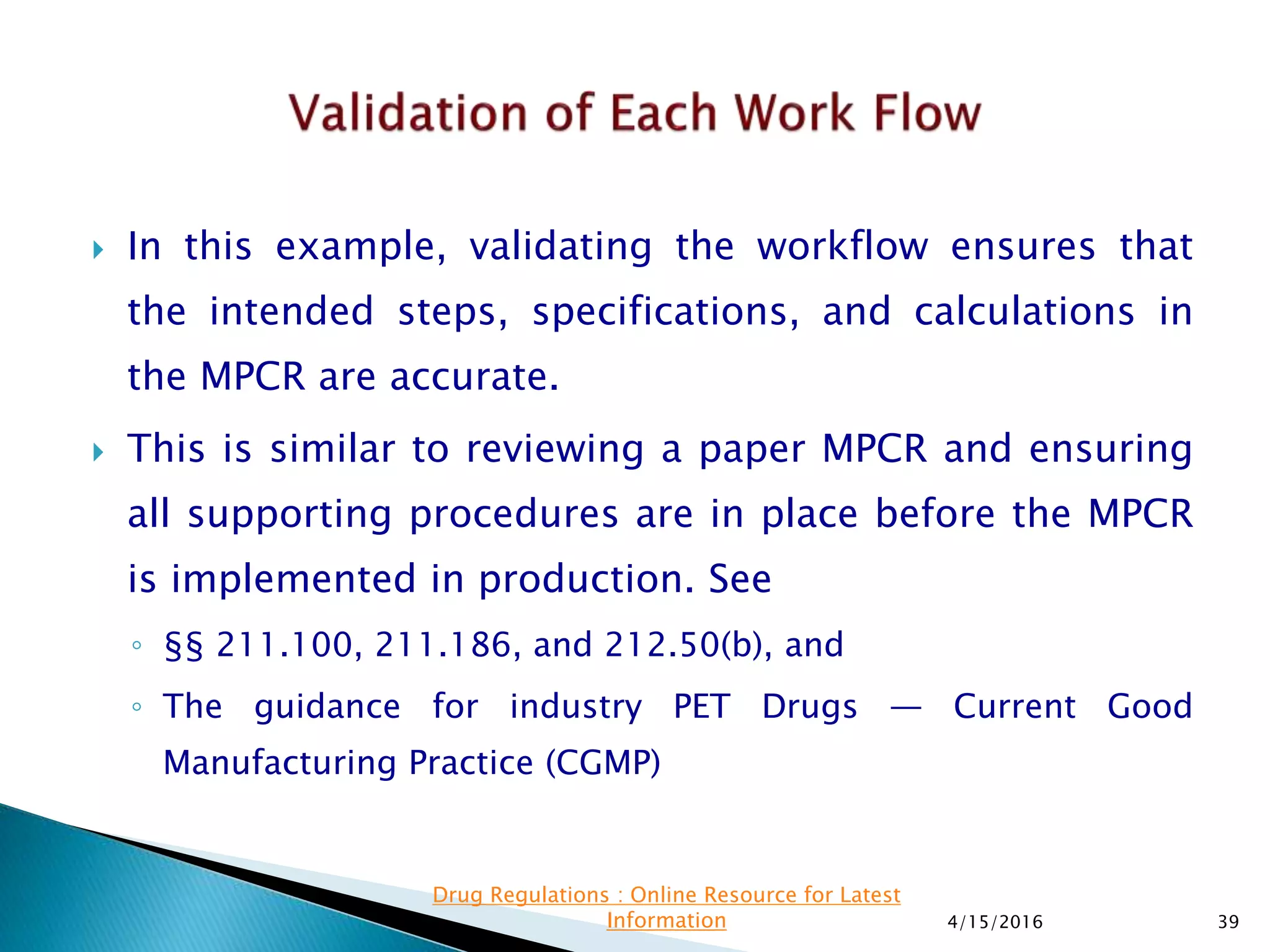
 In this example, validating the workflow ensures that
the intended steps, specifications, and calculations in
the MPCR are accurate.
 This is similar to reviewing a paper MPCR and ensuring
all supporting procedures are in place before the MPCR
is implemented in production. See
◦ §§ 211.100, 211.186, and 212.50(b), and
◦ The guidance for industry PET Drugs — Current Good
Manufacturing Practice (CGMP)
4/15/2016 39
Drug Regulations : Online Resource for Latest
Information
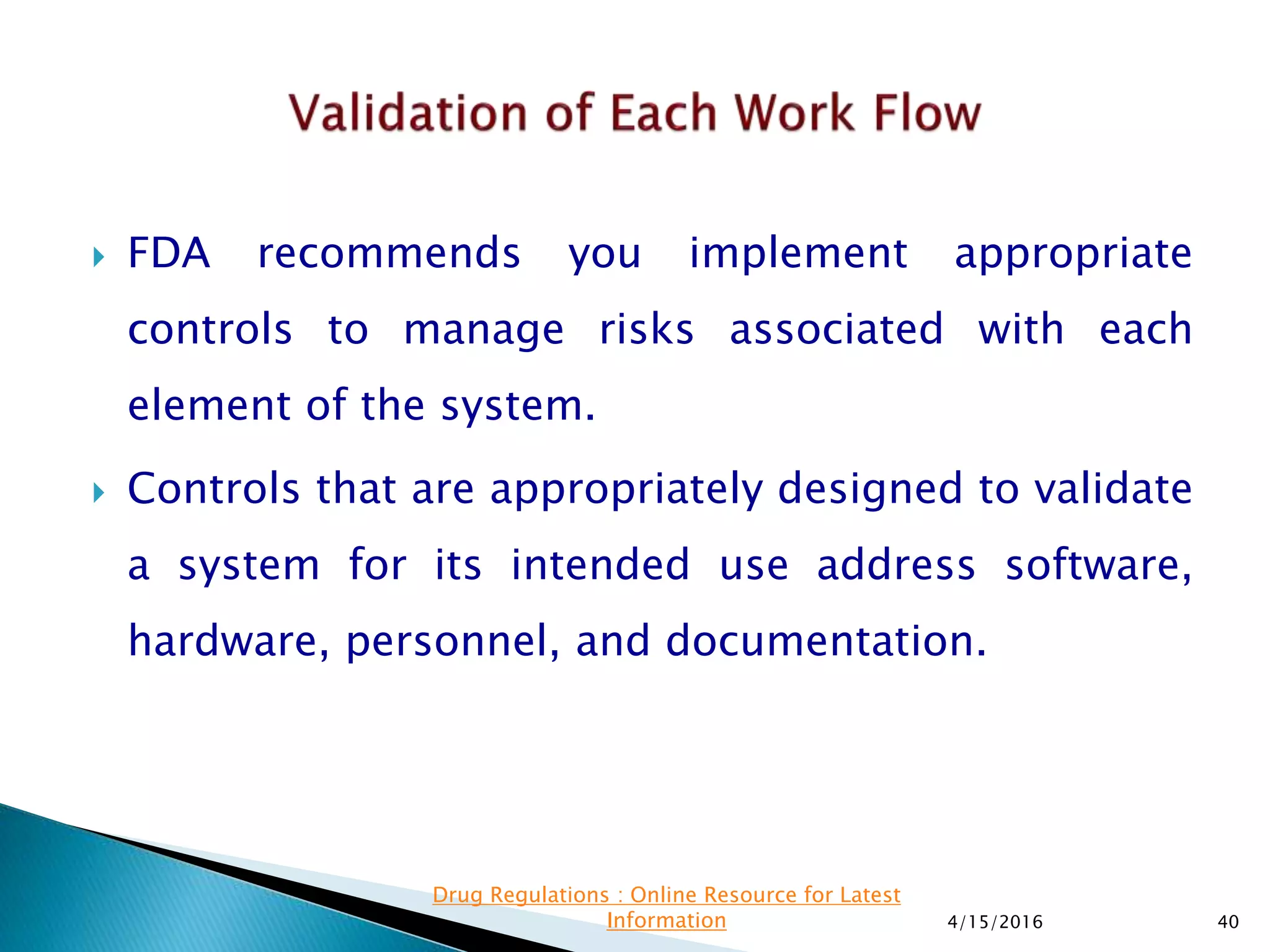
 FDA recommends you implement appropriate
controls to manage risks associated with each
element of the system.
 Controls that are appropriately designed to validate
a system for its intended use address software,
hardware, personnel, and documentation.
4/15/2016 40
Drug Regulations : Online Resource for Latest
Information
 How should access to CGMP computer systems be
restricted?
 FDA recommends
◦ To exercise appropriate controls to assure that changes to
computerized MPCRs, or other records, or input of
laboratory data into computerized records, can be made
only by authorized personnel (§ 211.68(b)).
4/15/2016 41
Drug Regulations : Online Resource for Latest
Information
 How should access to CGMP computer systems be
restricted?
 FDA recommends
◦ To restrict the ability to alter specifications,
process parameters, or manufacturing or testing
methods by technical means where possible
 (for example, by limiting permissions to change
settings or data).
4/15/2016 42
Drug Regulations : Online Resource for Latest
Information
 How should access to CGMP computer systems be restricted?
 FDA recommends
◦ That the system administrator role, including any rights to
alter files and settings, be assigned to personnel
independent from those responsible for the record content.
◦ To maintain a list of authorized individuals and their access
privileges for each CGMP computer system in use.
4/15/2016 43
Drug Regulations : Online Resource for Latest
Information
 These independent security role assignments may not be
practical for small operations or facilities with few employees
◦ PET or
◦ Medical gas facilities
 FDA recommends alternate control strategies to be
implemented.
4/15/2016 44
Drug Regulations : Online Resource for Latest
Information
 For example
 In a rare instance if same person is required to hold the
system administrator role and to be responsible for the
content of the records
◦ FDA suggests having a second person review settings and content.
 If second-person review is not possible
◦ the Agency recommends that the person recheck settings and his or her
own work.
4/15/2016 45
Drug Regulations : Online Resource for Latest
Information
 Why is FDA concerned with the use of shared login accounts
for computer systems?
 FDA Recommends
◦ To exercise appropriate controls to assure that only authorized personnel
make changes to computerized MPCRs, or other records, or input
laboratory data into computerized records, and
◦ To implement documentation controls that ensure actions are attributable
to a specific individual
 See §§ 211.68(b), 211.188(b)(11), 204 211.194(a)(7) and (8), and 212.50(c)(10)
4/15/2016 46
Drug Regulations : Online Resource for Latest
Information
 When login credentials are shared, a unique individual cannot
be identified through the login
 Therefore the system would thus not conform to the CGMP
requirements in parts 211 and 212.
 FDA requires that systems controls, including documentation
controls, be designed to follow CGMP to assure product
quality
◦ for example, §§ 211.100 and 212.50
4/15/2016 47
Drug Regulations : Online Resource for Latest
Information
 How should blank forms be controlled?
 There must be document controls in place to assure product
quality
◦ (see §§ 211.100,213 211.160(a), 211.186, 212.20(d), and 212.60(g)).
 FDA recommends that, if used, blank forms be controlled by
the quality unit or by another document control method.
 Blank forms include but not limited to, worksheets, laboratory
notebooks, and MPCRs
4/15/2016 48
Drug Regulations : Online Resource for Latest
Information
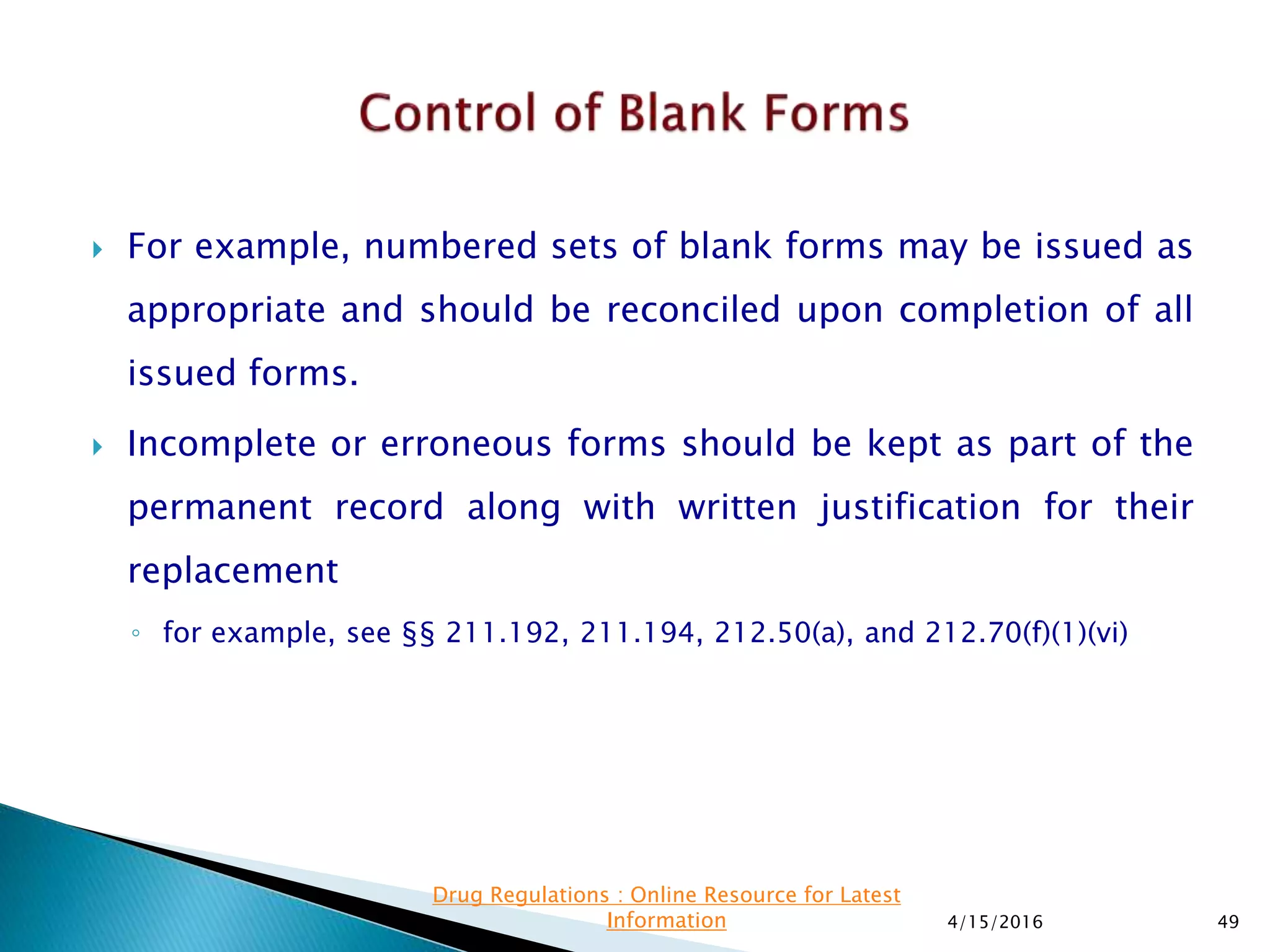
 For example, numbered sets of blank forms may be issued as
appropriate and should be reconciled upon completion of all
issued forms.
 Incomplete or erroneous forms should be kept as part of the
permanent record along with written justification for their
replacement
◦ for example, see §§ 211.192, 211.194, 212.50(a), and 212.70(f)(1)(vi)
4/15/2016 49
Drug Regulations : Online Resource for Latest
Information
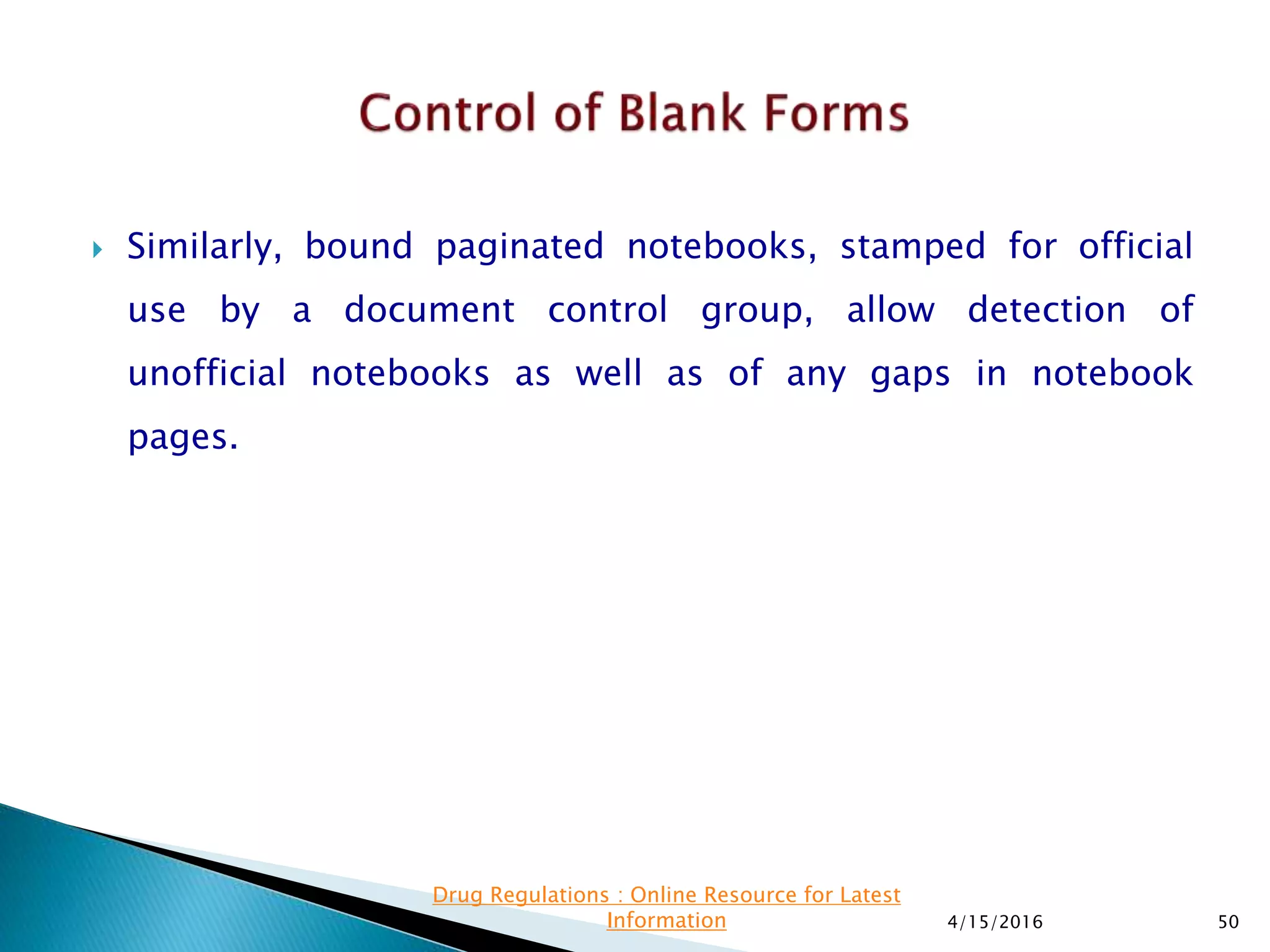
 Similarly, bound paginated notebooks, stamped for official
use by a document control group, allow detection of
unofficial notebooks as well as of any gaps in notebook
pages.
4/15/2016 50
Drug Regulations : Online Resource for Latest
Information
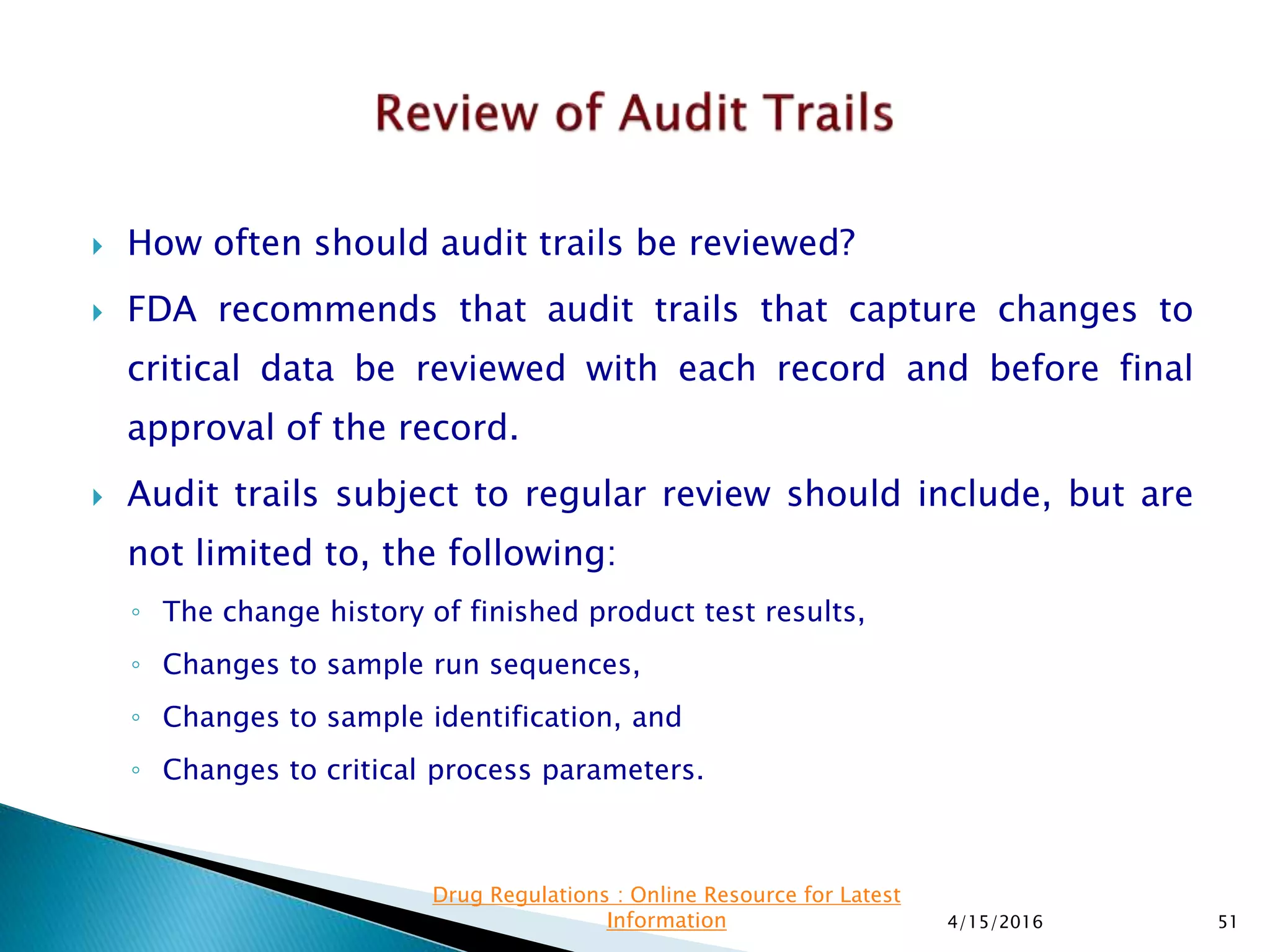
 How often should audit trails be reviewed?
 FDA recommends that audit trails that capture changes to
critical data be reviewed with each record and before final
approval of the record.
 Audit trails subject to regular review should include, but are
not limited to, the following:
◦ The change history of finished product test results,
◦ Changes to sample run sequences,
◦ Changes to sample identification, and
◦ Changes to critical process parameters.
4/15/2016 51
Drug Regulations : Online Resource for Latest
Information
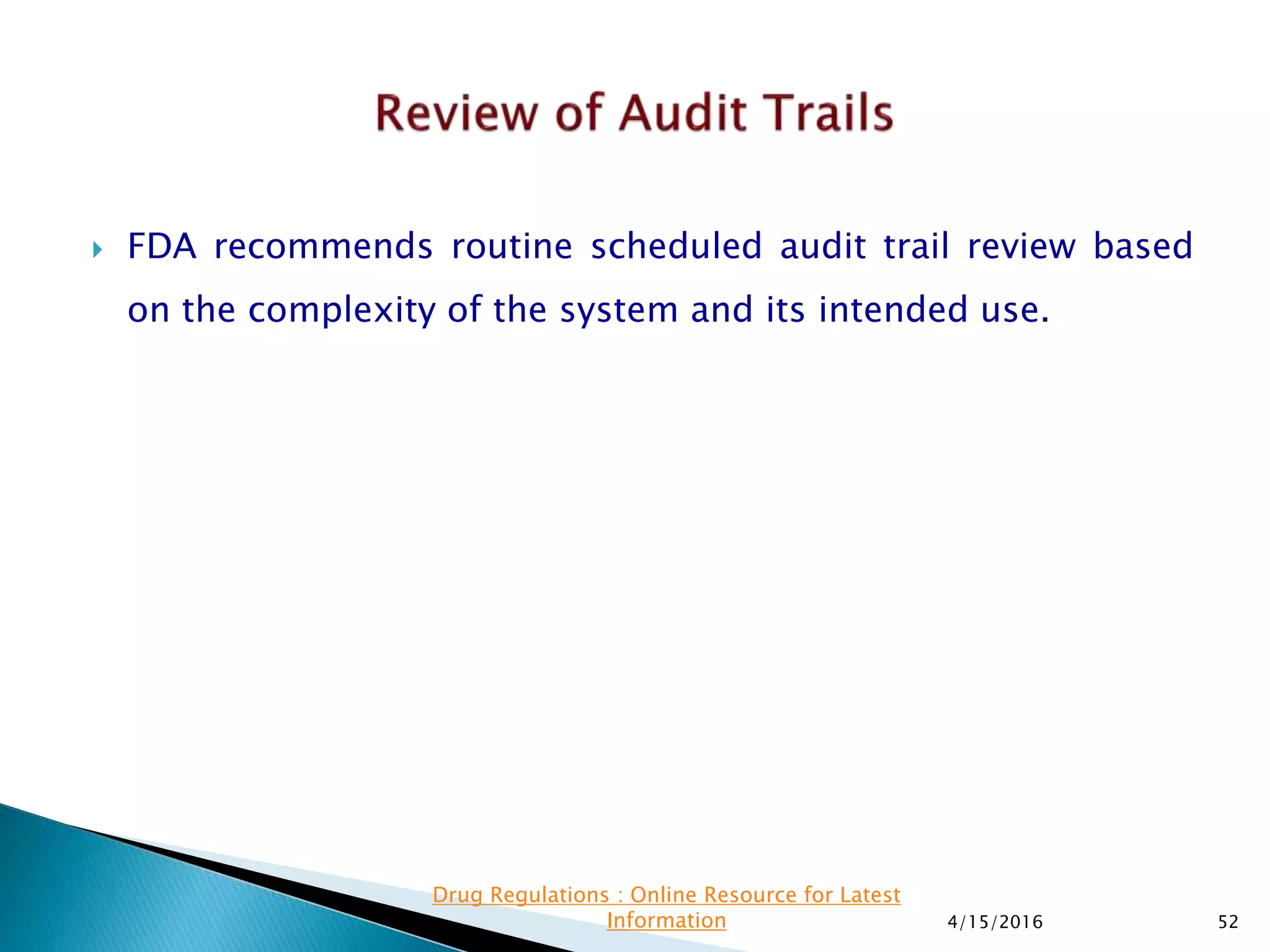
 FDA recommends routine scheduled audit trail review based
on the complexity of the system and its intended use.
4/15/2016 52
Drug Regulations : Online Resource for Latest
Information
 Who should review audit trails?
 Audit trails are considered part of the associated records.
 Personnel responsible for record review under CGMP should
review the audit trails
 These should capture changes to critical data associated with
the record as they review the rest of the record
◦ for example, §§ 211.22(a), 211.101(c), 211.194(a)(8), and 212.20(d)
4/15/2016 53
Drug Regulations : Online Resource for Latest
Information
 For example,
 All production and control records, which includes audit
trails, must be reviewed and approved by the quality unit
◦ § 211.192
 This is similar to the expectation that cross-outs on paper be
assessed when reviewing data.
4/15/2016 54
Drug Regulations : Online Resource for Latest
Information
 Can electronic copies be used as accurate reproductions of
paper or electronic records?
 Yes.
 Electronic copies can be used as true copies of paper or
electronic records
 This is provided the copies preserve the content and meaning
of the original data,
◦ Which should include associated metadata and the static or dynamic
nature of the original records.
4/15/2016 55
Drug Regulations : Online Resource for Latest
Information
 True copies of dynamic electronic records may be made and
maintained in the format of the original records or in a
compatible format,
 This is provided that
◦ The content and meaning of the original records are preserved and
◦ That a suitable reader and copying equipment (for example, software and
hardware, including media readers) are readily available
 §§ 211.180(d) and 212.110
4/15/2016 56
Drug Regulations : Online Resource for Latest
Information
 Is it acceptable to retain paper printouts or static records
instead of original electronic records from stand-alone
computerized laboratory instruments, such as an FT-IR
instrument?
 A paper printout or static record may satisfy retention
requirements if it is a complete copy of the original record
◦ (see §§ 211.68(b), 211.188, 211.194, and 212.60).
4/15/2016 57
Drug Regulations : Online Resource for Latest
Information
 For example, pH meters and balances may create a paper
printout or static image during data acquisition as the
original record.
 In this case, the paper printout or static image created during
acquisition, or a true copy, should be retained (§ 211.180).
4/15/2016 58
Drug Regulations : Online Resource for Latest
Information
 However, electronic records from certain types of laboratory
instruments are dynamic records,
 In this case a printout or a static record does not preserve the
dynamic format which is part of the complete original record.
 For example, the spectral file created by FT-IR can be
reprocessed,
 However a static record or printout is fixed, which would not
satisfy CGMP requirements to retain original records or true
copies (§ 211.180(d)).
 Also, if the full spectrum is not displayed, contaminants may be
excluded.
4/15/2016 59
Drug Regulations : Online Resource for Latest
Information
 Control strategies must ensure that original laboratory
records, including paper and electronic records, are subject
to second-person review (§ 211.194(a)(8)) to make certain
that all test results are appropriately reported.
4/15/2016 60
Drug Regulations : Online Resource for Latest
Information
 For PET drugs, see the guidance for industry PET Drugs —
Current Good Manufacturing Practice (CGMP) for discussion of
equipment and laboratory controls, including regulatory
requirements for records.
4/15/2016 61
Drug Regulations : Online Resource for Latest
Information
 Can electronic signatures be used instead of
handwritten signatures for master production and
control records?
 Yes,
 Electronic signatures with the appropriate controls
can be used instead of handwritten signatures or
initials in any CGMP required record.
4/15/2016 62
Drug Regulations : Online Resource for Latest
Information
 § 211.186(a) specifies a “full signature,
handwritten,”
◦ However the Federal Register on September 29, 1978 (43 FR
45069) explains that part of the intent of the full signature
requirement is to be able to clearly identify the individual
responsible for signing the record.
◦ An electronic signature with the appropriate controls to securely
link the signature with the associated record fulfills this
requirement.
4/15/2016 63
Drug Regulations : Online Resource for Latest
Information
 § 211.186(a) specifies a “full signature,
handwritten,”
◦ This comports with part 11, which establishes criteria for when electronic
signatures are considered the legally binding equivalent of handwritten
signatures.
◦ Firms using electronic signatures should document the controls used to
ensure that they are able to identify the specific person who signed the
records electronically.
4/15/2016 64
Drug Regulations : Online Resource for Latest
Information
 There is no requirement for a handwritten
signature for the MPCR in the PET CGMP
regulations (21 CFR part 212).
4/15/2016 65
Drug Regulations : Online Resource for Latest
Information
 When does electronic data become a CGMP record?
◦ When generated to satisfy a CGMP requirement, all data
become a CGMP record.
◦ This data must be documented, or saved at the time of
performance to create a record incompliance with CGMP
requirements,
 Including, but not limited to, §§ 211.100(b) and 211.160(a).
4/15/2016 66
Drug Regulations : Online Resource for Latest
Information
 FDA expects processes to be designed so that
quality data required to be created and maintained
cannot be modified.
 For example,
◦ Chromatograms should be sent to long-term storage upon
run completion instead of at the end of a day’s runs.
 Archiving or a permanent record
4/15/2016 67
Drug Regulations : Online Resource for Latest
Information
 It is not acceptable
◦ To record data on pieces of paper that will be discarded after
the data are transcribed to a permanent laboratory notebook
 see §§ 211.100(b), 211.160(a), and 211.180(d)
◦ To store data electronically in temporary memory, in a manner
that allows for manipulation, before creating a permanent
record.
 Electronic data that are automatically saved into
temporary memory do not meet CGMP documentation
or retention requirements.
4/15/2016 68
Drug Regulations : Online Resource for Latest
Information
 A combination of technical and procedural controls may be
employed to meet CGMP documentation practices for
electronic systems.
 For example
◦ A computer system, such as a Laboratory Information Management
System (LIMS) or an Electronic Batch Record (EBR) system, can be
designed to automatically save after each separate entry.
◦ This would be similar to recording each entry contemporaneously on a
paper batch record to satisfy CGMP requirements.
◦ The computer system could be combined with a procedure requiring
data be entered immediately when generated.
4/15/2016 69
Drug Regulations : Online Resource for Latest
Information
 For PET drugs, see the “Laboratory Controls” section of the
guidance for industry PET Drugs — Current Good
Manufacturing Practice (CGMP).
4/15/2016 70
Drug Regulations : Online Resource for Latest
Information
 Why has the FDA cited use of actual samples during “system
suitability” or test, prep, or equilibration runs in warning
letters?
◦ FDA prohibits sampling and testing with the goal of achieving a specific
result or to overcome an unacceptable result
 e.g., testing different samples until the desired passing result is obtained
◦ This practice is also referred to as testing into compliance,
◦ This is not consistent with CGMP
◦ See the guidance for industry Investigating Out-of-Specification (OOS)
Test Results for Pharmaceutical Production.
4/15/2016 71
Drug Regulations : Online Resource for Latest
Information
 In some situations, use of actual samples to perform system
suitability testing has been used as a means of testing into
compliance.
 FDA considers it a violative practice to use an actual sample
in test, prep, or equilibration runs as a means of disguising
testing into compliance.
4/15/2016 72
Drug Regulations : Online Resource for Latest
Information
 System Suitability Tests : United States
Pharmacopeia (USP)
 These should include replicate injections of a
standard preparation or other standard solutions to
determine if requirements for precision are
satisfied
◦ see USP General Chapter <621> Chromatography.
4/15/2016 73
Drug Regulations : Online Resource for Latest
Information
 System suitability tests, including the identity of
the preparation to be injected and the rationale for
its selection, should be performed according to the
firm’s established written procedures and the
approved application or applicable compendial
monograph
◦ (§§ 211.160 and 212.60).
4/15/2016 74
Drug Regulations : Online Resource for Latest
Information
 If an actual sample is to be used for system suitability testing,
it should be a properly characterized secondary standard.
 Written procedures should be established and followed, and
the sample should be from a different batch than the
sample(s) being tested
◦ §§ 211.160, 211.165, and 212.60
 All data should be included in the record that is retained
 This should be subject to review unless there is documented
scientific justification for its exclusion.
4/15/2016 75
Drug Regulations : Online Resource for Latest
Information
 Is it acceptable to only save the final results from reprocessed
laboratory chromatography?
 No.
◦ Analytical methods should be capable and stable.
◦ For most lab analyses, reprocessing data should not be regularly needed.
◦ If chromatography is reprocessed, written procedures must be established and
followed and each result retained for review
 see §§367 211.160(a), 211.160(b), 211.165(c), 211.194(a)(4), and 212.60(a)).
 FDA requires complete data in laboratory records
 This includes raw data, graphs, charts, and spectra from
laboratory instruments (§§ 211.194(a) and 212.60(g)(3)).
4/15/2016 76
Drug Regulations : Online Resource for Latest
Information
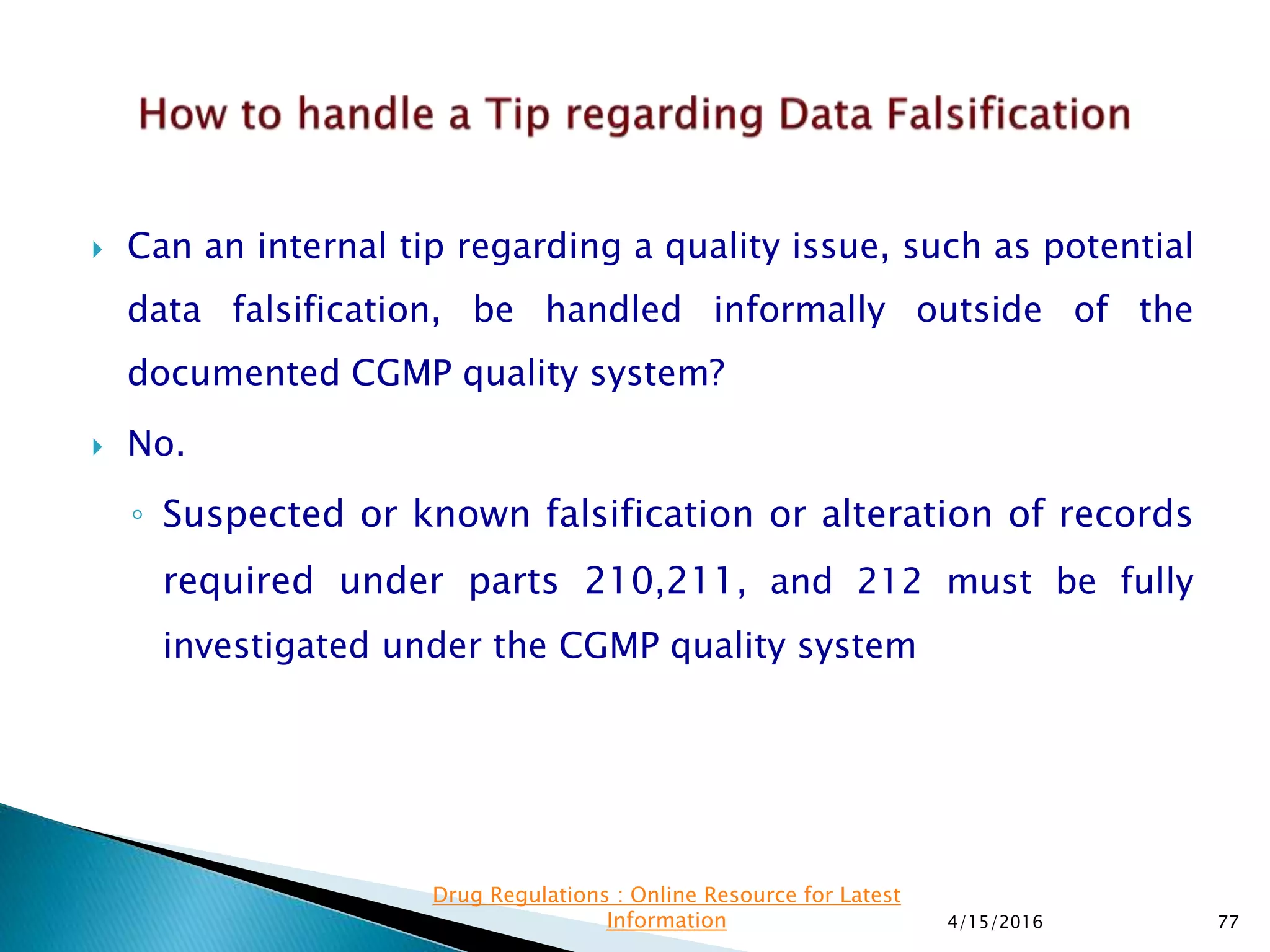
 Can an internal tip regarding a quality issue, such as potential
data falsification, be handled informally outside of the
documented CGMP quality system?
 No.
◦ Suspected or known falsification or alteration of records
required under parts 210,211, and 212 must be fully
investigated under the CGMP quality system
4/15/2016 77
Drug Regulations : Online Resource for Latest
Information
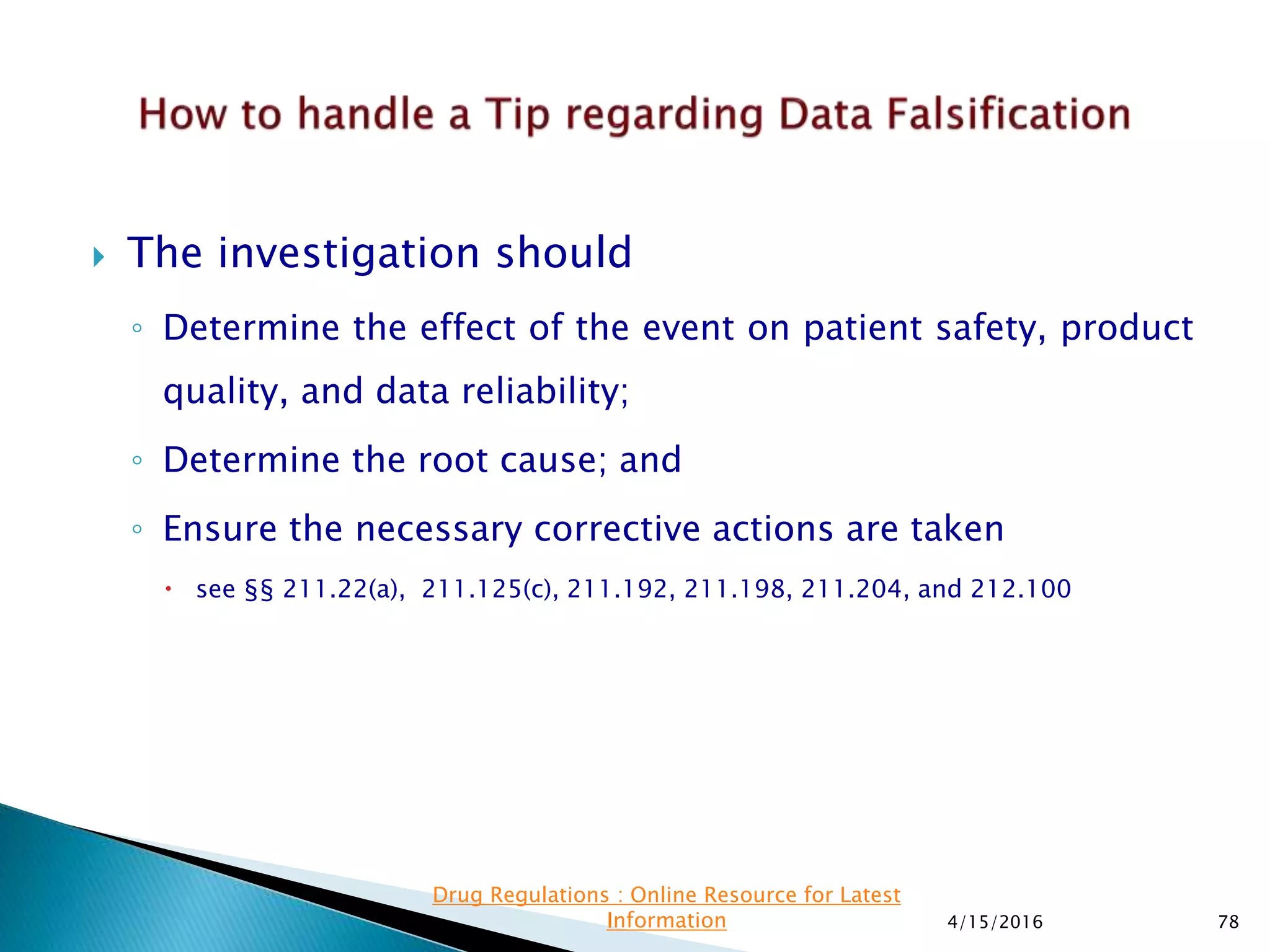
 The investigation should
◦ Determine the effect of the event on patient safety, product
quality, and data reliability;
◦ Determine the root cause; and
◦ Ensure the necessary corrective actions are taken
 see §§ 211.22(a), 211.125(c), 211.192, 211.198, 211.204, and 212.100
4/15/2016 78
Drug Regulations : Online Resource for Latest
Information
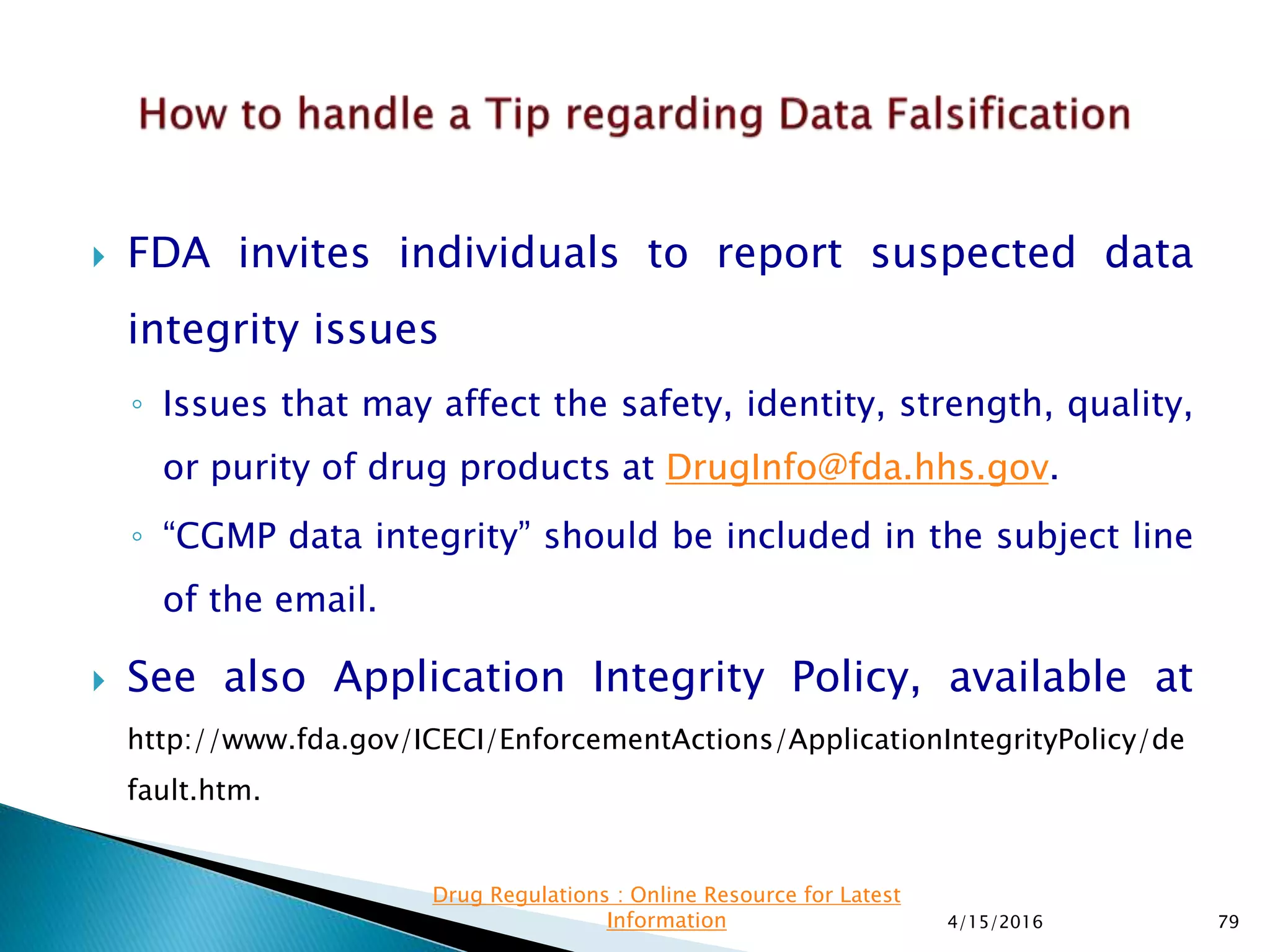
 FDA invites individuals to report suspected data
integrity issues
◦ Issues that may affect the safety, identity, strength, quality,
or purity of drug products at DrugInfo@fda.hhs.gov.
◦ “CGMP data integrity” should be included in the subject line
of the email.
 See also Application Integrity Policy, available at
http://www.fda.gov/ICECI/EnforcementActions/ApplicationIntegrityPolicy/de
fault.htm.
4/15/2016 79
Drug Regulations : Online Resource for Latest
Information
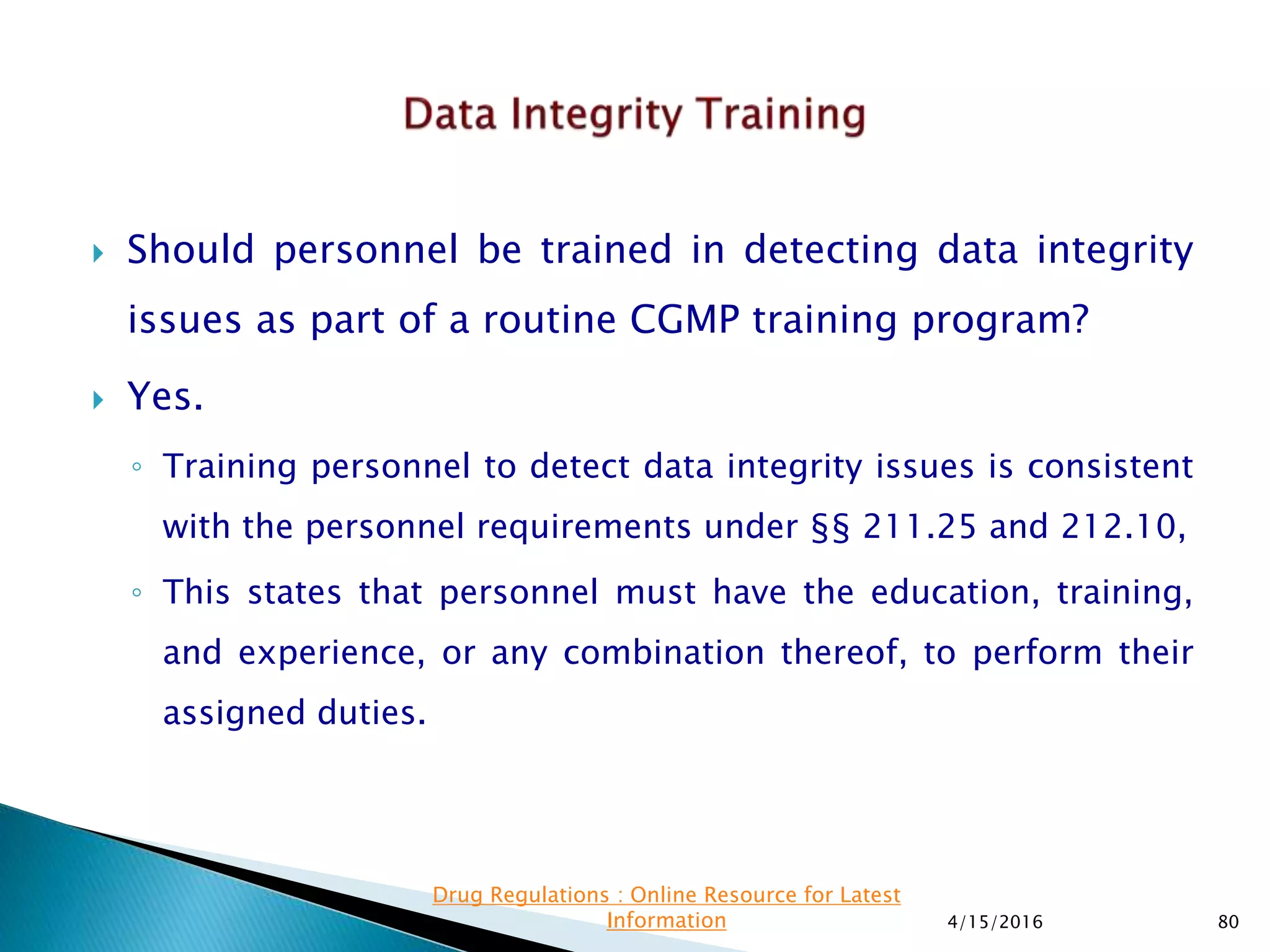
 Should personnel be trained in detecting data integrity
issues as part of a routine CGMP training program?
 Yes.
◦ Training personnel to detect data integrity issues is consistent
with the personnel requirements under §§ 211.25 and 212.10,
◦ This states that personnel must have the education, training,
and experience, or any combination thereof, to perform their
assigned duties.
4/15/2016 80
Drug Regulations : Online Resource for Latest
Information
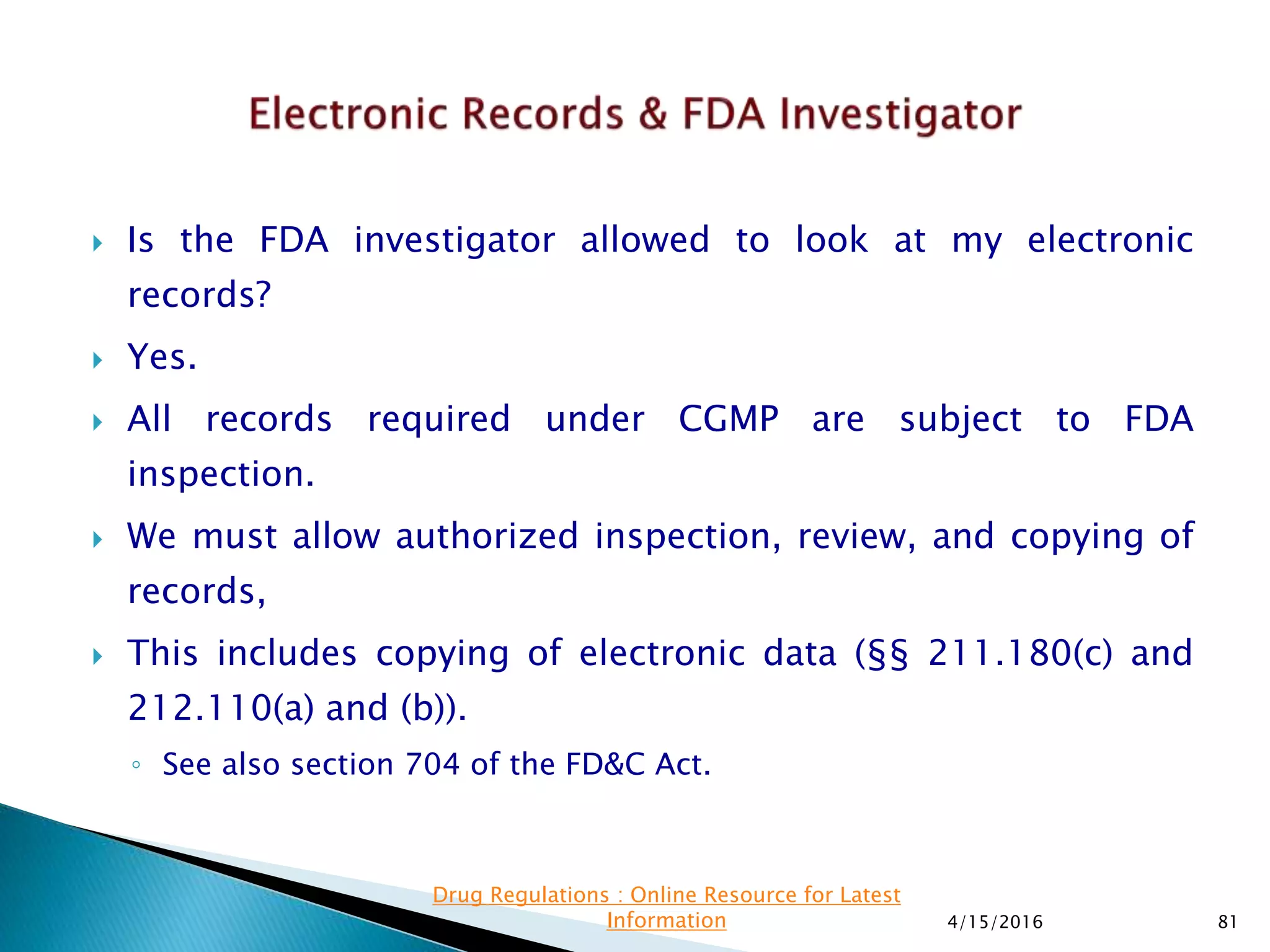
 Is the FDA investigator allowed to look at my electronic
records?
 Yes.
 All records required under CGMP are subject to FDA
inspection.
 We must allow authorized inspection, review, and copying of
records,
 This includes copying of electronic data (§§ 211.180(c) and
212.110(a) and (b)).
◦ See also section 704 of the FD&C Act.
4/15/2016 81
Drug Regulations : Online Resource for Latest
Information
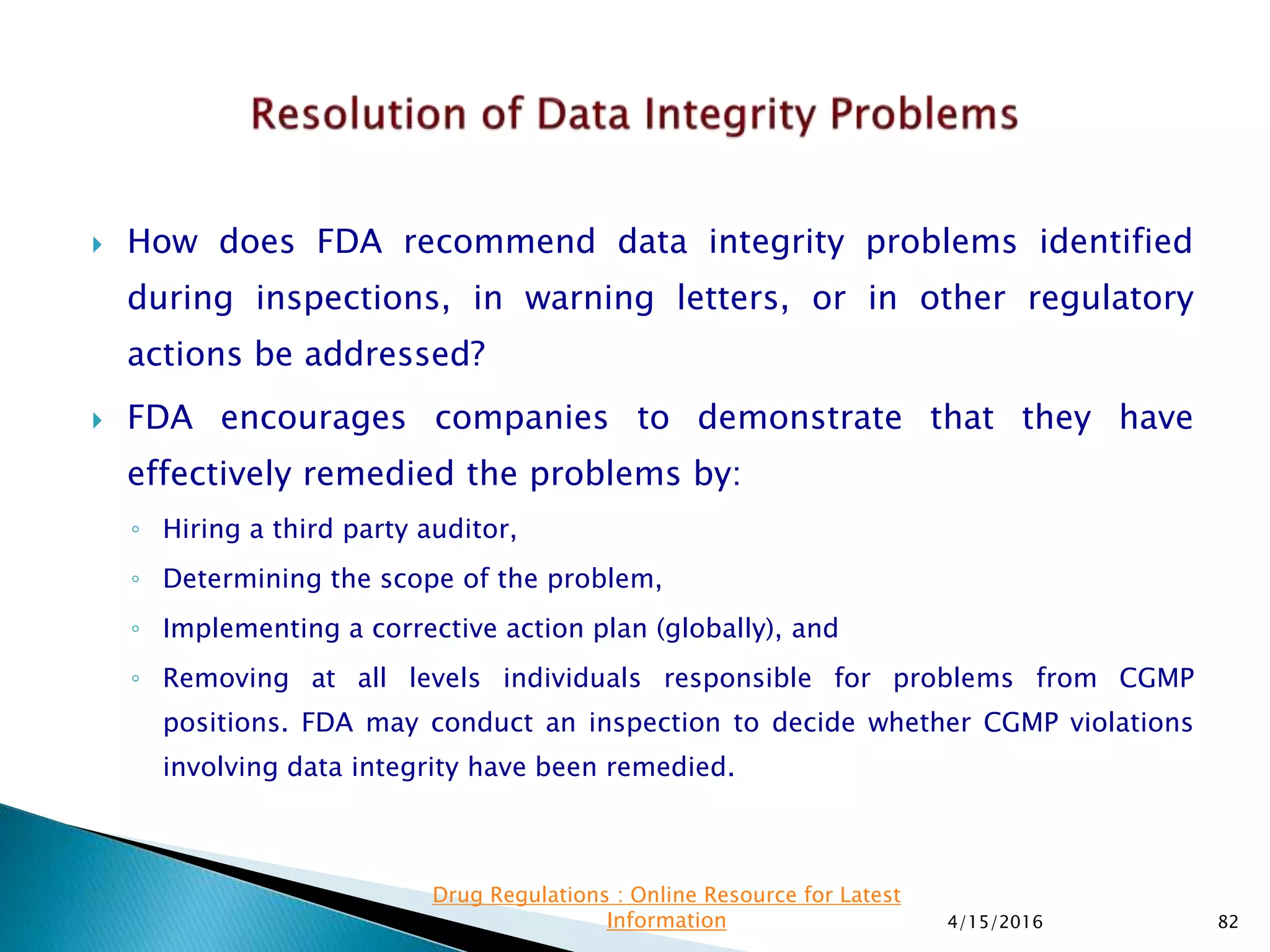
 How does FDA recommend data integrity problems identified
during inspections, in warning letters, or in other regulatory
actions be addressed?
 FDA encourages companies to demonstrate that they have
effectively remedied the problems by:
◦ Hiring a third party auditor,
◦ Determining the scope of the problem,
◦ Implementing a corrective action plan (globally), and
◦ Removing at all levels individuals responsible for problems from CGMP
positions. FDA may conduct an inspection to decide whether CGMP violations
involving data integrity have been remedied.
4/15/2016 82
Drug Regulations : Online Resource for Latest
Information
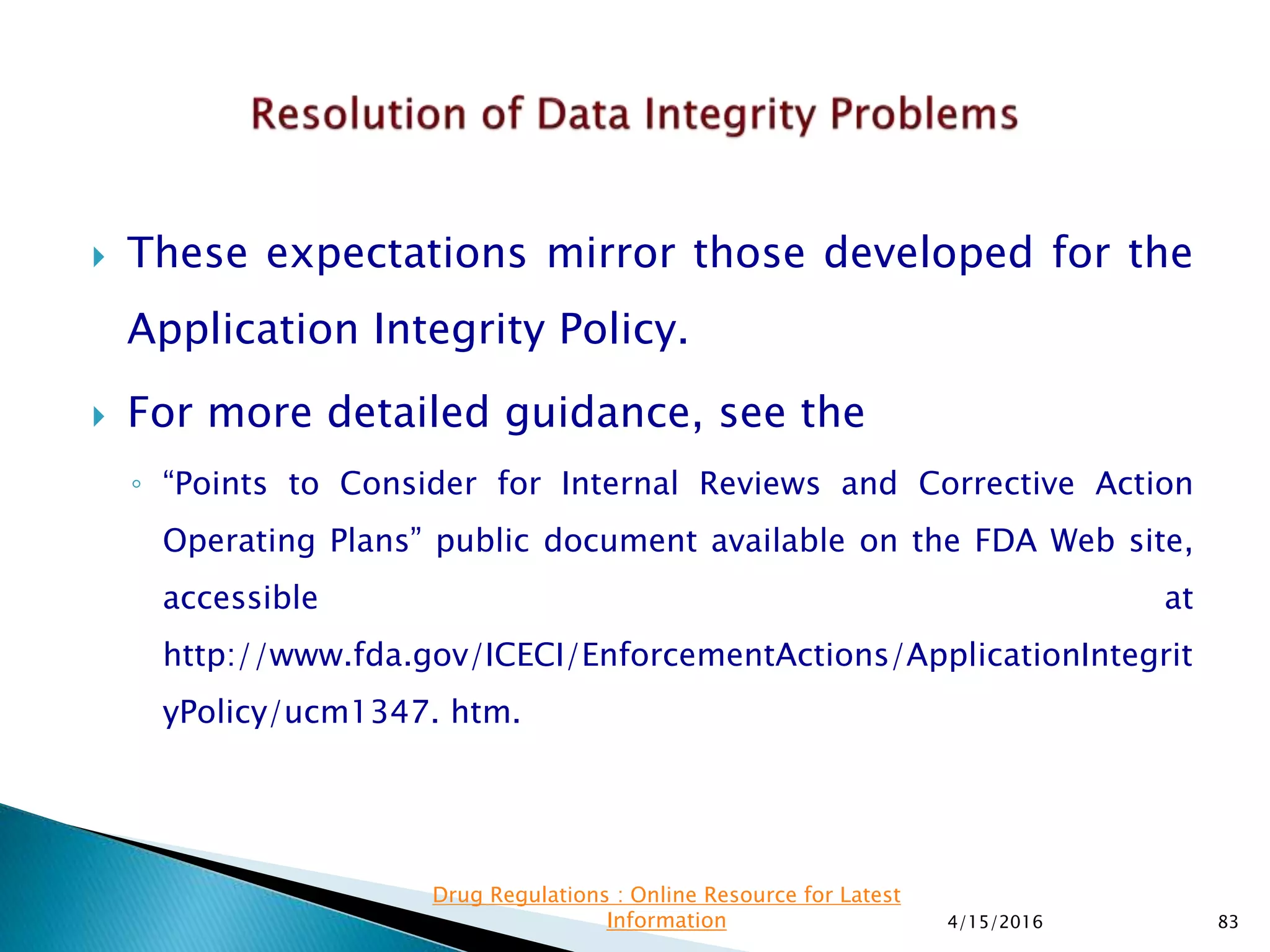
 These expectations mirror those developed for the
Application Integrity Policy.
 For more detailed guidance, see the
◦ “Points to Consider for Internal Reviews and Corrective Action
Operating Plans” public document available on the FDA Web site,
accessible at
http://www.fda.gov/ICECI/EnforcementActions/ApplicationIntegrit
yPolicy/ucm1347. htm.
4/15/2016 83
Drug Regulations : Online Resource for Latest
Information
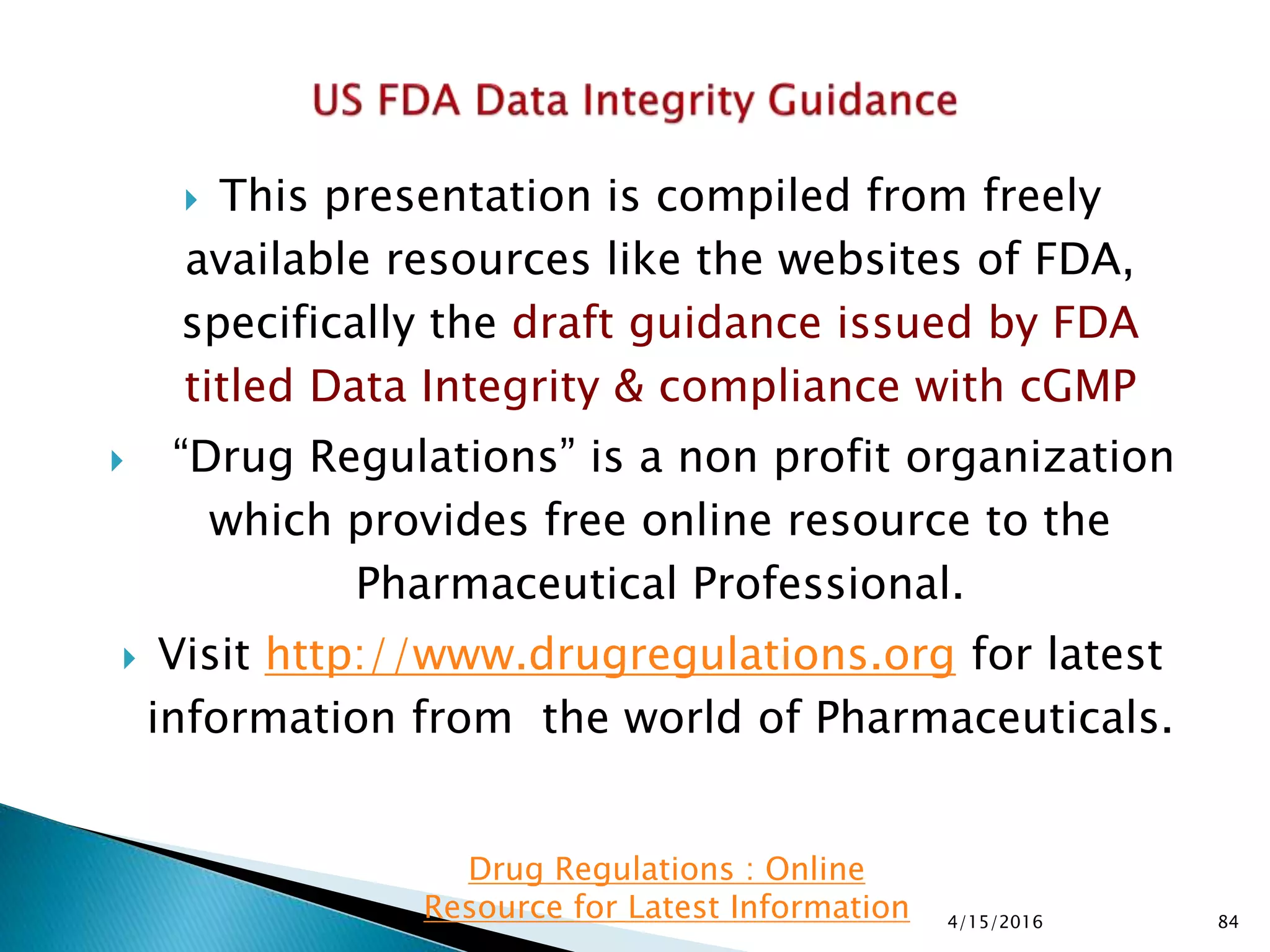
 This presentation is compiled from freely
available resources like the websites of FDA,
specifically the draft guidance issued by FDA
titled Data Integrity & compliance with cGMP
 “Drug Regulations” is a non profit organization
which provides free online resource to the
Pharmaceutical Professional.
 Visit http://www.drugregulations.org for latest
information from the world of Pharmaceuticals.
4/15/2016 84
Drug Regulations : Online
Resource for Latest Information

Presentation on US FDA Data Integrity Guidance.

  • 1.
    This presentation iscompiled by “ Drug Regulations” a non profit organization which provides free online resource to the Pharmaceutical Professional. Visit http://www.drugregulations.org for latest information from the world of Pharmaceuticals. 4/15/2016 1
  • 2.
     This presentationis compiled from freely available resources like the websites of FDA, specifically the draft guidance issued by FDA titled Data Integrity & compliance with cGMP  “Drug Regulations” is a non profit organization which provides free online resource to the Pharmaceutical Professional.  Visit http://www.drugregulations.org for latest information from the world of Pharmaceuticals. 4/15/2016 2 Drug Regulations : Online Resource for Latest Information
  • 3.
    4/15/2016 3 Drug Regulations: Online Resource for Latest Information
  • 4.
     The purposeof this guidance is to clarify the role of data integrity  in  current good manufacturing practice (CGMP) for drugs, as required in 21 CFR parts 210, 211, and 212. 4/15/2016 4 Drug Regulations : Online Resource for Latest Information
  • 5.
     Part 210 Covers Current Good Manufacturing Practice in Manufacturing, Processing, Packing, or Holding of Drugs; 4/15/2016 5 Drug Regulations : Online Resource for Latest Information
  • 6.
     Part 211 Covers Current Good Manufacturing Practice for Finished Pharmaceuticals; 4/15/2016 6 Drug Regulations : Online Resource for Latest Information
  • 7.
     Part 212 Covers Current Good Manufacturing Practice for Positron Emission Tomography Drugs. 4/15/2016 7 Drug Regulations : Online Resource for Latest Information
  • 8.
     This guidanceprovides the  Agency’s current thinking on the creation and handling of data in accordance with CGMP requirements. 4/15/2016 8 Drug Regulations : Online Resource for Latest Information
  • 9.
     FDA expectsthat data be reliable and accurate ◦ (see the “Background” section).  CGMP regulations and guidance allow for flexible and risk-based strategies to prevent and detect data integrity issues.  Firms should implement meaningful and effective strategies to manage their data integrity risks  This should be based upon their process understanding and knowledge management of technologies and business models. 4/15/2016 9 Drug Regulations : Online Resource for Latest Information
  • 10.
    4/15/2016 10 Drug Regulations: Online Resource for Latest Information
  • 11.
     In recentyears, FDA has increasingly observed CGMP violations involving data integrity during CGMP inspections.  This is troubling because ensuring data integrity is an important component of ◦ Industry’s responsibility to ensure the safety, efficacy, and quality of drugs, and ◦ Of FDA’s ability to protect the public health. 4/15/2016 11 Drug Regulations : Online Resource for Latest Information
  • 12.
     These dataintegrity-related CGMP violations have led to numerous regulatory actions, including warning letters, import alerts, and consent decrees.  The underlying premise in §§ 210.1 and 212.2 is that CGMP sets forth minimum requirements to assure that drugs meet the standards of the FD&C Act regarding  Safety,  Identity,  Strength,  Quality, and  Purity. 4/15/2016 12 Drug Regulations : Online Resource for Latest Information
  • 13.
     Electronic signatureand record-keeping requirements are laid out in 21 CFR part 11  They apply to certain records subject to records requirements set forth in Agency regulations, including parts 210, 211, and 212.  For more information, see guidance for industry Part 11, Electronic Records;  Electronic Signatures — Scope and Application. 4/15/2016 13 Drug Regulations : Online Resource for Latest Information
  • 14.
     The guidanceoutlines FDA’s current thinking regarding the narrow scope and application of part 11 pending FDA’s reexamination of part 11 as it applies to all FDA-regulated products. 4/15/2016 14 Drug Regulations : Online Resource for Latest Information
  • 15.
    4/15/2016 15 Drug Regulations: Online Resource for Latest Information
  • 16.
     Data integrityrefers to following attributes of data  Completeness,  Consistency, and  Accuracy 4/15/2016 16 Drug Regulations : Online Resource for Latest Information
  • 17.
     This datashould be (ALCOA) ◦ Attributable, ◦ Legible, ◦ Contemporaneously recorded, ◦ Original or a true copy, and ◦ Accurate 4/15/2016 17 Drug Regulations : Online Resource for Latest Information
  • 18.
     Metadata isthe contextual information required to understand data.  A data value is by itself meaningless without additional information about the data.  Metadata is often described as data about data. 4/15/2016 18 Drug Regulations : Online Resource for Latest Information
  • 19.
     Metadata isstructured information that describes, explains, or otherwise makes it easier to retrieve, use, or manage data. 4/15/2016 19 Drug Regulations : Online Resource for Latest Information
  • 20.
     For example,the number “23” is meaningless without metadata, such as an indication of the unit “mg.”  Among other things, metadata for a particular piece of data could include ◦ Date/time stamp for when the data were acquired ◦ User ID of the person who conducted the test or analysis that generated the data ◦ Instrument ID used to acquire the data ◦ Audit trails 4/15/2016 20 Drug Regulations : Online Resource for Latest Information
  • 21.
     Data shouldbe maintained throughout the record’s retention period  This should be done with all associated metadata required to reconstruct the CGMP activity ◦ (e.g., §§ 211.188 and 211.194).  The relationships between data and their metadata should be preserved in a secure and traceable manner. 4/15/2016 21 Drug Regulations : Online Resource for Latest Information
  • 22.
     Audit trailmeans ◦ A secure ◦ Computer-generated ◦ Time-stamped ◦ Electronic record  This record should allow for reconstruction of the course of events relating to the creation, modification, or deletion of an electronic record. 4/15/2016 22 Drug Regulations : Online Resource for Latest Information
  • 23.
     An audittrail is a chronology of the record.  “who,  what,  when, and  why” 4/15/2016 23 Drug Regulations : Online Resource for Latest Information
  • 24.
     For example, The audit trail for a high performance liquid chromatography (HPLC) run could include ◦ The user name, ◦ Date/time of the run, ◦ The integration parameters used, and ◦ Details of a reprocessing, if any, ◦ Change justification for the reprocessing. 4/15/2016 24 Drug Regulations : Online Resource for Latest Information
  • 25.
     Electronic audittrails include those that track creation, modification, or deletion of data ◦ (such as processing parameters and results)  And  Those that track actions at the record or system level ◦ such as attempts to access the system or rename or delete a file 4/15/2016 25 Drug Regulations : Online Resource for Latest Information
  • 26.
     How doesFDA use the terms “static” and “dynamic” as they relate to record formats?  Static is used to indicate a fixed-data document such as a paper record or an electronic image,  Dynamic means that the record format allows interaction between the user and the record content. 4/15/2016 26 Drug Regulations : Online Resource for Latest Information
  • 27.
     For example, A dynamic chromatographic record allows the user to ◦ Change the baseline and ◦ Reprocess chromatographic data so that the resulting peaks may appear smaller or larger. ◦ Modify formulas or entries in a spreadsheet used to compute test results or other information such as calculated yield. 4/15/2016 27 Drug Regulations : Online Resource for Latest Information
  • 28.
     How doesFDA use the term “backup” in § 211.68(b)?  FDA uses the term backup in § 211.68(b) to refer to a true copy of the original data  This should be maintained securely throughout the records retention period ◦ (for example, § 211.180). 4/15/2016 28 Drug Regulations : Online Resource for Latest Information
  • 29.
     The backupfile should ◦ contain the data  (which includes associated metadata)  and ◦ Should be in the original format or in a format compatible with the original format. 4/15/2016 29 Drug Regulations : Online Resource for Latest Information
  • 30.
     This shouldnot be confused with backup copies  These are created during normal computer use  They are temporarily maintained for disaster recovery ◦ (e.g., in case of a computer crash or other interruption).  Such temporary backup copies would not satisfy the requirement in § 211.68(b) to maintain a backup file of data. 4/15/2016 30 Drug Regulations : Online Resource for Latest Information
  • 31.
     What arethe “systems” in “computer or related systems” in § 211.68?  The American National Standards Institute (ANSI) defines systems as following organized to accomplish a set of specific functions. ◦ People, ◦ Machines, and ◦ Methods 4/15/2016 31 Drug Regulations : Online Resource for Latest Information
  • 32.
     Computer orrelated systems can refer to ◦ Computer hardware ◦ Software ◦ Peripheral devices ◦ Networks ◦ Cloud infrastructure ◦ Operators ◦ Associated documents  (e.g., user manuals and standard operating procedures). 4/15/2016 32 Drug Regulations : Online Resource for Latest Information
  • 33.
     When isit permissible to exclude CGMP data from decision making?  Any data created as part of a CGMP record must be ◦ Evaluated by the quality unit as part of release criteria  (see §§ 211.22 and 212.70) and ◦ Maintained for CGMP purposes  (e.g., § 211.180). 4/15/2016 33 Drug Regulations : Online Resource for Latest Information
  • 34.
     Electronic datagenerated to fulfill CGMP requirements should include relevant metadata. 4/15/2016 34 Drug Regulations : Online Resource for Latest Information
  • 35.
     To excludedata from the release criteria decision- making process, there must be a valid, documented, scientific justification for its exclusion: See ◦ The guidance for industry Investigating Out-of- Specification (OOS) Test Results for Pharmaceutical Production, and ◦ §§ 211.188, 211.192, and 212.71(b)). 4/15/2016 35 Drug Regulations : Online Resource for Latest Information
  • 36.
     The requirementsfor record retention and review do not differ depending on the data format;  Paper-based and electronic data record-keeping systems are subject to the same requirements. 4/15/2016 36 Drug Regulations : Online Resource for Latest Information
  • 37.
     Does eachworkflow on our computer system need to be validated? ◦ Yes  A workflow, such as creation of an electronic master production and control record (MPCR), is an intended use of a computer system ◦ This should be checked through validation  (see§§ 211.63, 211.68(b), and 211.110(a)). 4/15/2016 37 Drug Regulations : Online Resource for Latest Information
  • 38.
     If computersystem is validated, but not its intended use, we cannot know if workflow runs correctly.  For example, qualifying the Manufacturing Execution System (MES) platform, a computer system, ensures that it meets specifications;  However, it does not demonstrate that a given MPCR generated by the MES contains the correct calculations. 4/15/2016 38 Drug Regulations : Online Resource for Latest Information
  • 39.
     In thisexample, validating the workflow ensures that the intended steps, specifications, and calculations in the MPCR are accurate.  This is similar to reviewing a paper MPCR and ensuring all supporting procedures are in place before the MPCR is implemented in production. See ◦ §§ 211.100, 211.186, and 212.50(b), and ◦ The guidance for industry PET Drugs — Current Good Manufacturing Practice (CGMP) 4/15/2016 39 Drug Regulations : Online Resource for Latest Information
  • 40.
     FDA recommendsyou implement appropriate controls to manage risks associated with each element of the system.  Controls that are appropriately designed to validate a system for its intended use address software, hardware, personnel, and documentation. 4/15/2016 40 Drug Regulations : Online Resource for Latest Information
  • 41.
     How shouldaccess to CGMP computer systems be restricted?  FDA recommends ◦ To exercise appropriate controls to assure that changes to computerized MPCRs, or other records, or input of laboratory data into computerized records, can be made only by authorized personnel (§ 211.68(b)). 4/15/2016 41 Drug Regulations : Online Resource for Latest Information
  • 42.
     How shouldaccess to CGMP computer systems be restricted?  FDA recommends ◦ To restrict the ability to alter specifications, process parameters, or manufacturing or testing methods by technical means where possible  (for example, by limiting permissions to change settings or data). 4/15/2016 42 Drug Regulations : Online Resource for Latest Information
  • 43.
     How shouldaccess to CGMP computer systems be restricted?  FDA recommends ◦ That the system administrator role, including any rights to alter files and settings, be assigned to personnel independent from those responsible for the record content. ◦ To maintain a list of authorized individuals and their access privileges for each CGMP computer system in use. 4/15/2016 43 Drug Regulations : Online Resource for Latest Information
  • 44.
     These independentsecurity role assignments may not be practical for small operations or facilities with few employees ◦ PET or ◦ Medical gas facilities  FDA recommends alternate control strategies to be implemented. 4/15/2016 44 Drug Regulations : Online Resource for Latest Information
  • 45.
     For example In a rare instance if same person is required to hold the system administrator role and to be responsible for the content of the records ◦ FDA suggests having a second person review settings and content.  If second-person review is not possible ◦ the Agency recommends that the person recheck settings and his or her own work. 4/15/2016 45 Drug Regulations : Online Resource for Latest Information
  • 46.
     Why isFDA concerned with the use of shared login accounts for computer systems?  FDA Recommends ◦ To exercise appropriate controls to assure that only authorized personnel make changes to computerized MPCRs, or other records, or input laboratory data into computerized records, and ◦ To implement documentation controls that ensure actions are attributable to a specific individual  See §§ 211.68(b), 211.188(b)(11), 204 211.194(a)(7) and (8), and 212.50(c)(10) 4/15/2016 46 Drug Regulations : Online Resource for Latest Information
  • 47.
     When logincredentials are shared, a unique individual cannot be identified through the login  Therefore the system would thus not conform to the CGMP requirements in parts 211 and 212.  FDA requires that systems controls, including documentation controls, be designed to follow CGMP to assure product quality ◦ for example, §§ 211.100 and 212.50 4/15/2016 47 Drug Regulations : Online Resource for Latest Information
  • 48.
     How shouldblank forms be controlled?  There must be document controls in place to assure product quality ◦ (see §§ 211.100,213 211.160(a), 211.186, 212.20(d), and 212.60(g)).  FDA recommends that, if used, blank forms be controlled by the quality unit or by another document control method.  Blank forms include but not limited to, worksheets, laboratory notebooks, and MPCRs 4/15/2016 48 Drug Regulations : Online Resource for Latest Information
  • 49.
     For example,numbered sets of blank forms may be issued as appropriate and should be reconciled upon completion of all issued forms.  Incomplete or erroneous forms should be kept as part of the permanent record along with written justification for their replacement ◦ for example, see §§ 211.192, 211.194, 212.50(a), and 212.70(f)(1)(vi) 4/15/2016 49 Drug Regulations : Online Resource for Latest Information
  • 50.
     Similarly, boundpaginated notebooks, stamped for official use by a document control group, allow detection of unofficial notebooks as well as of any gaps in notebook pages. 4/15/2016 50 Drug Regulations : Online Resource for Latest Information
  • 51.
     How oftenshould audit trails be reviewed?  FDA recommends that audit trails that capture changes to critical data be reviewed with each record and before final approval of the record.  Audit trails subject to regular review should include, but are not limited to, the following: ◦ The change history of finished product test results, ◦ Changes to sample run sequences, ◦ Changes to sample identification, and ◦ Changes to critical process parameters. 4/15/2016 51 Drug Regulations : Online Resource for Latest Information
  • 52.
     FDA recommendsroutine scheduled audit trail review based on the complexity of the system and its intended use. 4/15/2016 52 Drug Regulations : Online Resource for Latest Information
  • 53.
     Who shouldreview audit trails?  Audit trails are considered part of the associated records.  Personnel responsible for record review under CGMP should review the audit trails  These should capture changes to critical data associated with the record as they review the rest of the record ◦ for example, §§ 211.22(a), 211.101(c), 211.194(a)(8), and 212.20(d) 4/15/2016 53 Drug Regulations : Online Resource for Latest Information
  • 54.
     For example, All production and control records, which includes audit trails, must be reviewed and approved by the quality unit ◦ § 211.192  This is similar to the expectation that cross-outs on paper be assessed when reviewing data. 4/15/2016 54 Drug Regulations : Online Resource for Latest Information
  • 55.
     Can electroniccopies be used as accurate reproductions of paper or electronic records?  Yes.  Electronic copies can be used as true copies of paper or electronic records  This is provided the copies preserve the content and meaning of the original data, ◦ Which should include associated metadata and the static or dynamic nature of the original records. 4/15/2016 55 Drug Regulations : Online Resource for Latest Information
  • 56.
     True copiesof dynamic electronic records may be made and maintained in the format of the original records or in a compatible format,  This is provided that ◦ The content and meaning of the original records are preserved and ◦ That a suitable reader and copying equipment (for example, software and hardware, including media readers) are readily available  §§ 211.180(d) and 212.110 4/15/2016 56 Drug Regulations : Online Resource for Latest Information
  • 57.
     Is itacceptable to retain paper printouts or static records instead of original electronic records from stand-alone computerized laboratory instruments, such as an FT-IR instrument?  A paper printout or static record may satisfy retention requirements if it is a complete copy of the original record ◦ (see §§ 211.68(b), 211.188, 211.194, and 212.60). 4/15/2016 57 Drug Regulations : Online Resource for Latest Information
  • 58.
     For example,pH meters and balances may create a paper printout or static image during data acquisition as the original record.  In this case, the paper printout or static image created during acquisition, or a true copy, should be retained (§ 211.180). 4/15/2016 58 Drug Regulations : Online Resource for Latest Information
  • 59.
     However, electronicrecords from certain types of laboratory instruments are dynamic records,  In this case a printout or a static record does not preserve the dynamic format which is part of the complete original record.  For example, the spectral file created by FT-IR can be reprocessed,  However a static record or printout is fixed, which would not satisfy CGMP requirements to retain original records or true copies (§ 211.180(d)).  Also, if the full spectrum is not displayed, contaminants may be excluded. 4/15/2016 59 Drug Regulations : Online Resource for Latest Information
  • 60.
     Control strategiesmust ensure that original laboratory records, including paper and electronic records, are subject to second-person review (§ 211.194(a)(8)) to make certain that all test results are appropriately reported. 4/15/2016 60 Drug Regulations : Online Resource for Latest Information
  • 61.
     For PETdrugs, see the guidance for industry PET Drugs — Current Good Manufacturing Practice (CGMP) for discussion of equipment and laboratory controls, including regulatory requirements for records. 4/15/2016 61 Drug Regulations : Online Resource for Latest Information
  • 62.
     Can electronicsignatures be used instead of handwritten signatures for master production and control records?  Yes,  Electronic signatures with the appropriate controls can be used instead of handwritten signatures or initials in any CGMP required record. 4/15/2016 62 Drug Regulations : Online Resource for Latest Information
  • 63.
     § 211.186(a)specifies a “full signature, handwritten,” ◦ However the Federal Register on September 29, 1978 (43 FR 45069) explains that part of the intent of the full signature requirement is to be able to clearly identify the individual responsible for signing the record. ◦ An electronic signature with the appropriate controls to securely link the signature with the associated record fulfills this requirement. 4/15/2016 63 Drug Regulations : Online Resource for Latest Information
  • 64.
     § 211.186(a)specifies a “full signature, handwritten,” ◦ This comports with part 11, which establishes criteria for when electronic signatures are considered the legally binding equivalent of handwritten signatures. ◦ Firms using electronic signatures should document the controls used to ensure that they are able to identify the specific person who signed the records electronically. 4/15/2016 64 Drug Regulations : Online Resource for Latest Information
  • 65.
     There isno requirement for a handwritten signature for the MPCR in the PET CGMP regulations (21 CFR part 212). 4/15/2016 65 Drug Regulations : Online Resource for Latest Information
  • 66.
     When doeselectronic data become a CGMP record? ◦ When generated to satisfy a CGMP requirement, all data become a CGMP record. ◦ This data must be documented, or saved at the time of performance to create a record incompliance with CGMP requirements,  Including, but not limited to, §§ 211.100(b) and 211.160(a). 4/15/2016 66 Drug Regulations : Online Resource for Latest Information
  • 67.
     FDA expectsprocesses to be designed so that quality data required to be created and maintained cannot be modified.  For example, ◦ Chromatograms should be sent to long-term storage upon run completion instead of at the end of a day’s runs.  Archiving or a permanent record 4/15/2016 67 Drug Regulations : Online Resource for Latest Information
  • 68.
     It isnot acceptable ◦ To record data on pieces of paper that will be discarded after the data are transcribed to a permanent laboratory notebook  see §§ 211.100(b), 211.160(a), and 211.180(d) ◦ To store data electronically in temporary memory, in a manner that allows for manipulation, before creating a permanent record.  Electronic data that are automatically saved into temporary memory do not meet CGMP documentation or retention requirements. 4/15/2016 68 Drug Regulations : Online Resource for Latest Information
  • 69.
     A combinationof technical and procedural controls may be employed to meet CGMP documentation practices for electronic systems.  For example ◦ A computer system, such as a Laboratory Information Management System (LIMS) or an Electronic Batch Record (EBR) system, can be designed to automatically save after each separate entry. ◦ This would be similar to recording each entry contemporaneously on a paper batch record to satisfy CGMP requirements. ◦ The computer system could be combined with a procedure requiring data be entered immediately when generated. 4/15/2016 69 Drug Regulations : Online Resource for Latest Information
  • 70.
     For PETdrugs, see the “Laboratory Controls” section of the guidance for industry PET Drugs — Current Good Manufacturing Practice (CGMP). 4/15/2016 70 Drug Regulations : Online Resource for Latest Information
  • 71.
     Why hasthe FDA cited use of actual samples during “system suitability” or test, prep, or equilibration runs in warning letters? ◦ FDA prohibits sampling and testing with the goal of achieving a specific result or to overcome an unacceptable result  e.g., testing different samples until the desired passing result is obtained ◦ This practice is also referred to as testing into compliance, ◦ This is not consistent with CGMP ◦ See the guidance for industry Investigating Out-of-Specification (OOS) Test Results for Pharmaceutical Production. 4/15/2016 71 Drug Regulations : Online Resource for Latest Information
  • 72.
     In somesituations, use of actual samples to perform system suitability testing has been used as a means of testing into compliance.  FDA considers it a violative practice to use an actual sample in test, prep, or equilibration runs as a means of disguising testing into compliance. 4/15/2016 72 Drug Regulations : Online Resource for Latest Information
  • 73.
     System SuitabilityTests : United States Pharmacopeia (USP)  These should include replicate injections of a standard preparation or other standard solutions to determine if requirements for precision are satisfied ◦ see USP General Chapter <621> Chromatography. 4/15/2016 73 Drug Regulations : Online Resource for Latest Information
  • 74.
     System suitabilitytests, including the identity of the preparation to be injected and the rationale for its selection, should be performed according to the firm’s established written procedures and the approved application or applicable compendial monograph ◦ (§§ 211.160 and 212.60). 4/15/2016 74 Drug Regulations : Online Resource for Latest Information
  • 75.
     If anactual sample is to be used for system suitability testing, it should be a properly characterized secondary standard.  Written procedures should be established and followed, and the sample should be from a different batch than the sample(s) being tested ◦ §§ 211.160, 211.165, and 212.60  All data should be included in the record that is retained  This should be subject to review unless there is documented scientific justification for its exclusion. 4/15/2016 75 Drug Regulations : Online Resource for Latest Information
  • 76.
     Is itacceptable to only save the final results from reprocessed laboratory chromatography?  No. ◦ Analytical methods should be capable and stable. ◦ For most lab analyses, reprocessing data should not be regularly needed. ◦ If chromatography is reprocessed, written procedures must be established and followed and each result retained for review  see §§367 211.160(a), 211.160(b), 211.165(c), 211.194(a)(4), and 212.60(a)).  FDA requires complete data in laboratory records  This includes raw data, graphs, charts, and spectra from laboratory instruments (§§ 211.194(a) and 212.60(g)(3)). 4/15/2016 76 Drug Regulations : Online Resource for Latest Information
  • 77.
     Can aninternal tip regarding a quality issue, such as potential data falsification, be handled informally outside of the documented CGMP quality system?  No. ◦ Suspected or known falsification or alteration of records required under parts 210,211, and 212 must be fully investigated under the CGMP quality system 4/15/2016 77 Drug Regulations : Online Resource for Latest Information
  • 78.
     The investigationshould ◦ Determine the effect of the event on patient safety, product quality, and data reliability; ◦ Determine the root cause; and ◦ Ensure the necessary corrective actions are taken  see §§ 211.22(a), 211.125(c), 211.192, 211.198, 211.204, and 212.100 4/15/2016 78 Drug Regulations : Online Resource for Latest Information
  • 79.
     FDA invitesindividuals to report suspected data integrity issues ◦ Issues that may affect the safety, identity, strength, quality, or purity of drug products at DrugInfo@fda.hhs.gov. ◦ “CGMP data integrity” should be included in the subject line of the email.  See also Application Integrity Policy, available at http://www.fda.gov/ICECI/EnforcementActions/ApplicationIntegrityPolicy/de fault.htm. 4/15/2016 79 Drug Regulations : Online Resource for Latest Information
  • 80.
     Should personnelbe trained in detecting data integrity issues as part of a routine CGMP training program?  Yes. ◦ Training personnel to detect data integrity issues is consistent with the personnel requirements under §§ 211.25 and 212.10, ◦ This states that personnel must have the education, training, and experience, or any combination thereof, to perform their assigned duties. 4/15/2016 80 Drug Regulations : Online Resource for Latest Information
  • 81.
     Is theFDA investigator allowed to look at my electronic records?  Yes.  All records required under CGMP are subject to FDA inspection.  We must allow authorized inspection, review, and copying of records,  This includes copying of electronic data (§§ 211.180(c) and 212.110(a) and (b)). ◦ See also section 704 of the FD&C Act. 4/15/2016 81 Drug Regulations : Online Resource for Latest Information
  • 82.
     How doesFDA recommend data integrity problems identified during inspections, in warning letters, or in other regulatory actions be addressed?  FDA encourages companies to demonstrate that they have effectively remedied the problems by: ◦ Hiring a third party auditor, ◦ Determining the scope of the problem, ◦ Implementing a corrective action plan (globally), and ◦ Removing at all levels individuals responsible for problems from CGMP positions. FDA may conduct an inspection to decide whether CGMP violations involving data integrity have been remedied. 4/15/2016 82 Drug Regulations : Online Resource for Latest Information
  • 83.
     These expectationsmirror those developed for the Application Integrity Policy.  For more detailed guidance, see the ◦ “Points to Consider for Internal Reviews and Corrective Action Operating Plans” public document available on the FDA Web site, accessible at http://www.fda.gov/ICECI/EnforcementActions/ApplicationIntegrit yPolicy/ucm1347. htm. 4/15/2016 83 Drug Regulations : Online Resource for Latest Information
  • 84.
     This presentationis compiled from freely available resources like the websites of FDA, specifically the draft guidance issued by FDA titled Data Integrity & compliance with cGMP  “Drug Regulations” is a non profit organization which provides free online resource to the Pharmaceutical Professional.  Visit http://www.drugregulations.org for latest information from the world of Pharmaceuticals. 4/15/2016 84 Drug Regulations : Online Resource for Latest Information