





























This presentation is compiled by “ Drug Regulations” a
non profit organization which provides free online
resource to the Pharmaceutical Professional.
Visit http://www.drugregulations.org for latest
information from the world of Pharmaceuticals.
4/1/2016 1
 This presentation is compiled from freely available resources like
the websites of FDA, EMA ,WHO and research papers published
by experts in this field like
Sandle, T Reinmüller, B , Hyde, W,, Costello, E.K., Lauber, C. L.,
Hamady, M., Fierer, N., Gordon, J.I., Knight, R.
 Paper published by T. Sandle on clean room contamination was
referred extensively for this presentation.
 “Drug Regulations” is a non profit organization which provides
free online resource to the Pharmaceutical Professional.
 Visit http://www.drugregulations.org for latest information from
the world of Pharmaceuticals.
4/1/2016 2
Drug Regulations : Online
Resource for Latest Information
4/1/2016 3
Drug Regulations : Online Resource for Latest
Information
 Staff gowning
 Personnel behavior
 How to minimize cleanroom risk
 Basic training
◦ Cleanroom staff
◦ Cleanroom entry
◦ Gowning practices
4/1/2016 4
Drug Regulations : Online Resource for Latest
Information
 Cleanroom contamination can arise from a
number of sources.
 Type of cleanroom
 Its geographic location
 The types of products processed
4/1/2016 5
Drug Regulations : Online Resource for Latest
Information
 Contamination sources can be divided into
following
◦ People
◦ Water
◦ Air and ventilation Surfaces
◦ Transport of items in and out of clean areas
4/1/2016 6
Drug Regulations : Online Resource for Latest
Information
 Most contamination can be traced to
humans working in cleanrooms.
◦ Conclusion based on organisms associated with
isolates from environmental monitoring in
controlled environments.
 These microorganisms are transient or
residential to the human skin.
4/1/2016 7
Drug Regulations : Online Resource for Latest
Information
 Human personnel shed high numbers
of skin cells mostly as skin flakes.
 The cleanroom garments worn by
personnel cannot contain all human
detritus.
4/1/2016 8
Drug Regulations : Online Resource for Latest
Information
 Trillions of microbial cells across the epithelial surface
and within the mouth and gut.
 These microorganisms play a role in human physiology
and organ function including digestion and immunity.
 The microorganisms also affect the outside
environment
 This is due to shedding from the skin or deposited
through different orifices.
4/1/2016 9
Drug Regulations : Online Resource for Latest
Information
 This latter issue has important implications for
cleanrooms.
 The outer layer of human skin can host up to one
million microorganisms per square centimeter.
 The population, as well as the diversity, varies
according to anatomical locale.
4/1/2016 10
Drug Regulations : Online Resource for Latest
Information
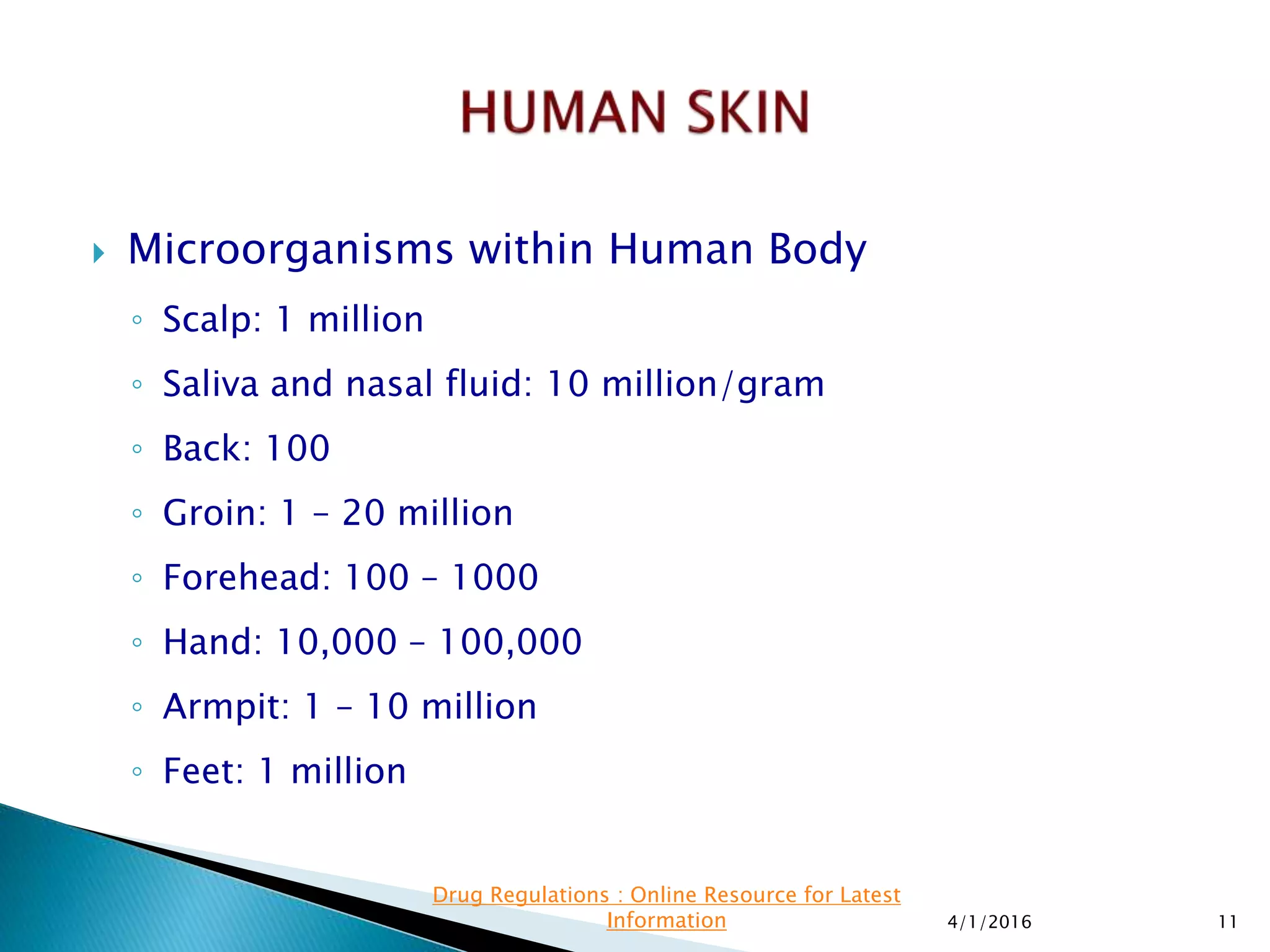
 Microorganisms within Human Body
◦ Scalp: 1 million
◦ Saliva and nasal fluid: 10 million/gram
◦ Back: 100
◦ Groin: 1 – 20 million
◦ Forehead: 100 – 1000
◦ Hand: 10,000 – 100,000
◦ Armpit: 1 – 10 million
◦ Feet: 1 million
4/1/2016 11
Drug Regulations : Online Resource for Latest
Information
 Research suggests that a typical person sheds
 1,000,000,000 skin cells per day of a size 33 μm x 44 μm x 4
μm
 This is equivalent to a rate of 30,000 to 40,000 dead skin cells
shed from the surface of the skin every minute.
 Of these approximately 10% of particles carry microorganisms.
 There are, on average, four microorganisms per skin cell.
 A term commonly used to describe skin flakes with adhered
microorganisms is “microbial carrying particles.”
4/1/2016 12
Drug Regulations : Online Resource for Latest
Information
 People are
 A source of contamination,
 Agents for transferring contamination possibly to locations
that could pose a product risk.
4/1/2016 13
Drug Regulations : Online Resource for Latest
Information
 Microorganisms are spread from
◦ Sneezing
◦ Coughing
◦ Touching
 Microorganisms suspended in the air are less of a
concern
 When such organisms gravitate towards a product
or critical location, they present a significant risk.
4/1/2016 14
Drug Regulations : Online Resource for Latest
Information
4/1/2016 15
Drug Regulations : Online Resource for Latest
Information
 The Human Microbiome Project (HMP)
◦ United States National Institutes of Health initiative.
◦ The project goal is to identify and characterize the
microorganisms found in association with both healthy and
diseased humans (the human microbiome).
 Our understanding of the risk the people pose to
cleanrooms has been advanced
4/1/2016 16
Drug Regulations : Online Resource for Latest
Information
 The human microbiome describes the aggregate of
microorganisms and their genetic interactions that
reside
◦ On the surface and in deep layers of skin
◦ In the saliva and oral mucosa
◦ In the conjunctiva
◦ In the gastrointestinal tract
4/1/2016 17
Drug Regulations : Online Resource for Latest
Information
 Skin is a complex ecosystem
 Supports a range of microbial communities
 These live in distinct niches
 These niches are affected by
◦ Available nutrients
◦ Several non-nutritional factors such as pH, humidity, and
temperature.
 Epithelial cells are continually being shed,
 Many microbial communities on the external surface are
rarely stable.
4/1/2016 18
Drug Regulations : Online Resource for Latest
Information
 Outer layer of Skin
 Has High population
 Considerable diversity of microbial species
across
 There are approximately 1000 species of
bacteria from 19 phyla on human skin.
4/1/2016 19
Drug Regulations : Online Resource for Latest
Information
 Of these, most bacteria can be categorized
into following phyla:
◦ Actinobacteria (51.8%).
◦ Actinobacteria are a group of Gram-positive
bacteria with high guanine and cytosine content,
 Such as Micrococcus, Corynebacteria and
Propionibacteria.
4/1/2016 20
Drug Regulations : Online Resource for Latest
Information
 Of these, most bacteria can be categorized
into following phyla:
◦ Firmicutes (24.4%).
◦ This includes the genera Clostridia and Bacillus.
4/1/2016 21
Drug Regulations : Online Resource for Latest
Information
 Of these, most bacteria can be categorized into
following phyla:
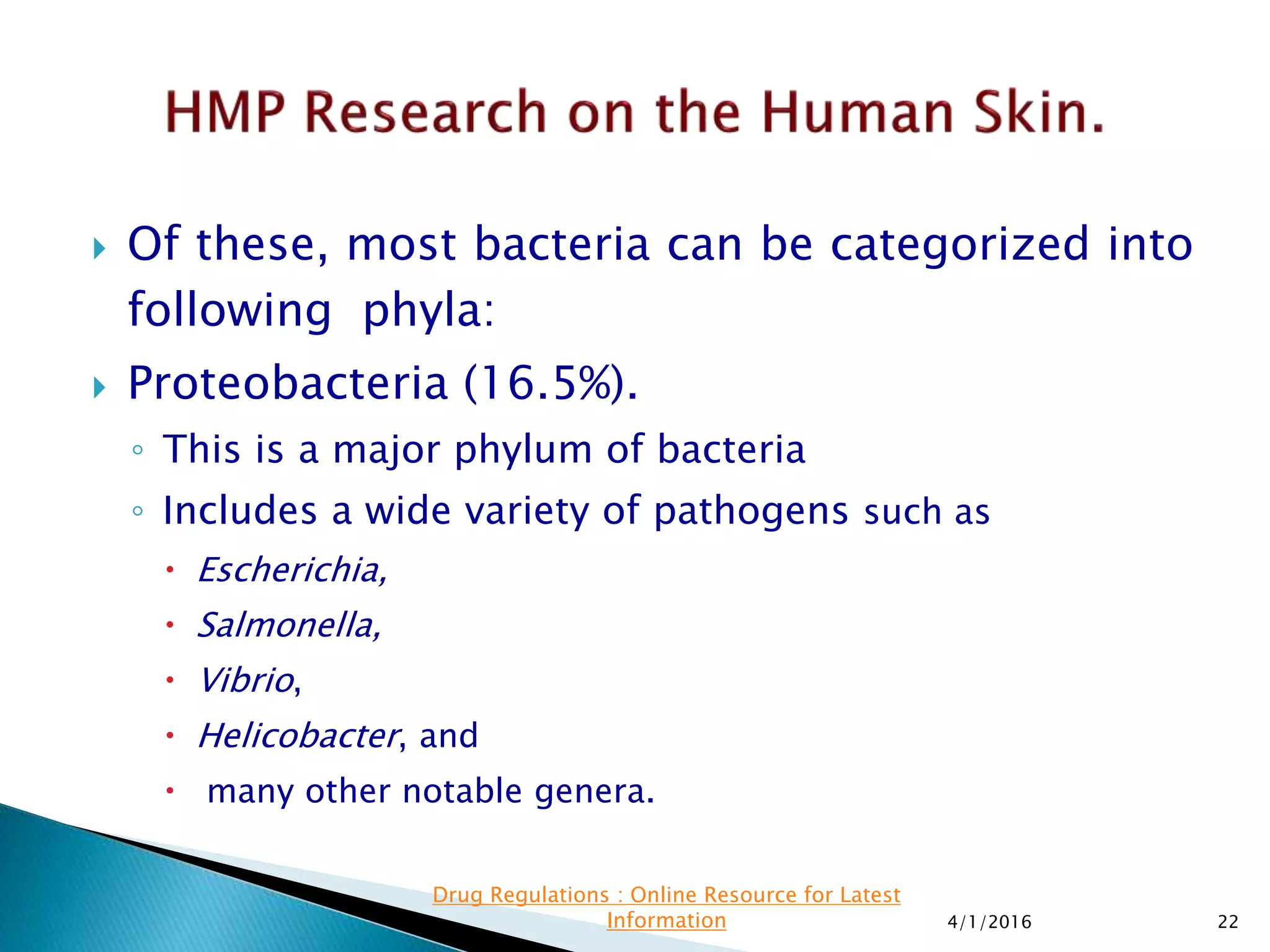
 Proteobacteria (16.5%).
◦ This is a major phylum of bacteria
◦ Includes a wide variety of pathogens such as
 Escherichia,
 Salmonella,
 Vibrio,
 Helicobacter, and
 many other notable genera.
4/1/2016 22
Drug Regulations : Online Resource for Latest
Information
 Of these, most bacteria can be categorized into
following phyla:
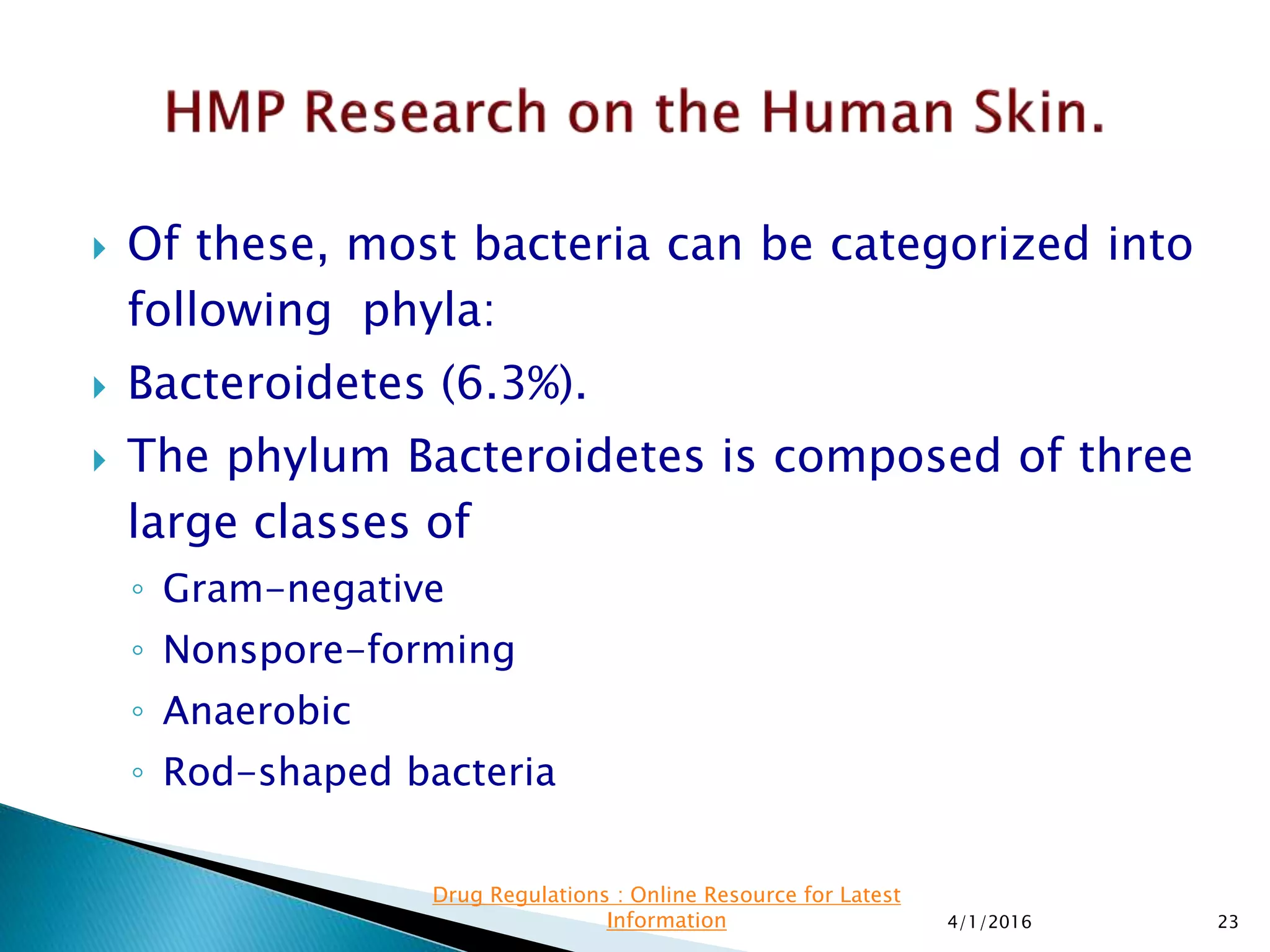
 Bacteroidetes (6.3%).
 The phylum Bacteroidetes is composed of three
large classes of
◦ Gram-negative
◦ Nonspore-forming
◦ Anaerobic
◦ Rod-shaped bacteria
4/1/2016 23
Drug Regulations : Online Resource for Latest
Information
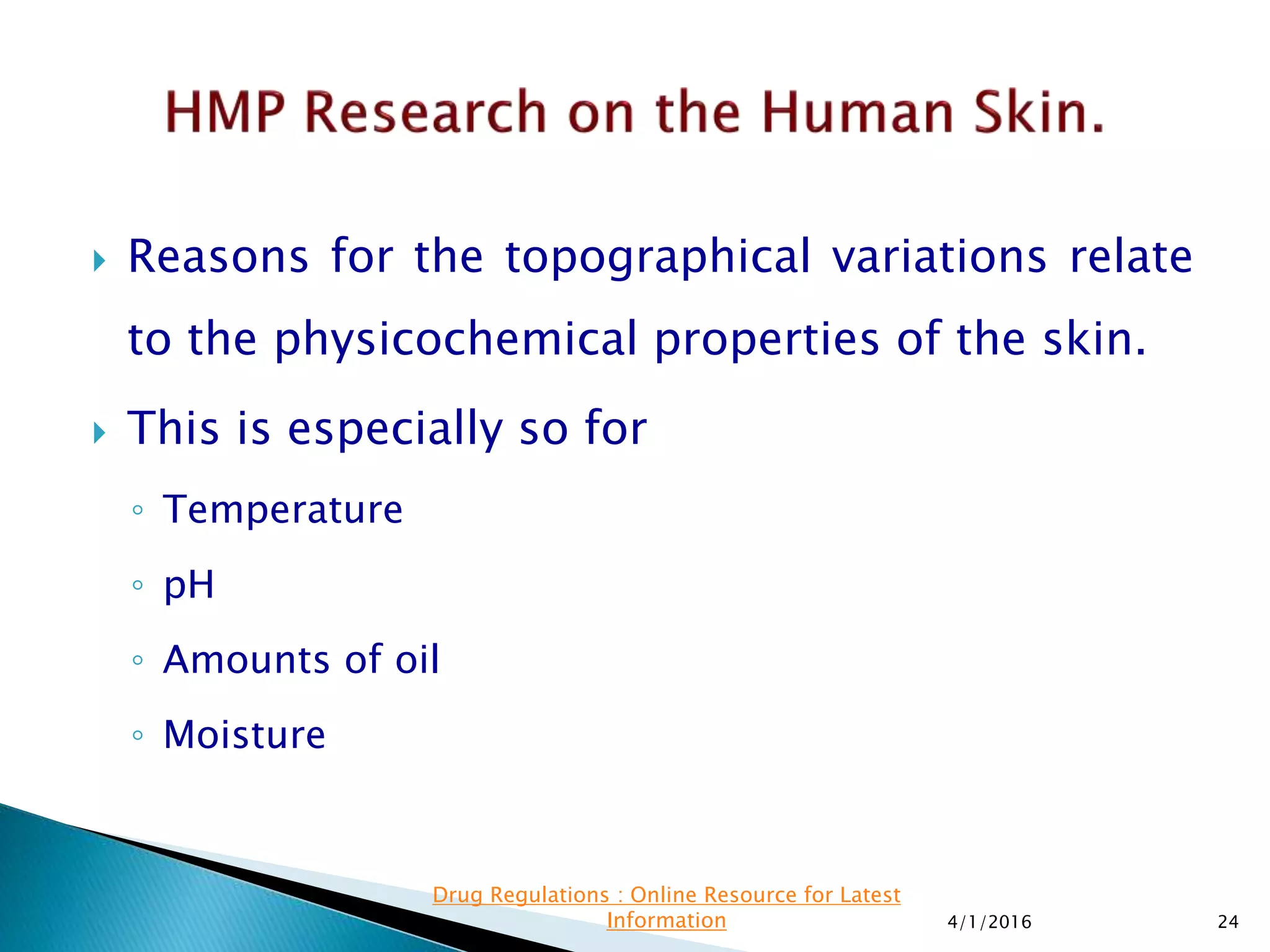
 Reasons for the topographical variations relate
to the physicochemical properties of the skin.
 This is especially so for
◦ Temperature
◦ pH
◦ Amounts of oil
◦ Moisture
4/1/2016 24
Drug Regulations : Online Resource for Latest
Information
 From this, there are three main
ecological areas of the skin:
◦ Sebaceous
◦ Moist
◦ Dry
4/1/2016 25
Drug Regulations : Online Resource for Latest
Information
 Examples of microbial divergence include
◦ Propionibacteria and Staphylococci species dominating the Dry, calloused areas
(arms and legs)
◦ Gram-positive cocci (primarily the Micrococcaceae) are found on the arms and
legs
◦ Gram-positive rods are found in high numbers on the torso.
◦ Staphylococci and Corynebacteria are found together with some Gram-negative
bacteria in moist areas.
 These types of microorganisms generally reflect the types recovered
from cleanrooms
4/1/2016 26
Drug Regulations : Online Resource for Latest
Information
 Gram-positive bacteria predominate across the
skin as
◦ The skin is generally a dry environment
◦ Any fluids present on the surface generally have a high osmotic
pressure
 Thus Gram-positive bacteria are better adapted for
such environments, not least to being resistant to
desiccation.
◦ (especially the Staphylococci and Micrococci)
4/1/2016 27
Drug Regulations : Online Resource for Latest
Information
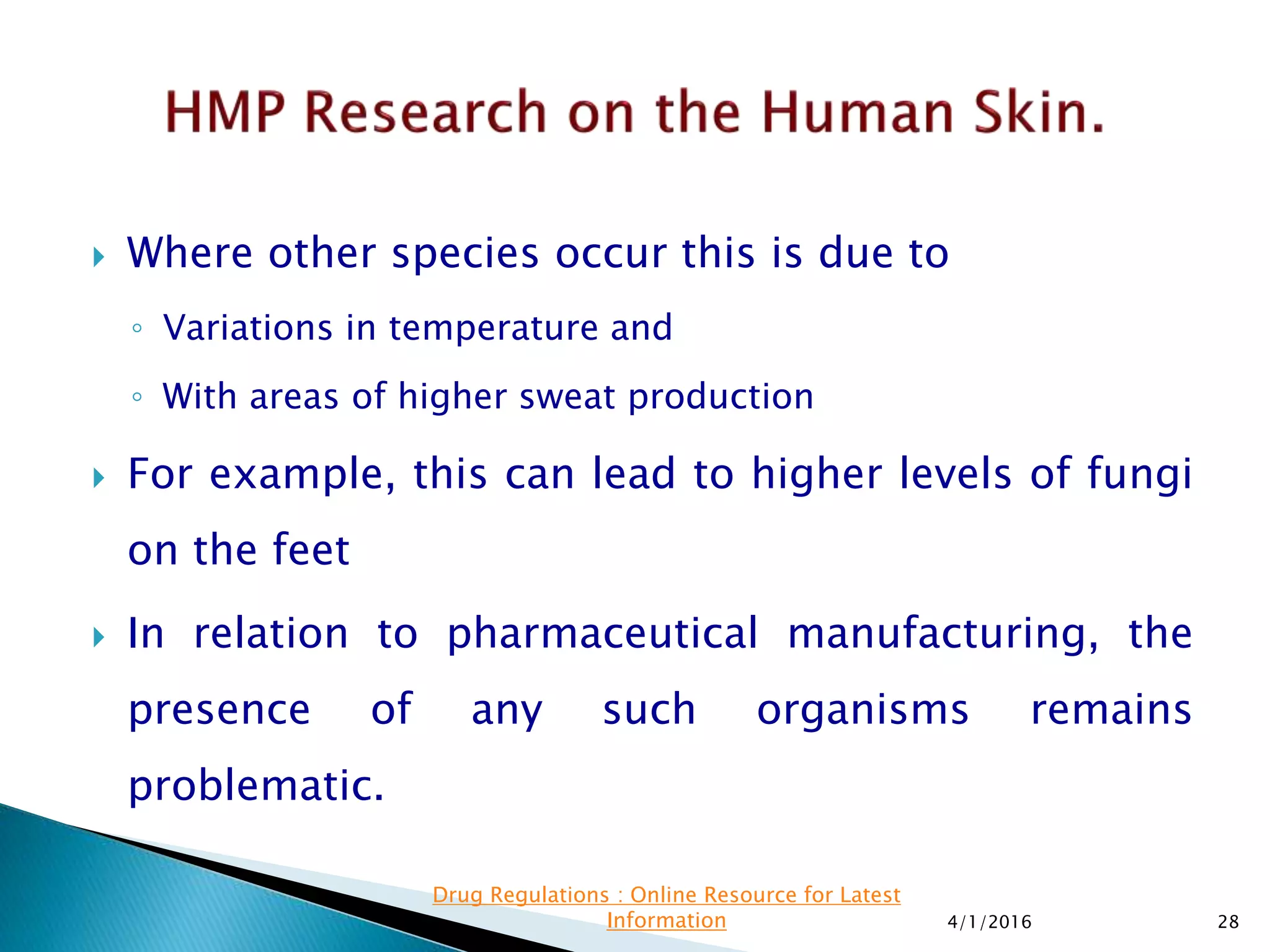
 Where other species occur this is due to
◦ Variations in temperature and
◦ With areas of higher sweat production
 For example, this can lead to higher levels of fungi
on the feet
 In relation to pharmaceutical manufacturing, the
presence of any such organisms remains
problematic.
4/1/2016 28
Drug Regulations : Online Resource for Latest
Information
 The ratio of the microorganisms recovered from
the skin is relatively evenly divided between the
aerobic and the anaerobic.
 The aerobic microorganisms tend to live on the
outermost layers of the skin
 The anaerobic microorganisms live in the deeper
layers of the skin and hair follicles
4/1/2016 29
Drug Regulations : Online Resource for Latest
Information
 The information from HMP introduces several
implications for cleanroom environmental monitoring.
◦ Whether gowning practices are adequate to exclude all
microorganisms from the richest areas of the skin microbiome.
 Most bacteria free-floating in cleanroom air current are
not free-living
 They are instead the result of
◦ Direct particle shedding of desquamated skin cells and
◦ Subsequent re-suspension of skin detritus in the air stream.
4/1/2016 30
Drug Regulations : Online Resource for Latest
Information
 The answer to earlier question should lead to a
consideration of:
◦ The types of cleanroom undergarments used
◦ An examination as to whether these provide an effective
barrier, especially for the more moist parts of the body.
◦ The importance of the outer gown covering all parts of the
body, including the forehead.
◦ The quality of cleanroom certified undergarments.
4/1/2016 31
Drug Regulations : Online Resource for Latest
Information
 The answer to earlier question should lead to a
consideration of:
◦ The level of training required for operators in relation to
gowning and the way that gowning qualification was
conducted.
◦ How long a cleanroom suit should be worn for in relation to
material integrity against operator perspiration.
◦ The environment in which gowns are donned, where higher
air-change rates might prove effective.
4/1/2016 32
Drug Regulations : Online Resource for Latest
Information
 The answer to earlier question should lead to a
consideration of:
◦ How often gowns should be recycled which involves
washing and irradiation.
◦ What types of testing is conducted on recycled gowns
◦ What the procedures are for rejecting gowns where a
loss of integrity is detected.
4/1/2016 33
Drug Regulations : Online Resource for Latest
Information
 Cleanroom microbiologists may wish to consider how
concerned they are with each of the items listed in
excluding microorganisms found on all regions of the
skin.
 There must be good understanding of the environmental
monitoring methods used to assess cleanrooms.
 These may not show how good or bad gown changing and
gown wearing is.
 These concerns are best addressed through good gowning
practices
4/1/2016 34
Drug Regulations : Online Resource for Latest
Information
4/1/2016 35
Drug Regulations : Online Resource for Latest
Information
 Despite some advances with automation and robotics, in
most situations people cannot be eliminated from
cleanrooms.
 Control of contamination from people in cleanrooms is
achieved by application of two principles:
◦ We “wrap” the people to minimize the amount of “shedding” of
microorganisms.
◦ We put localized protection around the product to minimize the amount of
contact with the people.
4/1/2016 36
Drug Regulations : Online Resource for Latest
Information
 The localized protection is achieved through local air
protection, such as
◦ Unidirectional airflow cabinets and
◦ Isolators.
 With clothing, personnel working in cleanrooms are required
to wear special clothing designed for the clean environments.
 Such clothing is necessary because the human body creates
its own microenvironment of potentially damaging particulate
contamination.
4/1/2016 37
Drug Regulations : Online Resource for Latest
Information
 To be effective, cleanroom clothing must:
◦ Form a particulate barrier for the human micro-
environment.
◦ Allow freedom of movement and be comfortable.
◦ Address any specialist requirement,
 e.g. static dissipation.
 Avoid being a significant particulate contributor in itself.
◦ Cleanroom garments must meet specific protection criteria.
4/1/2016 38
Drug Regulations : Online Resource for Latest
Information
 Not all cleanroom garments are of the same quality.
 This involves manufacturing the garments from special
materials, following particular construction methods, and
then tailored for individual styling.
 The gowns must be comfortable, easy to apply and practical
in use.
 Some gowns are disposable and others are made to be re-
laundered and sterilized depending on the cleanroom grade.
4/1/2016 39
Drug Regulations : Online Resource for Latest
Information
4/1/2016 40
Drug Regulations : Online Resource for Latest
Information
 Fabrics used in the manufacture of cleanroom garments must
have the following features:
◦ Be low in particulate shedding.
◦ Permit the body to breathe while trapping particles within the garment.
◦ The contaminant should be retained within the garment and not released
into the surrounding atmosphere.
◦ Be flexible enough for comfortable wearing.
◦ Withstand repeated cleaning and sterilization cycles.
◦ Meet any specific requirements such as control of static.
◦ Meet opacity requirements.
◦ Look and feel as good as possible. Be cost-effective.
4/1/2016 41
Drug Regulations : Online Resource for Latest
Information
 There are three broad categories of fabric used in the
construction of cleanroom garments:
4/1/2016 42
Drug Regulations : Online Resource for Latest
Information
 Woven fabrics.
◦ Woven or re-usable fabrics are the most commonly used fabrics in
cleanroom environments.
◦ Such garments are woven on sophisticated looms from yarns of
continuous filaments of polyester.
◦ The thickness of the yarn and filaments is important –
 the finer the yarn, the tighter the weave can be made, and the better the filtration.
◦ The pattern and tightness of the weave is important to reduce the pore
size to a minimum.
◦ The use of continuous filament polyester means that there are few loose
ends from which particles may be shed.
4/1/2016 43
Drug Regulations : Online Resource for Latest
Information
 Laminated or membrane fabrics.
◦ Laminated fabrics are favored for some high-
grade microelectronic environments.
◦ These types of garments are not commonly used
in the pharmaceutical sector.
4/1/2016 44
Drug Regulations : Online Resource for Latest
Information
 Disposable or limited life materials.
◦ The most common of these non-woven fabrics are from spun
bonded olefin and polypropylene.
◦ Comprising a densely interlinked matt of fibers, these fabrics can
provide good results for a limited period.
◦ Garments from such materials need to be processed and
decontaminated before use in the cleanroom.
◦ Disposable or limited use garments are mainly used in those
environments where protection of the wearer against potentially
hazardous products is required.
4/1/2016 45
Drug Regulations : Online Resource for Latest
Information
4/1/2016 46
Drug Regulations : Online Resource for Latest
Information
 Garments are designed to provide protection for the head, body,
hands and feet.
 In establishing a system for garment selection, it is important to
consider the broader aspects of cleanroom use:
◦ Suitability of fabric,
◦ Garment style,
◦ Layers,
◦ The nature of the tasks involved,
◦ Costs,
◦ Regulatory requirements, and
◦ Any specific customer requirements.
4/1/2016 47
Drug Regulations : Online Resource for Latest
Information
 The classification of the cleanroom will inevitably be the
major factor in determining the degree of personnel
protection required and the fundamental choice of garments.
 One important issue with gowns is the maximum length of
time that a gown can be worn.
 As people perspire, the integrity of the gown will weaken.
4/1/2016 48
Drug Regulations : Online Resource for Latest
Information
 Complicating factors are the temperature and humidity
of the cleanroom and the variations between people.
 The length of time will also depend upon the grade of
the cleanroom.
 In aseptic areas, such as ISO 14644 class 7 / EU GMP
Grade B areas, gowns are typically worn only for the
length of the shift
◦ (normally four hour periods to enable operators to take breaks).
4/1/2016 49
Drug Regulations : Online Resource for Latest
Information
 In lower grade cleanrooms, a gown might be worn
for several sessions during the course of the
working day.
 Other factors affecting the lifespan of the gowns
that are subject to recycling are repairs and the
number of permitted washing cycles.
 With repairs, it is prudent to have a repair policy.
4/1/2016 50
Drug Regulations : Online Resource for Latest
Information
 This will vary across facilities, and again, it will be affected by
the cleanroom class.
 With aseptic areas, if a gown becomes torn it is normally
discarded.
 In other grades of cleanroom, a gown can be repaired
depending upon the size of the hole and the impact on the
material.
 Some organizations set a maximum size for any hole or tear
and for the number of times a gown can be repaired.
 Gowns that are recycled are subject to laundering.
4/1/2016 51
Drug Regulations : Online Resource for Latest
Information
 Gowns are washed by special washing machines with suitable
detergents,
 They are then dried, folded, and then wrapped in cleanroom packaging.
 For gowns that are to be used in aseptic areas, such gowns are
irradiated.
 A policy should be in place outlining how often a gown can be processed
-- typical times range between 20 and 40 times.
 To make the tracking task easier, many gowns sterilized by irradiation or
gassing are fitted with barcodes and scanned.
 It is further important to establish the extent that the sterilization
process affects the integrity of the gown material.
4/1/2016 52
Drug Regulations : Online Resource for Latest
Information
 In order to assess the contamination risks from re-
laundering, gowns are subject to particle counting.
 There are different ways to do this
 Most common means is the Helmke Drum particle
emission test.
 With this, the test method simulates particle
shedding of clothing under movement.
4/1/2016 53
Drug Regulations : Online Resource for Latest
Information
 The garment under test is tumbled in a rotating drum
(approximately 10 revolutions per minute)
 This releases particles from the surface of the
cleanroom garment in a controlled manner.
 An automatic particle counter is used to sample the air
within the drum
 Determination of the average particle concentration of
the air during the initial ten minutes of the test is
performed.
4/1/2016 54
Drug Regulations : Online Resource for Latest
Information
 The common standard is the IEST "Recommended Practice RP-CC003.3:
Garment System Considerations for Cleanrooms and Other Controlled
Environments".
 An alternative measure is the Body Box test.
 This method simulates particle filtration and release under real wear
conditions.
 As a consequence it measures the contamination of the cleanroom by
the clothing/wearer.
 For this, particle counters determine the quantity of particles generated
by the wearer/garment that are emitted into the chamber.
4/1/2016 55
Drug Regulations : Online Resource for Latest
Information
4/1/2016 56
Drug Regulations : Online Resource for Latest
Information
 Cosmetics, such as powder, rouge, eye liner, mascara, and lipstick
must be banned in cleanroom environments.
 Jewelry, such as rings, watches, necklaces, bracelets, earrings and
other items, together with all forms of visible piercing, are
commonly not allowed in cleanrooms.
 The best method of changing into cleanroom garments is one that
minimizes contamination getting onto the outside of the garments.
 Change areas can vary in design, but it is common to find them
divided into three zones:
4/1/2016 57
Drug Regulations : Online Resource for Latest
Information
 Pre-change zone.
 Outside of changing rooms 'tacky mats' or polymeric flooring can be
positioned to help reduce the level of particles carried on footwear.
4/1/2016 58
Drug Regulations : Online Resource for Latest
Information
 Changing zone.
 The changing room design contributes to the assurance of
appropriate personnel access and microbial contamination control.
 The changing room should be provided with filtered air.
 Intermediate (bag) filters will typically be suitable for this purpose,
though High Efficiency Particulate Air (HEPA) filtration may be used.
 The air pressure should be negative with regards to the
manufacturing area corridor, but positive relative to external
adjacent areas.
4/1/2016 59
Drug Regulations : Online Resource for Latest
Information
 Cleanroom entrance zone.
 This must be of the same grade or class as the main cleanroom into
which the area leads.
 Ideally there should be separate routes through airlocks for material
required in cleanrooms.
 Taking items through personnel change areas should be
discouraged.
4/1/2016 60
Drug Regulations : Online Resource for Latest
Information
4/1/2016 61
Drug Regulations : Online Resource for Latest
Information
 Personnel training in gowning is an important function.
 Gowning practices must be assessed periodically and monitored
frequently.
 Training programs should ideally include visual assessment and
microbiological assessment.
 The microbiological assessment varies, but can include
◦ The exposure of settle plates during the change process and
◦ The assessment of gown cleanliness through post-use suit contact plates.
 The results of the cleanroom sampling should not exceed those of the
room class.
 If results are exceeded, the individual may be an unusually high shedder
of skin particles.
4/1/2016 62
Drug Regulations : Online Resource for Latest
Information
 Training required for staff who work in cleanrooms should
include:
◦ Introduction to micro-organisms and microbiological contamination
control.
◦ Entry and exit of production facilities (including gowning)
◦ Personal hygiene training
◦ Microbiological risks associated with specific production tasks.
◦ Training must be documented and regularly reviewed. Training must be
effective.
◦ Actual performance of personnel competency in gowning should be
demonstrated on a regular basis.
4/1/2016 63
Drug Regulations : Online Resource for Latest
Information
4/1/2016 64
Drug Regulations : Online Resource for Latest
Information
 Working in clean environments demands
 Knowledge,
 Discipline,
 Motivation as well as
 A thorough understanding of contamination risks among all
personnel involved.
 Each individual cleanroom should have its own documented rules
and procedures.
4/1/2016 65
Drug Regulations : Online Resource for Latest
Information
 Training includes reminding personnel that they must not be
allowed to touch critical products and equipment with their naked
hands.
 All critical work must be undertaken wearing gloves.
 Critical activities requiring personnel contact such as aseptic
processing or sampling must be done through the use of clean
utensils such as tweezers, forceps, and the equivalent.
 All devices and gloves used must fully comply with the cleanliness
demands of the cleanroom and work undertaken in the cleanroom.
 They must be cleaned, disinfected, or sterilized as appropriate for
the criticality or activity and risk of contamination.
4/1/2016 66
Drug Regulations : Online Resource for Latest
Information
 Another aspect of best practice is in instructing personnel in the
appropriate behaviors within the cleanroom.
 The generation of contamination is proportional to activity
conducted.
 A person with head, arms, and body moving can generate about
1,000,000 particles ≥ 0.5 μm/min.
 A person who is walking can generate about 5,000,000 particles ≥
0.5 μm/min.
4/1/2016 67
Drug Regulations : Online Resource for Latest
Information
 However a person in motionless position can generate only
100,000 particles ≥ 0.5 μm/min.
 In addition, personnel should reduce activities like talking,
singing, whistling, coughing, sneezing etc., especially when
being close to the handled products and production
equipment.
4/1/2016 68
Drug Regulations : Online Resource for Latest
Information
 People working in cleanrooms and other forms of controlled
environments must be physically healthy.
 Diseases in the upper respiratory tract as well as stomach disorders can
create problem in hygienic applications.
 Another factor that can impact upon the environment is the number of
people in the cleanroom.
 Only necessary and limited number of persons should be allowed in a
cleanroom at the same time.
 The more persons simultaneously present in a cleanroom, then the
higher the contamination level will be,
◦ i.e., the higher concentration of particles in the air
 This is particularly important in relation to changing rooms.
4/1/2016 69
Drug Regulations : Online Resource for Latest
Information
4/1/2016 70
Drug Regulations : Online Resource for Latest
Information
 Good personal hygiene is a requirement of all
pharmaceutical cleanroom activities.
 However, studies show poor compliance is
common in relation to basic hand washing
technique.
 Hand hygiene and glove hygiene are important
given the high numbers of microorganisms found
on the human body
 They also pose risk of contamination by transfer
4/1/2016 71
Drug Regulations : Online Resource for Latest
Information
 Microorganisms associated with hands are found mainly
on the surface of the skin and under the superficial cells
of the stratum corneum.
 The dominant species is Staphylococcus epidermidis
 This is found on almost every hand, together with other
species of Staphylococcus and species of the genera
Micrococcus.
 Hands must be washed with soap and water prior to
entry to the cleanroom.
4/1/2016 72
Drug Regulations : Online Resource for Latest
Information
 Hand washing facilities should not be located in an
actual cleanroom, but rather in an area leading to
the cleanroom changing room.
 As an alternative, a hygienic handrub can be used.
 Where gloves are required these should be put on
using a method designed to prevent the ungloved
hand from touching the clean or sterile outer part
of the glove.
4/1/2016 73
Drug Regulations : Online Resource for Latest
Information
 Once in the cleanroom, gloved hands should be
subject to periodic hand sanitization
 When decontaminating hands with an alcohol-
based antiseptic hand rub,
◦ Apply product to palm of one hand and rub hands together,
◦ Covering all surfaces of hands, fingers and wrists,
◦ Until hands are dry
 (alcohol-based hand rubs are not to be used with water).
4/1/2016 74
Drug Regulations : Online Resource for Latest
Information
 The process typically takes between thirty seconds
and one minute.
 Follow the manufacturer’s recommendations
regarding the volume of product to use.
 The technique for applying alcohol to gloved hands
is similar to applying a handrub to skin.
 It is important to ensure that all surfaces are
covered.
4/1/2016 75
Drug Regulations : Online Resource for Latest
Information
 With glove sanitization, there are two alcohols of
choice:
 Ethyl alcohol (ethanol) and isopropyl alcohol (IPA)
 Other alcohols, such as methyl alcohol (methanol)
are unsuitable.
4/1/2016 76
Drug Regulations : Online Resource for Latest
Information
 IPA is slightly more bactericidal than ethanol
 Ethanol has better viricidal properties
 Another factor is application to the skin;
 IPA can be quite harsh.
 Thus, ethanol is more often applied to bare skin
(often in a denatured form)
 Whereas IPA is more often applied to gloves.
4/1/2016 77
Drug Regulations : Online Resource for Latest
Information
 These sanitizers have bactericidal action against vegetative
cells but not spores.
 The concentration of alcohol to water varies, although the
optimal range is 60 to 90% (volume/volume).
 Below 60%, bactericidal action drops,
 Above 90% there is insufficient water for the bacterial cell to
absorb water.
 The alcohol does not enter the cell and is unable to denature
the bacterial proteins.
 Most preparatory concentrations are 70%.
4/1/2016 78
Drug Regulations : Online Resource for Latest
Information
 While most bacteria are killed after ten seconds of
contact with alcohol contact times in practice are
longer due to the variability of hand rubbing.
 Typical contact times are thirty seconds.
 It is important that the selection of a hand sanitizer
is qualified.
4/1/2016 79
Drug Regulations : Online Resource for Latest
Information
 There are different approaches that can be taken
for qualification.
 Most of these require
◦ Individuals to wear gloves
◦ Place their hands into broth containing a high concentration
of a non-pathogenic microorganism.
◦ Disinfectant is then applied
◦ Bacterial reduction is assessed through placing the treated
hands into broth and performing dilutions
4/1/2016 80
Drug Regulations : Online Resource for Latest
Information
4/1/2016 81
Drug Regulations : Online Resource for Latest
Information
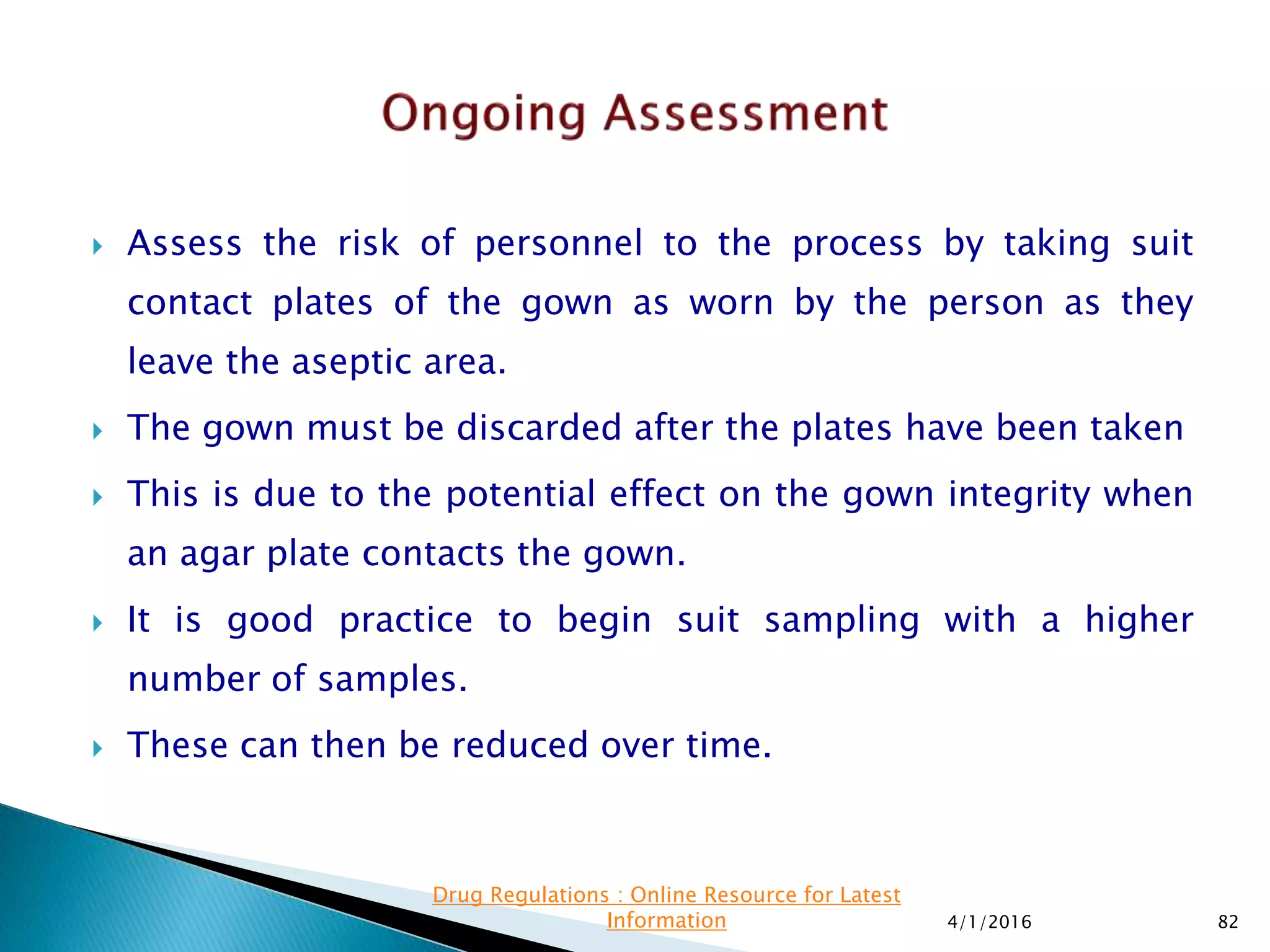
 Assess the risk of personnel to the process by taking suit
contact plates of the gown as worn by the person as they
leave the aseptic area.
 The gown must be discarded after the plates have been taken
 This is due to the potential effect on the gown integrity when
an agar plate contacts the gown.
 It is good practice to begin suit sampling with a higher
number of samples.
 These can then be reduced over time.
4/1/2016 82
Drug Regulations : Online Resource for Latest
Information
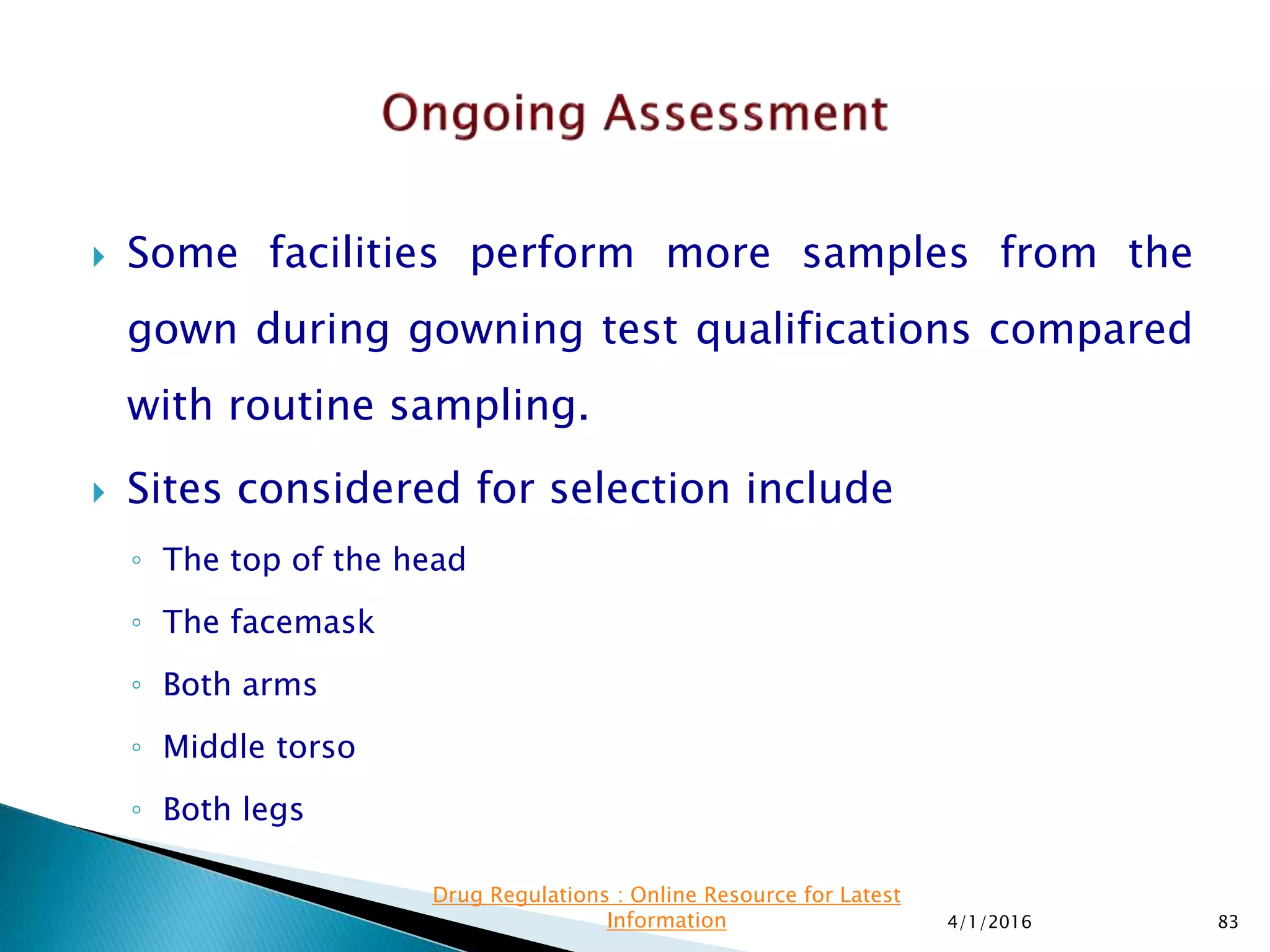
 Some facilities perform more samples from the
gown during gowning test qualifications compared
with routine sampling.
 Sites considered for selection include
◦ The top of the head
◦ The facemask
◦ Both arms
◦ Middle torso
◦ Both legs
4/1/2016 83
Drug Regulations : Online Resource for Latest
Information
 In terms of limits, for EU GMP Grade B/ISO class 7 areas, the aim is
often to adopt the same limits as per the limits applied to
fingerplates.
 The action level for gowns is ordinarily 5 CU/25cm
 Experience has shown that higher counts are obtained from the top
of the head,
 This is perhaps because this is the warmest region of the body.
 Care must be undertaken when sampling as so not to break the
integrity of the gown.
4/1/2016 84
Drug Regulations : Online Resource for Latest
Information
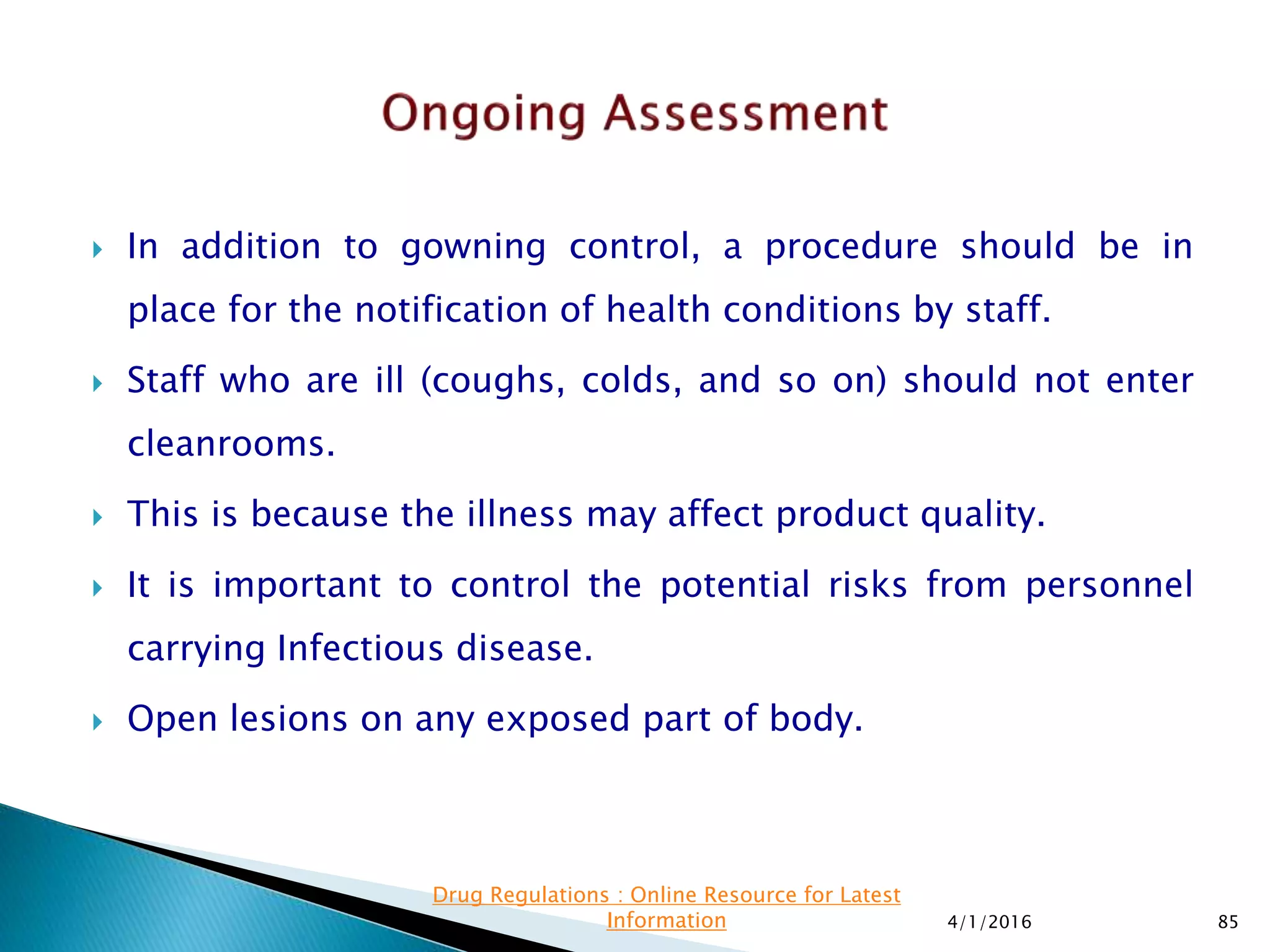
 In addition to gowning control, a procedure should be in
place for the notification of health conditions by staff.
 Staff who are ill (coughs, colds, and so on) should not enter
cleanrooms.
 This is because the illness may affect product quality.
 It is important to control the potential risks from personnel
carrying Infectious disease.
 Open lesions on any exposed part of body.
4/1/2016 85
Drug Regulations : Online Resource for Latest
Information
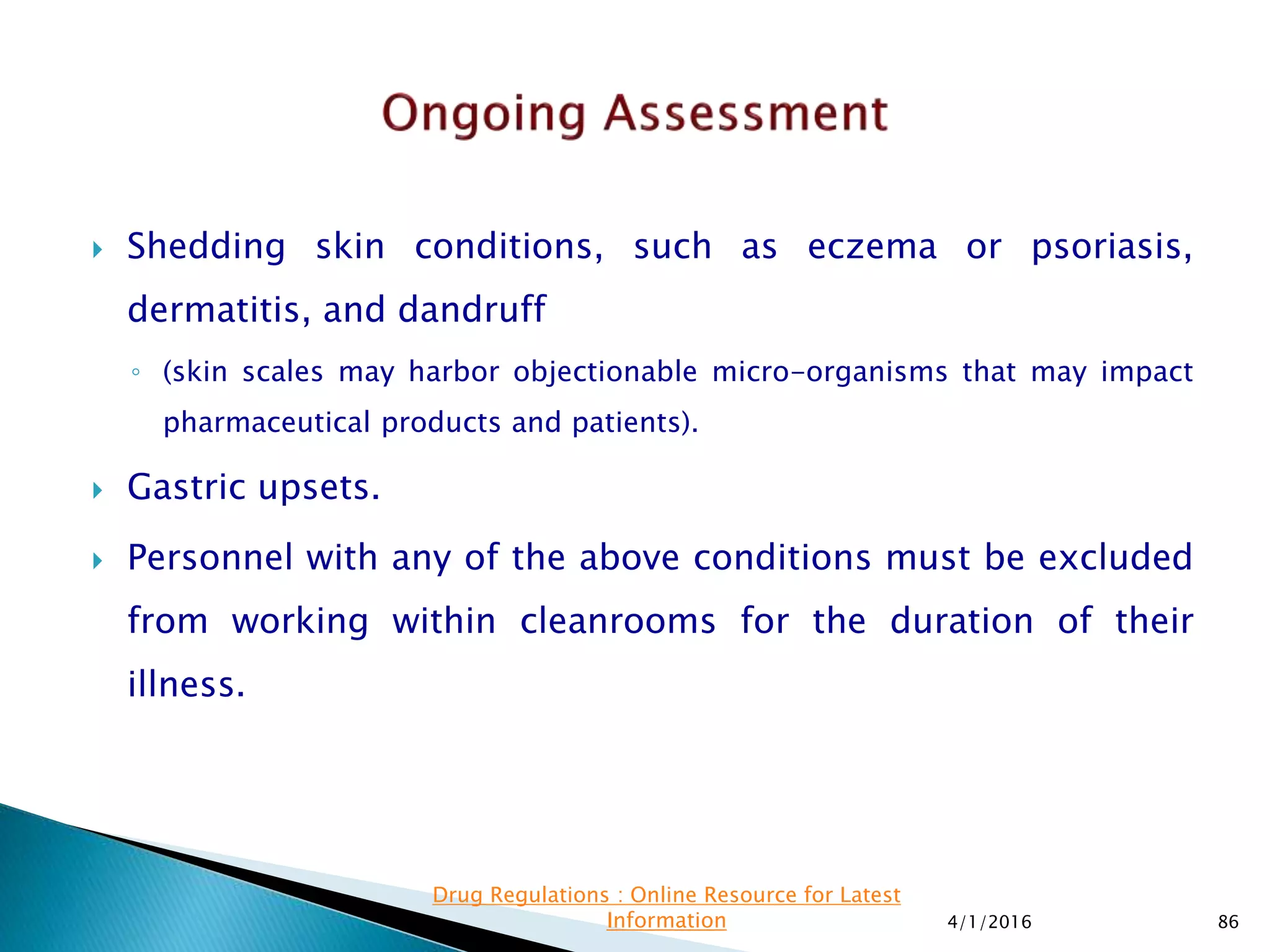
 Shedding skin conditions, such as eczema or psoriasis,
dermatitis, and dandruff
◦ (skin scales may harbor objectionable micro-organisms that may impact
pharmaceutical products and patients).
 Gastric upsets.
 Personnel with any of the above conditions must be excluded
from working within cleanrooms for the duration of their
illness.
4/1/2016 86
Drug Regulations : Online Resource for Latest
Information
 This presentation is compiled from freely available resources like
the websites of FDA, EMA ,WHO and research papers published
by experts in this field like
Sandle, T Reinmüller, B , Hyde, W,, Costello, E.K., Lauber, C. L.,
Hamady, M., Fierer, N., Gordon, J.I., Knight, R.
 Paper published by T. Sandle on clean room contamination was
referred extensively for this presentation.
 “Drug Regulations” is a non profit organization which provides
free online resource to the Pharmaceutical Professional.
 Visit http://www.drugregulations.org for latest information from
the world of Pharmaceuticals.
4/1/2016 87
Drug Regulations : Online
Resource for Latest Information

Understanding and Preventing Clean Room Contamination

  • 1.
    This presentation iscompiled by “ Drug Regulations” a non profit organization which provides free online resource to the Pharmaceutical Professional. Visit http://www.drugregulations.org for latest information from the world of Pharmaceuticals. 4/1/2016 1
  • 2.
     This presentationis compiled from freely available resources like the websites of FDA, EMA ,WHO and research papers published by experts in this field like Sandle, T Reinmüller, B , Hyde, W,, Costello, E.K., Lauber, C. L., Hamady, M., Fierer, N., Gordon, J.I., Knight, R.  Paper published by T. Sandle on clean room contamination was referred extensively for this presentation.  “Drug Regulations” is a non profit organization which provides free online resource to the Pharmaceutical Professional.  Visit http://www.drugregulations.org for latest information from the world of Pharmaceuticals. 4/1/2016 2 Drug Regulations : Online Resource for Latest Information
  • 3.
    4/1/2016 3 Drug Regulations: Online Resource for Latest Information
  • 4.
     Staff gowning Personnel behavior  How to minimize cleanroom risk  Basic training ◦ Cleanroom staff ◦ Cleanroom entry ◦ Gowning practices 4/1/2016 4 Drug Regulations : Online Resource for Latest Information
  • 5.
     Cleanroom contaminationcan arise from a number of sources.  Type of cleanroom  Its geographic location  The types of products processed 4/1/2016 5 Drug Regulations : Online Resource for Latest Information
  • 6.
     Contamination sourcescan be divided into following ◦ People ◦ Water ◦ Air and ventilation Surfaces ◦ Transport of items in and out of clean areas 4/1/2016 6 Drug Regulations : Online Resource for Latest Information
  • 7.
     Most contaminationcan be traced to humans working in cleanrooms. ◦ Conclusion based on organisms associated with isolates from environmental monitoring in controlled environments.  These microorganisms are transient or residential to the human skin. 4/1/2016 7 Drug Regulations : Online Resource for Latest Information
  • 8.
     Human personnelshed high numbers of skin cells mostly as skin flakes.  The cleanroom garments worn by personnel cannot contain all human detritus. 4/1/2016 8 Drug Regulations : Online Resource for Latest Information
  • 9.
     Trillions ofmicrobial cells across the epithelial surface and within the mouth and gut.  These microorganisms play a role in human physiology and organ function including digestion and immunity.  The microorganisms also affect the outside environment  This is due to shedding from the skin or deposited through different orifices. 4/1/2016 9 Drug Regulations : Online Resource for Latest Information
  • 10.
     This latterissue has important implications for cleanrooms.  The outer layer of human skin can host up to one million microorganisms per square centimeter.  The population, as well as the diversity, varies according to anatomical locale. 4/1/2016 10 Drug Regulations : Online Resource for Latest Information
  • 11.
     Microorganisms withinHuman Body ◦ Scalp: 1 million ◦ Saliva and nasal fluid: 10 million/gram ◦ Back: 100 ◦ Groin: 1 – 20 million ◦ Forehead: 100 – 1000 ◦ Hand: 10,000 – 100,000 ◦ Armpit: 1 – 10 million ◦ Feet: 1 million 4/1/2016 11 Drug Regulations : Online Resource for Latest Information
  • 12.
     Research suggeststhat a typical person sheds  1,000,000,000 skin cells per day of a size 33 μm x 44 μm x 4 μm  This is equivalent to a rate of 30,000 to 40,000 dead skin cells shed from the surface of the skin every minute.  Of these approximately 10% of particles carry microorganisms.  There are, on average, four microorganisms per skin cell.  A term commonly used to describe skin flakes with adhered microorganisms is “microbial carrying particles.” 4/1/2016 12 Drug Regulations : Online Resource for Latest Information
  • 13.
     People are A source of contamination,  Agents for transferring contamination possibly to locations that could pose a product risk. 4/1/2016 13 Drug Regulations : Online Resource for Latest Information
  • 14.
     Microorganisms arespread from ◦ Sneezing ◦ Coughing ◦ Touching  Microorganisms suspended in the air are less of a concern  When such organisms gravitate towards a product or critical location, they present a significant risk. 4/1/2016 14 Drug Regulations : Online Resource for Latest Information
  • 15.
    4/1/2016 15 Drug Regulations: Online Resource for Latest Information
  • 16.
     The HumanMicrobiome Project (HMP) ◦ United States National Institutes of Health initiative. ◦ The project goal is to identify and characterize the microorganisms found in association with both healthy and diseased humans (the human microbiome).  Our understanding of the risk the people pose to cleanrooms has been advanced 4/1/2016 16 Drug Regulations : Online Resource for Latest Information
  • 17.
     The humanmicrobiome describes the aggregate of microorganisms and their genetic interactions that reside ◦ On the surface and in deep layers of skin ◦ In the saliva and oral mucosa ◦ In the conjunctiva ◦ In the gastrointestinal tract 4/1/2016 17 Drug Regulations : Online Resource for Latest Information
  • 18.
     Skin isa complex ecosystem  Supports a range of microbial communities  These live in distinct niches  These niches are affected by ◦ Available nutrients ◦ Several non-nutritional factors such as pH, humidity, and temperature.  Epithelial cells are continually being shed,  Many microbial communities on the external surface are rarely stable. 4/1/2016 18 Drug Regulations : Online Resource for Latest Information
  • 19.
     Outer layerof Skin  Has High population  Considerable diversity of microbial species across  There are approximately 1000 species of bacteria from 19 phyla on human skin. 4/1/2016 19 Drug Regulations : Online Resource for Latest Information
  • 20.
     Of these,most bacteria can be categorized into following phyla: ◦ Actinobacteria (51.8%). ◦ Actinobacteria are a group of Gram-positive bacteria with high guanine and cytosine content,  Such as Micrococcus, Corynebacteria and Propionibacteria. 4/1/2016 20 Drug Regulations : Online Resource for Latest Information
  • 21.
     Of these,most bacteria can be categorized into following phyla: ◦ Firmicutes (24.4%). ◦ This includes the genera Clostridia and Bacillus. 4/1/2016 21 Drug Regulations : Online Resource for Latest Information
  • 22.
     Of these,most bacteria can be categorized into following phyla:  Proteobacteria (16.5%). ◦ This is a major phylum of bacteria ◦ Includes a wide variety of pathogens such as  Escherichia,  Salmonella,  Vibrio,  Helicobacter, and  many other notable genera. 4/1/2016 22 Drug Regulations : Online Resource for Latest Information
  • 23.
     Of these,most bacteria can be categorized into following phyla:  Bacteroidetes (6.3%).  The phylum Bacteroidetes is composed of three large classes of ◦ Gram-negative ◦ Nonspore-forming ◦ Anaerobic ◦ Rod-shaped bacteria 4/1/2016 23 Drug Regulations : Online Resource for Latest Information
  • 24.
     Reasons forthe topographical variations relate to the physicochemical properties of the skin.  This is especially so for ◦ Temperature ◦ pH ◦ Amounts of oil ◦ Moisture 4/1/2016 24 Drug Regulations : Online Resource for Latest Information
  • 25.
     From this,there are three main ecological areas of the skin: ◦ Sebaceous ◦ Moist ◦ Dry 4/1/2016 25 Drug Regulations : Online Resource for Latest Information
  • 26.
     Examples ofmicrobial divergence include ◦ Propionibacteria and Staphylococci species dominating the Dry, calloused areas (arms and legs) ◦ Gram-positive cocci (primarily the Micrococcaceae) are found on the arms and legs ◦ Gram-positive rods are found in high numbers on the torso. ◦ Staphylococci and Corynebacteria are found together with some Gram-negative bacteria in moist areas.  These types of microorganisms generally reflect the types recovered from cleanrooms 4/1/2016 26 Drug Regulations : Online Resource for Latest Information
  • 27.
     Gram-positive bacteriapredominate across the skin as ◦ The skin is generally a dry environment ◦ Any fluids present on the surface generally have a high osmotic pressure  Thus Gram-positive bacteria are better adapted for such environments, not least to being resistant to desiccation. ◦ (especially the Staphylococci and Micrococci) 4/1/2016 27 Drug Regulations : Online Resource for Latest Information
  • 28.
     Where otherspecies occur this is due to ◦ Variations in temperature and ◦ With areas of higher sweat production  For example, this can lead to higher levels of fungi on the feet  In relation to pharmaceutical manufacturing, the presence of any such organisms remains problematic. 4/1/2016 28 Drug Regulations : Online Resource for Latest Information
  • 29.
     The ratioof the microorganisms recovered from the skin is relatively evenly divided between the aerobic and the anaerobic.  The aerobic microorganisms tend to live on the outermost layers of the skin  The anaerobic microorganisms live in the deeper layers of the skin and hair follicles 4/1/2016 29 Drug Regulations : Online Resource for Latest Information
  • 30.
     The informationfrom HMP introduces several implications for cleanroom environmental monitoring. ◦ Whether gowning practices are adequate to exclude all microorganisms from the richest areas of the skin microbiome.  Most bacteria free-floating in cleanroom air current are not free-living  They are instead the result of ◦ Direct particle shedding of desquamated skin cells and ◦ Subsequent re-suspension of skin detritus in the air stream. 4/1/2016 30 Drug Regulations : Online Resource for Latest Information
  • 31.
     The answerto earlier question should lead to a consideration of: ◦ The types of cleanroom undergarments used ◦ An examination as to whether these provide an effective barrier, especially for the more moist parts of the body. ◦ The importance of the outer gown covering all parts of the body, including the forehead. ◦ The quality of cleanroom certified undergarments. 4/1/2016 31 Drug Regulations : Online Resource for Latest Information
  • 32.
     The answerto earlier question should lead to a consideration of: ◦ The level of training required for operators in relation to gowning and the way that gowning qualification was conducted. ◦ How long a cleanroom suit should be worn for in relation to material integrity against operator perspiration. ◦ The environment in which gowns are donned, where higher air-change rates might prove effective. 4/1/2016 32 Drug Regulations : Online Resource for Latest Information
  • 33.
     The answerto earlier question should lead to a consideration of: ◦ How often gowns should be recycled which involves washing and irradiation. ◦ What types of testing is conducted on recycled gowns ◦ What the procedures are for rejecting gowns where a loss of integrity is detected. 4/1/2016 33 Drug Regulations : Online Resource for Latest Information
  • 34.
     Cleanroom microbiologistsmay wish to consider how concerned they are with each of the items listed in excluding microorganisms found on all regions of the skin.  There must be good understanding of the environmental monitoring methods used to assess cleanrooms.  These may not show how good or bad gown changing and gown wearing is.  These concerns are best addressed through good gowning practices 4/1/2016 34 Drug Regulations : Online Resource for Latest Information
  • 35.
    4/1/2016 35 Drug Regulations: Online Resource for Latest Information
  • 36.
     Despite someadvances with automation and robotics, in most situations people cannot be eliminated from cleanrooms.  Control of contamination from people in cleanrooms is achieved by application of two principles: ◦ We “wrap” the people to minimize the amount of “shedding” of microorganisms. ◦ We put localized protection around the product to minimize the amount of contact with the people. 4/1/2016 36 Drug Regulations : Online Resource for Latest Information
  • 37.
     The localizedprotection is achieved through local air protection, such as ◦ Unidirectional airflow cabinets and ◦ Isolators.  With clothing, personnel working in cleanrooms are required to wear special clothing designed for the clean environments.  Such clothing is necessary because the human body creates its own microenvironment of potentially damaging particulate contamination. 4/1/2016 37 Drug Regulations : Online Resource for Latest Information
  • 38.
     To beeffective, cleanroom clothing must: ◦ Form a particulate barrier for the human micro- environment. ◦ Allow freedom of movement and be comfortable. ◦ Address any specialist requirement,  e.g. static dissipation.  Avoid being a significant particulate contributor in itself. ◦ Cleanroom garments must meet specific protection criteria. 4/1/2016 38 Drug Regulations : Online Resource for Latest Information
  • 39.
     Not allcleanroom garments are of the same quality.  This involves manufacturing the garments from special materials, following particular construction methods, and then tailored for individual styling.  The gowns must be comfortable, easy to apply and practical in use.  Some gowns are disposable and others are made to be re- laundered and sterilized depending on the cleanroom grade. 4/1/2016 39 Drug Regulations : Online Resource for Latest Information
  • 40.
    4/1/2016 40 Drug Regulations: Online Resource for Latest Information
  • 41.
     Fabrics usedin the manufacture of cleanroom garments must have the following features: ◦ Be low in particulate shedding. ◦ Permit the body to breathe while trapping particles within the garment. ◦ The contaminant should be retained within the garment and not released into the surrounding atmosphere. ◦ Be flexible enough for comfortable wearing. ◦ Withstand repeated cleaning and sterilization cycles. ◦ Meet any specific requirements such as control of static. ◦ Meet opacity requirements. ◦ Look and feel as good as possible. Be cost-effective. 4/1/2016 41 Drug Regulations : Online Resource for Latest Information
  • 42.
     There arethree broad categories of fabric used in the construction of cleanroom garments: 4/1/2016 42 Drug Regulations : Online Resource for Latest Information
  • 43.
     Woven fabrics. ◦Woven or re-usable fabrics are the most commonly used fabrics in cleanroom environments. ◦ Such garments are woven on sophisticated looms from yarns of continuous filaments of polyester. ◦ The thickness of the yarn and filaments is important –  the finer the yarn, the tighter the weave can be made, and the better the filtration. ◦ The pattern and tightness of the weave is important to reduce the pore size to a minimum. ◦ The use of continuous filament polyester means that there are few loose ends from which particles may be shed. 4/1/2016 43 Drug Regulations : Online Resource for Latest Information
  • 44.
     Laminated ormembrane fabrics. ◦ Laminated fabrics are favored for some high- grade microelectronic environments. ◦ These types of garments are not commonly used in the pharmaceutical sector. 4/1/2016 44 Drug Regulations : Online Resource for Latest Information
  • 45.
     Disposable orlimited life materials. ◦ The most common of these non-woven fabrics are from spun bonded olefin and polypropylene. ◦ Comprising a densely interlinked matt of fibers, these fabrics can provide good results for a limited period. ◦ Garments from such materials need to be processed and decontaminated before use in the cleanroom. ◦ Disposable or limited use garments are mainly used in those environments where protection of the wearer against potentially hazardous products is required. 4/1/2016 45 Drug Regulations : Online Resource for Latest Information
  • 46.
    4/1/2016 46 Drug Regulations: Online Resource for Latest Information
  • 47.
     Garments aredesigned to provide protection for the head, body, hands and feet.  In establishing a system for garment selection, it is important to consider the broader aspects of cleanroom use: ◦ Suitability of fabric, ◦ Garment style, ◦ Layers, ◦ The nature of the tasks involved, ◦ Costs, ◦ Regulatory requirements, and ◦ Any specific customer requirements. 4/1/2016 47 Drug Regulations : Online Resource for Latest Information
  • 48.
     The classificationof the cleanroom will inevitably be the major factor in determining the degree of personnel protection required and the fundamental choice of garments.  One important issue with gowns is the maximum length of time that a gown can be worn.  As people perspire, the integrity of the gown will weaken. 4/1/2016 48 Drug Regulations : Online Resource for Latest Information
  • 49.
     Complicating factorsare the temperature and humidity of the cleanroom and the variations between people.  The length of time will also depend upon the grade of the cleanroom.  In aseptic areas, such as ISO 14644 class 7 / EU GMP Grade B areas, gowns are typically worn only for the length of the shift ◦ (normally four hour periods to enable operators to take breaks). 4/1/2016 49 Drug Regulations : Online Resource for Latest Information
  • 50.
     In lowergrade cleanrooms, a gown might be worn for several sessions during the course of the working day.  Other factors affecting the lifespan of the gowns that are subject to recycling are repairs and the number of permitted washing cycles.  With repairs, it is prudent to have a repair policy. 4/1/2016 50 Drug Regulations : Online Resource for Latest Information
  • 51.
     This willvary across facilities, and again, it will be affected by the cleanroom class.  With aseptic areas, if a gown becomes torn it is normally discarded.  In other grades of cleanroom, a gown can be repaired depending upon the size of the hole and the impact on the material.  Some organizations set a maximum size for any hole or tear and for the number of times a gown can be repaired.  Gowns that are recycled are subject to laundering. 4/1/2016 51 Drug Regulations : Online Resource for Latest Information
  • 52.
     Gowns arewashed by special washing machines with suitable detergents,  They are then dried, folded, and then wrapped in cleanroom packaging.  For gowns that are to be used in aseptic areas, such gowns are irradiated.  A policy should be in place outlining how often a gown can be processed -- typical times range between 20 and 40 times.  To make the tracking task easier, many gowns sterilized by irradiation or gassing are fitted with barcodes and scanned.  It is further important to establish the extent that the sterilization process affects the integrity of the gown material. 4/1/2016 52 Drug Regulations : Online Resource for Latest Information
  • 53.
     In orderto assess the contamination risks from re- laundering, gowns are subject to particle counting.  There are different ways to do this  Most common means is the Helmke Drum particle emission test.  With this, the test method simulates particle shedding of clothing under movement. 4/1/2016 53 Drug Regulations : Online Resource for Latest Information
  • 54.
     The garmentunder test is tumbled in a rotating drum (approximately 10 revolutions per minute)  This releases particles from the surface of the cleanroom garment in a controlled manner.  An automatic particle counter is used to sample the air within the drum  Determination of the average particle concentration of the air during the initial ten minutes of the test is performed. 4/1/2016 54 Drug Regulations : Online Resource for Latest Information
  • 55.
     The commonstandard is the IEST "Recommended Practice RP-CC003.3: Garment System Considerations for Cleanrooms and Other Controlled Environments".  An alternative measure is the Body Box test.  This method simulates particle filtration and release under real wear conditions.  As a consequence it measures the contamination of the cleanroom by the clothing/wearer.  For this, particle counters determine the quantity of particles generated by the wearer/garment that are emitted into the chamber. 4/1/2016 55 Drug Regulations : Online Resource for Latest Information
  • 56.
    4/1/2016 56 Drug Regulations: Online Resource for Latest Information
  • 57.
     Cosmetics, suchas powder, rouge, eye liner, mascara, and lipstick must be banned in cleanroom environments.  Jewelry, such as rings, watches, necklaces, bracelets, earrings and other items, together with all forms of visible piercing, are commonly not allowed in cleanrooms.  The best method of changing into cleanroom garments is one that minimizes contamination getting onto the outside of the garments.  Change areas can vary in design, but it is common to find them divided into three zones: 4/1/2016 57 Drug Regulations : Online Resource for Latest Information
  • 58.
     Pre-change zone. Outside of changing rooms 'tacky mats' or polymeric flooring can be positioned to help reduce the level of particles carried on footwear. 4/1/2016 58 Drug Regulations : Online Resource for Latest Information
  • 59.
     Changing zone. The changing room design contributes to the assurance of appropriate personnel access and microbial contamination control.  The changing room should be provided with filtered air.  Intermediate (bag) filters will typically be suitable for this purpose, though High Efficiency Particulate Air (HEPA) filtration may be used.  The air pressure should be negative with regards to the manufacturing area corridor, but positive relative to external adjacent areas. 4/1/2016 59 Drug Regulations : Online Resource for Latest Information
  • 60.
     Cleanroom entrancezone.  This must be of the same grade or class as the main cleanroom into which the area leads.  Ideally there should be separate routes through airlocks for material required in cleanrooms.  Taking items through personnel change areas should be discouraged. 4/1/2016 60 Drug Regulations : Online Resource for Latest Information
  • 61.
    4/1/2016 61 Drug Regulations: Online Resource for Latest Information
  • 62.
     Personnel trainingin gowning is an important function.  Gowning practices must be assessed periodically and monitored frequently.  Training programs should ideally include visual assessment and microbiological assessment.  The microbiological assessment varies, but can include ◦ The exposure of settle plates during the change process and ◦ The assessment of gown cleanliness through post-use suit contact plates.  The results of the cleanroom sampling should not exceed those of the room class.  If results are exceeded, the individual may be an unusually high shedder of skin particles. 4/1/2016 62 Drug Regulations : Online Resource for Latest Information
  • 63.
     Training requiredfor staff who work in cleanrooms should include: ◦ Introduction to micro-organisms and microbiological contamination control. ◦ Entry and exit of production facilities (including gowning) ◦ Personal hygiene training ◦ Microbiological risks associated with specific production tasks. ◦ Training must be documented and regularly reviewed. Training must be effective. ◦ Actual performance of personnel competency in gowning should be demonstrated on a regular basis. 4/1/2016 63 Drug Regulations : Online Resource for Latest Information
  • 64.
    4/1/2016 64 Drug Regulations: Online Resource for Latest Information
  • 65.
     Working inclean environments demands  Knowledge,  Discipline,  Motivation as well as  A thorough understanding of contamination risks among all personnel involved.  Each individual cleanroom should have its own documented rules and procedures. 4/1/2016 65 Drug Regulations : Online Resource for Latest Information
  • 66.
     Training includesreminding personnel that they must not be allowed to touch critical products and equipment with their naked hands.  All critical work must be undertaken wearing gloves.  Critical activities requiring personnel contact such as aseptic processing or sampling must be done through the use of clean utensils such as tweezers, forceps, and the equivalent.  All devices and gloves used must fully comply with the cleanliness demands of the cleanroom and work undertaken in the cleanroom.  They must be cleaned, disinfected, or sterilized as appropriate for the criticality or activity and risk of contamination. 4/1/2016 66 Drug Regulations : Online Resource for Latest Information
  • 67.
     Another aspectof best practice is in instructing personnel in the appropriate behaviors within the cleanroom.  The generation of contamination is proportional to activity conducted.  A person with head, arms, and body moving can generate about 1,000,000 particles ≥ 0.5 μm/min.  A person who is walking can generate about 5,000,000 particles ≥ 0.5 μm/min. 4/1/2016 67 Drug Regulations : Online Resource for Latest Information
  • 68.
     However aperson in motionless position can generate only 100,000 particles ≥ 0.5 μm/min.  In addition, personnel should reduce activities like talking, singing, whistling, coughing, sneezing etc., especially when being close to the handled products and production equipment. 4/1/2016 68 Drug Regulations : Online Resource for Latest Information
  • 69.
     People workingin cleanrooms and other forms of controlled environments must be physically healthy.  Diseases in the upper respiratory tract as well as stomach disorders can create problem in hygienic applications.  Another factor that can impact upon the environment is the number of people in the cleanroom.  Only necessary and limited number of persons should be allowed in a cleanroom at the same time.  The more persons simultaneously present in a cleanroom, then the higher the contamination level will be, ◦ i.e., the higher concentration of particles in the air  This is particularly important in relation to changing rooms. 4/1/2016 69 Drug Regulations : Online Resource for Latest Information
  • 70.
    4/1/2016 70 Drug Regulations: Online Resource for Latest Information
  • 71.
     Good personalhygiene is a requirement of all pharmaceutical cleanroom activities.  However, studies show poor compliance is common in relation to basic hand washing technique.  Hand hygiene and glove hygiene are important given the high numbers of microorganisms found on the human body  They also pose risk of contamination by transfer 4/1/2016 71 Drug Regulations : Online Resource for Latest Information
  • 72.
     Microorganisms associatedwith hands are found mainly on the surface of the skin and under the superficial cells of the stratum corneum.  The dominant species is Staphylococcus epidermidis  This is found on almost every hand, together with other species of Staphylococcus and species of the genera Micrococcus.  Hands must be washed with soap and water prior to entry to the cleanroom. 4/1/2016 72 Drug Regulations : Online Resource for Latest Information
  • 73.
     Hand washingfacilities should not be located in an actual cleanroom, but rather in an area leading to the cleanroom changing room.  As an alternative, a hygienic handrub can be used.  Where gloves are required these should be put on using a method designed to prevent the ungloved hand from touching the clean or sterile outer part of the glove. 4/1/2016 73 Drug Regulations : Online Resource for Latest Information
  • 74.
     Once inthe cleanroom, gloved hands should be subject to periodic hand sanitization  When decontaminating hands with an alcohol- based antiseptic hand rub, ◦ Apply product to palm of one hand and rub hands together, ◦ Covering all surfaces of hands, fingers and wrists, ◦ Until hands are dry  (alcohol-based hand rubs are not to be used with water). 4/1/2016 74 Drug Regulations : Online Resource for Latest Information
  • 75.
     The processtypically takes between thirty seconds and one minute.  Follow the manufacturer’s recommendations regarding the volume of product to use.  The technique for applying alcohol to gloved hands is similar to applying a handrub to skin.  It is important to ensure that all surfaces are covered. 4/1/2016 75 Drug Regulations : Online Resource for Latest Information
  • 76.
     With glovesanitization, there are two alcohols of choice:  Ethyl alcohol (ethanol) and isopropyl alcohol (IPA)  Other alcohols, such as methyl alcohol (methanol) are unsuitable. 4/1/2016 76 Drug Regulations : Online Resource for Latest Information
  • 77.
     IPA isslightly more bactericidal than ethanol  Ethanol has better viricidal properties  Another factor is application to the skin;  IPA can be quite harsh.  Thus, ethanol is more often applied to bare skin (often in a denatured form)  Whereas IPA is more often applied to gloves. 4/1/2016 77 Drug Regulations : Online Resource for Latest Information
  • 78.
     These sanitizershave bactericidal action against vegetative cells but not spores.  The concentration of alcohol to water varies, although the optimal range is 60 to 90% (volume/volume).  Below 60%, bactericidal action drops,  Above 90% there is insufficient water for the bacterial cell to absorb water.  The alcohol does not enter the cell and is unable to denature the bacterial proteins.  Most preparatory concentrations are 70%. 4/1/2016 78 Drug Regulations : Online Resource for Latest Information
  • 79.
     While mostbacteria are killed after ten seconds of contact with alcohol contact times in practice are longer due to the variability of hand rubbing.  Typical contact times are thirty seconds.  It is important that the selection of a hand sanitizer is qualified. 4/1/2016 79 Drug Regulations : Online Resource for Latest Information
  • 80.
     There aredifferent approaches that can be taken for qualification.  Most of these require ◦ Individuals to wear gloves ◦ Place their hands into broth containing a high concentration of a non-pathogenic microorganism. ◦ Disinfectant is then applied ◦ Bacterial reduction is assessed through placing the treated hands into broth and performing dilutions 4/1/2016 80 Drug Regulations : Online Resource for Latest Information
  • 81.
    4/1/2016 81 Drug Regulations: Online Resource for Latest Information
  • 82.
     Assess therisk of personnel to the process by taking suit contact plates of the gown as worn by the person as they leave the aseptic area.  The gown must be discarded after the plates have been taken  This is due to the potential effect on the gown integrity when an agar plate contacts the gown.  It is good practice to begin suit sampling with a higher number of samples.  These can then be reduced over time. 4/1/2016 82 Drug Regulations : Online Resource for Latest Information
  • 83.
     Some facilitiesperform more samples from the gown during gowning test qualifications compared with routine sampling.  Sites considered for selection include ◦ The top of the head ◦ The facemask ◦ Both arms ◦ Middle torso ◦ Both legs 4/1/2016 83 Drug Regulations : Online Resource for Latest Information
  • 84.
     In termsof limits, for EU GMP Grade B/ISO class 7 areas, the aim is often to adopt the same limits as per the limits applied to fingerplates.  The action level for gowns is ordinarily 5 CU/25cm  Experience has shown that higher counts are obtained from the top of the head,  This is perhaps because this is the warmest region of the body.  Care must be undertaken when sampling as so not to break the integrity of the gown. 4/1/2016 84 Drug Regulations : Online Resource for Latest Information
  • 85.
     In additionto gowning control, a procedure should be in place for the notification of health conditions by staff.  Staff who are ill (coughs, colds, and so on) should not enter cleanrooms.  This is because the illness may affect product quality.  It is important to control the potential risks from personnel carrying Infectious disease.  Open lesions on any exposed part of body. 4/1/2016 85 Drug Regulations : Online Resource for Latest Information
  • 86.
     Shedding skinconditions, such as eczema or psoriasis, dermatitis, and dandruff ◦ (skin scales may harbor objectionable micro-organisms that may impact pharmaceutical products and patients).  Gastric upsets.  Personnel with any of the above conditions must be excluded from working within cleanrooms for the duration of their illness. 4/1/2016 86 Drug Regulations : Online Resource for Latest Information
  • 87.
     This presentationis compiled from freely available resources like the websites of FDA, EMA ,WHO and research papers published by experts in this field like Sandle, T Reinmüller, B , Hyde, W,, Costello, E.K., Lauber, C. L., Hamady, M., Fierer, N., Gordon, J.I., Knight, R.  Paper published by T. Sandle on clean room contamination was referred extensively for this presentation.  “Drug Regulations” is a non profit organization which provides free online resource to the Pharmaceutical Professional.  Visit http://www.drugregulations.org for latest information from the world of Pharmaceuticals. 4/1/2016 87 Drug Regulations : Online Resource for Latest Information