Student name:
Ms. Bhalekar Pournima Ashok
( Pharmaceutical chemistry,
Roll no- CH101)
Guide name:
Mrs. M. Harde
(Ass. Prof. Pharmaceutical Analysis)
IPQC: Definition
 IPQC Concerned with providing accurate specific and
definite description of procedure to be employed from the
receipt of raw material to the release of the finished
product.
 Checks performed during production in order to monitor
and, if necessary, to adjust the process to ensure that the
product conforms to its specifications. The control of the
environment or equipment may also be regarded as a part of
in process control.

In-process controls are usually performed within the production
area. The performance of such in-process controls should not
have any negative effect on the quality of the product or another
product.
Introduction:-
 IPQC is concerned with providing accurate, specific, and
definite description of procedures to be employed from the
receipt of raw materials to the release of finished dosage forms.
 It is a planned system to identify the materials, equipment,
process, and operations.
 In general the in process control procedures are usually rapid
and simple tests or inspections that are performed when the
manufacturing of a product batch is in progress.
Objective
1. To minimize the human errors.
2. Provides accurate, specific, and definite description of the
procedure to be employed.
3. To detect the errors if and when it does occur.
4. Corrective action instituted by people.
5. To pin point the responsibility to the personnel involved in
the operation of the entire process.
6. To enforce the flow of manufacturing and packing
operations according to established routes and practice.
7. Rigidly followed.
8. Should detect any abnormality immediately and at the same
time indicate the kind of action needed to correct the
problem.
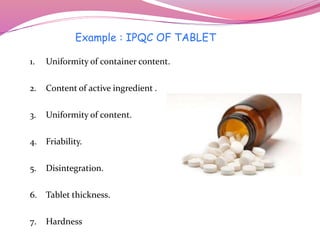
Example : IPQC OF TABLET
1. Uniformity of container content.
2. Content of active ingredient .
3. Uniformity of content.
4. Friability.
5. Disintegration.
6. Tablet thickness.
7. Hardness
Tablet hardness testing, is a laboratory technique used by the
pharmaceutical industry to test the breaking point and structural
integrity of a tablet "under conditions of storage, transportation,
and handling before usage. The breaking point of a tablet is based
on its shape. It is similar to friability testing, but they are not the
same thing.
Hardness testing
Friability:
 It is the tendency of tablets to powder, chip, or fragment and
this can affect the Elegance appearance , consumer acceptance of
tablet, and also add to tablets weight variation or content
uniformity problems.
 It is property that is related to the
hardness of the tablet.
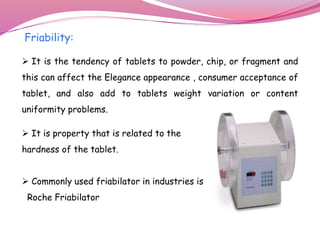
 Commonly used friabilator in industries is
Roche Friabilator
Ipqc

Ipqc

  • 1.
    Student name: Ms. BhalekarPournima Ashok ( Pharmaceutical chemistry, Roll no- CH101) Guide name: Mrs. M. Harde (Ass. Prof. Pharmaceutical Analysis)
  • 3.
    IPQC: Definition  IPQCConcerned with providing accurate specific and definite description of procedure to be employed from the receipt of raw material to the release of the finished product.  Checks performed during production in order to monitor and, if necessary, to adjust the process to ensure that the product conforms to its specifications. The control of the environment or equipment may also be regarded as a part of in process control. 
  • 4.
    In-process controls areusually performed within the production area. The performance of such in-process controls should not have any negative effect on the quality of the product or another product.
  • 5.
    Introduction:-  IPQC isconcerned with providing accurate, specific, and definite description of procedures to be employed from the receipt of raw materials to the release of finished dosage forms.  It is a planned system to identify the materials, equipment, process, and operations.  In general the in process control procedures are usually rapid and simple tests or inspections that are performed when the manufacturing of a product batch is in progress.
  • 6.
    Objective 1. To minimizethe human errors. 2. Provides accurate, specific, and definite description of the procedure to be employed. 3. To detect the errors if and when it does occur. 4. Corrective action instituted by people. 5. To pin point the responsibility to the personnel involved in the operation of the entire process. 6. To enforce the flow of manufacturing and packing operations according to established routes and practice. 7. Rigidly followed. 8. Should detect any abnormality immediately and at the same time indicate the kind of action needed to correct the problem.
  • 7.
    Example : IPQCOF TABLET 1. Uniformity of container content. 2. Content of active ingredient . 3. Uniformity of content. 4. Friability. 5. Disintegration. 6. Tablet thickness. 7. Hardness
  • 9.
    Tablet hardness testing,is a laboratory technique used by the pharmaceutical industry to test the breaking point and structural integrity of a tablet "under conditions of storage, transportation, and handling before usage. The breaking point of a tablet is based on its shape. It is similar to friability testing, but they are not the same thing. Hardness testing
  • 10.
    Friability:  It isthe tendency of tablets to powder, chip, or fragment and this can affect the Elegance appearance , consumer acceptance of tablet, and also add to tablets weight variation or content uniformity problems.  It is property that is related to the hardness of the tablet.  Commonly used friabilator in industries is Roche Friabilator