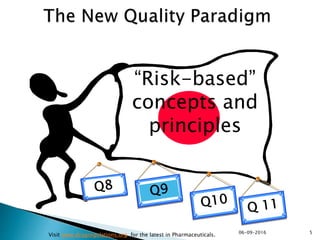
The document outlines the principles and guidelines for an effective pharmaceutical quality system based on ICH Q10, emphasizing the integration of quality risk management throughout the product lifecycle. It highlights the importance of management commitment, communication, and continual improvement in achieving quality objectives within the pharmaceutical sector. The content also describes the necessary systems for monitoring process performance and product quality, as well as the management of changes and outsourced activities.
This presentation iscompiled by “ Drug Regulations”
a non profit organization which provides free online
resource to the Pharmaceutical Professional.
Visit http://www.drugregulations.org for latest
information from the world of Pharmaceuticals.
2.
This presentation iscompiled from freely available
resource like the website of ICH specifically
ICH Q-10 Guidelines
“Drug Regulations” is a non profit organization
which provides free online resource to the
Pharmaceutical Professional.
Visit Our Website GMP Training
for latest information from the world of
Pharmaceuticals.
06-09-2016 2
Visit Our WEBSITE GMP Training
http://fdagmp.blogspot.in/
3.
Quality
◦ Thesuitability of either a drug substance or a drug
product for its intended use. This term includes
such attributes as the identity, strength, and purity
(ICH Q6A)
306-09-2016
Visit www.drugregulations.org for the latest in Pharmaceuticals.
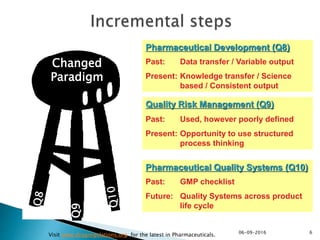
Pharmaceutical Development (Q8)
Past:Data transfer / Variable output
Present: Knowledge transfer / Science
based / Consistent output
Pharmaceutical Quality Systems (Q10)
Past: GMP checklist
Future: Quality Systems across product
life cycle
Quality Risk Management (Q9)
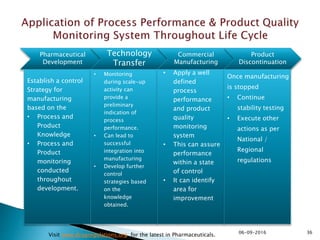
Past: Used, however poorly defined
Present: Opportunity to use structured
process thinking
Changed
ParadigmQ9
606-09-2016
Visit www.drugregulations.org for the latest in Pharmaceuticals.
7.
Science is nolonger isolated; it is living
across the lifecycle of the product/process
within a Quality Management System
706-09-2016
Visit www.drugregulations.org for the latest in Pharmaceuticals.
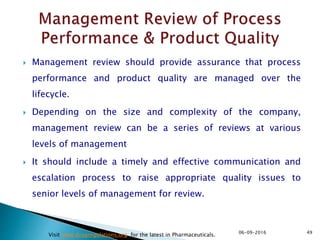
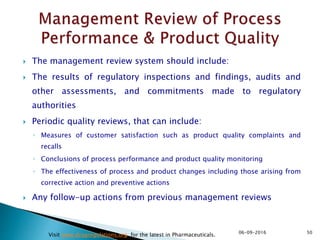
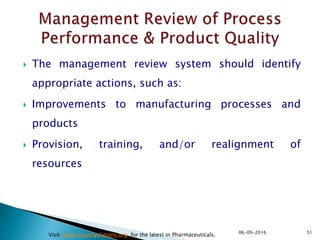
8.
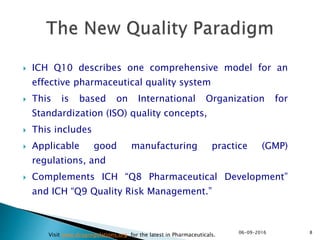
ICH Q10describes one comprehensive model for an
effective pharmaceutical quality system
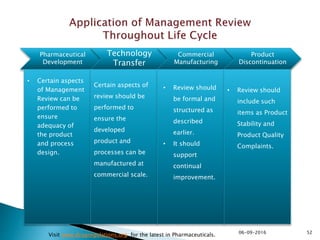
This is based on International Organization for
Standardization (ISO) quality concepts,
This includes
Applicable good manufacturing practice (GMP)
regulations, and
Complements ICH “Q8 Pharmaceutical Development”
and ICH “Q9 Quality Risk Management.”
806-09-2016
Visit www.drugregulations.org for the latest in Pharmaceuticals.
9.
ICH Q10is a model for a pharmaceutical quality system that
can be implemented throughout the different stages of a
product lifecycle.
Much of the content of ICH Q10 applicable to manufacturing
sites is currently specified by regional GMP requirements.
ICH Q10 is not intended to create any new expectations
beyond current regulatory requirements.
Consequently, the content of ICH Q10 that is additional to
current regional GMP requirements is optional.
906-09-2016
Visit www.drugregulations.org for the latest in Pharmaceuticals.
10.
1006-09-2016
Visit www.drugregulations.org forthe latest in Pharmaceuticals.
Pharmaceutical
Development
Technology
Transfer
Commercial
Manufacturing
Product
Discontinuation
• DS
Development
• Formulation
development
• MFG. of I P
• Delivery system
development
• M P DEV &
scale-up
• Analytical
method
development
• New product
transfers
during
development
through
manufacturing
• Transfers
within or
between
manufacturing
and testing
sites for
marketed
products
• Acquisition
and control
of materials
• Provision of
facilities,
utilities, and
equipment
• Production
• QC & QA
• Release
• Storage
• Distribution
• Retention of
documentation
• Sample
retention
• Continued
product
assessment
and reporting
11.
11
Pharmaceutical
Development
Technology
Transfer
Commercial
Manufacturing
Product
Discontinuation
• DS
Development
• Formulation
development
•MFG. of I P
• Delivery system
development
• M P DEV &
scale-up
• Analytical
method
development
• New product
transfers
during
development
through
manufacturing
• Transfers
within or
between
manufacturing
and testing
sites for
marketed
products
• Acquisition
and control
of materials
• Provision of
facilities,
utilities, and
equipment
• Production
• QC & QA
• Release
• Storage
• Distribution
• Retention of
documentation
• Sample
retention
• Continued
product
assessment
and reporting
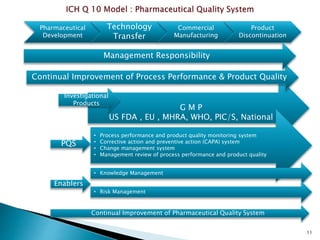
G M P
US FDA , EU , MHRA, WHO, PIC/S, National
Investigational
Products
• Process performance and product quality monitoring system
• Corrective action and preventive action (CAPA) system
• Change management system
• Management review of process performance and product quality
PQS
Enablers
• Knowledge Management
• Risk Management
Continual Improvement of Process Performance & Product Quality
Continual Improvement of Pharmaceutical Quality System
Management Responsibility
12.
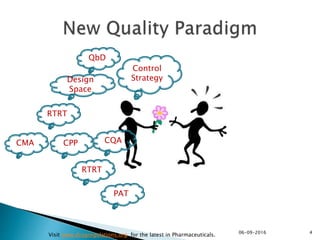
The new paradigmemphasize:
1. Quality must be mainly built in and it will not improve by
additional testing and inspection
2. Better utilization of modern science throughout product
lifecycle
3. QRM is a key enabler throughout product lifecycle
4. Robust PQS, with appropriate knowledge management,
assures quality throughout product life cycle
5. An integrated approach to development, manufacturing and
quality for both industry and regulators
1206-09-2016
Visit www.drugregulations.org for the latest in Pharmaceuticals.
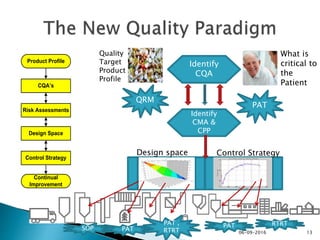
13.
CQA’s
Product Profile
Risk Assessments
DesignSpace
Control Strategy
Continual
Improvement
13
Identify
CQA
Identify
CMA &
CPP
Quality
Target
Product
Profile
What is
critical to
the
Patient
QRM
PAT
Design space Control Strategy
SOP PAT
PAT ,
RTRT
PAT RTRT
06-09-2016
14.
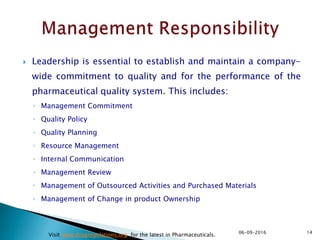
Leadership isessential to establish and maintain a company-
wide commitment to quality and for the performance of the
pharmaceutical quality system. This includes:
◦ Management Commitment
◦ Quality Policy
◦ Quality Planning
◦ Resource Management
◦ Internal Communication
◦ Management Review
◦ Management of Outsourced Activities and Purchased Materials
◦ Management of Change in product Ownership
1406-09-2016
Visit www.drugregulations.org for the latest in Pharmaceuticals.
15.
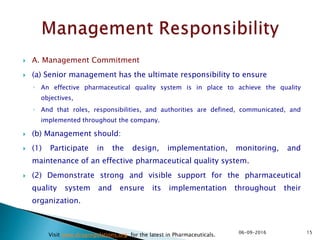
A. ManagementCommitment
(a) Senior management has the ultimate responsibility to ensure
◦ An effective pharmaceutical quality system is in place to achieve the quality
objectives,
◦ And that roles, responsibilities, and authorities are defined, communicated, and
implemented throughout the company.
(b) Management should:
(1) Participate in the design, implementation, monitoring, and
maintenance of an effective pharmaceutical quality system.
(2) Demonstrate strong and visible support for the pharmaceutical
quality system and ensure its implementation throughout their
organization.
1506-09-2016
Visit www.drugregulations.org for the latest in Pharmaceuticals.
16.
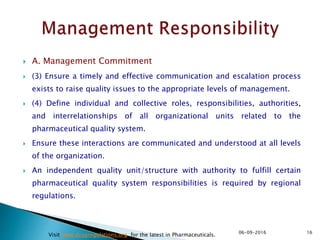
A. ManagementCommitment
(3) Ensure a timely and effective communication and escalation process
exists to raise quality issues to the appropriate levels of management.
(4) Define individual and collective roles, responsibilities, authorities,
and interrelationships of all organizational units related to the
pharmaceutical quality system.
Ensure these interactions are communicated and understood at all levels
of the organization.
An independent quality unit/structure with authority to fulfill certain
pharmaceutical quality system responsibilities is required by regional
regulations.
1606-09-2016
Visit www.drugregulations.org for the latest in Pharmaceuticals.
17.
A. ManagementCommitment
(5) Conduct management reviews of process performance and
product quality and of the pharmaceutical quality system.
(6) Advocate continual improvement.
(7) Commit appropriate resources.
1706-09-2016
Visit www.drugregulations.org for the latest in Pharmaceuticals.
18.
B. QualityPolicy
(a) Senior management should establish a quality policy that
describes the overall intentions and direction of the company
related to quality.
(b) The quality policy should include an expectation to comply
with applicable regulatory requirements and should facilitate
continual improvement of the pharmaceutical quality system.
(c) The quality policy should be communicated to and
understood by personnel at all levels in the company.
(d) The quality policy should be reviewed periodically for
continuing effectiveness.
1806-09-2016
Visit www.drugregulations.org for the latest in Pharmaceuticals.
19.
C. QualityPlanning
(a) Senior management should ensure the quality objectives
to implement the quality policy are defined and
communicated.
(b) Quality objectives should be supported by all relevant
levels of the company.
(c) Quality objectives should align with the company’s
strategies and be consistent with the quality policy.
1906-09-2016
Visit www.drugregulations.org for the latest in Pharmaceuticals.
20.
C. QualityPlanning
(d) Management should provide the appropriate resources
and training to achieve the quality objectives.
(e) Performance indicators that measure progress against
quality objectives should be established, monitored,
communicated regularly, and acted upon as appropriate.
2006-09-2016
Visit www.drugregulations.org for the latest in Pharmaceuticals.
21.
D. ResourceManagement
(a) Management should determine and provide adequate and
appropriate resources to implement and maintain the
pharmaceutical quality system and continually improve its
effectiveness.
◦ (human, financial, materials, facilities, and equipment)
(b) Management should ensure that resources are
appropriately applied to a specific product, process, or site.
2106-09-2016
Visit www.drugregulations.org for the latest in Pharmaceuticals.
22.
E. InternalCommunication
(a) Management should ensure appropriate communication
processes are established and implemented within the
organization.
(b) Communications processes should ensure the flow of
appropriate information between all levels of the company.
(c) Communication processes should ensure the appropriate
and timely escalation of certain product quality and
pharmaceutical quality system issues.
2206-09-2016
Visit www.drugregulations.org for the latest in Pharmaceuticals.
23.
F. ManagementReview
(a) Senior management should be responsible for
pharmaceutical quality system governance through
management review to ensure its continuing suitability and
effectiveness.
(b) Management should assess the conclusions of periodic
reviews of process performance and product quality and of
the pharmaceutical quality system.
2306-09-2016
Visit www.drugregulations.org for the latest in Pharmaceuticals.
24.
G. Managementof Outsourced Activities and Purchased
Materials
The pharmaceutical quality system, including the
management responsibilities described in this section,
extends to the control and review of any outsourced activities
and quality of purchased materials.
The pharmaceutical company is ultimately responsible to
ensure processes are in place to assure the control of
outsourced activities and quality of purchased materials.
2406-09-2016
Visit www.drugregulations.org for the latest in Pharmaceuticals.
25.
G. Managementof Outsourced Activities and Purchased Materials
These processes should incorporate quality risk management and
include:
(a) Assessing prior to outsourcing operations or selecting material
suppliers, the suitability and competence of the other party to carry out
the activity or provide the material using a defined supply chain
◦ (e.g., audits, material evaluations, qualification).
(b) Defining the responsibilities and communication processes for
quality-related activities of the involved parties.
For outsourced activities, this should be included in a written agreement
between the contract giver and contract acceptor.
2506-09-2016
Visit www.drugregulations.org for the latest in Pharmaceuticals.
26.
G. Managementof Outsourced Activities and Purchased
Materials
(c) Monitoring and review of the performance of the contract
acceptor or the quality of the material from the provider, and the
identification and implementation of any essential improvements.
(d) Monitoring incoming ingredients and materials to ensure they are
from approved sources using the agreed supply chain.
2606-09-2016
Visit www.drugregulations.org for the latest in Pharmaceuticals.
27.
H. Managementof Change in Product Ownership
When product ownership changes (e.g., through acquisitions),
management should consider the complexity of this and
ensure:
(a) The ongoing responsibilities are defined for each company
involved
(b) The essential information is transferred
2706-09-2016
Visit www.drugregulations.org for the latest in Pharmaceuticals.
28.
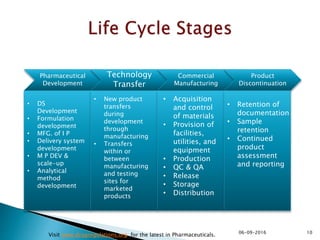
For thepurposes of this guidance, the product lifecycle
includes technical activities for new and existing products:
Apply these elements in a manner appropriate and
proportionate manner to each of the product lifecycle stages,
Recognize the differences among the stages
Recognize different goals of each stage.
Apply innovative approaches to improve product quality.
2806-09-2016
Visit www.drugregulations.org for the latest in Pharmaceuticals.
29.
Pharmaceutical QualitySystem Elements
There are four elements
The elements might be required under regional GMP
regulations.
However, the Q10 model’s intent is to enhance these
elements to promote the lifecycle approach to product
quality.
2906-09-2016
Visit www.drugregulations.org for the latest in Pharmaceuticals.
30.
These fourelements are:
Process performance and product quality monitoring system
Corrective action and preventive action (CAPA) system
Change management system
Management review of process performance and product
quality
3006-09-2016
Visit www.drugregulations.org for the latest in Pharmaceuticals.
31.
1. Plan andexecute a system for the monitoring of process
performance and product quality to ensure a state of
control is maintained.
2. The process performance and product quality monitoring
system should: ( See Next Slides)
3106-09-2016
Visit www.drugregulations.org for the latest in Pharmaceuticals.
32.
3. Use qualityrisk management to establish the control strategy.
• This can include parameters and attributes related to drug
substance and drug product materials and components,
• Facility and equipment operating conditions,
• In-process controls,
• Finished product specifications,
• The associated methods and
• Frequency of monitoring and control.
• The control strategy should facilitate timely feedback/feed
forward and appropriate corrective action and preventive action.
3206-09-2016
Visit www.drugregulations.org for the latest in Pharmaceuticals.
33.
4. Provide thetools for measurement and analysis of
parameters and attributes identified in the control strategy
(e.g., data management and statistical tools).
5. (Analyze parameters and attributes identified in the control
strategy to verify continued operation within a state of
control.
6. Identify sources of variation affecting process performance
and product quality
◦ Use this for potential continual improvement activities to reduce or
control variation.
3306-09-2016
Visit www.drugregulations.org for the latest in Pharmaceuticals.
34.
7. Include feedbackon product quality from both internal and
external sources
• Complaints
• Product rejections
• Nonconformance’s
• Recalls
• Deviations
• Audits and regulatory inspections, and findings
3406-09-2016
Visit www.drugregulations.org for the latest in Pharmaceuticals.
35.
8. Provide knowledge
•Enhance process understanding,
• Enrich the design space (where established), and
• Enable innovative approaches to process validation.
3506-09-2016
Visit www.drugregulations.org for the latest in Pharmaceuticals.
36.
3606-09-2016
Visit www.drugregulations.org forthe latest in Pharmaceuticals.
Pharmaceutical
Development
Technology
Transfer
Commercial
Manufacturing
Product
Discontinuation
Establish a control
Strategy for
manufacturing
based on the
• Process and
Product
Knowledge
• Process and
Product
monitoring
conducted
throughout
development.
• Monitoring
during scale-up
activity can
provide a
preliminary
indication of
process
performance.
• Can lead to
successful
integration into
manufacturing
• Develop further
control
strategies based
on the
knowledge
obtained.
• Apply a well
defined
process
performance
and product
quality
monitoring
system
• This can assure
performance
within a state
of control
• It can identify
area for
improvement
Once manufacturing
is stopped
• Continue
stability testing
• Execute other
actions as per
National /
Regional
regulations
37.
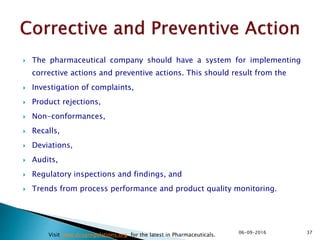
The pharmaceuticalcompany should have a system for implementing
corrective actions and preventive actions. This should result from the
Investigation of complaints,
Product rejections,
Non-conformances,
Recalls,
Deviations,
Audits,
Regulatory inspections and findings, and
Trends from process performance and product quality monitoring.
3706-09-2016
Visit www.drugregulations.org for the latest in Pharmaceuticals.
38.
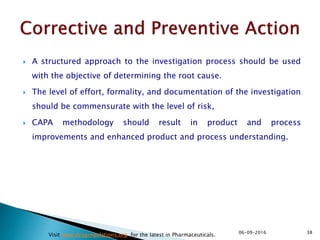
A structuredapproach to the investigation process should be used
with the objective of determining the root cause.
The level of effort, formality, and documentation of the investigation
should be commensurate with the level of risk,
CAPA methodology should result in product and process
improvements and enhanced product and process understanding.
3806-09-2016
Visit www.drugregulations.org for the latest in Pharmaceuticals.
39.
3906-09-2016
Visit www.drugregulations.org forthe latest in Pharmaceuticals.
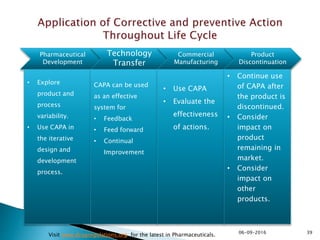
Pharmaceutical
Development
Technology
Transfer
Commercial
Manufacturing
Product
Discontinuation
• Explore
product and
process
variability.
• Use CAPA in
the iterative
design and
development
process.
CAPA can be used
as an effective
system for
• Feedback
• Feed forward
• Continual
Improvement
• Use CAPA
• Evaluate the
effectiveness
of actions.
• Continue use
of CAPA after
the product is
discontinued.
• Consider
impact on
product
remaining in
market.
• Consider
impact on
other
products.
40.
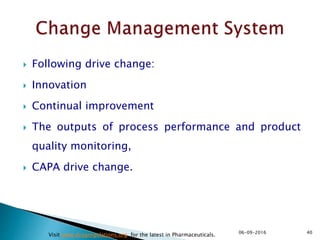
Following drivechange:
Innovation
Continual improvement
The outputs of process performance and product
quality monitoring,
CAPA drive change.
4006-09-2016
Visit www.drugregulations.org for the latest in Pharmaceuticals.
41.
Company shouldhave an effective process to
manage these changes.
Management of change involves
Evaluation
Approval
Implementation
4106-09-2016
Visit www.drugregulations.org for the latest in Pharmaceuticals.
42.
Formality ofchange management process
differs.
Prior to the initial regulatory submission
and after submission.
This is especially relevant when changes to
the regulatory filing might be required.
4206-09-2016
Visit www.drugregulations.org for the latest in Pharmaceuticals.
43.
The systemensures continual improvement is
undertaken in a timely and effective manner.
It should provide a high degree of assurance
there are no unintended consequences of the
change.
The system should include the following, for
the stage of the lifecycle: ( See next slide)
4306-09-2016
Visit www.drugregulations.org for the latest in Pharmaceuticals.
44.
Quality riskmanagement should be utilized
to evaluate proposed changes.
The level of effort and formality of the
evaluation should be commensurate with
the level of risk.
4406-09-2016
Visit www.drugregulations.org for the latest in Pharmaceuticals.
45.
Proposed changesshould be evaluated relative to the
marketing authorization.
This should include design space, where established,
and/or current product and process understanding.
There should be an assessment to determine whether a
change to the regulatory filing is required under
regional requirements.
4506-09-2016
Visit www.drugregulations.org for the latest in Pharmaceuticals.
46.
Working withinthe design space is not
considered a change from a regulatory filing
perspective.
However, from a pharmaceutical quality system
standpoint, all changes should be evaluated by
a company’s change management system.
4606-09-2016
Visit www.drugregulations.org for the latest in Pharmaceuticals.
47.
Proposed changesshould be evaluated by expert teams
contributing the appropriate expertise.
◦ e.g. Pharmaceutical Development, Manufacturing, Quality, Regulatory
Affairs, and Medical
This will ensure the change is technically justified.
Prospective evaluation criteria for a proposed change should
be set.
After implementation evaluate the change to confirm
fulfillment of objectives.
4706-09-2016
Visit www.drugregulations.org for the latest in Pharmaceuticals.
48.
4806-09-2016
Visit www.drugregulations.org forthe latest in Pharmaceuticals.
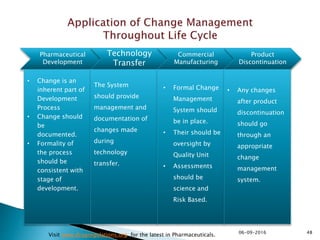
Pharmaceutical
Development
Technology
Transfer
Commercial
Manufacturing
Product
Discontinuation
• Change is an
inherent part of
Development
Process
• Change should
be
documented.
• Formality of
the process
should be
consistent with
stage of
development.
The System
should provide
management and
documentation of
changes made
during
technology
transfer.
• Formal Change
Management
System should
be in place.
• Their should be
oversight by
Quality Unit
• Assessments
should be
science and
Risk Based.
• Any changes
after product
discontinuation
should go
through an
appropriate
change
management
system.
49.
Management reviewshould provide assurance that process
performance and product quality are managed over the
lifecycle.
Depending on the size and complexity of the company,
management review can be a series of reviews at various
levels of management
It should include a timely and effective communication and
escalation process to raise appropriate quality issues to
senior levels of management for review.
4906-09-2016
Visit www.drugregulations.org for the latest in Pharmaceuticals.
50.
The managementreview system should include:
The results of regulatory inspections and findings, audits and
other assessments, and commitments made to regulatory
authorities
Periodic quality reviews, that can include:
◦ Measures of customer satisfaction such as product quality complaints and
recalls
◦ Conclusions of process performance and product quality monitoring
◦ The effectiveness of process and product changes including those arising from
corrective action and preventive actions
Any follow-up actions from previous management reviews
5006-09-2016
Visit www.drugregulations.org for the latest in Pharmaceuticals.
51.
The managementreview system should identify
appropriate actions, such as:
Improvements to manufacturing processes and
products
Provision, training, and/or realignment of
resources
5106-09-2016
Visit www.drugregulations.org for the latest in Pharmaceuticals.
52.
5206-09-2016
Visit www.drugregulations.org forthe latest in Pharmaceuticals.
Pharmaceutical
Development
Technology
Transfer
Commercial
Manufacturing
Product
Discontinuation
• Certain aspects
of Management
Review can be
performed to
ensure
adequacy of
the product
and process
design.
Certain aspects of
review should be
performed to
ensure the
developed
product and
processes can be
manufactured at
commercial scale.
• Review should
be formal and
structured as
described
earlier.
• It should
support
continual
improvement.
• Review should
include such
items as Product
Stability and
Product Quality
Complaints.
53.
A. ManagementReview of the Pharmaceutical Quality System
Management should have a formal process for reviewing the pharmaceutical
quality system on a periodic basis. The review should include:
(a) Measurement of achievement of pharmaceutical quality system objectives
(b) Assessment of performance indicators that can be used to monitor the
effectiveness of processes within the pharmaceutical quality system, such as:
(1) Complaint, deviation, CAPA and change management processes
(2) Feedback on outsourced activities
(3) Self-assessment processes including risk assessments, trending, and audits
(4) External assessments such as regulatory inspections and findings and
customer audits
5306-09-2016
Visit www.drugregulations.org for the latest in Pharmaceuticals.
54.
B. Monitoringof Internal and External Factors That Can Have an
Impact on the Pharmaceutical Quality System
Factors monitored by management can include:
Emerging regulations, guidance, and quality issues that can have an
impact on the Pharmaceutical Quality System
Innovations that might enhance the pharmaceutical quality system
Changes in business environment and objectives
5406-09-2016
Visit www.drugregulations.org for the latest in Pharmaceuticals.
55.
B. Monitoringof Internal and External Factors That Can Have an
Impact on the Pharmaceutical Quality System
Factors monitored by management can include:
Emerging regulations, guidance, and quality issues that can have an
impact on the Pharmaceutical Quality System
Innovations that might enhance the pharmaceutical quality system
Changes in business environment and objectives
Changes in product ownership
5506-09-2016
Visit www.drugregulations.org for the latest in Pharmaceuticals.
56.
C. Outcomesof Management Review and Monitoring
The outcome of management review of the pharmaceutical quality
system and monitoring of internal and external factors can include:
Improvements to the pharmaceutical quality system and related
processes
Allocation or reallocation of resources and/or personnel training
Revisions to quality policy and quality objectives
Documentation and timely and effective communication of the
results of the management review and actions, including escalation
of appropriate issues to senior management.
5606-09-2016
Visit www.drugregulations.org for the latest in Pharmaceuticals.
57.
This presentation iscompiled from freely available
resource like the website of ICH specifically
ICH Q-10 Guidelines
“Drug Regulations” is a non profit organization
which provides free online resource to the
Pharmaceutical Professional.
Visit Our Website GMP Training
for latest information from the world of
Pharmaceuticals.
06-09-2016 57
Visit Our WEBSITE GMP Training
http://fdagmp.blogspot.in/