Dr Ravi Kinhikar 
Handling OOS 
(Out of Specification)
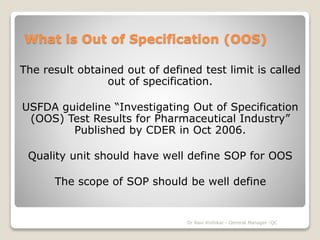
What is Out of Specification (OOS) 
The result obtained out of defined test limit is called 
out of specification. 
USFDA guideline “Investigating Out of Specification 
(OOS) Test Results for Pharmaceutical Industry” 
Published by CDER in Oct 2006. 
Quality unit should have well define SOP for OOS 
The scope of SOP should be well define 
Dr Ravi Kinhikar - General Manager -QC
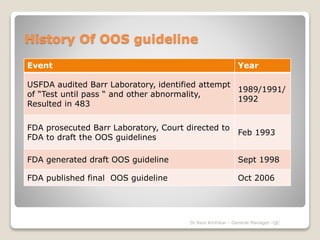
History Of OOS guideline 
Event Year 
USFDA audited Barr Laboratory, identified attempt 
of “Test until pass “ and other abnormality, 
Resulted in 483 
1989/1991/ 
1992 
FDA prosecuted Barr Laboratory, Court directed to 
FDA to draft the OOS guidelines 
Feb 1993 
FDA generated draft OOS guideline Sept 1998 
FDA published final OOS guideline Oct 2006 
Dr Ravi Kinhikar - General Manager -QC
OOS Investigation 
Laboratory Investigation 
. 
Must be 
• Thorough 
• Timely 
• Unbiased 
• Well documented 
• Scientifically sound 
Dr Ravi Kinhikar - General Manager -QC
OOS Investigation –(Phase I) 
. 
Laboratory Investigation 
Check list to identify obvious Laboratory error 
1. Analyst qualification and training on intended work 
2. Correctness Test specification and Method 
3. Instrument calibration or performance 
4. Preparation test solutions and dilutions 
5. Validity of Reagents and standards 
6. Performance of system suitability 
7. Correctness of calculation and etc…. 
Dr Ravi Kinhikar - General 
Manager -QC
OOS Investigation –(Phase I) 
. 
Laboratory Investigation 
If Analyst Error identified, it should be 
• logical and appropriate 
• not on hypothetical basis 
Identify appropriate assignable cause for Laboratory error 
Correct the error, and repeat the analysis to invalidate the 
OOS. 
Suggest the Corrective and Preventive actions e.g. training 
to the Analyst, Requalification of Analyst etc. whatever the 
scientifically appropriate. 
Dr Ravi Kinhikar - General Manager -QC
OOS Investigation –(Phase II) 
. 
Extended Investigation 
If No assignable cause found in phase I investigation, 
Phase II investigation should be initiated 
• Retesting of Material with other analyst (n≥ 3) 
• Resampling and testing 
• Investigation at Plant 
• Further Extend investigation (upon rejection) 
Dr Ravi Kinhikar - General Manager -QC
Tool for OOS Investigation & 
Related Corrective and 
Preventive action 
Dr Ravi Kinhikar
Identify the Suspect 
5M –Tool to Identify the Route cause 
Man 
Machine 
Material 
Method 
Movement 
Dr Ravi Kinhikar - General Manager -QC
Scan the Suspect 
Target the suspect 
Use 5 why technique to reach at root cause 
Ask Why, Why, Why, Why and Why five times and try to 
reach at more probable reason 
To check the reason scientifically sound - Process each 
reason with six sigma technique -DMAIC 
Dr Ravi Kinhikar - General Manager -QC
Process the Root cause 
Six sigma technique (DMAIC) 
Define 
Measure 
Analyze 
Improve 
Control 
Dr Ravi Kinhikar - General Manager -QC
Corrective And Preventive Action 
Draw appropriate root cause. 
Root cause should be logical and scientific. 
Collect the historical evidence if any with same process or any 
other process in the plant. 
Identify the need for extend the investigation to past or future 
batches… 
Provide corrective action with evidence 
Suggest preventive action 
( corrective action should be reviewed against similar process in 
the plant for no impact) 
Conclude the activity in timely manner. 
Dr Ravi Kinhikar - General Manager -QC
Admire your Questions… 
Thanks!!! 
Dr Ravi Kinhikar - General Manager -QC

Out of specification (oos)1

  • 1.
    Dr Ravi Kinhikar Handling OOS (Out of Specification)
  • 2.
    What is Outof Specification (OOS) The result obtained out of defined test limit is called out of specification. USFDA guideline “Investigating Out of Specification (OOS) Test Results for Pharmaceutical Industry” Published by CDER in Oct 2006. Quality unit should have well define SOP for OOS The scope of SOP should be well define Dr Ravi Kinhikar - General Manager -QC
  • 3.
    History Of OOSguideline Event Year USFDA audited Barr Laboratory, identified attempt of “Test until pass “ and other abnormality, Resulted in 483 1989/1991/ 1992 FDA prosecuted Barr Laboratory, Court directed to FDA to draft the OOS guidelines Feb 1993 FDA generated draft OOS guideline Sept 1998 FDA published final OOS guideline Oct 2006 Dr Ravi Kinhikar - General Manager -QC
  • 4.
    OOS Investigation LaboratoryInvestigation . Must be • Thorough • Timely • Unbiased • Well documented • Scientifically sound Dr Ravi Kinhikar - General Manager -QC
  • 5.
    OOS Investigation –(PhaseI) . Laboratory Investigation Check list to identify obvious Laboratory error 1. Analyst qualification and training on intended work 2. Correctness Test specification and Method 3. Instrument calibration or performance 4. Preparation test solutions and dilutions 5. Validity of Reagents and standards 6. Performance of system suitability 7. Correctness of calculation and etc…. Dr Ravi Kinhikar - General Manager -QC
  • 6.
    OOS Investigation –(PhaseI) . Laboratory Investigation If Analyst Error identified, it should be • logical and appropriate • not on hypothetical basis Identify appropriate assignable cause for Laboratory error Correct the error, and repeat the analysis to invalidate the OOS. Suggest the Corrective and Preventive actions e.g. training to the Analyst, Requalification of Analyst etc. whatever the scientifically appropriate. Dr Ravi Kinhikar - General Manager -QC
  • 7.
    OOS Investigation –(PhaseII) . Extended Investigation If No assignable cause found in phase I investigation, Phase II investigation should be initiated • Retesting of Material with other analyst (n≥ 3) • Resampling and testing • Investigation at Plant • Further Extend investigation (upon rejection) Dr Ravi Kinhikar - General Manager -QC
  • 8.
    Tool for OOSInvestigation & Related Corrective and Preventive action Dr Ravi Kinhikar
  • 9.
    Identify the Suspect 5M –Tool to Identify the Route cause Man Machine Material Method Movement Dr Ravi Kinhikar - General Manager -QC
  • 10.
    Scan the Suspect Target the suspect Use 5 why technique to reach at root cause Ask Why, Why, Why, Why and Why five times and try to reach at more probable reason To check the reason scientifically sound - Process each reason with six sigma technique -DMAIC Dr Ravi Kinhikar - General Manager -QC
  • 11.
    Process the Rootcause Six sigma technique (DMAIC) Define Measure Analyze Improve Control Dr Ravi Kinhikar - General Manager -QC
  • 12.
    Corrective And PreventiveAction Draw appropriate root cause. Root cause should be logical and scientific. Collect the historical evidence if any with same process or any other process in the plant. Identify the need for extend the investigation to past or future batches… Provide corrective action with evidence Suggest preventive action ( corrective action should be reviewed against similar process in the plant for no impact) Conclude the activity in timely manner. Dr Ravi Kinhikar - General Manager -QC
  • 13.
    Admire your Questions… Thanks!!! Dr Ravi Kinhikar - General Manager -QC