

This presentation is compiled by “ Drug Regulations” a
non profit organization which provides free online
resource to the Pharmaceutical Professional.
Visit http://www.drugregulations.org for latest
information from the world of Pharmaceuticals.
4/3/2016 1
 This presentation is compiled from freely
available resources like the websites of FDA, EMA
,WHO and research papers published by experts
in this field like
T. Sandle .
 “Drug Regulations” is a non profit organization
which provides free online resource to the
Pharmaceutical Professional.
 Visit http://www.drugregulations.org for latest
information from the world of Pharmaceuticals.
4/3/2016 2
Drug Regulations : Online
Resource for Latest Information
4/3/2016 3
Drug Regulations : Online Resource for Latest
Information
 Determination of Frequency of Monitoring:
◦ Using the concept of risk assessment to decide how
often to monitor different types of cleanrooms
 Risk Assessment Tools:
◦ Applying risk assessment tools to establish methods
for environmental monitoring
 Numerical Approaches:
◦ Considering a numerical approach to assess risk data
using a case study of an aseptic filling operation
4/3/2016 4
Drug Regulations : Online Resource for Latest
Information
4/3/2016 5
Drug Regulations : Online Resource for Latest
Information
 Environmental Monitoring ( EM) describes
the microbiological testing undertaken to
detect changing trends of microbial counts
and micro flora growth within cleanroom or
controlled environments.
4/3/2016 6
Drug Regulations : Online Resource for Latest
Information
 The results obtained provide information about
◦ The physical construction of the room
◦ The performance of the Heating, Ventilation, and Air-
Conditioning (HVAC) system
◦ Personnel cleanliness
◦ Gowning practices
◦ The equipment, and cleaning operations
4/3/2016 7
Drug Regulations : Online Resource for Latest
Information
 Over the past decade, environmental monitoring has
become more sophisticated.
 Earlier EM involved random sampling, using an
imaginary grid over the room and testing in each grid
 Currently the focus is on
◦ Risk assessment and
◦ The use of risk assessment tools to determine the most
appropriate methods for environmental monitoring.
4/3/2016 8
Drug Regulations : Online Resource for Latest
Information
4/3/2016 9
Drug Regulations : Online Resource for Latest
Information
 Adequate environmental monitoring
programme,
◦ A balance between using resources efficiently and
monitoring at sufficiently frequent intervals so
that a meaningful picture can be obtained.
◦ Sources of guidance with respect to monitoring
frequencies are very limited
4/3/2016 10
Drug Regulations : Online Resource for Latest
Information
 Monitoring frequencies specified within the
United States Pharmacopoeia (USP) <1116>
may not be suitable for all facilities.
 Some guidance can be obtained from the
International Organization for
Standardization’s (ISO) standards:
◦ Principally ISO 14644 and ISO 14698.
4/3/2016 11
Drug Regulations : Online Resource for Latest
Information
 However, these do not always fit with
regulatory guidance documents
 This is because they apply to controlled
environments across a range of industries
 Many industries other than
pharmaceuticals, apply higher standards
4/3/2016 12
Drug Regulations : Online Resource for Latest
Information
 When establishing an environmental control
programme, the frequency of monitoring
different controlled areas can be
determined based on ‘criticality factors’
relevant to each specific area.
4/3/2016 13
Drug Regulations : Online Resource for Latest
Information
4/3/2016 14
Drug Regulations : Online Resource for Latest
Information
 The establishment of a criticality scheme on
which to base monitoring frequencies is
designed to target monitoring of critical
process steps.
4/3/2016 15
Drug Regulations : Online Resource for Latest
Information
 Therefore, the final formulation process
would receive more monitoring than an
early manufacturing stage with a relatively
closed process.
4/3/2016 16
Drug Regulations : Online Resource for Latest
Information
 Using a criticality factor is a means of
assigning a monitoring frequency based on
the risk assessment of each critical area.
 The risk assessment relates to the potential
product impact from any risk.
4/3/2016 17
Drug Regulations : Online Resource for Latest
Information
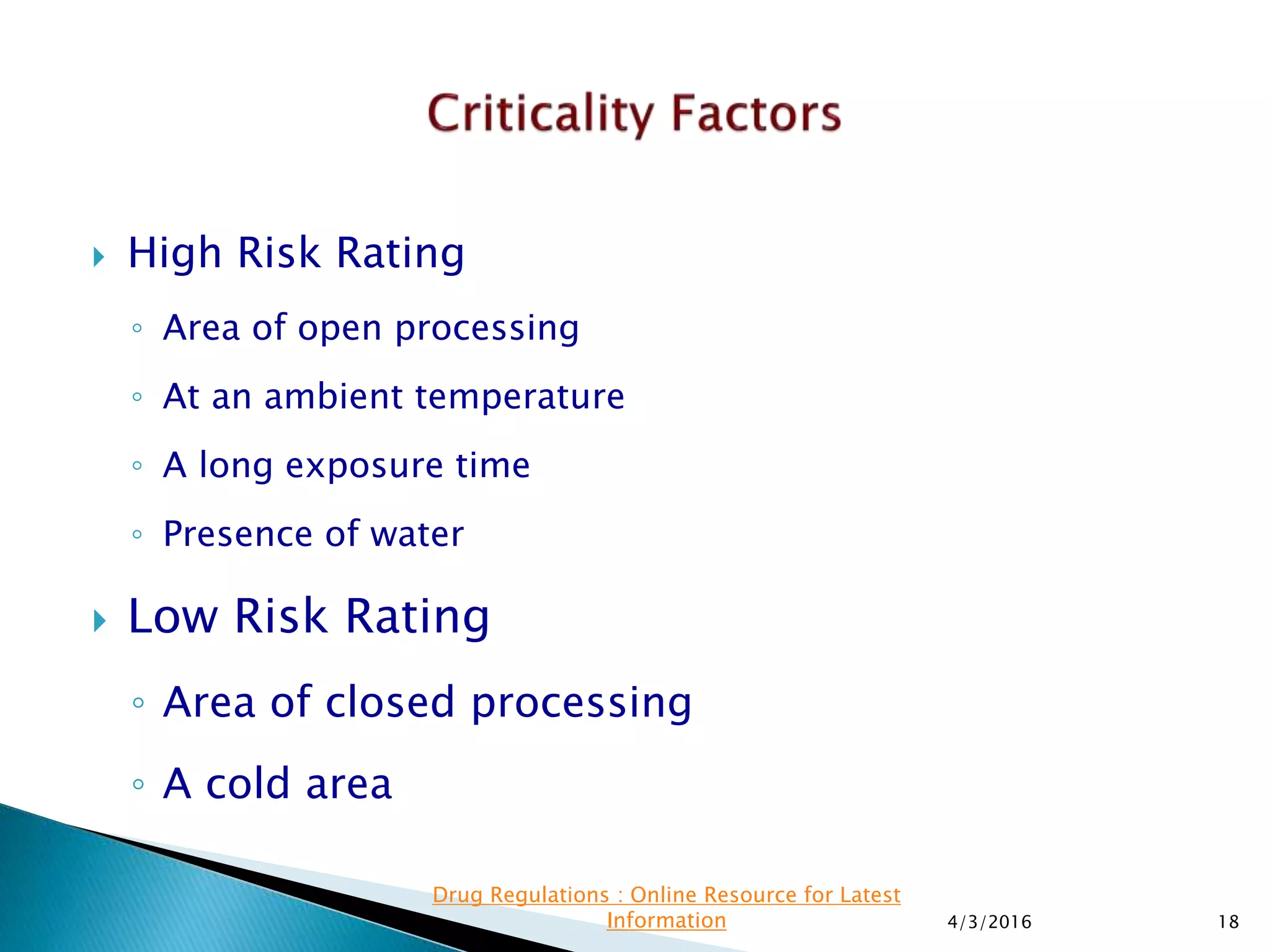
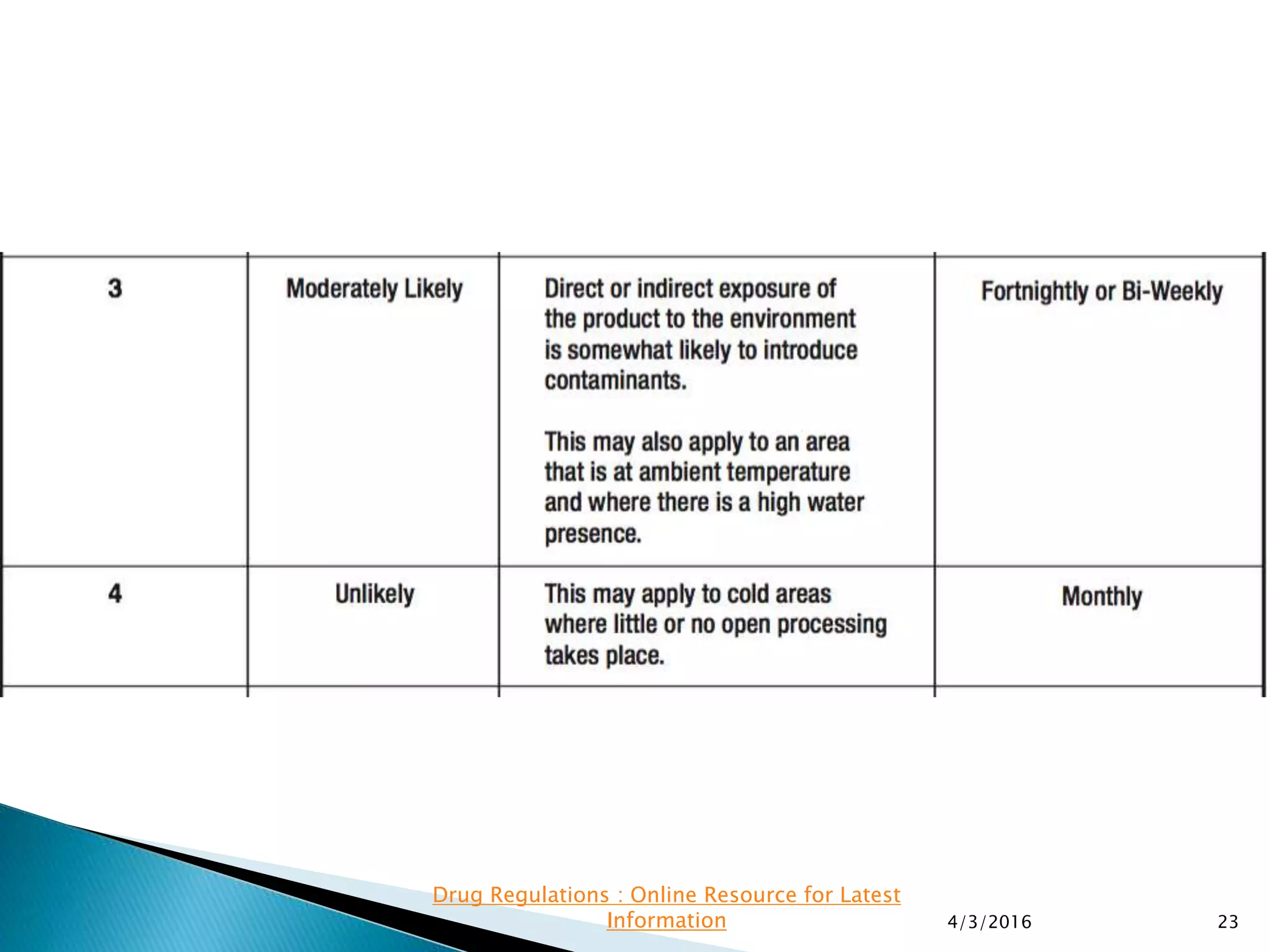
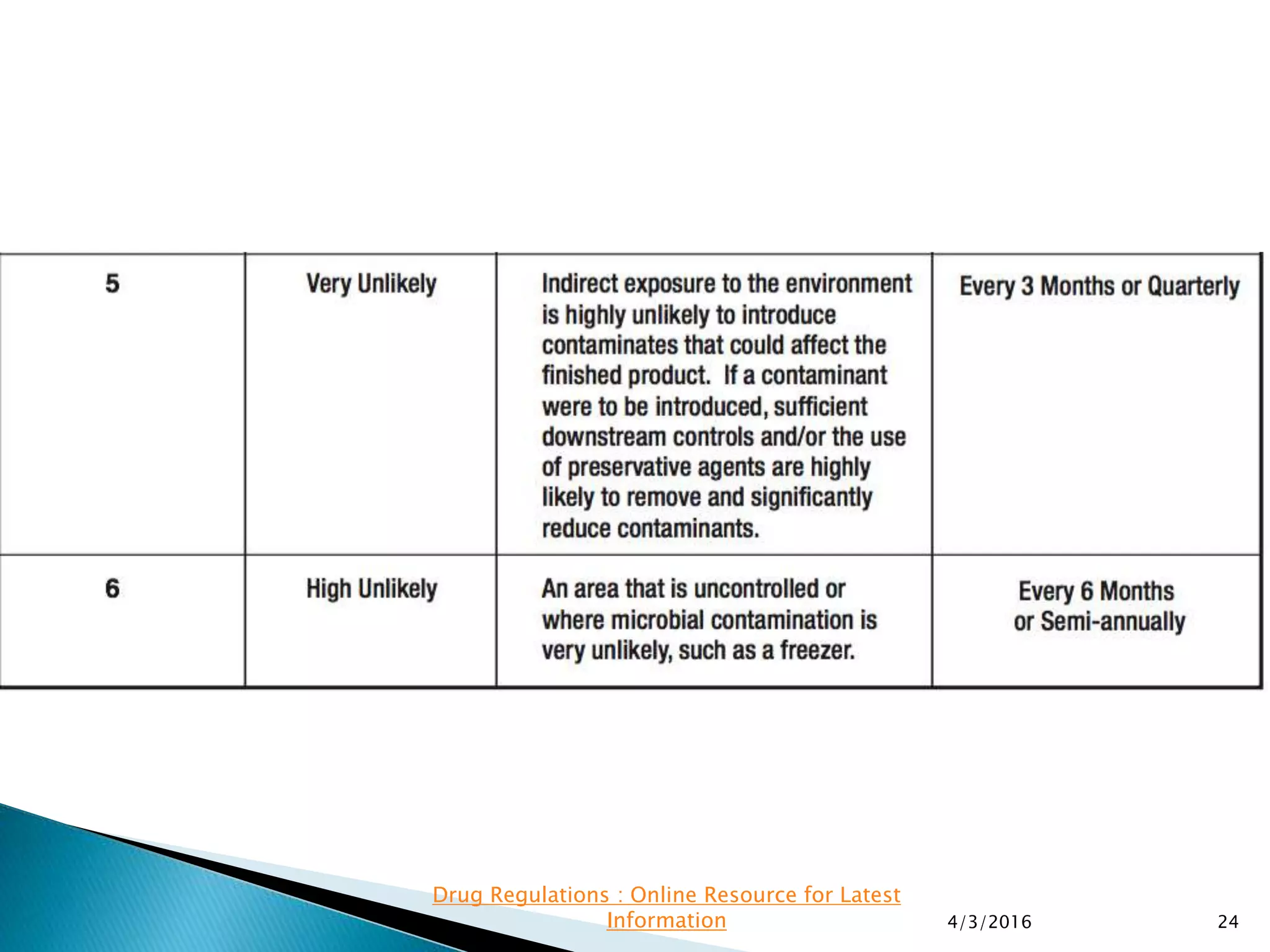
 High Risk Rating
◦ Area of open processing
◦ At an ambient temperature
◦ A long exposure time
◦ Presence of water
 Low Risk Rating
◦ Area of closed processing
◦ A cold area
4/3/2016 18
Drug Regulations : Online Resource for Latest
Information
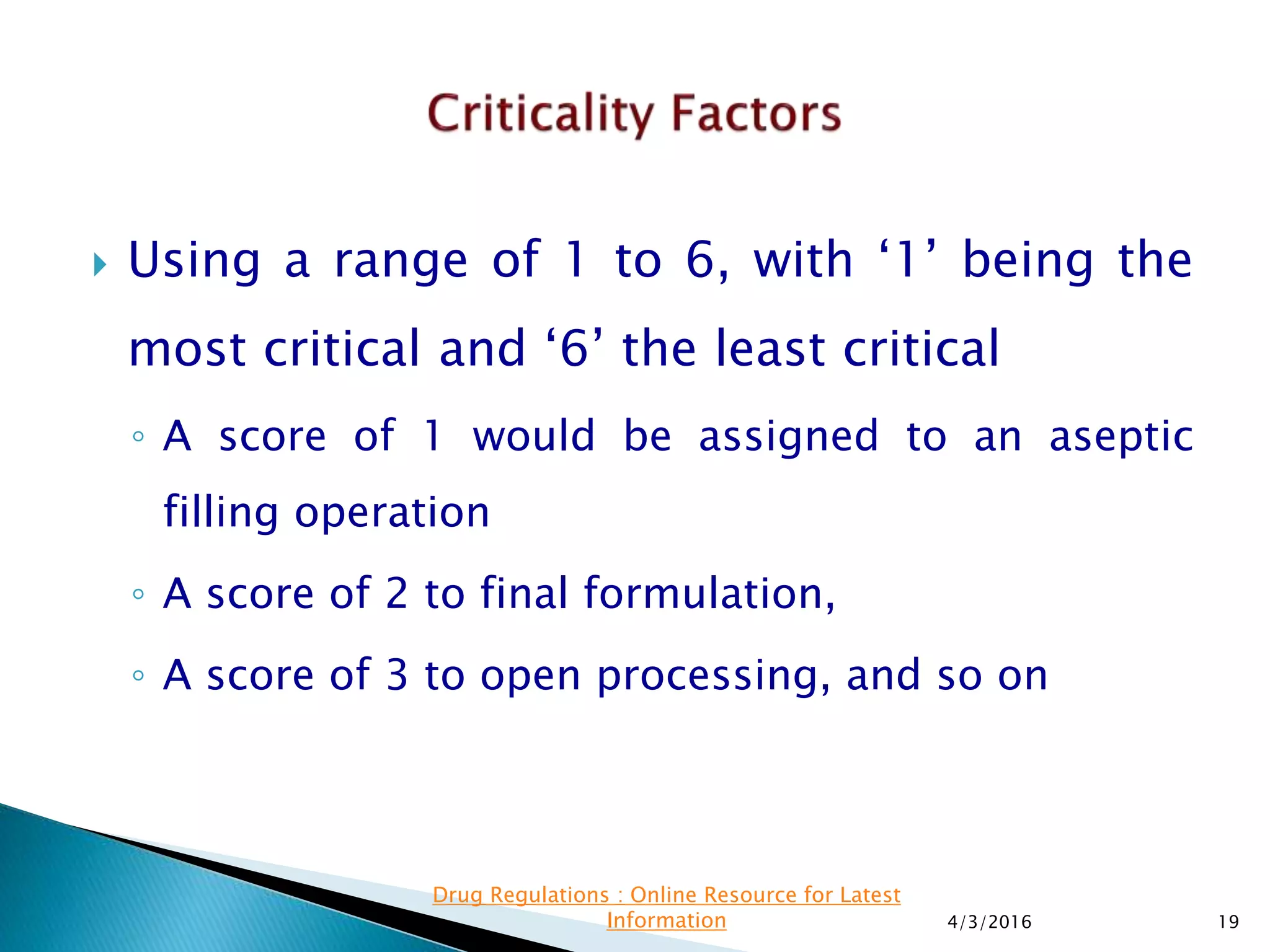
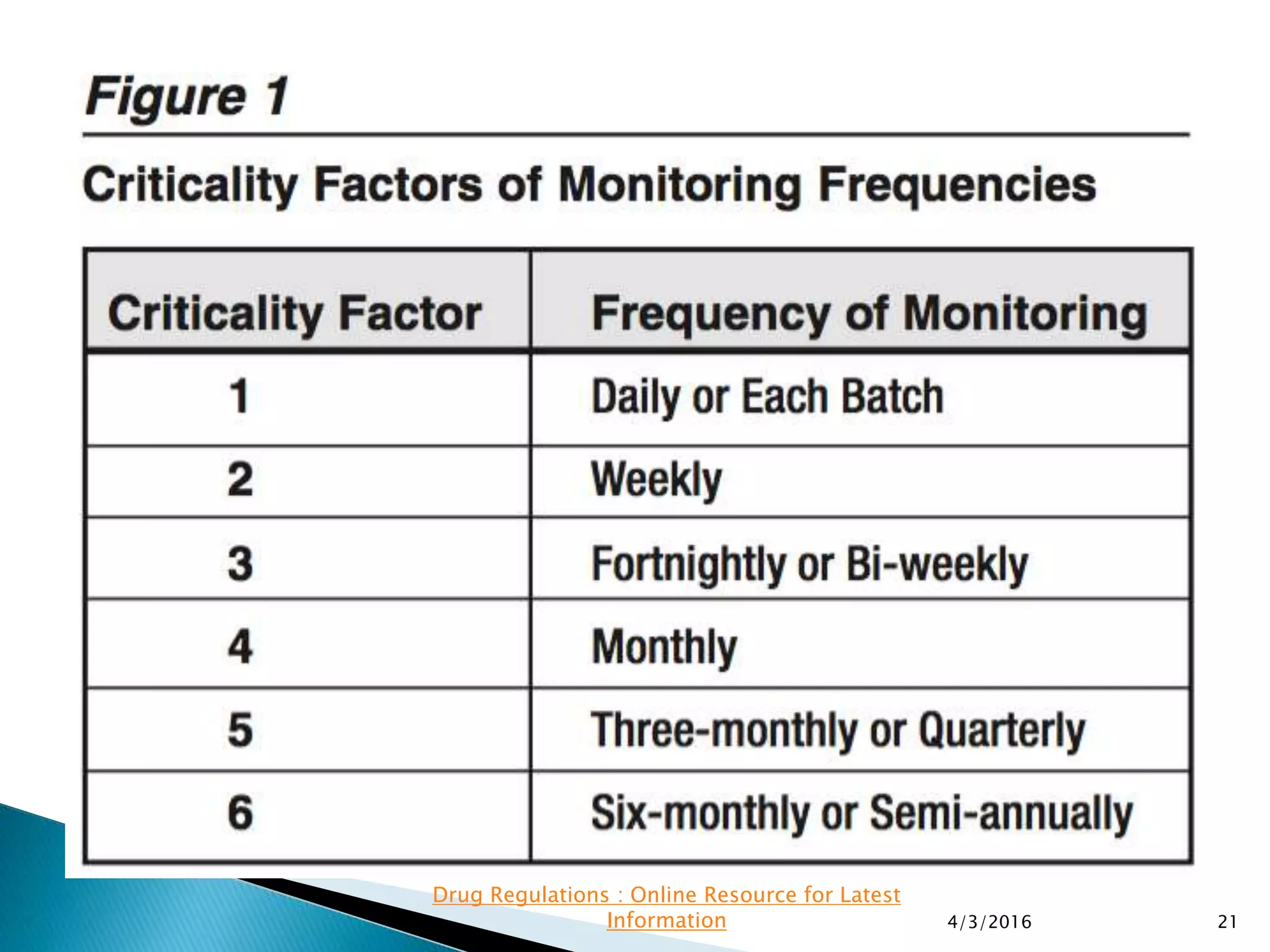
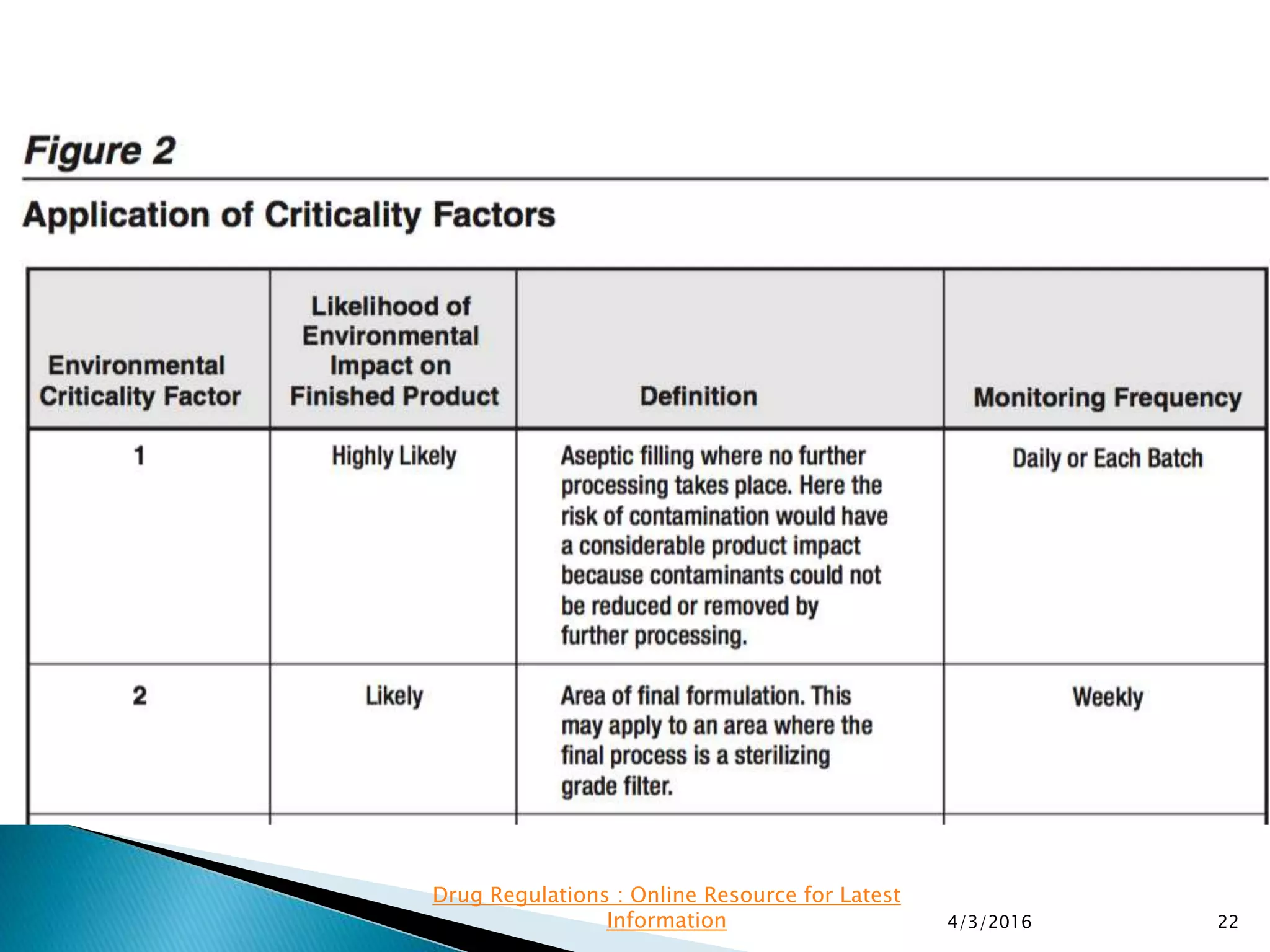
 Using a range of 1 to 6, with ‘1’ being the
most critical and ‘6’ the least critical
◦ A score of 1 would be assigned to an aseptic
filling operation
◦ A score of 2 to final formulation,
◦ A score of 3 to open processing, and so on
4/3/2016 19
Drug Regulations : Online Resource for Latest
Information
 Adapt such a scheme to particular area
 Defend it by way of supportable rationale
 For Monitoring frequencies Figure 1,
 Its application is seen in Figure 2.
4/3/2016 20
Drug Regulations : Online Resource for Latest
Information
4/3/2016 21
Drug Regulations : Online Resource for Latest
Information
4/3/2016 22
Drug Regulations : Online Resource for Latest
Information
4/3/2016 23
Drug Regulations : Online Resource for Latest
Information
4/3/2016 24
Drug Regulations : Online Resource for Latest
Information
 Each controlled area would be evaluated against set
criteria
 Then with the use of a series of guiding questions;
the monitoring frequency would be determined.
 Decision criteria include considerations in two
category areas:
◦ Areas of higher weighting
◦ Areas of higher monitoring frequency
◦ Examples of these categories follow:
4/3/2016 25
Drug Regulations : Online Resource for Latest
Information
 Giving Higher Weighting to –‘Dirtier’ activity
performed in a room adjacent to a clean activity,
even if the clean activity represents later
processing
 Areas that have a higher level of personnel transit
◦ (given that people are the main microbiological
contamination source).
◦ This may include corridors and changing rooms.
4/3/2016 26
Drug Regulations : Online Resource for Latest
Information
◦ Routes of transfer
◦ Areas that receive in-coming goods
◦ Component preparation activities and sites
 Duration of activity
◦ Such as a lower criticality for a 30-minute process
compared to a six-hour operation
◦ Warm or ambient areas as opposed to cold rooms
4/3/2016 27
Drug Regulations : Online Resource for Latest
Information
 Having Higher Monitoring Frequencies for –
◦ Areas with water or sinks as opposed to dry, ambient areas
◦ Open processing or open plant assembly compared to
processing that is open momentarily or to closed
processing
 (where product risk exposure time is examined)
◦ Final formulation, purification, secondary packaging,
product filling, etc.
4/3/2016 28
Drug Regulations : Online Resource for Latest
Information
 Once the monitoring frequency for each
controlled area is determined, it should be
reviewed at regular intervals.
 This review may invoke changes to room’s
status, and hence, its monitoring frequency,
or to changes for different sample types
within the room.
4/3/2016 29
Drug Regulations : Online Resource for Latest
Information
 For example, it may be that after reviewing
data for one year, surface samples produce
higher results than air samples for a series of
rooms.
 In this event, the microbiologist may opt to
vary the frequency of monitoring and take
surface samples more often than air samples.
4/3/2016 30
Drug Regulations : Online Resource for Latest
Information
 There would also be an increased focus on
cleaning and disinfection practices, and
their frequencies, based on such data.
 When both types of monitoring are
producing low level counts, the balance of
risk would be toward air samples.
4/3/2016 31
Drug Regulations : Online Resource for Latest
Information
 This is because air samples are direct
indicators of the quality of the process
 They assign a level of control to the process
 On the other hand surface samples are
indicators of cleaning and disinfection.
4/3/2016 32
Drug Regulations : Online Resource for Latest
Information
 If the results of surface samples are
generally satisfactory, as indicated by trend
analysis, then
◦ either the number of samples or the frequency at
which they are taken can be reduced.
4/3/2016 33
Drug Regulations : Online Resource for Latest
Information
 If subsequent data showed an increase in
counts, the monitoring frequency could
easily be restored.
 Indeed, all types of monitoring frequencies
may increase as part of an investigation, as
appropriate.
4/3/2016 34
Drug Regulations : Online Resource for Latest
Information
4/3/2016 35
Drug Regulations : Online Resource for Latest
Information
 Select status for each room
 Use risk assessment procedure to determine
locations for environmental monitoring.
 ISO 14698 and regulatory authorities
recommend risk based approach.
 They are increasingly asking drug
manufacturers about this subject.
4/3/2016 36
Drug Regulations : Online Resource for Latest
Information
 Risk-based approaches include
◦ Failure Mode and Effects Analysis (FMEA),
◦ Fault Tree Analysis (FTA), and
◦ Hazard Analysis and Critical Control Points
(HACCP),
 All employ a scoring approach.
4/3/2016 37
Drug Regulations : Online Resource for Latest
Information
 Other approaches include:
◦ Failure Mode, Effects, and Criticality Analysis (FMECA);
◦ Hazard Operability Analysis (HAZOP);
◦ Quantitative Microbiological Risk Assessment (QMRA);
◦ Modular Process Risk Model (MPRM);
◦ System Risk Analysis (SRA);
◦ Method for Limitation of Risks;
◦ Risk Profiling.
4/3/2016 38
Drug Regulations : Online Resource for Latest
Information
 At present, no definitive method exists,
 Various approaches differ in their process and
in the degree of complexity involved.
 However, the two most commonly used
methods appear to be
◦ HACCP, which originated in the food industry, and
◦ FMEA, which was developed for the engineering
industry
4/3/2016 39
Drug Regulations : Online Resource for Latest
Information
 These various analytical tools are similar in that
they involve:
◦ Constructing diagrams of workflows
◦ Pinpointing areas of greatest risk
◦ Examining potential sources of contamination
◦ Deciding on the most appropriate sample methods
◦ Helping to establish alert and action levels
◦ Taking into account changes to the work process and
seasonal activities
4/3/2016 40
Drug Regulations : Online Resource for Latest
Information
 These risk assessment approaches are
concerned with
◦ Selecting environmental monitoring locations.
◦ Integrating the environmental monitoring system
with a complete review of operations within the
cleanroom
◦ This ensures those facilities, operations, and
practices are also satisfactory.
4/3/2016 41
Drug Regulations : Online Resource for Latest
Information
 The approaches
◦ Recognize a risk
◦ Rate the level of the risk
◦ Set out a plan to minimize, control, and monitor the risk.
 The monitoring of the risk will help to determine
the
◦ Frequency,
◦ Locations for, and
◦ Level of environmental monitoring
4/3/2016 42
Drug Regulations : Online Resource for Latest
Information
 In this presentation following
techniques will be demonstrated
◦ A simple conceptualization of risk using a
table
◦ HACCP
◦ FMEA
4/3/2016 43
Drug Regulations : Online Resource for Latest
Information
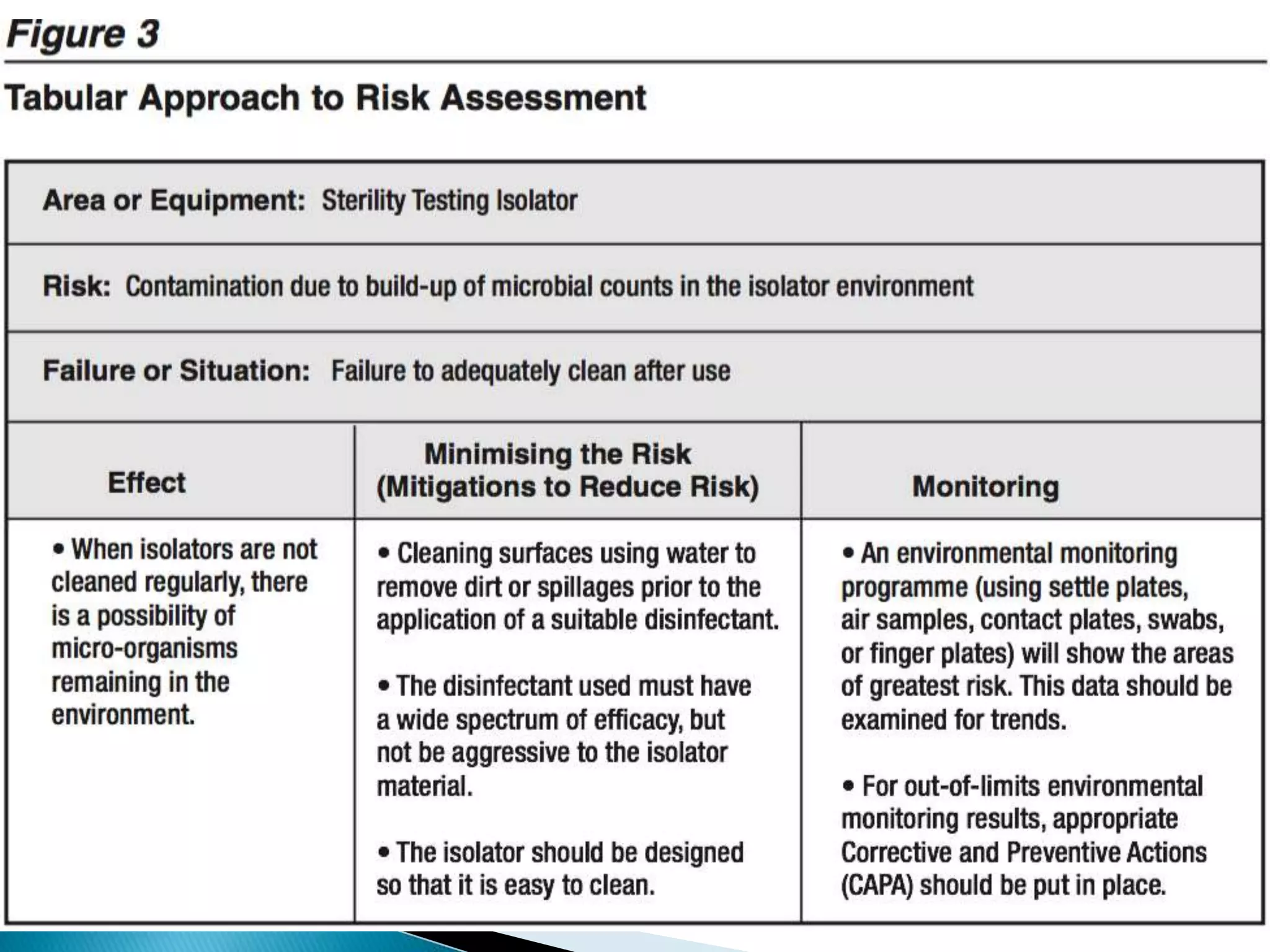
 Tabular Approach
 An example using a simple table for
analyzing risk in environmental
monitoring situations appears in
Figure 3.
4/3/2016 44
Drug Regulations : Online Resource for Latest
Information
4/3/2016 45
Drug Regulations : Online Resource for Latest
Information
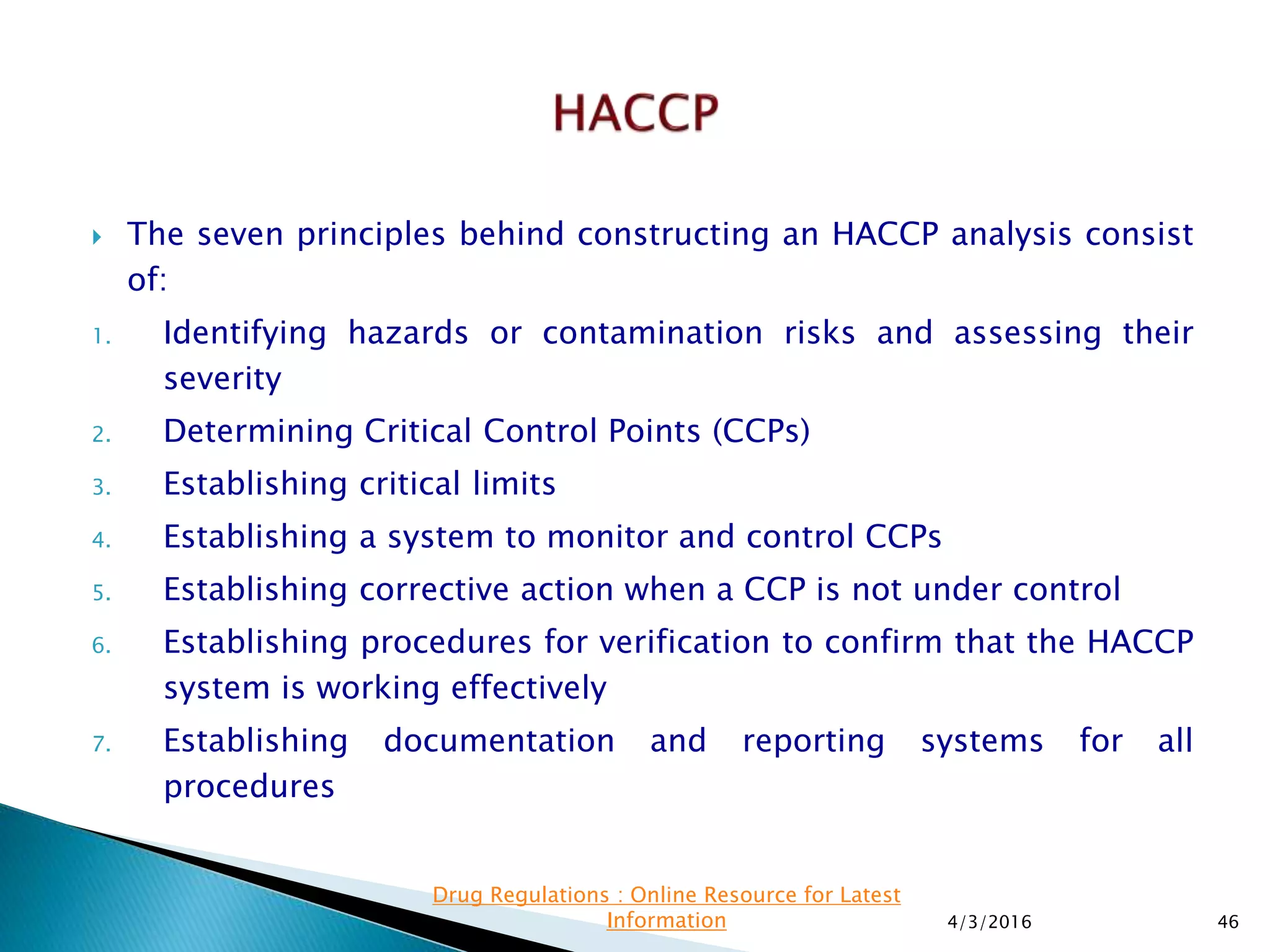
 The seven principles behind constructing an HACCP analysis consist
of:
1. Identifying hazards or contamination risks and assessing their
severity
2. Determining Critical Control Points (CCPs)
3. Establishing critical limits
4. Establishing a system to monitor and control CCPs
5. Establishing corrective action when a CCP is not under control
6. Establishing procedures for verification to confirm that the HACCP
system is working effectively
7. Establishing documentation and reporting systems for all
procedures
4/3/2016 46
Drug Regulations : Online Resource for Latest
Information
 Each of these seven key points is a
vital step in developing the risk
assessment.
 The seven points include:
4/3/2016 47
Drug Regulations : Online Resource for Latest
Information
 1. Construct a risk diagram, or diagrams, to identify sources of
contamination.
 Diagrams should show sources and routes of contamination.
 Examples include:
◦ Areas adjacent to Cleanroom or Isolator (e.g.: airlocks, changing rooms)
◦ Air supply and Room air
◦ Surfaces
◦ People
◦ Machines and Equipment
4/3/2016 48
Drug Regulations : Online Resource for Latest
Information
 2. Assess the importance of these sources and determine whether or
not they are hazards that should be controlled.
 Examples include:
◦ Amounts of contamination on, or in, the source that is available for transfer
◦ Ease by which the contamination is dispersed or transferred
◦ Proximity of the source to the critical point where the product is exposed
◦ Ease with which the contamination can pass through the control method
 The use of a scoring method can greatly help in assessing the
relative importance of these contamination sources.
4/3/2016 49
Drug Regulations : Online Resource for Latest
Information
 3. Identify the methods that can be used to control these
hazards.
 For example:
◦ Air Supply: High Efficiency Particulate Air (HEPA) filters
◦ Dirty Areas adjacent to Clean room or Isolator: differential pressures, airflow
movement
◦ Room Air: air change rates, use of barriers
◦ Surfaces: sterilization, effectiveness of cleaning and disinfection procedures
◦ People: clean room clothing and gloves, room ventilation, training
◦ Machines and Equipment: sterilization, effectiveness of cleaning, exhaust
systems
4/3/2016 50
Drug Regulations : Online Resource for Latest
Information
 4. Determine valid sampling methods to monitor
either the hazards or their control methods or
both.
 For example:
◦ HEPA filter integrity tests
◦ Air supply velocity, air change rates
◦ Room pressure differentials
◦ Particle counts
◦ Air samplers, settle plates, contact plates, etc.
4/3/2016 51
Drug Regulations : Online Resource for Latest
Information
 5. Establish a monitoring schedule with ‘alert’ and
‘action’ levels and the corrective measures to be
taken when these levels are exceeded.
 For example:
◦ The greater the hazard, the greater the amount of
monitoring required
◦ Trend analysis for alert and action levels, in or out of
control
4/3/2016 52
Drug Regulations : Online Resource for Latest
Information
 6. Verify that the contamination control system is
working effectively by reviewing key targets like product
rejection rate, sampling results, control methods, and
so on. These may require modification over time.
 For example:
◦ System for data review
◦ Examine filling trials
◦ Audits
◦ Reassess-hazards, effectiveness of control systems, frequency
◦ of monitoring, appropriateness of alert and action levels
4/3/2016 53
Drug Regulations : Online Resource for Latest
Information
 7. Establish and maintain
documentation.
 For example:
◦ Describe the steps being taken
◦ Describe the monitoring procedures
◦ Describe the reporting and review procedures
4/3/2016 54
Drug Regulations : Online Resource for Latest
Information
 Before implementing HACCP, it is important to train all
staff involved in the process and to use a multi-
disciplinary team.
 For example, the team may be comprised of personnel
from
◦ Production,
◦ Engineering,
◦ Quality Control (QC),
◦ Quality Assurance (QA),
◦ Validation, and so on.
4/3/2016 55
Drug Regulations : Online Resource for Latest
Information
 FMEA schemes vary in their approach,
scoring, and categorization.
 All methods share a numerical approach.
 The example presented here, based on a
sterility testing isolator
4/3/2016 56
Drug Regulations : Online Resource for Latest
Information
 Assign a score (from 1 to 5) to each of the following
categories:
◦ Severity
◦ Occurrence
◦ Detection
 Where:
◦ Severity is the consequence of a failure
◦ Occurrence is the likelihood of the failure happening based on past
experience
◦ Detection is based on the monitoring systems in place and on how
likely a failure can be detected
4/3/2016 57
Drug Regulations : Online Resource for Latest
Information
 By asking a series of questions, each main part of the cleanroom
or isolator system can be grouped or classified into key parts.
 Such questions include:
◦ What is the function of the equipment?
◦ What are its performance requirements?
◦ How can it fail to fulfill these functions?
◦ What can cause each failure?
◦ What happens when each failure occurs?
◦ How much does each failure matter? What are its consequences?
◦ What can be done to predict or prevent each failure?
◦ What should be done if a suitable proactive task cannot be found?
4/3/2016 58
Drug Regulations : Online Resource for Latest
Information
 The scoring is 1 (very good) to 5 (very bad).
 Therefore, a likelihood of high severity would be
rated 5;
 high occurrence rated 5;
 but a good detection system would be rated 1.
4/3/2016 59
Drug Regulations : Online Resource for Latest
Information
 Using these criteria, a final FMEA score is produced
from:
 Severity score x Occurrence score x Detection score
4/3/2016 60
Drug Regulations : Online Resource for Latest
Information
 Decisions on further action will depend upon the score produced.
 There is no published guidance on what the score that dictates some
form of action should be.
 However, 27 is the suggested score for the cut-off value at which action
is required.
 This is based on 27 being the score derived when the mid-score is
applied to all three categories
◦ (i.e., the numerical value '3' for severity 3 x occurrence 3 x detection 3) and
◦ the supposition that if the mid-rating (or a higher number) is scored for all three
categories, then at a minimum, the system should be examined in greater detail.
4/3/2016 61
Drug Regulations : Online Resource for Latest
Information
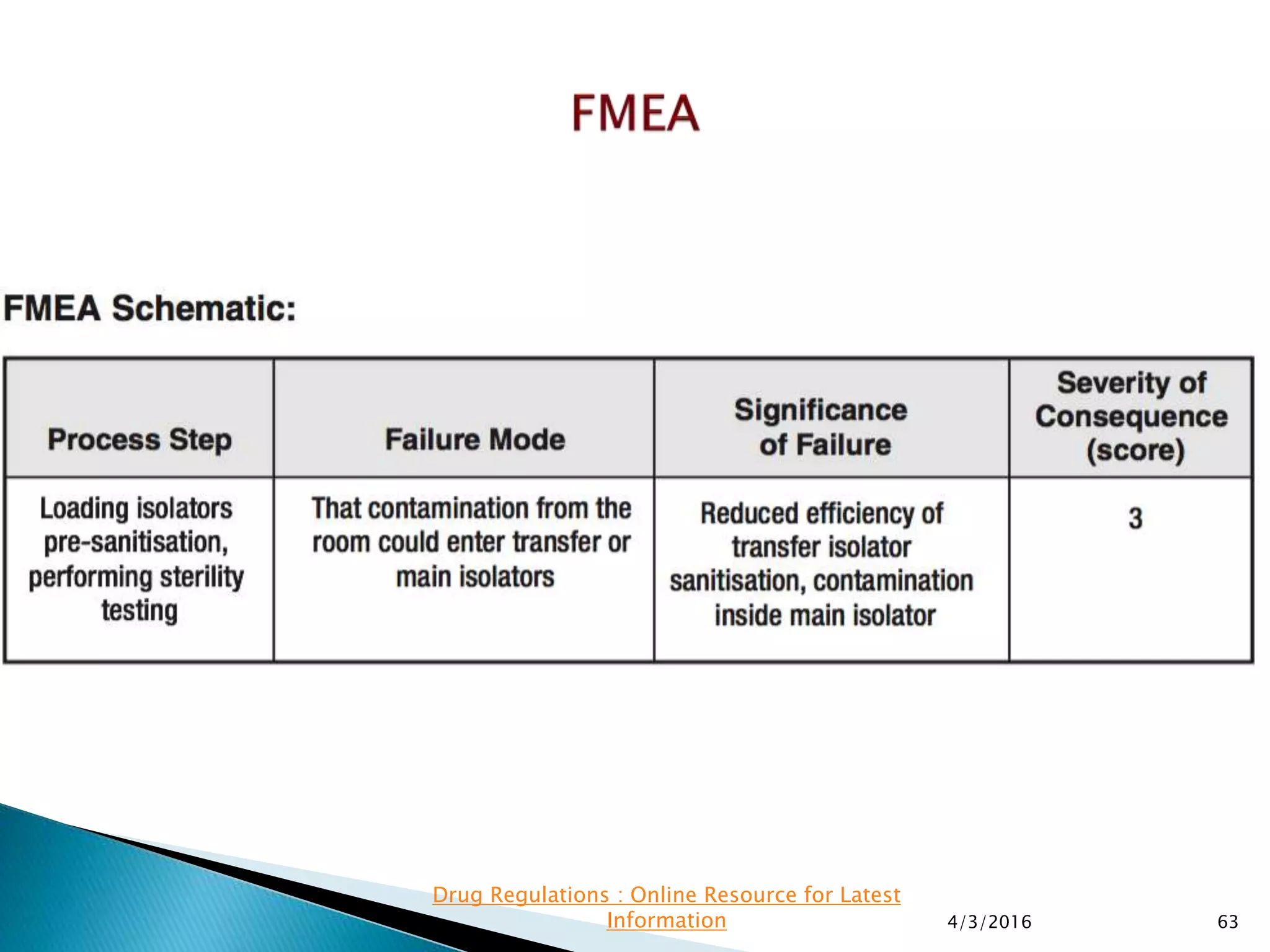
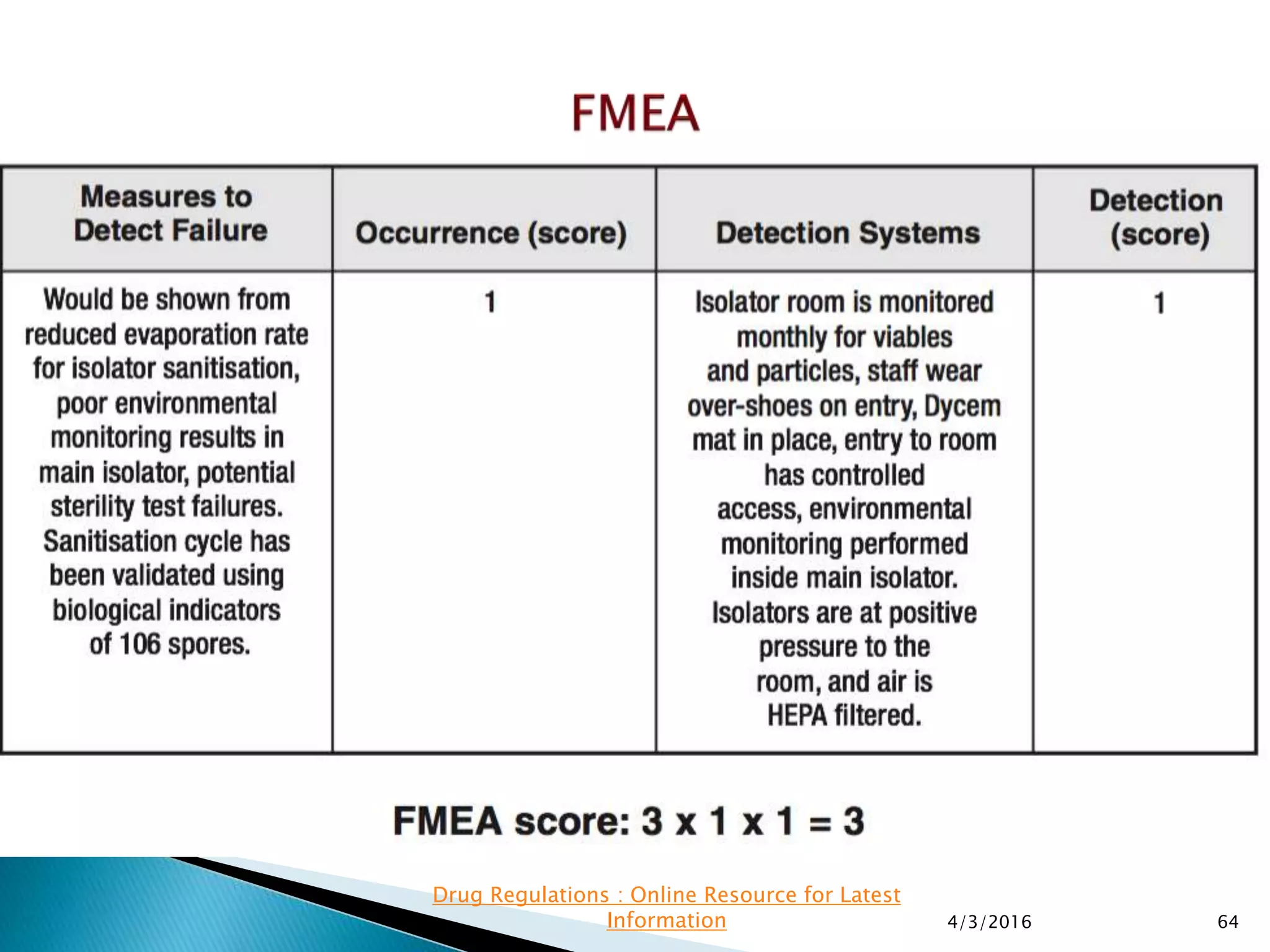
 Isolator Operation Example
 An example of one area of an isolator operation,
and the risks associated with the room in which the
isolator is housed, is examined below.
 Description of the Critical Area:
◦ The isolator is situated in an unclassified room.
◦ There is no requirement to place a sterility testing isolator in a
classified room.
4/3/2016 62
Drug Regulations : Online Resource for Latest
Information
4/3/2016 63
Drug Regulations : Online Resource for Latest
Information
4/3/2016 64
Drug Regulations : Online Resource for Latest
Information
 Analysis:
◦ There is no problem to be considered from the room
environment described.
◦ Entry to the room is controlled;
◦ The sanitization cycle has been challenged with a level of
microorganisms far greater than would ever be found in the
environment
 (spores of Geobacillus stearothermophilus);
4/3/2016 65
Drug Regulations : Online Resource for Latest
Information
 Analysis:
◦ All items entering the isolator are sanitized
 (using a chlorine dioxide-based sporicidal
disinfectant);
◦ And the isolator itself is an effective, positive
pressure barrier to the outside (at >15 pascals).
4/3/2016 66
Drug Regulations : Online Resource for Latest
Information
 Analysis:
◦ As detailed earlier, environmental monitoring is
performed inside the isolator during testing.
◦ This monitoring, which has an action level of 1
CFU (Colony Forming Unit), is designed to detect
any potential contamination inside the isolator
environment.
4/3/2016 67
Drug Regulations : Online Resource for Latest
Information
 A third component of the risk assessment approach is
to evaluate a risk once an activity has taken place.
 Then, by using a largely numerically- driven set of
tools, repeatability and reproducibility can be ensured.
 Examples of individual out-of-limits results and data-
sets relating to an operation are examined below using
examples from an aseptic filling process.
4/3/2016 68
Drug Regulations : Online Resource for Latest
Information
 Following this, an example of an overall
assessment of different processes over time is
explored.
 Numerical approaches are useful in applying a level
of consistency between one decision and another.
4/3/2016 69
Drug Regulations : Online Resource for Latest
Information
 Individual Assessments
 Some methods that can be used to quantify the risk
of contamination in pharmaceutical cleanrooms are
given in subsequent slides
 The models outlined are based on the work
performed by Whyte and Eaton (2003)
4/3/2016 70
Drug Regulations : Online Resource for Latest
Information
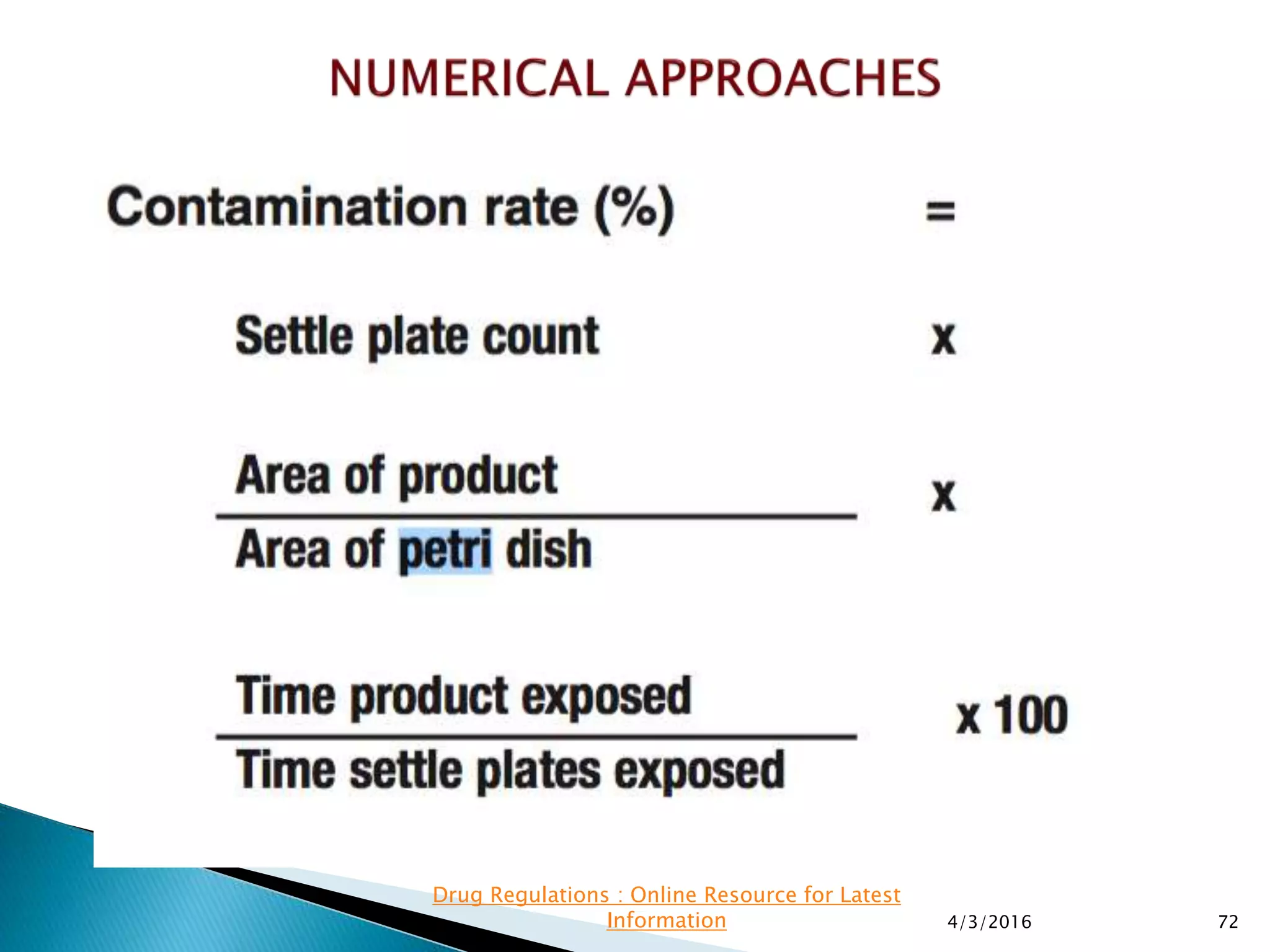
 Estimating the Risk to Product Using Settle Plate
Counts
 The method applies to the assessment of settle
plates at the point- of-fill, under the Grade A zone.
 It allows an estimate of the probable contamination
rate to the product as derived from the following
equation:
4/3/2016 71
Drug Regulations : Online Resource for Latest
Information
4/3/2016 72
Drug Regulations : Online Resource for Latest
Information
4/3/2016 73
Drug Regulations : Online Resource for Latest
Information
 The formula can also be applied to the monitoring
of product filtration activities when ‘1’ is entered as
a constant for neck area of product.
 There is no available guide as to what percentage
constitutes which level of risk.
 The 0.03% figure has been used by some
practitioners.
4/3/2016 74
Drug Regulations : Online Resource for Latest
Information
 This is based on the Parenteral Drug Association
Survey of Aseptic Filling Practices (2002),
 It is common in the pharmaceutical industry to
allow 0.03% of broth bottles in a media simulation
trial to exhibit growth at a ‘warning level’ (where
0.03% = 1/3,000, with 3,000 being the average
size of a media fill.
4/3/2016 75
Drug Regulations : Online Resource for Latest
Information
 An ‘action level’ is often set as 3/3,000 bottles or 0.1%.
 This would constitute a high risk.
 Logically, the range between 0.03 and 0.1 would be a
medium risk (Whyte and Eaton, 2004c).
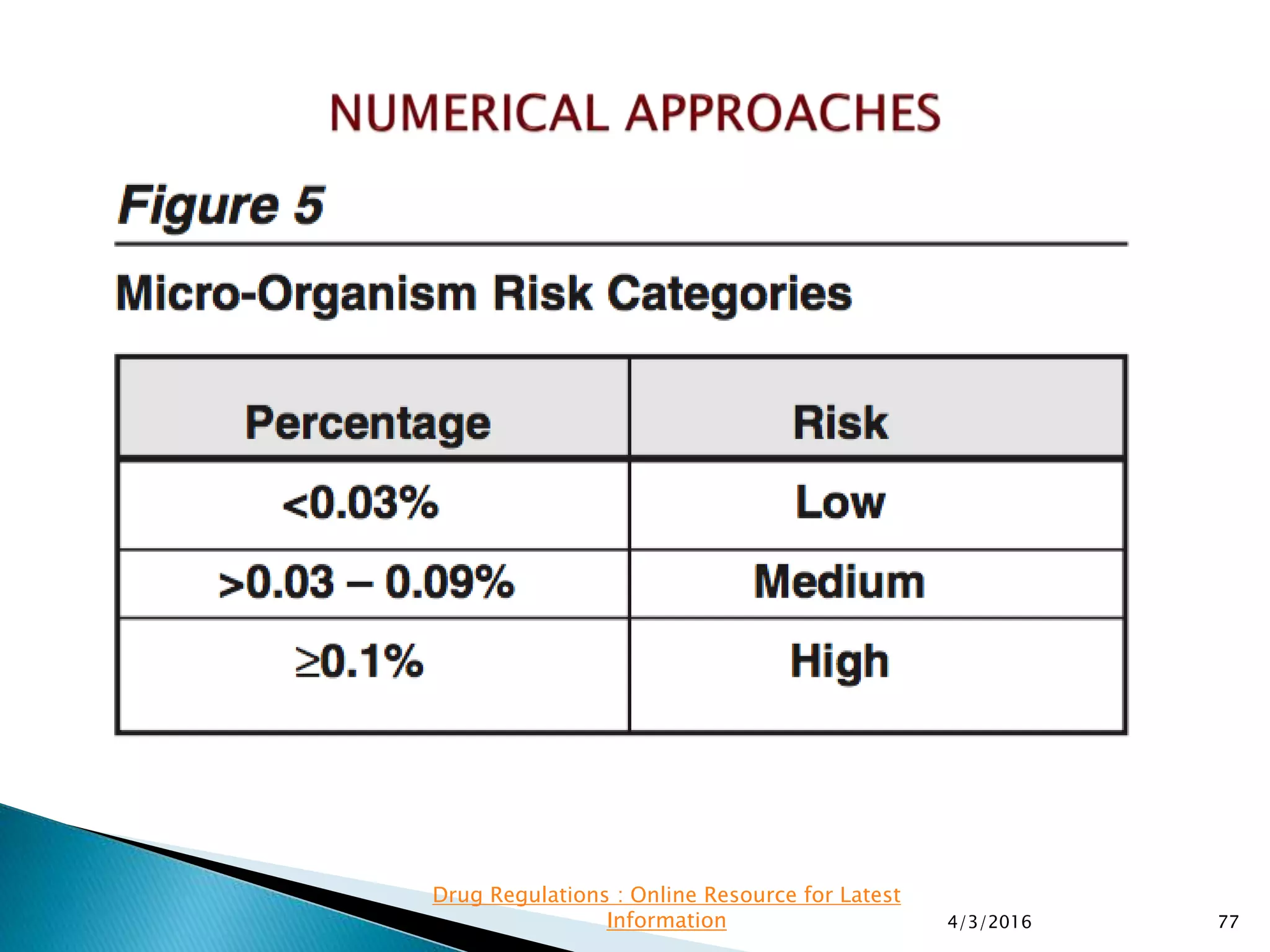
 Therefore, where the ‘risk’ is that of micro-organisms
detected on a settle plate, with a probability of <0.1%
depositing in the neck of a bottle when bottles are
exposed in a unidirectional air flow, risk categories
would be as shown in Figure 5.
4/3/2016 76
Drug Regulations : Online Resource for Latest
Information
4/3/2016 77
Drug Regulations : Online Resource for Latest
Information
 The formula can readily be applied to operations that relate
to Grade A operations, for example:
 Filtration connection, vessel to filling machine connection, the
filling activity, and loading a freeze-dryer.
 Where the operator is only present in the Grade B room and
has no impact on the Grade A operation, this is automatically
considered to be low risk if there are no other special factors.
 Low risk does not imply lack of action or assessment.
 However, it aims conceptualization of the result in terms of
probable risk to the batch.
4/3/2016 78
Drug Regulations : Online Resource for Latest
Information
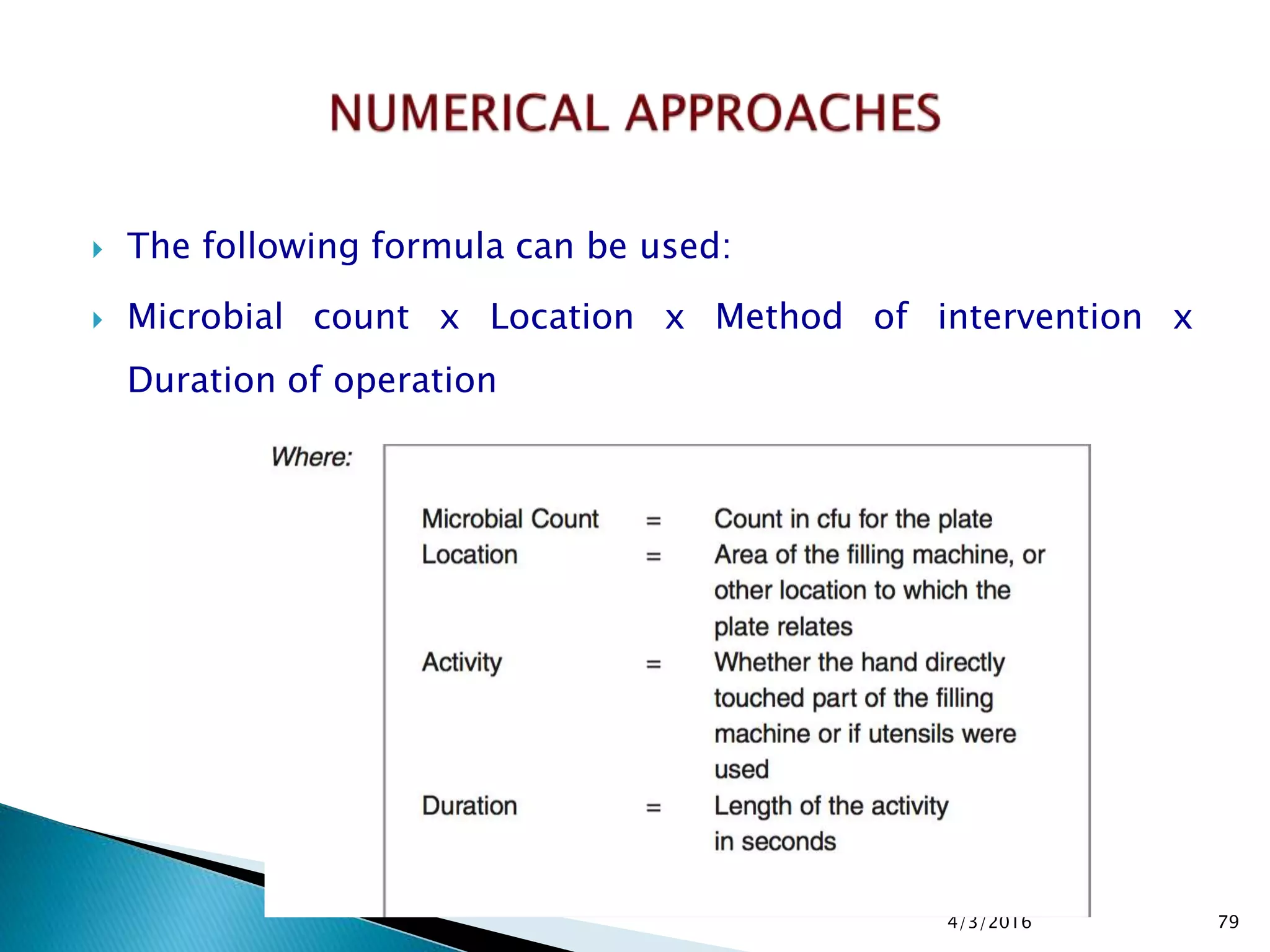
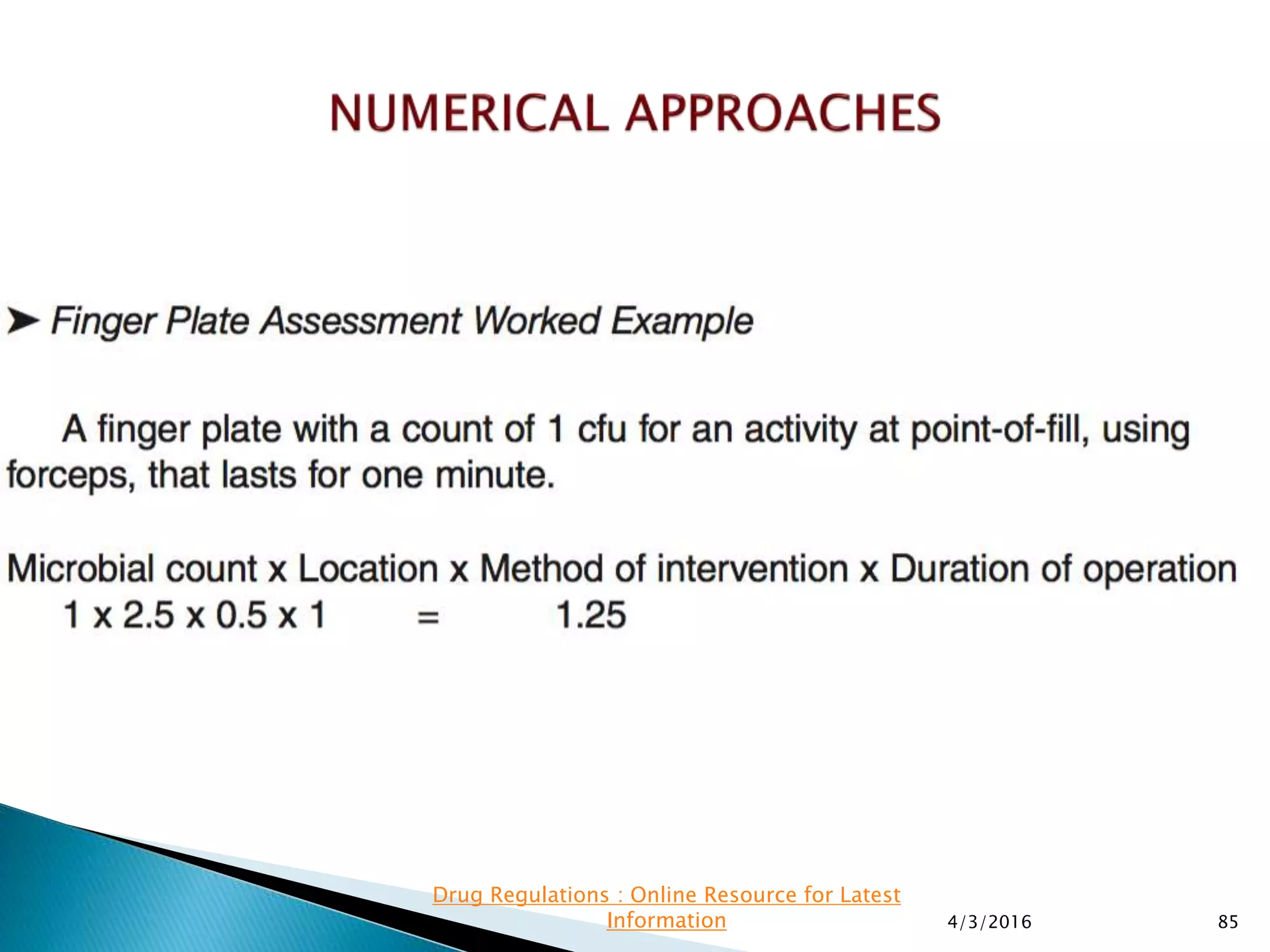
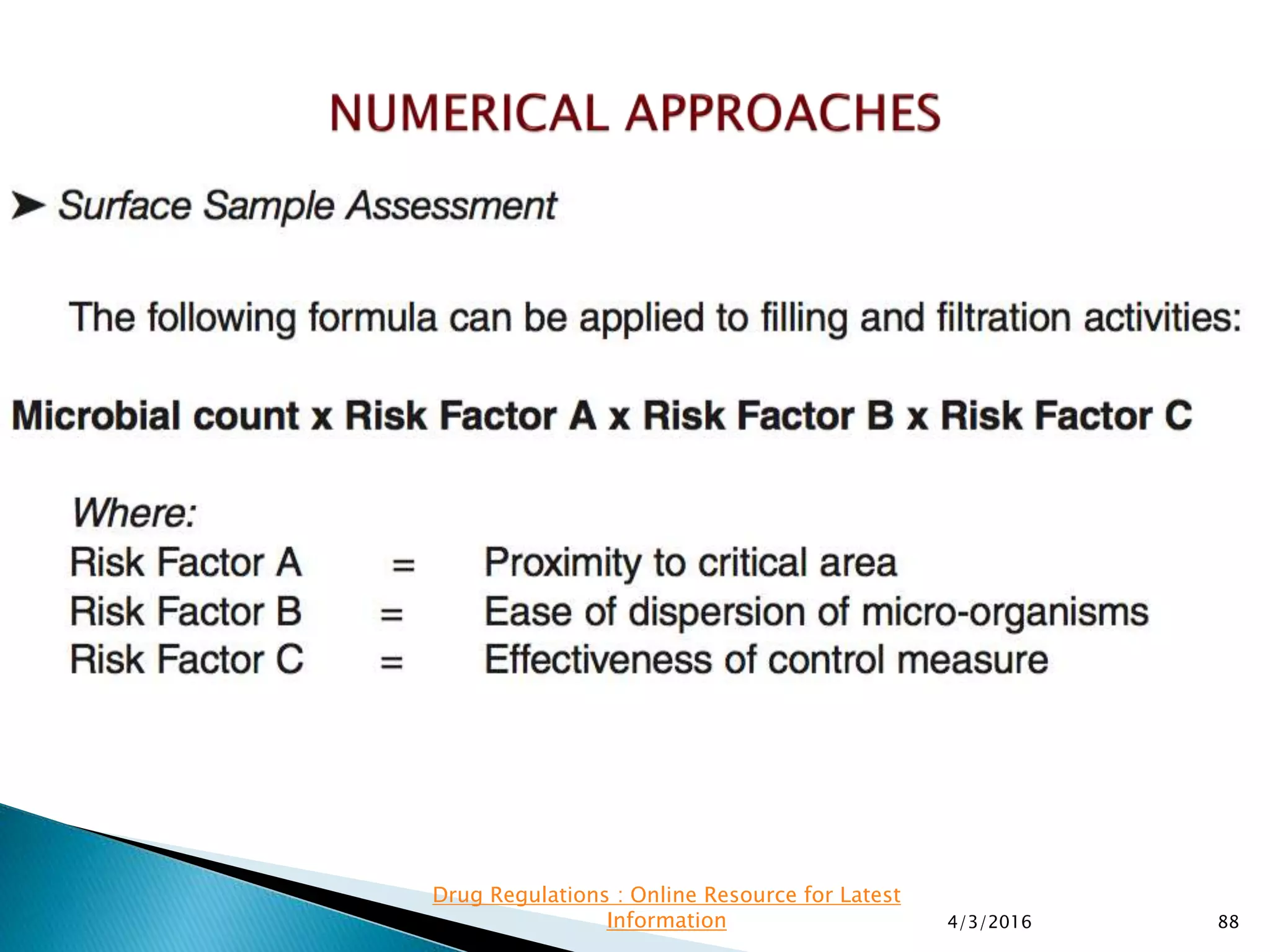
 The following formula can be used:
 Microbial count x Location x Method of intervention x
Duration of operation
4/3/2016 79
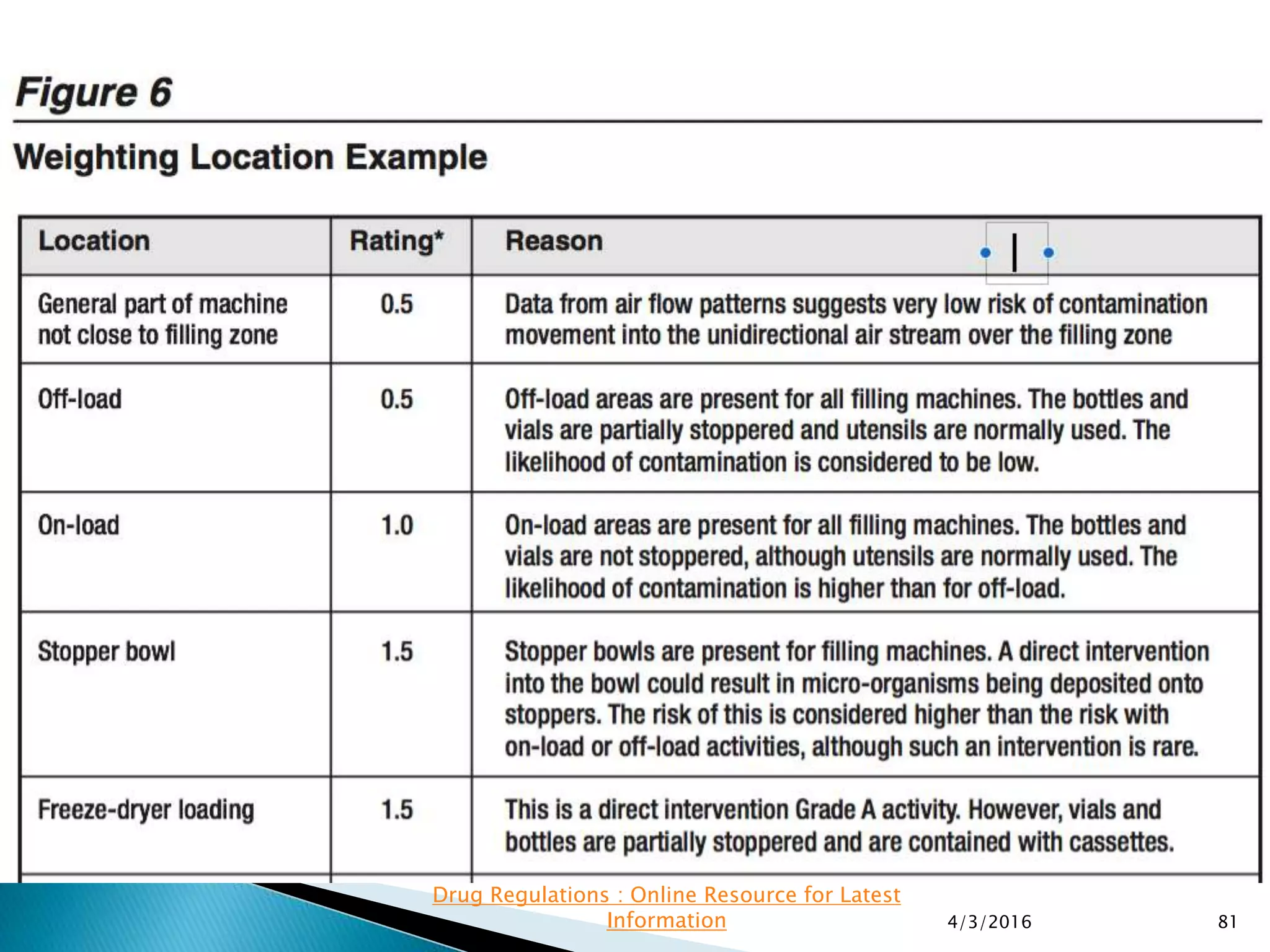
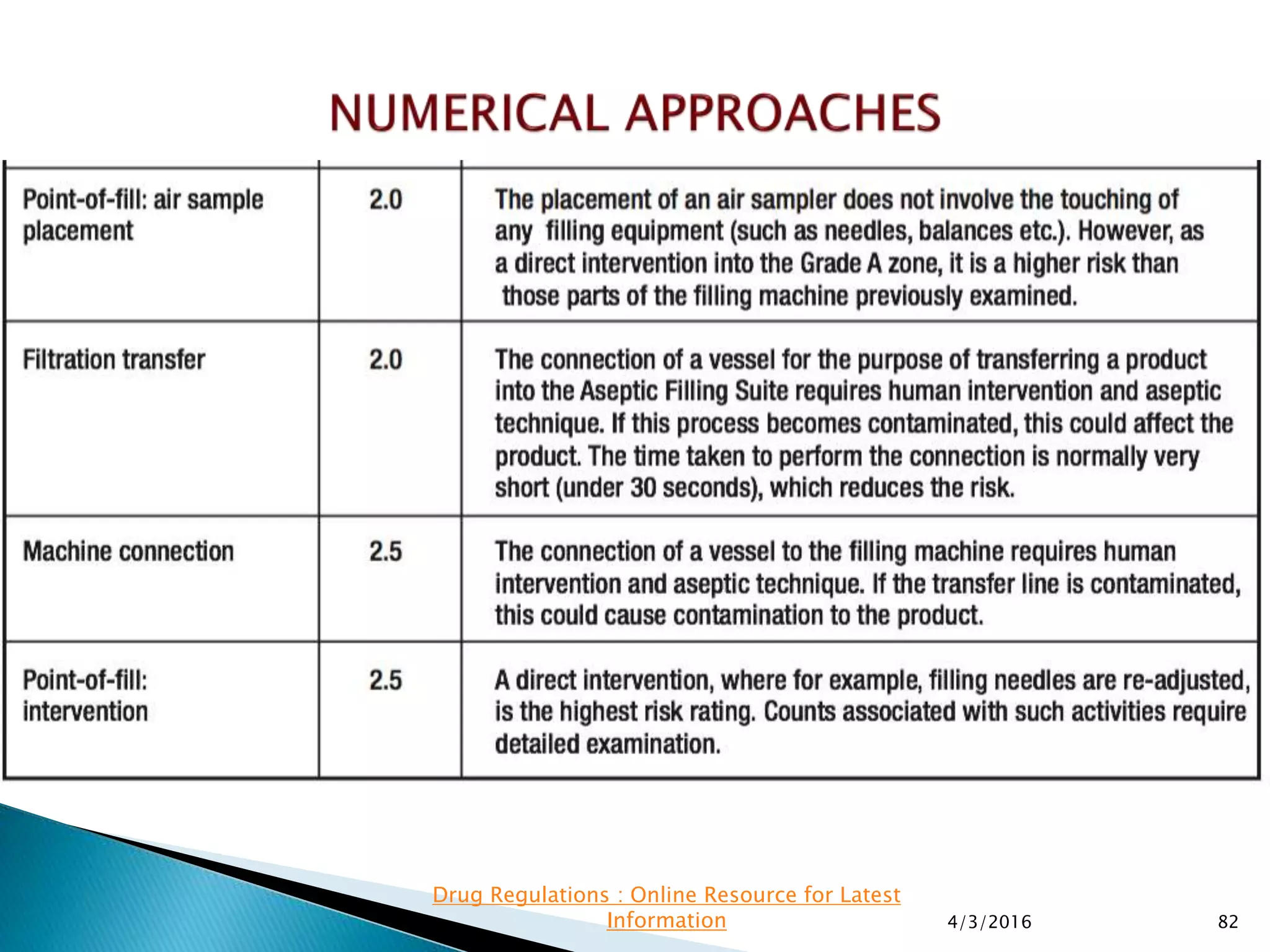
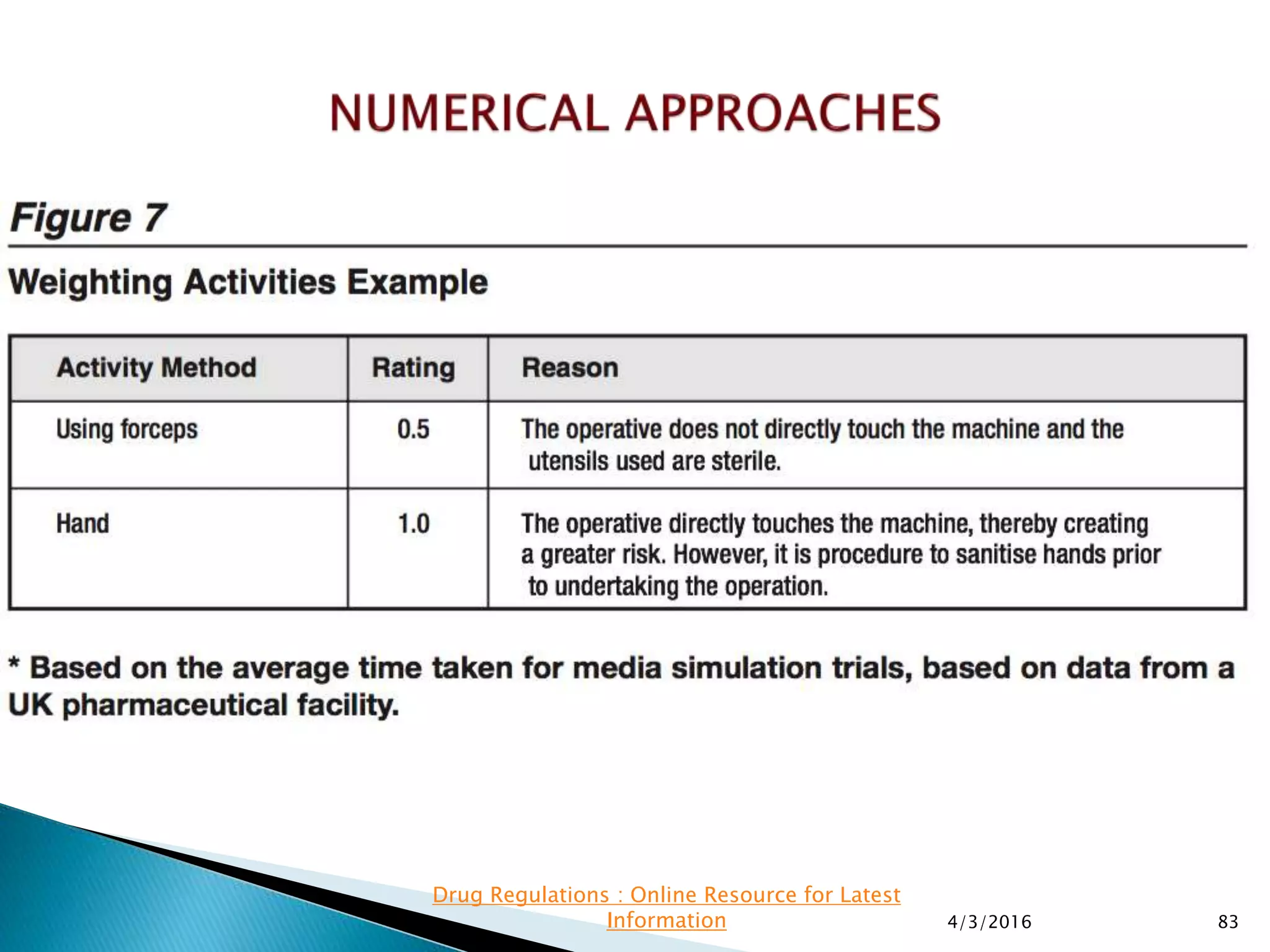
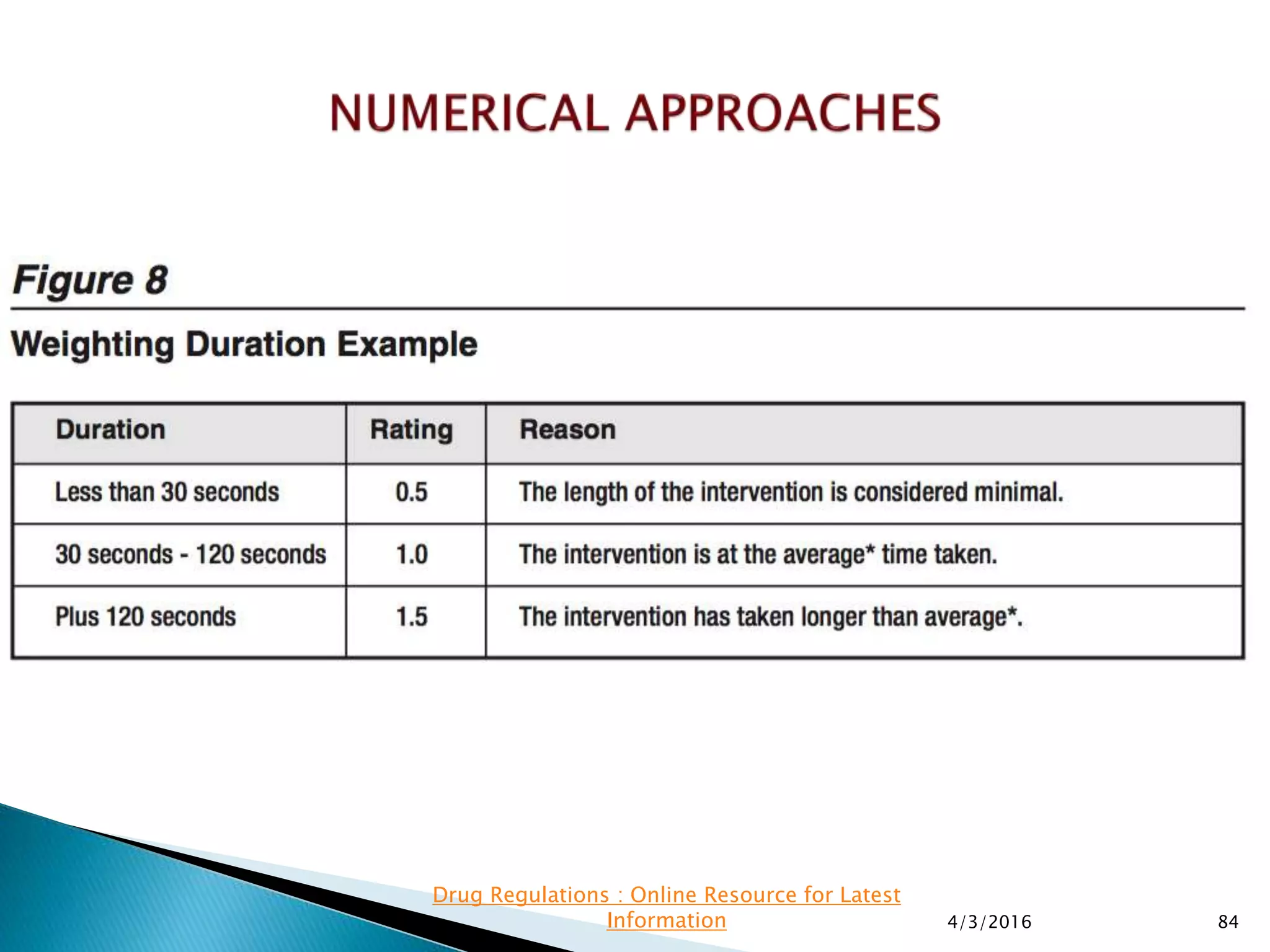
 In this example of a finger plate assessment, the location,
activities, and duration require weighting.
 Examples of logic that apply to the rating of the location,
activities, and duration categories can be seen in Figures 6, 7,
and 8, respectively
4/3/2016 80
Drug Regulations : Online Resource for Latest
Information
4/3/2016 81
Drug Regulations : Online Resource for Latest
Information
4/3/2016 82
Drug Regulations : Online Resource for Latest
Information
4/3/2016 83
Drug Regulations : Online Resource for Latest
Information
4/3/2016 84
Drug Regulations : Online Resource for Latest
Information
4/3/2016 85
Drug Regulations : Online Resource for Latest
Information
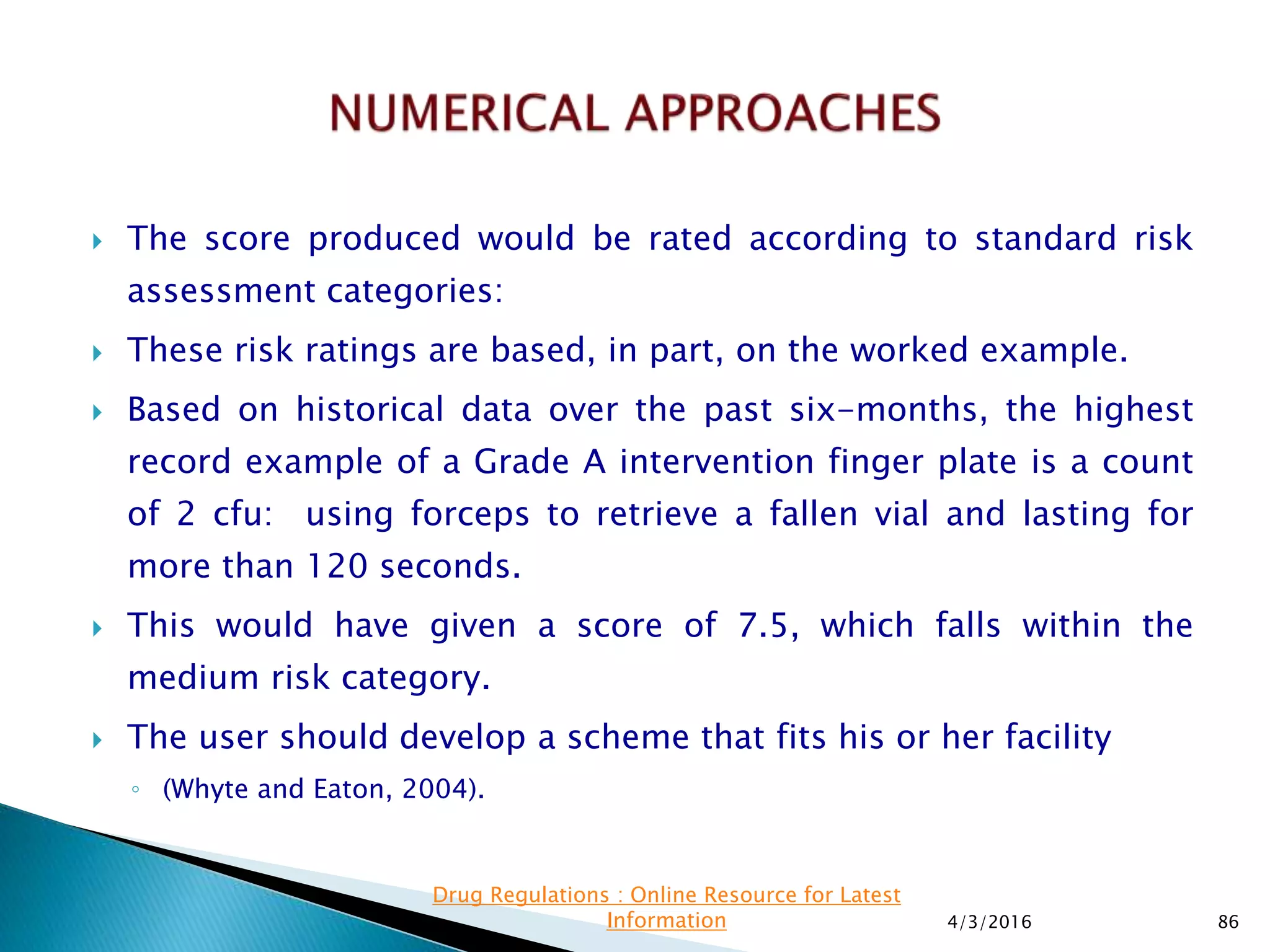
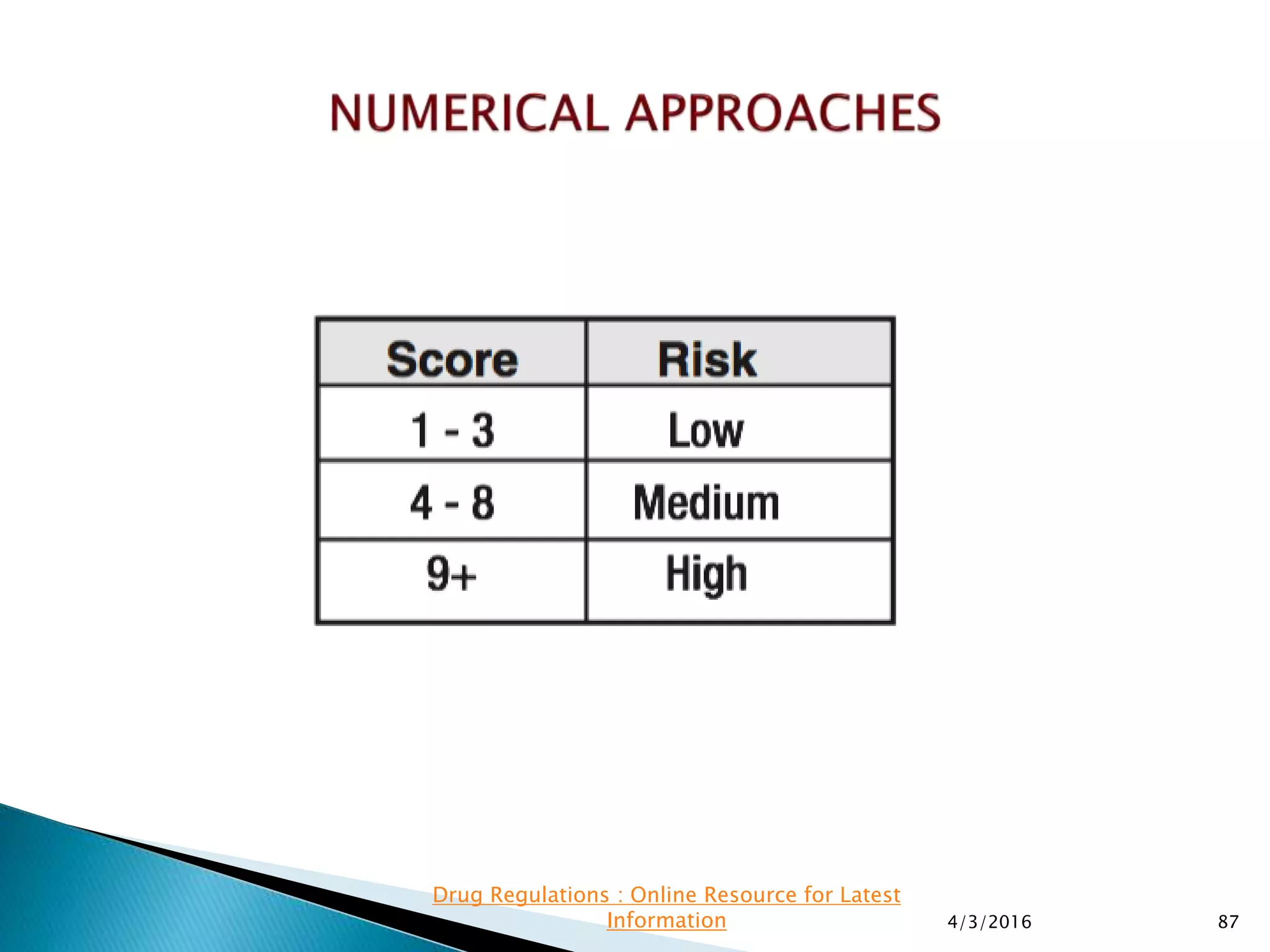
 The score produced would be rated according to standard risk
assessment categories:
 These risk ratings are based, in part, on the worked example.
 Based on historical data over the past six-months, the highest
record example of a Grade A intervention finger plate is a count
of 2 cfu: using forceps to retrieve a fallen vial and lasting for
more than 120 seconds.
 This would have given a score of 7.5, which falls within the
medium risk category.
 The user should develop a scheme that fits his or her facility
◦ (Whyte and Eaton, 2004).
4/3/2016 86
Drug Regulations : Online Resource for Latest
Information
4/3/2016 87
Drug Regulations : Online Resource for Latest
Information
4/3/2016 88
Drug Regulations : Online Resource for Latest
Information
4/3/2016 89
Drug Regulations : Online Resource for Latest
Information
4/3/2016 90
Drug Regulations : Online Resource for Latest
Information
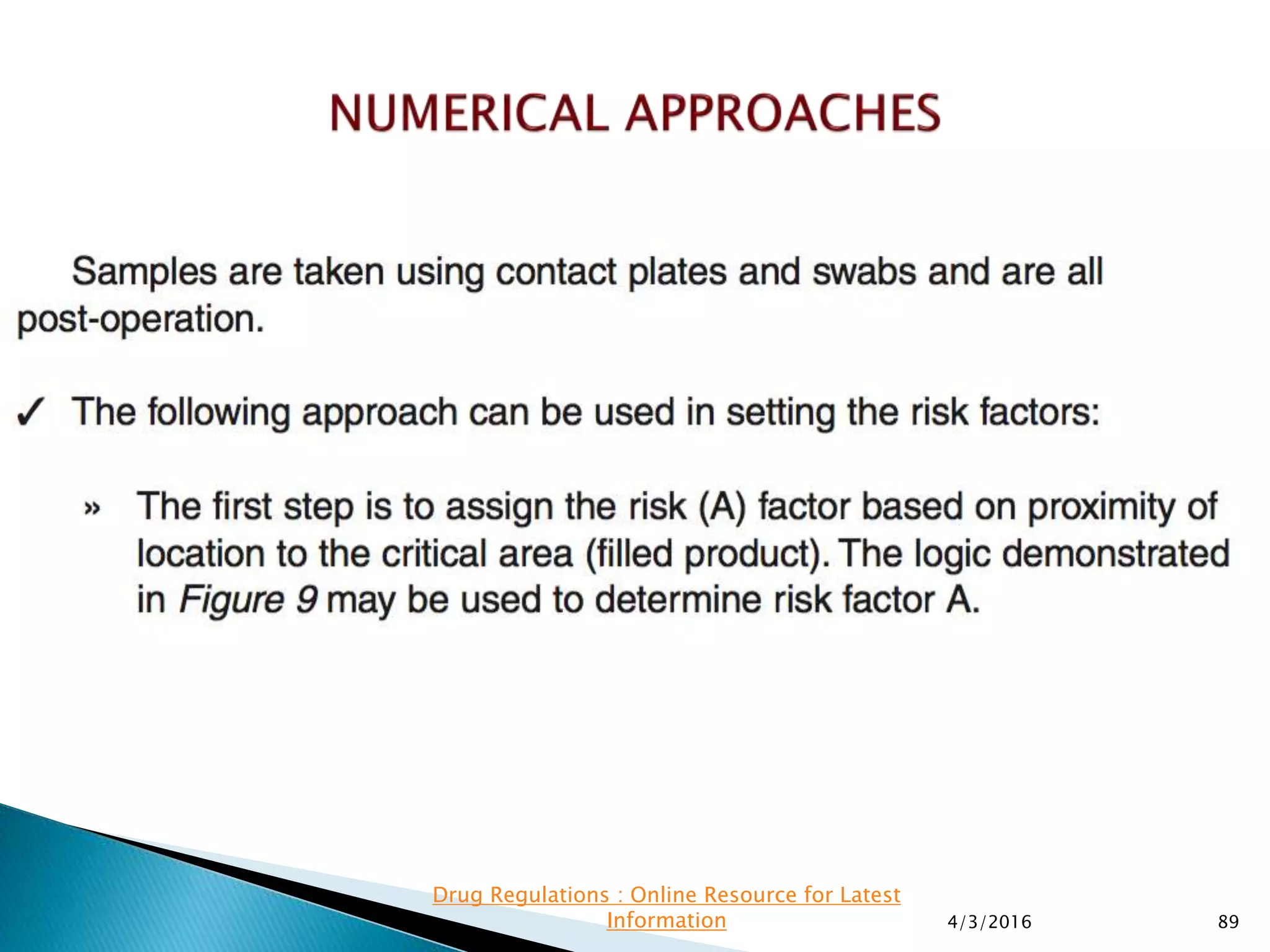
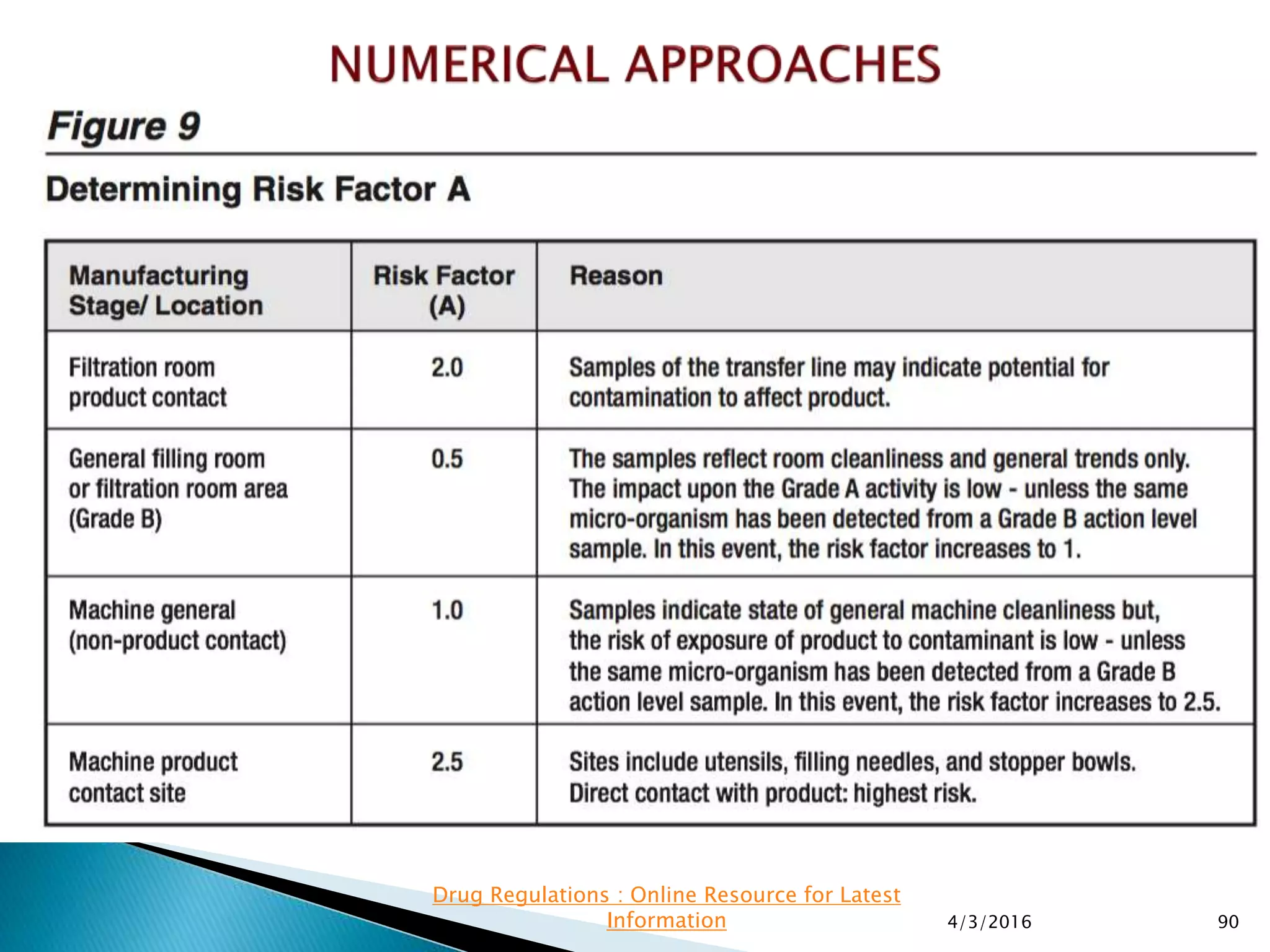
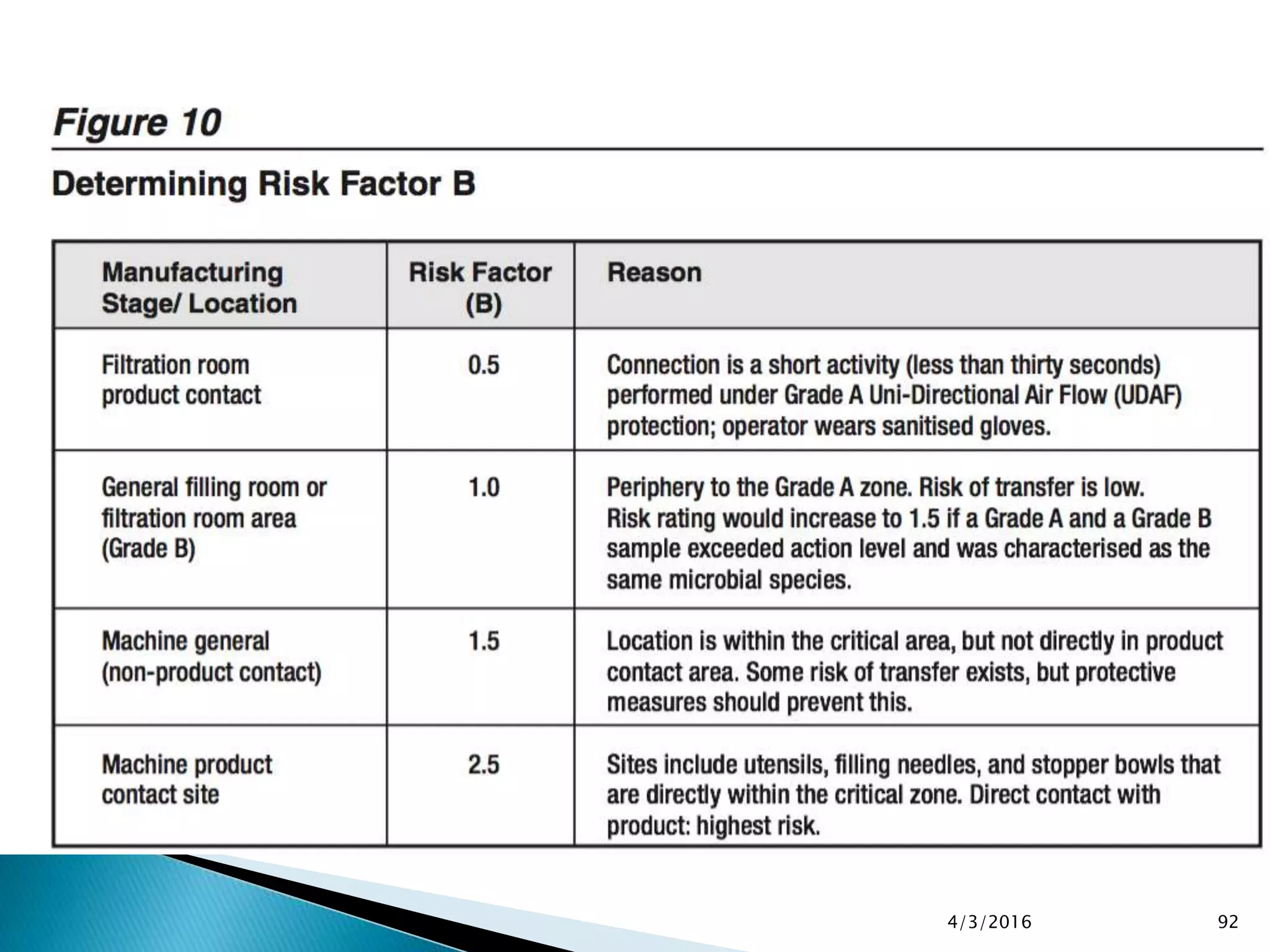
 The second step is to assign a risk factor (B)
based on ease of dispersion or transfer of
micro-organisms.
 See Figure 10 for an example of the
reasoning that would support Risk Factor B.
4/3/2016 91
Drug Regulations : Online Resource for Latest
Information
4/3/2016 92
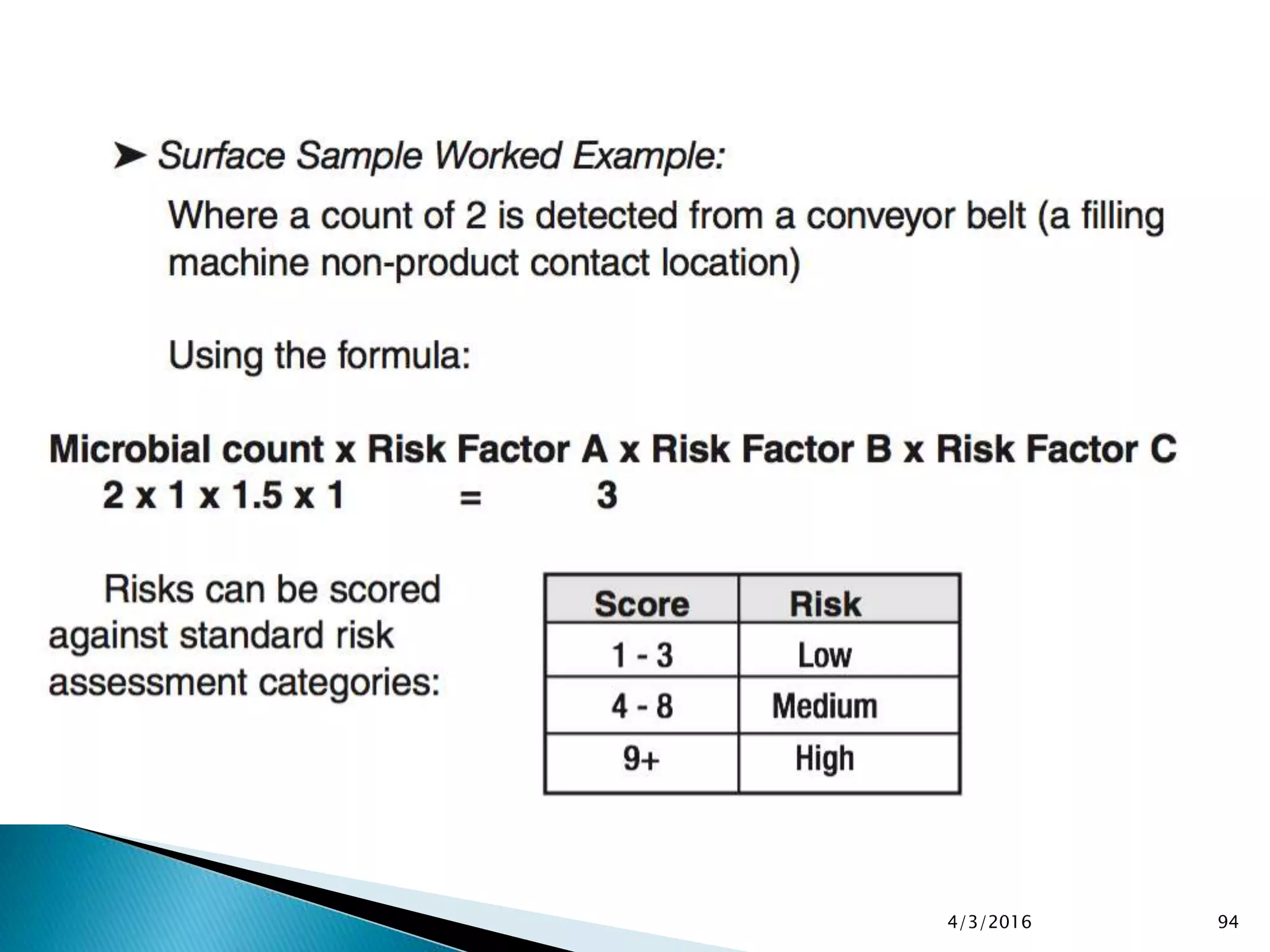
 The third step is to weight the risk factor
‘C’ by assessing the effectiveness of the
control measure.
 See Figure 11 for an example of this
assessment.
4/3/2016 93
Drug Regulations : Online Resource for Latest
Information
4/3/2016 94
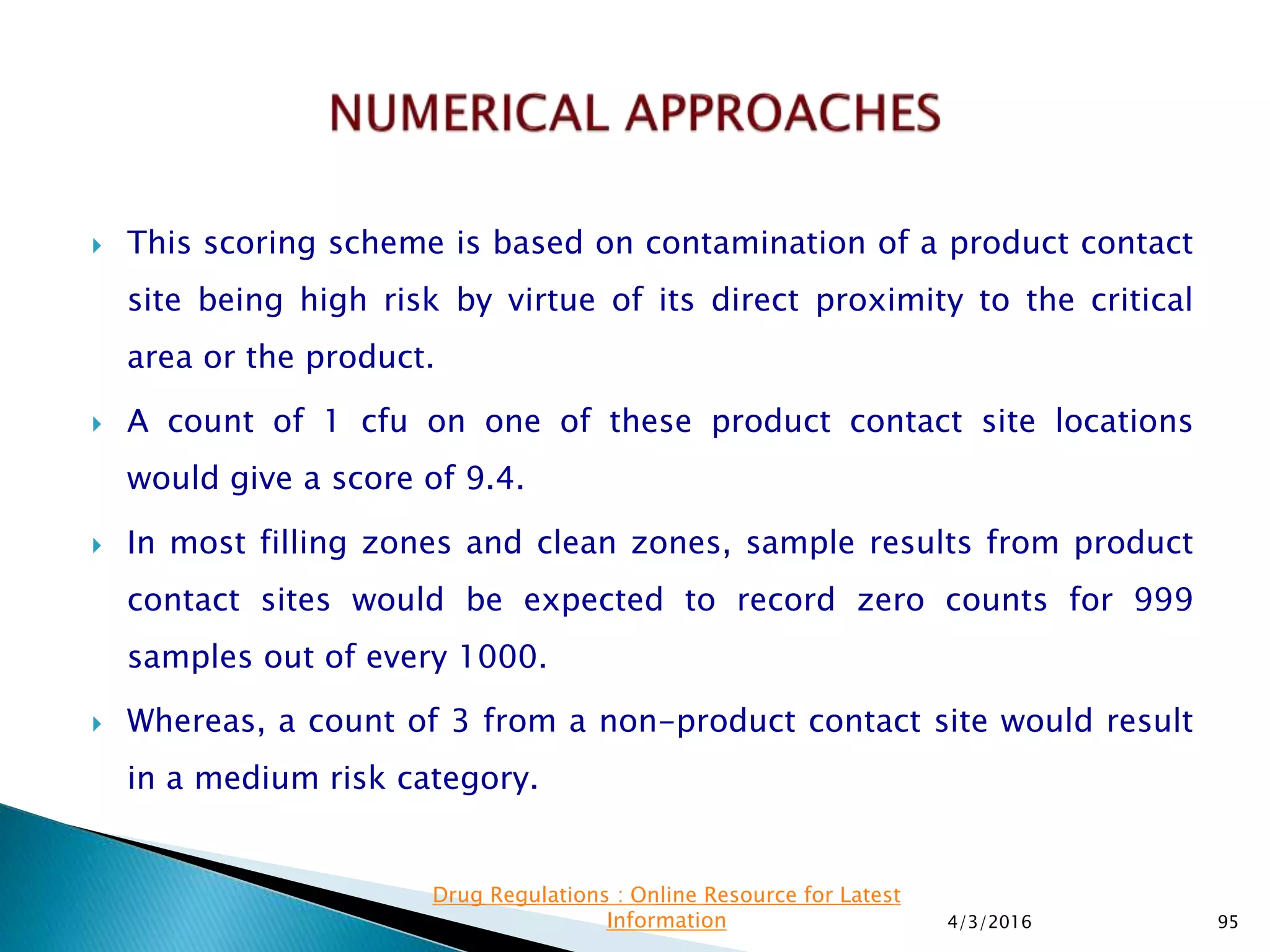
 This scoring scheme is based on contamination of a product contact
site being high risk by virtue of its direct proximity to the critical
area or the product.
 A count of 1 cfu on one of these product contact site locations
would give a score of 9.4.
 In most filling zones and clean zones, sample results from product
contact sites would be expected to record zero counts for 999
samples out of every 1000.
 Whereas, a count of 3 from a non-product contact site would result
in a medium risk category.
4/3/2016 95
Drug Regulations : Online Resource for Latest
Information
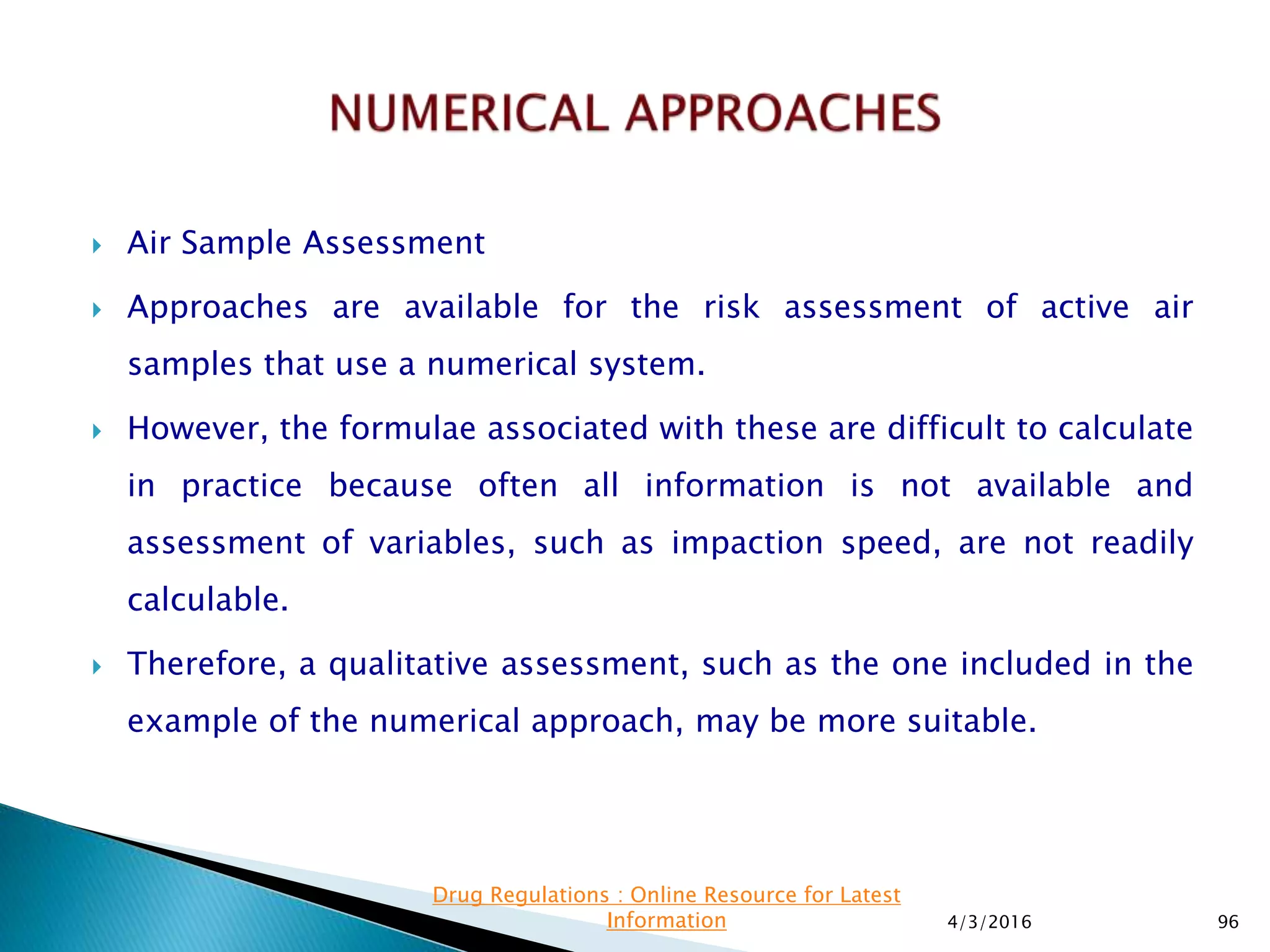
 Air Sample Assessment
 Approaches are available for the risk assessment of active air
samples that use a numerical system.
 However, the formulae associated with these are difficult to calculate
in practice because often all information is not available and
assessment of variables, such as impaction speed, are not readily
calculable.
 Therefore, a qualitative assessment, such as the one included in the
example of the numerical approach, may be more suitable.
4/3/2016 96
Drug Regulations : Online Resource for Latest
Information
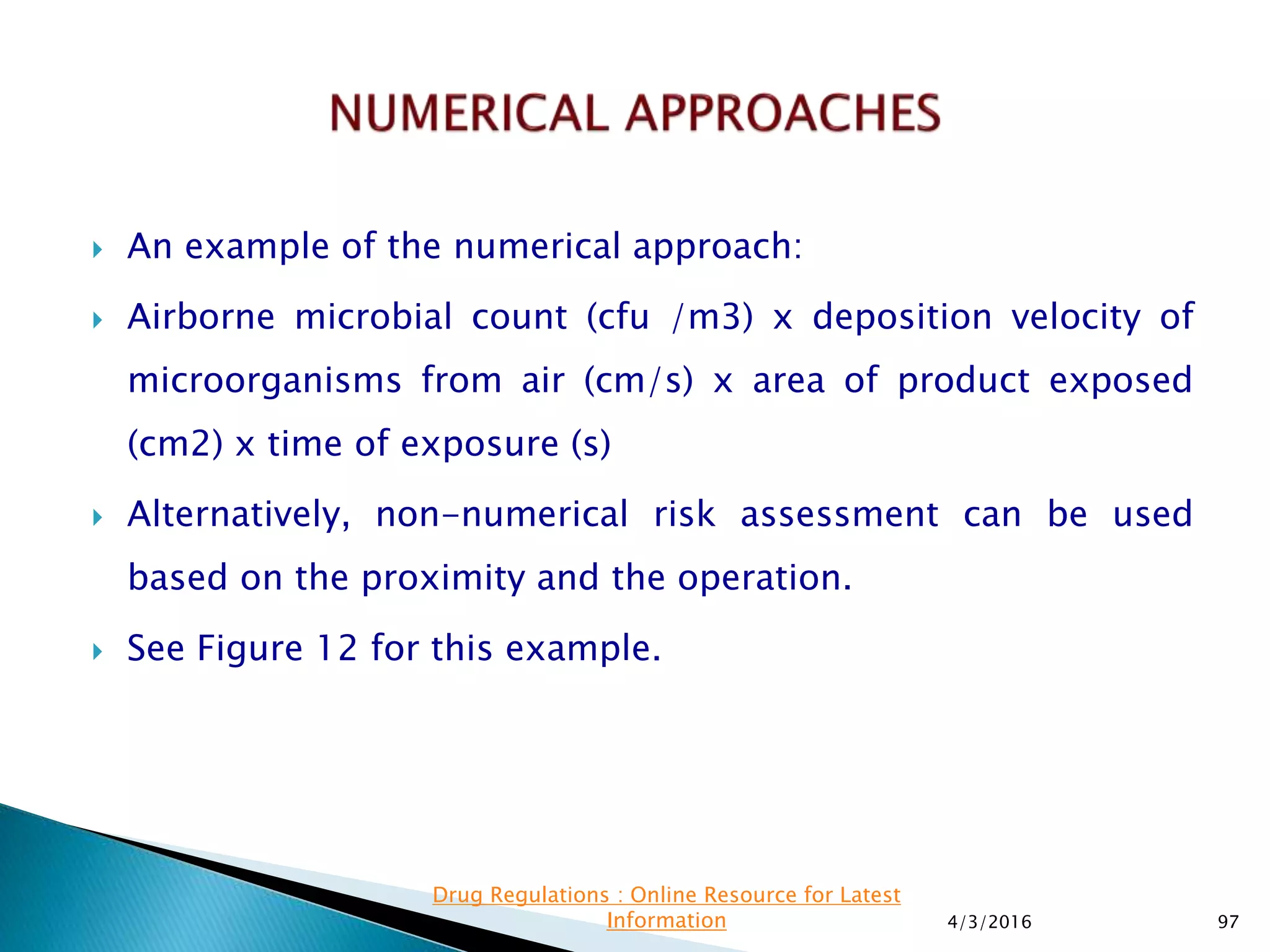
 An example of the numerical approach:
 Airborne microbial count (cfu /m3) x deposition velocity of
microorganisms from air (cm/s) x area of product exposed
(cm2) x time of exposure (s)
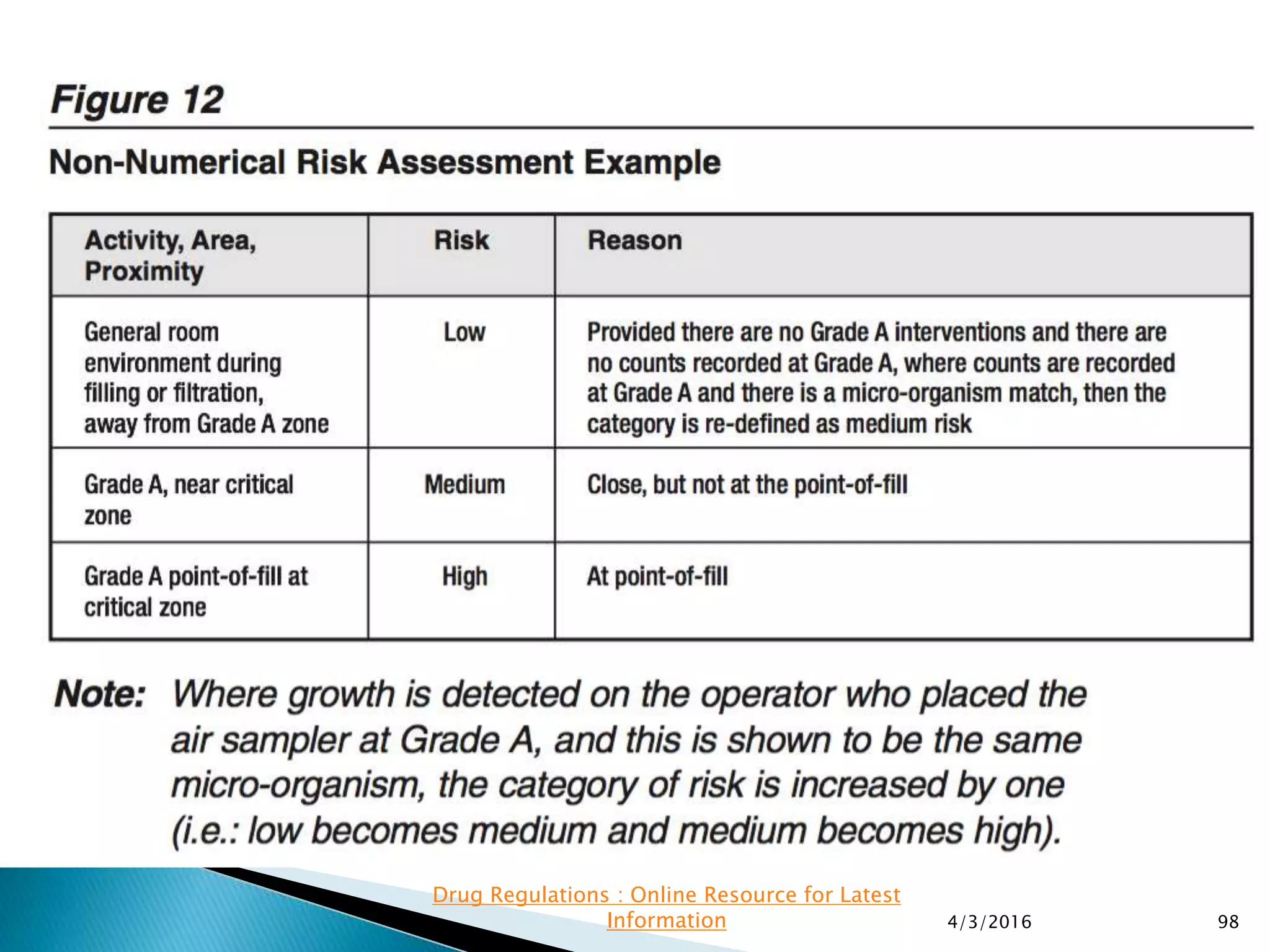
 Alternatively, non-numerical risk assessment can be used
based on the proximity and the operation.
 See Figure 12 for this example.
4/3/2016 97
Drug Regulations : Online Resource for Latest
Information
4/3/2016 98
Drug Regulations : Online Resource for Latest
Information
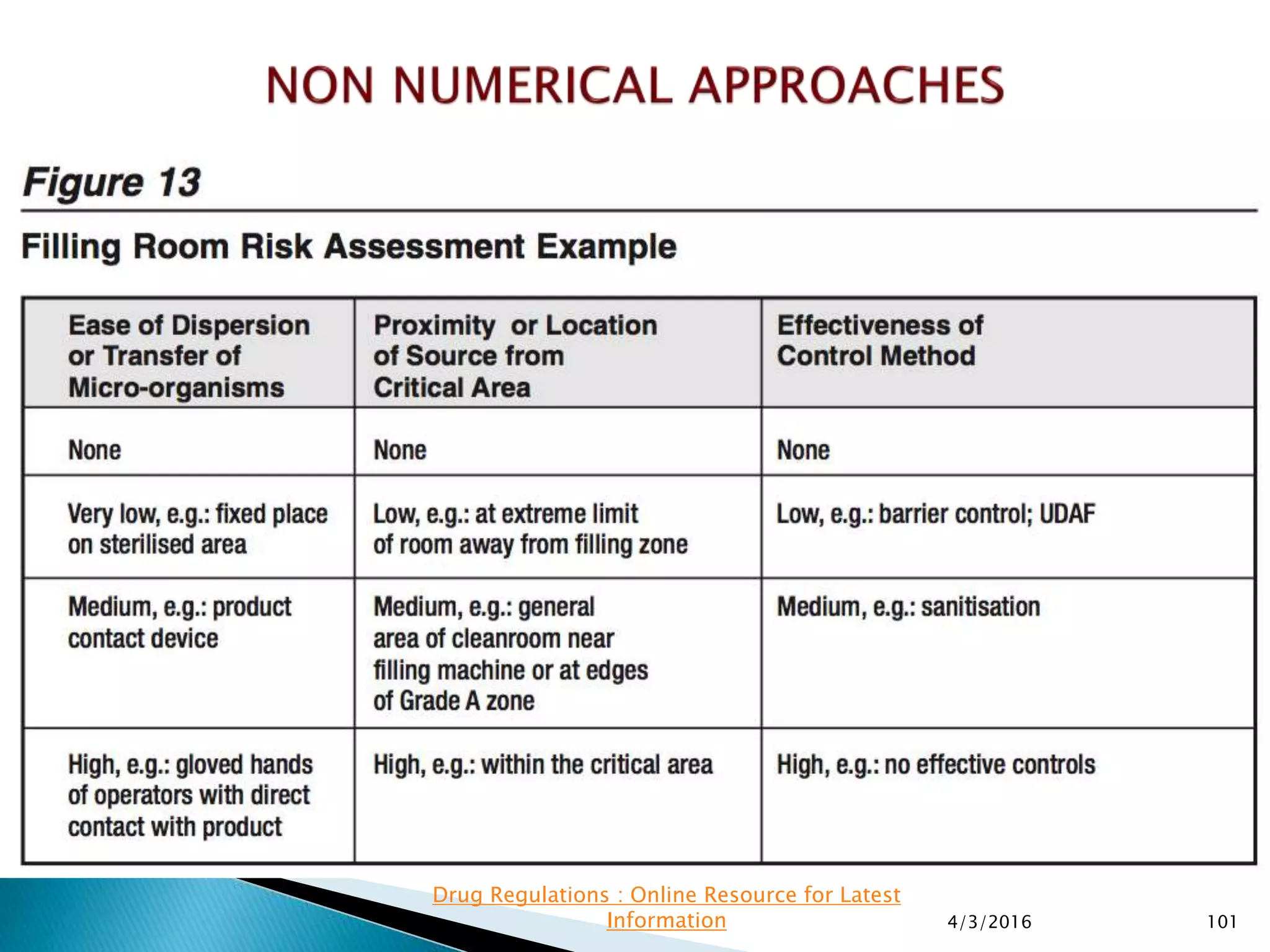
 Assigning a Risk Factor to Areas of the Filling Room
 The location where a high bio-burden is isolated within the
filling area is arguably of greater consequence than the actual
count.
 The location can be given a risk rating
◦ In relation to its proximity to the critical zone,
◦ Ease of dispersion or transfer, and
◦ Effectiveness of control methods
4/3/2016 99
Drug Regulations : Online Resource for Latest
Information
 The table shown in Figure 13 is proposed as a tool for risk
assessment and to aid investigations.
 It supplements the risk assessment tools that have been
previously examined.
4/3/2016 100
Drug Regulations : Online Resource for Latest
Information
4/3/2016 101
Drug Regulations : Online Resource for Latest
Information
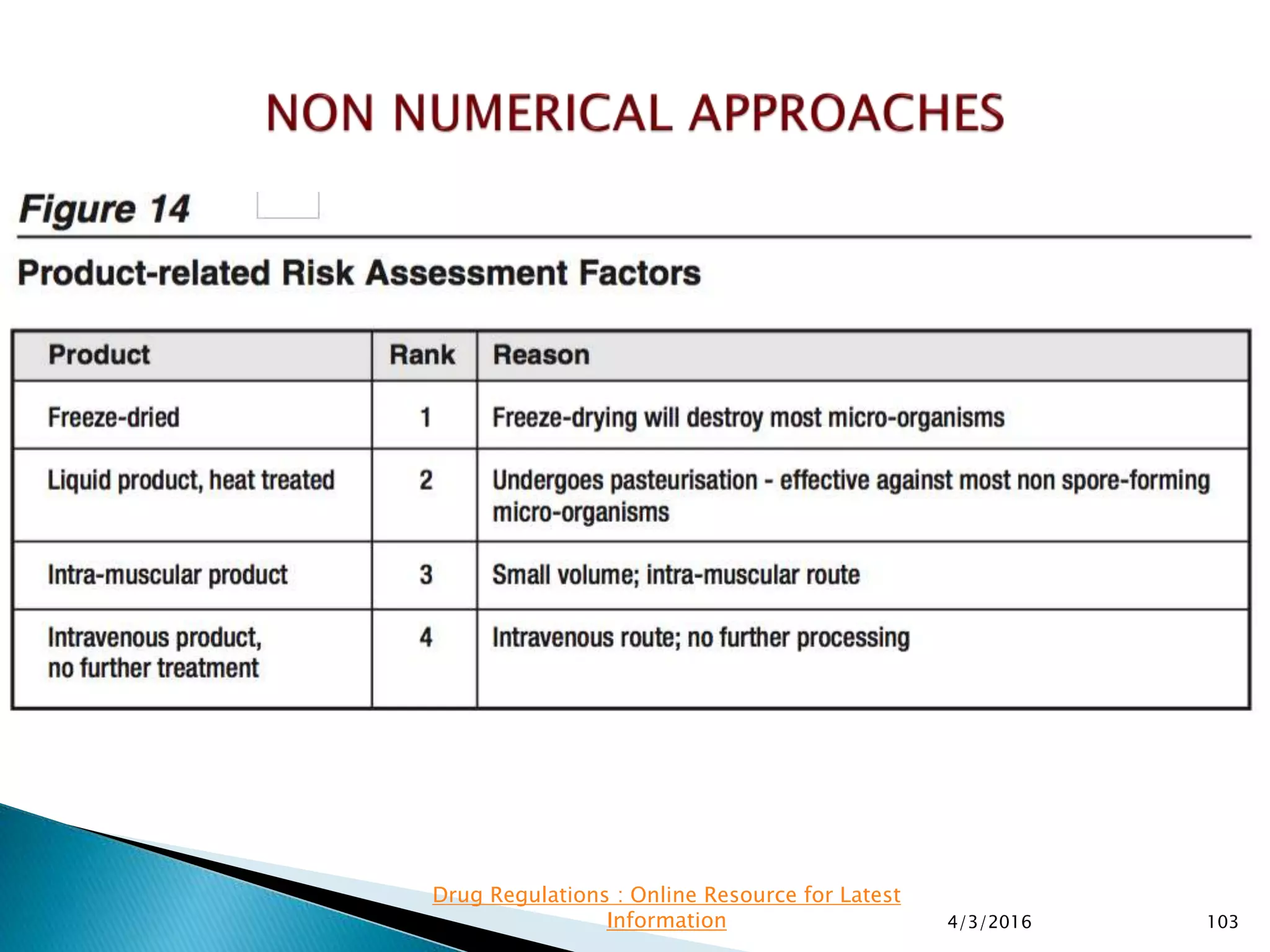
 The type of product and whether further processing occurs
can also influence the risk factors.
 See Figure 14 for an example.
 In considering batches with a high risk rating, further
processing of the product can be considered and ranked
 (1 = lowest risk, 4 = highest risk).
4/3/2016 102
Drug Regulations : Online Resource for Latest
Information
4/3/2016 103
Drug Regulations : Online Resource for Latest
Information
 An Overall Assessment
 The approach taken for an overall assessment involves the
historical examination of a number of operations and
assigning a value above which the operation is considered to
be atypical.
 A 95% cut-off is considered to be the most suitable cut-off
point.
4/3/2016 104
Drug Regulations : Online Resource for Latest
Information
4/3/2016 105
Drug Regulations : Online Resource for Latest
Information
 Criticality scoring is a way of assessing the totality of results
from an environmental monitoring session.
 This may be, for example, a batch fill.
 The data from the session is examined and points are awarded
for each result above a pre-set warning or action level.
 The total score is then summed and the results obtained are
compared to a set level at which atypical sessions are indicated.
 The pre-set level would be assessed from historical data over a
reasonable time period (such as one year).
4/3/2016 106
Drug Regulations : Online Resource for Latest
Information
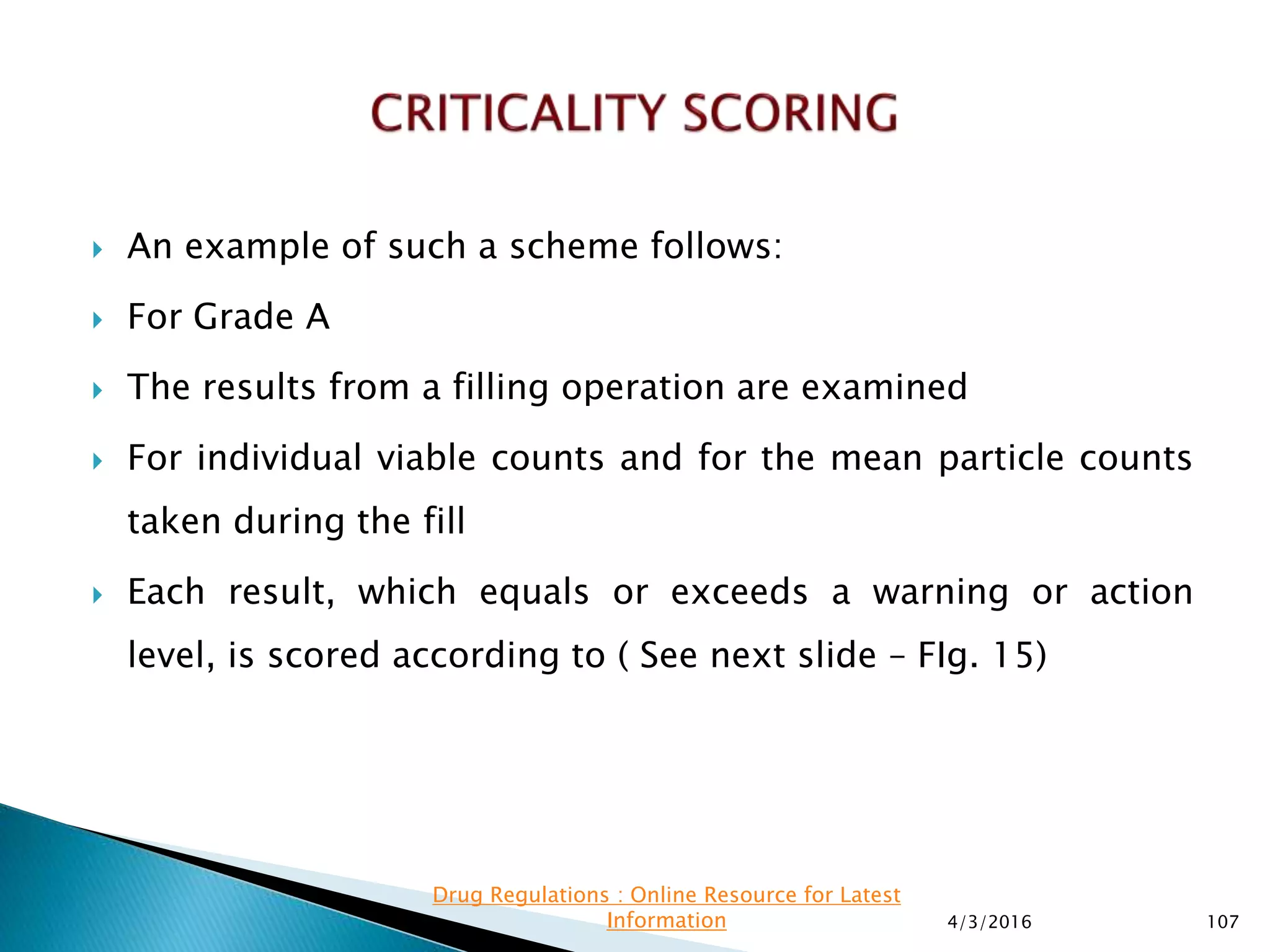
 An example of such a scheme follows:
 For Grade A
 The results from a filling operation are examined
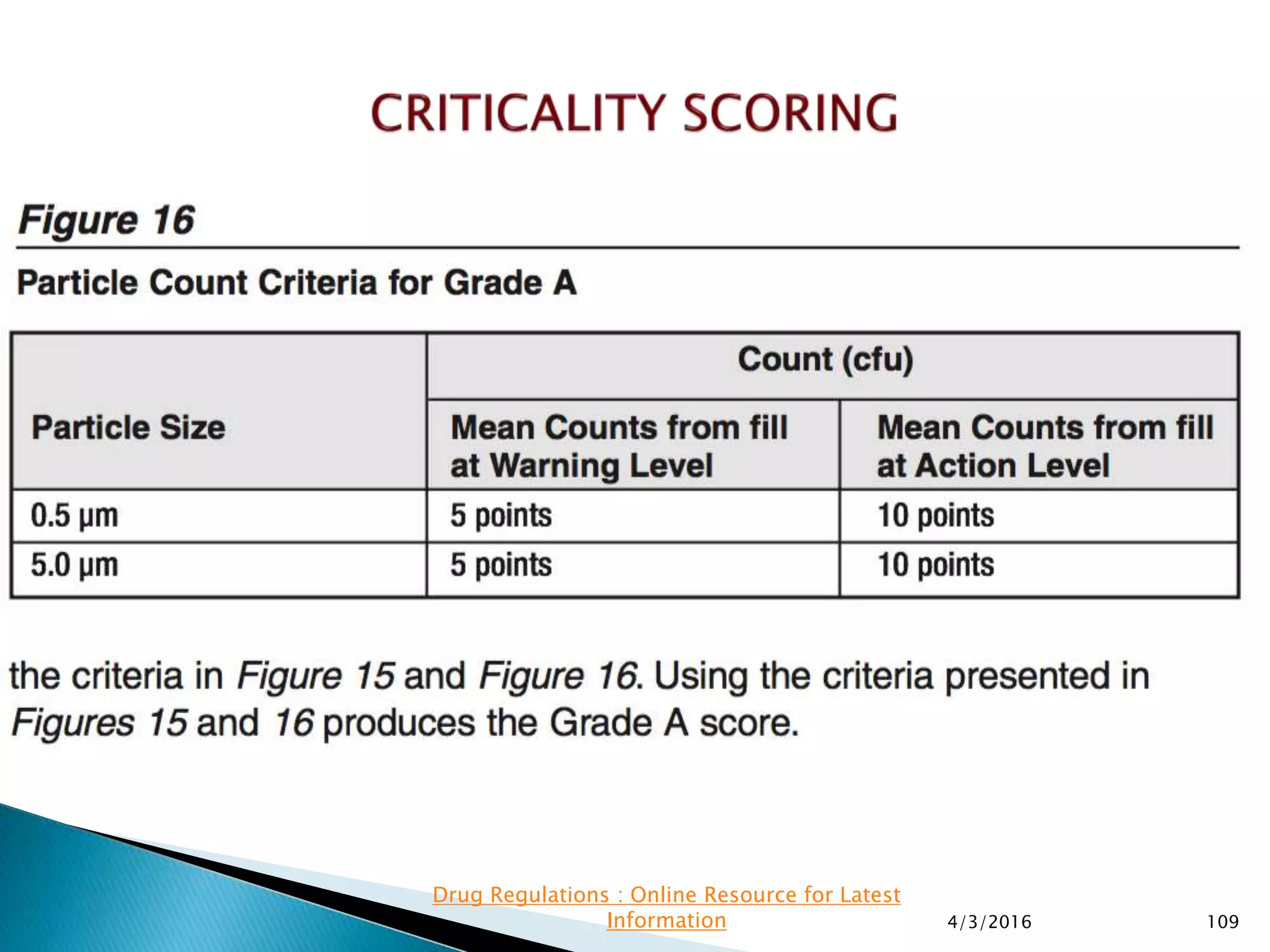
 For individual viable counts and for the mean particle counts
taken during the fill
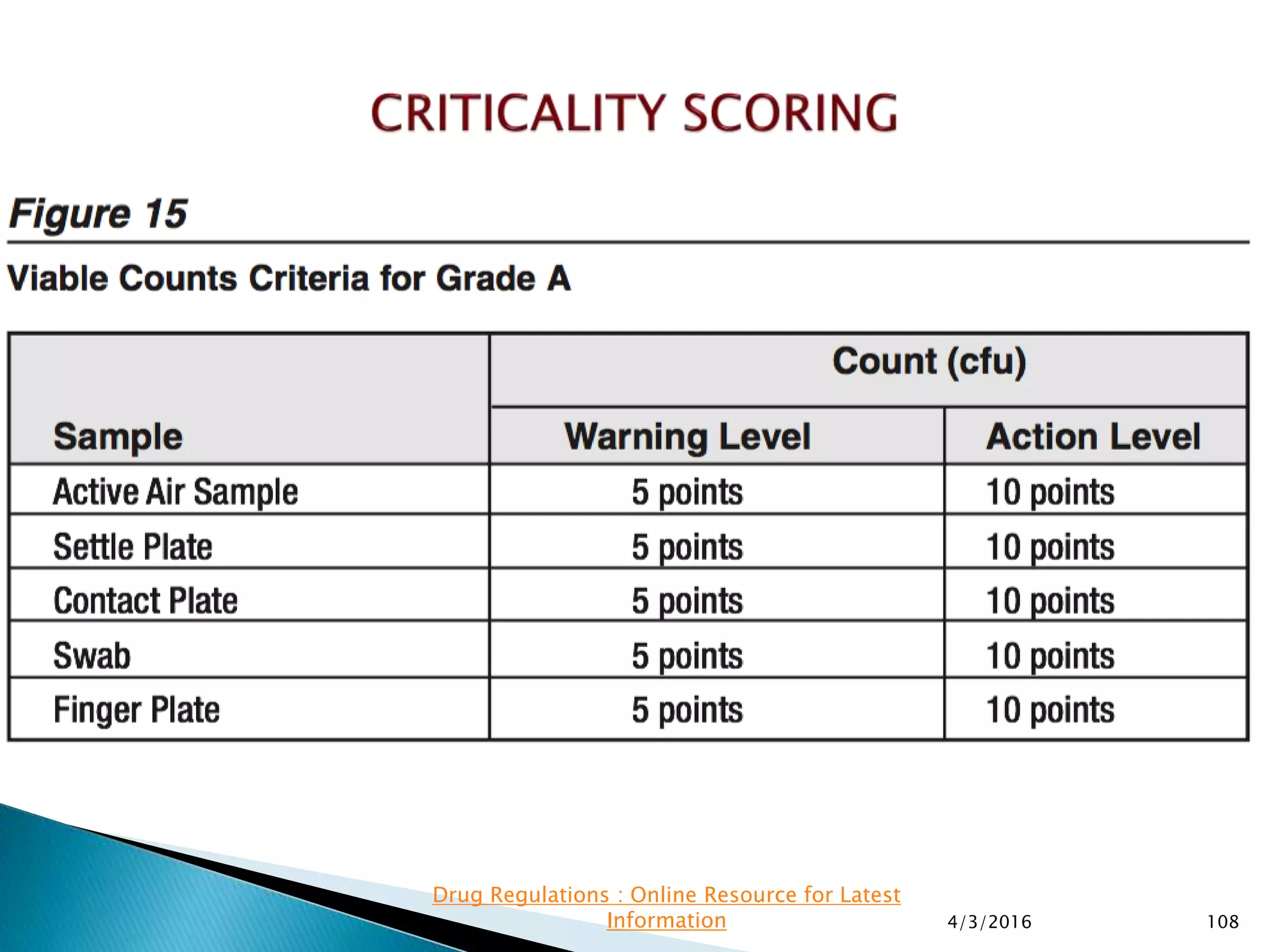
 Each result, which equals or exceeds a warning or action
level, is scored according to ( See next slide – FIg. 15)
4/3/2016 107
Drug Regulations : Online Resource for Latest
Information
4/3/2016 108
Drug Regulations : Online Resource for Latest
Information
4/3/2016 109
Drug Regulations : Online Resource for Latest
Information
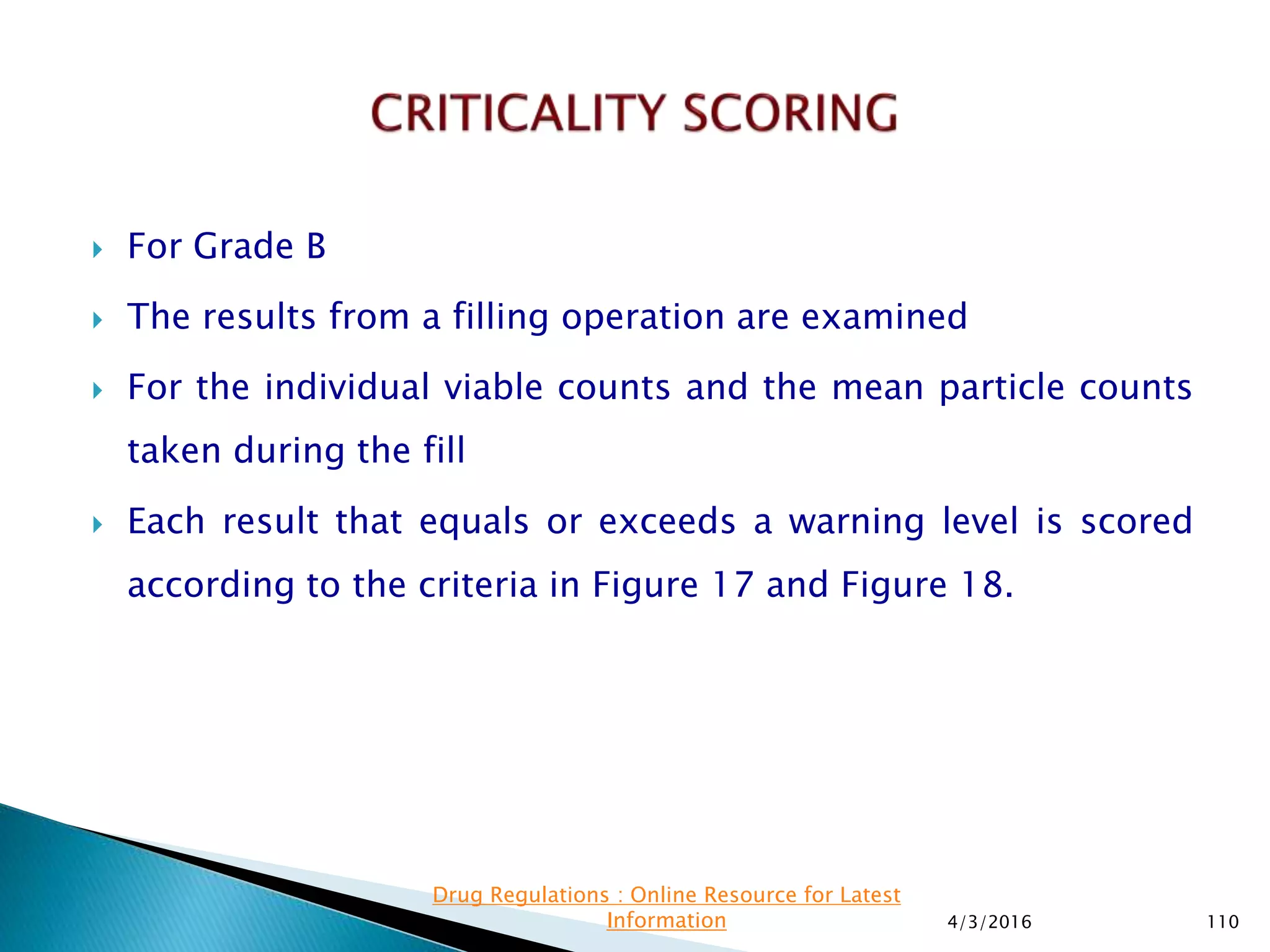
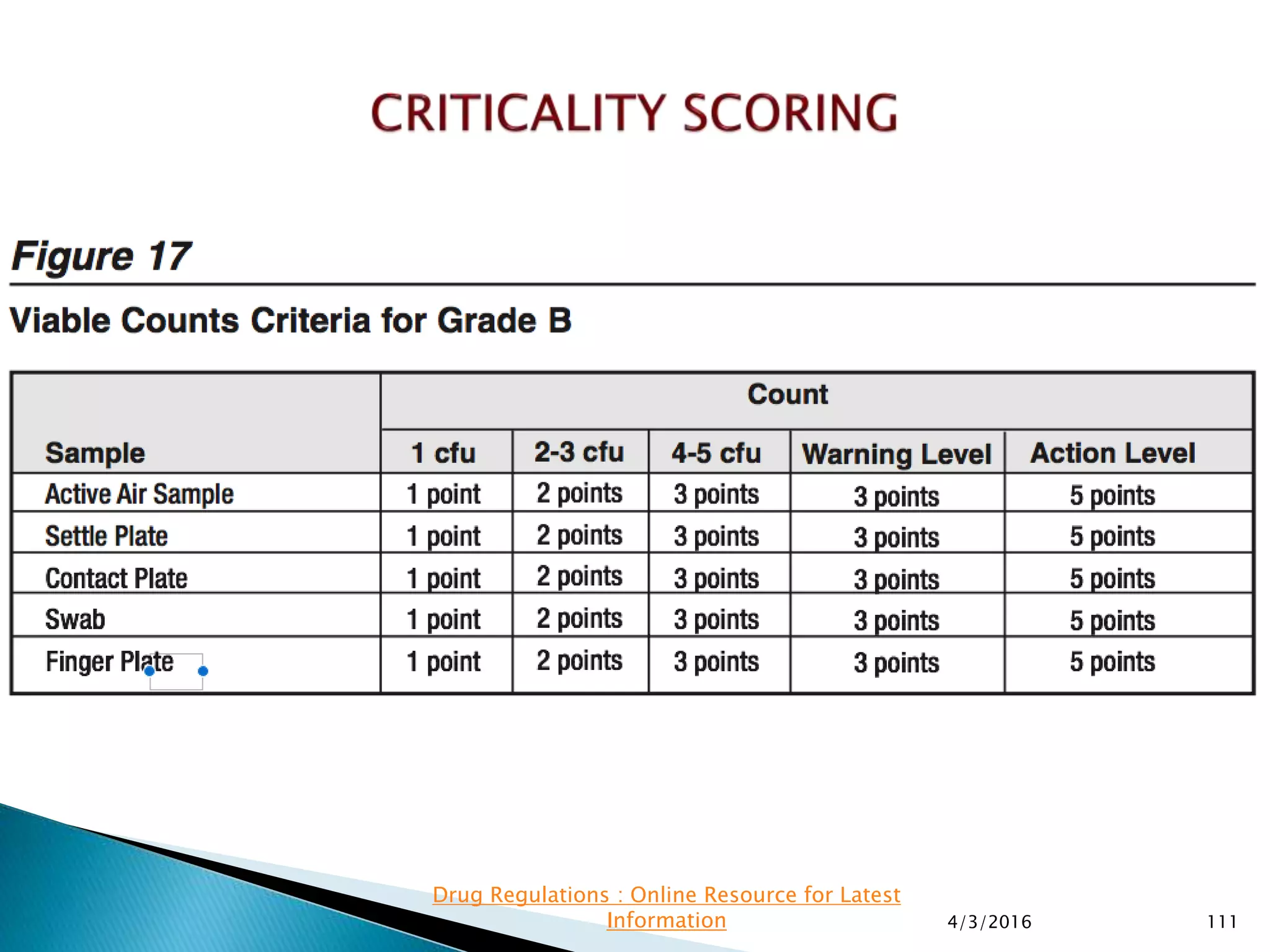
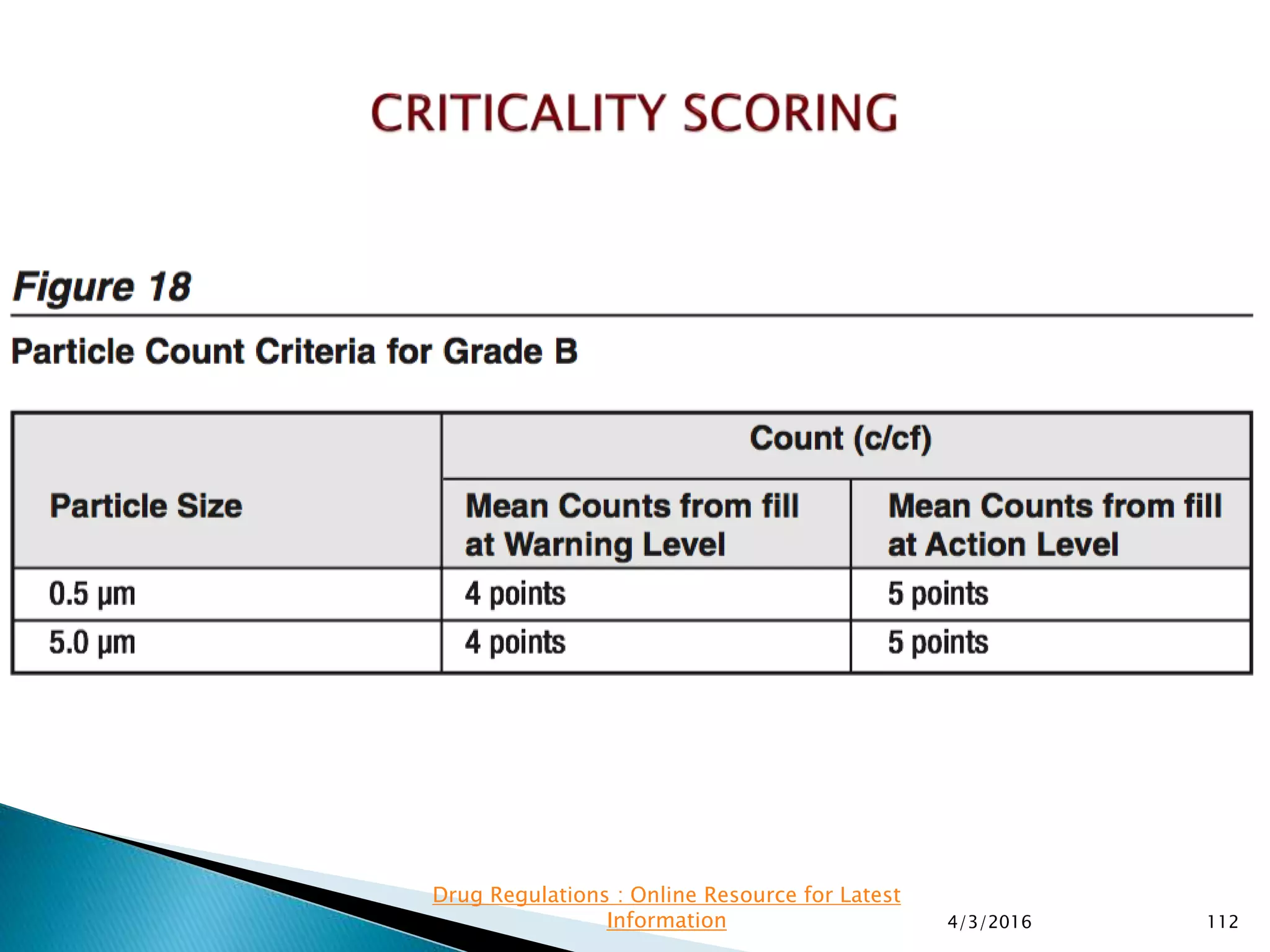
 For Grade B
 The results from a filling operation are examined
 For the individual viable counts and the mean particle counts
taken during the fill
 Each result that equals or exceeds a warning level is scored
according to the criteria in Figure 17 and Figure 18.
4/3/2016 110
Drug Regulations : Online Resource for Latest
Information
4/3/2016 111
Drug Regulations : Online Resource for Latest
Information
4/3/2016 112
Drug Regulations : Online Resource for Latest
Information
 If a warning level or action level is of the same count (cfu) as
a value in the count (cfu) column, the warning or action level
score should be selected.
 This produces the Grade B score.
 To produce the total criticality score, the two scores are
added together (Grade A + Grade B).
4/3/2016 113
Drug Regulations : Online Resource for Latest
Information
 Once the data has been generated, the score at which
approximately 95% of the fills would be below (and 5% would
be above) can be calculated.
 That figure would then be used as the cut-off value with
which to assess the ‘atypical’ filling operations.
4/3/2016 114
Drug Regulations : Online Resource for Latest
Information
 Figure 19 displays a simple representation of this
assessment.
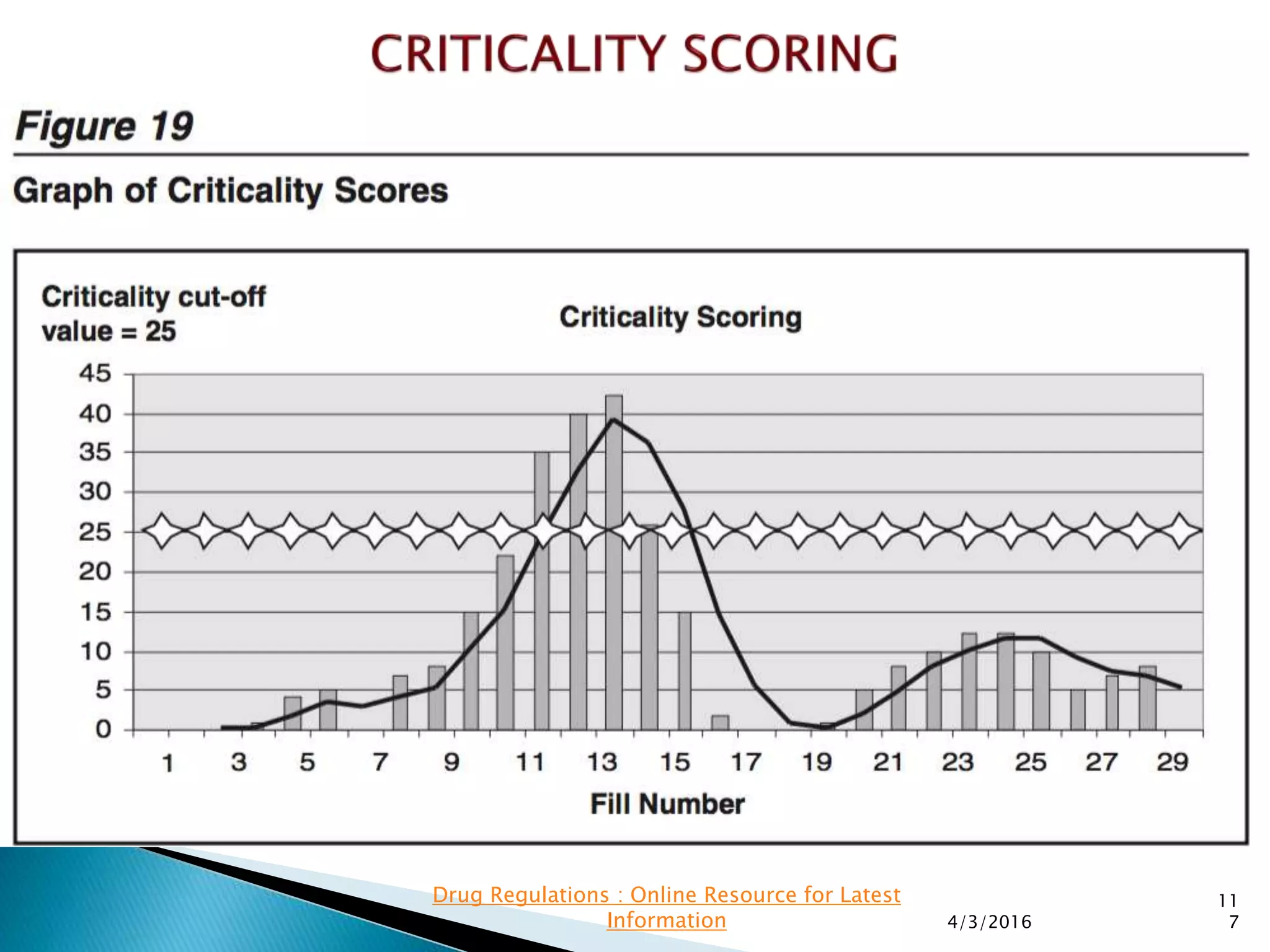
 For the data set, the criticality score was calculated at 25,
which corresponded with the 95th percentile for a set of data
from the filling of an example drug.
4/3/2016 115
Drug Regulations : Online Resource for Latest
Information
 The graph in Figure 19 indicates that some fills exceeded the
cut-off criticality value during a particular time period (see fill
numbers 12 through 15).
 After some corrective action, the scores for the fills were
reduced
◦ (see fill numbers 16 through 29) and the situation returned to a state of
control.
4/3/2016 116
Drug Regulations : Online Resource for Latest
Information
4/3/2016
11
7
Drug Regulations : Online Resource for Latest
Information
 This presentation is compiled from freely
available resources like the websites of FDA, EMA
,WHO and research papers published by experts
in this field like
T. Sandle .
 “Drug Regulations” is a non profit organization
which provides free online resource to the
Pharmaceutical Professional.
 Visit http://www.drugregulations.org for latest
information from the world of Pharmaceuticals.
4/3/2016
11
8
Drug Regulations : Online
Resource for Latest Information

Quality Risk Assessmsnt for Environmental Monitoring

  • 1.
    This presentation iscompiled by “ Drug Regulations” a non profit organization which provides free online resource to the Pharmaceutical Professional. Visit http://www.drugregulations.org for latest information from the world of Pharmaceuticals. 4/3/2016 1
  • 2.
     This presentationis compiled from freely available resources like the websites of FDA, EMA ,WHO and research papers published by experts in this field like T. Sandle .  “Drug Regulations” is a non profit organization which provides free online resource to the Pharmaceutical Professional.  Visit http://www.drugregulations.org for latest information from the world of Pharmaceuticals. 4/3/2016 2 Drug Regulations : Online Resource for Latest Information
  • 3.
    4/3/2016 3 Drug Regulations: Online Resource for Latest Information
  • 4.
     Determination ofFrequency of Monitoring: ◦ Using the concept of risk assessment to decide how often to monitor different types of cleanrooms  Risk Assessment Tools: ◦ Applying risk assessment tools to establish methods for environmental monitoring  Numerical Approaches: ◦ Considering a numerical approach to assess risk data using a case study of an aseptic filling operation 4/3/2016 4 Drug Regulations : Online Resource for Latest Information
  • 5.
    4/3/2016 5 Drug Regulations: Online Resource for Latest Information
  • 6.
     Environmental Monitoring( EM) describes the microbiological testing undertaken to detect changing trends of microbial counts and micro flora growth within cleanroom or controlled environments. 4/3/2016 6 Drug Regulations : Online Resource for Latest Information
  • 7.
     The resultsobtained provide information about ◦ The physical construction of the room ◦ The performance of the Heating, Ventilation, and Air- Conditioning (HVAC) system ◦ Personnel cleanliness ◦ Gowning practices ◦ The equipment, and cleaning operations 4/3/2016 7 Drug Regulations : Online Resource for Latest Information
  • 8.
     Over thepast decade, environmental monitoring has become more sophisticated.  Earlier EM involved random sampling, using an imaginary grid over the room and testing in each grid  Currently the focus is on ◦ Risk assessment and ◦ The use of risk assessment tools to determine the most appropriate methods for environmental monitoring. 4/3/2016 8 Drug Regulations : Online Resource for Latest Information
  • 9.
    4/3/2016 9 Drug Regulations: Online Resource for Latest Information
  • 10.
     Adequate environmentalmonitoring programme, ◦ A balance between using resources efficiently and monitoring at sufficiently frequent intervals so that a meaningful picture can be obtained. ◦ Sources of guidance with respect to monitoring frequencies are very limited 4/3/2016 10 Drug Regulations : Online Resource for Latest Information
  • 11.
     Monitoring frequenciesspecified within the United States Pharmacopoeia (USP) <1116> may not be suitable for all facilities.  Some guidance can be obtained from the International Organization for Standardization’s (ISO) standards: ◦ Principally ISO 14644 and ISO 14698. 4/3/2016 11 Drug Regulations : Online Resource for Latest Information
  • 12.
     However, thesedo not always fit with regulatory guidance documents  This is because they apply to controlled environments across a range of industries  Many industries other than pharmaceuticals, apply higher standards 4/3/2016 12 Drug Regulations : Online Resource for Latest Information
  • 13.
     When establishingan environmental control programme, the frequency of monitoring different controlled areas can be determined based on ‘criticality factors’ relevant to each specific area. 4/3/2016 13 Drug Regulations : Online Resource for Latest Information
  • 14.
    4/3/2016 14 Drug Regulations: Online Resource for Latest Information
  • 15.
     The establishmentof a criticality scheme on which to base monitoring frequencies is designed to target monitoring of critical process steps. 4/3/2016 15 Drug Regulations : Online Resource for Latest Information
  • 16.
     Therefore, thefinal formulation process would receive more monitoring than an early manufacturing stage with a relatively closed process. 4/3/2016 16 Drug Regulations : Online Resource for Latest Information
  • 17.
     Using acriticality factor is a means of assigning a monitoring frequency based on the risk assessment of each critical area.  The risk assessment relates to the potential product impact from any risk. 4/3/2016 17 Drug Regulations : Online Resource for Latest Information
  • 18.
     High RiskRating ◦ Area of open processing ◦ At an ambient temperature ◦ A long exposure time ◦ Presence of water  Low Risk Rating ◦ Area of closed processing ◦ A cold area 4/3/2016 18 Drug Regulations : Online Resource for Latest Information
  • 19.
     Using arange of 1 to 6, with ‘1’ being the most critical and ‘6’ the least critical ◦ A score of 1 would be assigned to an aseptic filling operation ◦ A score of 2 to final formulation, ◦ A score of 3 to open processing, and so on 4/3/2016 19 Drug Regulations : Online Resource for Latest Information
  • 20.
     Adapt sucha scheme to particular area  Defend it by way of supportable rationale  For Monitoring frequencies Figure 1,  Its application is seen in Figure 2. 4/3/2016 20 Drug Regulations : Online Resource for Latest Information
  • 21.
    4/3/2016 21 Drug Regulations: Online Resource for Latest Information
  • 22.
    4/3/2016 22 Drug Regulations: Online Resource for Latest Information
  • 23.
    4/3/2016 23 Drug Regulations: Online Resource for Latest Information
  • 24.
    4/3/2016 24 Drug Regulations: Online Resource for Latest Information
  • 25.
     Each controlledarea would be evaluated against set criteria  Then with the use of a series of guiding questions; the monitoring frequency would be determined.  Decision criteria include considerations in two category areas: ◦ Areas of higher weighting ◦ Areas of higher monitoring frequency ◦ Examples of these categories follow: 4/3/2016 25 Drug Regulations : Online Resource for Latest Information
  • 26.
     Giving HigherWeighting to –‘Dirtier’ activity performed in a room adjacent to a clean activity, even if the clean activity represents later processing  Areas that have a higher level of personnel transit ◦ (given that people are the main microbiological contamination source). ◦ This may include corridors and changing rooms. 4/3/2016 26 Drug Regulations : Online Resource for Latest Information
  • 27.
    ◦ Routes oftransfer ◦ Areas that receive in-coming goods ◦ Component preparation activities and sites  Duration of activity ◦ Such as a lower criticality for a 30-minute process compared to a six-hour operation ◦ Warm or ambient areas as opposed to cold rooms 4/3/2016 27 Drug Regulations : Online Resource for Latest Information
  • 28.
     Having HigherMonitoring Frequencies for – ◦ Areas with water or sinks as opposed to dry, ambient areas ◦ Open processing or open plant assembly compared to processing that is open momentarily or to closed processing  (where product risk exposure time is examined) ◦ Final formulation, purification, secondary packaging, product filling, etc. 4/3/2016 28 Drug Regulations : Online Resource for Latest Information
  • 29.
     Once themonitoring frequency for each controlled area is determined, it should be reviewed at regular intervals.  This review may invoke changes to room’s status, and hence, its monitoring frequency, or to changes for different sample types within the room. 4/3/2016 29 Drug Regulations : Online Resource for Latest Information
  • 30.
     For example,it may be that after reviewing data for one year, surface samples produce higher results than air samples for a series of rooms.  In this event, the microbiologist may opt to vary the frequency of monitoring and take surface samples more often than air samples. 4/3/2016 30 Drug Regulations : Online Resource for Latest Information
  • 31.
     There wouldalso be an increased focus on cleaning and disinfection practices, and their frequencies, based on such data.  When both types of monitoring are producing low level counts, the balance of risk would be toward air samples. 4/3/2016 31 Drug Regulations : Online Resource for Latest Information
  • 32.
     This isbecause air samples are direct indicators of the quality of the process  They assign a level of control to the process  On the other hand surface samples are indicators of cleaning and disinfection. 4/3/2016 32 Drug Regulations : Online Resource for Latest Information
  • 33.
     If theresults of surface samples are generally satisfactory, as indicated by trend analysis, then ◦ either the number of samples or the frequency at which they are taken can be reduced. 4/3/2016 33 Drug Regulations : Online Resource for Latest Information
  • 34.
     If subsequentdata showed an increase in counts, the monitoring frequency could easily be restored.  Indeed, all types of monitoring frequencies may increase as part of an investigation, as appropriate. 4/3/2016 34 Drug Regulations : Online Resource for Latest Information
  • 35.
    4/3/2016 35 Drug Regulations: Online Resource for Latest Information
  • 36.
     Select statusfor each room  Use risk assessment procedure to determine locations for environmental monitoring.  ISO 14698 and regulatory authorities recommend risk based approach.  They are increasingly asking drug manufacturers about this subject. 4/3/2016 36 Drug Regulations : Online Resource for Latest Information
  • 37.
     Risk-based approachesinclude ◦ Failure Mode and Effects Analysis (FMEA), ◦ Fault Tree Analysis (FTA), and ◦ Hazard Analysis and Critical Control Points (HACCP),  All employ a scoring approach. 4/3/2016 37 Drug Regulations : Online Resource for Latest Information
  • 38.
     Other approachesinclude: ◦ Failure Mode, Effects, and Criticality Analysis (FMECA); ◦ Hazard Operability Analysis (HAZOP); ◦ Quantitative Microbiological Risk Assessment (QMRA); ◦ Modular Process Risk Model (MPRM); ◦ System Risk Analysis (SRA); ◦ Method for Limitation of Risks; ◦ Risk Profiling. 4/3/2016 38 Drug Regulations : Online Resource for Latest Information
  • 39.
     At present,no definitive method exists,  Various approaches differ in their process and in the degree of complexity involved.  However, the two most commonly used methods appear to be ◦ HACCP, which originated in the food industry, and ◦ FMEA, which was developed for the engineering industry 4/3/2016 39 Drug Regulations : Online Resource for Latest Information
  • 40.
     These variousanalytical tools are similar in that they involve: ◦ Constructing diagrams of workflows ◦ Pinpointing areas of greatest risk ◦ Examining potential sources of contamination ◦ Deciding on the most appropriate sample methods ◦ Helping to establish alert and action levels ◦ Taking into account changes to the work process and seasonal activities 4/3/2016 40 Drug Regulations : Online Resource for Latest Information
  • 41.
     These riskassessment approaches are concerned with ◦ Selecting environmental monitoring locations. ◦ Integrating the environmental monitoring system with a complete review of operations within the cleanroom ◦ This ensures those facilities, operations, and practices are also satisfactory. 4/3/2016 41 Drug Regulations : Online Resource for Latest Information
  • 42.
     The approaches ◦Recognize a risk ◦ Rate the level of the risk ◦ Set out a plan to minimize, control, and monitor the risk.  The monitoring of the risk will help to determine the ◦ Frequency, ◦ Locations for, and ◦ Level of environmental monitoring 4/3/2016 42 Drug Regulations : Online Resource for Latest Information
  • 43.
     In thispresentation following techniques will be demonstrated ◦ A simple conceptualization of risk using a table ◦ HACCP ◦ FMEA 4/3/2016 43 Drug Regulations : Online Resource for Latest Information
  • 44.
     Tabular Approach An example using a simple table for analyzing risk in environmental monitoring situations appears in Figure 3. 4/3/2016 44 Drug Regulations : Online Resource for Latest Information
  • 45.
    4/3/2016 45 Drug Regulations: Online Resource for Latest Information
  • 46.
     The sevenprinciples behind constructing an HACCP analysis consist of: 1. Identifying hazards or contamination risks and assessing their severity 2. Determining Critical Control Points (CCPs) 3. Establishing critical limits 4. Establishing a system to monitor and control CCPs 5. Establishing corrective action when a CCP is not under control 6. Establishing procedures for verification to confirm that the HACCP system is working effectively 7. Establishing documentation and reporting systems for all procedures 4/3/2016 46 Drug Regulations : Online Resource for Latest Information
  • 47.
     Each ofthese seven key points is a vital step in developing the risk assessment.  The seven points include: 4/3/2016 47 Drug Regulations : Online Resource for Latest Information
  • 48.
     1. Constructa risk diagram, or diagrams, to identify sources of contamination.  Diagrams should show sources and routes of contamination.  Examples include: ◦ Areas adjacent to Cleanroom or Isolator (e.g.: airlocks, changing rooms) ◦ Air supply and Room air ◦ Surfaces ◦ People ◦ Machines and Equipment 4/3/2016 48 Drug Regulations : Online Resource for Latest Information
  • 49.
     2. Assessthe importance of these sources and determine whether or not they are hazards that should be controlled.  Examples include: ◦ Amounts of contamination on, or in, the source that is available for transfer ◦ Ease by which the contamination is dispersed or transferred ◦ Proximity of the source to the critical point where the product is exposed ◦ Ease with which the contamination can pass through the control method  The use of a scoring method can greatly help in assessing the relative importance of these contamination sources. 4/3/2016 49 Drug Regulations : Online Resource for Latest Information
  • 50.
     3. Identifythe methods that can be used to control these hazards.  For example: ◦ Air Supply: High Efficiency Particulate Air (HEPA) filters ◦ Dirty Areas adjacent to Clean room or Isolator: differential pressures, airflow movement ◦ Room Air: air change rates, use of barriers ◦ Surfaces: sterilization, effectiveness of cleaning and disinfection procedures ◦ People: clean room clothing and gloves, room ventilation, training ◦ Machines and Equipment: sterilization, effectiveness of cleaning, exhaust systems 4/3/2016 50 Drug Regulations : Online Resource for Latest Information
  • 51.
     4. Determinevalid sampling methods to monitor either the hazards or their control methods or both.  For example: ◦ HEPA filter integrity tests ◦ Air supply velocity, air change rates ◦ Room pressure differentials ◦ Particle counts ◦ Air samplers, settle plates, contact plates, etc. 4/3/2016 51 Drug Regulations : Online Resource for Latest Information
  • 52.
     5. Establisha monitoring schedule with ‘alert’ and ‘action’ levels and the corrective measures to be taken when these levels are exceeded.  For example: ◦ The greater the hazard, the greater the amount of monitoring required ◦ Trend analysis for alert and action levels, in or out of control 4/3/2016 52 Drug Regulations : Online Resource for Latest Information
  • 53.
     6. Verifythat the contamination control system is working effectively by reviewing key targets like product rejection rate, sampling results, control methods, and so on. These may require modification over time.  For example: ◦ System for data review ◦ Examine filling trials ◦ Audits ◦ Reassess-hazards, effectiveness of control systems, frequency ◦ of monitoring, appropriateness of alert and action levels 4/3/2016 53 Drug Regulations : Online Resource for Latest Information
  • 54.
     7. Establishand maintain documentation.  For example: ◦ Describe the steps being taken ◦ Describe the monitoring procedures ◦ Describe the reporting and review procedures 4/3/2016 54 Drug Regulations : Online Resource for Latest Information
  • 55.
     Before implementingHACCP, it is important to train all staff involved in the process and to use a multi- disciplinary team.  For example, the team may be comprised of personnel from ◦ Production, ◦ Engineering, ◦ Quality Control (QC), ◦ Quality Assurance (QA), ◦ Validation, and so on. 4/3/2016 55 Drug Regulations : Online Resource for Latest Information
  • 56.
     FMEA schemesvary in their approach, scoring, and categorization.  All methods share a numerical approach.  The example presented here, based on a sterility testing isolator 4/3/2016 56 Drug Regulations : Online Resource for Latest Information
  • 57.
     Assign ascore (from 1 to 5) to each of the following categories: ◦ Severity ◦ Occurrence ◦ Detection  Where: ◦ Severity is the consequence of a failure ◦ Occurrence is the likelihood of the failure happening based on past experience ◦ Detection is based on the monitoring systems in place and on how likely a failure can be detected 4/3/2016 57 Drug Regulations : Online Resource for Latest Information
  • 58.
     By askinga series of questions, each main part of the cleanroom or isolator system can be grouped or classified into key parts.  Such questions include: ◦ What is the function of the equipment? ◦ What are its performance requirements? ◦ How can it fail to fulfill these functions? ◦ What can cause each failure? ◦ What happens when each failure occurs? ◦ How much does each failure matter? What are its consequences? ◦ What can be done to predict or prevent each failure? ◦ What should be done if a suitable proactive task cannot be found? 4/3/2016 58 Drug Regulations : Online Resource for Latest Information
  • 59.
     The scoringis 1 (very good) to 5 (very bad).  Therefore, a likelihood of high severity would be rated 5;  high occurrence rated 5;  but a good detection system would be rated 1. 4/3/2016 59 Drug Regulations : Online Resource for Latest Information
  • 60.
     Using thesecriteria, a final FMEA score is produced from:  Severity score x Occurrence score x Detection score 4/3/2016 60 Drug Regulations : Online Resource for Latest Information
  • 61.
     Decisions onfurther action will depend upon the score produced.  There is no published guidance on what the score that dictates some form of action should be.  However, 27 is the suggested score for the cut-off value at which action is required.  This is based on 27 being the score derived when the mid-score is applied to all three categories ◦ (i.e., the numerical value '3' for severity 3 x occurrence 3 x detection 3) and ◦ the supposition that if the mid-rating (or a higher number) is scored for all three categories, then at a minimum, the system should be examined in greater detail. 4/3/2016 61 Drug Regulations : Online Resource for Latest Information
  • 62.
     Isolator OperationExample  An example of one area of an isolator operation, and the risks associated with the room in which the isolator is housed, is examined below.  Description of the Critical Area: ◦ The isolator is situated in an unclassified room. ◦ There is no requirement to place a sterility testing isolator in a classified room. 4/3/2016 62 Drug Regulations : Online Resource for Latest Information
  • 63.
    4/3/2016 63 Drug Regulations: Online Resource for Latest Information
  • 64.
    4/3/2016 64 Drug Regulations: Online Resource for Latest Information
  • 65.
     Analysis: ◦ Thereis no problem to be considered from the room environment described. ◦ Entry to the room is controlled; ◦ The sanitization cycle has been challenged with a level of microorganisms far greater than would ever be found in the environment  (spores of Geobacillus stearothermophilus); 4/3/2016 65 Drug Regulations : Online Resource for Latest Information
  • 66.
     Analysis: ◦ Allitems entering the isolator are sanitized  (using a chlorine dioxide-based sporicidal disinfectant); ◦ And the isolator itself is an effective, positive pressure barrier to the outside (at >15 pascals). 4/3/2016 66 Drug Regulations : Online Resource for Latest Information
  • 67.
     Analysis: ◦ Asdetailed earlier, environmental monitoring is performed inside the isolator during testing. ◦ This monitoring, which has an action level of 1 CFU (Colony Forming Unit), is designed to detect any potential contamination inside the isolator environment. 4/3/2016 67 Drug Regulations : Online Resource for Latest Information
  • 68.
     A thirdcomponent of the risk assessment approach is to evaluate a risk once an activity has taken place.  Then, by using a largely numerically- driven set of tools, repeatability and reproducibility can be ensured.  Examples of individual out-of-limits results and data- sets relating to an operation are examined below using examples from an aseptic filling process. 4/3/2016 68 Drug Regulations : Online Resource for Latest Information
  • 69.
     Following this,an example of an overall assessment of different processes over time is explored.  Numerical approaches are useful in applying a level of consistency between one decision and another. 4/3/2016 69 Drug Regulations : Online Resource for Latest Information
  • 70.
     Individual Assessments Some methods that can be used to quantify the risk of contamination in pharmaceutical cleanrooms are given in subsequent slides  The models outlined are based on the work performed by Whyte and Eaton (2003) 4/3/2016 70 Drug Regulations : Online Resource for Latest Information
  • 71.
     Estimating theRisk to Product Using Settle Plate Counts  The method applies to the assessment of settle plates at the point- of-fill, under the Grade A zone.  It allows an estimate of the probable contamination rate to the product as derived from the following equation: 4/3/2016 71 Drug Regulations : Online Resource for Latest Information
  • 72.
    4/3/2016 72 Drug Regulations: Online Resource for Latest Information
  • 73.
    4/3/2016 73 Drug Regulations: Online Resource for Latest Information
  • 74.
     The formulacan also be applied to the monitoring of product filtration activities when ‘1’ is entered as a constant for neck area of product.  There is no available guide as to what percentage constitutes which level of risk.  The 0.03% figure has been used by some practitioners. 4/3/2016 74 Drug Regulations : Online Resource for Latest Information
  • 75.
     This isbased on the Parenteral Drug Association Survey of Aseptic Filling Practices (2002),  It is common in the pharmaceutical industry to allow 0.03% of broth bottles in a media simulation trial to exhibit growth at a ‘warning level’ (where 0.03% = 1/3,000, with 3,000 being the average size of a media fill. 4/3/2016 75 Drug Regulations : Online Resource for Latest Information
  • 76.
     An ‘actionlevel’ is often set as 3/3,000 bottles or 0.1%.  This would constitute a high risk.  Logically, the range between 0.03 and 0.1 would be a medium risk (Whyte and Eaton, 2004c).  Therefore, where the ‘risk’ is that of micro-organisms detected on a settle plate, with a probability of <0.1% depositing in the neck of a bottle when bottles are exposed in a unidirectional air flow, risk categories would be as shown in Figure 5. 4/3/2016 76 Drug Regulations : Online Resource for Latest Information
  • 77.
    4/3/2016 77 Drug Regulations: Online Resource for Latest Information
  • 78.
     The formulacan readily be applied to operations that relate to Grade A operations, for example:  Filtration connection, vessel to filling machine connection, the filling activity, and loading a freeze-dryer.  Where the operator is only present in the Grade B room and has no impact on the Grade A operation, this is automatically considered to be low risk if there are no other special factors.  Low risk does not imply lack of action or assessment.  However, it aims conceptualization of the result in terms of probable risk to the batch. 4/3/2016 78 Drug Regulations : Online Resource for Latest Information
  • 79.
     The followingformula can be used:  Microbial count x Location x Method of intervention x Duration of operation 4/3/2016 79
  • 80.
     In thisexample of a finger plate assessment, the location, activities, and duration require weighting.  Examples of logic that apply to the rating of the location, activities, and duration categories can be seen in Figures 6, 7, and 8, respectively 4/3/2016 80 Drug Regulations : Online Resource for Latest Information
  • 81.
    4/3/2016 81 Drug Regulations: Online Resource for Latest Information
  • 82.
    4/3/2016 82 Drug Regulations: Online Resource for Latest Information
  • 83.
    4/3/2016 83 Drug Regulations: Online Resource for Latest Information
  • 84.
    4/3/2016 84 Drug Regulations: Online Resource for Latest Information
  • 85.
    4/3/2016 85 Drug Regulations: Online Resource for Latest Information
  • 86.
     The scoreproduced would be rated according to standard risk assessment categories:  These risk ratings are based, in part, on the worked example.  Based on historical data over the past six-months, the highest record example of a Grade A intervention finger plate is a count of 2 cfu: using forceps to retrieve a fallen vial and lasting for more than 120 seconds.  This would have given a score of 7.5, which falls within the medium risk category.  The user should develop a scheme that fits his or her facility ◦ (Whyte and Eaton, 2004). 4/3/2016 86 Drug Regulations : Online Resource for Latest Information
  • 87.
    4/3/2016 87 Drug Regulations: Online Resource for Latest Information
  • 88.
    4/3/2016 88 Drug Regulations: Online Resource for Latest Information
  • 89.
    4/3/2016 89 Drug Regulations: Online Resource for Latest Information
  • 90.
    4/3/2016 90 Drug Regulations: Online Resource for Latest Information
  • 91.
     The secondstep is to assign a risk factor (B) based on ease of dispersion or transfer of micro-organisms.  See Figure 10 for an example of the reasoning that would support Risk Factor B. 4/3/2016 91 Drug Regulations : Online Resource for Latest Information
  • 92.
  • 93.
     The thirdstep is to weight the risk factor ‘C’ by assessing the effectiveness of the control measure.  See Figure 11 for an example of this assessment. 4/3/2016 93 Drug Regulations : Online Resource for Latest Information
  • 94.
  • 95.
     This scoringscheme is based on contamination of a product contact site being high risk by virtue of its direct proximity to the critical area or the product.  A count of 1 cfu on one of these product contact site locations would give a score of 9.4.  In most filling zones and clean zones, sample results from product contact sites would be expected to record zero counts for 999 samples out of every 1000.  Whereas, a count of 3 from a non-product contact site would result in a medium risk category. 4/3/2016 95 Drug Regulations : Online Resource for Latest Information
  • 96.
     Air SampleAssessment  Approaches are available for the risk assessment of active air samples that use a numerical system.  However, the formulae associated with these are difficult to calculate in practice because often all information is not available and assessment of variables, such as impaction speed, are not readily calculable.  Therefore, a qualitative assessment, such as the one included in the example of the numerical approach, may be more suitable. 4/3/2016 96 Drug Regulations : Online Resource for Latest Information
  • 97.
     An exampleof the numerical approach:  Airborne microbial count (cfu /m3) x deposition velocity of microorganisms from air (cm/s) x area of product exposed (cm2) x time of exposure (s)  Alternatively, non-numerical risk assessment can be used based on the proximity and the operation.  See Figure 12 for this example. 4/3/2016 97 Drug Regulations : Online Resource for Latest Information
  • 98.
    4/3/2016 98 Drug Regulations: Online Resource for Latest Information
  • 99.
     Assigning aRisk Factor to Areas of the Filling Room  The location where a high bio-burden is isolated within the filling area is arguably of greater consequence than the actual count.  The location can be given a risk rating ◦ In relation to its proximity to the critical zone, ◦ Ease of dispersion or transfer, and ◦ Effectiveness of control methods 4/3/2016 99 Drug Regulations : Online Resource for Latest Information
  • 100.
     The tableshown in Figure 13 is proposed as a tool for risk assessment and to aid investigations.  It supplements the risk assessment tools that have been previously examined. 4/3/2016 100 Drug Regulations : Online Resource for Latest Information
  • 101.
    4/3/2016 101 Drug Regulations: Online Resource for Latest Information
  • 102.
     The typeof product and whether further processing occurs can also influence the risk factors.  See Figure 14 for an example.  In considering batches with a high risk rating, further processing of the product can be considered and ranked  (1 = lowest risk, 4 = highest risk). 4/3/2016 102 Drug Regulations : Online Resource for Latest Information
  • 103.
    4/3/2016 103 Drug Regulations: Online Resource for Latest Information
  • 104.
     An OverallAssessment  The approach taken for an overall assessment involves the historical examination of a number of operations and assigning a value above which the operation is considered to be atypical.  A 95% cut-off is considered to be the most suitable cut-off point. 4/3/2016 104 Drug Regulations : Online Resource for Latest Information
  • 105.
    4/3/2016 105 Drug Regulations: Online Resource for Latest Information
  • 106.
     Criticality scoringis a way of assessing the totality of results from an environmental monitoring session.  This may be, for example, a batch fill.  The data from the session is examined and points are awarded for each result above a pre-set warning or action level.  The total score is then summed and the results obtained are compared to a set level at which atypical sessions are indicated.  The pre-set level would be assessed from historical data over a reasonable time period (such as one year). 4/3/2016 106 Drug Regulations : Online Resource for Latest Information
  • 107.
     An exampleof such a scheme follows:  For Grade A  The results from a filling operation are examined  For individual viable counts and for the mean particle counts taken during the fill  Each result, which equals or exceeds a warning or action level, is scored according to ( See next slide – FIg. 15) 4/3/2016 107 Drug Regulations : Online Resource for Latest Information
  • 108.
    4/3/2016 108 Drug Regulations: Online Resource for Latest Information
  • 109.
    4/3/2016 109 Drug Regulations: Online Resource for Latest Information
  • 110.
     For GradeB  The results from a filling operation are examined  For the individual viable counts and the mean particle counts taken during the fill  Each result that equals or exceeds a warning level is scored according to the criteria in Figure 17 and Figure 18. 4/3/2016 110 Drug Regulations : Online Resource for Latest Information
  • 111.
    4/3/2016 111 Drug Regulations: Online Resource for Latest Information
  • 112.
    4/3/2016 112 Drug Regulations: Online Resource for Latest Information
  • 113.
     If awarning level or action level is of the same count (cfu) as a value in the count (cfu) column, the warning or action level score should be selected.  This produces the Grade B score.  To produce the total criticality score, the two scores are added together (Grade A + Grade B). 4/3/2016 113 Drug Regulations : Online Resource for Latest Information
  • 114.
     Once thedata has been generated, the score at which approximately 95% of the fills would be below (and 5% would be above) can be calculated.  That figure would then be used as the cut-off value with which to assess the ‘atypical’ filling operations. 4/3/2016 114 Drug Regulations : Online Resource for Latest Information
  • 115.
     Figure 19displays a simple representation of this assessment.  For the data set, the criticality score was calculated at 25, which corresponded with the 95th percentile for a set of data from the filling of an example drug. 4/3/2016 115 Drug Regulations : Online Resource for Latest Information
  • 116.
     The graphin Figure 19 indicates that some fills exceeded the cut-off criticality value during a particular time period (see fill numbers 12 through 15).  After some corrective action, the scores for the fills were reduced ◦ (see fill numbers 16 through 29) and the situation returned to a state of control. 4/3/2016 116 Drug Regulations : Online Resource for Latest Information
  • 117.
    4/3/2016 11 7 Drug Regulations :Online Resource for Latest Information
  • 118.
     This presentationis compiled from freely available resources like the websites of FDA, EMA ,WHO and research papers published by experts in this field like T. Sandle .  “Drug Regulations” is a non profit organization which provides free online resource to the Pharmaceutical Professional.  Visit http://www.drugregulations.org for latest information from the world of Pharmaceuticals. 4/3/2016 11 8 Drug Regulations : Online Resource for Latest Information