Good Manufacturing Practices
Presented by Priyanka sapkal
M.Pharm (II sem)
R.C.Patel Istitute of Pharmaceutical Education and Research,Shirpur Dist-Dhule.
1
1
What is GMP?
 Good Manufacturing Practice is a set of regulations,
codes, and guidelines for the manufacture of drug
substances and drug products, medical devices, in vivo
and in vitro diagnostic products, and foods.
2
2
Good Manufacturing Practices
 A basic principle of GMP is that quality cannot be tested into a
batch of product but must be built into each batch of product
during all stages of the manufacturing process.
 It is designed to minimize the risks involved in any
pharmaceutical production that cannot be eliminated through
testing the final product.
3
3
Principles of GMP
• To harmonize the manufacturing procedures globally with a marked standard, which
assures that the product is been manufactures in a good facility and a quality product.
• It Provide the frame of SISPQ , i.e. Safety, Identity, Strength, quality, and
Potency to a drug product.
• GMP is based on the controlled production of the drug products, under the federal Food ,
Drug and Cosmetic act, which states that ,
“ A drug products will be deemed to be adulterated unless the method used in or facilities
or controls used for its manufacture, processing ,packaging, or holding conforms to or are
operates or administered in conformity with current GMP.”
4
4
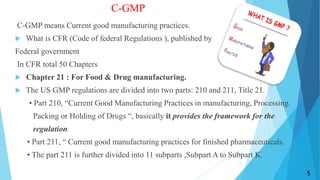
C-GMP
C-GMP means Current good manufacturing practices.
 What is CFR (Code of federal Regulations ), published by
Federal government
In CFR total 50 Chapters
 Chapter 21 : For Food & Drug manufacturing.
 The US GMP regulations are divided into two parts: 210 and 211, Title 21.
• Part 210, “Current Good Manufacturing Practices in manufacturing, Processing.
Packing or Holding of Drugs “, basically it provides the framework for the
regulation.
• Part 211, “ Current good manufacturing practices for finished pharmaceuticals.
• The part 211 is further divided into 11 subparts ,Subpart A to Subpart K.
5
5
Content of part 211 of US GMP regulation:
 Subpart A : General Provision
 Subpart B : Organization and personnel
 Subpart C : Buildings and Facilities
 Subpart D: Equipments.
 Subpart E : Control of components and Drug product containers and closures
 Subpart F : Production and process controls
 Subpart G: Packaging and labeling Control.
 Subpart H :Holdings and Distribution
 Subpart I: Laboratory Control .
 Subpart J: Records and reports
 Subpart K: Returned and salvaged drug products. 6
6
Sub part A GENERAL REQUIREMENTS
 Avoid risks and possibilities of mix-up at all stages of
Manufacturing, labeling, Packaging and testing and regular
monitoring of temp & humidity, Particle Count, DOP testing etc.
 Proper drainage system which prevents backflow. Avoid open
channels and if provided must be able to clean and disinfect.
7
7
Sub part B :Building & Facilities
1. Design and construction features.
2. Lighting.
3. Ventilation, air filtration, air heating and cooling.
4. Plumbing.
5. Sewage and refuse.
6. Washing and toilet facilities.
7. Sanitation.
8. Maintenance.
8
8
Role of GMP with respect to Personnel:
• Subpart B : Organization and personnel
• Every person involve in the manufacturing, process, packaging, or holding of the drug products
must have education, training and proper experience to perform the activity in a proper and
defined manner.
• Every employee should have a GMP training at least once in a year and also at the time of
induction only.
• Proper strength of qualified persons should be there.
• Proper Visit and Guidance of Consultant should be preferred.
• Personnel responsibilities :
1. Should wear clean clothing, also should take daily bath and shave.
2. Personnel shall practice good sanitization and health habits.
3. Access control should be there in controlled areas.
4. If you are ill or not healthy, take leave and come after complete fitness.
9
9
Subpart C- Building and facilities:
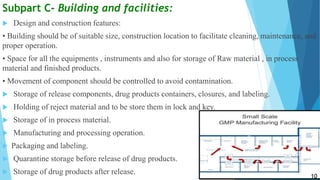
 Design and construction features:
• Building should be of suitable size, construction location to facilitate cleaning, maintenance, and
proper operation.
• Space for all the equipments , instruments and also for storage of Raw material , in process
material and finished products.
• Movement of component should be controlled to avoid contamination.
 Storage of release components, drug products containers, closures, and labeling.
 Holding of reject material and to be store them in lock and key.
 Storage of in process material.
 Manufacturing and processing operation.
 Packaging and labeling.
 Quarantine storage before release of drug products.
 Storage of drug products after release.
10
10
Aseptic processing:
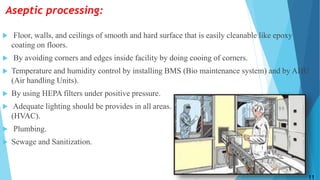
 Floor, walls, and ceilings of smooth and hard surface that is easily cleanable like epoxy
coating on floors.
 By avoiding corners and edges inside facility by doing cooing of corners.
 Temperature and humidity control by installing BMS (Bio maintenance system) and by AHU
(Air handling Units).
 By using HEPA filters under positive pressure.
 Adequate lighting should be provides in all areas. Heating, ventilation, and air conditioning
(HVAC).
 Plumbing.
 Sewage and Sanitization.
11
11
Subpart D: Equipment
 Equipment should be appropriate design, adequate size, and suitably located to facilitate
operation for its intended use and for cleaning ad maintenance.
 Equipment should be constructed with such a material that does not contaminate the
material in touch and also should be inert in nature, should be corrosion free.
 Equipment should be designed in such a way that’s its cleaning should be conducted
easily , also proper sanitization schedule should be there for every equipment and
instrument.
 For those equipment which are software controlled or computer controlled there should
be a routinely calibration, inspection or checking program, with respect to the SOP should
be governed.
12
12
Subpart F : Production and process control
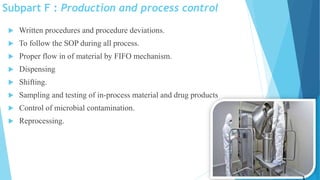
 Written procedures and procedure deviations.
 To follow the SOP during all process.
 Proper flow in of material by FIFO mechanism.
 Dispensing
 Shifting.
 Sampling and testing of in-process material and drug products
 Control of microbial contamination.
 Reprocessing.
13
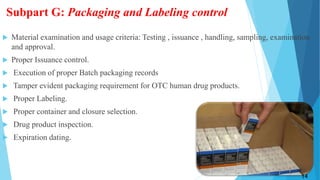
Subpart G: Packaging and Labeling control
 Material examination and usage criteria: Testing , issuance , handling, sampling, examination
and approval.
 Proper Issuance control.
 Execution of proper Batch packaging records
 Tamper evident packaging requirement for OTC human drug products.
 Proper Labeling.
 Proper container and closure selection.
 Drug product inspection.
 Expiration dating.
14
14
Subpart H: Laboratory Control
Responsibilities of quality control unit:
 The QC unit must be given responsibility and authority to approve or reject all components,
drug products containers, closures, process material , Packaging material, labeling and drug
products.
 Adequate laboratory facilities for testing and approval or rejection of the above listed
materials must be available.
 Establishment of scientifically sound and appropriate specification, standard test procedures,
sampling plans, test procedures design to assure the material conforms to appropriate
standards.
 Testing and release for distribution.
 Stability testing
 Reserve samples.
 Animals used in testing components.
15
15
Sub I Records
• Document all GMP activities
• Use Good Documentation Practices (GDP)
• Records must be readily available
 Good Documentation Practices
Documentation must be:
• permanent (black or blue ink)
• legible, clear, concise
• accurate
• Timely, complete
16
16
Subpart J Returned drug salvaged
 Returned drug products shall be identified as such and held. If the
conditions under which returned drug products have been held, stored
or shipped before or during their return or if the condition of the drug
product , its container ,carton or labelling as a result of storage or
shipping ,casts doubt on the safety ,identity strength .
 Drug salvaging :Drug have been subjected to improper storage
conditions extreme in temperature ,humidity ,smoke ,fumes pressure
,age , or radiation due to natural diasters,fires shall not be salvaged and
returned to the returned to the marketplace.
17
17
Conclusion
From the above discussion we can conclude that -
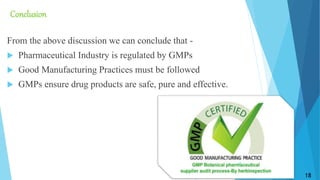
 Pharmaceutical Industry is regulated by GMPs
 Good Manufacturing Practices must be followed
 GMPs ensure drug products are safe, pure and effective.
18
18
References
 Dipak K.Sarker, Quality system & control for pharmaceutics by
published John wiley & sons Ltd P.N.-57-88
 Pharmaceutical Quality Assurance by M.A.Potdar, By Nirali
Prakashan,page no.2.1 to 2.15.
19
19
20
20

Good manufacturing practices (GMP)

  • 1.
    Good Manufacturing Practices Presentedby Priyanka sapkal M.Pharm (II sem) R.C.Patel Istitute of Pharmaceutical Education and Research,Shirpur Dist-Dhule. 1 1
  • 2.
    What is GMP? Good Manufacturing Practice is a set of regulations, codes, and guidelines for the manufacture of drug substances and drug products, medical devices, in vivo and in vitro diagnostic products, and foods. 2 2
  • 3.
    Good Manufacturing Practices A basic principle of GMP is that quality cannot be tested into a batch of product but must be built into each batch of product during all stages of the manufacturing process.  It is designed to minimize the risks involved in any pharmaceutical production that cannot be eliminated through testing the final product. 3 3
  • 4.
    Principles of GMP •To harmonize the manufacturing procedures globally with a marked standard, which assures that the product is been manufactures in a good facility and a quality product. • It Provide the frame of SISPQ , i.e. Safety, Identity, Strength, quality, and Potency to a drug product. • GMP is based on the controlled production of the drug products, under the federal Food , Drug and Cosmetic act, which states that , “ A drug products will be deemed to be adulterated unless the method used in or facilities or controls used for its manufacture, processing ,packaging, or holding conforms to or are operates or administered in conformity with current GMP.” 4 4
  • 5.
    C-GMP C-GMP means Currentgood manufacturing practices.  What is CFR (Code of federal Regulations ), published by Federal government In CFR total 50 Chapters  Chapter 21 : For Food & Drug manufacturing.  The US GMP regulations are divided into two parts: 210 and 211, Title 21. • Part 210, “Current Good Manufacturing Practices in manufacturing, Processing. Packing or Holding of Drugs “, basically it provides the framework for the regulation. • Part 211, “ Current good manufacturing practices for finished pharmaceuticals. • The part 211 is further divided into 11 subparts ,Subpart A to Subpart K. 5 5
  • 6.
    Content of part211 of US GMP regulation:  Subpart A : General Provision  Subpart B : Organization and personnel  Subpart C : Buildings and Facilities  Subpart D: Equipments.  Subpart E : Control of components and Drug product containers and closures  Subpart F : Production and process controls  Subpart G: Packaging and labeling Control.  Subpart H :Holdings and Distribution  Subpart I: Laboratory Control .  Subpart J: Records and reports  Subpart K: Returned and salvaged drug products. 6 6
  • 7.
    Sub part AGENERAL REQUIREMENTS  Avoid risks and possibilities of mix-up at all stages of Manufacturing, labeling, Packaging and testing and regular monitoring of temp & humidity, Particle Count, DOP testing etc.  Proper drainage system which prevents backflow. Avoid open channels and if provided must be able to clean and disinfect. 7 7
  • 8.
    Sub part B:Building & Facilities 1. Design and construction features. 2. Lighting. 3. Ventilation, air filtration, air heating and cooling. 4. Plumbing. 5. Sewage and refuse. 6. Washing and toilet facilities. 7. Sanitation. 8. Maintenance. 8 8
  • 9.
    Role of GMPwith respect to Personnel: • Subpart B : Organization and personnel • Every person involve in the manufacturing, process, packaging, or holding of the drug products must have education, training and proper experience to perform the activity in a proper and defined manner. • Every employee should have a GMP training at least once in a year and also at the time of induction only. • Proper strength of qualified persons should be there. • Proper Visit and Guidance of Consultant should be preferred. • Personnel responsibilities : 1. Should wear clean clothing, also should take daily bath and shave. 2. Personnel shall practice good sanitization and health habits. 3. Access control should be there in controlled areas. 4. If you are ill or not healthy, take leave and come after complete fitness. 9 9
  • 10.
    Subpart C- Buildingand facilities:  Design and construction features: • Building should be of suitable size, construction location to facilitate cleaning, maintenance, and proper operation. • Space for all the equipments , instruments and also for storage of Raw material , in process material and finished products. • Movement of component should be controlled to avoid contamination.  Storage of release components, drug products containers, closures, and labeling.  Holding of reject material and to be store them in lock and key.  Storage of in process material.  Manufacturing and processing operation.  Packaging and labeling.  Quarantine storage before release of drug products.  Storage of drug products after release. 10 10
  • 11.
    Aseptic processing:  Floor,walls, and ceilings of smooth and hard surface that is easily cleanable like epoxy coating on floors.  By avoiding corners and edges inside facility by doing cooing of corners.  Temperature and humidity control by installing BMS (Bio maintenance system) and by AHU (Air handling Units).  By using HEPA filters under positive pressure.  Adequate lighting should be provides in all areas. Heating, ventilation, and air conditioning (HVAC).  Plumbing.  Sewage and Sanitization. 11 11
  • 12.
    Subpart D: Equipment Equipment should be appropriate design, adequate size, and suitably located to facilitate operation for its intended use and for cleaning ad maintenance.  Equipment should be constructed with such a material that does not contaminate the material in touch and also should be inert in nature, should be corrosion free.  Equipment should be designed in such a way that’s its cleaning should be conducted easily , also proper sanitization schedule should be there for every equipment and instrument.  For those equipment which are software controlled or computer controlled there should be a routinely calibration, inspection or checking program, with respect to the SOP should be governed. 12 12
  • 13.
    Subpart F :Production and process control  Written procedures and procedure deviations.  To follow the SOP during all process.  Proper flow in of material by FIFO mechanism.  Dispensing  Shifting.  Sampling and testing of in-process material and drug products  Control of microbial contamination.  Reprocessing. 13
  • 14.
    Subpart G: Packagingand Labeling control  Material examination and usage criteria: Testing , issuance , handling, sampling, examination and approval.  Proper Issuance control.  Execution of proper Batch packaging records  Tamper evident packaging requirement for OTC human drug products.  Proper Labeling.  Proper container and closure selection.  Drug product inspection.  Expiration dating. 14 14
  • 15.
    Subpart H: LaboratoryControl Responsibilities of quality control unit:  The QC unit must be given responsibility and authority to approve or reject all components, drug products containers, closures, process material , Packaging material, labeling and drug products.  Adequate laboratory facilities for testing and approval or rejection of the above listed materials must be available.  Establishment of scientifically sound and appropriate specification, standard test procedures, sampling plans, test procedures design to assure the material conforms to appropriate standards.  Testing and release for distribution.  Stability testing  Reserve samples.  Animals used in testing components. 15 15
  • 16.
    Sub I Records •Document all GMP activities • Use Good Documentation Practices (GDP) • Records must be readily available  Good Documentation Practices Documentation must be: • permanent (black or blue ink) • legible, clear, concise • accurate • Timely, complete 16 16
  • 17.
    Subpart J Returneddrug salvaged  Returned drug products shall be identified as such and held. If the conditions under which returned drug products have been held, stored or shipped before or during their return or if the condition of the drug product , its container ,carton or labelling as a result of storage or shipping ,casts doubt on the safety ,identity strength .  Drug salvaging :Drug have been subjected to improper storage conditions extreme in temperature ,humidity ,smoke ,fumes pressure ,age , or radiation due to natural diasters,fires shall not be salvaged and returned to the returned to the marketplace. 17 17
  • 18.
    Conclusion From the abovediscussion we can conclude that -  Pharmaceutical Industry is regulated by GMPs  Good Manufacturing Practices must be followed  GMPs ensure drug products are safe, pure and effective. 18 18
  • 19.
    References  Dipak K.Sarker,Quality system & control for pharmaceutics by published John wiley & sons Ltd P.N.-57-88  Pharmaceutical Quality Assurance by M.A.Potdar, By Nirali Prakashan,page no.2.1 to 2.15. 19 19
  • 20.