Roman Architecture
Origins of Roman Architecture
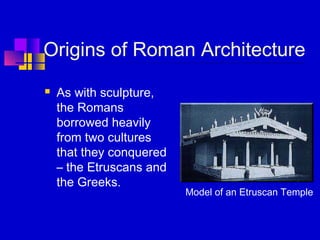
 As with sculpture,
the Romans
borrowed heavily
from two cultures
that they conquered
– the Etruscans and
the Greeks.
Model of an Etruscan Temple
Origins of Roman Architecture
 Elements of Roman architecture show
very significant Greek influence.
 However, Roman functional needs
sometimes differed, resulting in
interesting innovations.
 The Romans were less attached to
“ideal” forms and extended Greek ideas
to make them more functional.
Origins of Roman Architecture
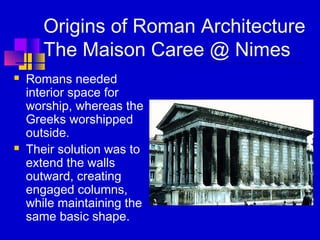
The Maison Caree @ Nimes
 Romans needed
interior space for
worship, whereas the
Greeks worshipped
outside.
 Their solution was to
extend the walls
outward, creating
engaged columns,
while maintaining the
same basic shape.
Origins of Roman Architecture
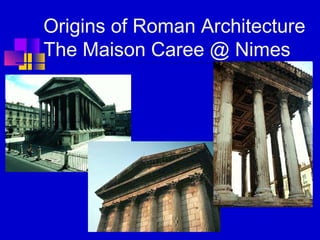
The Maison Caree @ Nimes
Roman Innovation
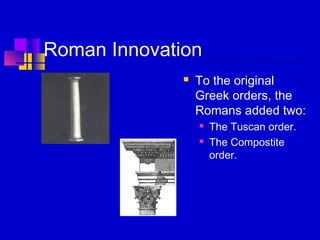
 To the original
Greek orders, the
Romans added two:
 The Tuscan order.
 The Compostite
order.
Roman Innovation
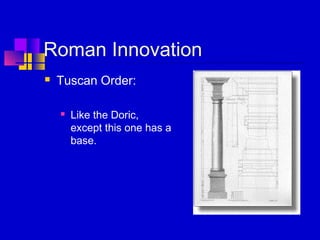
 Tuscan Order:
 Like the Doric,
except this one has a
base.
Roman Innovation
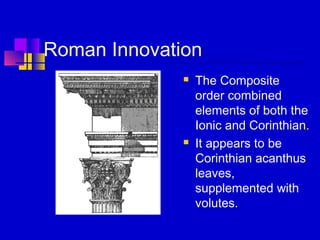
 The Composite
order combined
elements of both the
Ionic and Corinthian.
 It appears to be
Corinthian acanthus
leaves,
supplemented with
volutes.
Roman Innovation
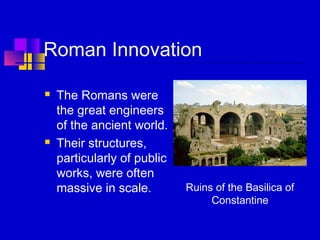
 The Romans were
the great engineers
of the ancient world.
 Their structures,
particularly of public
works, were often
massive in scale. Ruins of the Basilica of
Constantine
Roman Innovation
 The Roman ability to build massively was
largely determined by their discovery of slow-
drying concrete, made with pozzolana sand.
 This allowed not only bases, but also walls to
be constructed of mainly concrete or concrete
and rubble.
 Facings could be made of more expensive
stone or inexpensive brick.
 The result was strong structures that could be
formed in any desirable shape.
Roman Innovation – Massive
Building – the Temple of Fortuna
Primigenia
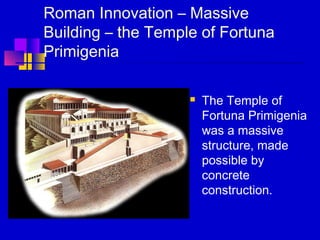
 The Temple of
Fortuna Primigenia
was a massive
structure, made
possible by
concrete
construction.
Roman Innovation – Massive
Building – Baths of Caracalla
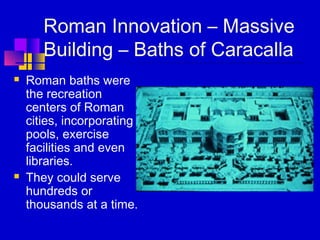
 Roman baths were
the recreation
centers of Roman
cities, incorporating
pools, exercise
facilities and even
libraries.
 They could serve
hundreds or
thousands at a time.
Roman Innovation – The
Arcuated Arch
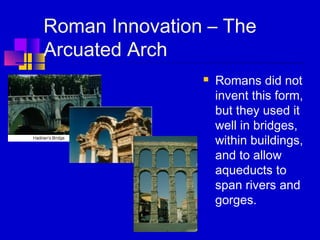
 Romans did not
invent this form,
but they used it
well in bridges,
within buildings,
and to allow
aqueducts to
span rivers and
gorges.
Roman Innovation –
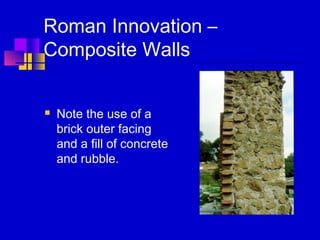
Composite Walls
 Note the use of a
brick outer facing
and a fill of concrete
and rubble.
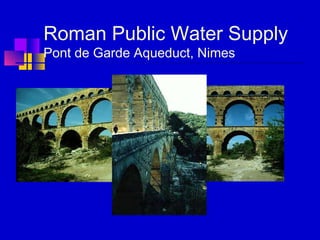
Roman Public Water Supply
Pont de Garde Aqueduct, Nimes
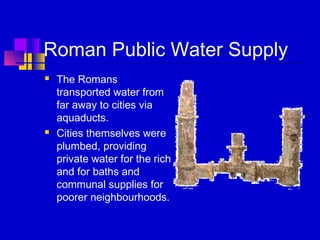
Roman Public Water Supply
 The Romans
transported water from
far away to cities via
aquaducts.
 Cities themselves were
plumbed, providing
private water for the rich
and for baths and
communal supplies for
poorer neighbourhoods.
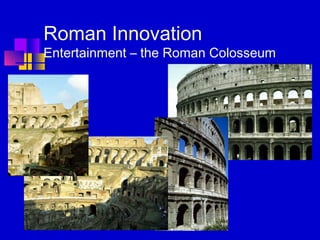
Roman Innovation
Entertainment – the Roman Colosseum
Roman Innovation
- Public Entertainment
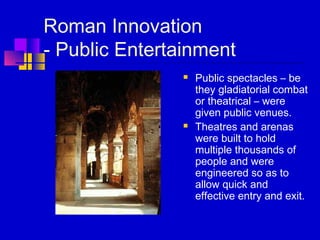
 Public spectacles – be
they gladiatorial combat
or theatrical – were
given public venues.
 Theatres and arenas
were built to hold
multiple thousands of
people and were
engineered so as to
allow quick and
effective entry and exit.
Roman Innovation
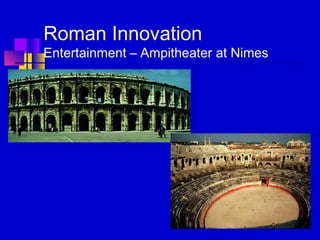
Entertainment – Ampitheater at Nimes
Roman Innovation
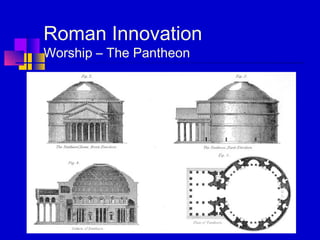
Worship – The Pantheon
Roman Innovation
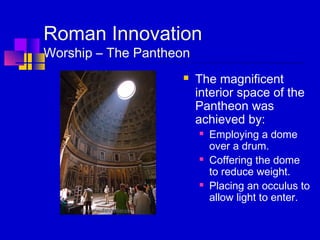
Worship – The Pantheon
 The magnificent
interior space of the
Pantheon was
achieved by:
 Employing a dome
over a drum.
 Coffering the dome
to reduce weight.
 Placing an occulus to
allow light to enter.
Roman Innovation
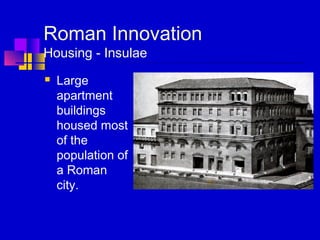
Housing - Insulae
 Large
apartment
buildings
housed most
of the
population of
a Roman
city.
Roman Innovation
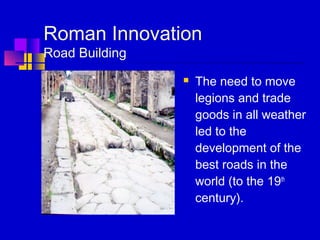
Road Building
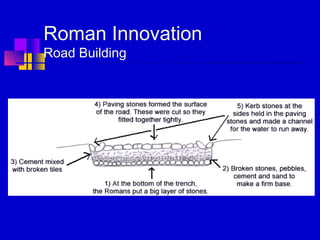
 The need to move
legions and trade
goods in all weather
led to the
development of the
best roads in the
world (to the 19th
century).
Roman Innovation
Road Building
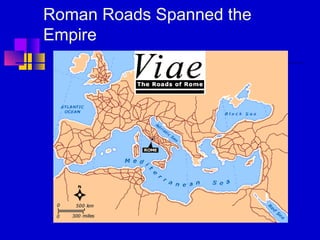
Roman Roads Spanned the
Empire
Public Buildings – Basilica
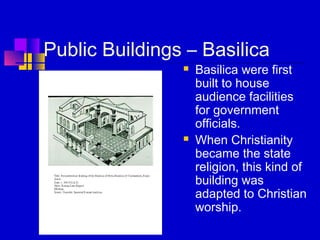
 Basilica were first
built to house
audience facilities
for government
officials.
 When Christianity
became the state
religion, this kind of
building was
adapted to Christian
worship.
Public Buildings -- Basilica
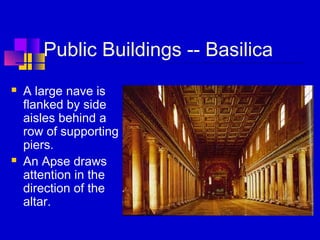
 A large nave is
flanked by side
aisles behind a
row of supporting
piers.
 An Apse draws
attention in the
direction of the
altar.
Conclusion
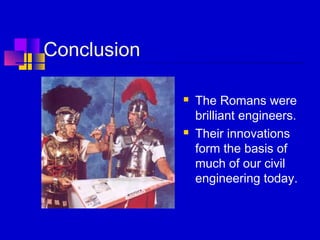
 The Romans were
brilliant engineers.
 Their innovations
form the basis of
much of our civil
engineering today.

Roman architecture

  • 1.
  • 2.
    Origins of RomanArchitecture  As with sculpture, the Romans borrowed heavily from two cultures that they conquered – the Etruscans and the Greeks. Model of an Etruscan Temple
  • 3.
    Origins of RomanArchitecture  Elements of Roman architecture show very significant Greek influence.  However, Roman functional needs sometimes differed, resulting in interesting innovations.  The Romans were less attached to “ideal” forms and extended Greek ideas to make them more functional.
  • 4.
    Origins of RomanArchitecture The Maison Caree @ Nimes  Romans needed interior space for worship, whereas the Greeks worshipped outside.  Their solution was to extend the walls outward, creating engaged columns, while maintaining the same basic shape.
  • 5.
    Origins of RomanArchitecture The Maison Caree @ Nimes
  • 6.
    Roman Innovation  Tothe original Greek orders, the Romans added two:  The Tuscan order.  The Compostite order.
  • 7.
    Roman Innovation  TuscanOrder:  Like the Doric, except this one has a base.
  • 8.
    Roman Innovation  TheComposite order combined elements of both the Ionic and Corinthian.  It appears to be Corinthian acanthus leaves, supplemented with volutes.
  • 9.
    Roman Innovation  TheRomans were the great engineers of the ancient world.  Their structures, particularly of public works, were often massive in scale. Ruins of the Basilica of Constantine
  • 10.
    Roman Innovation  TheRoman ability to build massively was largely determined by their discovery of slow- drying concrete, made with pozzolana sand.  This allowed not only bases, but also walls to be constructed of mainly concrete or concrete and rubble.  Facings could be made of more expensive stone or inexpensive brick.  The result was strong structures that could be formed in any desirable shape.
  • 11.
    Roman Innovation –Massive Building – the Temple of Fortuna Primigenia  The Temple of Fortuna Primigenia was a massive structure, made possible by concrete construction.
  • 12.
    Roman Innovation –Massive Building – Baths of Caracalla  Roman baths were the recreation centers of Roman cities, incorporating pools, exercise facilities and even libraries.  They could serve hundreds or thousands at a time.
  • 13.
    Roman Innovation –The Arcuated Arch  Romans did not invent this form, but they used it well in bridges, within buildings, and to allow aqueducts to span rivers and gorges.
  • 14.
    Roman Innovation – CompositeWalls  Note the use of a brick outer facing and a fill of concrete and rubble.
  • 15.
    Roman Public WaterSupply Pont de Garde Aqueduct, Nimes
  • 16.
    Roman Public WaterSupply  The Romans transported water from far away to cities via aquaducts.  Cities themselves were plumbed, providing private water for the rich and for baths and communal supplies for poorer neighbourhoods.
  • 17.
  • 18.
    Roman Innovation - PublicEntertainment  Public spectacles – be they gladiatorial combat or theatrical – were given public venues.  Theatres and arenas were built to hold multiple thousands of people and were engineered so as to allow quick and effective entry and exit.
  • 19.
  • 20.
  • 21.
    Roman Innovation Worship –The Pantheon  The magnificent interior space of the Pantheon was achieved by:  Employing a dome over a drum.  Coffering the dome to reduce weight.  Placing an occulus to allow light to enter.
  • 22.
    Roman Innovation Housing -Insulae  Large apartment buildings housed most of the population of a Roman city.
  • 23.
    Roman Innovation Road Building The need to move legions and trade goods in all weather led to the development of the best roads in the world (to the 19th century).
  • 24.
  • 25.
  • 26.
    Public Buildings –Basilica  Basilica were first built to house audience facilities for government officials.  When Christianity became the state religion, this kind of building was adapted to Christian worship.
  • 27.
    Public Buildings --Basilica  A large nave is flanked by side aisles behind a row of supporting piers.  An Apse draws attention in the direction of the altar.
  • 28.
    Conclusion  The Romanswere brilliant engineers.  Their innovations form the basis of much of our civil engineering today.