HISTORY of
ARCHITECTURE
EGYPTIAN
ARCHITECTURE
Factors influencing Egyptian Architecture
•Geographical
Nile river- was a trade route to Eastern and Western foreign trade
- On its banks therefore, the Egyptians sited their villages
and cemeteries
• Geological
-Stone is abundant in Egypt in quantity and variety
-the country was poor in metals.
-However, copper is gained chiefly from the Sinai peninsula.
-Tin was imported for the making of bronze.
-The chief kinds of stone were limestone, sandstone, alabaster,
granite,quartite and basalt.
-Quarrying was done with copper tools and by the use of timber
wedges which when swollen by water, split the blocks away
from the natural rock.
-Houses, palaces were constructed of large, sun-dried bricks.
• CLIMATIC
-Egypt has only two seasons. Spring and summer.
-Simplicity of design is conduced by the brilliant
sunshine; there was no real need for windows
and thus unbroken massive walls not only
protected the interior from the fierce heat of
the sun, but also provided an uninterrupted
surface for Hieroglyphics
- Roof was not an important consideration, and flat
roofs of stone slabs sufficed to cover the
buildings, and exclude the heat.
Hieroglyphics
-pictorial representation of religious ritual, historic
events and daily pursuits.
•HISTORICAL AND SOCIAL
-The Egyptian civilization Is among the most ancient social
and industrial conditions
-in Egypt government, employed large number of staffs,
trained craftsmen continuously, vast armies of
laborers for the erection of monumental Buildings.
Prisoners of war were also turned on to the same
work.
-Craftsmanship was very highly developed, particularly in
me royal workshops, and the Egyptians attained
great skill in weaving, glass blowing, pottery
turning, metal-working and in making musical
instruments, jewelry and furniture.
-The Kings of ancient Egypt are known as pharaohs,
sometimes they appear as gods and demi-gods
•RELIGIOUS
-Egyptians in the architecture, focused on both tombs and temples.
•Re/Ra-sun god
•Osiris, the man-god, who died and rose again, the god of death,
and through death of resurrection to eternal life.
•Isis, osiris’ wife, god of motherhood and protection
•Horus, the sky-god
• Hathor, goddess of love
• Set, dread god of evil
•Serapis, a bull-god representing the strange cult of
the sacred bulls.
two predominant types of buildings:
-temples of the gods
-pyramids of the early kings.
ARCHITECTURAL CHARACTER
•'gorge' – Egyptian cornice. Or also called hollow & roll
• Batter walls - which remained, one of the principal
characteristics of Egyptian architecture
The surface decoration of the masonry walls
is also held to have been derived from the
practice of scratching pictures on the early
mud-plaster walls called hieroglyphics.
Egyptian columns have distinctive
character and a very large proportion of
them plainly advertise their vegetable
origin, their shafts indicative of bundles of
plant stems, gathered in a little at the base,
and with capital seemingly derived from
the lotus bud, the papyrus flower or the
Ubiquitous palm.
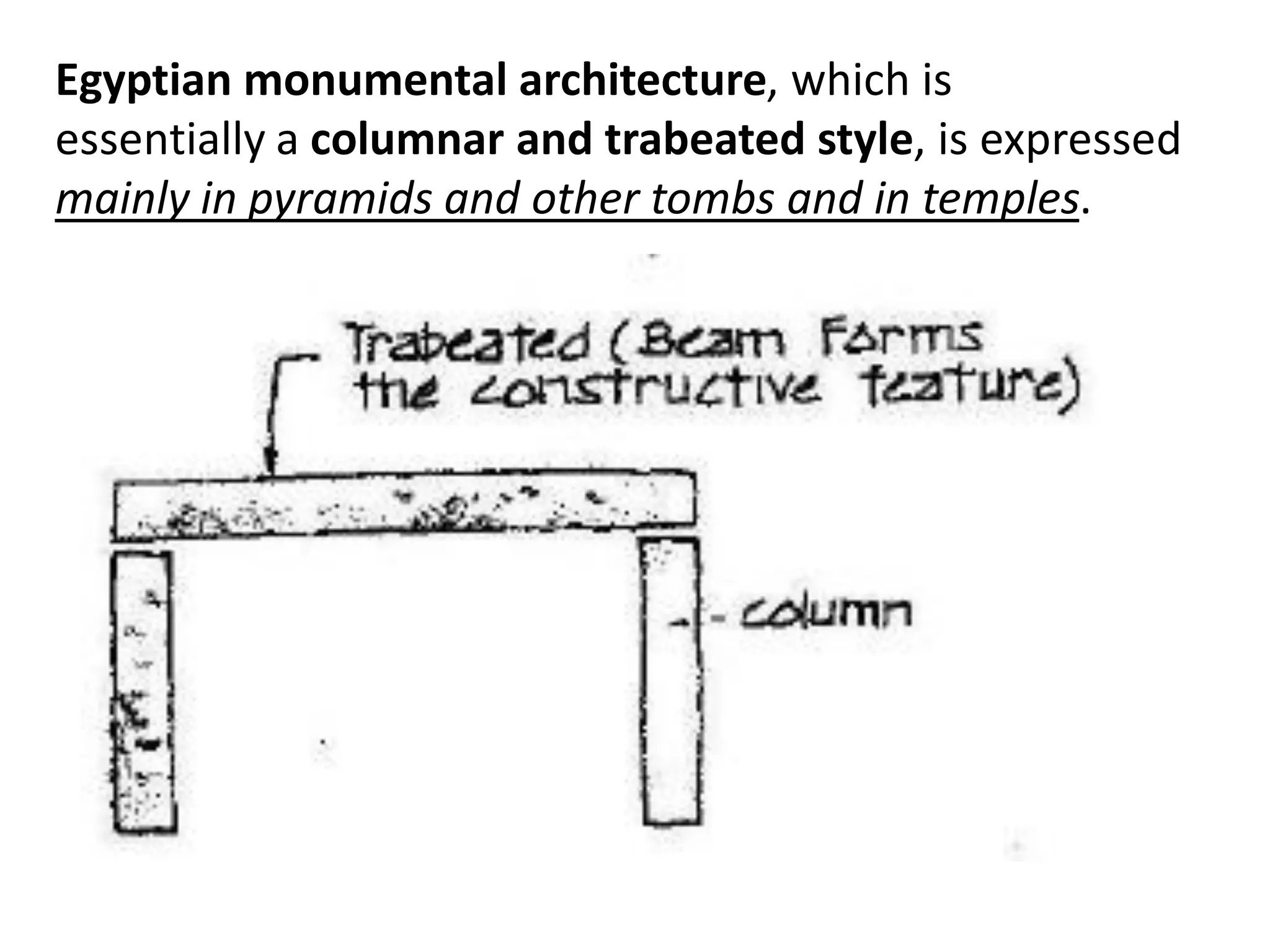
Egyptian monumental architecture, which is
essentially a columnar and trabeated style, is expressed
mainly in pyramids and other tombs and in temples.
Pylon- monumental gateway to an Egyptian
temple consisting with slanting walls
flanking the entrance portal
Egyptian temples approached by
impressive avenues of Sphinxes-
mythical monsters each with the
body of a lion and a head of a
man, hawk, ram or a woman-
possess in their massive pylons,
great courts, hypostyle halls,
inner sanctuaries and dim secret
rooms.
3 types of sphinx
Androsphinx- human-headed
Criosphinx- ram-headed
Hieracosphinx- falcon- headed
Architectural Egyptian Tomb
-Mastaba
-Pyramid
-Rock-hewn tombs
1. Mastaba
An ancient Egyptian rectangular, flat-topped funerary mound, with
battered (sloping) sides, covering a burial chamber befow ground.
Since the ancient Egyptians believed so strongly in an after-life. they
did their utmost, each according to his means, to build lasting
tombs, to preserve the body and to bury with it the finest
commodities that might be needed for the sustenance and eternal
enjoyment of the deceased. As early as the first Dynasty bands of
linen were used to wrap round the limbs of the body, to aid its
preservation called mummification.
SARCOPHAGUS-stone coffin: an ancient stone or marble
coffin, often decorated with sculpture and inscriptions
-The finest true pyramids are the famous three at GIZEH,
built by the fourth dynasty successors of Sneferu
Rock-Hewn Tombs
A type serving for the nobility rather than royalty
Examples:
1. The Great Temple of Ammon, Karnak, Thebes
The grandest of all Egyptian temples, was not
built upon one complete plan but owes its size,
disposition and magnificence to the work of
many Kings.
2. The Great Temple of Abu-Simbel
Is one of the rock-hewn temples at this place
commanded by the indefatigable Rameses II. In front of
which are four rock-cut seated colossal statues of
Rameses, over 20 m (66 ft.) high.
Obelisks
-originating in the sacred symbol of the sun god Hetiopolis,
and which usually stood in pairs astride temple
entrances, are huge monoliths square on plan and
tapering to an electrum.
-capped pyramidion at the summit, which was the sacred
part.
-four sides are cut with hieroglyphics
Ornament
-This was symbolical, and was an important element in
the style, including such features as the solar disc or
globe and the vulture with outspread wings as
a symbol of protection,
-diaper patterns, spirals and the feather ornament were
largely used.
-The scarab, or sacred beetle, was considered by the
Egyptians as the sign of their religion.
-The Egyptians were masters in the use of color, chiefly
using the primary ones blue, red, and yellow.
-lotus plant, the symbol of fertility and abundance,
produced by the overflowing Nile
-the palm, the papyrus, and others, each being copied as
the motif for a design

Egyptian architecture

  • 1.
  • 2.
  • 3.
    Factors influencing EgyptianArchitecture •Geographical Nile river- was a trade route to Eastern and Western foreign trade - On its banks therefore, the Egyptians sited their villages and cemeteries • Geological -Stone is abundant in Egypt in quantity and variety -the country was poor in metals. -However, copper is gained chiefly from the Sinai peninsula. -Tin was imported for the making of bronze. -The chief kinds of stone were limestone, sandstone, alabaster, granite,quartite and basalt. -Quarrying was done with copper tools and by the use of timber wedges which when swollen by water, split the blocks away from the natural rock. -Houses, palaces were constructed of large, sun-dried bricks.
  • 5.
    • CLIMATIC -Egypt hasonly two seasons. Spring and summer. -Simplicity of design is conduced by the brilliant sunshine; there was no real need for windows and thus unbroken massive walls not only protected the interior from the fierce heat of the sun, but also provided an uninterrupted surface for Hieroglyphics - Roof was not an important consideration, and flat roofs of stone slabs sufficed to cover the buildings, and exclude the heat. Hieroglyphics -pictorial representation of religious ritual, historic events and daily pursuits.
  • 6.
    •HISTORICAL AND SOCIAL -TheEgyptian civilization Is among the most ancient social and industrial conditions -in Egypt government, employed large number of staffs, trained craftsmen continuously, vast armies of laborers for the erection of monumental Buildings. Prisoners of war were also turned on to the same work. -Craftsmanship was very highly developed, particularly in me royal workshops, and the Egyptians attained great skill in weaving, glass blowing, pottery turning, metal-working and in making musical instruments, jewelry and furniture. -The Kings of ancient Egypt are known as pharaohs, sometimes they appear as gods and demi-gods
  • 7.
    •RELIGIOUS -Egyptians in thearchitecture, focused on both tombs and temples. •Re/Ra-sun god •Osiris, the man-god, who died and rose again, the god of death, and through death of resurrection to eternal life. •Isis, osiris’ wife, god of motherhood and protection •Horus, the sky-god • Hathor, goddess of love • Set, dread god of evil •Serapis, a bull-god representing the strange cult of the sacred bulls. two predominant types of buildings: -temples of the gods -pyramids of the early kings.
  • 9.
    ARCHITECTURAL CHARACTER •'gorge' –Egyptian cornice. Or also called hollow & roll • Batter walls - which remained, one of the principal characteristics of Egyptian architecture
  • 10.
    The surface decorationof the masonry walls is also held to have been derived from the practice of scratching pictures on the early mud-plaster walls called hieroglyphics.
  • 11.
    Egyptian columns havedistinctive character and a very large proportion of them plainly advertise their vegetable origin, their shafts indicative of bundles of plant stems, gathered in a little at the base, and with capital seemingly derived from the lotus bud, the papyrus flower or the Ubiquitous palm.
  • 14.
    Egyptian monumental architecture,which is essentially a columnar and trabeated style, is expressed mainly in pyramids and other tombs and in temples.
  • 15.
    Pylon- monumental gatewayto an Egyptian temple consisting with slanting walls flanking the entrance portal
  • 17.
    Egyptian temples approachedby impressive avenues of Sphinxes- mythical monsters each with the body of a lion and a head of a man, hawk, ram or a woman- possess in their massive pylons, great courts, hypostyle halls, inner sanctuaries and dim secret rooms. 3 types of sphinx Androsphinx- human-headed Criosphinx- ram-headed Hieracosphinx- falcon- headed
  • 18.
    Architectural Egyptian Tomb -Mastaba -Pyramid -Rock-hewntombs 1. Mastaba An ancient Egyptian rectangular, flat-topped funerary mound, with battered (sloping) sides, covering a burial chamber befow ground. Since the ancient Egyptians believed so strongly in an after-life. they did their utmost, each according to his means, to build lasting tombs, to preserve the body and to bury with it the finest commodities that might be needed for the sustenance and eternal enjoyment of the deceased. As early as the first Dynasty bands of linen were used to wrap round the limbs of the body, to aid its preservation called mummification.
  • 20.
    SARCOPHAGUS-stone coffin: anancient stone or marble coffin, often decorated with sculpture and inscriptions
  • 31.
    -The finest truepyramids are the famous three at GIZEH, built by the fourth dynasty successors of Sneferu
  • 38.
    Rock-Hewn Tombs A typeserving for the nobility rather than royalty
  • 40.
    Examples: 1. The GreatTemple of Ammon, Karnak, Thebes The grandest of all Egyptian temples, was not built upon one complete plan but owes its size, disposition and magnificence to the work of many Kings.
  • 43.
    2. The GreatTemple of Abu-Simbel Is one of the rock-hewn temples at this place commanded by the indefatigable Rameses II. In front of which are four rock-cut seated colossal statues of Rameses, over 20 m (66 ft.) high.
  • 45.
    Obelisks -originating in thesacred symbol of the sun god Hetiopolis, and which usually stood in pairs astride temple entrances, are huge monoliths square on plan and tapering to an electrum. -capped pyramidion at the summit, which was the sacred part. -four sides are cut with hieroglyphics
  • 52.
    Ornament -This was symbolical,and was an important element in the style, including such features as the solar disc or globe and the vulture with outspread wings as a symbol of protection, -diaper patterns, spirals and the feather ornament were largely used. -The scarab, or sacred beetle, was considered by the Egyptians as the sign of their religion. -The Egyptians were masters in the use of color, chiefly using the primary ones blue, red, and yellow.
  • 53.
    -lotus plant, thesymbol of fertility and abundance, produced by the overflowing Nile -the palm, the papyrus, and others, each being copied as the motif for a design