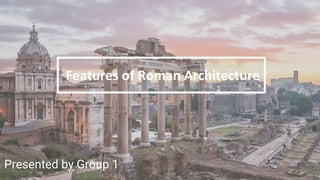
Features of Roman Architecture
Presented by Group 1
Introduction:
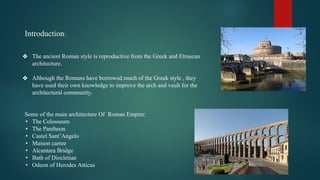
❖ The ancient Roman style is reproductive from the Greek and Etruscan
architecture.
❖ Although the Romans have borrowed much of the Greek style , they
have used their own knowledge to improve the arch and vault for the
architectural community.
Some of the main architecture Of Roman Empire:
• The Colosseum
• The Pantheon
• Castel Sant’Angelo
• Maison carree
• Alcantara Bridge
• Bath of Diocletian
• Odeon of Herodes Atticus
Building Materials and tools
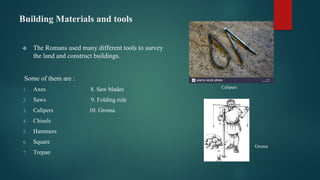
❖ The Romans used many different tools to survey
the land and construct buildings.
Some of them are :
1. Axes 8. Saw blades
2. Saws 9. Folding rule
3. Calipers 10. Groma
4. Chisels
5. Hammers
6. Square
7. Trepan
Calipers
Groma
Arch
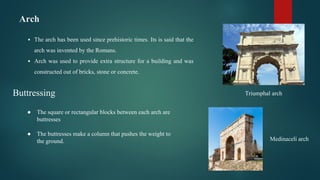
▪ The arch has been used since prehistoric times. Its is said that the
arch was invented by the Romans.
▪ Arch was used to provide extra structure for a building and was
constructed out of bricks, stone or concrete.
Triumphal arch
Medinaceli arch
Buttressing
● The square or rectangular blocks between each arch are
buttresses
● The buttresses make a column that pushes the weight to
the ground.
Columns
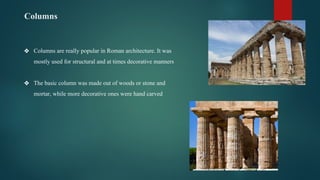
❖ Columns are really popular in Roman architecture. It was
mostly used for structural and at times decorative manners
❖ The basic column was made out of woods or stone and
mortar, while more decorative ones were hand carved
Wall and Floors
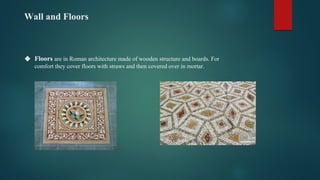
❖ Floors are in Roman architecture made of wooden structure and boards. For
comfort they cover floors with straws and then covered over in mortar.
Walls
Romans used some series of techniques, so they create different looking
walls.
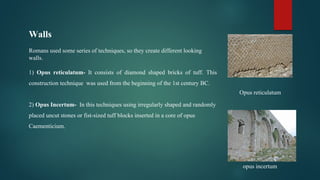
1) Opus reticulatum- It consists of diamond shaped bricks of tuff. This
construction technique was used from the beginning of the 1st century BC.
2) Opus Incertum- In this techniques using irregularly shaped and randomly
placed uncut stones or fist-sized tuff blocks inserted in a core of opus
Caementicium.
Opus reticulatum
opus incertum
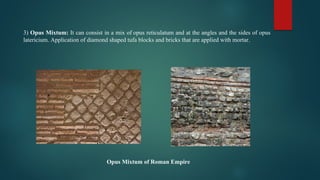
3) Opus Mixtum: It can consist in a mix of opus reticulatum and at the angles and the sides of opus
latericium. Application of diamond shaped tufa blocks and bricks that are applied with mortar.
Opus Mixtum of Roman Empire
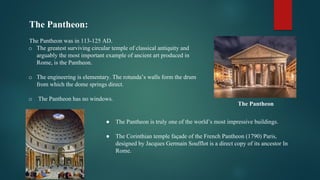
The Pantheon:
The Pantheon was in 113-125 AD.
o The greatest surviving circular temple of classical antiquity and
arguably the most important example of ancient art produced in
Rome, is the Pantheon.
o The engineering is elementary. The rotunda’s walls form the drum
from which the dome springs direct.
o The Pantheon has no windows.
● The Pantheon is truly one of the world’s most impressive buildings.
● The Corinthian temple façade of the French Pantheon (1790) Paris,
designed by Jacques Germain Soufflot is a direct copy of its ancestor In
Rome.
The Pantheon
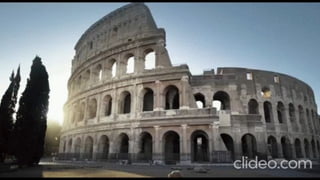
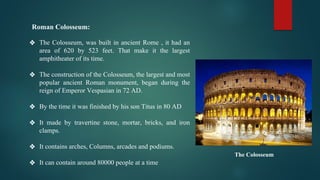
Roman Colosseum:
❖ The Colosseum, was built in ancient Rome , it had an
area of 620 by 523 feet. That make it the largest
amphitheater of its time.
❖ The construction of the Colosseum, the largest and most
popular ancient Roman monument, began during the
reign of Emperor Vespasian in 72 AD.
❖ By the time it was finished by his son Titus in 80 AD
❖ It made by travertine stone, mortar, bricks, and iron
clamps.
❖ It contains arches, Columns, arcades and podiums.
❖ It can contain around 80000 people at a time
The Colosseum
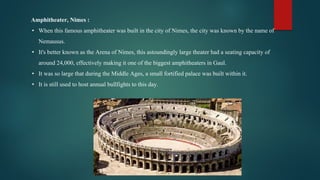
Amphitheater, Nimes :
• When this famous amphitheater was built in the city of Nimes, the city was known by the name of
Nemausus.
• It's better known as the Arena of Nimes, this astoundingly large theater had a seating capacity of
around 24,000, effectively making it one of the biggest amphitheaters in Gaul.
• It was so large that during the Middle Ages, a small fortified palace was built within it.
• It is still used to host annual bullfights to this day.
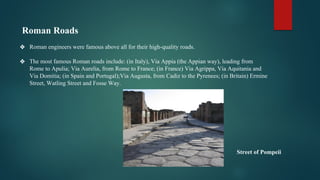
Roman Roads
❖ Roman engineers were famous above all for their high-quality roads.
❖ The most famous Roman roads include: (in Italy), Via Appia (the Appian way), leading from
Rome to Apulia; Via Aurelia, from Rome to France; (in France) Via Agrippa, Via Aquitania and
Via Domitia; (in Spain and Portugal);Via Augusta, from Cadiz to the Pyrenees; (in Britain) Ermine
Street, Watling Street and Fosse Way.
Street of Pompeii
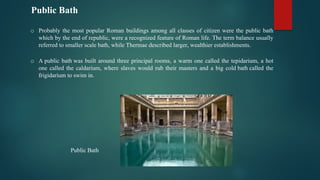
Public Bath
o Probably the most popular Roman buildings among all classes of citizen were the public bath
which by the end of republic, were a recognized feature of Roman life. The term balance usually
referred to smaller scale bath, while Thermae described larger, wealthier establishments.
o A public bath was built around three principal rooms, a warm one called the tepidarium, a hot
one called the caldarium, where slaves would rub their masters and a big cold bath called the
frigidarium to swim in.
Public Bath
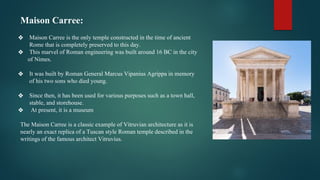
Maison Carree:
❖ Maison Carree is the only temple constructed in the time of ancient
Rome that is completely preserved to this day.
❖ This marvel of Roman engineering was built around 16 BC in the city
of Nimes.
❖ It was built by Roman General Marcus Vipanius Agrippa in memory
of his two sons who died young.
❖ Since then, it has been used for various purposes such as a town hall,
stable, and storehouse.
❖ At present, it is a museum
The Maison Carree is a classic example of Vitruvian architecture as it is
nearly an exact replica of a Tuscan style Roman temple described in the
writings of the famous architect Vitruvius.
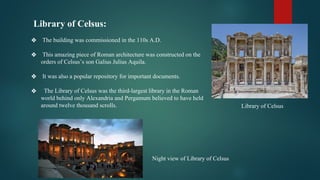
Library of Celsus:
❖ The building was commissioned in the 110s A.D.
❖ This amazing piece of Roman architecture was constructed on the
orders of Celsus’s son Galius Julius Aquila.
❖ It was also a popular repository for important documents.
❖ The Library of Celsus was the third-largest library in the Roman
world behind only Alexandria and Pergamum believed to have held
around twelve thousand scrolls.
Night view of Library of Celsus
Library of Celsus
Roman architecture

Roman architecture

  • 1.
    Features of RomanArchitecture Presented by Group 1
  • 3.
    Introduction: ❖ The ancientRoman style is reproductive from the Greek and Etruscan architecture. ❖ Although the Romans have borrowed much of the Greek style , they have used their own knowledge to improve the arch and vault for the architectural community. Some of the main architecture Of Roman Empire: • The Colosseum • The Pantheon • Castel Sant’Angelo • Maison carree • Alcantara Bridge • Bath of Diocletian • Odeon of Herodes Atticus
  • 5.
    Building Materials andtools ❖ The Romans used many different tools to survey the land and construct buildings. Some of them are : 1. Axes 8. Saw blades 2. Saws 9. Folding rule 3. Calipers 10. Groma 4. Chisels 5. Hammers 6. Square 7. Trepan Calipers Groma
  • 6.
    Arch ▪ The archhas been used since prehistoric times. Its is said that the arch was invented by the Romans. ▪ Arch was used to provide extra structure for a building and was constructed out of bricks, stone or concrete. Triumphal arch Medinaceli arch Buttressing ● The square or rectangular blocks between each arch are buttresses ● The buttresses make a column that pushes the weight to the ground.
  • 7.
    Columns ❖ Columns arereally popular in Roman architecture. It was mostly used for structural and at times decorative manners ❖ The basic column was made out of woods or stone and mortar, while more decorative ones were hand carved
  • 8.
    Wall and Floors ❖Floors are in Roman architecture made of wooden structure and boards. For comfort they cover floors with straws and then covered over in mortar.
  • 9.
    Walls Romans used someseries of techniques, so they create different looking walls. 1) Opus reticulatum- It consists of diamond shaped bricks of tuff. This construction technique was used from the beginning of the 1st century BC. 2) Opus Incertum- In this techniques using irregularly shaped and randomly placed uncut stones or fist-sized tuff blocks inserted in a core of opus Caementicium. Opus reticulatum opus incertum
  • 10.
    3) Opus Mixtum:It can consist in a mix of opus reticulatum and at the angles and the sides of opus latericium. Application of diamond shaped tufa blocks and bricks that are applied with mortar. Opus Mixtum of Roman Empire
  • 11.
    The Pantheon: The Pantheonwas in 113-125 AD. o The greatest surviving circular temple of classical antiquity and arguably the most important example of ancient art produced in Rome, is the Pantheon. o The engineering is elementary. The rotunda’s walls form the drum from which the dome springs direct. o The Pantheon has no windows. ● The Pantheon is truly one of the world’s most impressive buildings. ● The Corinthian temple façade of the French Pantheon (1790) Paris, designed by Jacques Germain Soufflot is a direct copy of its ancestor In Rome. The Pantheon
  • 12.
    Roman Colosseum: ❖ TheColosseum, was built in ancient Rome , it had an area of 620 by 523 feet. That make it the largest amphitheater of its time. ❖ The construction of the Colosseum, the largest and most popular ancient Roman monument, began during the reign of Emperor Vespasian in 72 AD. ❖ By the time it was finished by his son Titus in 80 AD ❖ It made by travertine stone, mortar, bricks, and iron clamps. ❖ It contains arches, Columns, arcades and podiums. ❖ It can contain around 80000 people at a time The Colosseum
  • 13.
    Amphitheater, Nimes : •When this famous amphitheater was built in the city of Nimes, the city was known by the name of Nemausus. • It's better known as the Arena of Nimes, this astoundingly large theater had a seating capacity of around 24,000, effectively making it one of the biggest amphitheaters in Gaul. • It was so large that during the Middle Ages, a small fortified palace was built within it. • It is still used to host annual bullfights to this day.
  • 14.
    Roman Roads ❖ Romanengineers were famous above all for their high-quality roads. ❖ The most famous Roman roads include: (in Italy), Via Appia (the Appian way), leading from Rome to Apulia; Via Aurelia, from Rome to France; (in France) Via Agrippa, Via Aquitania and Via Domitia; (in Spain and Portugal);Via Augusta, from Cadiz to the Pyrenees; (in Britain) Ermine Street, Watling Street and Fosse Way. Street of Pompeii
  • 15.
    Public Bath o Probablythe most popular Roman buildings among all classes of citizen were the public bath which by the end of republic, were a recognized feature of Roman life. The term balance usually referred to smaller scale bath, while Thermae described larger, wealthier establishments. o A public bath was built around three principal rooms, a warm one called the tepidarium, a hot one called the caldarium, where slaves would rub their masters and a big cold bath called the frigidarium to swim in. Public Bath
  • 16.
    Maison Carree: ❖ MaisonCarree is the only temple constructed in the time of ancient Rome that is completely preserved to this day. ❖ This marvel of Roman engineering was built around 16 BC in the city of Nimes. ❖ It was built by Roman General Marcus Vipanius Agrippa in memory of his two sons who died young. ❖ Since then, it has been used for various purposes such as a town hall, stable, and storehouse. ❖ At present, it is a museum The Maison Carree is a classic example of Vitruvian architecture as it is nearly an exact replica of a Tuscan style Roman temple described in the writings of the famous architect Vitruvius.
  • 17.
    Library of Celsus: ❖The building was commissioned in the 110s A.D. ❖ This amazing piece of Roman architecture was constructed on the orders of Celsus’s son Galius Julius Aquila. ❖ It was also a popular repository for important documents. ❖ The Library of Celsus was the third-largest library in the Roman world behind only Alexandria and Pergamum believed to have held around twelve thousand scrolls. Night view of Library of Celsus Library of Celsus